
Life, 1918-06-20 · page 22 of 36
Life — June 20, 1918 — page 22: what you’re looking at
What you’re looking at
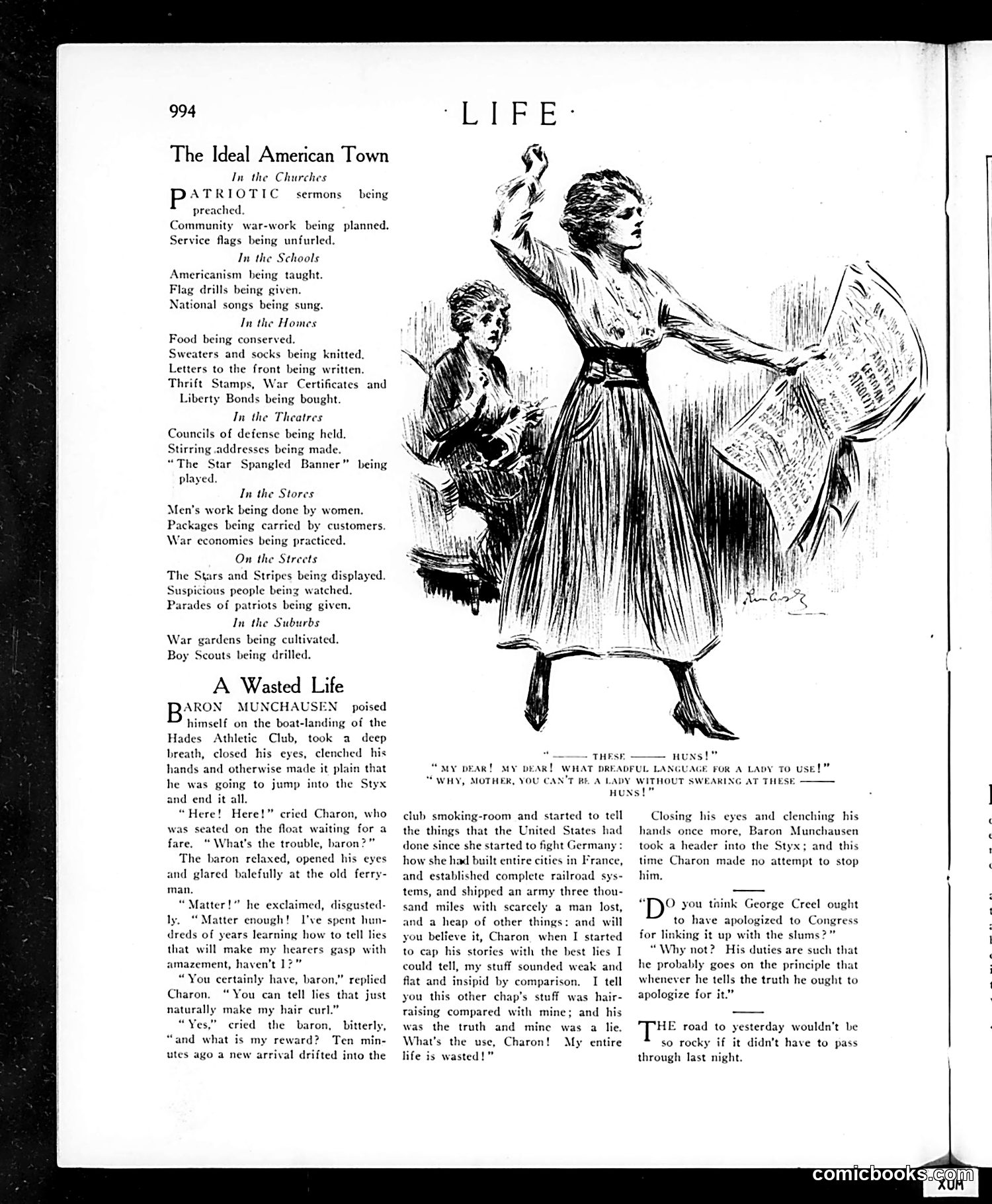
This page contains two satirical pieces from WWI-era Life magazine. **Top section** lists activities in an idealized American town during wartime—patriotic sermons, flag drills, food conservation, Liberty Bond purchases, war gardens, suspicious surveillance of citizens. The satire targets the total mobilization of civilian life during WWI, suggesting America's thorough (and perhaps excessive) commitment to the war effort. **"A Wasted Life"** mocks the famous Baron Munchausen, a legendary liar. The joke: he commits suicide because his lies now seem pedestrian compared to actual American war achievements—building cities in France, establishing railroads, shipping armies with minimal losses. Reality has outdone his fiction. This satirizes wartime propaganda's exaggeration of American military accomplishments, suggesting official accounts rival tall tales in their incredibility. The cartoon inset depicts a woman swearing at "Huns" (Germans), mocking both wartime hysteria and the contradiction of ladies abandoning propriety in the name of patriotism.
📄 Transcribed text from this page (OCR, searchable)
Machine-transcribed from the original scan — historical spelling and the odd misread are preserved.
994 The Ideal American Town In the Churches Petkoric preached. Community war-work being planned. Service flags being unfurled. In the Schools Americanism heing taught. Flag drills being given. National songs being sung. In the Homes Food being conserved. Sweaters and socks being knitted, Letters to the front being written. Thrift Stamps, War Certificates and Liberty Bonds being bought. In the Theatres Councils of defense being held. Stirring addresses being made. “The Star Spangled Banner” being played. sermons being In the Stores Men's work being done by women. Packages being carried by customers. War economies being practiced. On the Streets The Stars and Stripes being displayed. Suspicious people being watched. Parades of patriots being given. In the Suburbs War gardens being cultivated. Boy Scouts being drilled. A Wasted Life ARON MUNCHAUSEN poised himself on the boat-landing of the Hades Athletic Club, took a deep breath, closed his eyes, clenched his hands and otherwise made it plain that he was going to jump into the Styx and end it all. “Here! Here!” cried Charon, who was seated on the float waiting for a fare. “ What's the trouble, baron?” The baron relaxed, opened his eyes and glared balefully at the old ferry- man. Matter!” he exclaimed, disgusted- ly, “Matter enough! I've spent hun- dreds of years learning how to tell lies that will make my hearers gasp with amazement, haven't 1?" “You certainly have, baron,” replied Charon. “You can tell lies that just naturally make my hair curl.” “Yes,” cried the baron, bitterly, “and what is my reward? Ten min- utes ago a new arrival drifted into the - THESE ——— nuns!" “My DEAR! MY DEAR! WHAT DREAD “WHY, MOTHER, YOU CAN'T BEA LADY WITHOUT SWEARING AT THESE UL LANGUAGE FOR A LADY TO US! HuNs! club smoking-room and started to tell the things that the United States had done since she started to fight Germany : how she had built entire cities in France, and established complete railroad sys- tems, and shipped an army three thou- sand miles with scarcely a man lost, and a heap of other things: and will you believe it, Charon when I started to cap his stories with the best lies I could tell, my stuff sounded weak and flat and insipid by comparison. I tell you this other chap’s stuff was hair- raising compared with mine; and his was the truth and mine was a lie. What's the use, Charon! My entire life is wasted!” Closing his eyes and clenching his hands once more, Baron Munchausen took a header into the Styx; and this time Charon made no attempt to stop him. ‘D° you think George Creel ought to have apologized to Congress for linking it up with the slums?” “Why not? His duties are such that he probably goes on the principle that whenever he tells the truth he ought to apologize for it.” HE road to yesterday wouldn't be so rocky if it didn’t have to pass through last night.