
Life, 1918-06-20 · page 31 of 36
Life — June 20, 1918 — page 31: what you’re looking at
What you’re looking at
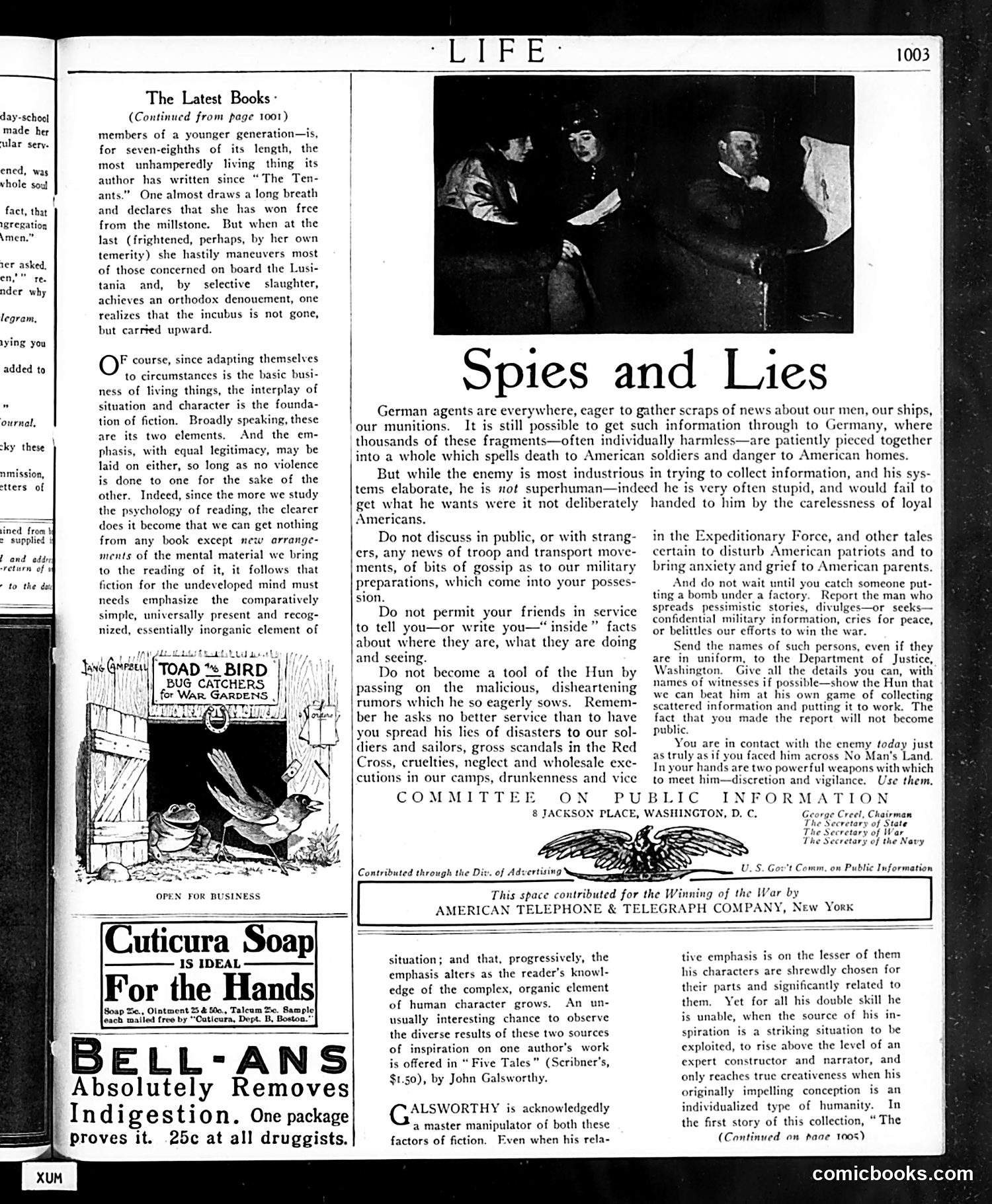
This is a U.S. government propaganda poster from World War I, issued by the Committee on Public Information. The main message warns Americans against careless talk that could aid Germany. The poster depicts German intelligence agents as omnipresent threats, explaining how seemingly trivial information—troop movements, military gossip, rumors—gets "patiently pieced together" by enemies into actionable intelligence that endangers American soldiers. The government demands citizens: - Avoid public discussion of military matters - Prevent servicemen from sharing "inside" details - Reject defeatist rumors (portrayed as deliberate Hun propaganda) - **Report suspected spies and defeatists to the Department of Justice**, naming witnesses This reflects WWI-era paranoia about German espionage and the government's aggressive domestic surveillance campaign, conflating loose talk with treason and encouraging citizens to become informants against neighbors and even uniformed soldiers spreading "pessimistic stories."
📄 Transcribed text from this page (OCR, searchable)
Machine-transcribed from the original scan — historical spelling and the odd misread are preserved.
The Latest Books - (Continued from page 1001) members of a younger generation—is, for seven-eighths of its length, the most unhamperedly living thing its author has written since “The Ten- t ants.” One almost draws a long breath and declares that she has won free from the millstone. But when at the last (frightened, perhaps, by her own temerity) she hastily maneuvers most of those concerned on board the Lusi- tania and, by selective slaughter, achieves an orthodox denouement, one realizes that the incubus is not gone, but carrted upward. day-school made her ular serv. ened, was whole soul fact, that gregation \men,” rer asked, en,” re. nder why legram, ying you F course, since adapting themselves to circumstances is the basic busi- ness of living things, the interplay of i situation and character is the founda- tion of fiction. Broadly speaking, these \ are its two elements. And the em- phasis, with equal legitimacy, may be laid on either, so long as no violence is done to one for the sake of the other. Indeed, since the more we study the psychology of reading, the clearer does it become that we can get nothing from any book except new arrange- ments of the mental material we bring to the reading of it, it follows that fiction for the undeveloped mind must needs emphasize the comparatively simple, universally present and recog- nized, essentially inorganic clement of added to pies and Lies German agents are everywhere, cager to gather scraps of news about our men, our ships, our munitions. It is still possible to get such information through to Germany, where thousands of these fragments—often individually harmless—are patiently pieced together into a whole which spells death to American soldiers and danger to American homes. But while the enemy is most industrious in trying to collect information, and his tems elaborate, he is not superhuman—indeed he is very often stupid, and would fail to | get what he wants were it not deliberately handed to him by the carelessness of loyal | Americans. Do not discuss in public, or with strang- ers, any news of troop and transport move- ments, of bits of gossip as to our military preparations, which come into your posses: sion. Do not permit your friends in service to tell you—or write you—“ inside” facts about where they are, what they are doing and seeing. Do not become a tool of the Hun by jpassing on the malicious, disheartening |rumors which he so eagerly sows. Remem- ber he asks no better service than to have you spread his lies of disasters to our sol- diers and sailors, gross scandals in the Red Cross, cruelties, neglect and wholesale exe- cutions in our camps, drunkenness and vice to meet him—discretion and vigilance. Use them. COMMITTEE ON PUBLIC INFORMATION 8 JACKSON PLACE, WASHINGTON, D. C. 1, ournal, y these nmission, stters of ined from bi applied i Land eddn sreturn of in the Expeditionary Force, and other tales certain to disturb American patriots and to bring anxiety and grief to American parents. And do not wait until you catch someone put- ting a bomb under a factory. Report the man who spreads pessimistic stories, divulges—or seeks— confidential military information, cries for peace, or belittles our efforts to win the war. Send the names of such persons, even if they are in uniform, to the Department of Justice, Washington. Give all the details you can, with’ | names of witnesses if possible—show the Hun that we can beat him at his own game of collecting scattered information and putting it to work. The fact that you made the report will not become public. You are in contact with the enemy today just as truly as if you faced him across No Man's Land. In your hands are two powerful weapons with which to the ‘ on Pd ws PEEL duc Grreuy TOAD % BIRD fii} BUG CATCHERS | for War GARDENS , retary of War the Navy “t Comm, on Public Information Contributed through the Div. of Advertising This space contributed for the Winning of the War by AMERICAN TELEPHONE & TELEGRAPH COMPANY, New York 1S IDEAL situation; and that, progressively, the tive emphasis is on the lesser of them For the Hands lGoap Zie., Olntment 25 & tMe., Talcum Ze. Sample] jeach mailed free by “Caticura, Dept. B, Bostoa.” | Absolutely Removes Indigestion. One package proves a 25c at all druggists. emphasis alters as the reader's knowl- edge of the complex, organic element of human character grows. An un- usually interesting chance to observe the diverse results of these two sources of inspiration on one author's work is offered in “ Five Tales” (Scribner's, $1.50), by John Galsworthy. ALSWORTHY is acknowledgedly a master manipulator of both these factors of fiction. Even when his rela- his characters are shrewdly chosen for their parts and significantly related to them. Yet for all his double skill he is unable, when the source of his in- spiration is a striking situation to be exploited, to rise above the level of an expert constructor and narrator, and hes true creativeness when his originally impelling conception is an individualized type of humanity. In the first story of this collection, “ The (Continued on page 1008) only r comicbooks.com