
Life, 1918-06-20 · page 29 of 36
Life — June 20, 1918 — page 29: what you’re looking at
What you’re looking at
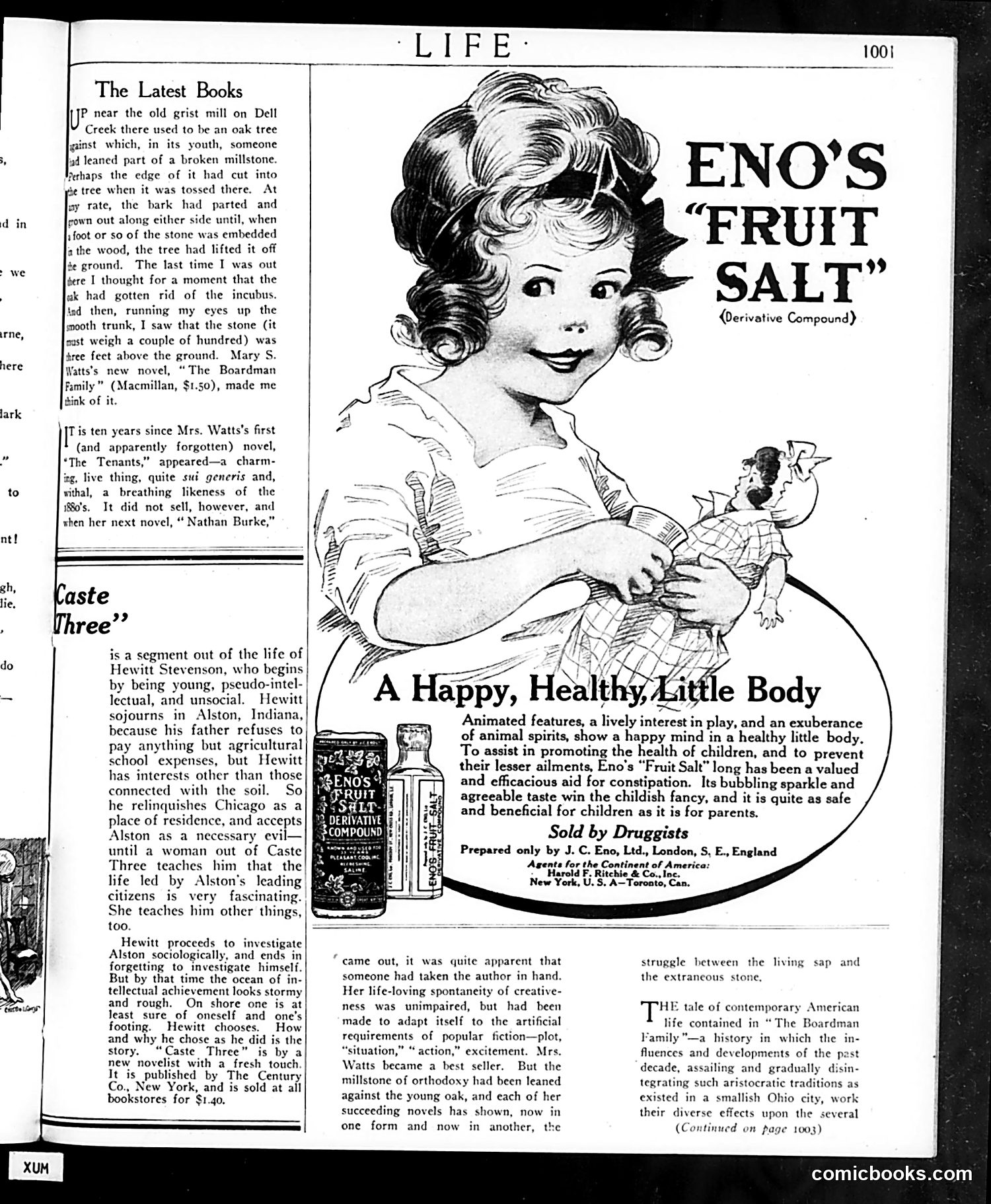
This page is primarily a **book review** and **advertisement**, not political satire. The left column discusses novels by Mrs. Mary S. Watts, particularly "Caste Three," a story about an intellectual young man (Hewitt Stevenson) in small-town Indiana who must choose between intellectual pursuits and practical life. The reviewer uses an extended metaphor about a tree and embedded millstone to describe how Watts's work captures conflicting forces. The right side is a **commercial advertisement** for "Eno's Fruit Salt," a laxative marketed as beneficial for children's digestive health. The cheerful illustrated woman and child represent the product's promised effects—a "happy, healthy little body." This type of patent medicine ad was common in early 20th-century magazines. There is no political cartoon or satire here. The page represents typical *Life* magazine content from an era when literary criticism and commercial advertising coexisted on the same pages.
📄 Transcribed text from this page (OCR, searchable)
Machine-transcribed from the original scan — historical spelling and the odd misread are preserved.
din > we irne, here gh, lie. The Latest Books P near the old grist mill on Dell Creek there used to be an oak tree linst which, in its youth, someone lad leaned part of a broken millstone. chaps the edge of it had cut into ye tree when it was tossed there. At xy rate, the bark had parted and frown out along either side until, when js foot or so of the stone was embedded athe wood, the tree had lifted it off se ground. The last time I was out léere I thought for a moment that the ak had gotten rid of the incubus. ied then, running my eyes up the smooth trunk, I saw that the stone (it ast weigh a couple of hundred) was tree feet above the ground. Mary S. Watts’s new novel, “The Boardman Family” (Macmillan, $1.50), made me think of it. E is ten years since Mrs. Watts’s first (and apparently forgotten) novel, “The Tenants,” appeared—a charm- ing, live thing, quite sui generis and, withal, a breathing likeness of the 1880's. It did not sell, however, and shen her next novel, “ Nathan Burke,” is a segment out of the life of Hewitt Stevenson, who begins by being young, pseudo-intel- | lectual, and unsocial. Hewitt sojourns in Alston, Indiana, because his father refuses to pay anything but agricultural school expenses, but Hewitt has interests other than those connected with the soil. So he relinquishes Chicago as a place of residence, and accepts Alston as a necessary evil— until a woman out of Caste Three teaches him that the} life led by Alston's leading citizens is very fascinating. She teaches him other things, | too. Hewitt proceeds to investigate Alston sociologically, and ends in forgetting to investigate himself. But by that time the ocean of in- tellectual achievement looks stormy and rough. On shore one is at least sure of oneself and one’s footing. Hewitt chooses. How and why he chose as he did is the story. “Caste Three” is by a new novelist with a fresh touch. It is published by The Century Co., New York, and is sold at ail bookstores for $1.40. ENO’ “FRUIT SALT” Derivative Compound) NNR ME | BLIP IZ ; ‘ Lf lay. LE A UM hag A Happy, HealthyLitfle Bod appy, Healthy, £ittle Body Animated features, a lively interest in play, and an exuberance of animal spirits, show a happy mind in a healthy little body. To assist in promoting the health of children, and to prevent their lesser ailments, Eno’s “Fruit Salt” long has been a valued and efficacious aid for constipation. Its bubbling sparkle and agreeable taste win the childish fancy, and it is quite as safe and beneficial for children as it is for parents. Sold by Druggists Prepared only by J. C. Eno, Ltd., London, S, E., England Agents for the Continent of America: Harold F. Ritchie & Co., Inc. New York, U.S. A—Toronto, Can. °2 DERIVATIVE ScOMPOUND “came out, it was quite apparent that someone had taken the author in hand. Her life-loving spontaneity of creative- ness was unimpaired, but had been HE struggle between the living sap and the extraneous stone. ale of contemporary American made to adapt itself to the artificial requirements of popular fiction—plot, “situation,” “ action,” excitement. Mrs. Watts became a best seller. But the millstone of orthodoxy had been leaned against the young oak, and each of her succeeding novels has shown, now in one form and now in another, the life contained in “The Boardman Family "—a_ history in which the in- fluences and developments of the past decade, assailing and ally disin- tegrating such aristocratic traditions as existed in a smallish Ohio city, work their diverse effects upon the several (Continued on page 1003) comicbooks.com