
Life, 1918-06-20 · page 16 of 36
Life — June 20, 1918 — page 16: what you’re looking at
What you’re looking at
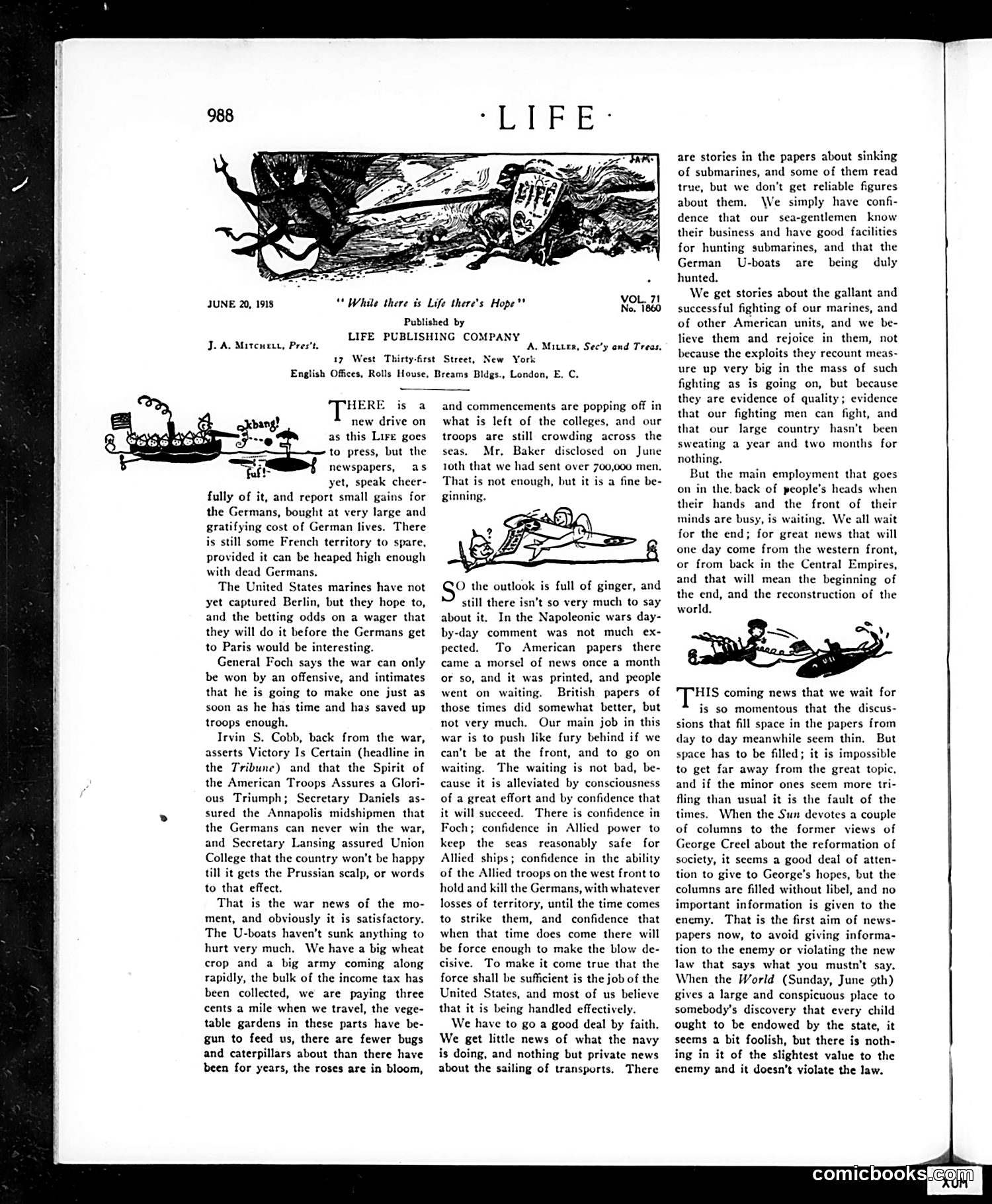
This page contains editorial commentary on World War I, not political cartoons. The small illustrations (submarine, airplane, soldier) are decorative vignettes accompanying the text. The editorial addresses American optimism about the war's trajectory. It reports favorably on recent military developments: U.S. troops deploying (700,000 sent overseas), successful marine operations, and confident statements from military leaders (Secretary Daniels, General Foch, Secretary Lansing). The tone is cautiously upbeat but realistic—acknowledging that while news is scarce and requires "faith," there's confidence in Allied strategy and American industrial capacity (wheat crops, income tax collection, home gardens). The piece reflects June 1918 WWI context: Germany's spring offensive had stalled, American forces were arriving in large numbers, and the eventual Allied victory appeared increasingly likely, though fighting continued.
📄 Transcribed text from this page (OCR, searchable)
Machine-transcribed from the original scan — historical spelling and the odd misread are preserved.
JUNE 20, 1918 “* While there is Life there's Hope” VOL. 7! No, 1860 Published by LIFE PUBLISHING COMPANY J. A. Mitcnent, Pres’t, A. Mitura, Sec’y and Treas, 17 West Thirty-first Street, New York English Offices, Rolls House, Breams Bldgs., London, E. C. HERE is a new drive on as this Lire goes to press, but the newspapers, as yet, speak cheer- fully of it, and report small gains for the Germans, bought at very large and gratifying cost of German lives. There is still some French territory to spare, provided it can be heaped high enough with dead Germans. The United States marines have not yet captured Berlin, but they hope to, and the betting odds on a wager that they will do it before the Germans get to Paris would be interesting. General Foch says the war can only be won by an offensive, and intimates that he is going to make one just as soon as he has time and has saved up troops enough, Irvin S. Cobb, back from the war, asserts Victory Is Certain (headline in the Tribune) and that the Spirit of the American Troops Assures a Glori- ous Triumph; Secretary Daniels as- sured the Annapolis midshipmen that the Germans can never win the war, and Secretary Lansing assured Union College that the country won't be happy till it gets the Prussian scalp, or words to that effect. That is the war news of the mo- ment, and obviously it is satisfactory. The U-boats haven't sunk anything to hurt very much. We have a big wheat crop and a big army coming along rapidly, the bulk of the income tax has been collected, we are paying three cents a mile when we travel, the vege- table gardens in these parts have be- gun to feed us, there are fewer bugs and caterpillars about than there have been for years, the roses are in bloom, and commencements are popping off in what is left of the colleges, and our troops are still crowding across the seas. Mr. Baker disclosed on June loth that we had sent over 700,000 men. That is not enough, but it is a fine be- ginning. Se the outlook is full of ginger, and still there isn’t so very much to say about it. In the Napoleonic wars day- by-day comment was not much ex- pected. To American papers there came a morsel of news once a month or so, and it was printed, and people went on waiting. British papers of those times did somewhat better, but not very much, Our main job in this war is to push like fury behind if we can't be at the front, and to go on waiting. The waiting is not bad, be- cause it is alleviated by consciousness of a great effort and by confidence that it will succeed. There is confidence in Foch; confidence in Allied power to keep the seas reasonably safe for Allied ships; confidence in the ability of the Allied troops on the west front to hold and kill the Germans, with whatever losses of territory, until the time comes to strike them, and confidence that when that time does come there will be force enough to make the blow de- cisive. To make it come true that the force shall be sufficient is the job of the United States, and most of us believe that it is being handled effectively. We have to go a good deal by faith. We get little news of what the navy is doing, and nothing but private news about the sailing of transports. There are stories in the papers about sinking of submarines, and some of them read true, but we don’t get reliable figures about them. We simply have confi- dence that our sea-gentlemen know their business and have good facilities for hunting submarines, and that the German U-boats are being duly hunted. We get stories about the gallant and successful fighting of our marines, and of other American units, and we be- lieve them and rejoice in them, not because the exploits they recount meas- ure up very big in the mass of such fighting as is going on, but because they are evidence of quality; evidence that our fighting men can fight, and that our large country hasn't been sweating a year and two months for nothing. But the main employment that goes on in the. back of people's heads when their hands and the front of their minds are busy, is waiting, We all wait for the end; for great news that will one day come from the western front, or from back in the Central Empires, and that will mean the beginning of the end, and the reconstruction of the world. —N HIS coming news that we wait for is so momentous that the discus- ns that fill space in the papers from to day meanwhile seem thin, But sp has to be filled; it is impossible to get far away from the great topic, and if the minor ones seem more tri- fling than usual it is the fault of the times. When the Sun devotes a couple of columns to the former views of George Creel about the reformation of society, it seems a good deal of atten- tion to give to George’s hopes, but the columns are filled without libel, and no important information is given to the enemy. That is the first aim of news- papers now, to avoid giving informa- tion to the enemy or violating the new law that says what you mustn't say. When the World (Sunday, June oth) gives a large and conspicuous place to somebody's discovery that every child ought to be endowed by the state, it seems a bit foolish, but there is noth- ing in it of the slightest value to the enemy and it doesn’t violate the law. comicbooksieonl