
A complete issue · 40 pages · 1918
Life — May 9, 1918
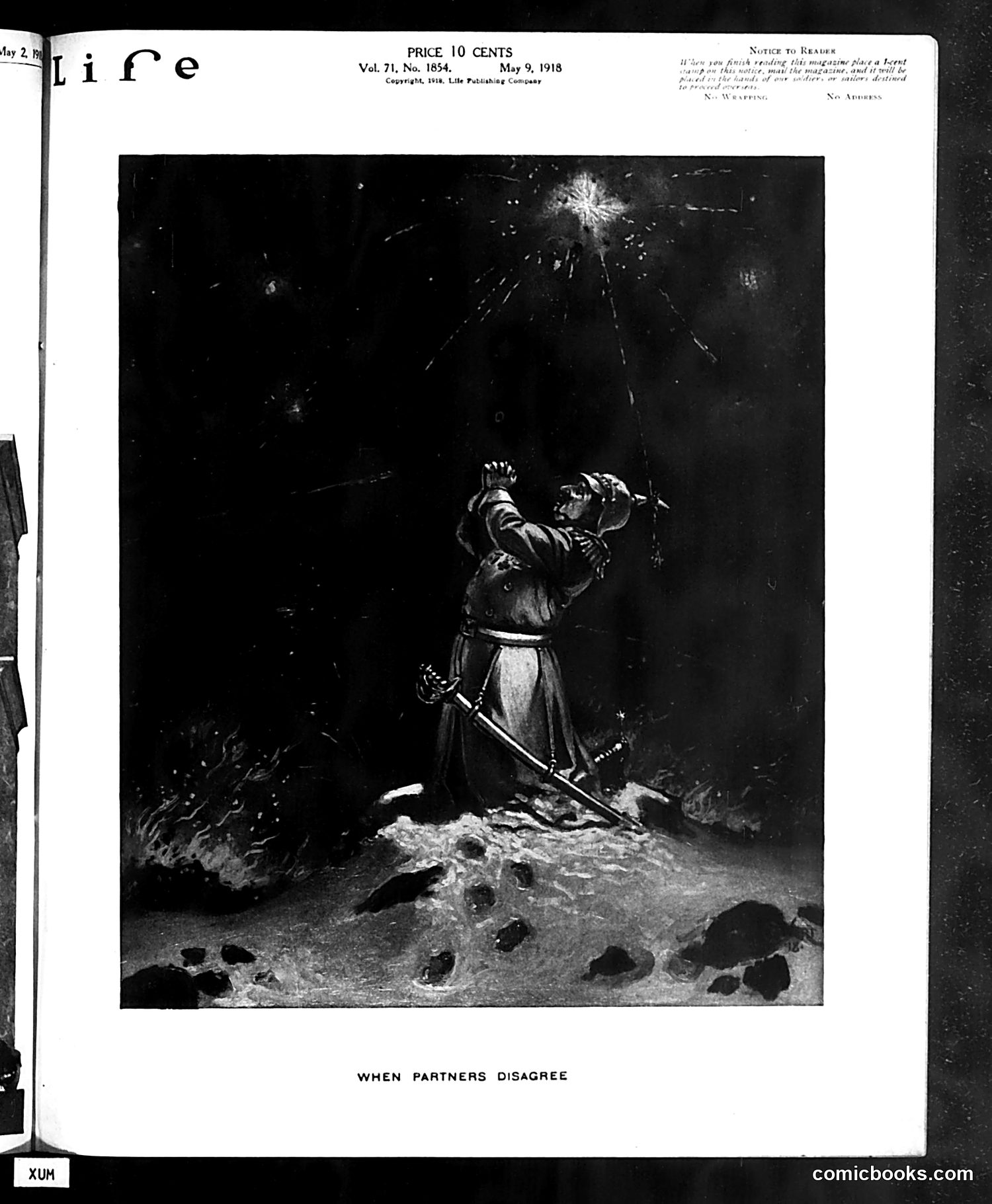
This May 9, 1918 Life magazine cartoon depicts a figure in military/royal dress wielding a sword, reaching upward toward an explosion or burst of light in a dark sky. The caption "When Partners Disagree" suggests conflict between allies. Given the 1918 date during World War I's final months, this likely references tensions between Allied powers—possibly the U.S. and its European allies, or internal disagreements about war strategy and peace negotiations. The figure's gestures suggest desperation or conflict during negotiations. The dramatic chiaroscuro composition and military iconography emphasize the stakes of diplomatic disputes among wartime partners. The specific historical referent remains unclear without additional context, but the satire critiques the fracturing of Allied unity at a crucial moment.
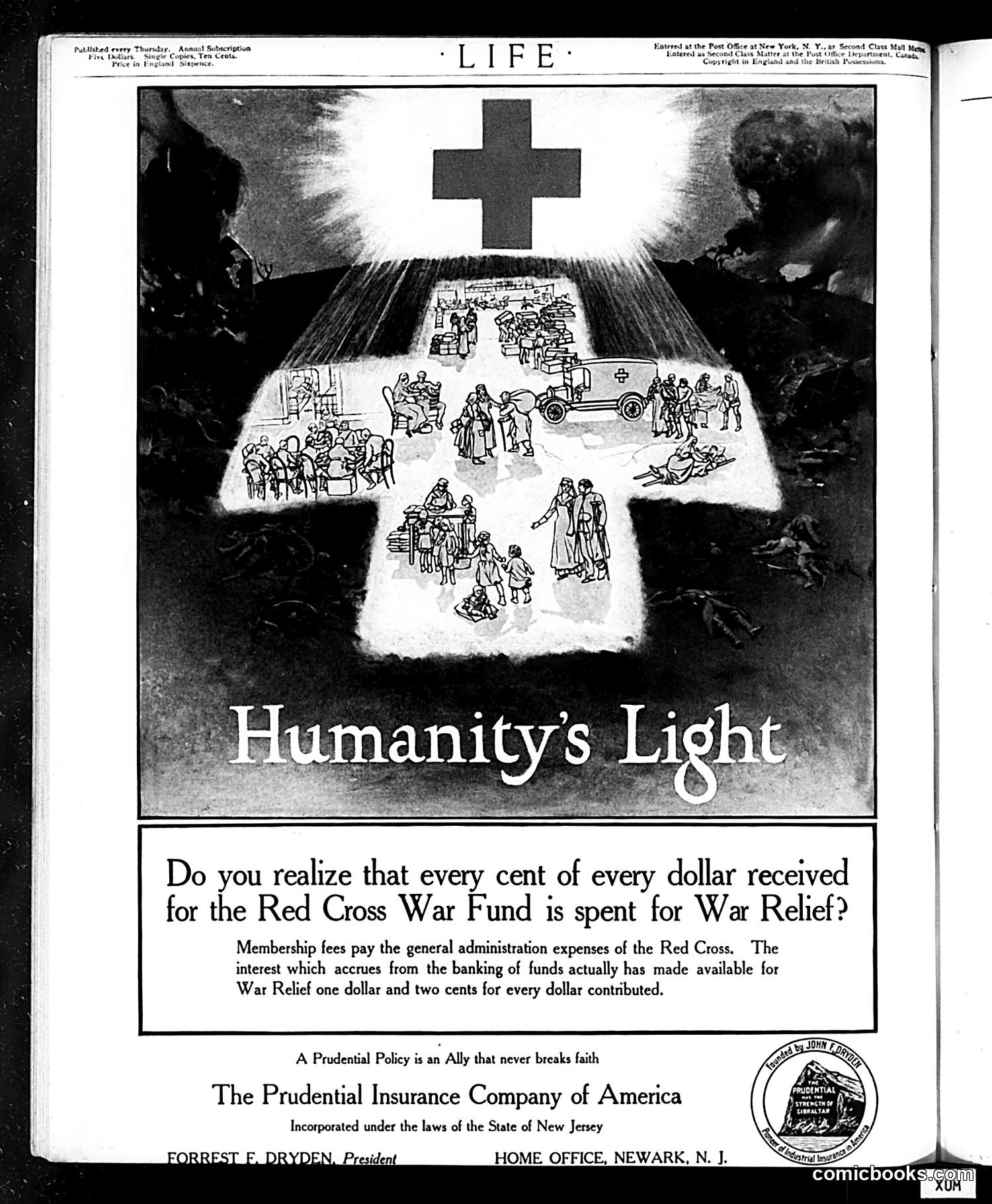
This is a Red Cross fundraising advertisement disguised as editorial content in *Life* magazine. The central image shows a glowing cross illuminating various scenes of humanitarian aid—people receiving medical care, food, and assistance from vehicles marked with the Red Cross symbol. The accompanying text makes a specific claim: that every dollar donated to the Red Cross War Fund goes entirely to war relief, with membership fees covering administrative costs separately. It emphasizes that banking interest on funds has made available an additional dollar and two cents for relief per dollar contributed. The advertisement is placed by The Prudential Insurance Company, positioning itself as a trustworthy financial institution endorsing the Red Cross's financial integrity during what appears to be a World War-era fundraising campaign.
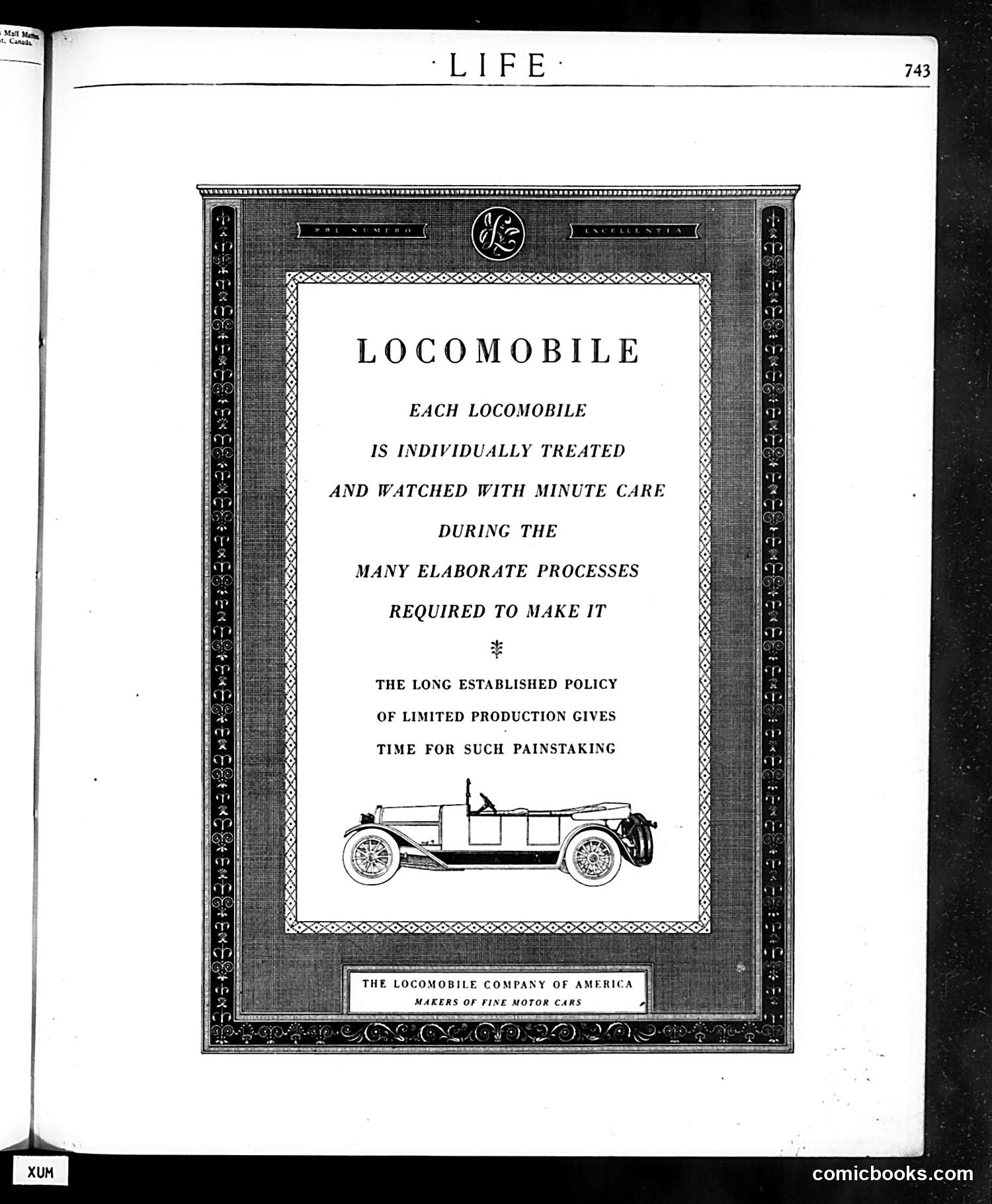
This is an **advertisement, not a cartoon or satire**. It appears in *Life* magazine (page 743) promoting the Locomobile Company of America's automobiles. The ad emphasizes luxury car manufacturing through rhetoric about craftsmanship: each vehicle receives individual attention and "minute care" through "elaborate processes." The company's "long established policy of limited production" is positioned as enabling meticulous work—a premium market strategy suggesting exclusivity justifies higher prices. The illustration shows a side-view of an early 1900s touring car. The ornate border and refined typography reinforce the brand's positioning as a maker of "fine motor cars" for affluent buyers. This represents early automotive advertising emphasizing handcrafted quality over mass production—a selling point that distinguished luxury manufacturers from emerging competitors like Ford.
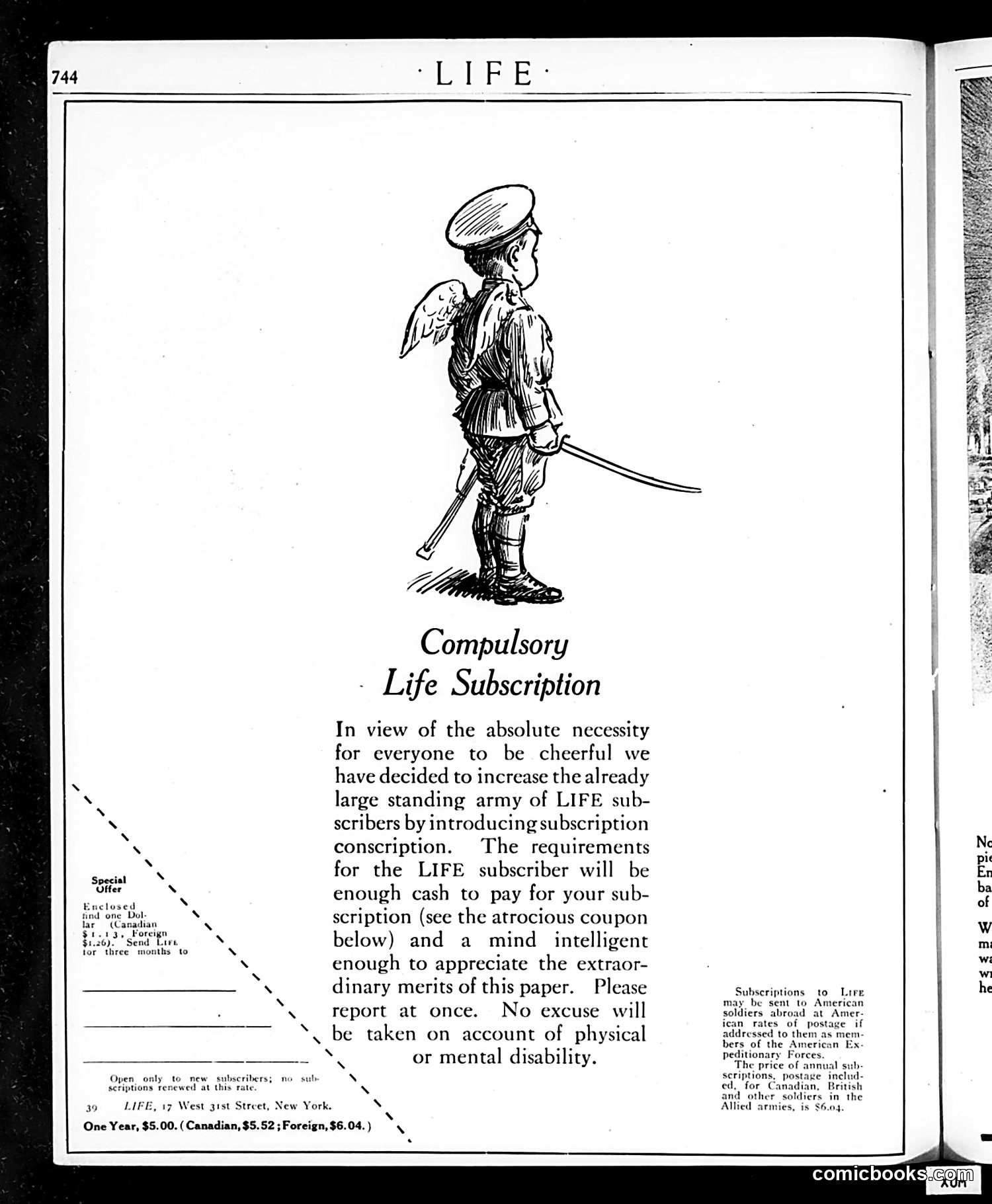
This is a satirical advertisement for LIFE magazine subscriptions, using World War I-era imagery to mock **mandatory military conscription**. The illustration depicts an angelic soldier (complete with wings and halo) carrying a sword, appearing to "recruit" readers through force rather than choice. The joke: LIFE presents subscription as "conscription"—mandatory service with no excuses accepted, mirroring actual military draft language of the period. The cherub-soldier enforcer humorously suggests the magazine considers itself patriotic duty. The text acknowledges subscribers abroad at American military rates, placing this during WWI when many American soldiers were stationed overseas. The satire critiques both aggressive subscription tactics and the broader cultural militarization of the era.
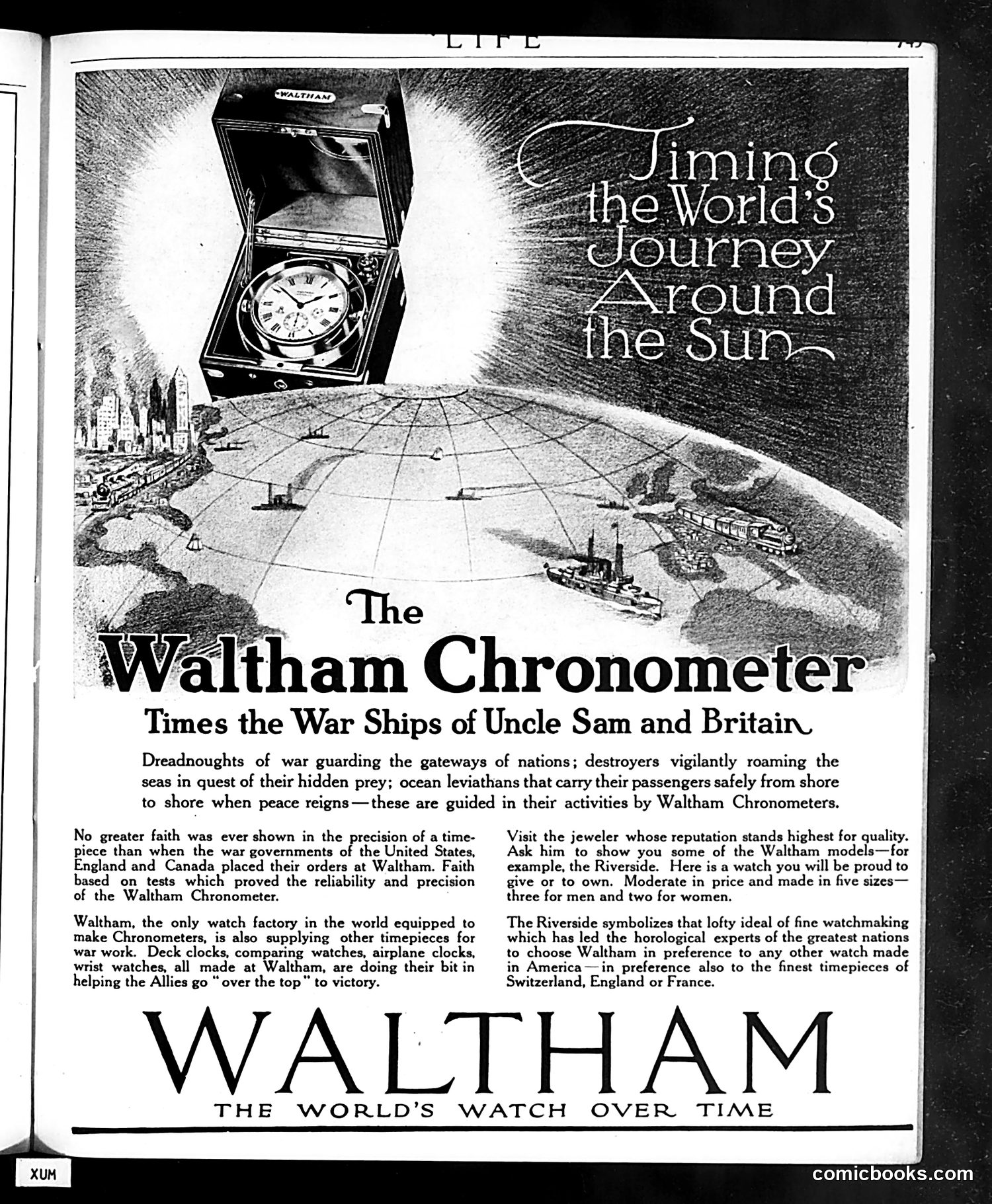
This is a **World War I-era advertisement** (not satire), likely from 1917-1918, promoting Waltham watches as precision instruments for military use. The ad claims Waltham chronometers were supplied to the U.S. and British governments for wartime operations—equipping naval vessels, destroyers, and other military applications requiring precise timekeeping. The globe illustration shows ships and military activity across continents. The rhetoric emphasizes reliability and patriotism: Waltham watches supposedly helped "the Allies go 'over the top' to victory." The ad positions the company as essential to Allied military success, contrasting Waltham favorably against Swiss, English, and French competitors. This represents **wartime corporate marketing**, leveraging national pride and military contracts to boost consumer confidence in the brand.
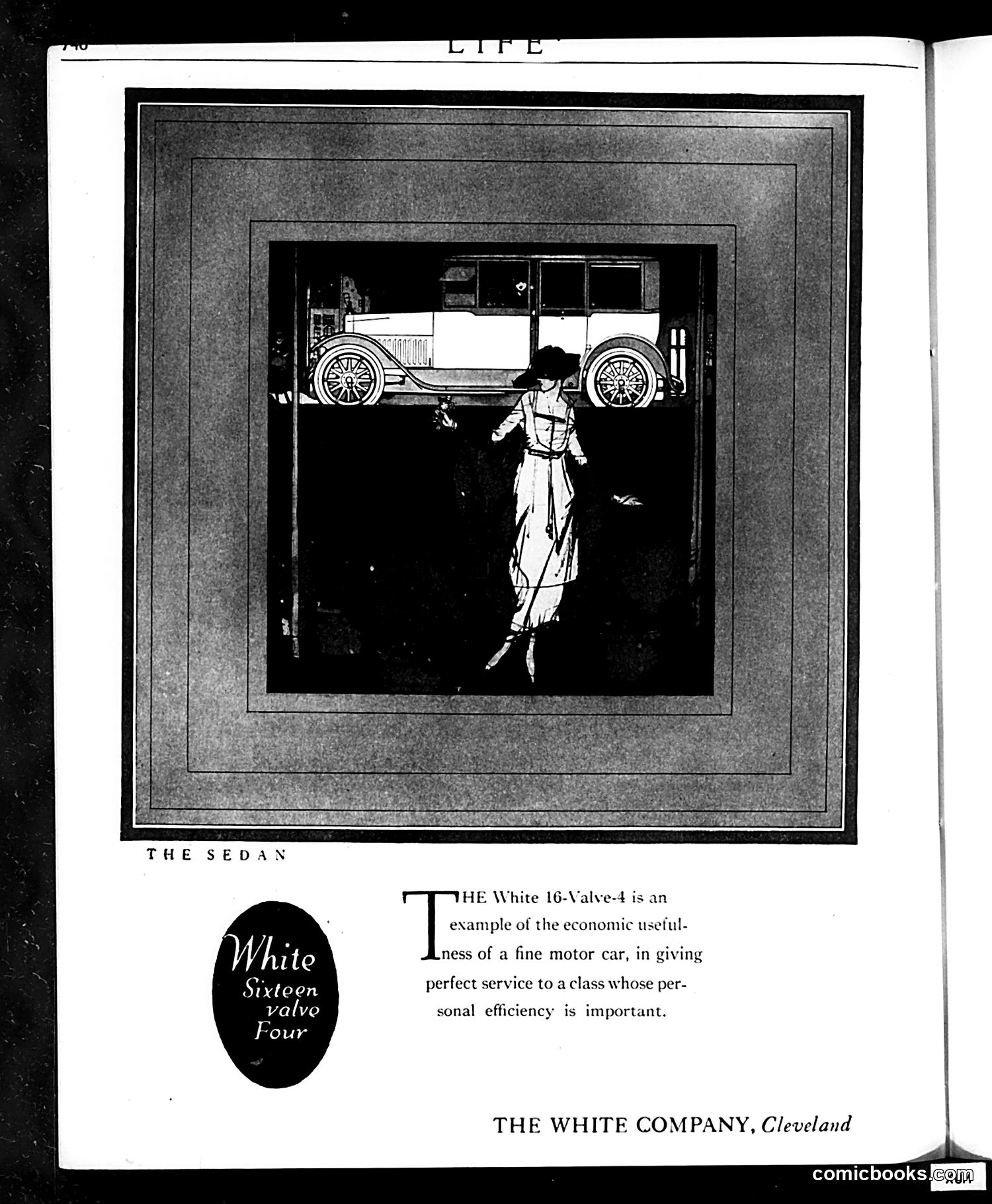
This page is primarily a **White automobile advertisement**, not satire. It features a stylized illustration of a woman in 1920s dress admiring a White 16-Valve-4 sedan displayed in what appears to be a showroom or garage. The ad copy emphasizes the car's appeal to professionals valuing "personal efficiency"—targeting affluent, presumably educated women and businesspeople. The illustration style is typical of 1920s advertising art. There is **no political cartoon or satire here**. This is straightforward commercial advertising positioned in *Life* magazine, which regularly carried paid advertisements alongside its satirical editorial content. The "economic usefulness" rhetoric reflects period marketing focused on automobiles as tools for productive, modern living.
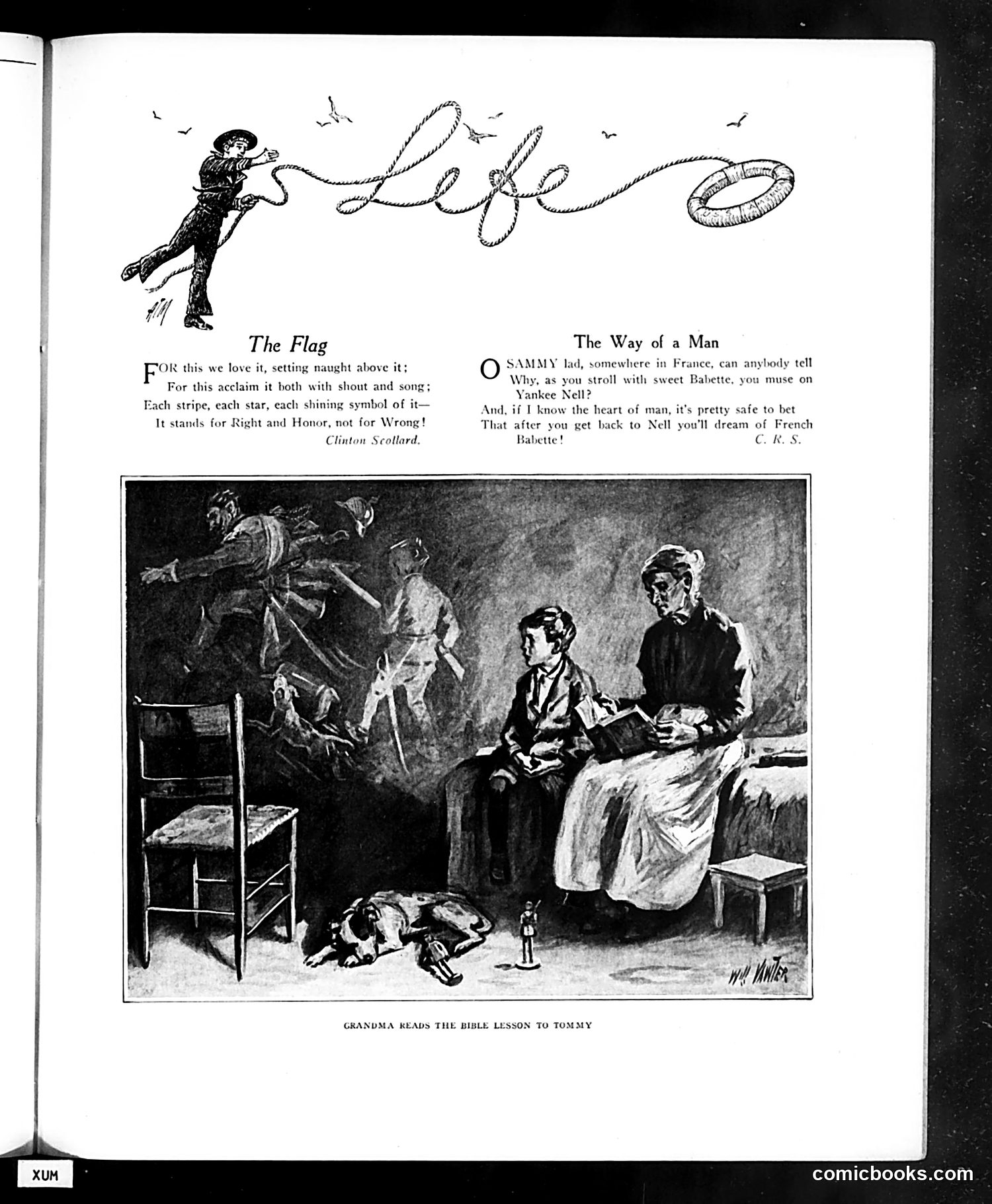
This page contains two unrelated items: **"The Flag"** (top left) is a patriotic poem by Clinton Scollard celebrating American values—"Right and Honor, not for Wrong." **"The Way of a Man"** (top right) is a brief humorous verse addressing a soldier ("Sammy") in France during World War I, joking that he'll pine for French pastry (Babette) after returning home to American food. **The illustration** titled "Grandma Reads the Bible Lesson to Tommy" shows a domestic scene of a grandmother teaching a young boy scripture while a dog sleeps nearby. This depicts traditional American family values and religious instruction—likely reflecting early 20th-century ideals about moral education during childhood. The page emphasizes patriotism, wholesome family life, and American virtue, typical themes for *Life* magazine during or shortly after WWI.
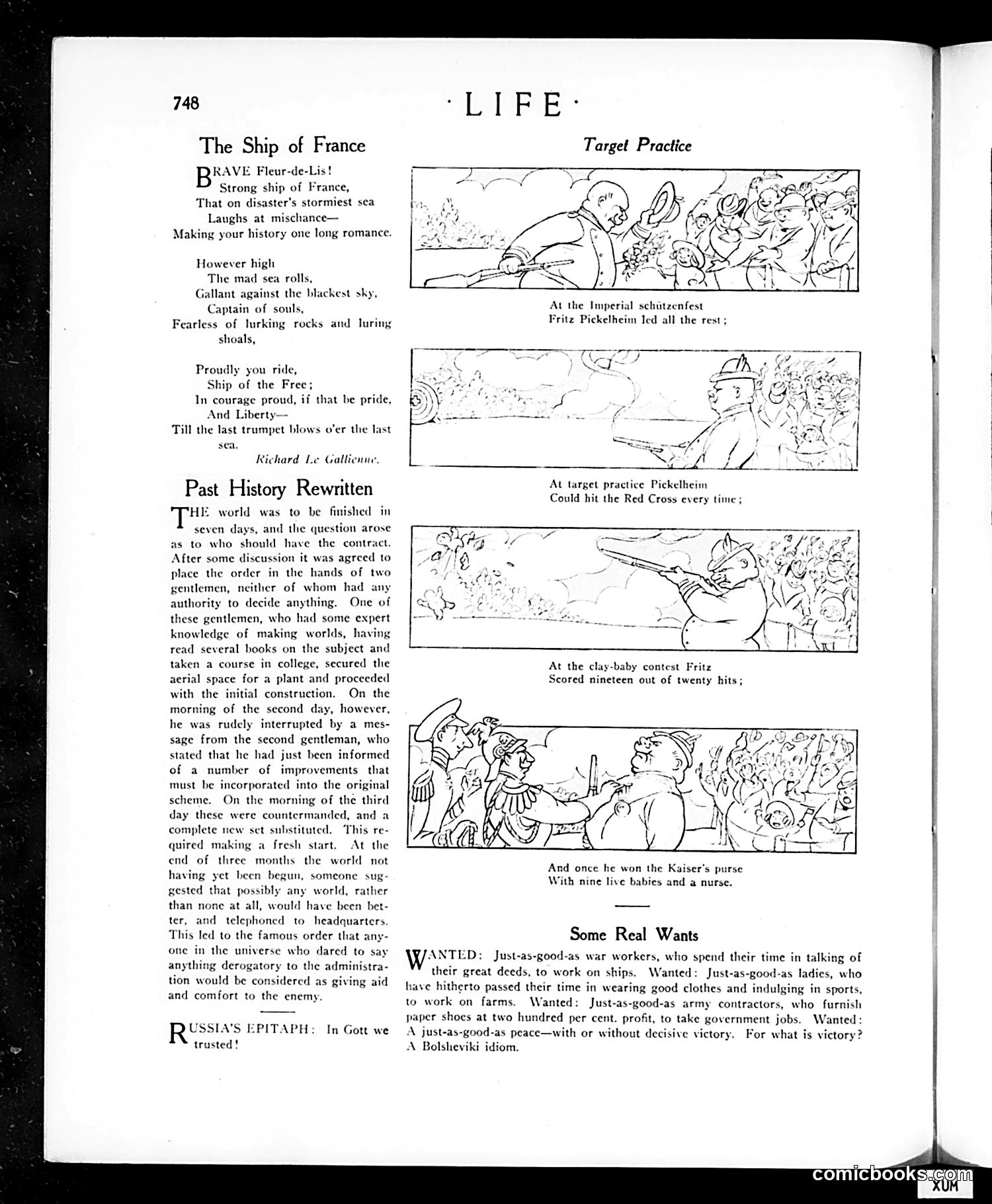
This page contains two distinct sections: **"The Ship of France"** - A patriotic poem praising French naval courage, attributed to Richard Le Gallienne. It celebrates France as a brave vessel navigating dangerous seas, using maritime metaphors for national pride and freedom. **"Past History Rewritten"** - A satirical piece mocking bureaucratic incompetence. Two unnamed gentlemen are tasked with finishing creation of "the world," but their work is interrupted by contradictory orders requiring complete restarts. The satire critiques administrative dysfunction and endless revision—likely commentary on wartime or contemporary government inefficiency. **"Target Practice"** - Four cartoon panels (right side) depict "Fritz" (German soldier stereotype) and "Pickelheim" in military training scenarios, showing Allied soldiers' competitive target practice with German opponents. This reflects WWI-era satirical humor. **"Some Real Wants"** - Brief section sardonically listing wartime labor shortages and profiteering.
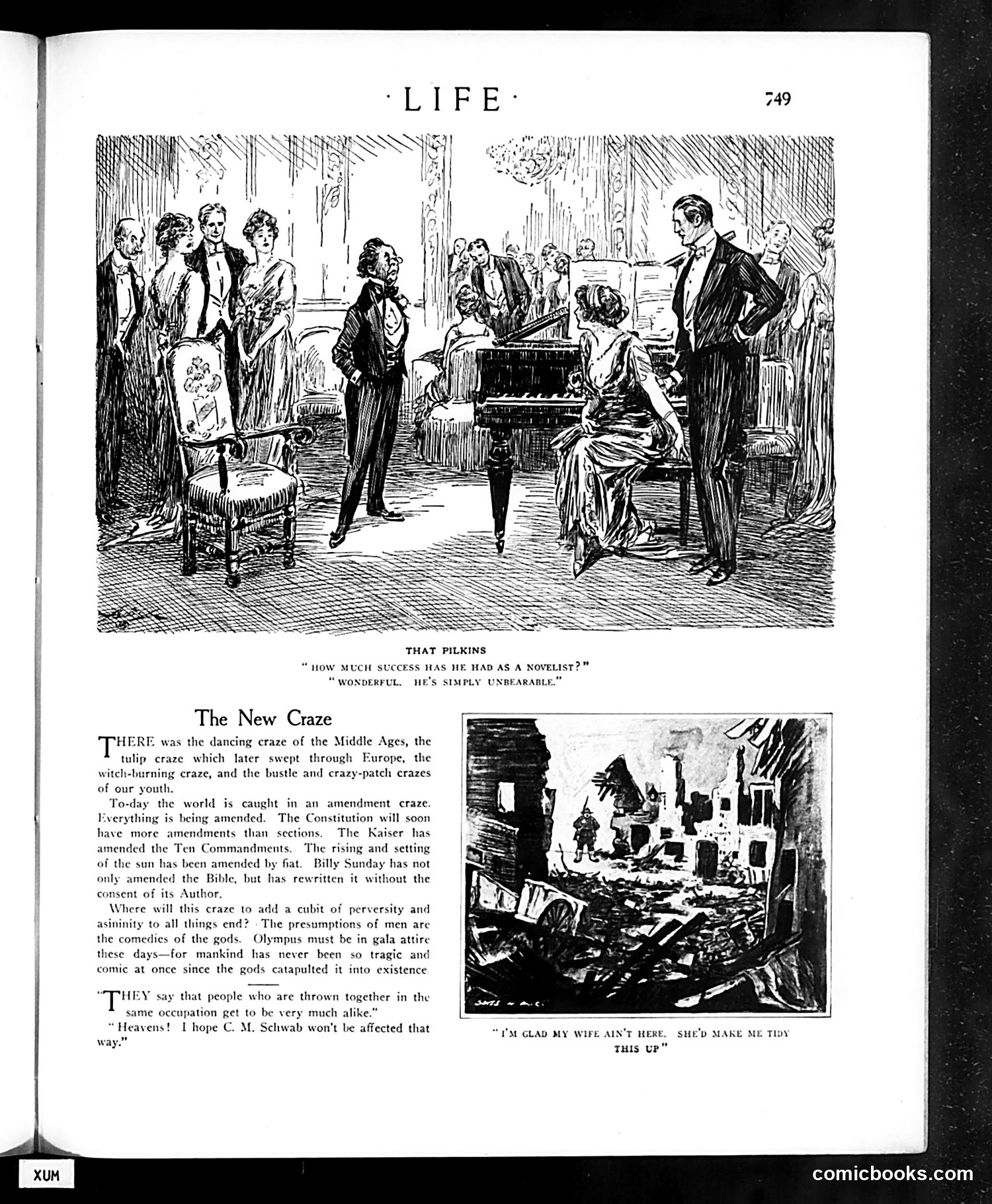
The top sketch titled "That Pilkins" depicts a social gathering where a man plays piano while others listen. The caption suggests Pilkins has achieved success as a novelist and is described as "unbearable"—satirizing how newly successful literary figures become insufferable in high society. The article "The New Craze" below mocks contemporary trends toward amending established institutions. It references historical crazes (dancing plagues, tulip mania) before discussing the current "amendment craze"—likely referencing Progressive Era reforms. The piece sarcastically notes that everything from the Constitution to the Bible is being amended, criticizing how modern society obsessively revises established norms and traditions. The lower illustration shows a domestic scene with the caption "I'm glad my wife ain't here. She'd make me tidy this up"—a joke about household disorder and marital dynamics.
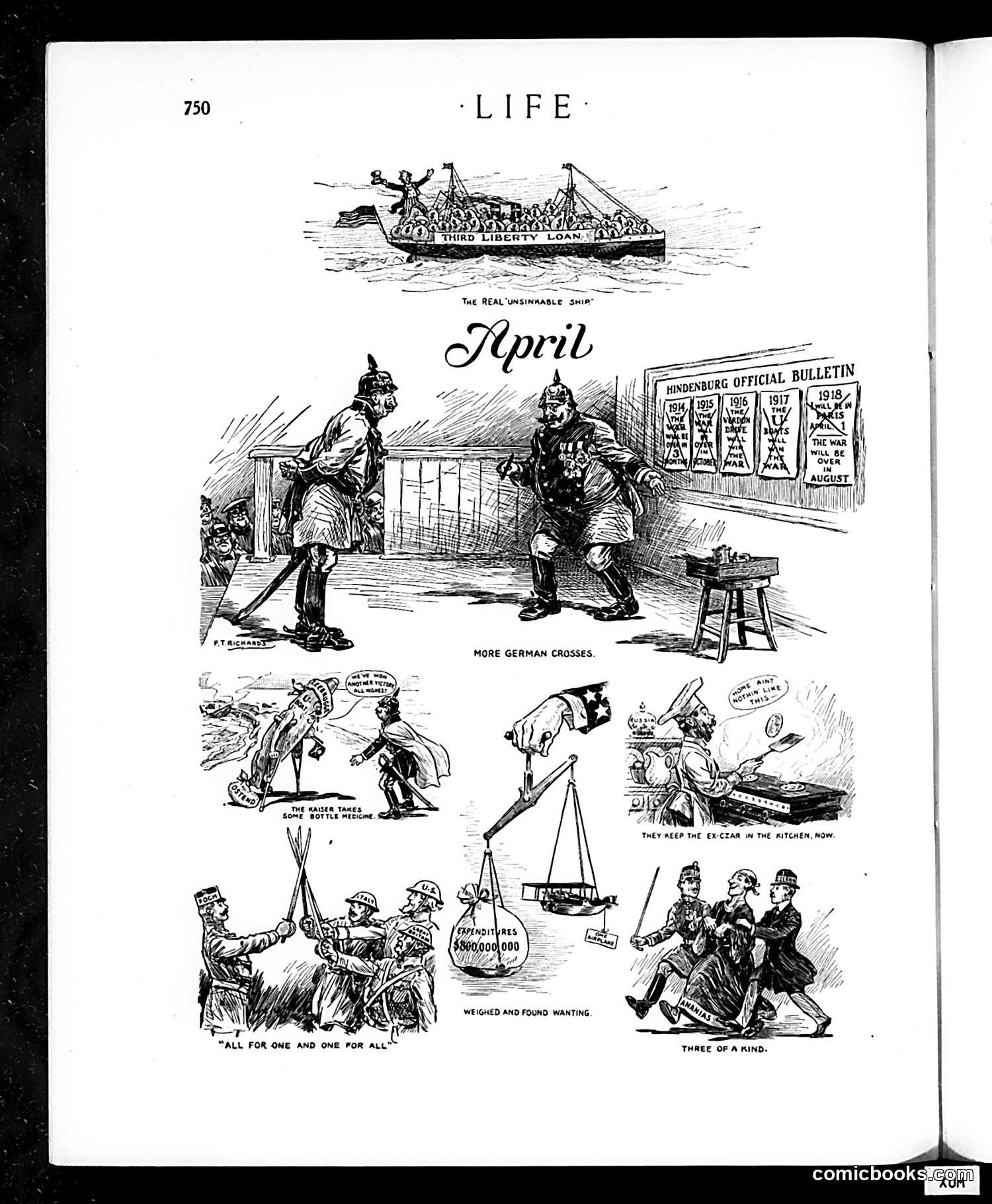
This page satirizes World War I through multiple cartoons. The top image shows the "Third Liberty Loan" ship packed with soldiers—referencing American bond drives to finance the war effort. The central cartoon depicts two German military figures labeled "MORE GERMAN CROSSES," likely commenting on casualty counts and military decorations awarded for kills. Below are smaller satirical scenes mocking German leadership and the war effort. One shows figures discussing "bottle medicine," another depicts a vessel marked "expenditures $900,000,000" being weighed and found wanting. The final cartoon shows three figures labeled "THREE OF A KIND," likely critiquing Allied leadership or strategy. The "Hindenburg Official Bulletin" in the upper right predicts war's end by August—satirizing German optimism or propaganda about the conflict's timeline. The overall tone mocks German military pretensions while commenting on American war involvement and costs.
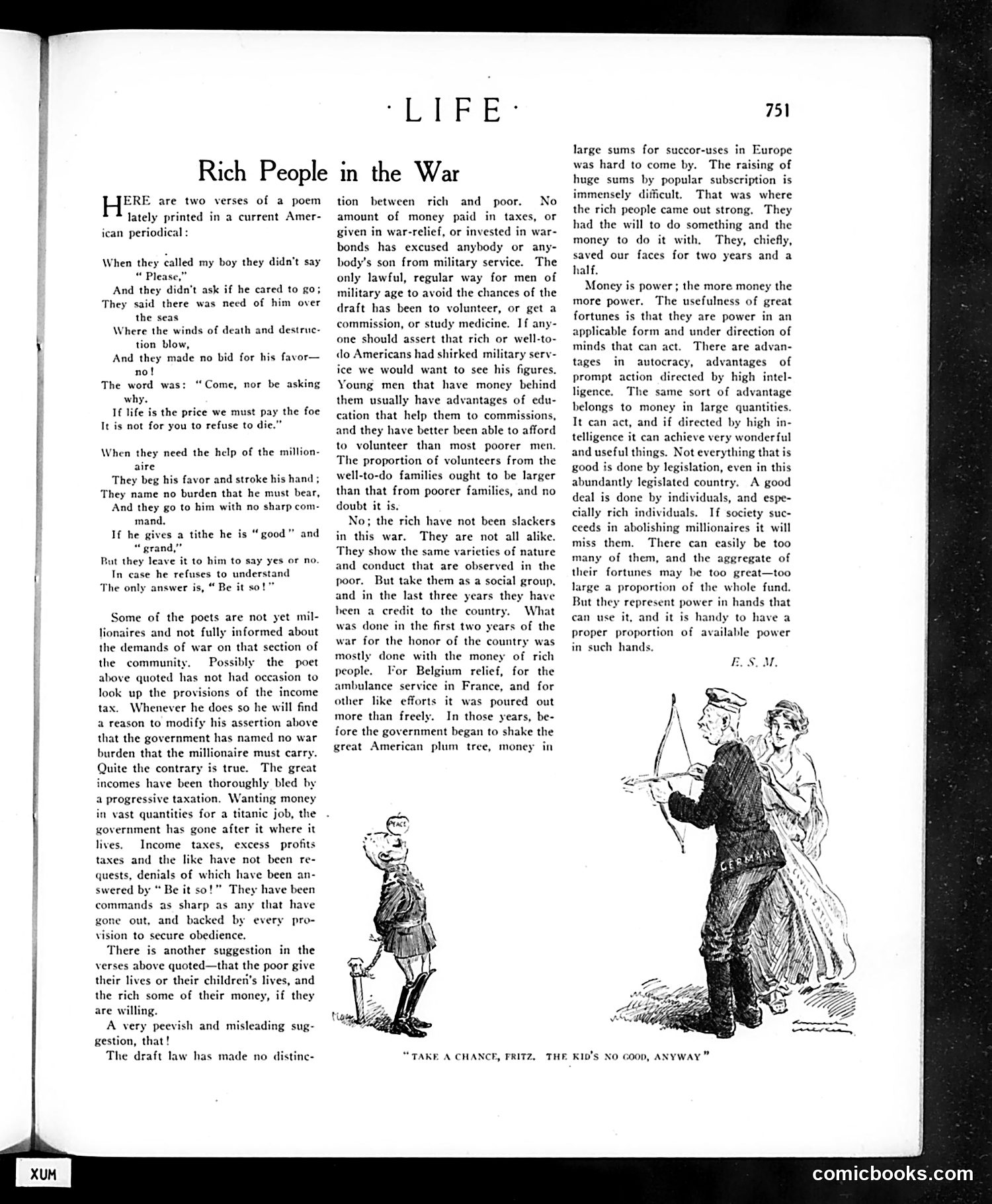
This article critiques wealthy Americans' contributions during WWI. The text argues that rich people, despite having resources, largely avoided military service through education, commissions, or medical exemptions. The accompanying cartoon (captioned "Take a Chance, Fritz. The Kid's No Good, Anyway") depicts a wealthy man offering his reluctant son to a German soldier—satirizing the notion that rich families could dodge drafts while poor families sacrificed children to combat. The article's central irony: while the wealthy funded relief efforts and war bonds, they used their advantages to escape the draft's personal costs. The satire suggests this represents moral hypocrisy and inequality in wartime sacrifice.
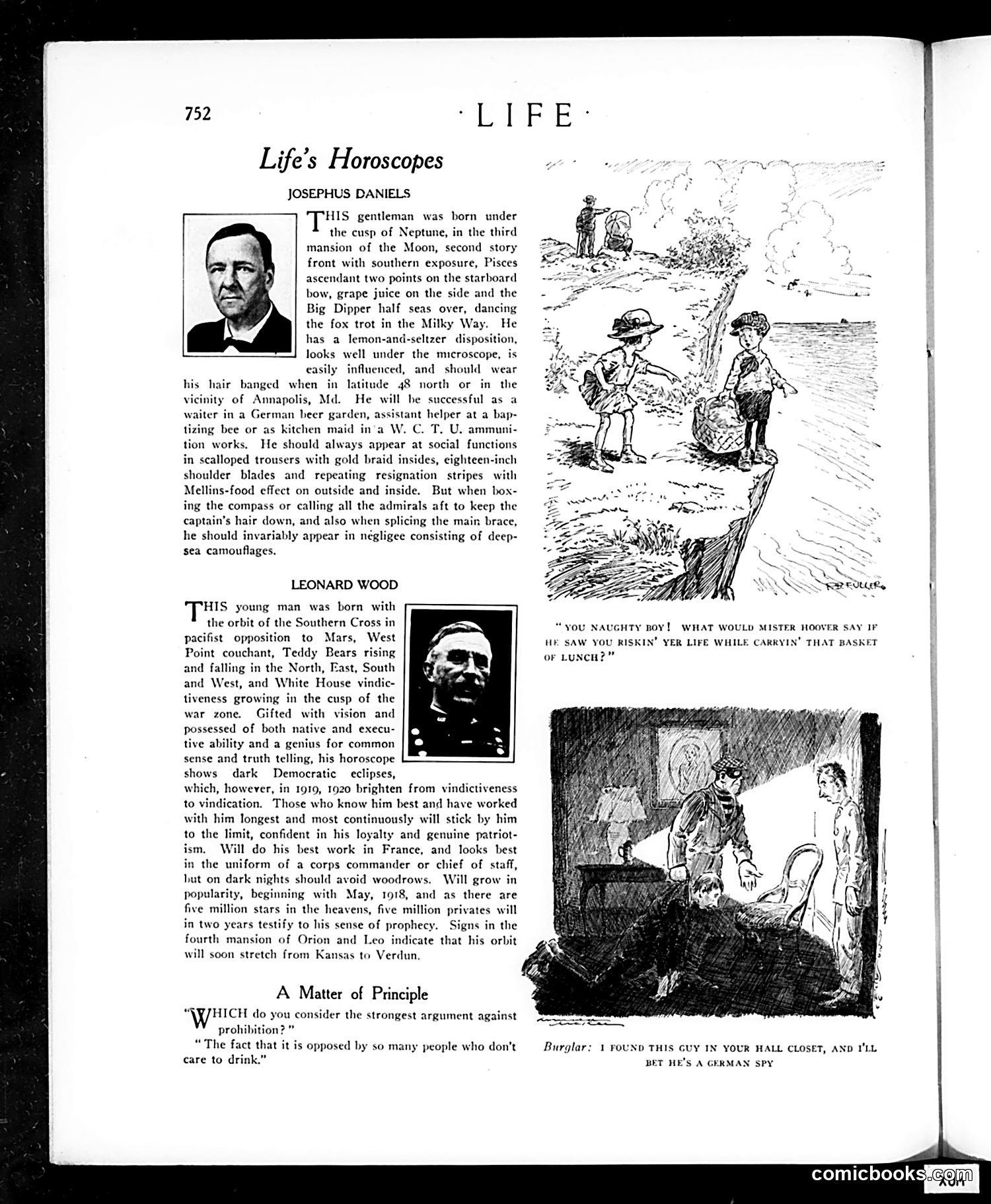
This page presents humorous astrological character sketches of two men—Josephus Daniels and Leonard Wood—using satirical "horoscopes" as a format. **Josephus Daniels** is mocked for his Neptune birth sign, with jokes about his appearance, fashion choices (scalloped trousers, "gold braid insides"), and unsuitability for naval authority—ironic since he was Secretary of the Navy. **Leonard Wood** receives similarly pointed satire regarding his Democratic affiliations and military ambitions, with references to his future political prospects and a jab about avoiding "dark nights" and "woodrows" (a pun on Woodrow Wilson, presumably). The bottom section, "A Matter of Principle," presents a joke about prohibition arguments. Two illustrations accompany the text—one showing children at play, another depicting a burglary scene with spy implications.
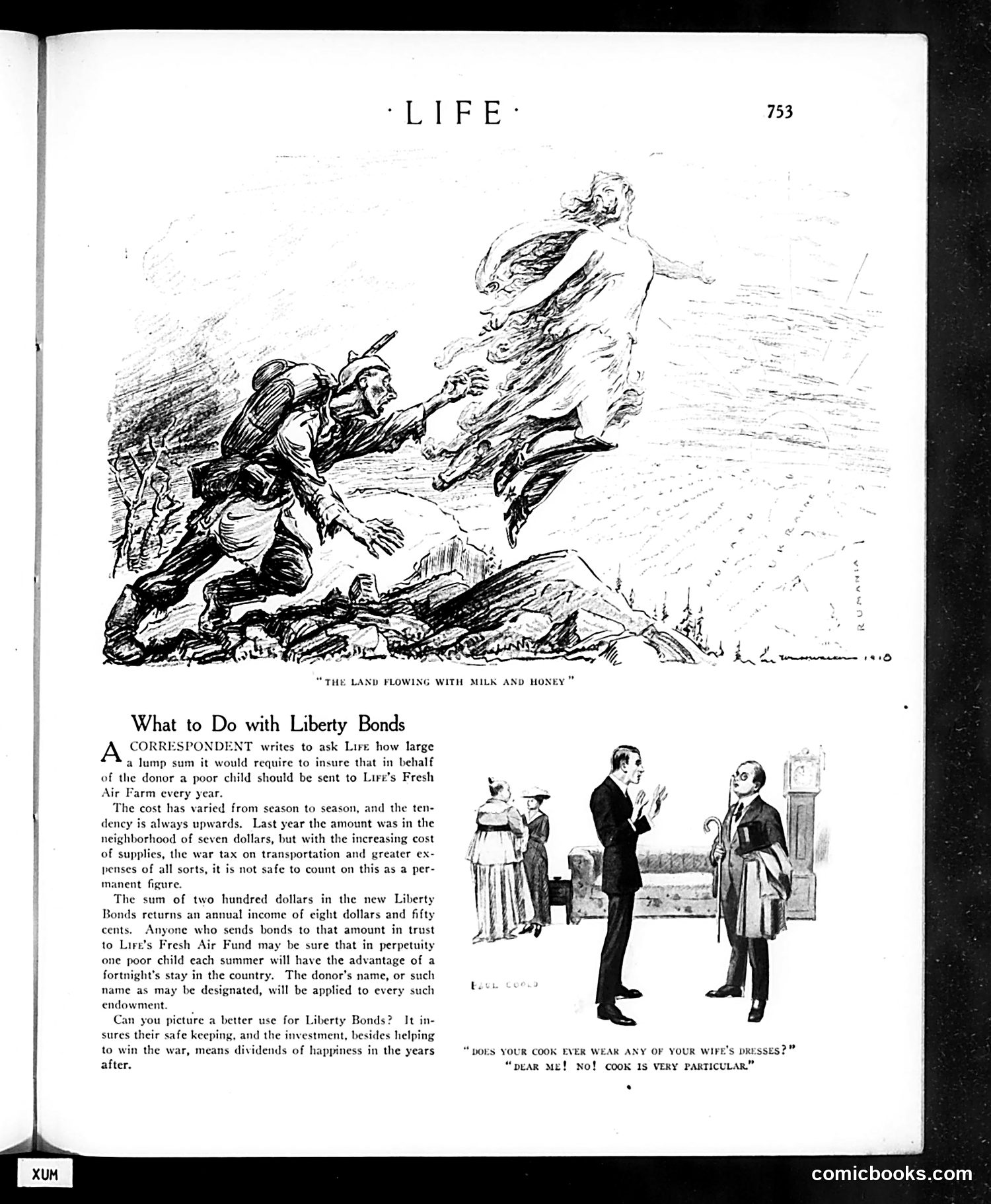
This page contains two satirical pieces from *Life* magazine (page 753): **Top illustration**: "The Land Flowing with Silk and Honey" depicts soldiers chasing what appears to be an allegorical female figure—likely representing enemy territory or spoils of war. This reflects WWI-era propaganda imagery. **Bottom section**: "What to Do with Liberty Bonds" addresses a practical wartime finance question. A correspondent asks how to use Liberty Bonds (government bonds sold to finance WWI) as charitable donations. The article proposes giving $200 bonds to Lind's Fresh Air Farm to send poor children to the country annually. The accompanying cartoon shows two men in conversation with women present, with dialogue about a cook's wardrobe—a humorous domestic scene that appears tangential to the main article's serious philanthropic purpose.
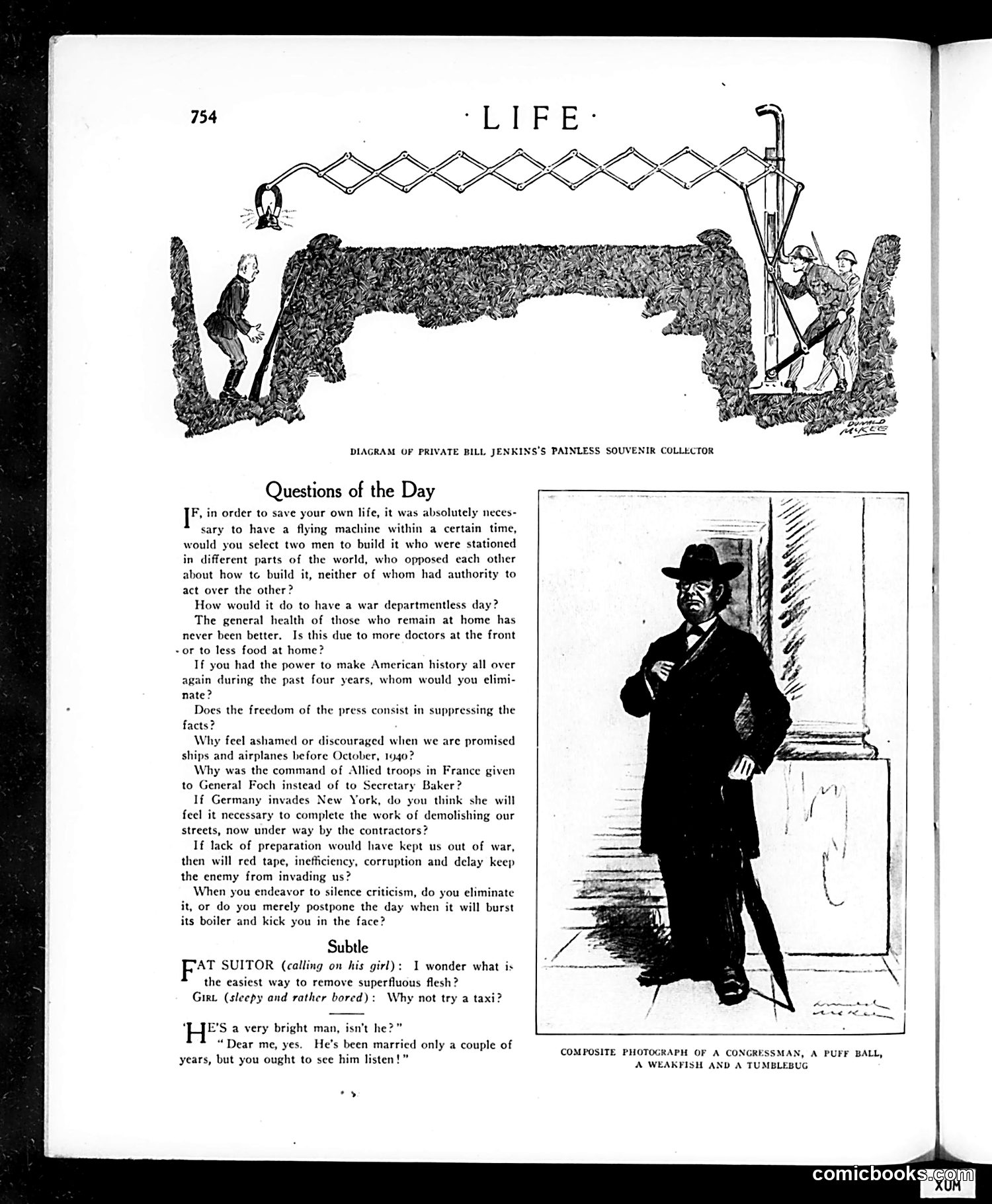
This page contains two distinct satirical pieces: **Top**: A humorous diagram labeled "Private Bill Jenkins's Painless Souvenir Collector" shows figures in a hedgerow collecting items. This appears to be visual wordplay about souvenirs from wartime. **Bottom**: "Questions of the Day" poses contemporary political/military questions, including references to a "war departmentless day," Allied troop command (General Foch vs. Secretary Baker), and German street demolition. These reference World War I concerns—military leadership, preparation, and criticism. The sidebar joke "Subtle" depicts a conversation where a man asks about removing "superfluous flesh," and his companion dismissively suggests a taxi instead of exercise—a jab at laziness. The composite photograph shows a congressman as a "puff ball, a weakfish and a tumblebug"—a caricature-style critique using animal comparisons. These collectively satirize WWI-era military incompetence, political leadership disputes, and congressional inadequacy.
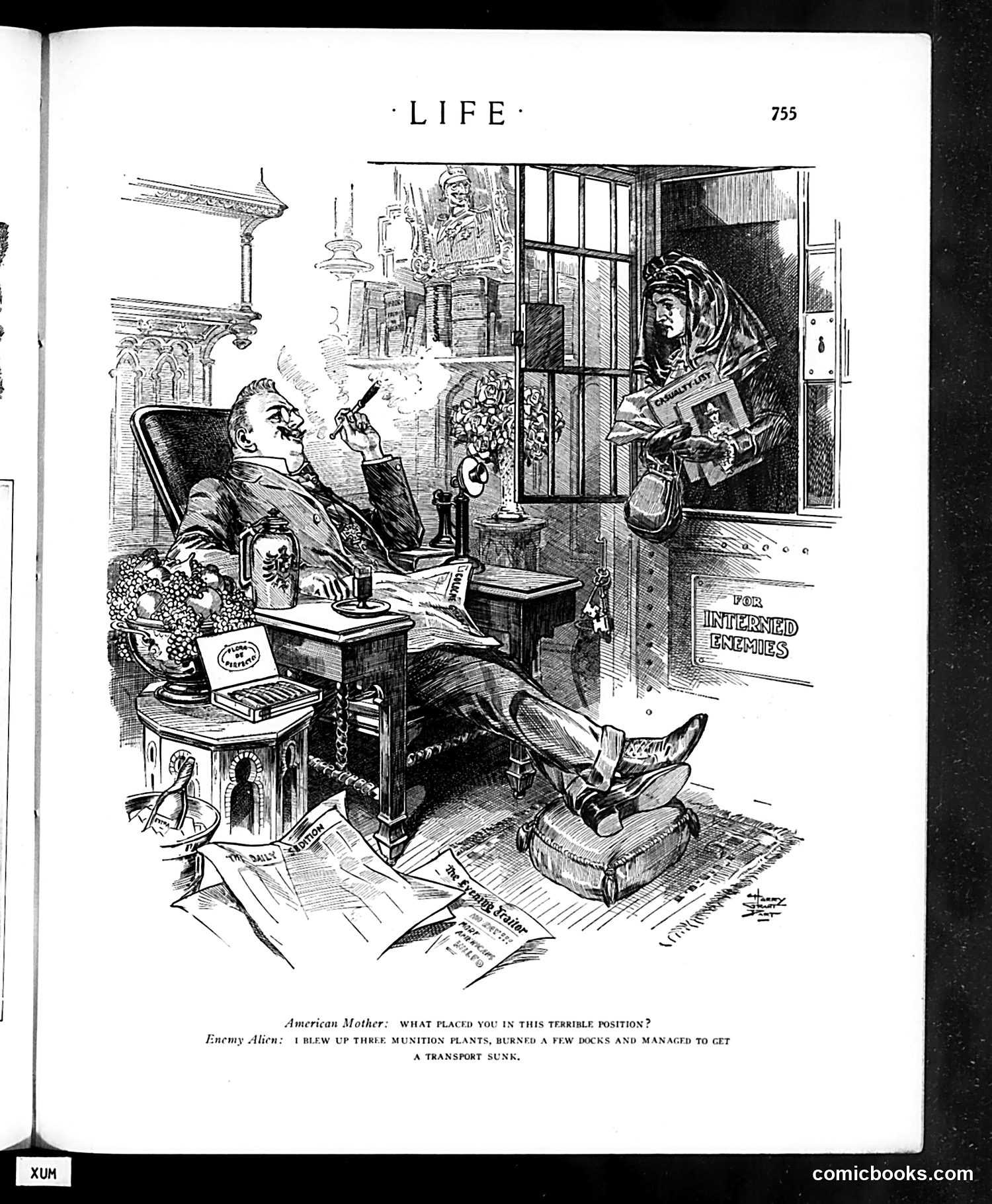
This is a WWI-era satirical cartoon titled "For Interned Enemies." It depicts an American official (left) relaxed at his desk, smoking and reading, while an "Enemy Alien" figure peers through the window, appearing distressed and holding what looks like a newspaper. The caption explains the enemy alien's predicament: he "blew up three munition plants, burned a few docks and managed to get a transport sunk"—describing sabotage activities—yet somehow ended up interned rather than executed. The "American Mother" asks sarcastically what placed him in this "terrible position," suggesting the official's treatment is inappropriately lenient given the sabotage described. This reflects WWI anxieties about enemy aliens and domestic security, satirizing whether internment was adequate punishment for wartime sabotage.
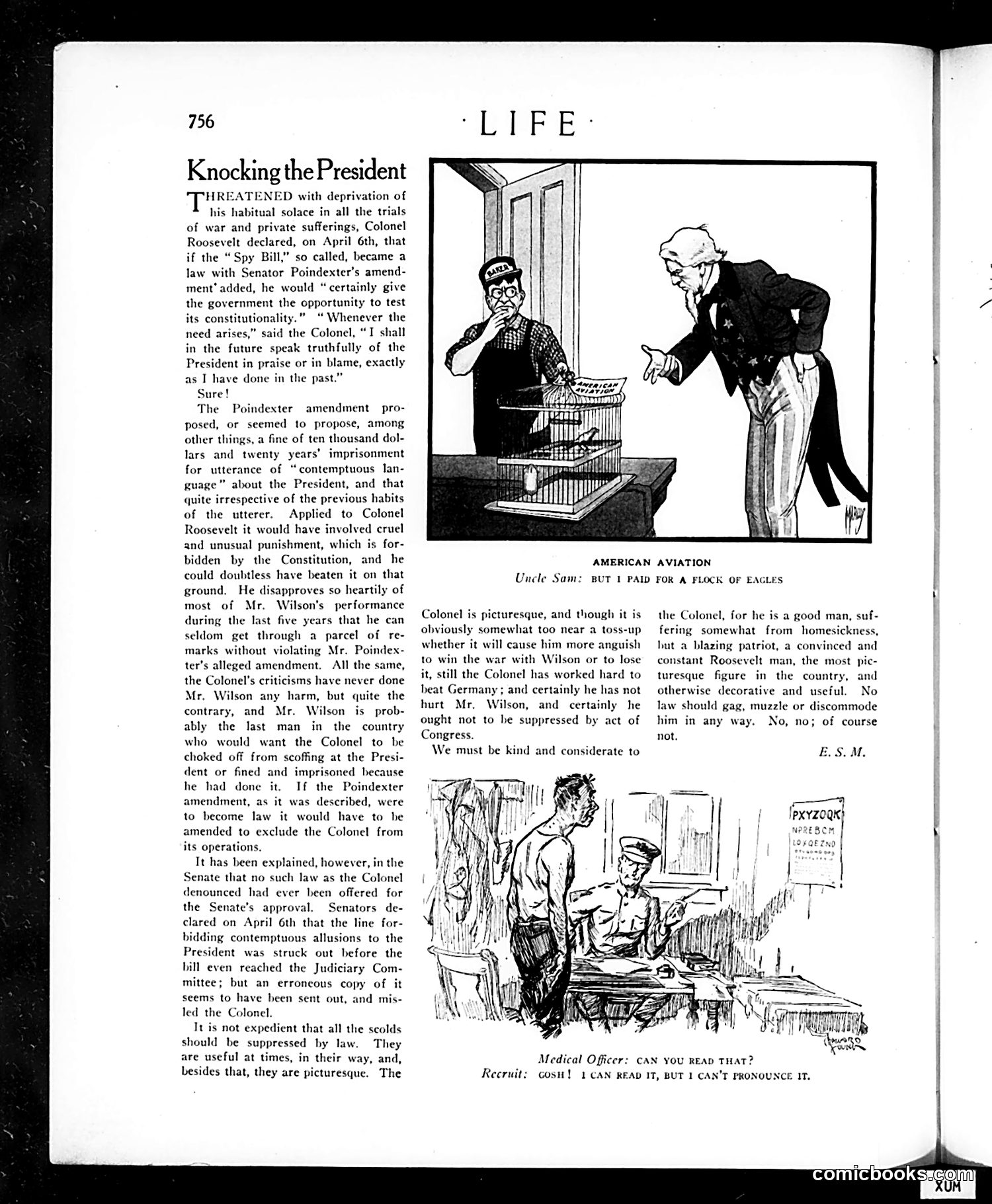
This page satirizes a 1918 controversy over the "Spy Bill" and Senator Poindexter's proposed amendment that would criminalize "contemptuous language" about the President (Woodrow Wilson). **Colonel Theodore Roosevelt**, the former President, publicly declared he would challenge such a law as unconstitutional, claiming his right to criticize Wilson's wartime leadership. The article defends Roosevelt's right to speak freely, arguing that while he's a chronic critic of Wilson, his criticism hasn't harmed the President—and that suppressing such "scolding" would be unwise. The piece acknowledges the amendment's text was misreported and may never have actually passed the Senate, but uses the episode to defend free speech. The two cartoons are lighter asides: "American Aviation" shows Uncle Sam discussing paid eagles (military symbolism), while the recruiting scene below depicts a recruit unable to pronounce military documentation—comedic filler unrelated to the main political argument.
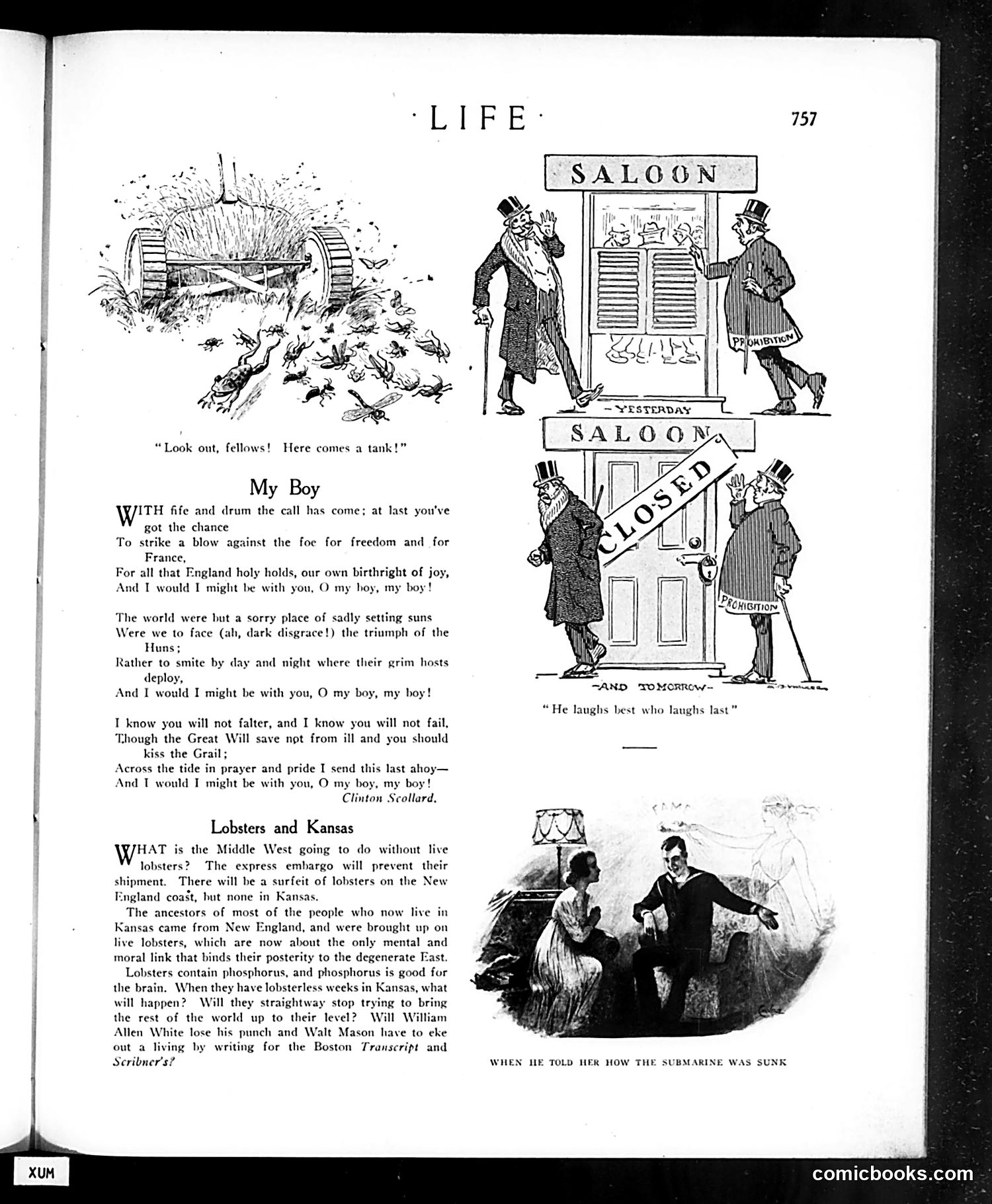
This page from *Life* magazine contains three distinct pieces reflecting American concerns during World War I: **"My Boy"** (poem by Clinton Scollard): A patriotic verse urging a young man to enlist and fight against "the Huns" (Germans) for England, France, and American freedom. It reflects 1910s-era recruitment rhetoric. **Tank cartoon** (top left): Shows soldiers warning of an approaching tank—likely satirizing early WWI mechanized warfare, which was novel and terrifying to contemporary audiences. **Saloon cartoons** (right): Depict a saloon switching from "Yesterday" (open) to "Closed" "And Tomorrow," with the caption "He laughs best who laughs last." This appears to reference Prohibition debates—sardonically suggesting saloons will eventually close. **"Lobsters and Kansas"** (bottom): Humorous commentary on a federal embargo preventing live lobster shipment to Kansas. The piece jokes that Midwesterners descended from New Englanders will lose their cultural/mental connection without this regional delicacy, mocking both regional pride and pseudo-scientific claims about phosphorus and intelligence.
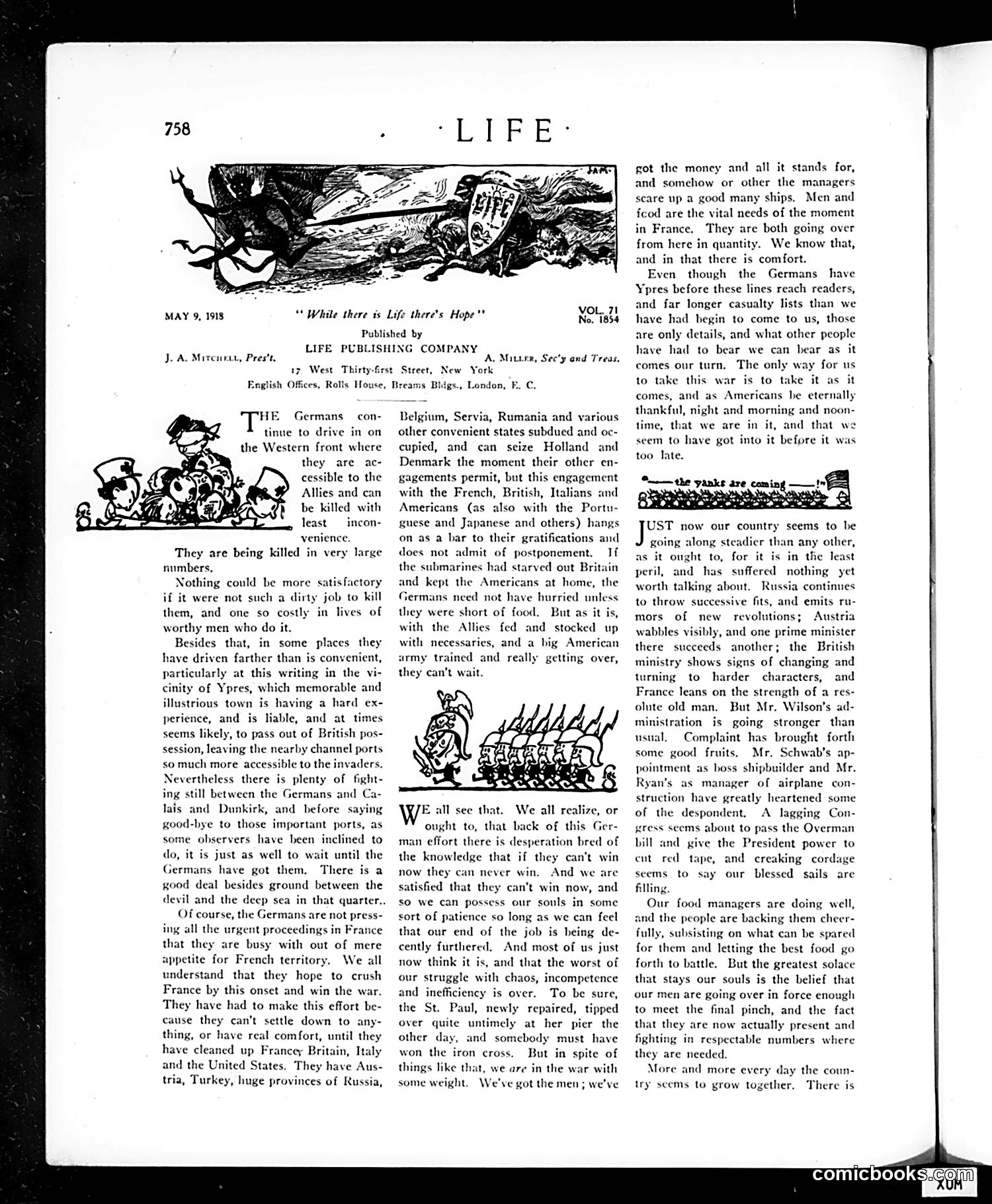
This May 1918 *Life* editorial addresses the German Spring Offensive on the Western Front. The magazine argues that despite German advances—notably threatening Ypres—American entry into the war has shifted momentum decisively. The key points: Germans are "desperate" because they recognize they cannot win a prolonged conflict. The Allies, now supplied and reinforced by American troops and resources ("We've got the men; we've got the money"), can absorb setbacks like the loss of Ypres as mere "details." The St. Paul reference appears to mock German claims (the "iron cross") about a recently-capsized ship. The tone is reassuring wartime propaganda—acknowledging tactical losses while insisting strategic victory is inevitable due to American industrial capacity and manpower. The cartoons (unclear in detail here) likely reinforced this message of Allied resilience.
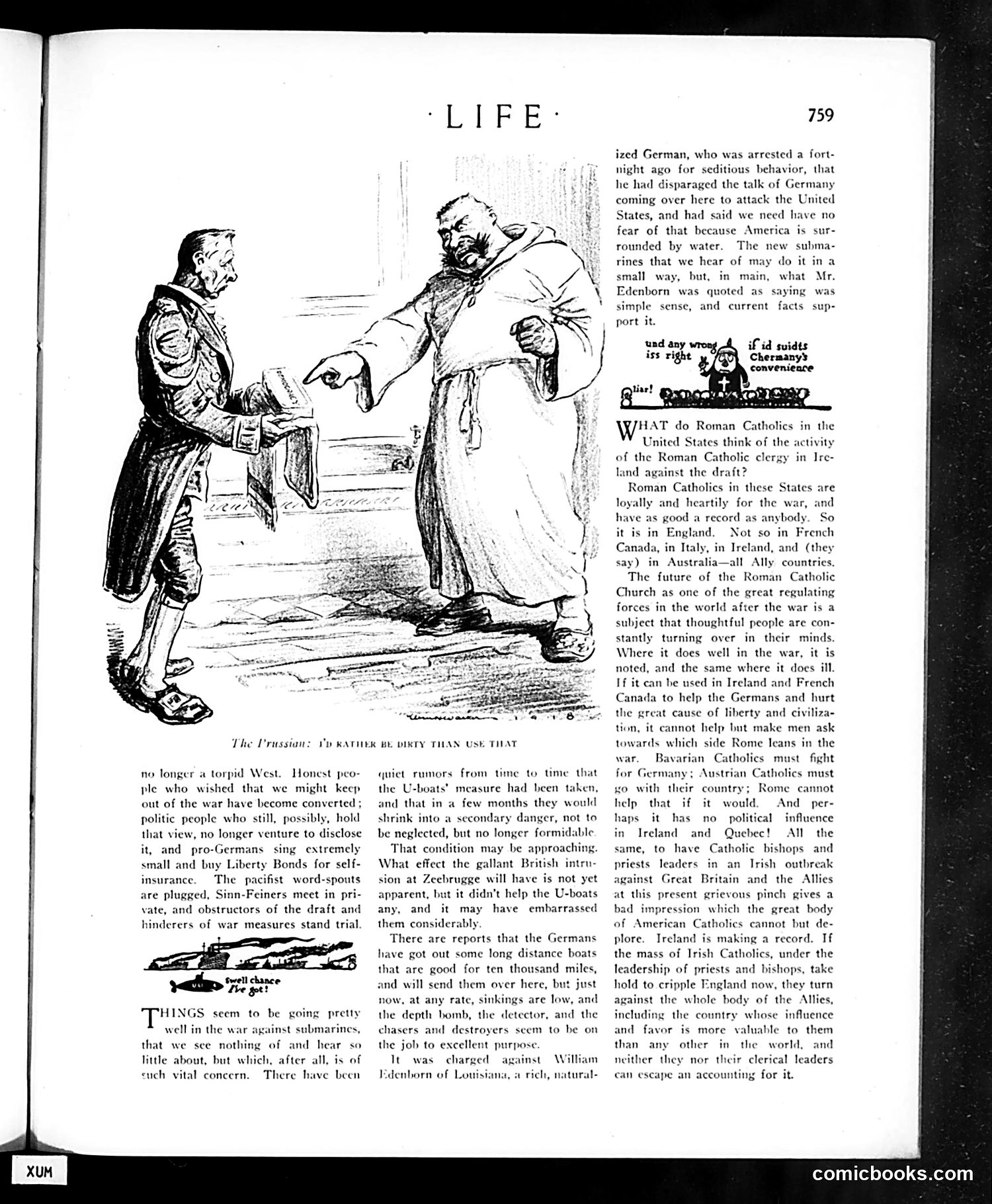
This *Life* magazine page contains two distinct editorial pieces from WWI era (likely 1918, given references to submarine warfare and the draft). **The Cartoon:** Shows a Prussian military figure confronting an Irish priest. The caption reads "I'D RATHER BE DIRTY THAN USE THAT"—a satirical jab at Irish Catholic clergy allegedly opposing the American war effort and the draft. **The Political Context:** The editorial attacks Roman Catholic priests in Ireland for allegedly helping Germany by resisting conscription and the Allied cause. It contrasts American Catholics' support for the war against Irish and French-Canadian Catholic resistance. The author warns that if Catholic leaders undermine the Allied war effort, they damage the Church's post-war credibility as a "regulating force." **The Satire's Point:** By pairing the Prussian with the priest, Life suggests Irish Catholic opposition to the draft aligns them with America's enemy—a serious accusation questioning their patriotism during wartime. The piece conflates religious authority with potential disloyalty.
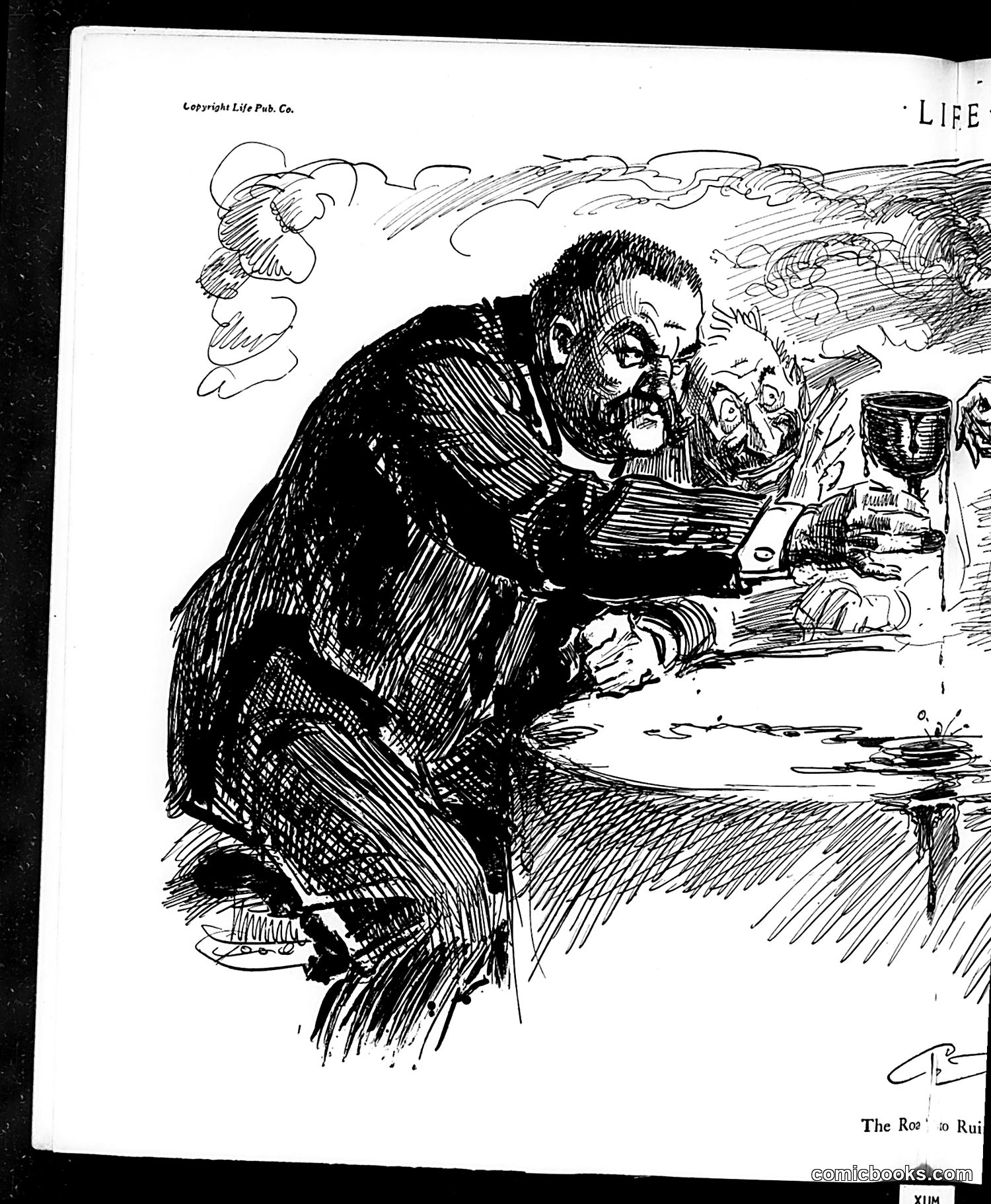
This appears to be a satirical cartoon from Life magazine showing a figure in dark clothing at a table, seemingly in a position of power or authority over smaller figures. The caption reads "The Ro[ad to] Ruin" (partially visible). The exaggerated caricature style—with emphasized facial features and grotesque proportions—was typical of early 20th-century political satire. The figure's menacing posture and dominant position over the smaller characters suggests commentary on corruption, exploitation, or abuse of power. However, without a complete caption or publication date visible, I cannot definitively identify the specific political figure being caricatured or the exact historical event referenced. The artwork style suggests early 1900s, but the exact subject and satirical message remain unclear from this image alone.
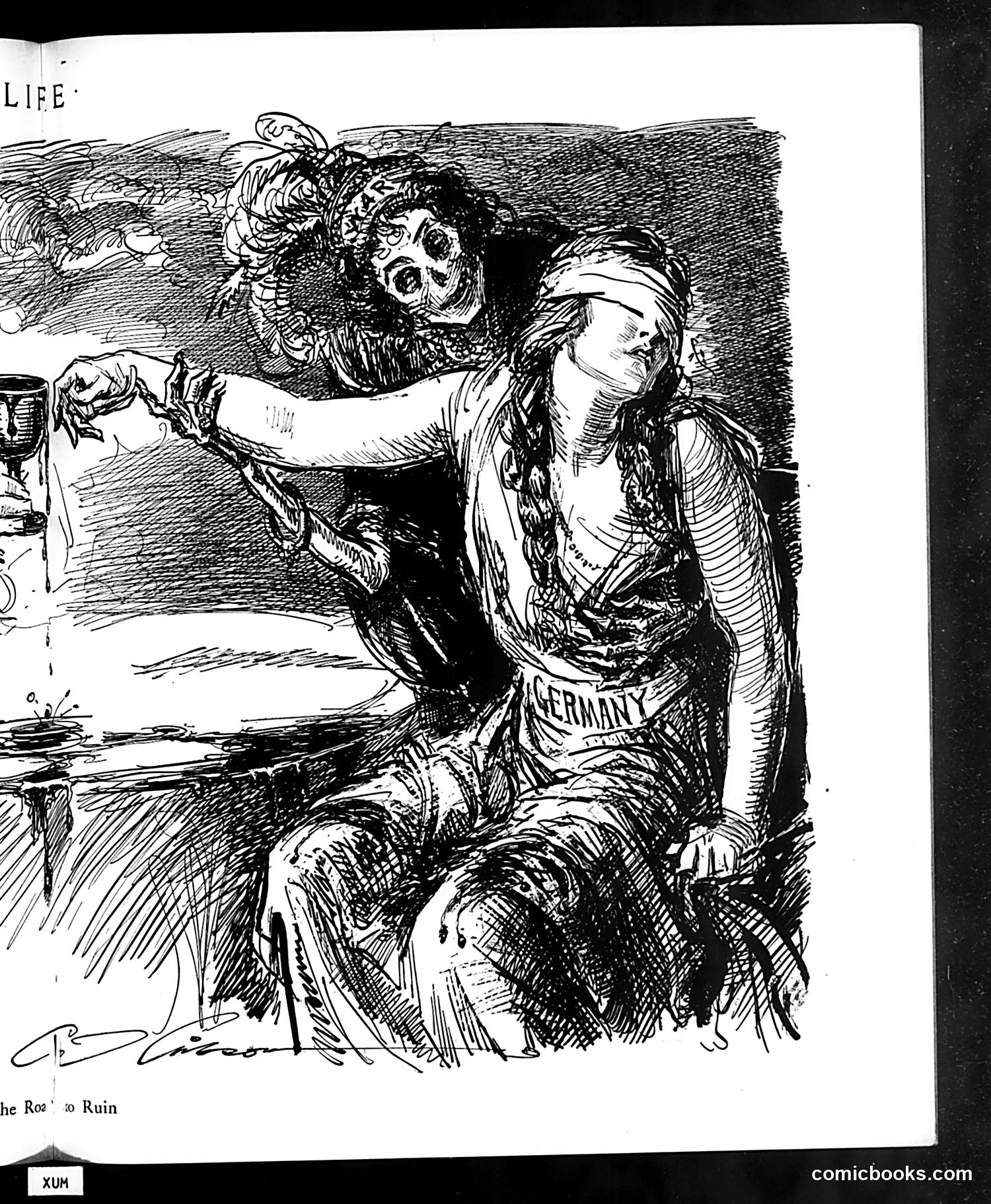
This is a political cartoon from *Life* magazine depicting a blindfolded female figure labeled "GERMANY" being led toward ruin by a skeletal death figure behind her. The woman appears distressed and is being manipulated by the menacing force at her back. The cartoon satirizes Germany's political situation, likely during the Weimar period or WWI aftermath, suggesting the nation is being led blindly toward destruction by destructive forces (represented by the death figure). The blindfold emphasizes Germany's inability or unwillingness to see the danger ahead. The skeletal figure represents death, war, or catastrophic consequences. The satire critiques German leadership or policies as self-destructive, warning of impending national ruin.
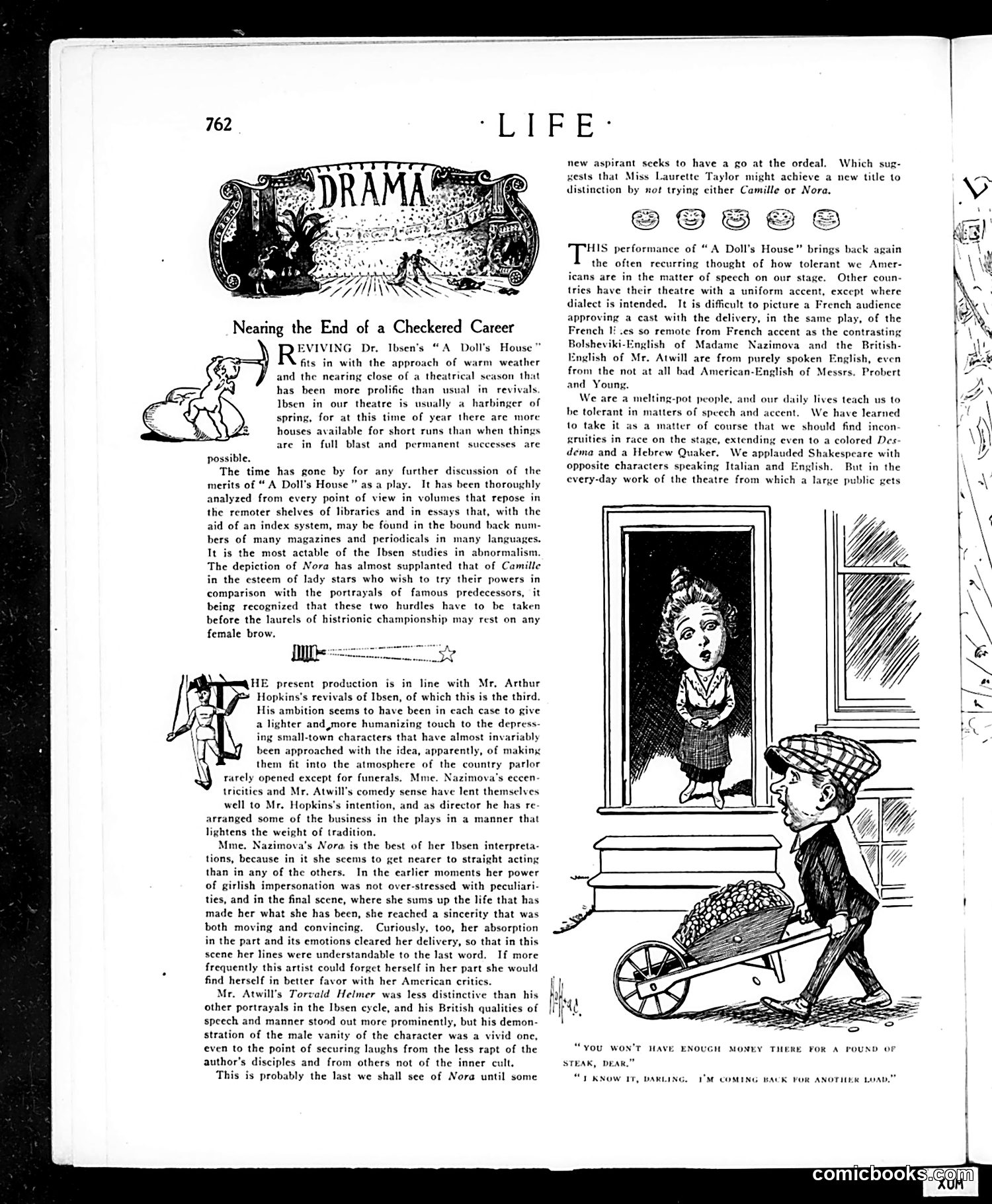
This is a theater review discussing a revival of Ibsen's *A Doll's House*, likely from the 1920s based on references to contemporary actors. The accompanying cartoon illustrates a comedic scene from the play. **The Main Point:** The article praises the production while making a broader cultural observation—that Americans are unusually tolerant of diverse accents on stage, unlike more uniform European theaters. The critic notes that the cast includes performers with markedly different speech patterns (Madame Nazimova's accent, Mr. Atwill's British delivery, and American actors), which would be unacceptable in French or other theaters but reflects America's "melting-pot" identity. **Key References:** - Laurette Taylor (actress mentioned as potential alternative to this production) - Madame Nazimova (praised for her Nora performance) - Arthur Hopkins (director attempting to make Ibsen more humanized and less depressing) **The Cartoon:** Shows a domestic scene with a woman at a window and a man pushing a wheelbarrow below, with dialogue about money and "another load"—likely depicting the play's themes of domestic struggle.
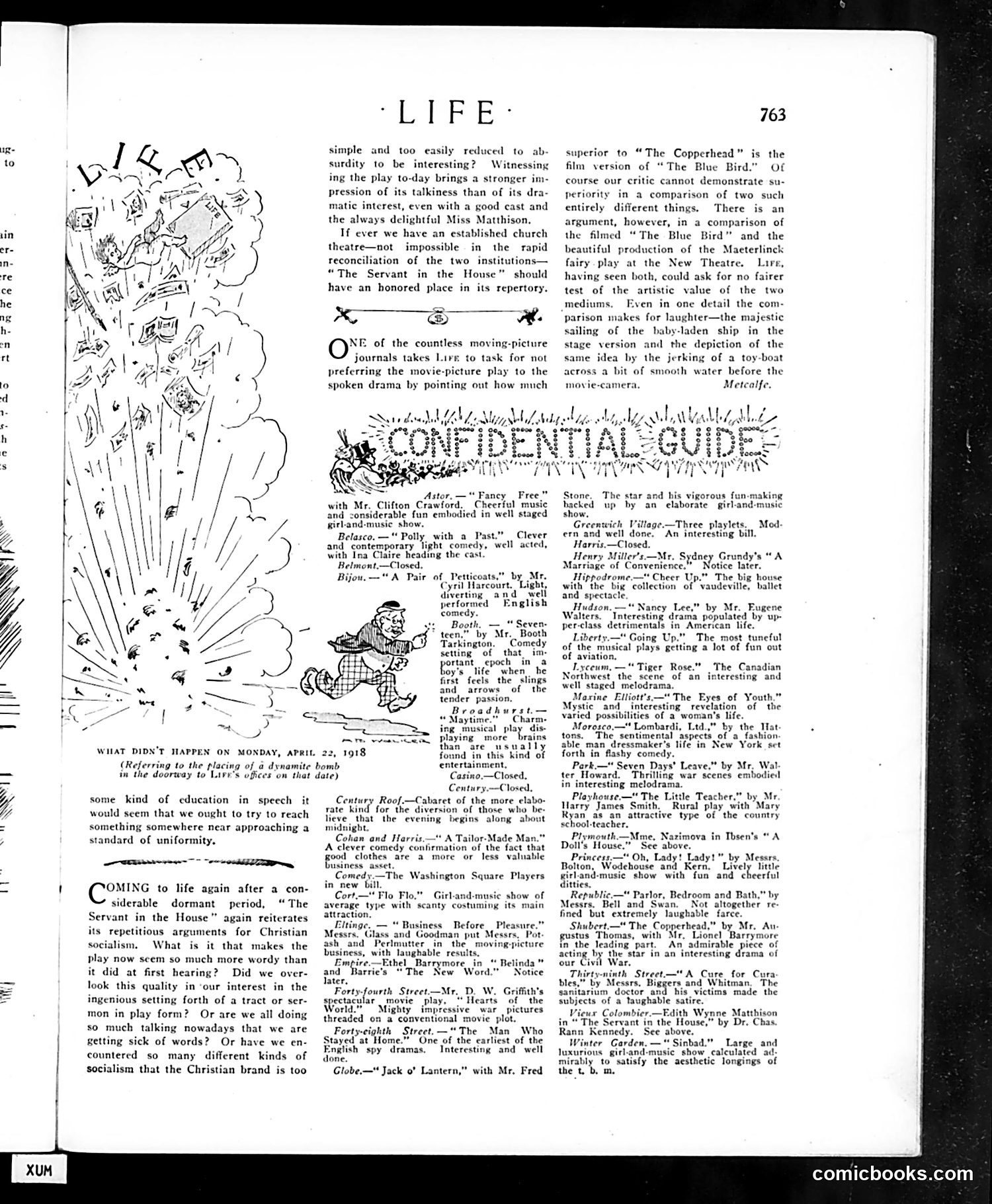
This page from *Life* magazine (dated around 1918, based on references) contains theater reviews and a political cartoon commentary. **The Cartoon**: The illustration labeled "WHAT DIDN'T HAPPEN ON MONDAY, APRIL 22" depicts a dynamite bomb explosion. The caption references "the placing of a dynamite bomb in the doorway to Life's offices on that date." This refers to an actual anarchist bombing attempt against *Life* magazine's offices—a real violent incident the magazine is satirizing by asking what *didn't* happen (implying the bomb failed or caused no damage). **The Commentary**: The text below criticizes "The Servant in the House," a Christian socialist play, arguing it's become tedious and preachy. The author questions whether audiences have grown tired of socialist rhetoric generally, or if the play was always this wordy. **The Theater Reviews**: The bulk of the page lists Broadway theaters and current productions (musicals, comedies, spy dramas), typical of *Life*'s entertainment coverage. The cartoon reflects real political violence of the era targeting media institutions.
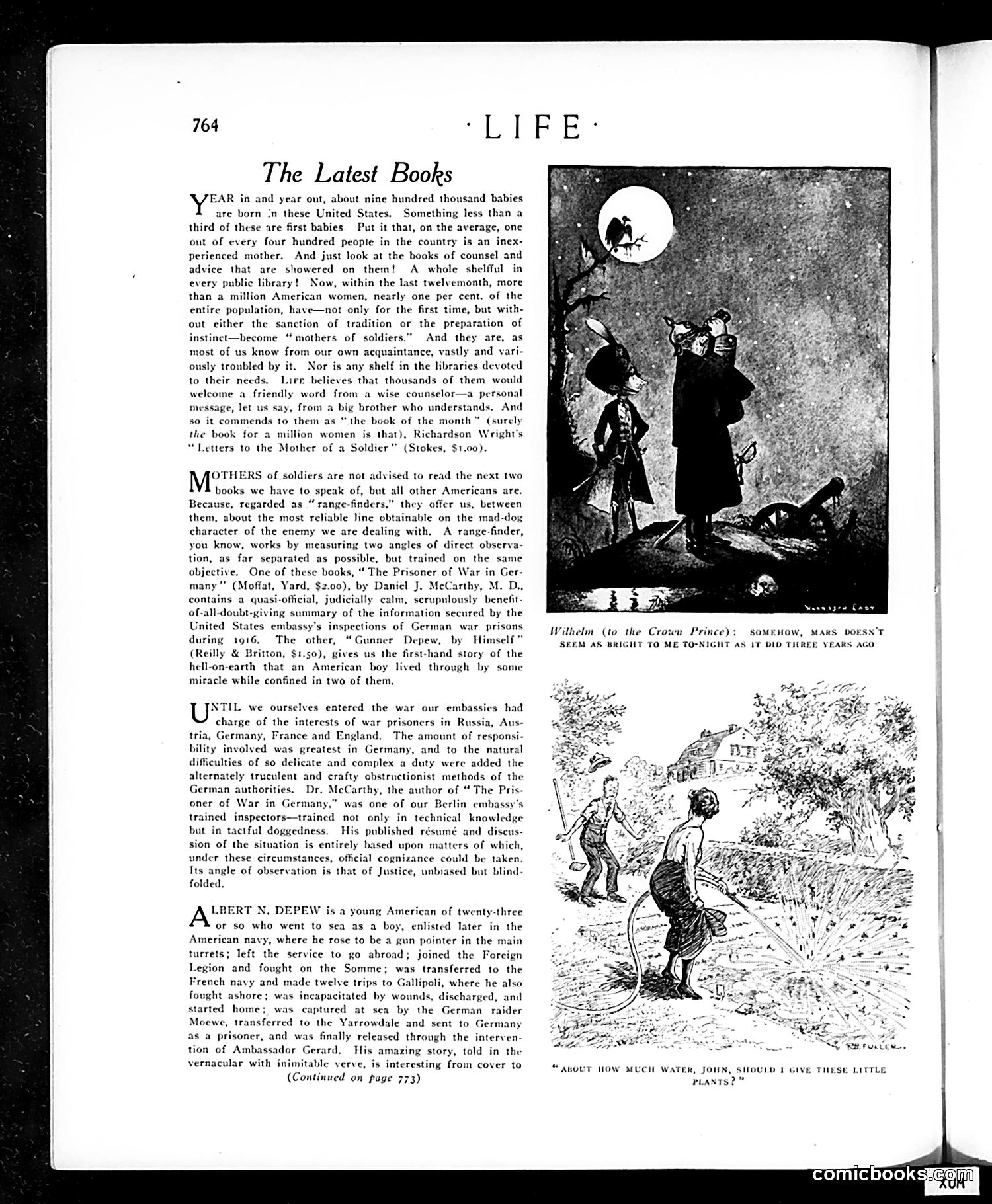
This page reviews three contemporary books addressing American experiences in World War I. The central focus is *Letters to the Mother of a Soldier* by Richardson Wright—positioned as essential reading for the approximately one million American women who became "mothers of soldiers" during the war, lacking traditional guidance or literary resources for their unique situation. The page then recommends two "range-finder" books offering contrasting perspectives on German prisoner-of-war treatment: Dr. Daniel McCarthy's official *The Prisoner of War in Germany* (based on U.S. embassy inspections) and Albert Depew's firsthand account *Gunner Depew, by Himself* (describing his harrowing imprisonment after capture at sea). The accompanying illustrations—showing a soldier figure and a rural scene—appear decorative rather than directly satirical. The content reflects Life's wartime mission: informing American readers about the conflict's home-front and combat realities through curated literature.
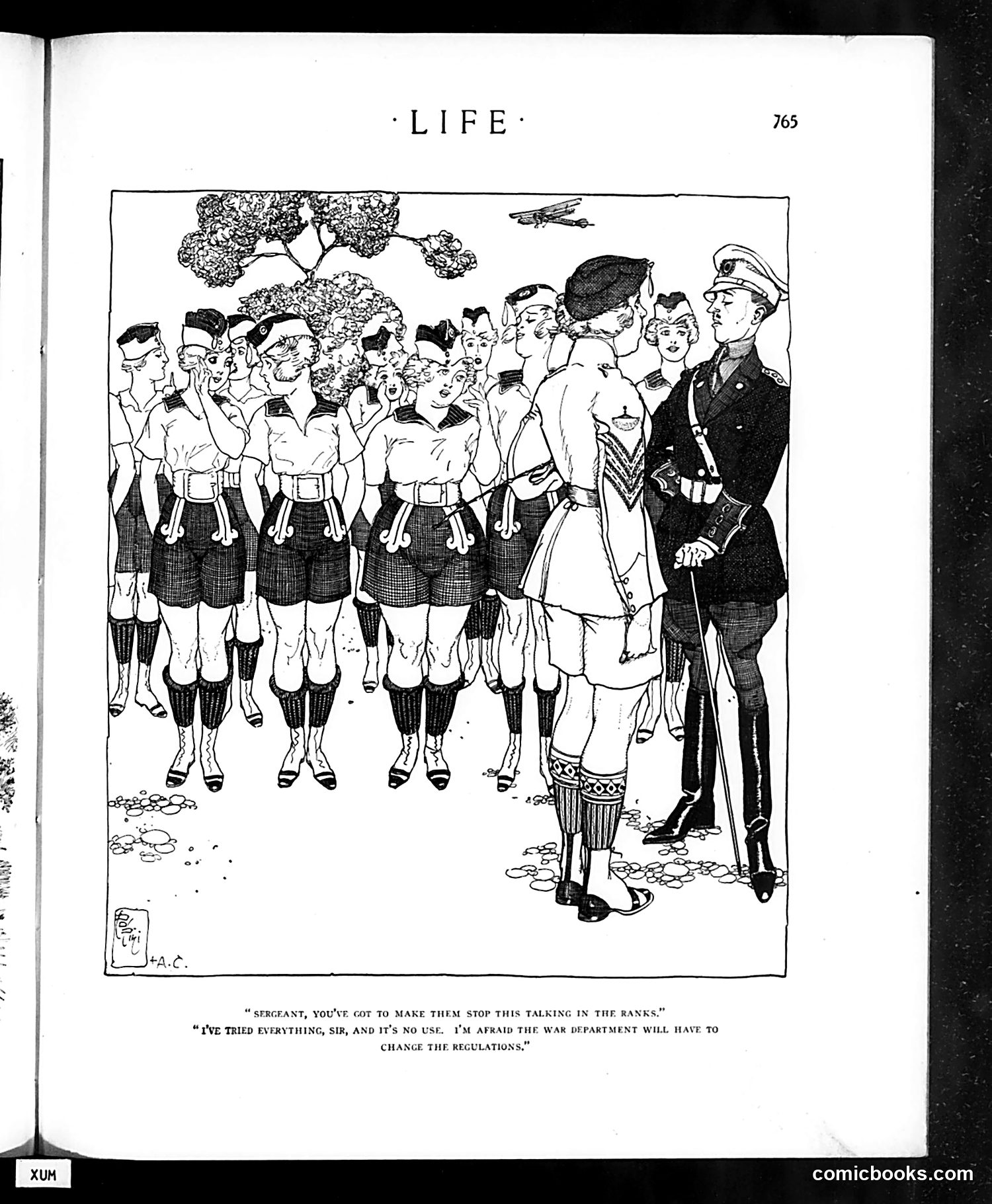
This cartoon satirizes military discipline during wartime. A sergeant addresses an officer about female soldiers who won't stop talking in the ranks. The sergeant has "tried everything" to enforce silence but failed—so drastically, he suggests the War Department must "change the regulations." The satire targets two things: (1) the perceived chattiness of women soldiers (likely WACs or similar corps), treated as inherently undisciplinable; (2) the absurdity of suggesting regulations be altered rather than enforcing existing ones. The cartoon reflects 1940s attitudes about women in the military—depicted as inherently problematic and requiring special handling. The joke assumes readers will find women's inability (or unwillingness) to follow military silence protocols amusing and characteristic.
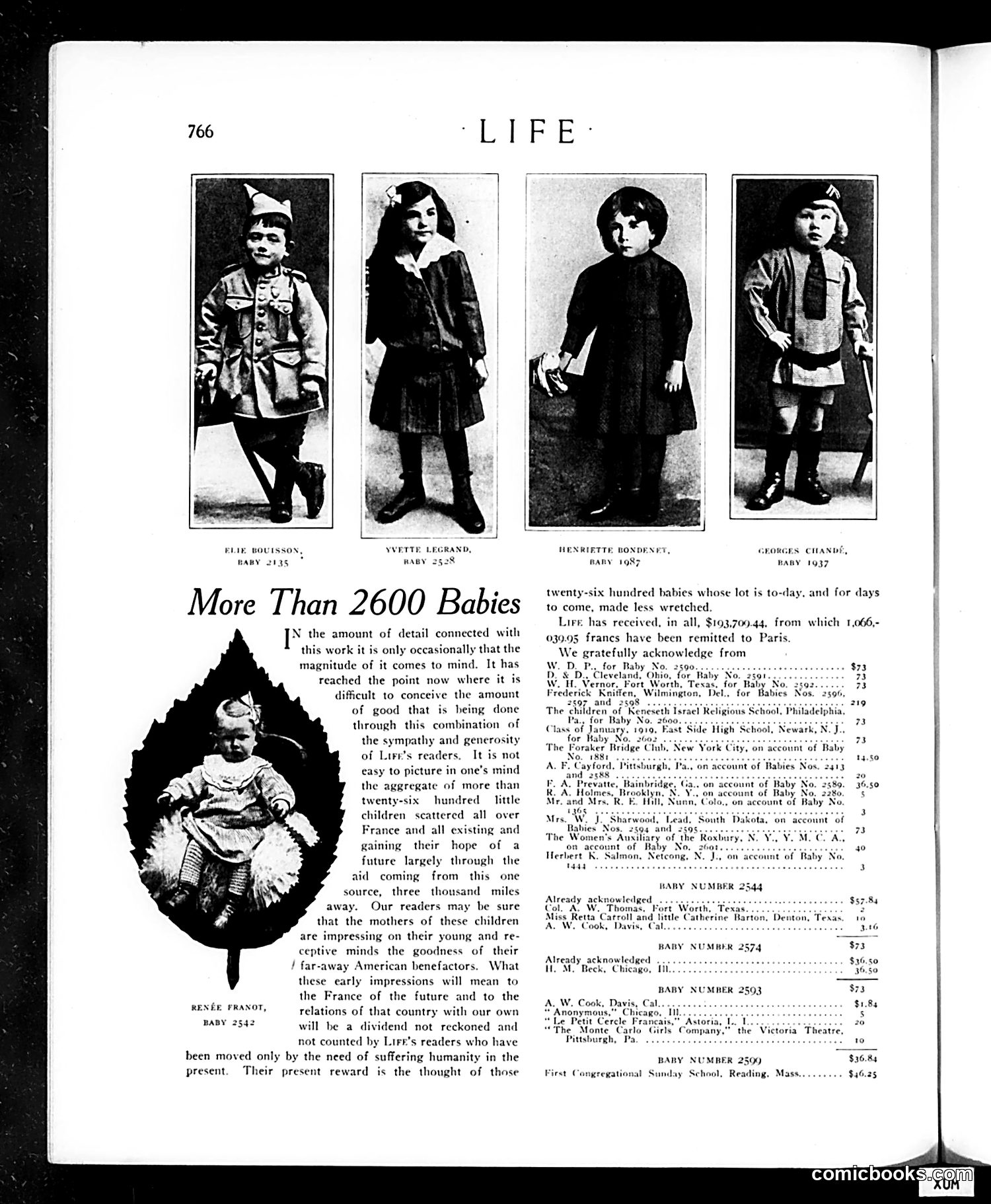
This page documents **Life magazine's charitable sponsorship program for French war orphans**, likely from the post-World War I era (based on references to Paris and French children). The four portrait photographs at top show individual babies being supported: Elie Bouisson, Yvette Legrand, Henriette Bondenet, and Georges Chandé—each identified by their "Baby Number." The main article "More Than 2600 Babies" celebrates Life's readers' fundraising success, emphasizing both humanitarian relief and soft diplomatic messaging: American generosity toward French children will supposedly create goodwill between nations. The page includes a decorative illustration of an infant and lists detailed financial acknowledgments—donors' names, locations, and contributions toward specific babies' support. **The satire/point**: This represents Life magazine's editorial mission combining progressive philanthropy with American exceptionalism—celebrating readers' charitable impulses while subtly promoting American cultural influence abroad through child welfare.
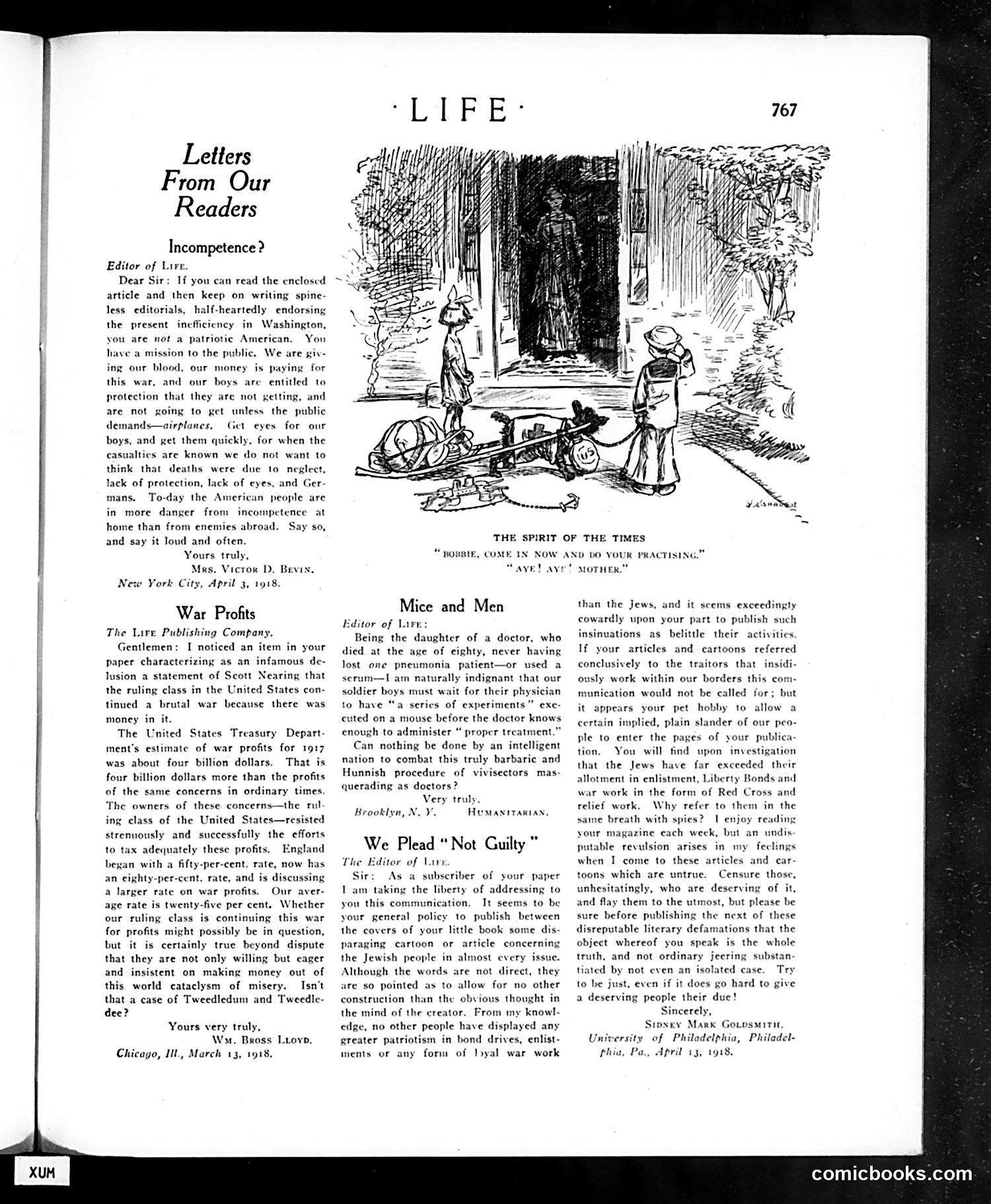
This cartoon satirizes American military unpreparedness during World War I. The sketch shows a wounded or dead soldier lying in a doorway while two figures (likely a mother and nurse or civilian) stand helplessly nearby. The caption reads: "Double, come in now and do your practising...Aye! Aye! Mother." The satire is biting: it contrasts a child's obedient practice of military drills with the grim reality of an actual casualty. The juxtaposition mocks the gap between home-front preparation and battlefield readiness—suggesting Americans were merely "practicing" war while soldiers died from inadequate support. This connects directly to the letters published below, particularly Mrs. Victor D. Bevin's complaint about governmental incompetence, lack of airplanes, and insufficient protection for American soldiers. The cartoon visually reinforces her accusation that deaths resulted from negligence at home rather than enemy action.
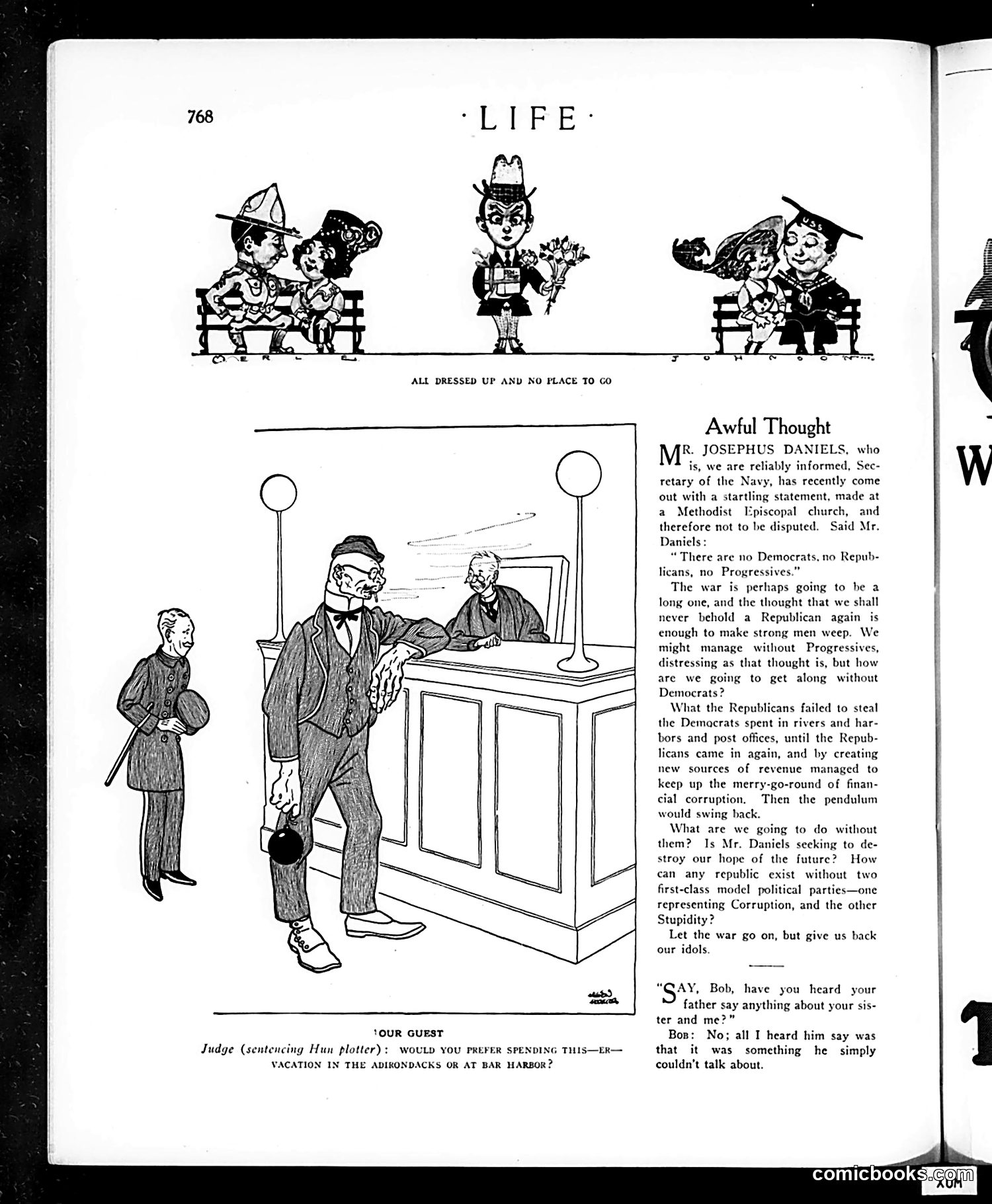
The page contains two satirical pieces from *Life* magazine mocking American politics during World War I. **"All Dressed Up and No Place to Go"** (top cartoons) illustrates the caption's meaning: elaborately dressed figures have nowhere to go—satirizing overcomplicated preparation or readiness without purpose. **"Awful Thought"** (main article) quotes Secretary of the Navy Josephus Daniels claiming the war will eliminate political parties. The satire is biting: the author sarcastically responds that America *needs* both major parties—one representing "Corruption" and the other "Stupidity"—implying both Republicans and Democrats are equally compromised or incompetent. The piece mocks Daniels's idealism, suggesting partisan corruption is so fundamental to American politics that its absence would be catastrophic. **"Our Guest"** (bottom cartoon) shows a judge offering a defendant vacation choice between luxury locations, satirizing leniency toward connected defendants—suggesting justice is negotiable for the privileged. The page reflects wartime cynicism about American institutions and political corruption.
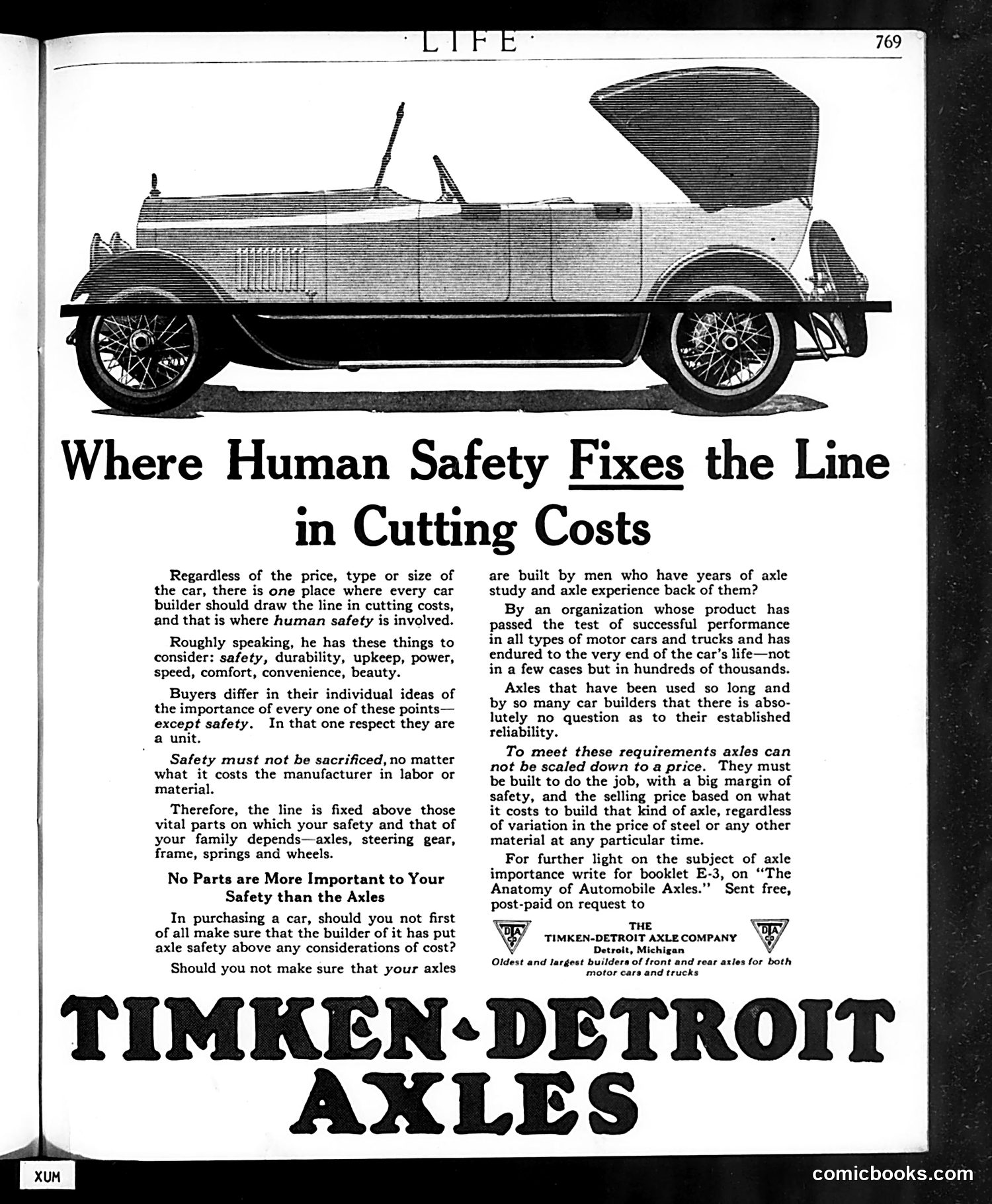
This is primarily **advertising copy**, not satire or political commentary. The Timken-Detroit Axle Company uses the page to argue for manufacturing integrity during an era of cost-cutting competition. **The argument:** While car manufacturers compete on price, comfort, and features, they should never compromise on safety—specifically axles, steering, frame, and springs. The ad emphasizes that quality axles cannot be "scaled down to a price" but must be built with proper margins of safety, even if material costs fluctuate. **Historical context:** This appears to target 1920s automobile buyers concerned about reliability and safety as cars became mass-produced. The ad positions Timken-Detroit as the trustworthy choice through decades of proven performance across multiple manufacturers. **The implicit criticism:** Unethical competitors were apparently cutting corners on critical components to reduce costs—a practice the ad warns against. The message: don't let price shopping endanger your family. The illustration shows a simple open-touring car of the era, reinforcing that this applies to all vehicle types.
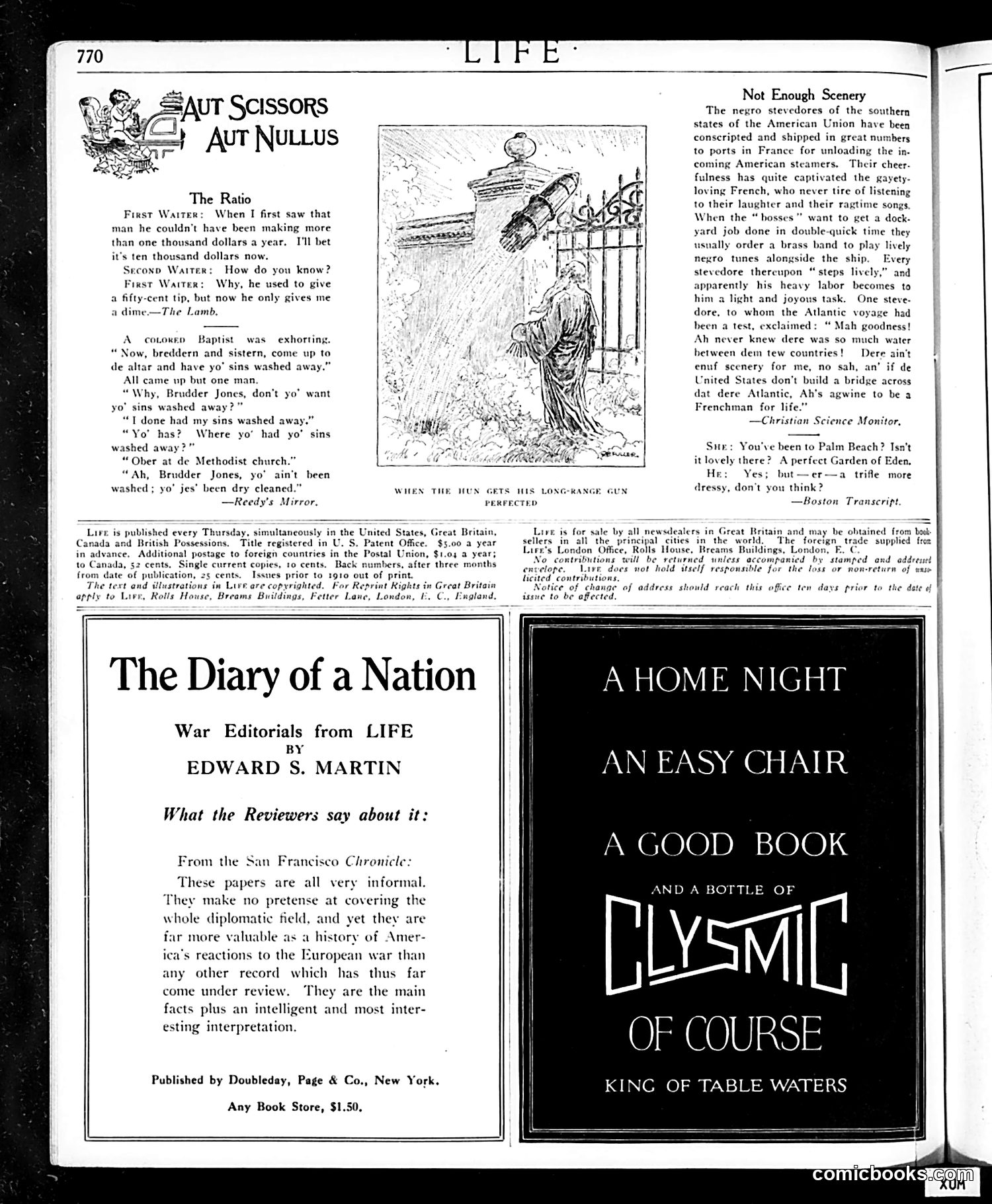
This page contains several satirical pieces typical of Life's humor: **Main Cartoon ("Aut Scissors, Aut Nullus"):** Two brief dialogues mock social climbing and religious hypocrisy. The first shows a man's wealth increasing dramatically, suggesting nouveau riche status. The second mocks a Baptist minister's attempt to convert a man who's already been "dry cleaned" at a Methodist church—a joke about competing religions and the absurdity of spiritual "washing." **"Not Enough Scenery" Section:** This piece satirizes Black stevedores conscripted to unload American ships in France during WWI. The satire is complex: while celebrating their charm and musical abilities to French employers, it presents a stereotyped final quote ("Mah goodness...Frenchman for life") depicting a worker overwhelmed by the Atlantic's vastness. The humor appears to mock both American racial attitudes and the workers themselves. **Other Advertisements:** The page also includes book promotions and a Clysmic mineral water advertisement, typical of period magazine filler. The satire reflects early-20th-century attitudes toward race and class that would be considered deeply offensive today.
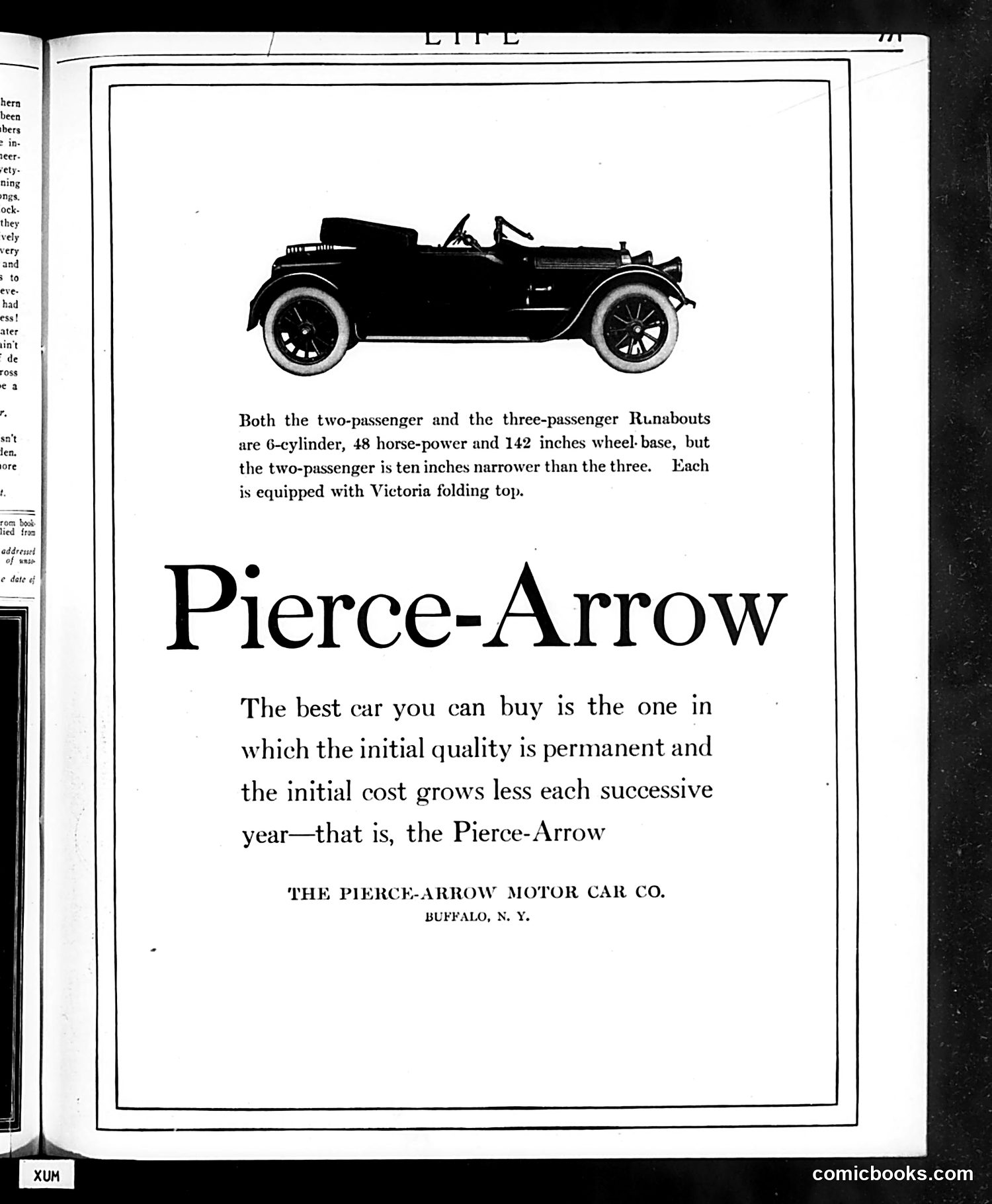
This is a vintage advertisement, not a political cartoon. It promotes Pierce-Arrow automobiles, a luxury car brand manufactured in Buffalo, New York. The page features an illustration of an open-top Runabout model and describes technical specifications (6-cylinder engine, 48 horsepower, 142-inch wheelbase). The advertising copy argues Pierce-Arrow's value proposition: while initial purchase cost may be high, the car's quality remains permanent and its relative cost decreases annually compared to competitors. This appeals to affluent early 20th-century buyers seeking investment-worthy automobiles. The "Victoria folding top" indicates a convertible feature. There is no satire or political commentary present—this is straightforward commercial advertising typical of *Life* magazine's revenue model.
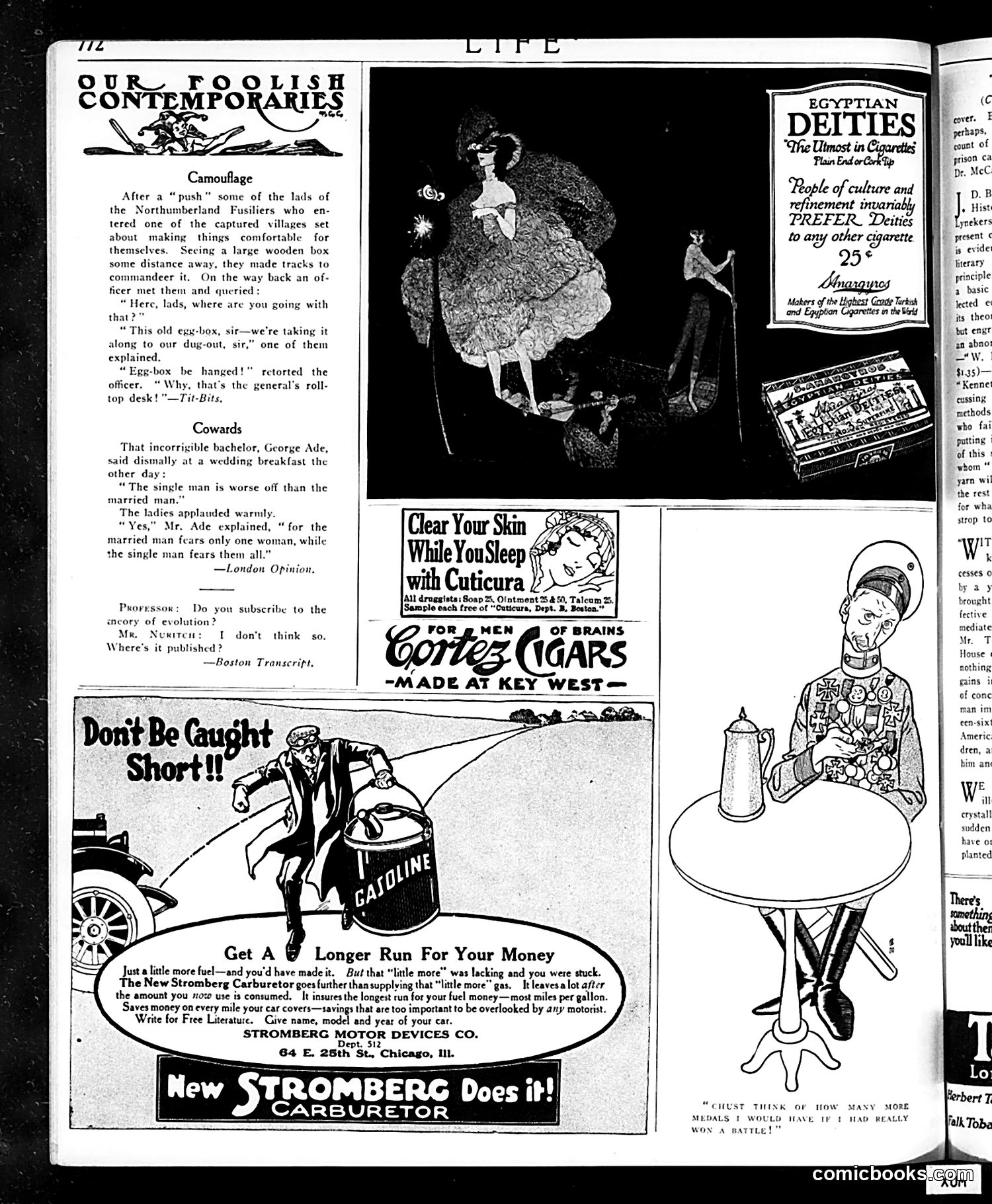
This page contains **humorous anecdotes and advertisements** rather than political cartoons. The text pieces are short jokes typical of early 20th-century humor magazines: 1. **"Camouflage"**: A WWI-era anecdote about British soldiers (Northumberland Fusiliers) mistaking their commanding general's desk for a wooden box—satirizing military confusion and soldiers' resourcefulness during trench warfare. 2. **"Cowards"**: A bachelor/marriage joke attributed to humorist George Ade, playing on the paradox that single men fear all women while married men fear only one. 3. **"Professor"**: A brief joke about evolution, suggesting the theory isn't published (implying it's not legitimate). The advertisements promote **Egyptian Deities cigarettes**, **Cuticura soap/ointment**, **Footez cigars**, and **Stromberg carburetors**—typical commercial products of the era using period marketing language ("people of culture and refinement prefer..."). The page reflects **early 1900s humor conventions** and wartime references, with no significant political satire visible.
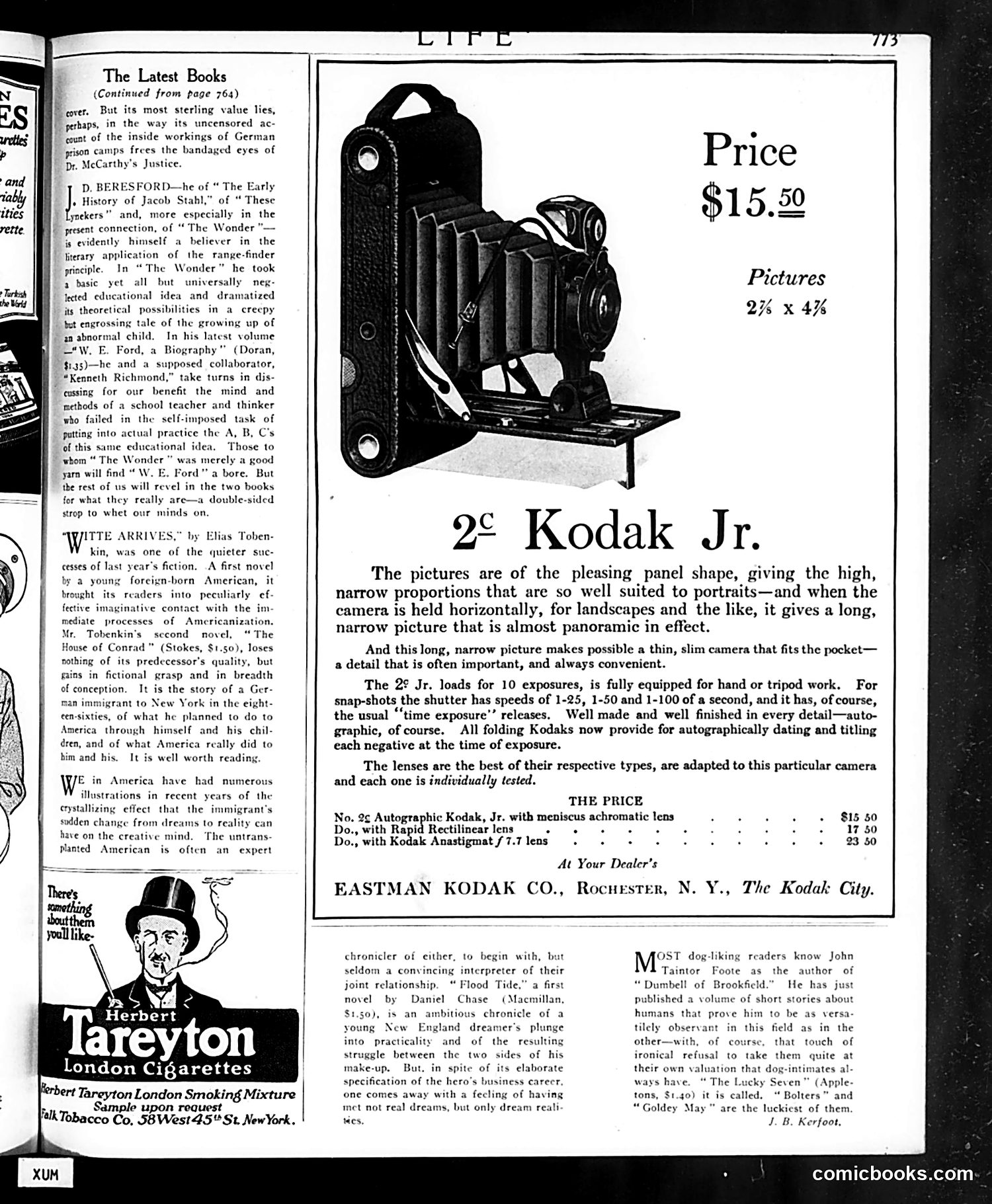
This page is primarily an **advertisement for the 2¢ Kodak Jr. camera** ($15.50), occupying the right column with a product photograph and detailed specifications. The left column contains **book reviews** from Life's "The Latest Books" section, discussing recent novels including works by D. Beresford, Elias Tobenkin, and others—emphasizing themes of immigration, Americanization, and the tension between idealism and reality in American life. Below the reviews is a **Herbert Tareyton London Cigarettes advertisement**, featuring a cartoon of a man in a top hat making a dismissive gesture, with text reading "There's something better than well life." For modern readers: this represents a **typical Life magazine page blending literary criticism with period advertising**, including a now-shocking cigarette ad. The book reviews reflect early 20th-century literary interests in immigration narratives and psychological character studies. The Kodak ad emphasizes pocket-sized convenience—a major selling point for portable cameras of that era.
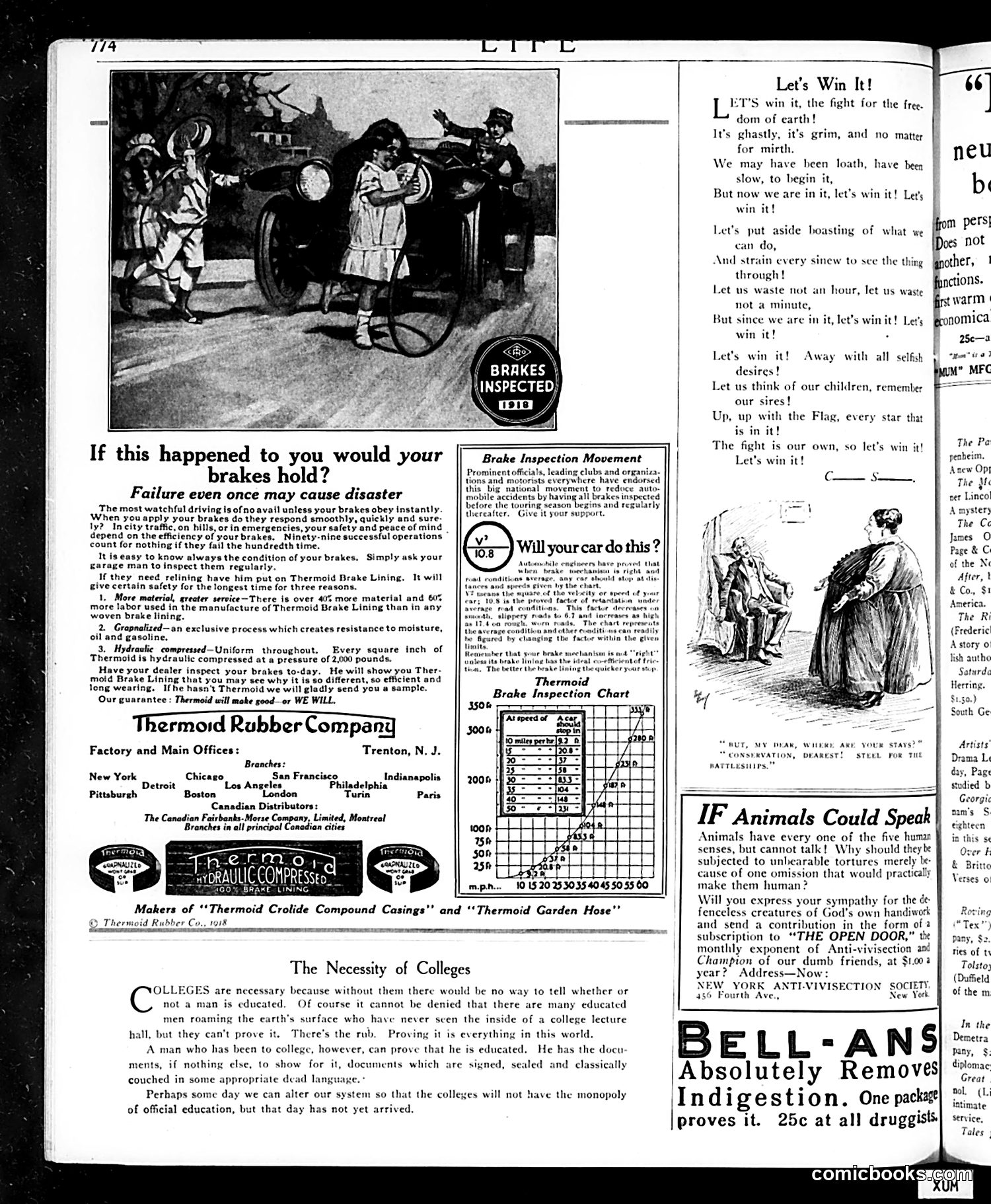
This page combines **advertising, patriotic propaganda, and social commentary** from World War I era. The top section features a **Thermoid Brake Lining advertisement** using fear-based messaging—showing a car accident scenario to convince readers that brake inspection is essential. The "Brake Inspection Movement" section promotes official vehicle safety checks, framed as a civic duty. The **"Let's Win It!" poem** is rousing WWI patriotic verse, calling citizens to support the war effort without complaint ("let's put aside boasting"), emphasizing sacrifice for "our children" and national honor ("Up, up with the Flag"). The **"If Animals Could Speak" section** advocates for animal welfare, suggesting animals' inability to communicate their suffering shouldn't excuse human cruelty—likely referencing wartime treatment of animals used in military service. The **"Necessity of Colleges" essay** satirizes higher education as purely credentialing institutions—mocking that colleges exist mainly to provide "signed, sealed" documents proving education, not actual learning. It critiques institutional gatekeeping of respectability.
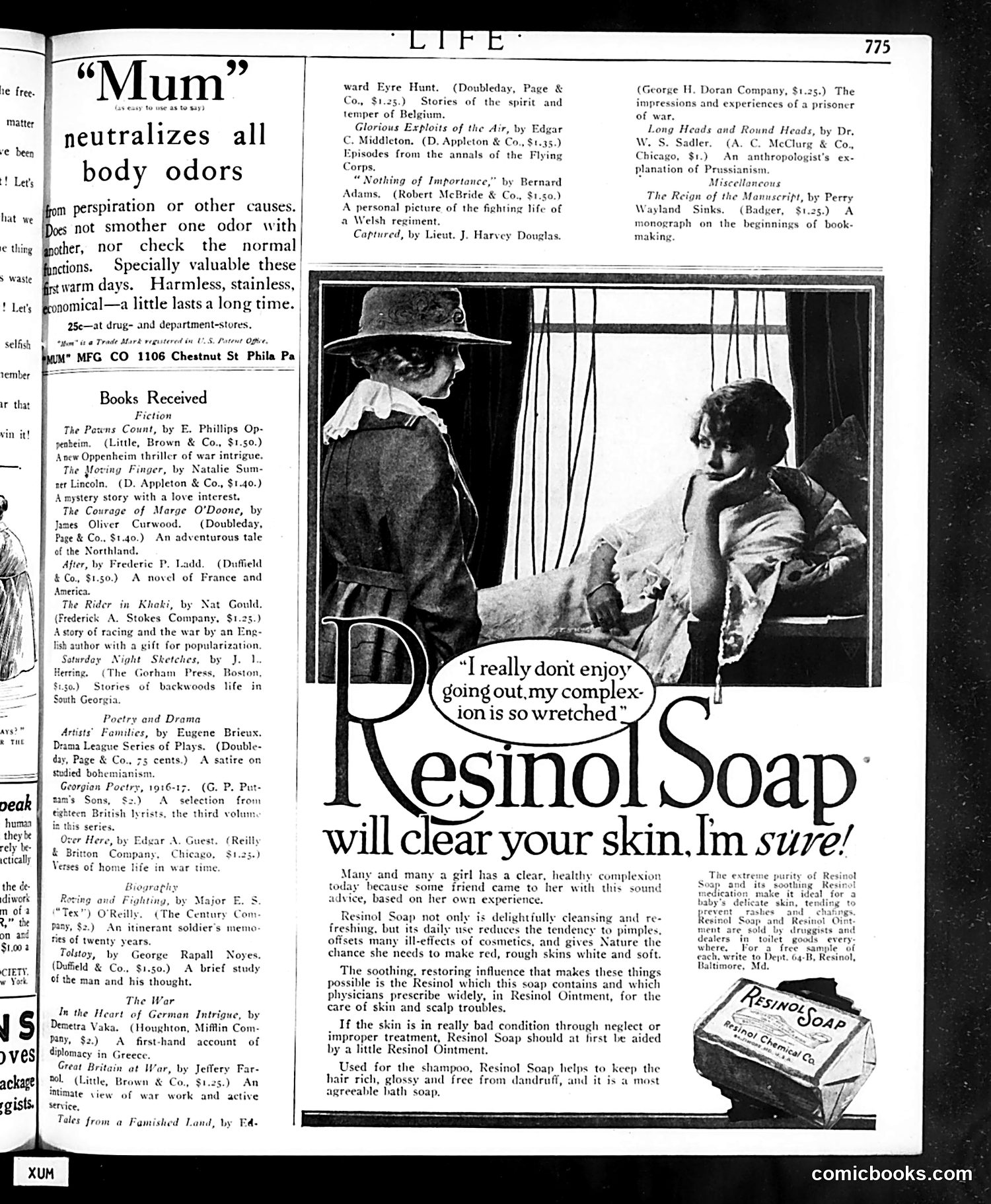
This page combines book reviews with advertisements. The main content is a **Resinol Soap advertisement** featuring a dialogue between two young women. One woman, dressed to go out, expresses reluctance about socializing because her "complexion is so wretched." Her friend responds that Resinol Soap "will clear your skin." The advertisement reflects early 20th-century beauty anxieties, particularly around **complexion and social acceptance**. The copy emphasizes that clear skin was essential for girls' social lives and that the soap reduces pimples and cosmetic damage while restoring natural appearance. The surrounding "Books Received" section lists fiction and poetry, many war-related (reflecting WWI era publication). These include *The Powns Count*, *Captured*, and *Great Britain at War*—typical of the period's literary output. **Context for modern readers**: This advertisement normalizes the idea that skin imperfections prevent social participation, a marketing tactic still recognizable today but presented here with particular earnestness about female appearance standards.
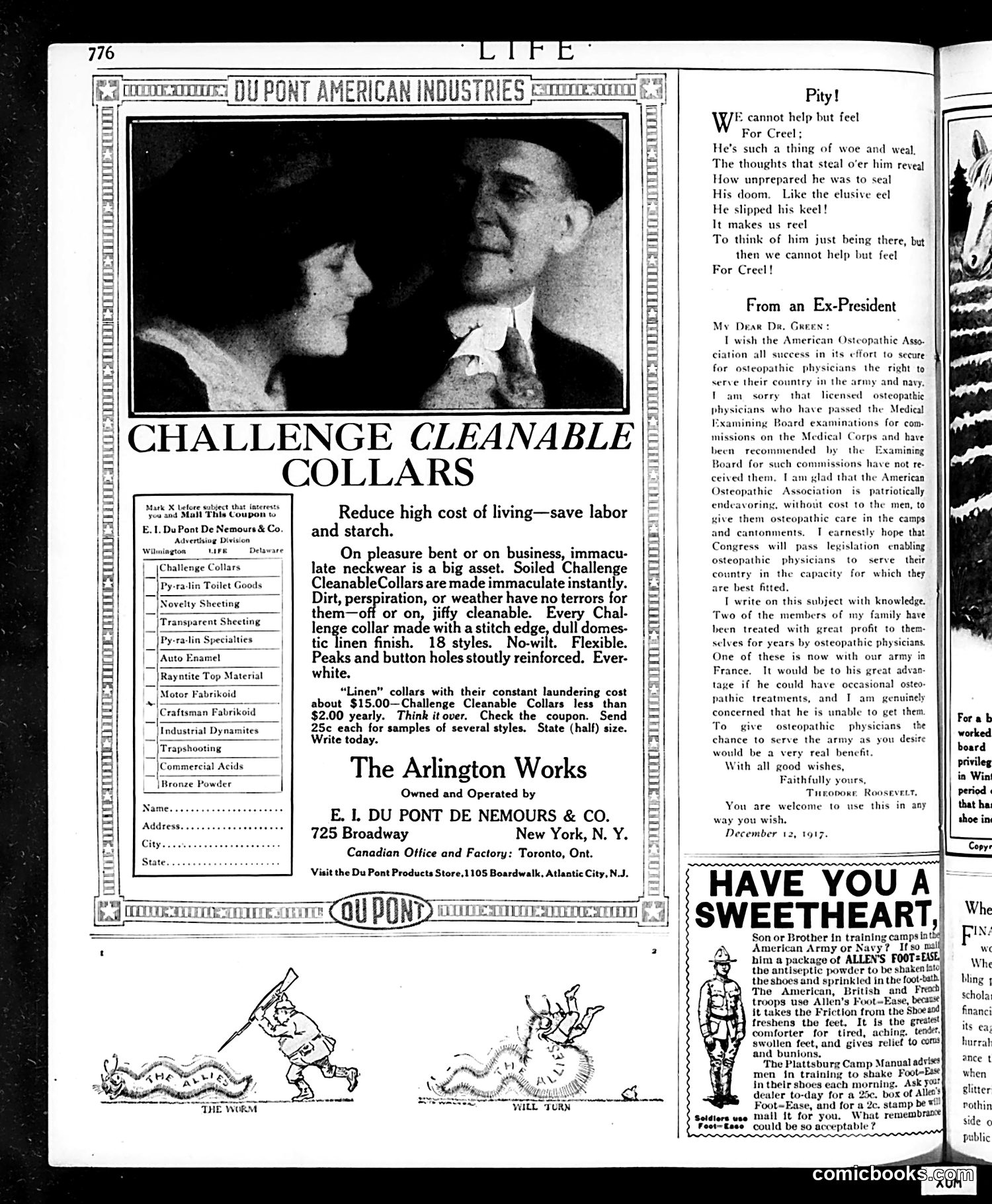
This page mixes advertising with patriotic and political content from World War I era. **Main Content:** The poem "Pity!" mourns someone named Creel—likely George Creel, head of the U.S. Committee on Public Information during WWI. The cryptic verse ("elusive eel / slipped his keel") suggests his political downfall or loss of influence, presented as something to regret. **Letter from Theodore Roosevelt** endorses osteopathic physicians' right to serve in the military medical corps. Roosevelt's name-lending authority validates this professional cause, framed as patriotic necessity for troops in camps and France. **Advertisements** for DuPont collar products and Allen's Foot-Ease powder exploit patriotic sentiment by targeting soldiers and their families—practical products marketed as supporting the war effort. The page reflects 1917 America: commercial exploitation of wartime concerns, establishment figures legitimizing professional interests, and public anxiety about soldier welfare and home-front support.
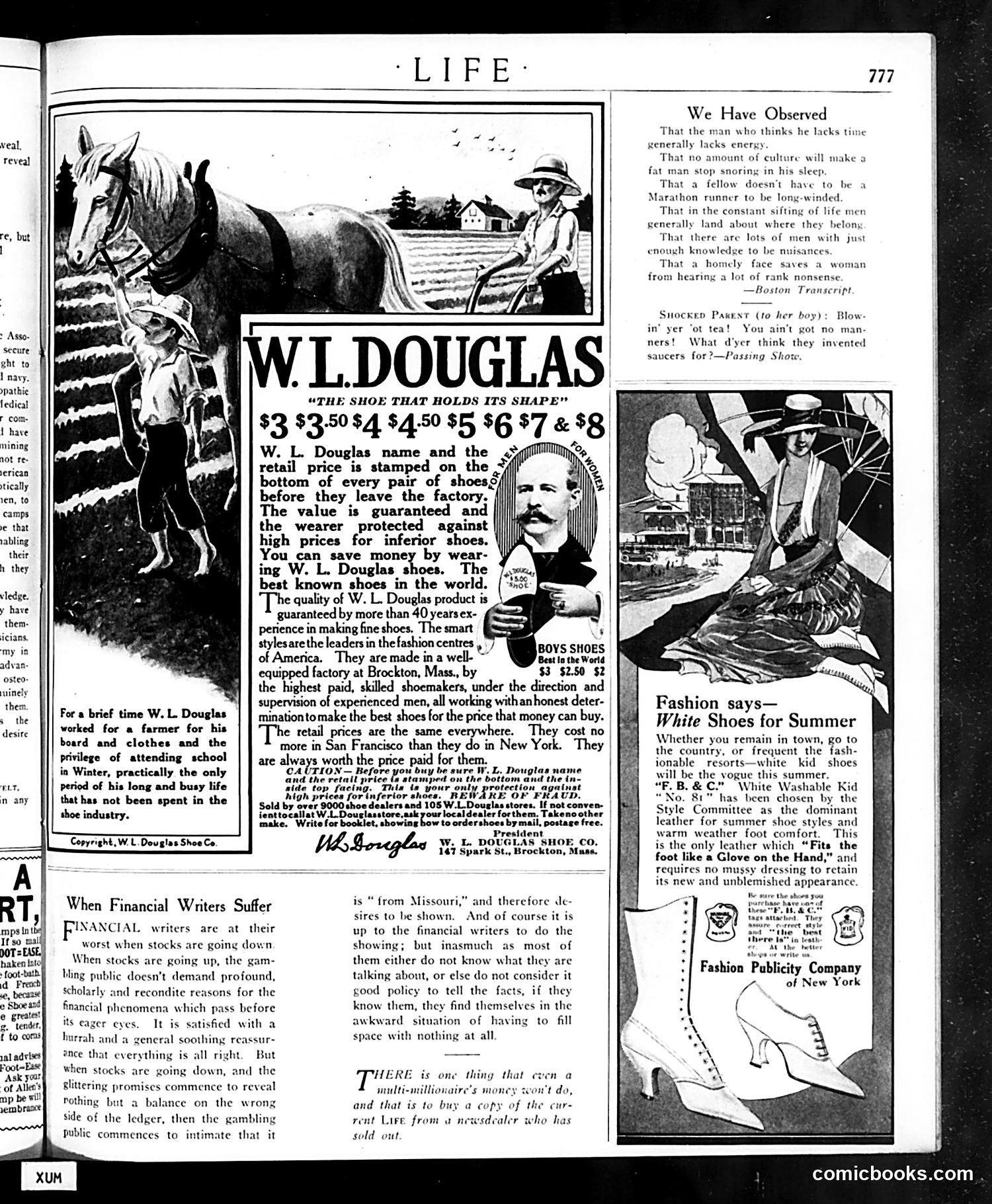
This page is primarily **advertising and light humor** rather than political satire. The main content features a **W.L. Douglas shoes advertisement**—a major shoe brand—emphasizing the guaranteed retail price stamped on every shoe ($3-$8) and the company's 40+ years of manufacturing reputation in Brockton, Massachusetts. The ad promises value and protection against inflated prices. The page includes scattered **humorous observations** ("We Have Observed") typical of Life's satirical style—witty social commentary about human nature (lazy people blaming lack of time, homely women avoiding unwanted attention, etc.). The **"Shocked Parent" joke** concerns a child's table manners, not politics. A secondary ad promotes **white kid leather shoes for summer**, marketed as fashionable resort wear for the season. **"When Financial Writers Suffer"** discusses how financial journalists struggle to justify stock market downturns with credible analysis when they lack real information. This reflects early 20th-century magazine format: mixing advertisements with light satirical commentary on everyday life and social absurdities rather than partisan political critique.
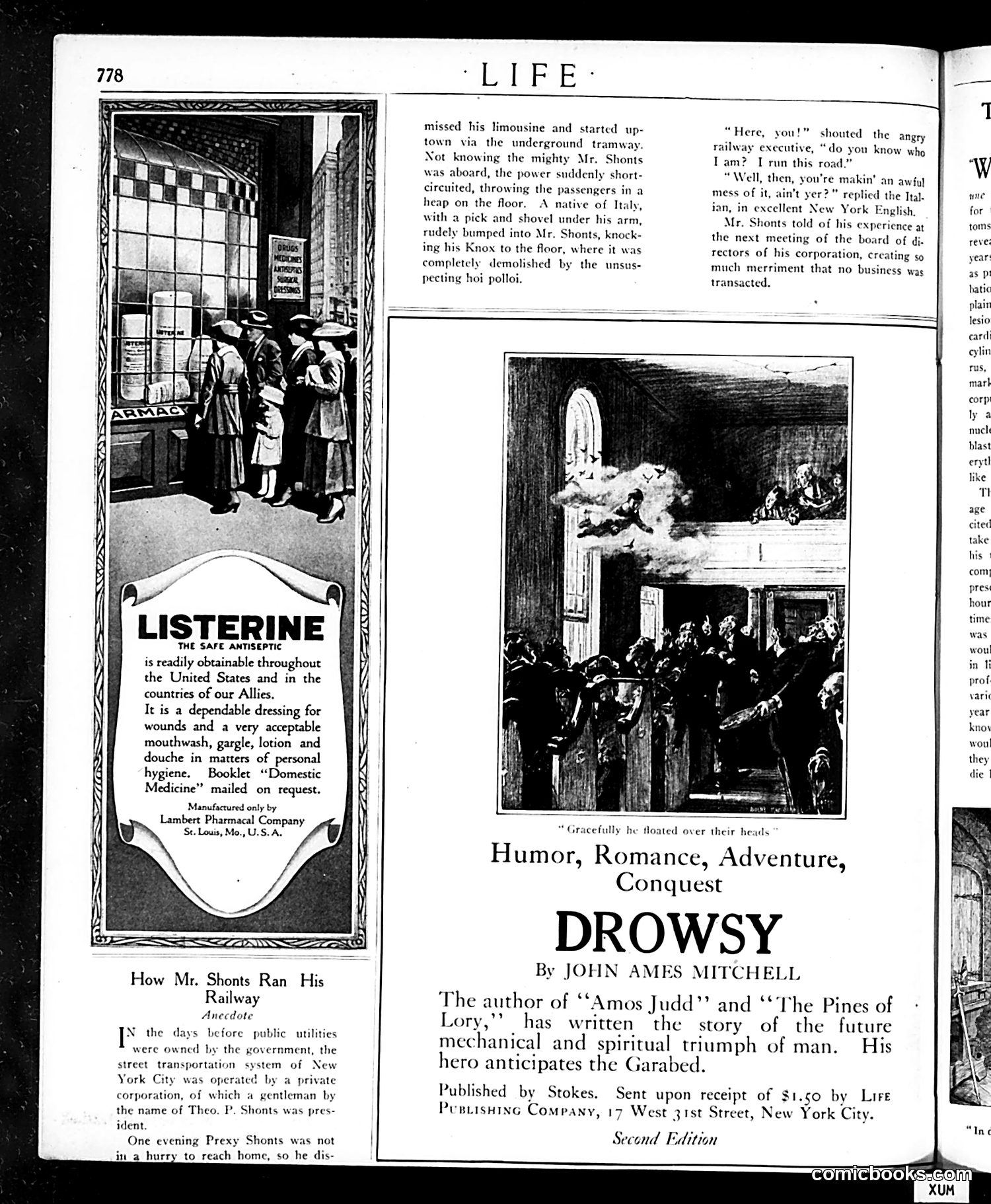
This page contains two main elements: **Left side:** An anecdote about Theo. P. Shonts, president of New York City's private streetcar corporation. The satire mocks corporate pomposity—when a power outage throws passengers (including Shonts) to the floor, an Italian laborer accidentally knocks off Shonts's hat and, not recognizing him, responds to his angry self-identification with: "Well, then, you're makin' an awful mess of it, ain't yer?" The joke is that a common worker's honest criticism deflates the executive's self-importance. This reflects Progressive-era skepticism toward unaccountable corporate power over essential public services. **Right side:** Advertisement for Listerine antiseptic (marketed for wounds and personal hygiene) and a book announcement for *Drowsy* by John Ames Mitchell, described as a story of "mechanical and spiritual triumph of man." The page reflects early 20th-century American attitudes: corporate critique, working-class vernacular humor, and faith in technological progress.
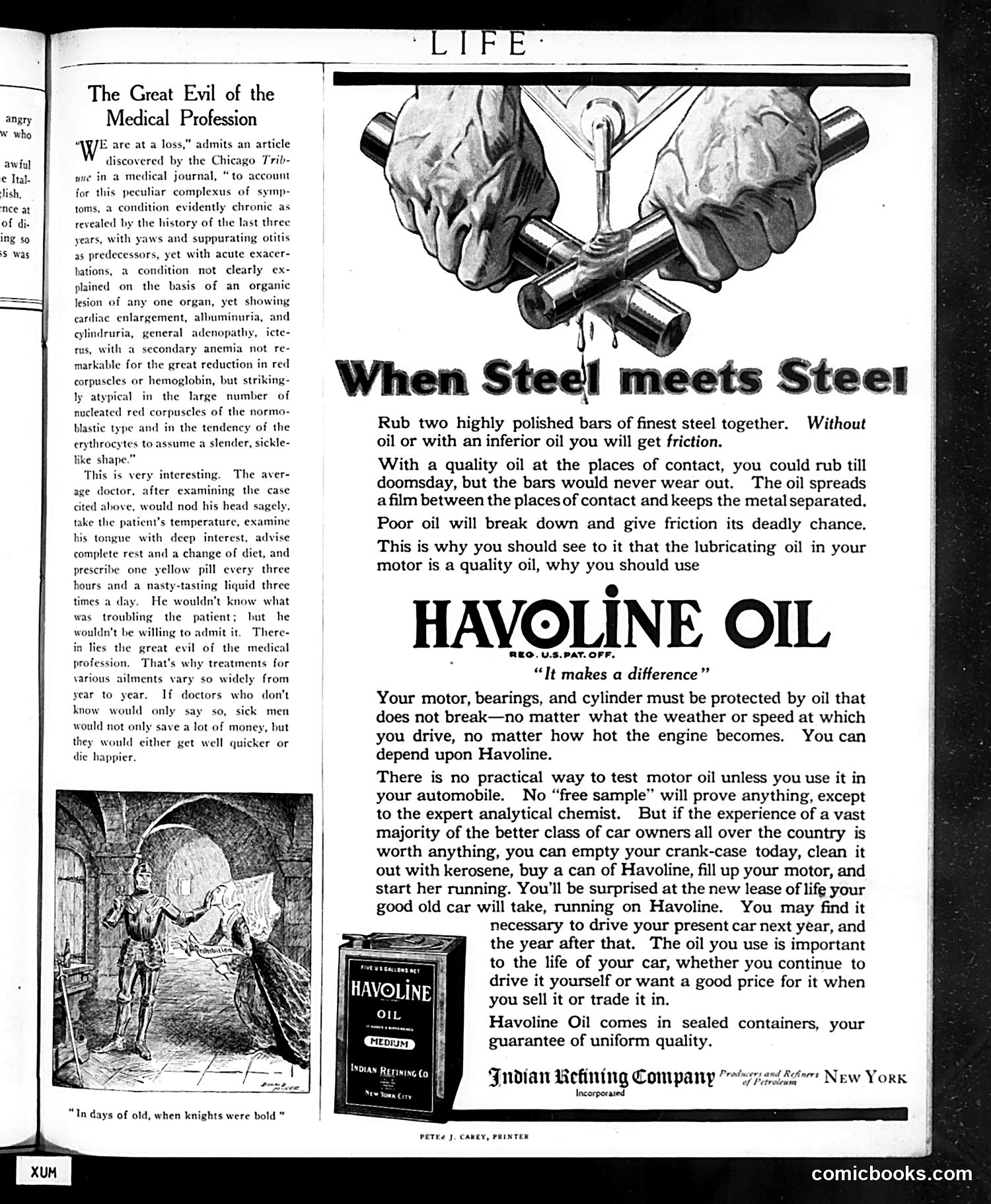
This page contains two distinct sections: **Left column:** A satirical editorial titled "The Great Evil of the Medical Profession" critiques doctors' dishonesty. It quotes a medical journal describing baffling symptoms, then argues that average physicians would diagnose confidently despite not understanding the case. The satire's point: doctors won't admit ignorance, instead prescribing generic treatments (pills, rest, diet changes) they hope will work. The piece argues that if incompetent doctors simply said "I don't know," patients would save money and either recover faster or "die happier"—implying false hope is worse than honest failure. **Right side:** A Havoline Oil advertisement uses an extended metaphor comparing motor lubrication to steel-on-steel friction. Two polished steel bars rubbed together will wear out without oil; quality oil creates a protective film between surfaces. Similarly, motor oil protects engines. The ad emphasizes that only real-world testing (using it in your car) proves quality—"free samples" mean nothing. The juxtaposition appears coincidental rather than satirical.
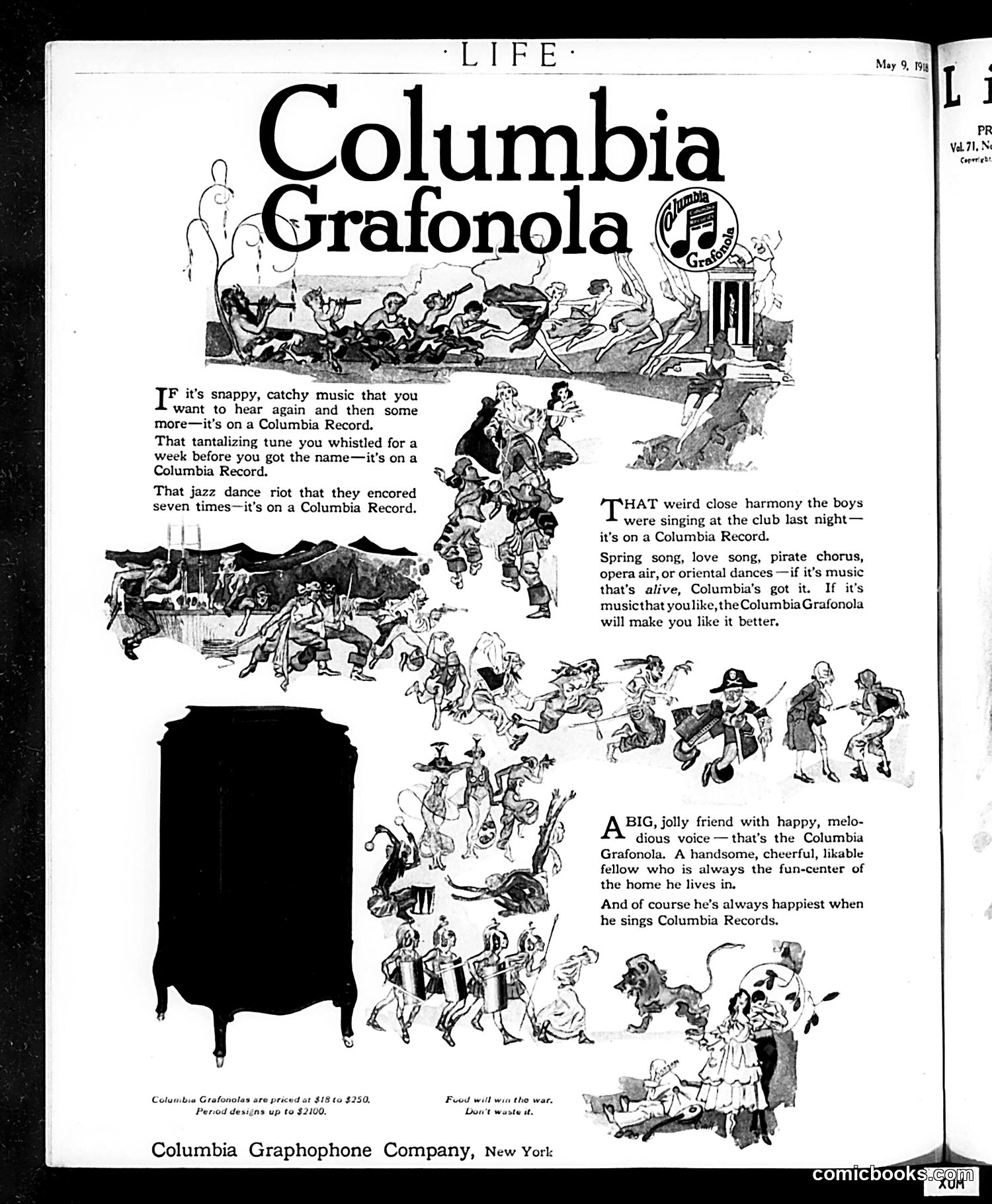
This is a **full-page advertisement** for Columbia's phonograph and records, not political satire. The page promotes the "Columbia Grafonola"—a phonograph machine priced $18-$250—by describing the variety of music available on Columbia Records. The imagery shows stylized dancing and musical figures celebrating different music genres (jazz, opera, oriental dances, etc.). The text personifies the Grafonola as "a big, jolly friend" who brings music and joy into homes. A notable detail: the small text "Food will win the war. Don't waste it" suggests this advertisement appeared during **World War I** (when the U.S. was involved, 1917-1918), incorporating a wartime public service message about food rationing. The satire is gentle—the exaggerated claims that every popular song "it's on a Columbia Record" humorously suggest Columbia's comprehensive catalog. This is commercial advertising using humor and personification rather than political commentary.