
Life, 1918-05-09 · page 11 of 40
Life — May 9, 1918 — page 11: what you’re looking at
What you’re looking at
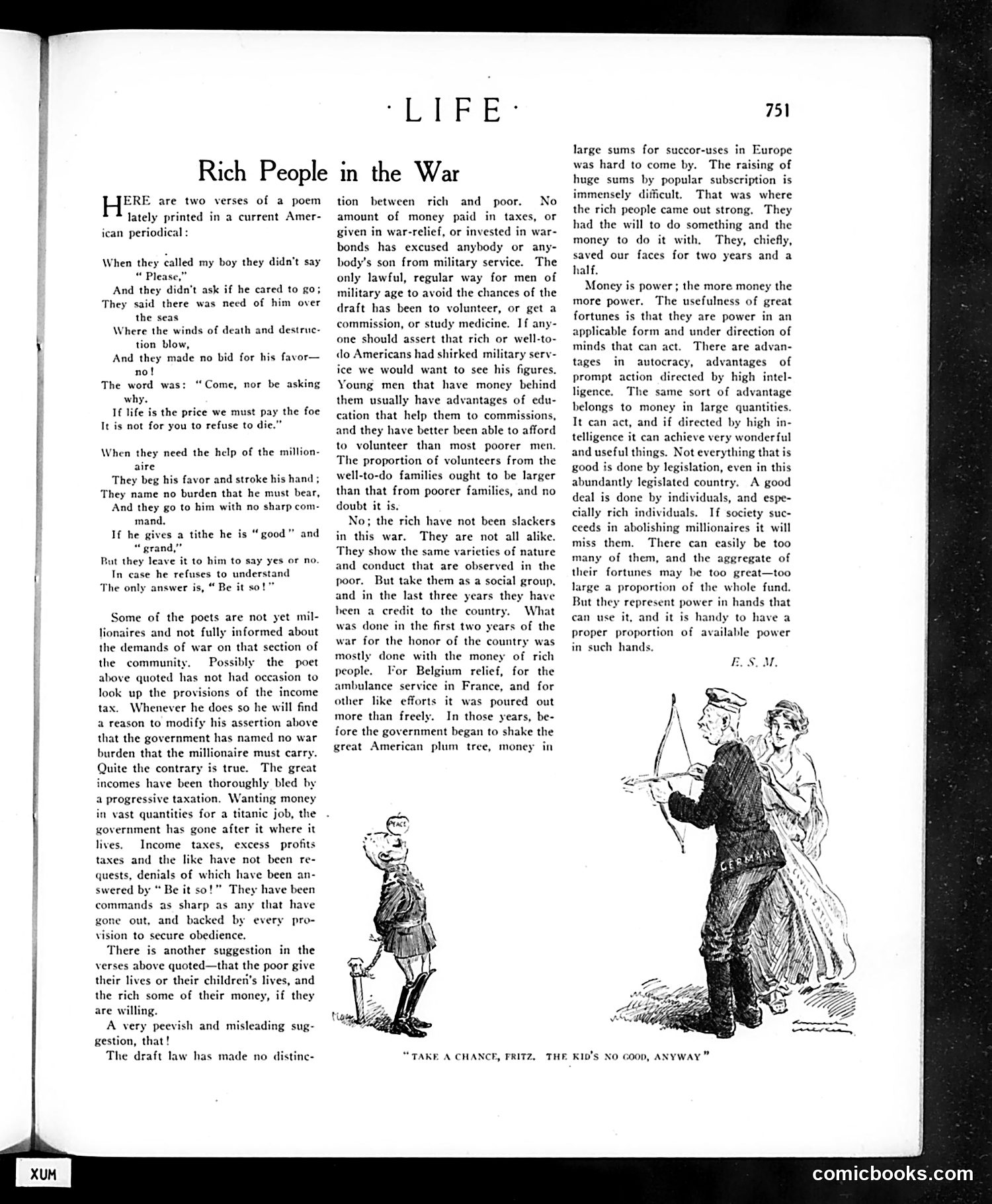
This article critiques wealthy Americans' contributions during WWI. The text argues that rich people, despite having resources, largely avoided military service through education, commissions, or medical exemptions. The accompanying cartoon (captioned "Take a Chance, Fritz. The Kid's No Good, Anyway") depicts a wealthy man offering his reluctant son to a German soldier—satirizing the notion that rich families could dodge drafts while poor families sacrificed children to combat. The article's central irony: while the wealthy funded relief efforts and war bonds, they used their advantages to escape the draft's personal costs. The satire suggests this represents moral hypocrisy and inequality in wartime sacrifice.
📄 Transcribed text from this page (OCR, searchable)
Machine-transcribed from the original scan — historical spelling and the odd misread are preserved.
Rich People ERE are two verses of a poem lately printed in a current Amer- ican periodical : When they called my boy they didn’t say “ Please,” And they didn’t ask if he cared to go; They said there was need of him over the seas Where the winds of death and destrue- tion blow, And they made no bid for his favor— no! The word was: “Come, nor be asking why. If life is the price we must pay the foe It is not for you to refuse to die.” When they need the help of the million- aire They beg his favor and stroke his hand ; ‘They name no burden that he must bear, And they go to him with no sharp com- mand. If he gives a tithe he is “ grand,” But they leave it to him to say yes or no, In case he refuses to understand “ Be it sol” good” and ye only answer i Some of the poets are not yet mil- lionaires and not fully informed about the demands of war on that section of the communi Possibly the poet above quoted has not had occasion to look up the provisions of the income tax. Whenever he does so he will find a reason to modify his assertion above that the government has named no war burden that the millionaire must carry. Quite the contrary is true. The great incomes have been thoroughly bled by a progressive taxation. Wanting money in vast quantities for a titanic job, the government has gone after it where it lives. Income taxes, excess profits taxes and the like have not been re- quests, denials of which have been an- swered by “ Be it so!" They have been commands as sharp as any that have gone out, and backed by every pro- vision to secure obedience. There is another suggestion in the verses above quoted—that the poor give their lives or their children’s lives, and the rich some of their money, if they are willing. A very peevish and misleading sug- gestion, that! The draft law has made no distine- “LIFE: in the War tion between rich and poor. No amount of money paid in taxes, or given in war-relief, or invested in war- bonds has excused anybody or any- hody’s son from military service. The only lawful, regular way for men of military age to avoid the chances of the draft has been to volunteer, or get a commission, or study medicine. If an one should assert that rich or well-to- do Americans had shirked military serv- ice we would want to see his figures. Young men that have money behind them usually have advantages of edu- cation that help them to commissions, and they have better been able to afford to volunteer than most poorer men. The proportion of volunteers from the well-to-do families ought to be larger than that from poorer families, and no doubt it i: No; the rich have not been slackers in this war. They are not all alike. They show the same varieties of nature and conduct that are observed in the poor. But take them as a social group, and in the last three years they have been a credit to the country. What was done in the first two years of the war for the honor of the country was mostly done with the money of rich people. For Belgium relief, for the ambulance service in France, and for other like efforts it was poured out more than freely. In those years, be- fore the government began to shake the great American plum tree, money in large sums for succor-uses in was hard to come by. The rai: huge sums by popular subscription is immensely difficult. That was where the rich people came out strong, They had the will to do something and the money to do it with, They, chiefly, saved our faces for two years and a half. Money is power ; the more money the more power. The usefulness of great fortunes is that they are power in an applicable form and under direction of minds that can act. There are advan- tages in autocracy, advantages of prompt action directed by high intel- ligence. The same sort of advantage belongs to money in large quantities. It can act, and if directed by high in- telligence it can achieve very wonderful and useful things. Not everything that is good is done by legislation, even in this abundantly legislated country. A good deal is done by individuals, and espe- cially rich individuals. If society suc- ceeds in abolishing millionaires it will miss them. There can easily be too y of them, and the aggregate of their fortunes may be too great—too large a proportion of the whole fund. But they represent power in hands that can use it, and it is handy to have a proper proportion of available power in such hands. “TAKE A CHANCE, FRITZ, THE K10'S NO GOOD, ANYWAY” comicbooks.com