
Life, 1918-05-09 · page 23 of 40
Life — May 9, 1918 — page 23: what you’re looking at
What you’re looking at
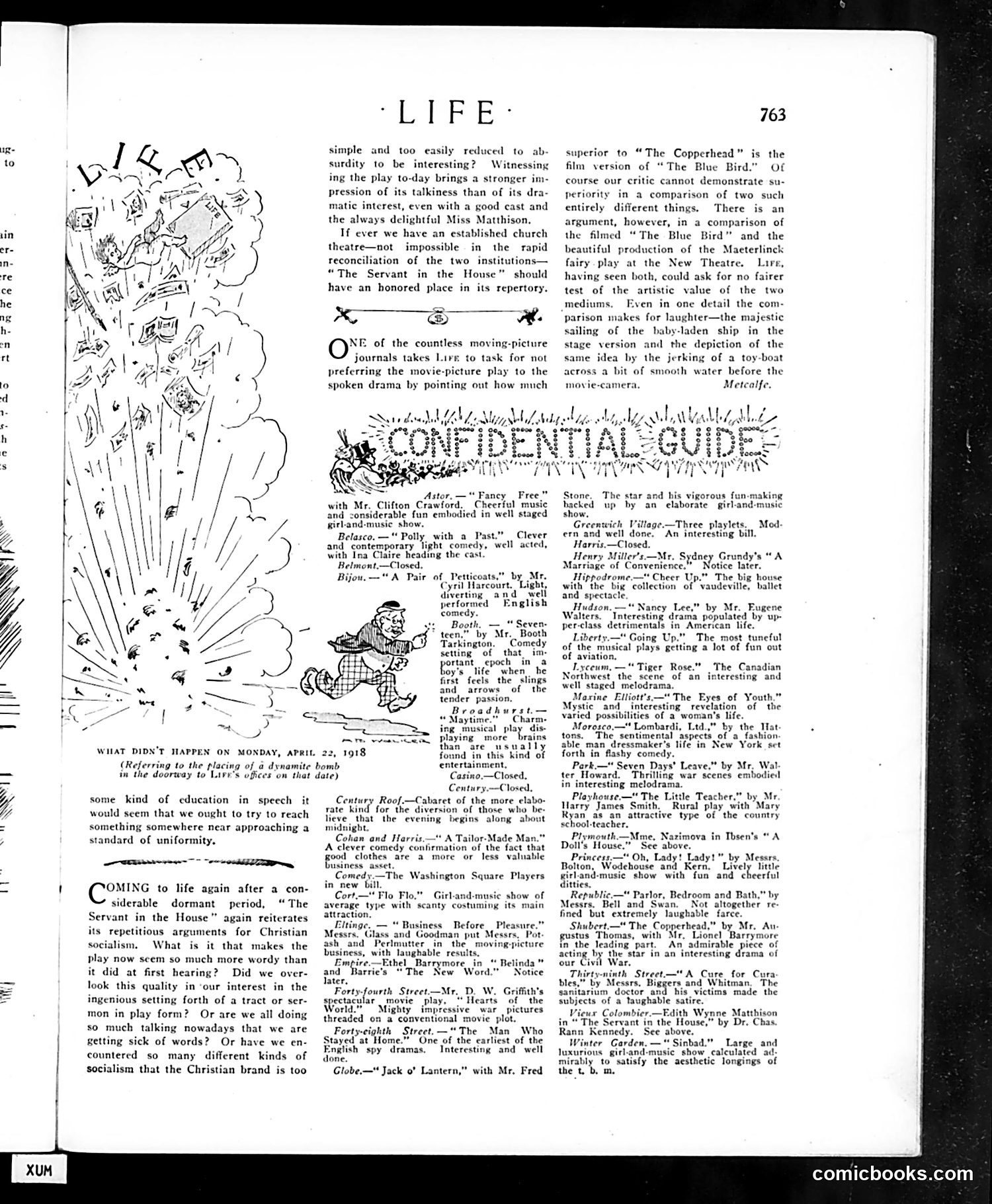
This page from *Life* magazine (dated around 1918, based on references) contains theater reviews and a political cartoon commentary. **The Cartoon**: The illustration labeled "WHAT DIDN'T HAPPEN ON MONDAY, APRIL 22" depicts a dynamite bomb explosion. The caption references "the placing of a dynamite bomb in the doorway to Life's offices on that date." This refers to an actual anarchist bombing attempt against *Life* magazine's offices—a real violent incident the magazine is satirizing by asking what *didn't* happen (implying the bomb failed or caused no damage). **The Commentary**: The text below criticizes "The Servant in the House," a Christian socialist play, arguing it's become tedious and preachy. The author questions whether audiences have grown tired of socialist rhetoric generally, or if the play was always this wordy. **The Theater Reviews**: The bulk of the page lists Broadway theaters and current productions (musicals, comedies, spy dramas), typical of *Life*'s entertainment coverage. The cartoon reflects real political violence of the era targeting media institutions.
📄 Transcribed text from this page (OCR, searchable)
Machine-transcribed from the original scan — historical spelling and the odd misread are preserved.
ne 0 d - ¢- e WHAT DIDN'T HAPPEN ON MONDAY, APRIL. (Referring to the placing in the doorway to Live's off some kind of education in speech it would seem that we ought to try to reach something somewhere near approaching a standard of uniformity, OMING to life again after a con- siderable dormant period, “The ervant in the House" again reiterates its repetitious arguments for Christian socialism, What is it that makes the play now seem so much more wordy than it did at first hearing? Did we over- look this quality in ‘our interest in the ingenious setting forth of a tract or ser- mon in play form? Or are we all doing so much talking nowadays that we are getting sick of words? Or have we en- countered so many different kinds of socialism that the Christian brand is too fa dynamite bomb 5 on that date) ‘LIFE : simple and too easily reduced to ab- surdity 10 be interesting? ing the play to-day brings a stronger im- pression of its talkiness than of its dra- matic interest, even with a good cast and the always delightful Miss Mathison. If ever we have an established church theatre—not impossible in the rapid reconciliation of the two institutions— “The Servant in the House” should have an honored place in its repertory. ae @ we NE of the countless moving-picture journals takes Lire to task for not preferring the movie-picture play to the spoken drama by pointing out how much Witnessing Wass Free” a Astor, —" Fancy | Free with Mr. Clifton Crawford. Cheerful music and considerable fun embodied in well staged girl-and-music show, Belasco. —" Polly with a Past.” Clever and contemporary light comedy, well acted, with Ina Claire heading the cast Belmont.—Closed, Bijou. —“ A Pair of | Petticoats.” by Mr. Cyril Harcourt. Light, diverting and — well performed English comedy. Booth. — * Seven- teen,” by Mr, Booth Tarkington. Comedy setting of that. im- portant epoch in a hoy's life when he first feels the slings and. arrows of the tender passion. Broadhurst.— “Maytime.” Charm: ing musical play dis- playing more brains than are usually 1918 found in this kind of an. wae entertainment, Casino.—Closed, Century.—Closed, Century Roof.—Cabaret of the more elabo- rate kind for the diversion of those who be- lieve that the evening begins along about night. Cohan and Harris." A Tailor-Made Mar A clever comedy confirmation of the fact that ood clothes are a more or less valuable jusiness. asset Comedy.—The Was in new bill Cort—* Flo Flo." Girl: average type with ‘scanty costuming its 1 attraction. Eltinge, — “ Business Before. Pleasure. Messrs. Glass and Goodman put Messrs, Pot: ash and Perlmutter in the moving-picture business, with laughable results, Empire.—Ethel_ Barrymore in“ Belinda” and Barrie's “The New Word.” Notice later. Forty fourth Street —Mr, D. W. Griffith's spectacular ‘movie play, “Hearts of | the World.” Mighty impressive war pictures threaded on a conventional movie plot. Forty-cighth Street. —“ The Man Who Stayed at Home.” One of the earliest of the English “spy dramas. Interesting and well done. Globe,—"* Jack o’ Lantern,” with Mr, Fred ngton Square Players nusic show of 763 superior to “The Copperhead” is the film version of “The Blue Bird.” Of course our critic cannot demonstrate su- periority in a comparison of two such entirely different things, There is an ‘gument, however, in a comparison of the filmed “The Blue Bird” and the beautiful production of the Maeterlinck fairy play at the New Theatre, Lire, having seen both, could ask for no fairer test of the artistic value of the two mediums. Even in one detail the com- parison makes for laughter—the majest sailing of the baby-laden ship in the stage version and the depiction of the same idea by the jerking of a toy-boat across a bit of smooth water before the Metcalfe movie-camera, Stone, The star and his vigorous fun-making hacked up by an elaborate girl-and-music show, Greenwich Vitlage-—Three playlets. Mod- ern and well done. An interesting bill. Harris.—Closed. Henry Miller’s—Mr. Sydney Grundy's A Marriage of Convenience.” Notice later. Hippodrome.—" Cheer Up." The big house with the big collection of vaudeville, ballet and spectacle. Hudson.—" Nancy Lee,” by Mr. Fugene Walters. Tateresting drama populated by up- per-class detrimentals in American life. Liberty." Going Up." The most tuneful of the musical plays getting a lot of fun out of aviation, Lyceum, —" Tiger Rose.” ‘The Canadian Northwest the scene of an interesting and well staged melodrama. Maxine Elliott’s— The Eyes of Youth.” Mystic and ‘interesting revelation of the varied possibilities of a woman's life. Morosco.—* Lombardi, Ltd.," by the Mat- tons. The sentimental aspects of a fashion able man dressmaker’s life in New York set forth in flashy comedy. Park.—" Seven Days’ Leave,” by Mr, Wal ter Howard. Thrilling war scenes embodied in interesting melodrama. Playhouse.—* The Little Teacher.” by Mr Marry James Smith, Rural play with Mary Ryan as an attractive type of the country school-teacher. Plymouth.—Mme, Nazimova in Ibsen's “A Doll's House.” See above, Princess.—" Oh, Lady! Lady!" by Messrs, Bolton, Wodehouse and Kern. Lively little gicland-musie show with fun and cheerful itties, Republic.— Parlor, Bedroom and Bath,” by Messrs, Bell and Swan. Not altogether re- fined but extremely laughable farce. Shubert—" The Copperhead,” by Mr. Aw: gustus Thomas, with Mr. Lionel Barrymore in the leading part. An admirable piece of acting by the star in an interesting drama of War. rtyeninth Street—"A Cure for Cura by Messrs, Biggers and Whitman. The sanitarium doctor and his victims made the subjects of a laughable satire. Views Colomb ith Wynne Matthison in “ The Servant in the House,” by Dr. Chas. Rann Kennedy. See above. Winter Carden. —“ Sinbad.” Large and luxurious girland-music show calculated ad: mirably to satisfy the aesthetic longings of the t, b, m, comicbooks.com