
Life, 1918-05-09 · page 22 of 40
Life — May 9, 1918 — page 22: what you’re looking at
What you’re looking at
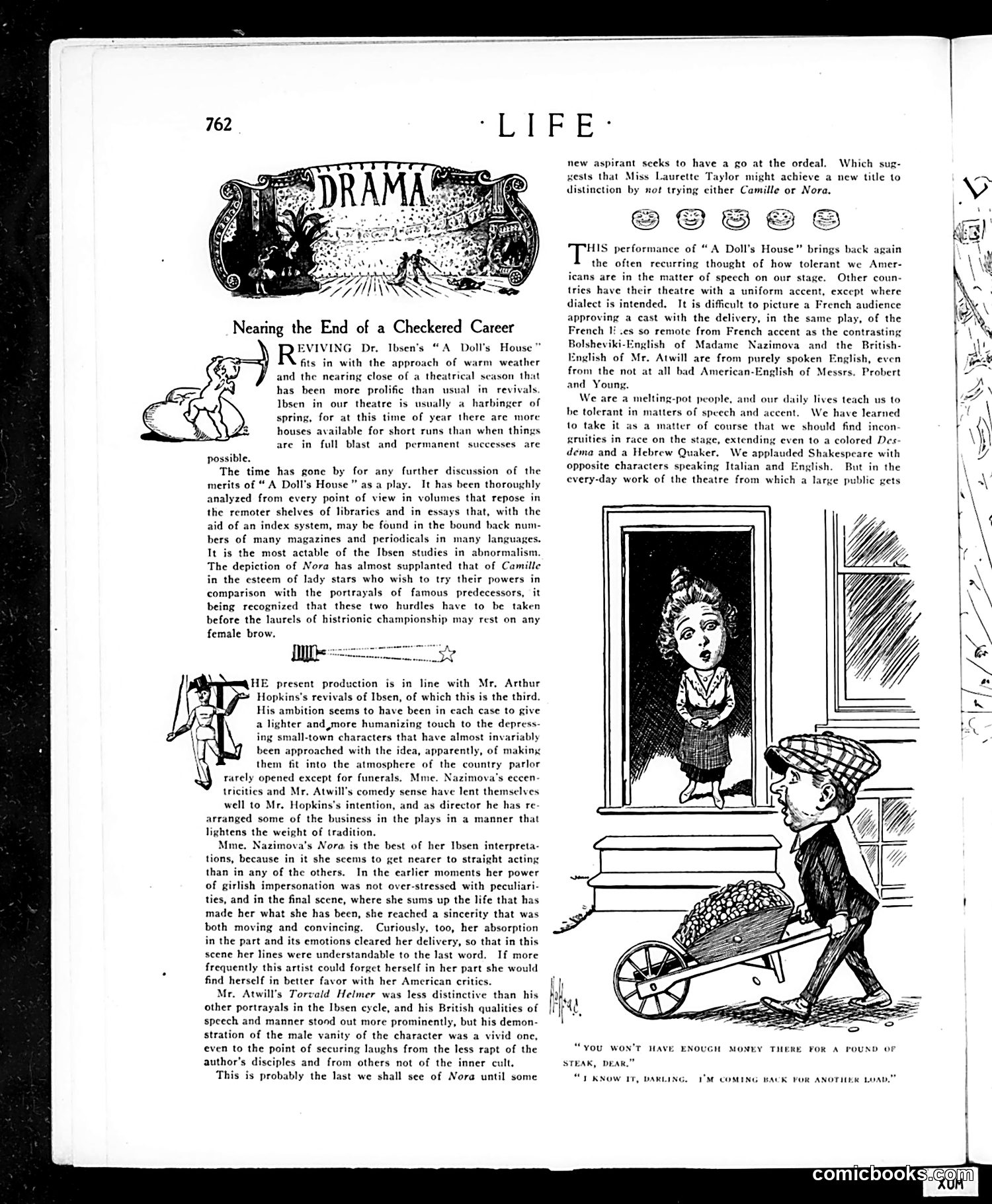
This is a theater review discussing a revival of Ibsen's *A Doll's House*, likely from the 1920s based on references to contemporary actors. The accompanying cartoon illustrates a comedic scene from the play. **The Main Point:** The article praises the production while making a broader cultural observation—that Americans are unusually tolerant of diverse accents on stage, unlike more uniform European theaters. The critic notes that the cast includes performers with markedly different speech patterns (Madame Nazimova's accent, Mr. Atwill's British delivery, and American actors), which would be unacceptable in French or other theaters but reflects America's "melting-pot" identity. **Key References:** - Laurette Taylor (actress mentioned as potential alternative to this production) - Madame Nazimova (praised for her Nora performance) - Arthur Hopkins (director attempting to make Ibsen more humanized and less depressing) **The Cartoon:** Shows a domestic scene with a woman at a window and a man pushing a wheelbarrow below, with dialogue about money and "another load"—likely depicting the play's themes of domestic struggle.
📄 Transcribed text from this page (OCR, searchable)
Machine-transcribed from the original scan — historical spelling and the odd misread are preserved.
‘LIFE * new aspirant seeks to have a go at the ordeal. Which sug- gests that Miss Laurette Taylor might achieve a new title to distinction by not trying either Camille or Nora. HIS performance of “A Doll's House” brings back again the often recurring thought of how tolerant we Amer jcans are in the matter of specch on our stage. Other coun- tries have their theatre with a uniform accent, except where dialect is intended, It is difficult to picture a French audience . approving a cast with the delivery, in the same play, of the Nearing the End of a Checkered Career French I .es so remote from French accent as the contrasting VIVING: De. Ibsen's A. Doll's Hous Bolsheviki-English of Madame Nazimova and the British- fits in with the approach of warm weather Enslish of Mr. Atwill are from purely spoken English, even and the nearing close of e theatrical season that £00 the not at all bad American-English of Messrs. Probert and Young. has been more prolific than usual in revivals. . . ; 2 Ibsen in our theatre is usually a harbinger of We are a melting-pot people, and our daily lives teach us to “ spring, for at this time of year there are more be tolerant in matters of speech and accent. We have learned 1 \ houses available for short runs than when things 1 take it ay a matter of course that we should find incon \ {\ are in full blast and. permanent successes are Rtuities in race on the stage, extending even to a colored Des }| dema and a Hebrew Quaker. We applauded Shakespeare with |, 7 possible. The time has gone by for any further discussion of the opposite characters speaking Italian and English. But in the \ every-day work of the theatre from which a large public gets \\ a merits of “ A Doll's House” as a p It has been thoroughly analyzed from every point of view in volumes that repose in the remoter shelves of librarics and in e: that, with the aid of an index system, may be found in the bound back num- bers of many magazines and periodicals in many languages. It is the most actable of the Ibsen studies in abnormal The depiction of Nora has almost supplanted that of Can in the esteem of lady stars who wish to try their powers in comparison with the portrayals of famous predecessors, it being recognized that these two hurdles have to be taken before the laurels of histrionic championship may rest on any female brow. HE present production is in line with Mr, Arthur Hopkins's revivals of Ibsen, of which this is the third. His ambition seems to have been in cach case to give a lighter and more humanizing touch to the depress- ing small-town characters that have almost invariably been approached with the idea, apparently, of making them fit into the atmosphere of the country parlor rarely opened except for funerals. Mme. Nazimova’s eccen- tricities and Mr, Atwill’s comedy sense have lent themselves well to Mr. Hopkins’s intention, and as director he has re arranged some of the business in the plays in a manner that lightens the weight of tradition, Mime. Nazimova’s Nora is the best of her Ibsen interpreta- tions, because in it she scems to get nearer to straight acting than in any of the others. In the earlier moments her power of girlish impersonation was not over-stressed with peculiari- ties, and in the final scene, where she sums up the life that has made her what she has been, she reached a sincerity that was both moving and convincing. Curiously, too, her absorption in the part and its emotions cleared her delivery, so that in this scene her lines were understandable to the last word. If more frequently this artist could forget herself in her part she would find herself in better favor with her American critics. Mr. Atwill’s Torvald Helmer was less distinctive than his other portrayals in the Ibsen cycle, and his British qualities of speech and manner stond out more prominently, but his demon- stration of the male vanity of the character was a vivid onc, even to the point of securing laughs from the less rapt of the “You WON'T HAVE ENOU { author's disciples and from others not of the inner cult. STEAK, DEAR.” | This is probably the last we shall see of Nora until some MONEY THERE FOR A POUND OP “OD KNOW TT, DARLING. 1M COMING BACK FOR ANOTICER LOAD.” comichooksieary)