
Life, 1918-05-09 · page 24 of 40
Life — May 9, 1918 — page 24: what you’re looking at
What you’re looking at
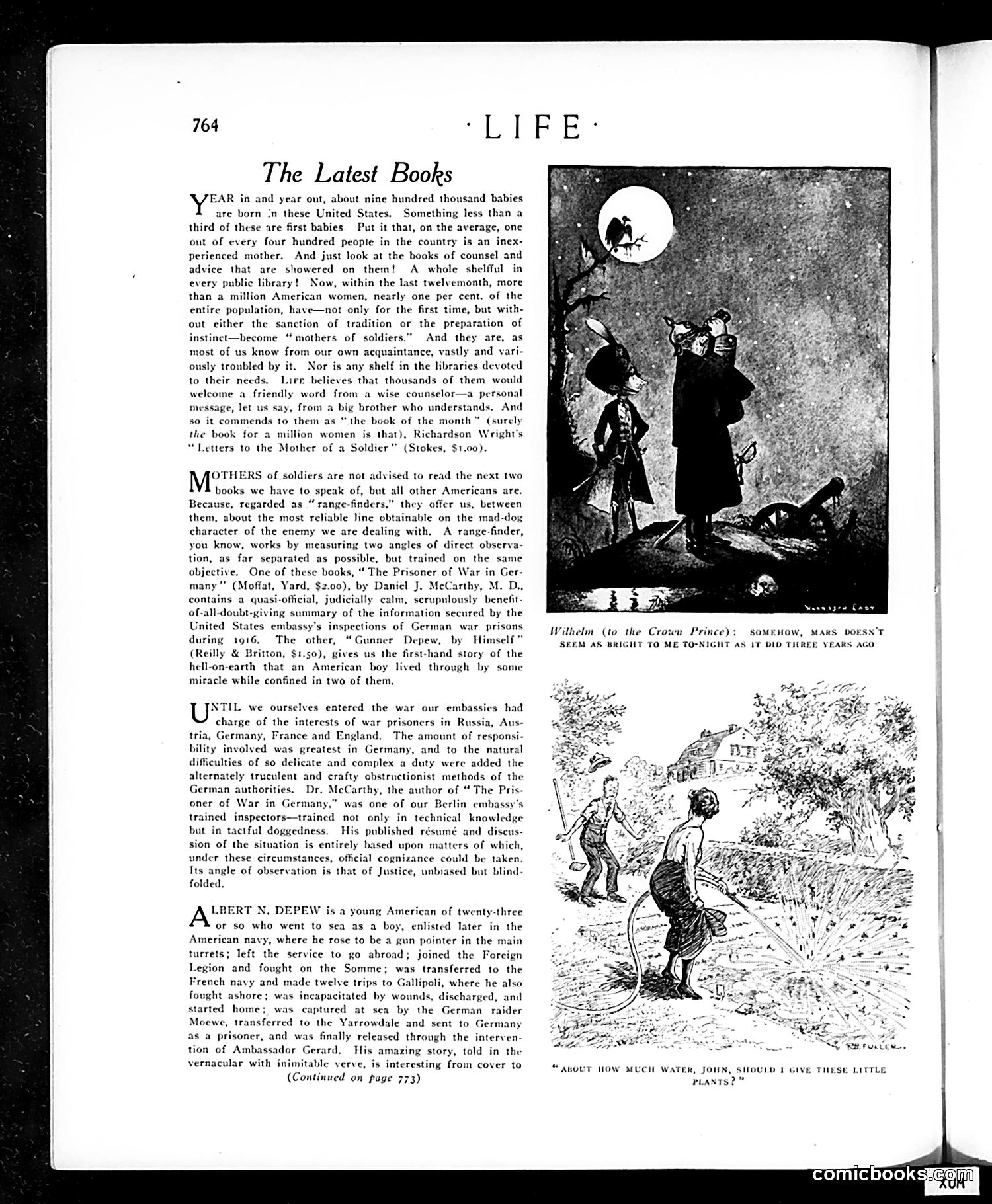
This page reviews three contemporary books addressing American experiences in World War I. The central focus is *Letters to the Mother of a Soldier* by Richardson Wright—positioned as essential reading for the approximately one million American women who became "mothers of soldiers" during the war, lacking traditional guidance or literary resources for their unique situation. The page then recommends two "range-finder" books offering contrasting perspectives on German prisoner-of-war treatment: Dr. Daniel McCarthy's official *The Prisoner of War in Germany* (based on U.S. embassy inspections) and Albert Depew's firsthand account *Gunner Depew, by Himself* (describing his harrowing imprisonment after capture at sea). The accompanying illustrations—showing a soldier figure and a rural scene—appear decorative rather than directly satirical. The content reflects Life's wartime mission: informing American readers about the conflict's home-front and combat realities through curated literature.
📄 Transcribed text from this page (OCR, searchable)
Machine-transcribed from the original scan — historical spelling and the odd misread are preserved.
The Latest Books AR in and year out, about nine hundred thousand babies are born in these United States. Something less than a third of these are first babies Put it that, on the average, one out of every four hundred peopte in the country is an inex- perienced mother. And just look at the books of counsel and advice that are showered on them! A whole sheliful in every public library! Now, within the last twelvemonth, more than a million American women, nearly one per cent. of the entire population, have—not only for the first time, but with- out either the sanction of tradition or the preparation of instinct—become “mothers of soldiers.” And they are, as most of us know from our own acquaintance, vastly and vari- ously troubled by it. Nor is any shelf in the libraries devoted to their needs. Lire believes that thousands of them would welcome a friendly word from a wise counselor—a personal message, let us say, from a big brother who understands, And so it commends to them as “the book of the month” (surely the book for a million women is that), Richardson Wright's Letters to the Mother of a Soldier” (Stokes, $1.00). OTHERS of soldiers are not advised to read the next two books we have to speak of, but all other Americans are. Because, regarded as “range-finders,” they offer us, between them, about the most reliable line obtainable on the mad-dog character of the enemy we are dealing with, A range-finder, you know, works by measuring two angles of direct observa- tion, as far separated as possible, but trained on the same objective. One of these books, “ The Prisoner of War in Ger- many” (Moffat, Yard, $2.00), by Daniel J. McCarthy, M. D., contains a quasi-oficial, of-all-doubt-giving summary of the information secured by the United States embassy’s inspections of German war prisons during 1916, The other, “Gunner Depew, by Himself” (Reilly & Britton, $1.50), gives us the first-hand story of the hell-on-earth that an American boy lived through by some miracle while confined in two of them. ly calm, scrupulously benefit- NTIL we ourselves entered the war our embassies had charge of the interests of war prisoners in Russia, Aus tria, Germany, France and England, The amount of respons bility involved was greatest in Germany, and to the natural difficulties of so delicate and complex a duty were added the alternately truculent and crafty obstructionist methods of the German authorities. Dr. McCarthy, the author of “ The Pris- oner of War in Germany,” was one of our Berlin embassy’s trained inspectors—trained not only in technical knowledge but in tactful doggedness, His published résumé and discus- sion of the situation is entirely based upon matters of which, under these circumstances, official cognizance could be taken. Its angle of observation is that of Justice, unbiased but blind- folded. LBERT N, DEPEW is a young American of twenty-three or so who went to sea as a boy, enlisted later in the American navy, where he rose to be a gun pointer in the main turrets; left the service to go abroad; joined the Foreign Legion and fought on the Somme; was transferred to the French navy and made twelve trips to Gallipoli, where he also fought ashore; was incapacitated by wounds, discharged, and started home; was captured at sea by the German raider Moewe, transferred to the Yarrowdale and sent to Germany as a prisoner, and was finally released through the interven- tion of Ambassador Gerard. His amazing story, told in the vernacular with inimitable verve, is interesting from cover to (Continued on page 773) Messisee C Wilhelm (to the Crown Prince): somMEnow, MARS DOESN'T SEEM AS BRIGHT TO ME TO-NIGHT AS IT DID THREE YEARS AGO “ABOUT HOW MUCH WATER, JOHN, SHOULD 1 GIVE THESE LITTLE PLANTS?” comicbookseer