
A complete issue · 40 pages · 1918
Life — March 14, 1918
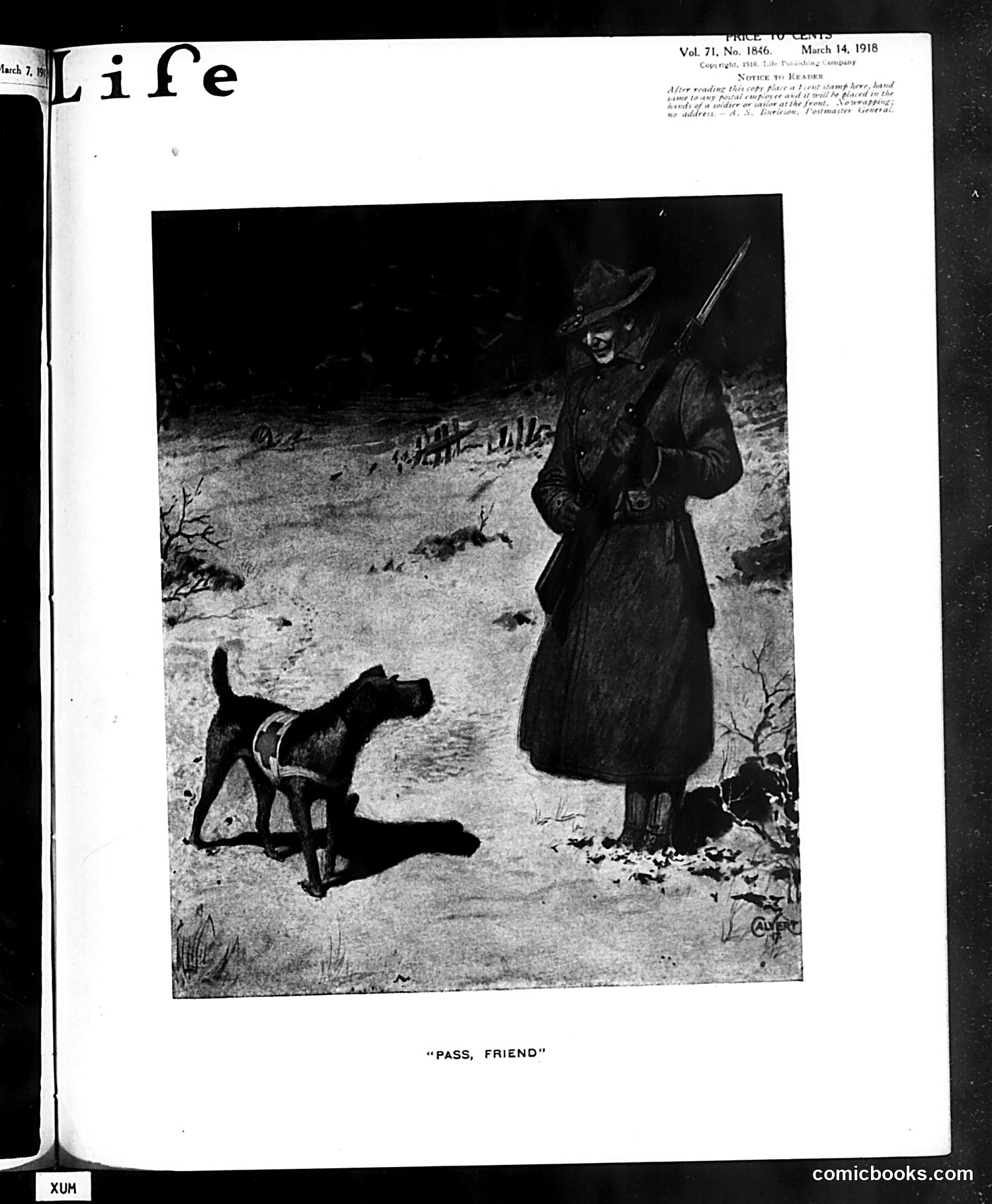
This illustration depicts a World War I military checkpoint scene. A uniformed soldier with a rifle stands guard while confronting a figure on the ground and a dog. The caption "Pass, Friend" suggests the ironic moment of a soldier checking credentials or passage during wartime. The image likely satirizes the absurdity of military checkpoint procedures, perhaps mocking the formality of "passes" or authorization during combat conditions. The dog's presence and the prone figure suggest confusion or the breakdown of normal protocol during wartime chaos. Published in March 1918, during America's active involvement in WWI, this would resonate with contemporary readers familiar with trench warfare procedures, military bureaucracy, and the grim realities of the front lines. The satire appears to critique the disconnect between rigid military rules and battlefield reality.
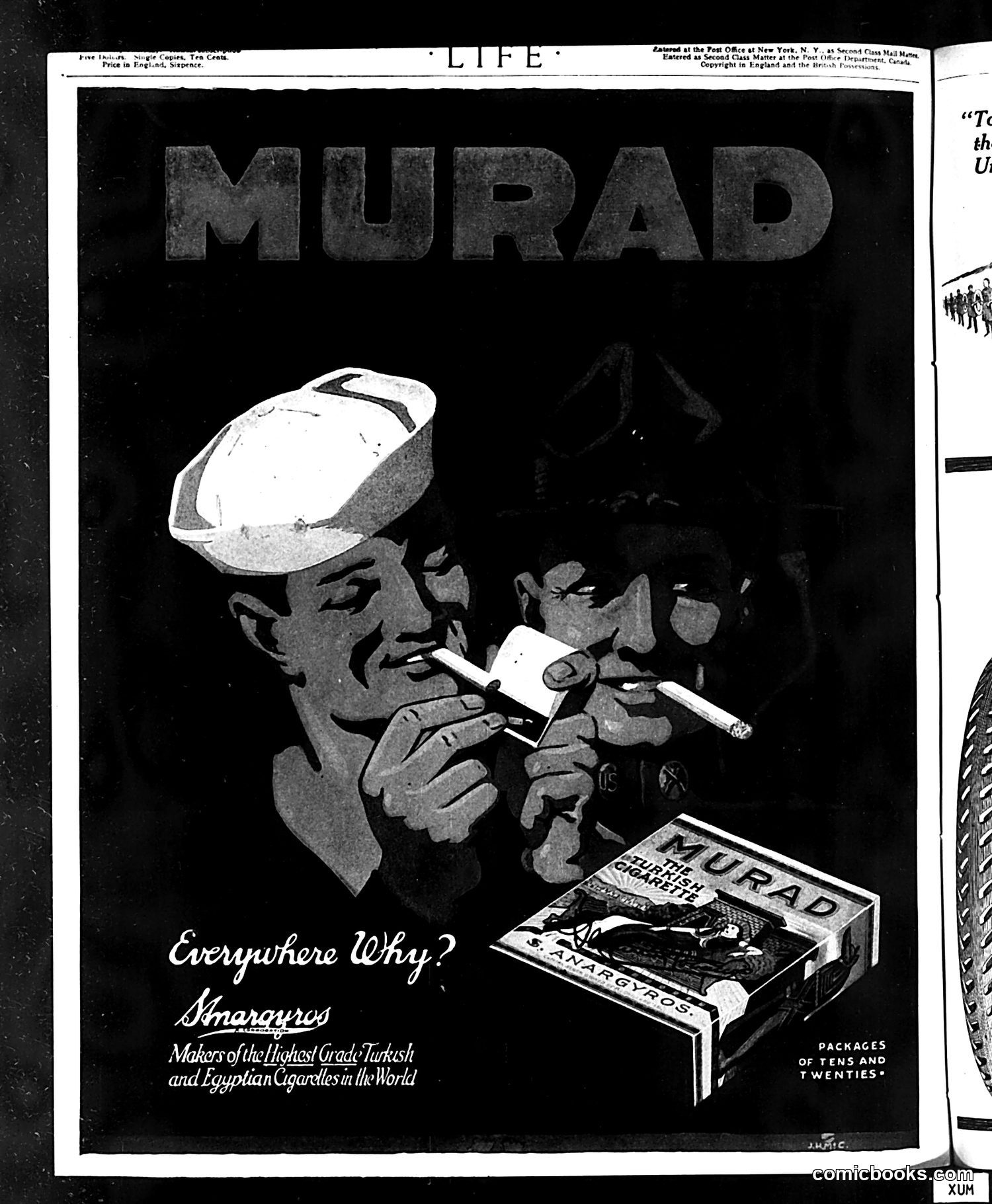
This is a **cigarette advertisement**, not political satire. The large illustration shows a caricatured man with exaggerated Middle Eastern features (mustache, cap) smoking a cigarette while holding a box of Murad cigarettes. The ad's text reads "Everywhere Why? Smaryrnos [sic]—Makers of the Highest Grade Turkish and Egyptian Cigarettes in the World," with packaging visible showing "Murad" branding. This represents early 20th-century advertising that relied on ethnic stereotyping to market "exotic" tobacco products. The caricature exploits Orientalist imagery—associating the product with a foreign, masculine figure—to appeal to American consumers seeking sophisticated imported goods. The humor derives from crude ethnic characterization rather than political commentary.
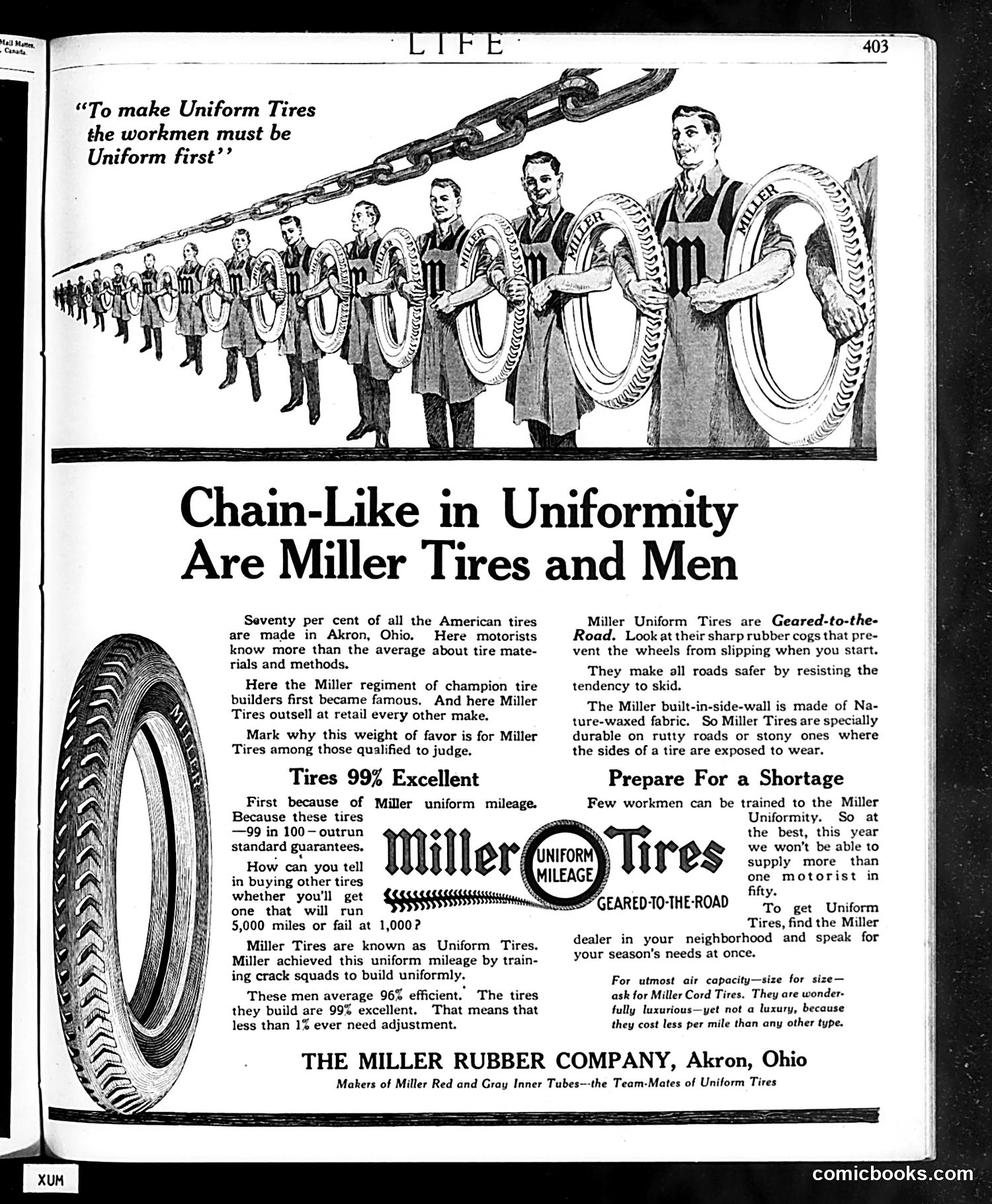
This page is primarily a **Miller Tires advertisement** from The Miller Rubber Company in Akron, Ohio. However, it uses satirical imagery to sell products. The main cartoon depicts workers in military-style uniforms marching in rigid formation, each holding giant tires. The chain imagery and military drill reference **industrial standardization and worker uniformity**—suggesting that like soldiers, factory workers are interchangeable, uniform, and controlled. The satire is subtle: the ad presents this regimentation as efficient and positive ("Chain-Like in Uniformity"), transforming what modern readers might recognize as **dehumanizing factory conditions** into a selling point. It celebrates the standardized production methods that made Miller Tires competitive while also inadvertently mocking the rigid conformity demanded of industrial workers. This reflects 1920s attitudes toward mass production and labor.
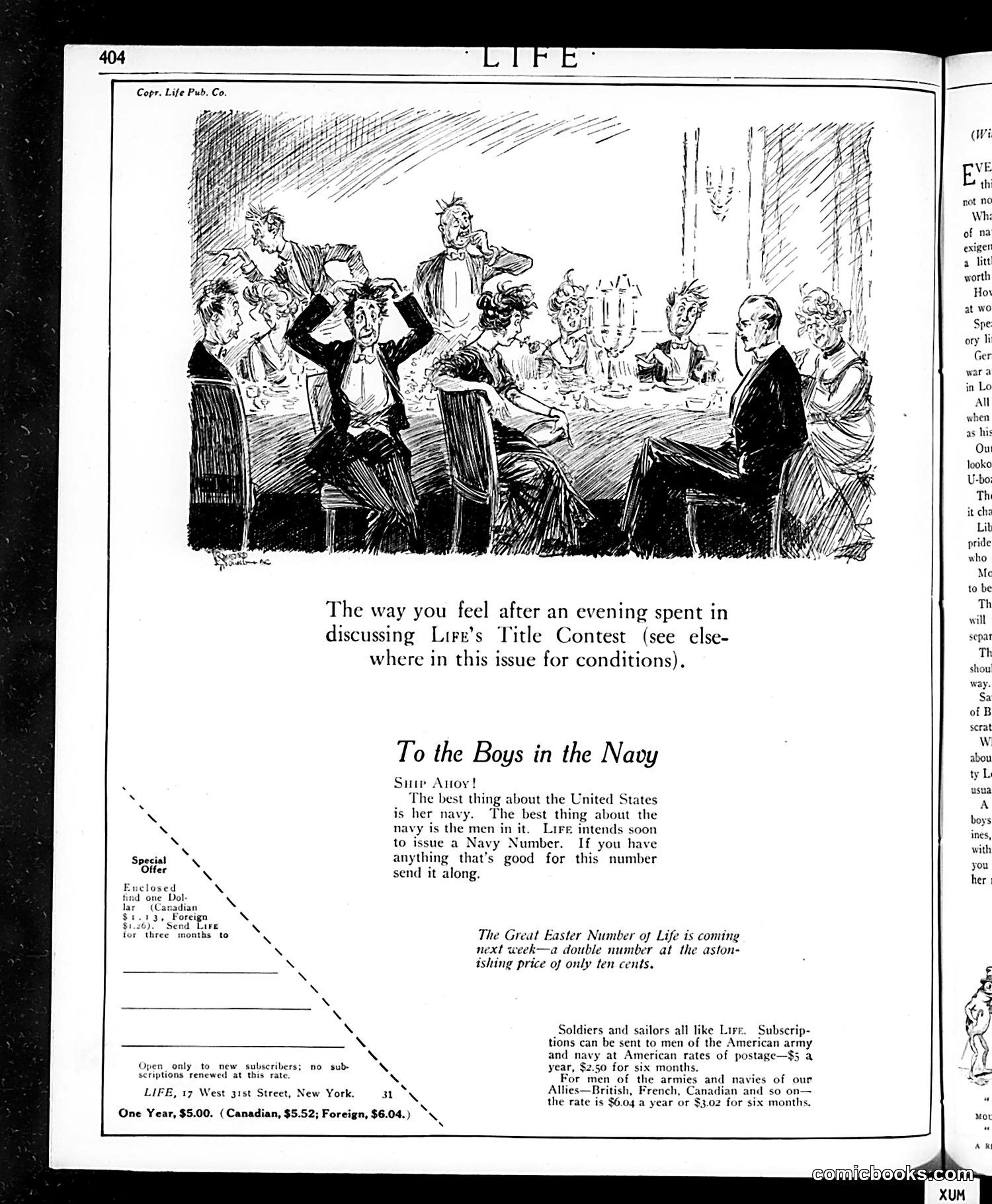
This page is primarily **advertising and promotional content** for LIFE magazine itself, not political satire. The cartoon depicts an animated dinner party discussion, illustrating the caption below: "The way you feel after an evening spent in discussing LIFE's Title Contest." The image suggests that debating magazine contest entries generates lively, engaging conversation—a marketing pitch showing LIFE as intellectually stimulating. Below is a recruitment appeal "To the Boys in the Navy," promoting a forthcoming Navy-themed issue. The magazine also advertises subscription offers and rates for American servicemen and allied troops during what appears to be **World War I** (based on references to "men of the American army and navy" and allied nations). The page functions as self-promotion rather than social commentary.
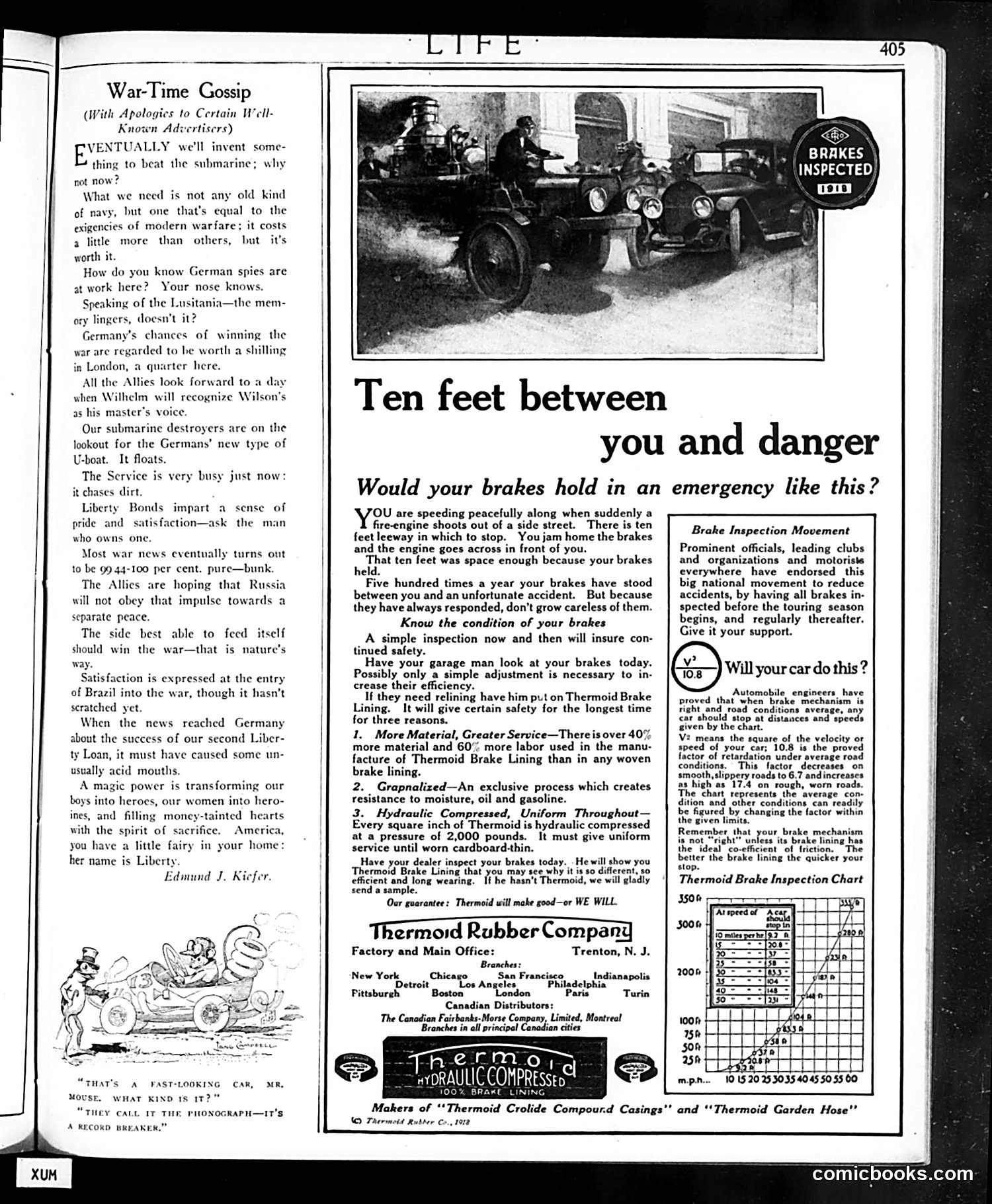
This page is primarily **advertising**, not political satire. The dominant content is a Thermoid Rubber Company advertisement for brake lining, featuring a safety-focused pitch about automobile brakes. The smaller left-column piece, "War-Time Gossip," appears to be satirical commentary on WWI, referencing German spies, the Lusitania sinking, submarine warfare, and the Liberty Loan. The tone suggests skepticism or irony about war claims. The bottom cartoon shows a speeding car with the caption "THAT'S A FAST-LOOKING CAR, MR. MOORE. WHAT KIND IS IT?" / "THEY CALL IT THE PHONOGRAPH—IT'S A RECORD BREAKER," which is a simple pun about record-breaking speed. The overall page mixes wartime editorial commentary with commercial messaging, typical of early-1900s American magazine layouts.
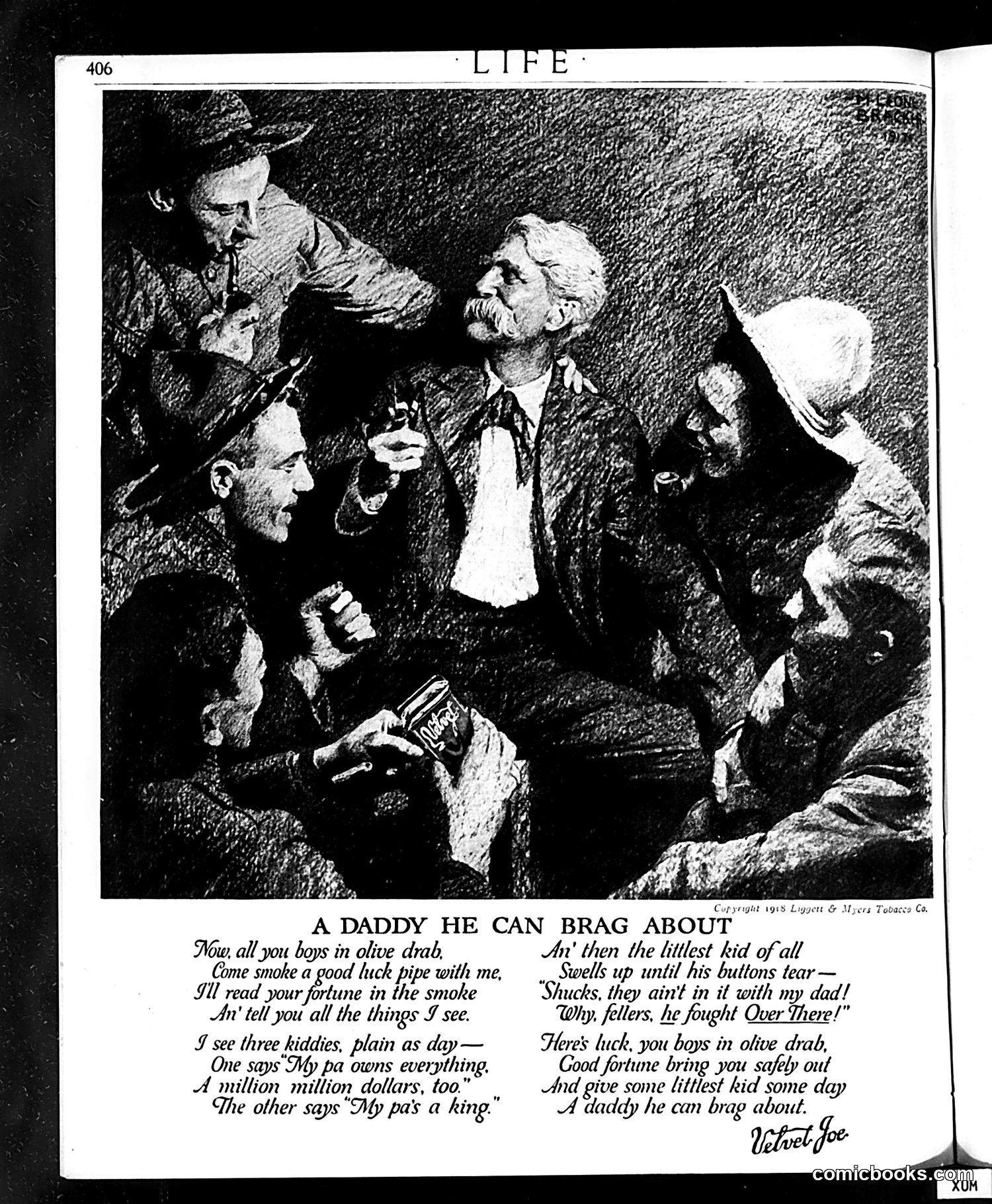
This WWI-era cartoon satirizes working-class fathers trying to impress their sons. An older man (likely a fortune teller) reads the fortunes of young boys in military uniforms, who boast about their fathers' accomplishments. The joke targets class anxiety: one boy claims his father "owns everything" and is worth "a million dollars," while another insists his father is "a king." The punchline suggests these boys lack genuine accomplishment to be proud of, so they invent inflated parental achievements. The cartoon critiques both paternal boasting and childhood materialism during wartime. The character "Velvet Joe" (possibly a recurring LIFE figure) delivers the moral: real valor comes from having a father who "fought Over There"—a soldier in WWI—the only achievement worthy of genuine pride.
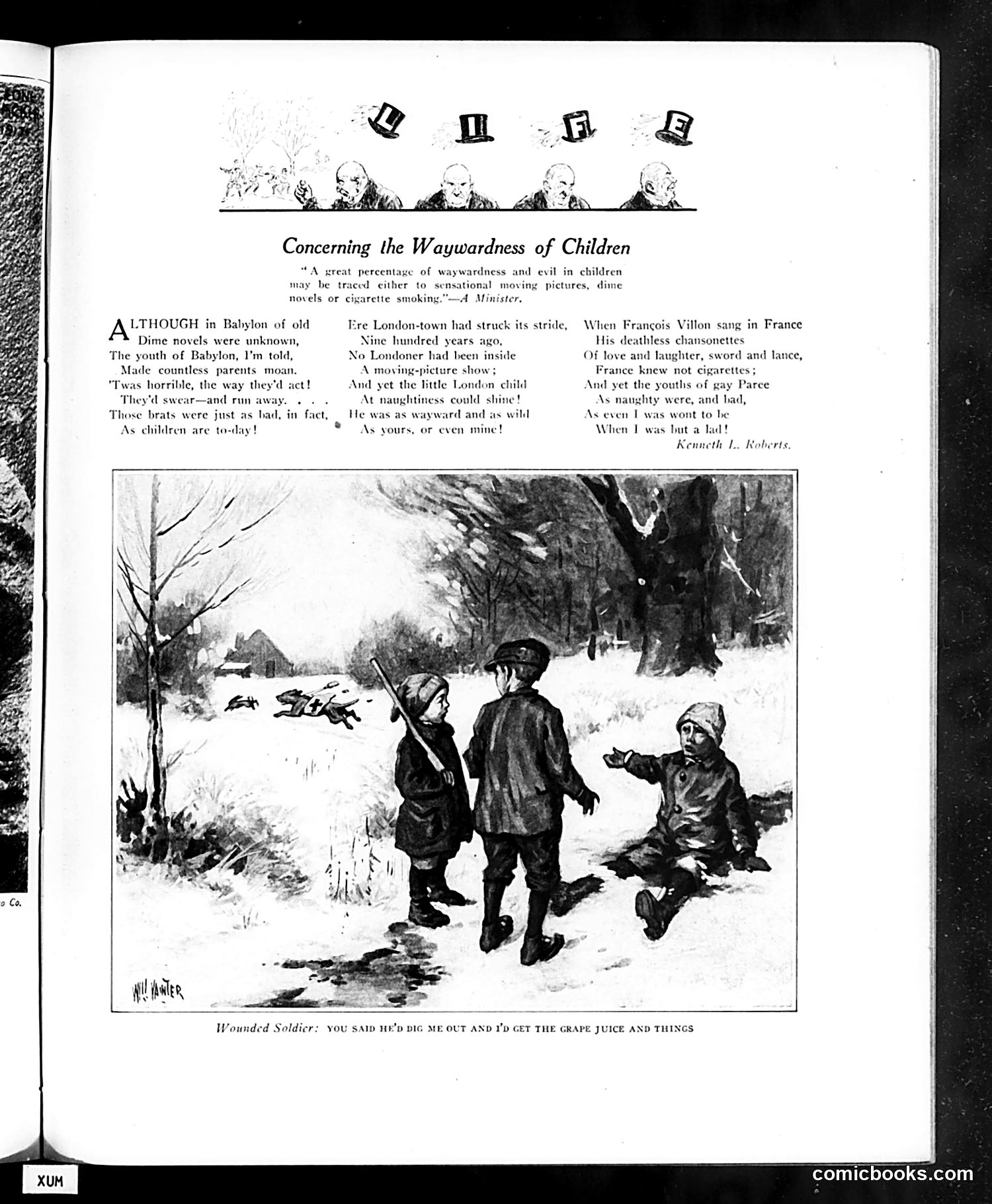
This page addresses child misbehavior in early 20th-century America. The article's epigraph blames "sensational moving pictures, dime novels or cigarette smoking" for corrupting youth—reflecting contemporary moral panic about new mass media. The poem by Kenneth L. Roberts contrasts historical waywardness (Babylon, medieval London, Renaissance France) with modern American children, suggesting misbehavior is timeless, not uniquely caused by modern influences. The illustration by Will Harman depicts children playing war—one child says he's a "wounded soldier" who needs grape juice and medical care. This satirizes how children absorb and dramatize current events (likely WWI) through play, supporting the article's argument that childhood mischief predates modern corrupting influences.
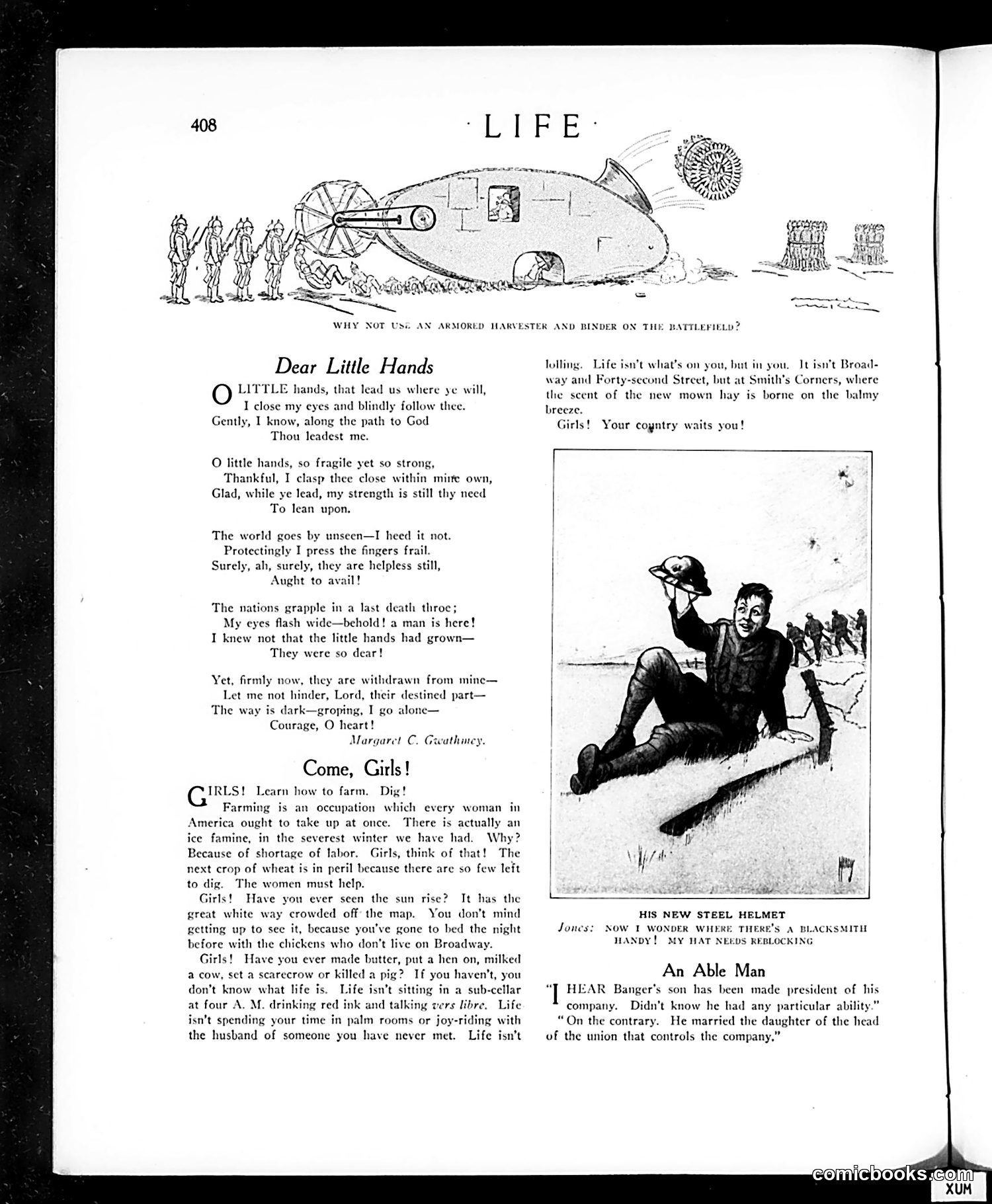
The top cartoon satirizes military innovation during what appears to be World War I. It depicts an enormous armored vehicle with a cannon, accompanied by marching soldiers. The caption asks: "WHY NOT USE AN ARMORED HARVESTER AND BINDER ON THE BATTLEFIELD?"—mocking the absurdity of applying agricultural machinery to warfare. This is satirical commentary on either overconfidence in new war technology or the disconnect between industrial progress and practical military solutions. Below are inspirational pieces: a patriotic poem "Dear Little Hands" by Margaret C. Gwathmey encouraging women's participation in the war effort (farming, factory work), and an anecdote titled "An Able Man" about competence in leadership. The satirical thrust critiques technological optimism while simultaneously promoting civilian mobilization for the war.
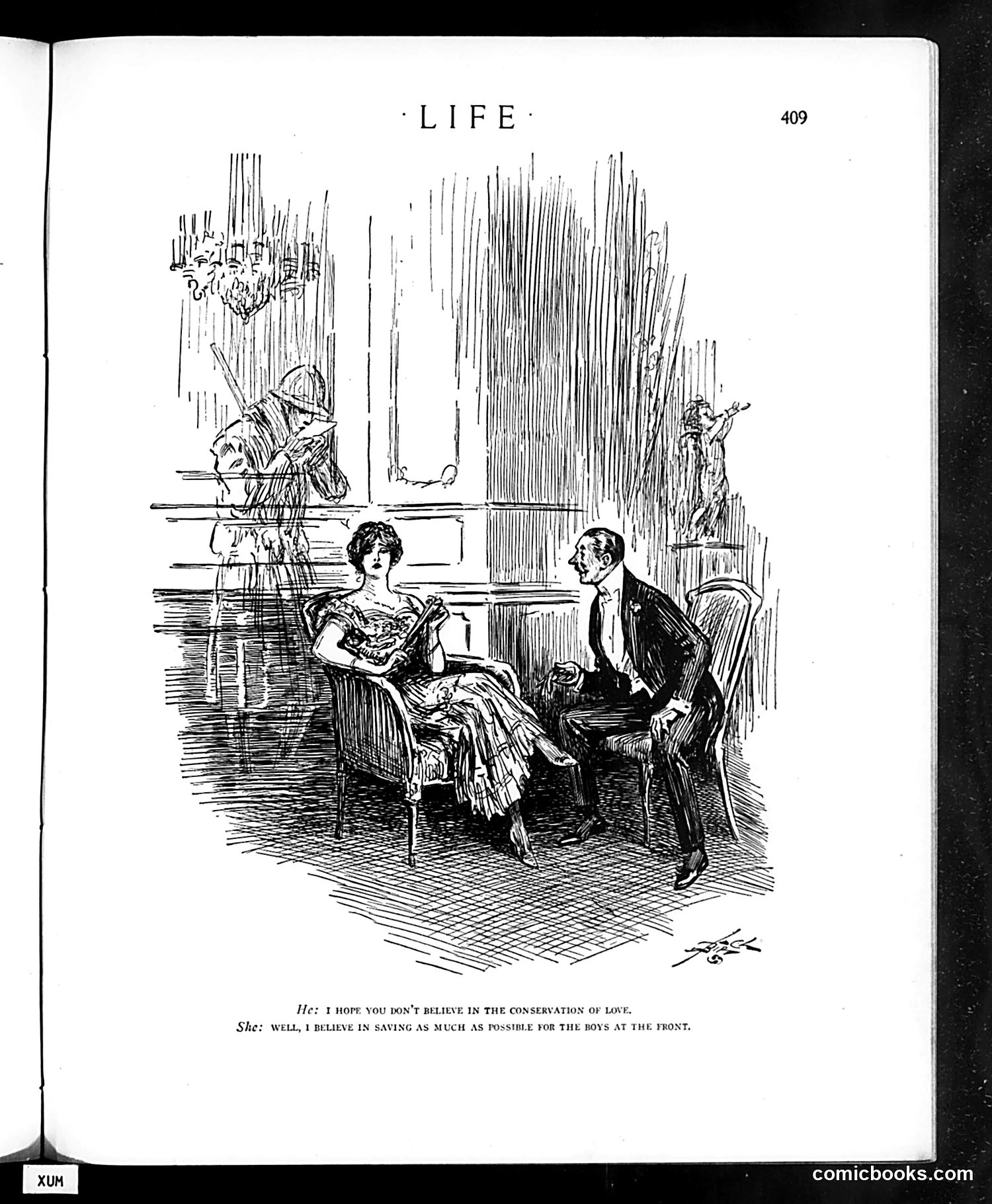
This single-panel cartoon depicts a domestic conversation between a well-dressed couple in an elegant interior. The man expresses skepticism about "the conservation of love," while the woman counters that she believes in "saving as much as possible for the boys at the front." The satire addresses WWI-era attitudes toward romance and patriotism. The woman's comment about "boys at the front" suggests she's prioritizing soldiers' morale over her own romantic life—a socially-acceptable stance during wartime. The cartoon gently mocks this excessive patriotic fervor by showing how it extends even into intimate relationships, turning wartime sacrifice into domestic conversation fodder. The joke relies on understanding that such rhetoric was common propaganda during the First World War.
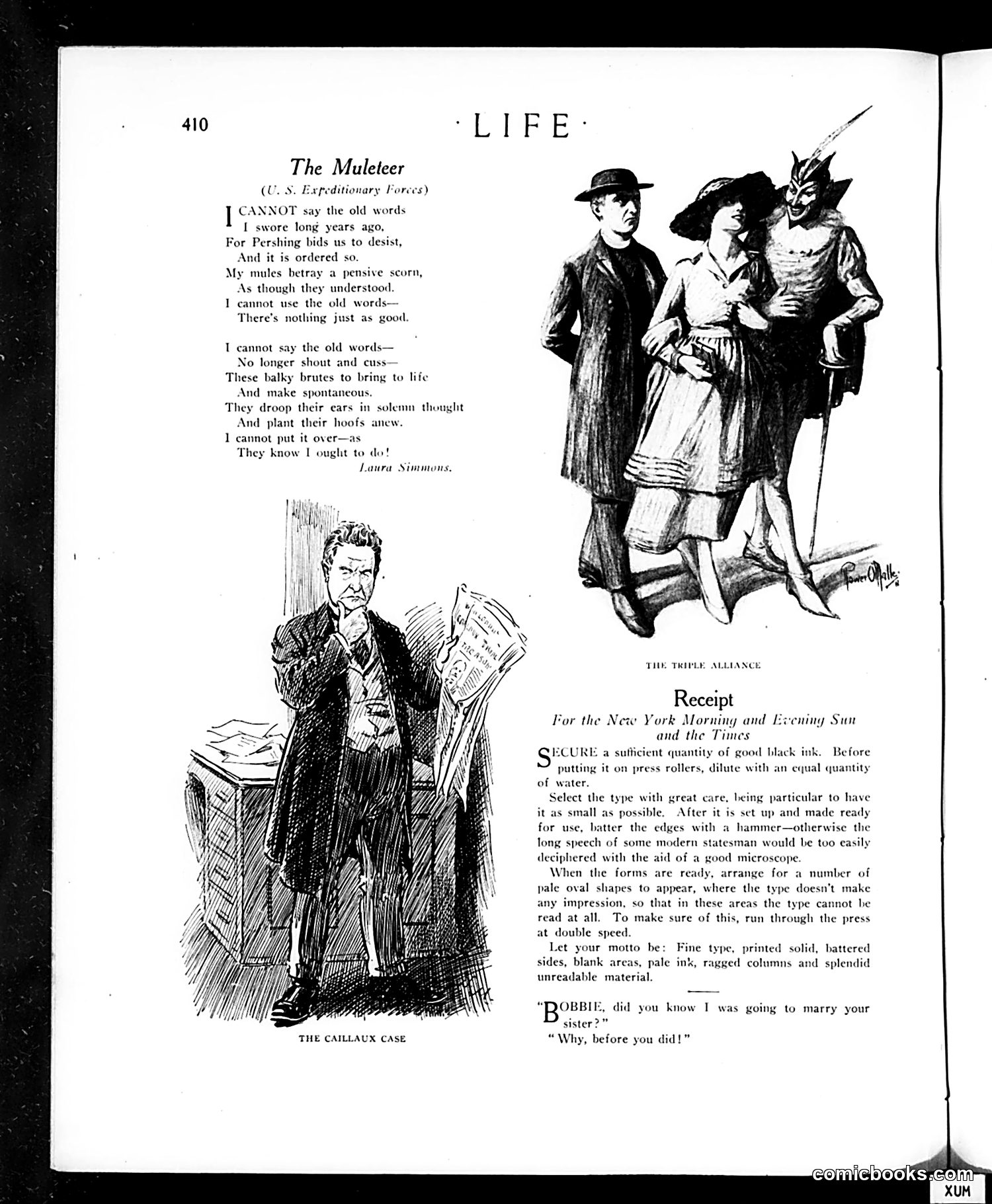
This page contains three distinct elements: 1. **"The Muleteer" poem** by Laura Simmons—a humorous verse about a muleteer who cannot use the traditional curses and shouts expected of his profession, having sworn off such language. 2. **"The Caillaux Case"** illustration (left)—a political cartoon referencing a scandal involving French politician Joseph Caillaux. The sketch shows a distressed man holding papers, likely satirizing the scandal's exposure in the press. 3. **"The Triple Alliance" illustration** (right)—shows three figures in apparent conspiracy or collusion, though the specific political reference is unclear without additional context. 4. **"Receipt" section**—satirical instructions for newspaper printing, mocking sensationalist journalism practices of the era by suggesting deliberately poor typesetting and layout. The page overall demonstrates *Life* magazine's characteristic blend of literary humor and political satire.
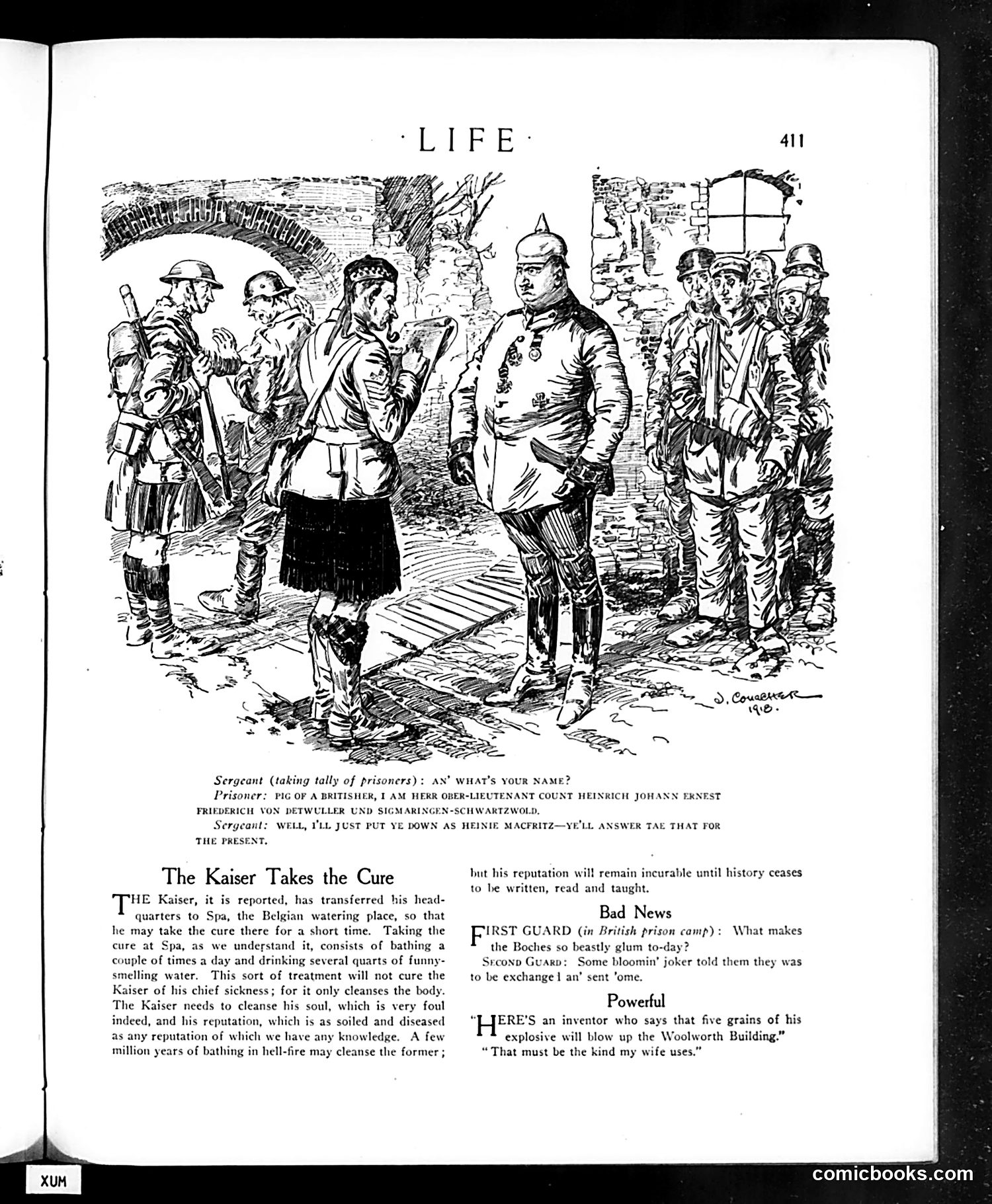
This page satirizes **Kaiser Wilhelm II of Germany** during World War I. The main cartoon depicts the Kaiser (center, in distinctive spiked helmet) being interrogated by Allied soldiers, likely as a prisoner of war. The caption reveals his claimed identity: "Herr Ober-Lieutenant Count Heinrich Johann Ernest Friederich von Detwuller und Sigmaring-Schwartzwold"—a humorous, made-up name suggesting the Kaiser is attempting to hide his identity or evade responsibility. The accompanying text "The Kaiser Takes the Cure" jokes darkly about the Kaiser needing moral and spiritual cleansing, implying his guilt. The brief "Bad News" and "Powerful" items are unrelated satirical quips typical of *Life* magazine's humor section. The satire mocks the Kaiser's potential capture and his reputation as a war criminal requiring accountability.
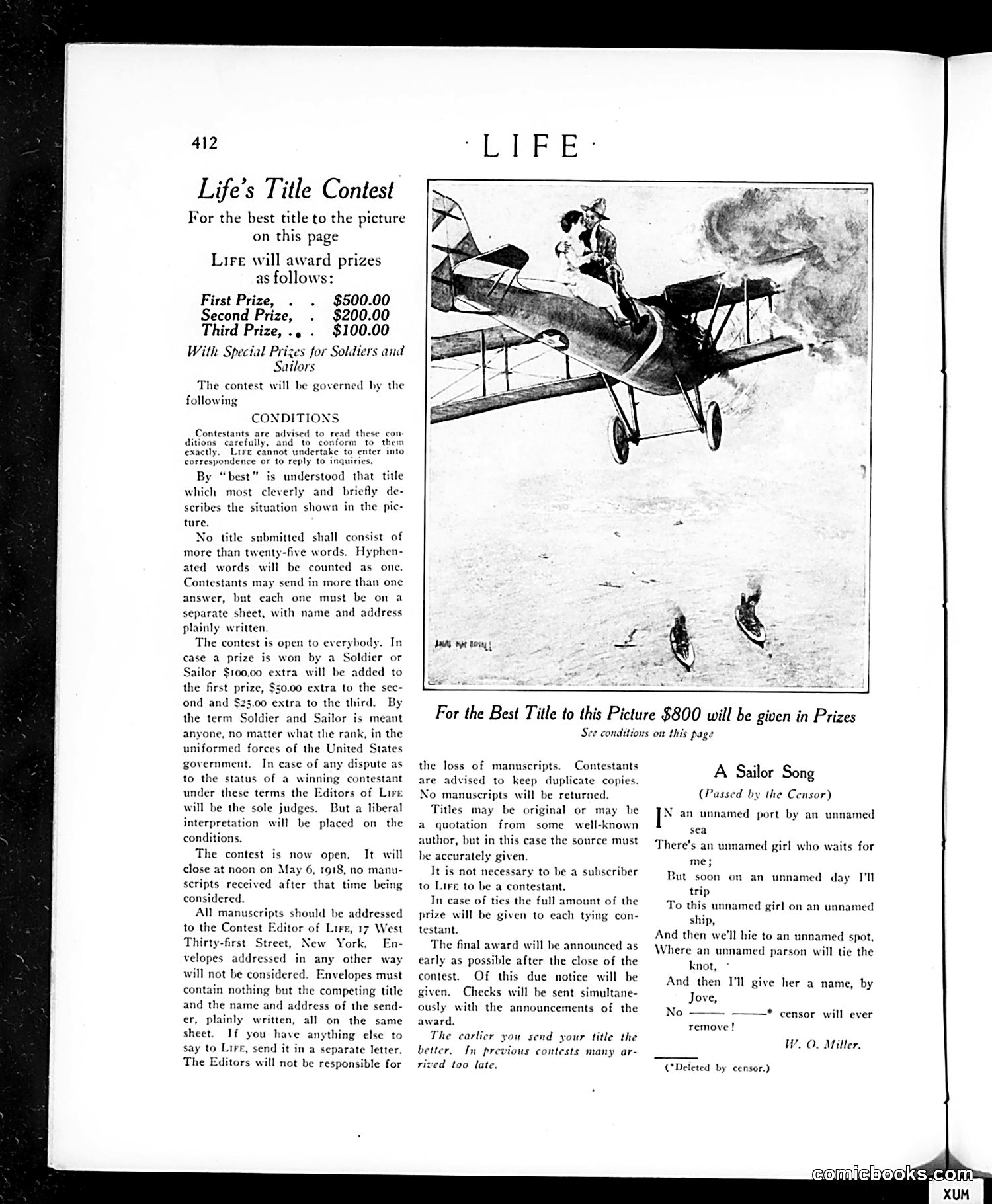
This page announces **Life's Title Contest** for the aviation image shown—a humorous illustration of what appears to be a man and woman in or near a small early airplane. The contest offers $800 in prizes ($500 first place) for readers to submit witty captions, with special bonus amounts for entries by soldiers and sailors. Below is a poem titled **"A Sailor Song"** attributed to W. O. Miller and marked "(Passed by the Censor)." The poem humorously describes an unnamed sailor waiting for an unnamed girl in an unnamed port on an unnamed day—a comedic exercise in repetitive vagueness, likely satirizing wartime censorship restrictions that prevented publication of specific military locations and personnel details during World War I.
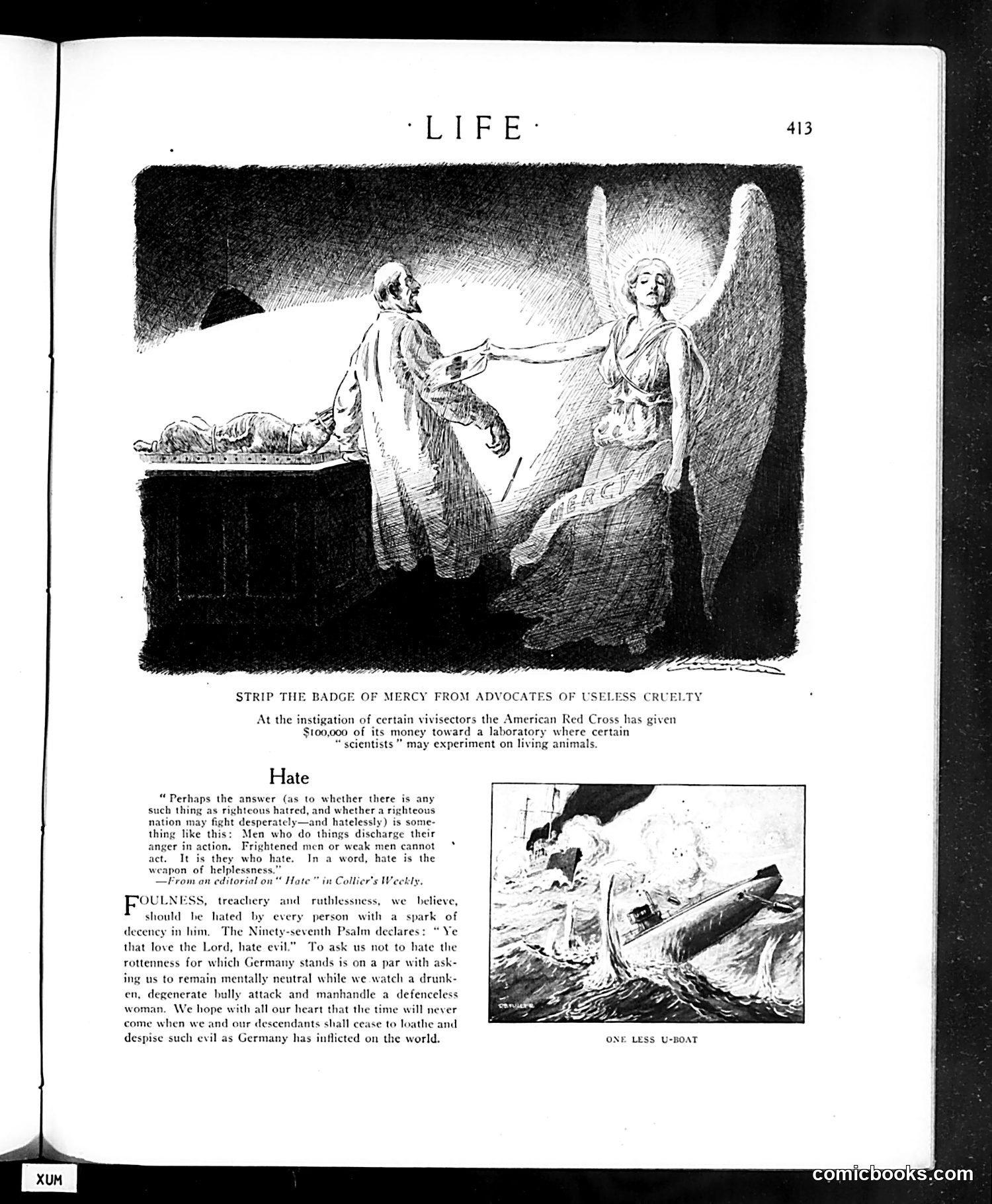
**Top Cartoon:** Depicts an angel offering a badge labeled "Mercy" to a kneeling figure. The caption states the American Red Cross donated $100,000 to a laboratory for animal experimentation. The satire criticizes this as contradictory—the Red Cross, an organization symbolizing mercy and humanitarian aid, is funding animal cruelty. The angel's gesture is ironic: rather than conferring mercy, the Red Cross is "stripping the badge of mercy from advocates of useless cruelty." **"Hate" Section:** An anti-German editorial condemning Germany's ruthlessness in World War I, invoking scripture and calling for descendants to "cease to loathe and despise" such evil—though the present moment demands it. **Bottom Image:** "One Less U-Boat" shows a sunken submarine, illustrating German military aggression at sea. The page reflects WWI-era American propaganda and moral outrage.
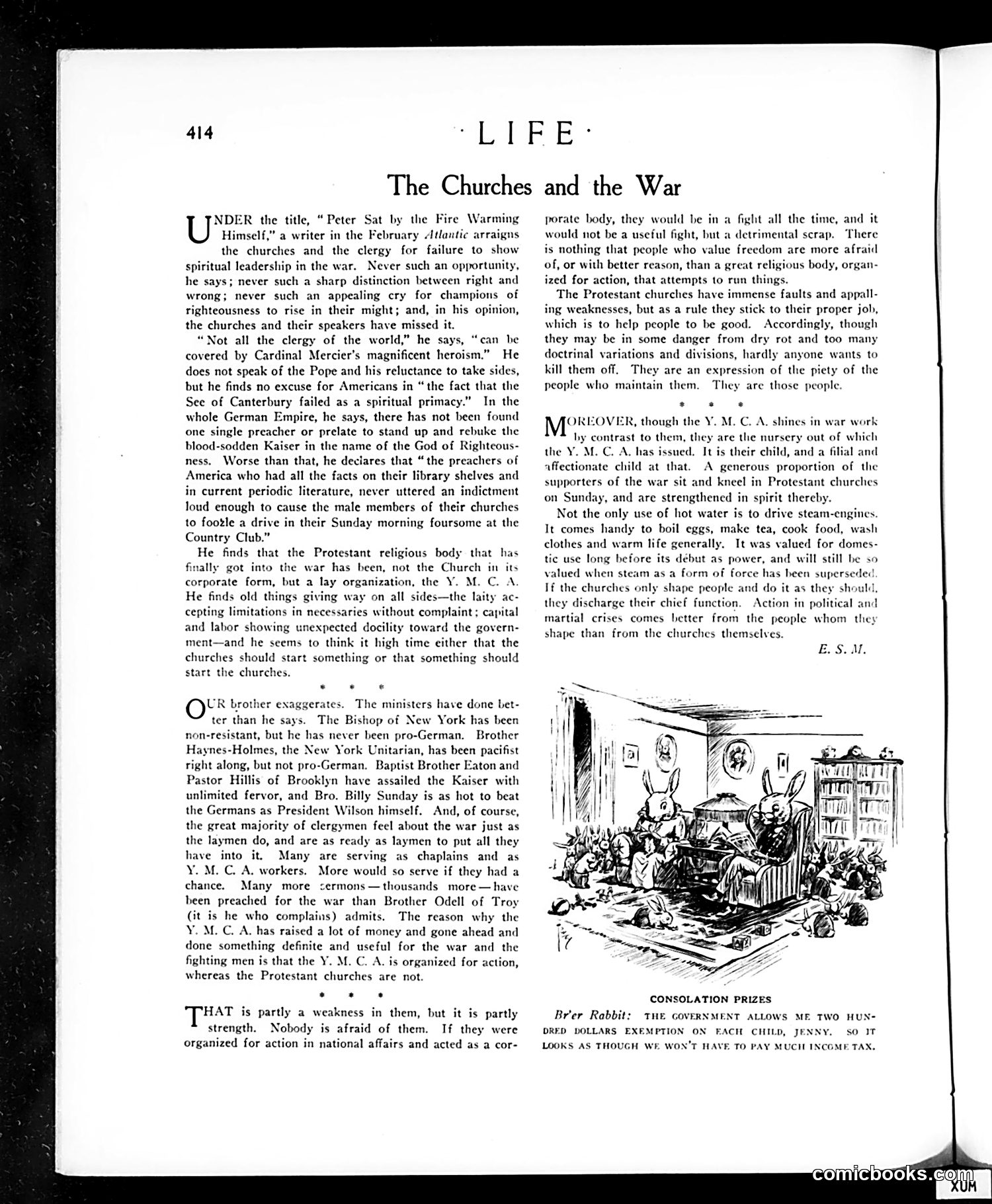
This single-panel cartoon depicts a rabbit in a study, surrounded by books and religious iconography (portraits on walls). The caption reads: "The government allows me two hundred dollars exemption on each child, Jenny, so it looks as though we won't have to pay much income tax." The satire targets religious exemptions from taxation during wartime (likely WWI era, based on the article context discussing churches and war). The joke criticizes how families—represented by this rabbit—could exploit child tax exemptions to avoid contributing financially to the war effort, even as churches debated their patriotic duties. The cartoon mocks the irony of religious institutions claiming pacifism while their members benefit from tax loopholes meant to support families, not dodge national obligations.
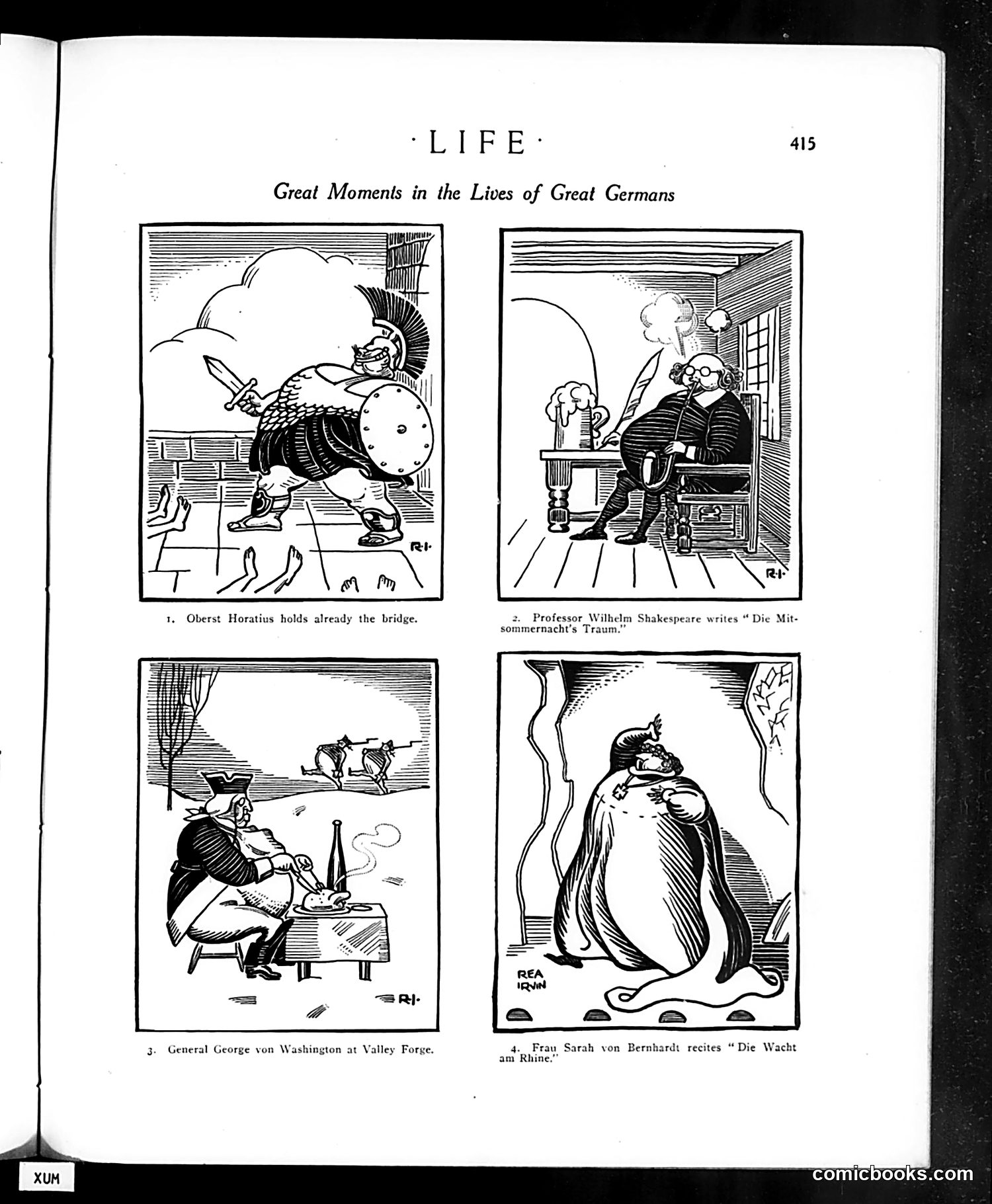
This is satirical commentary on German military and cultural figures, presented as four comic vignettes: 1. **Oberst Horatius holds already the bridge** - A Roman historical reference repurposed to mock German military heroism 2. **Professor Wilhelm Shakespeare writes "Die Mitsommernacht's Traum"** - Absurdist humor claiming Shakespeare was German 3. **General George von Washington at Valley Forge** - Another non-German historical figure "Germanized" with the "von" prefix 4. **Frau Sarah von Bernhardt recites "Die Wacht am Rhine"** - The French actress given German identity The satire appears to ridicule German cultural appropriation or exaggeration of their contributions to world civilization. By retroactively claiming famous non-German figures as German with comic exaggeration, Life mocks nationalist pretensions—likely reflecting WWI-era American skepticism toward German claims of cultural superiority.
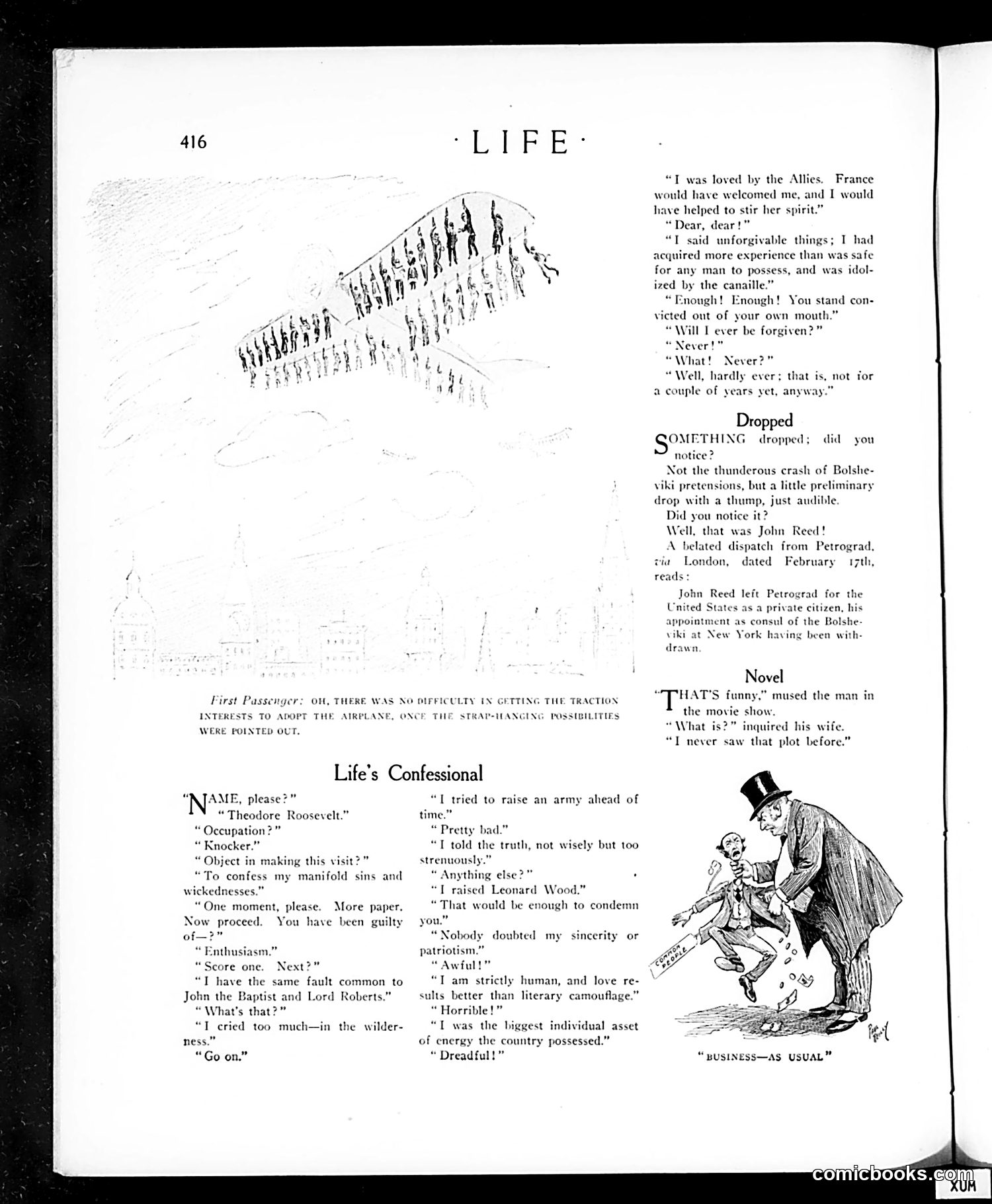
This page contains three satirical pieces targeting prominent figures from the World War I era: **"Life's Confessional"** mocks Theodore Roosevelt through a mock-confession format. Roosevelt admits to being a "knocker" (critic) who raised armies, spoke too strenuously about truth, and was idolized by "the canaille" (common people). The satire suggests Roosevelt was a self-aggrandizing warmonger whose main "sin" was excessive enthusiasm and influence—criticisms common among his detractors during and after WWI. **"Dropped"** references John Reed, the American journalist and communist sympathizer who left Petrograd (Leningrad) after his appointment as Bolshevik consul to New York was withdrawn. The item sarcastically presents his departure as a minor, barely-noticed event rather than significant news. **"Novel"** is a brief joke about movie plots being unoriginal. The cartoons satirize American political figures and events of the post-WWI period, targeting Roosevelt's interventionism and Reed's communist associations—reflecting the magazine's skeptical, satirical perspective on American public figures and radical politics.
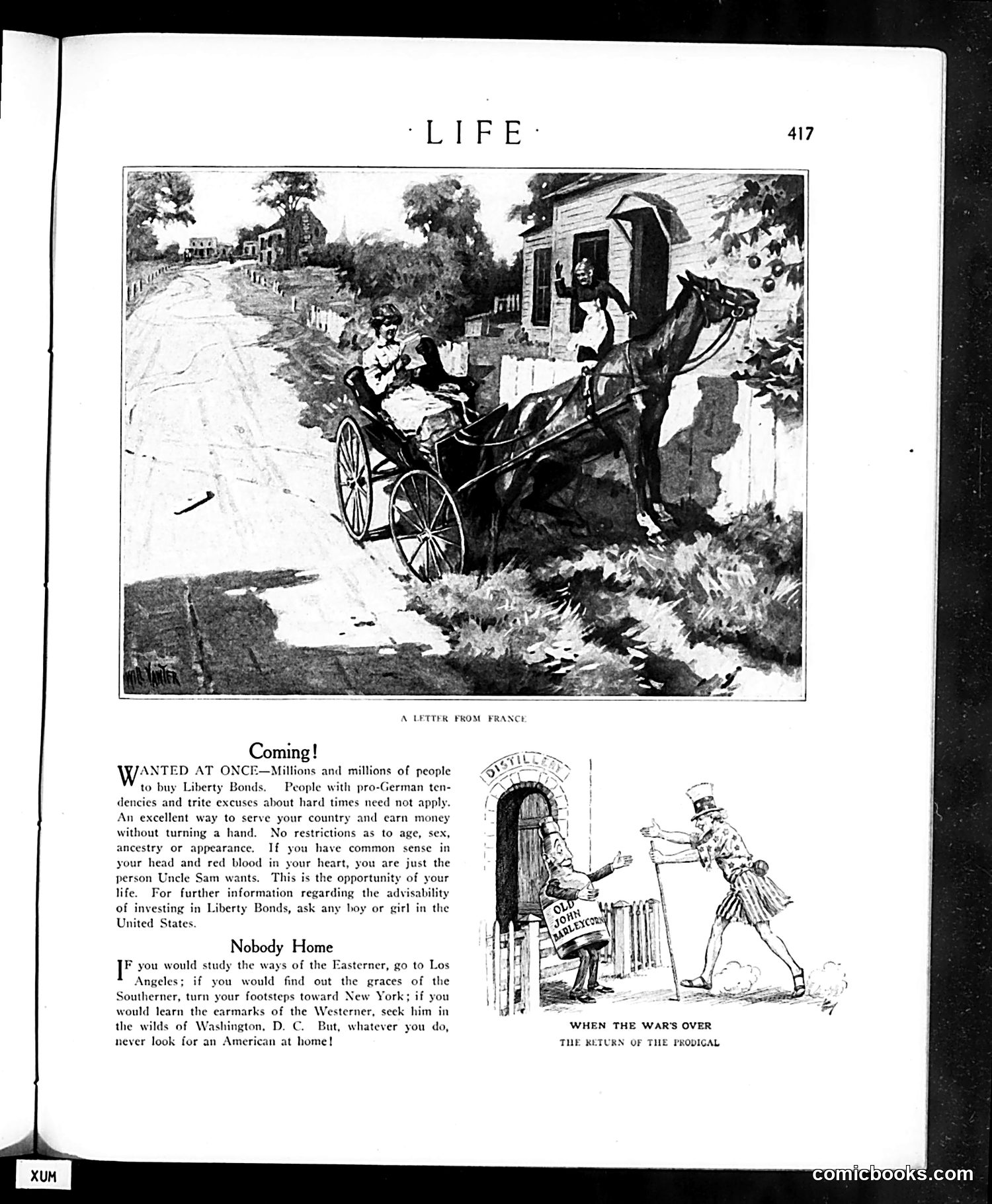
This page contains **Liberty Bond recruitment propaganda** (top section) and **social satire** (bottom sections). The top ad recruits Americans to buy government bonds to finance WWI, explicitly excluding "pro-German" sympathizers—reflecting wartime xenophobia and suspicion of German-Americans. The middle section titled "Nobody Home" satirizes American restlessness and rootlessness: if you want to understand regional character types (Easterners, Southerners, Westerners), you paradoxically must travel *away* from home, because Americans never stay put. The bottom cartoon, "When the Wars Over: The Return of the Prodigal," adapts the Biblical parable of the Prodigal Son. It depicts a ragged, starving soldier returning home from WWI to find the door closed—suggesting Americans' feared indifference to returning veterans and society's "nobody home" attitude. The satire criticizes American apathy toward those sacrificing abroad.
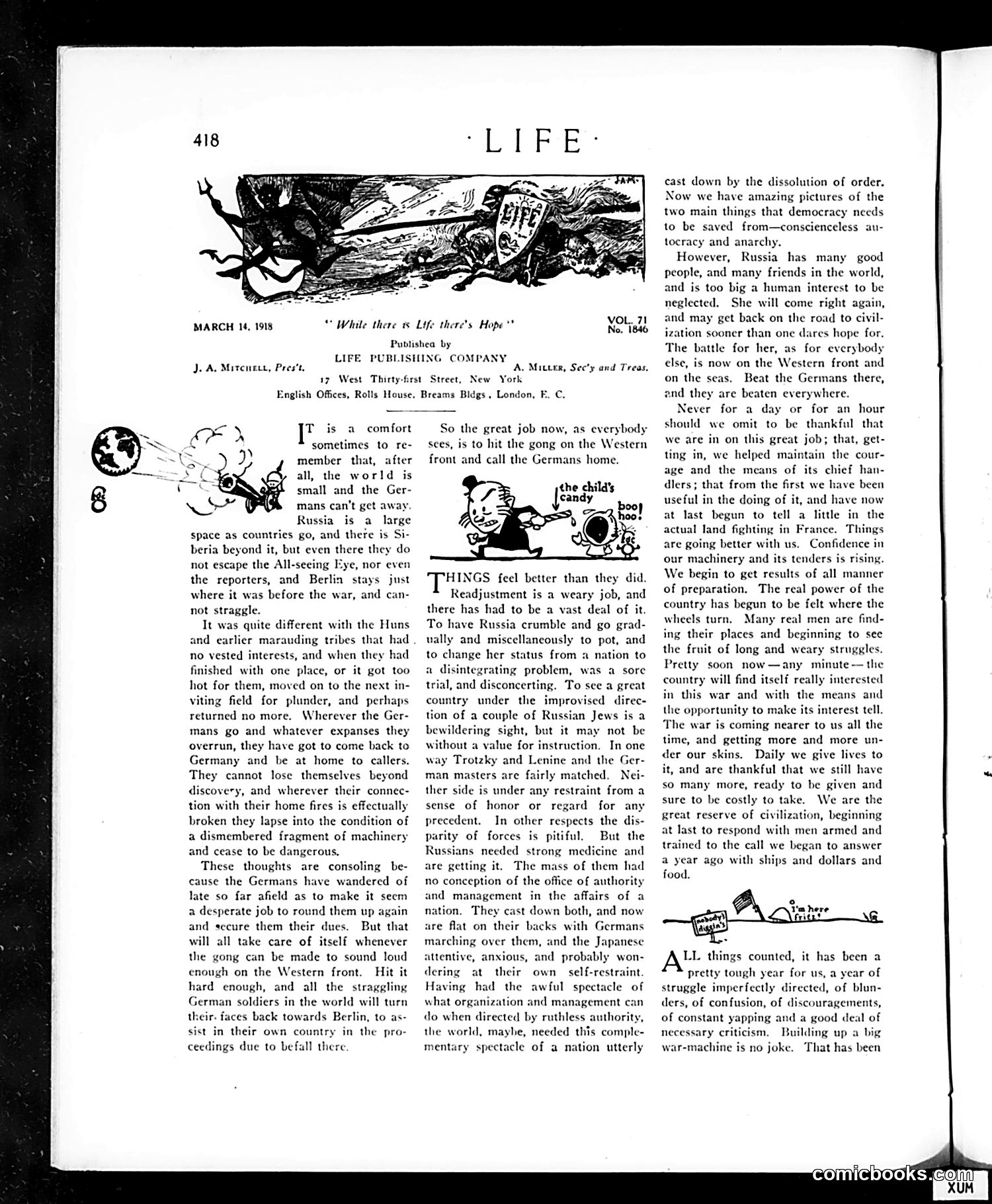
This page addresses Russia's collapse during World War I, following the Bolshevik Revolution and separate peace with Germany. The editorial uses two metaphors to explain the situation: **The "All-seeing Eye" cartoon** illustrates that Germany cannot escape consequences—they must return home to face justice, unlike historical invaders who could disappear into vast territories. **The main text discusses Russia's predicament**: The author expresses concern that Russia's dissolution into chaos under "a couple of Russian Jews" (referring to Lenin and Trotsky) represents democracy's danger from both "conscienceless autocracy and anarchy." However, the piece argues Russia remains strategically important and will recover if Germany is defeated on the Western Front. The tone is sympathetic to Russia's potential while clearly anti-Bolshevik, viewing the revolutionary government as chaotic and foreign-controlled. The piece reflects American anxiety about Russia's exit from the war and its destabilizing effects on the Allied cause.
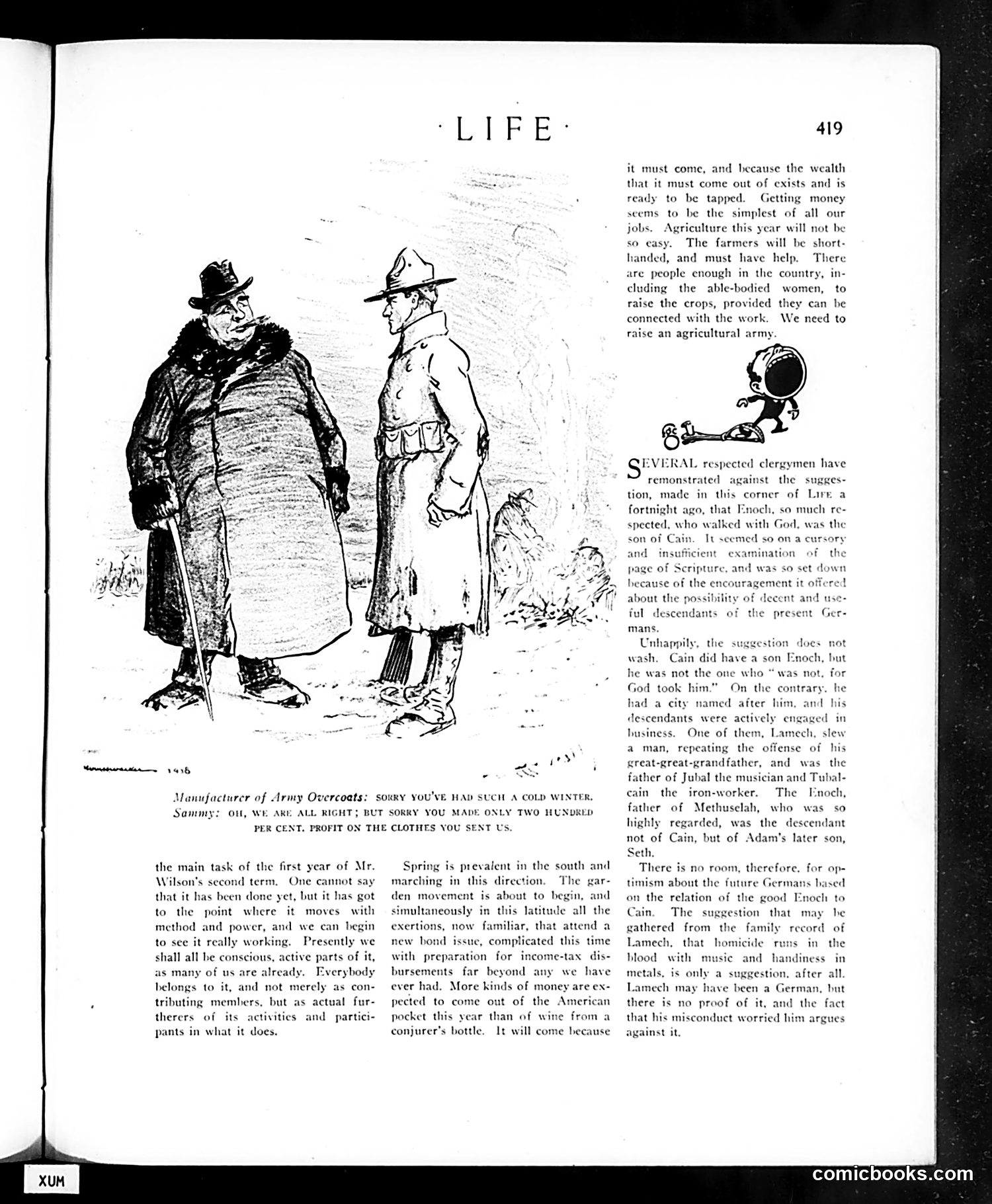
This page contains a single political cartoon with accompanying satirical text about World War I-era American issues. **The Cartoon:** A manufacturer of army overcoats complains to "Sammy" (Uncle Sam, representing the U.S. government) that he's only made a 200 percent profit on military clothing supplies during a harsh winter. The joke satirizes war profiteering—contractors were making enormous profits supplying the military while soldiers suffered cold. **The Text Below:** Discusses President Wilson's second term priorities, including the need for agricultural workers (many men were in the military), income taxes, and war financing. The final section humorously debates whether the biblical figure Enoch descended from Cain, then absurdly suggests that since Lamech (Enoch's descendant) was a murderer, modern Germans—presumably implying they're descendants of Lamech—are inherently warlike. This is obviously tongue-in-cheek ethnic stereotyping used for satirical effect against Germany.
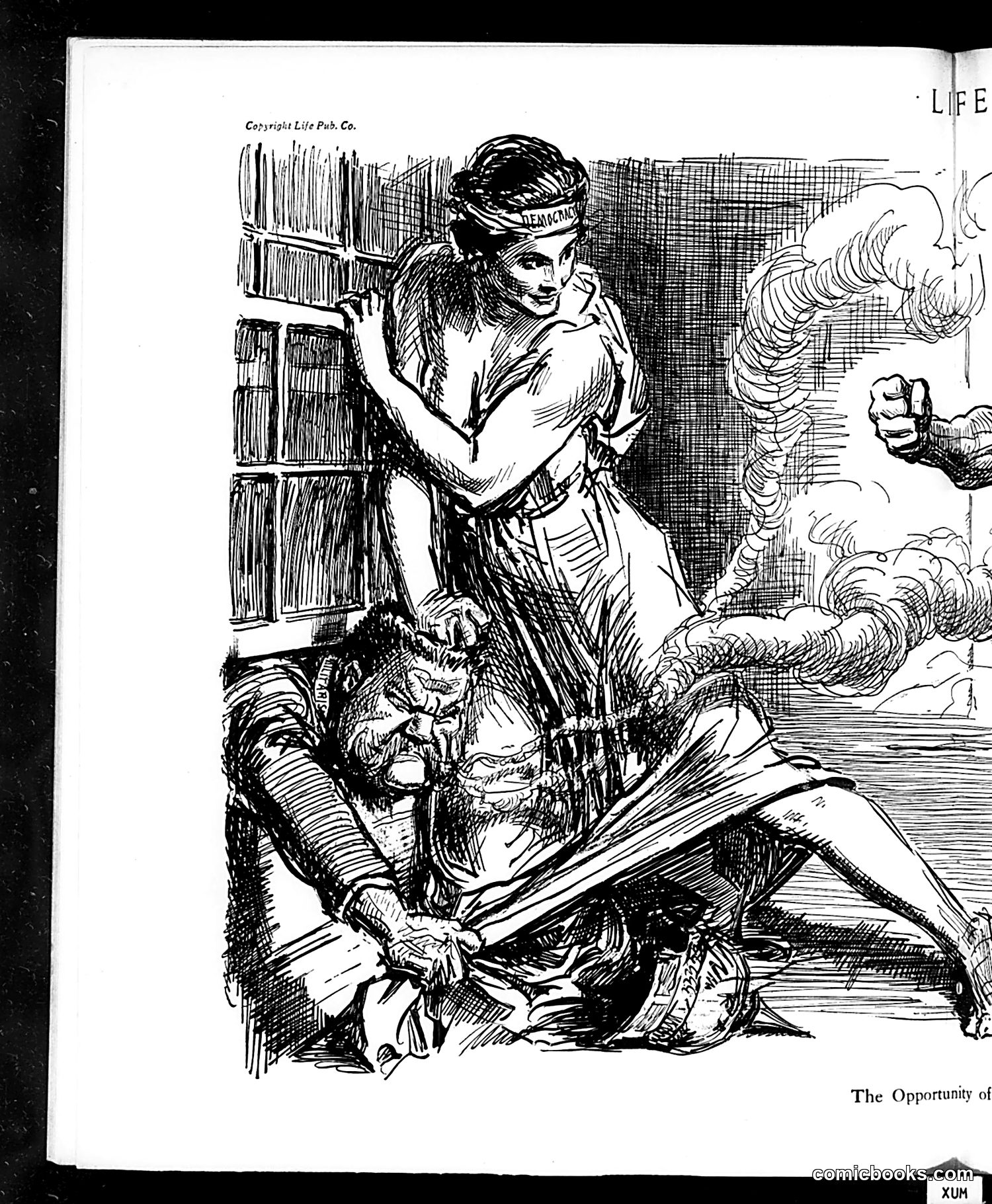
This appears to be a satirical illustration from Life magazine showing a woman in classical "Liberty" or "Justice" dress (indicated by the headband) standing over a prone, caricatured figure. The style of caricature suggests this depicts a racial or ethnic stereotype common to early 20th-century American political cartoons. The composition suggests commentary on power dynamics or opportunity—the standing figure represents an idealized American virtue or principle, while the prone figure likely represents a marginalized group. Without the complete caption visible, the specific political event or issue being satirized is unclear, but the visual hierarchy and classical allegorical elements indicate this was critiquing American social or political inequality of that era.
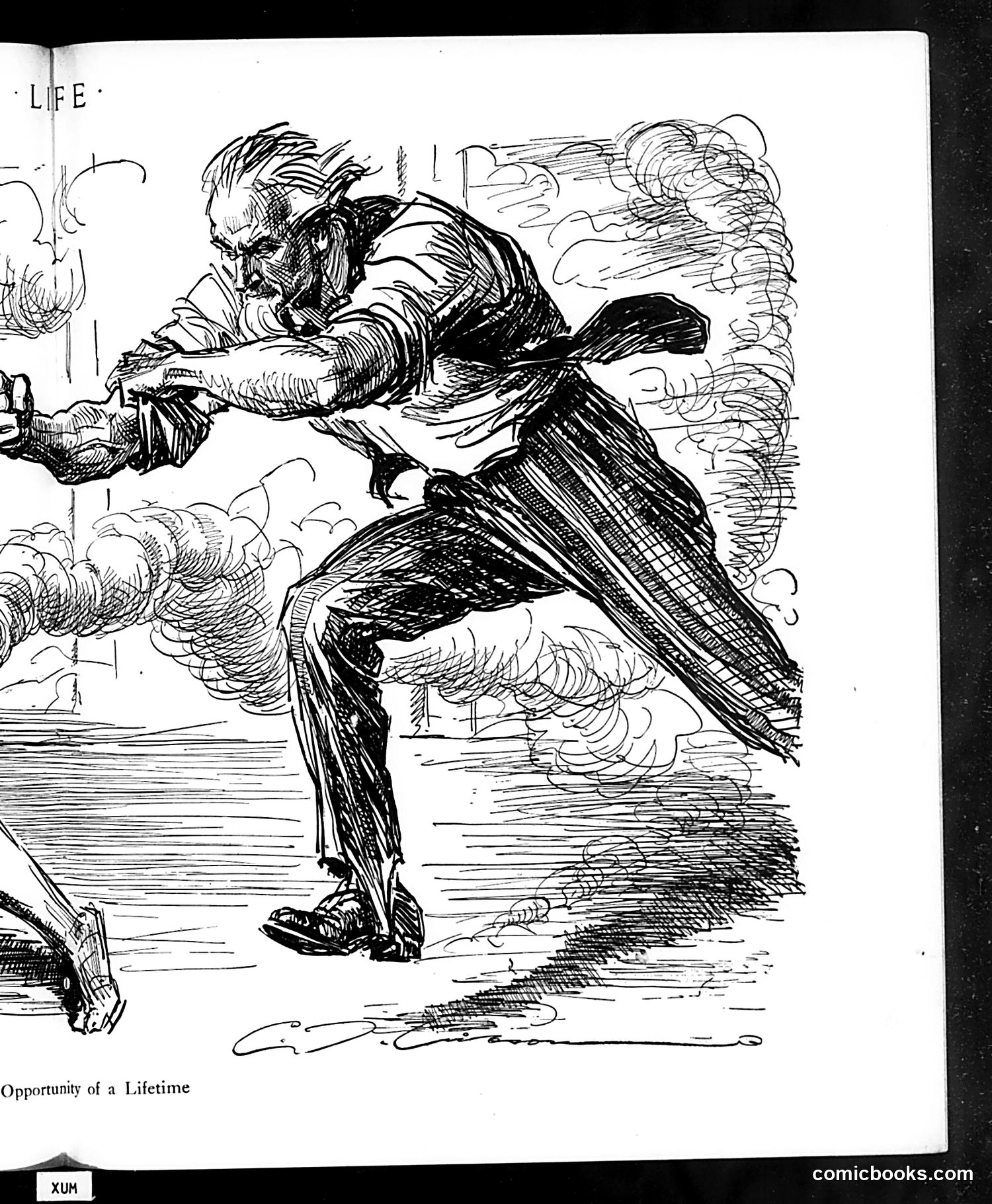
This satirical cartoon from *Life* magazine depicts a man in formal attire (suit and tie) striking an exaggerated martial pose—leg raised high, arms extended aggressively—as if preparing for combat. The title "Opportunity of a Lifetime" suggests ironic commentary on a significant moment or chance. The caricature style and dynamic posture suggest this is likely political satire, though without additional context, the specific figure and historical event remain unclear. The aggressive stance and formal dress might reference a politician or public figure facing a crucial confrontation or decision. The cartoon's central message appears to satirize how someone is seizing or preparing for a major challenge, with the exaggerated physicality emphasizing either their eagerness or the absurdity of their response to the situation.
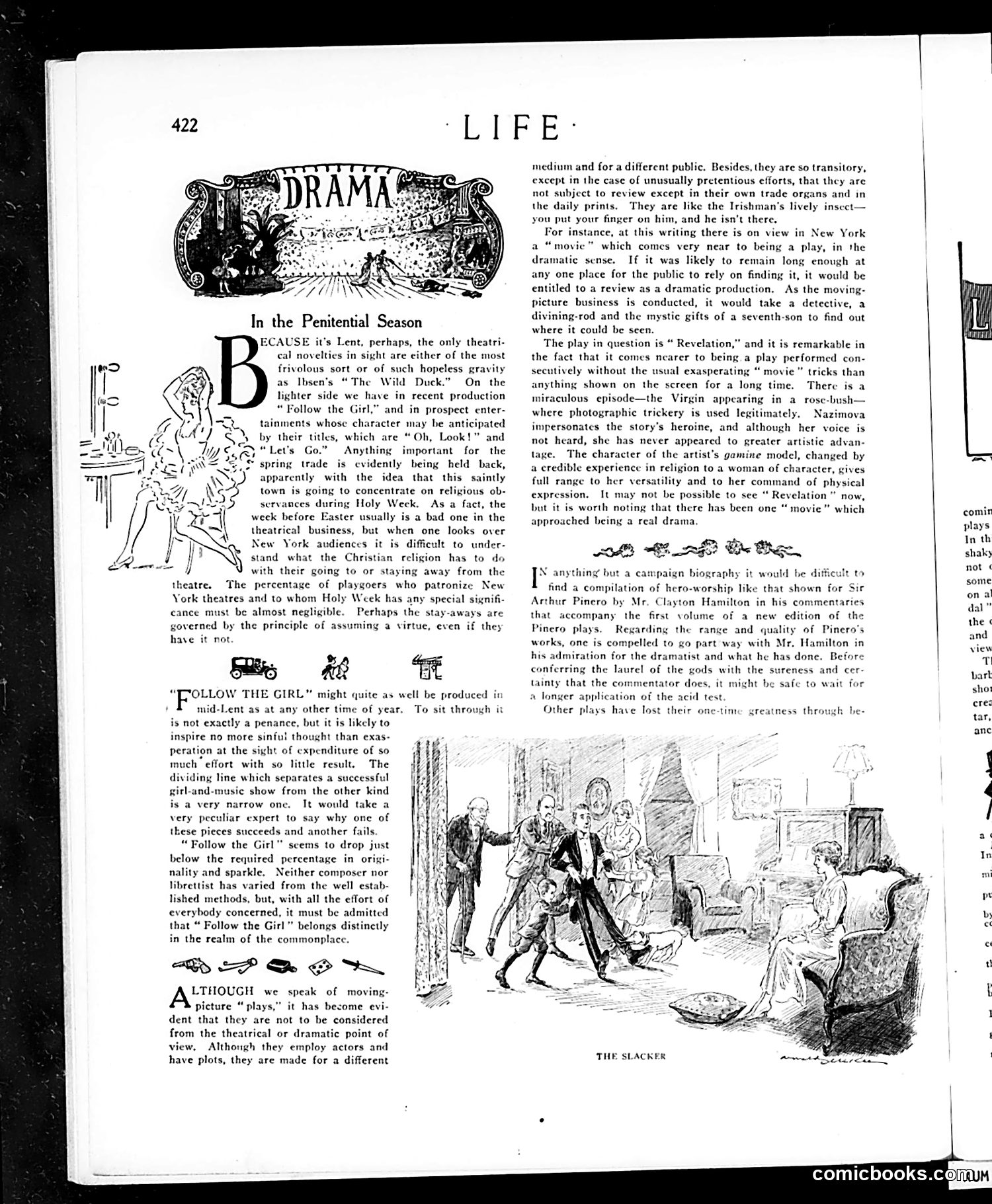
This page critiques theatrical offerings during Lent in New York. The main points: **"In the Penitential Season"**: The author notes that theaters offer mostly frivolous comedies ("Follow the Girl," "Oh, Look!") or heavy dramas (Ibsen's "The Wild Duck") during Lent, with important productions held for later. He sarcastically observes that New York audiences likely aren't actually staying away for religious reasons—suggesting theatergoers aren't particularly devout despite the city's pretensions. **"Follow the Girl"**: A mediocre musical comedy lacking originality and sparkle, representing the forgettable, commonplace entertainment that fails to distinguish itself. **Moving Pictures**: The author argues films shouldn't be reviewed as theater—they're a different medium for different audiences, and their transitory nature makes them difficult to even locate for review. **"Revelation"**: A notable film exception featuring actress Nazimova, with unusually coherent narrative structure and legitimate artistic merit rather than cheap "movie tricks." The satirical tone criticizes both theatrical mediocrity and the pretense of religious observance.
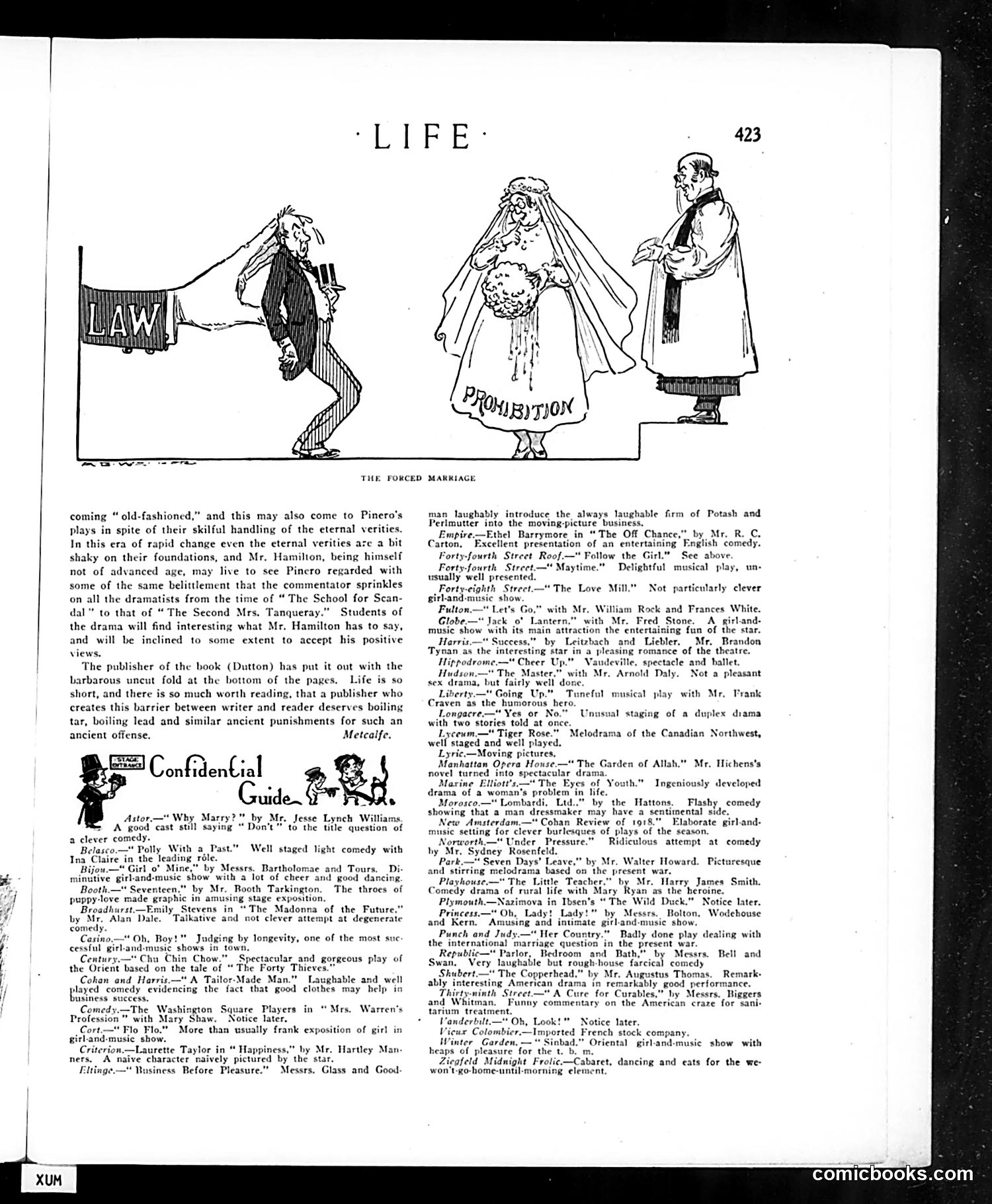
This cartoon satirizes **Prohibition's impact on marriage**. The image shows three figures: on the left, "Law" (labeled) forcibly pushing a man in a suit; in the center, a bride labeled "Prohibition" being married off; on the right, a clergy member conducting the ceremony. The satire suggests that Prohibition legislation was being "forced" into an unwanted union with traditional American institutions—specifically marriage and social customs. The joke plays on the notion that Prohibition, like an arranged marriage, was an unpopular, coercive measure being imposed by legal authority rather than accepted willingly by the public. This reflects early 20th-century tensions around Prohibition's passage and enforcement, treating the law as an unwanted "spouse" forced upon the American people through legal compulsion rather than democratic consent.
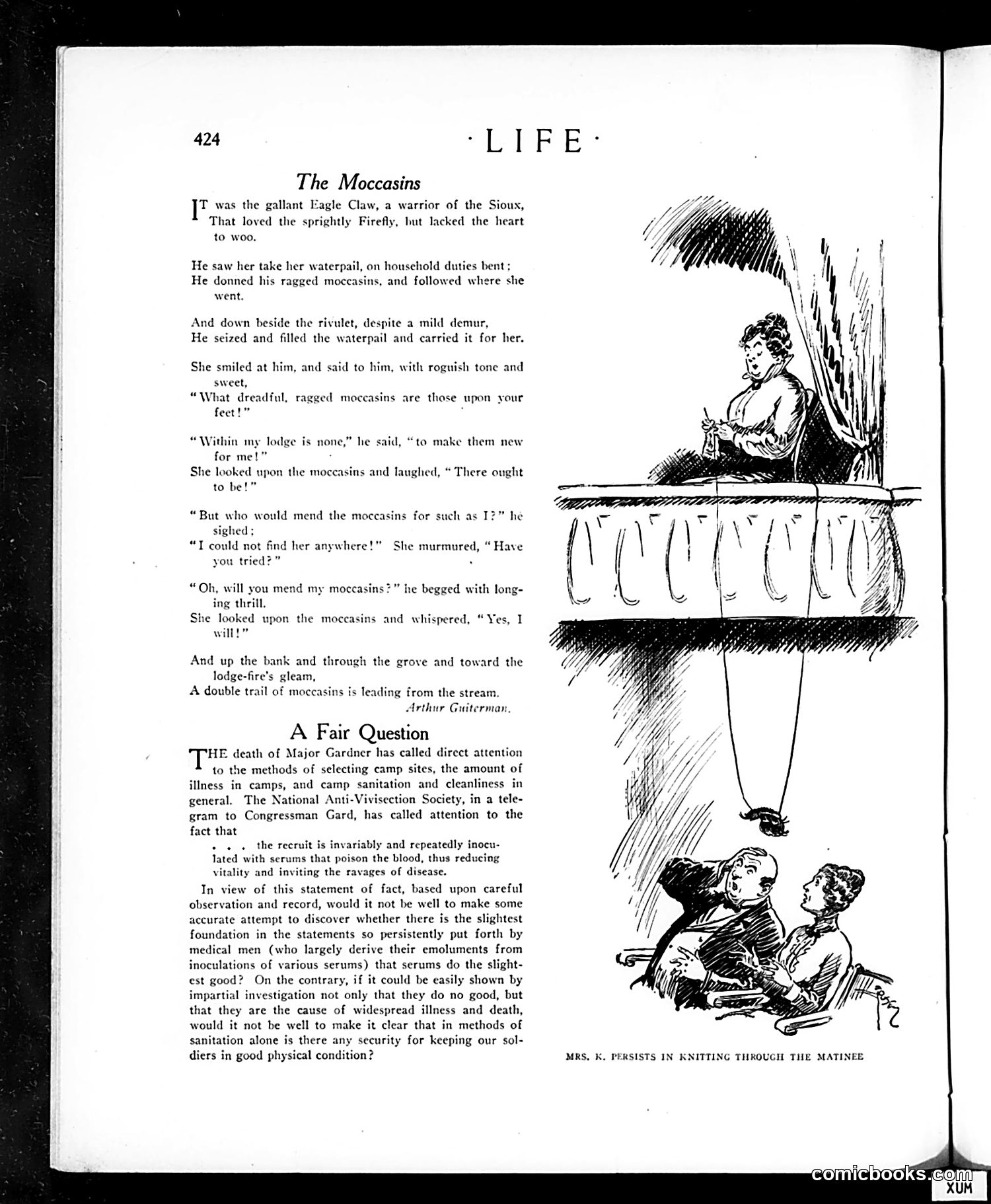
**"The Moccasins"** is a humorous poem by Arthur Guiterman using Native American characters (Eagle Claw, a Sioux warrior, and Firefly) to tell a romantic courtship story. The satire targets gender roles: the bashful warrior performs household labor (fetching water) to woo the woman, who teases him about his shabby moccasins. When he laments having no one to repair them, she pointedly asks, "Have you tried?"—implying he should do it himself rather than expect women's domestic labor. The accompanying illustration shows the couple by a river, with the poem's gentle mockery of traditional male courtship rituals. **"A Fair Question"** discusses military health, prompted by Major Gardner's death. The Anti-Vivisection Society challenges medical claims that inoculations benefit soldiers, arguing instead that serums poison recruits and that proper sanitation—not vaccines—ensures health. This reflects early 20th-century anti-vaccination sentiment. The bottom illustration shows a woman knitting during a theater matinee, unrelated to the articles above.
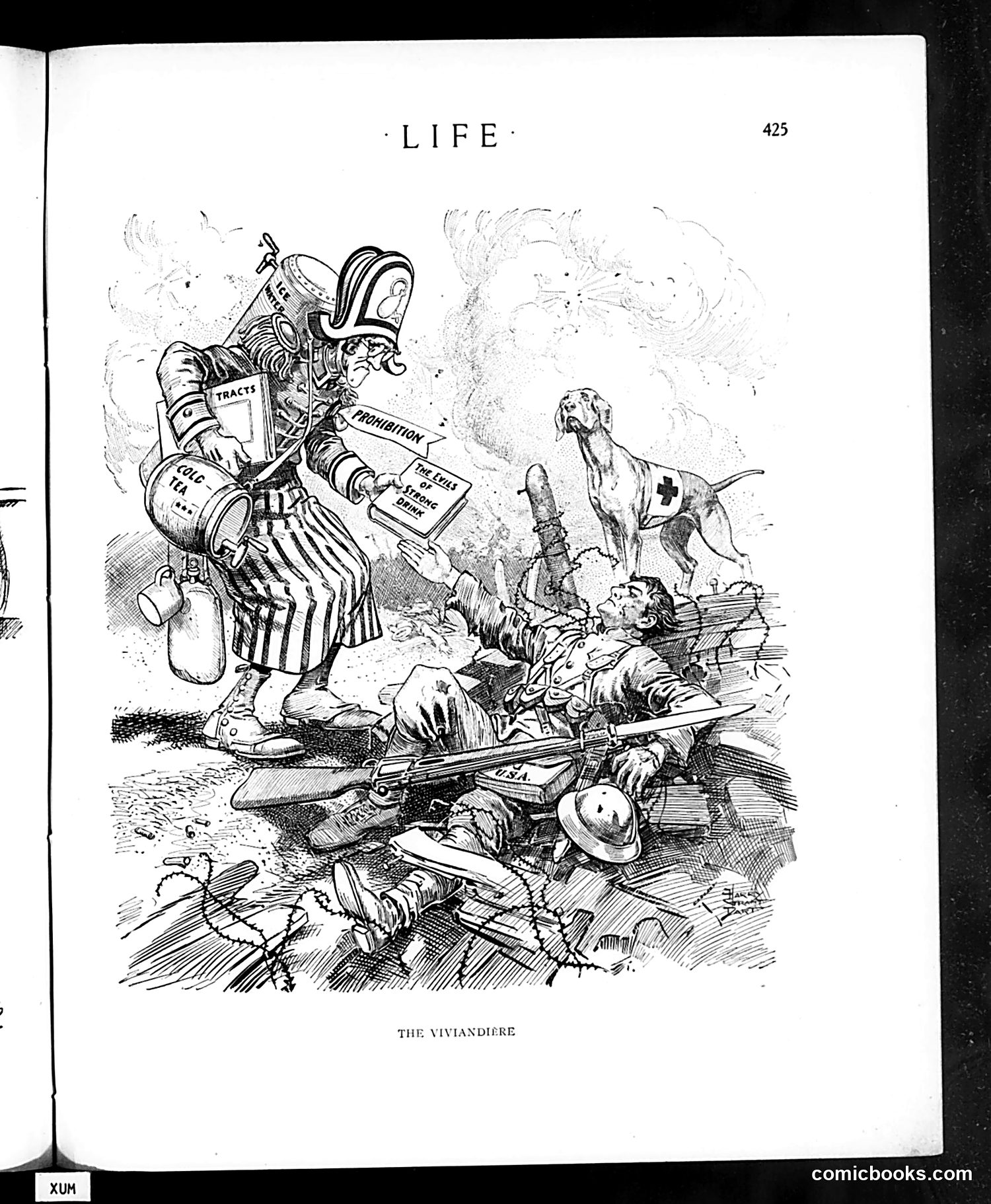
This political cartoon depicts an elaborately dressed female figure (labeled "vivandière"—a woman who followed armies to sell provisions) as a military supplier or war profiteer. She's laden with supplies marked "TRACTS," "PROHIBITION," and other labels, suggesting she peddles various social causes or reform movements like merchandise. Below her, two wounded or exhausted soldiers lie among military debris, appearing to suffer the consequences of her activities. A Red Cross dog stands nearby, suggesting humanitarian concern amid the chaos. The satire appears to critique how social reform movements—particularly Prohibition and other "tracts" or ideological campaigns—are commercialized or exploited for profit, leaving ordinary people (soldiers/citizens) damaged in their wake. The vivandière represents opportunistic profiteering from social causes.
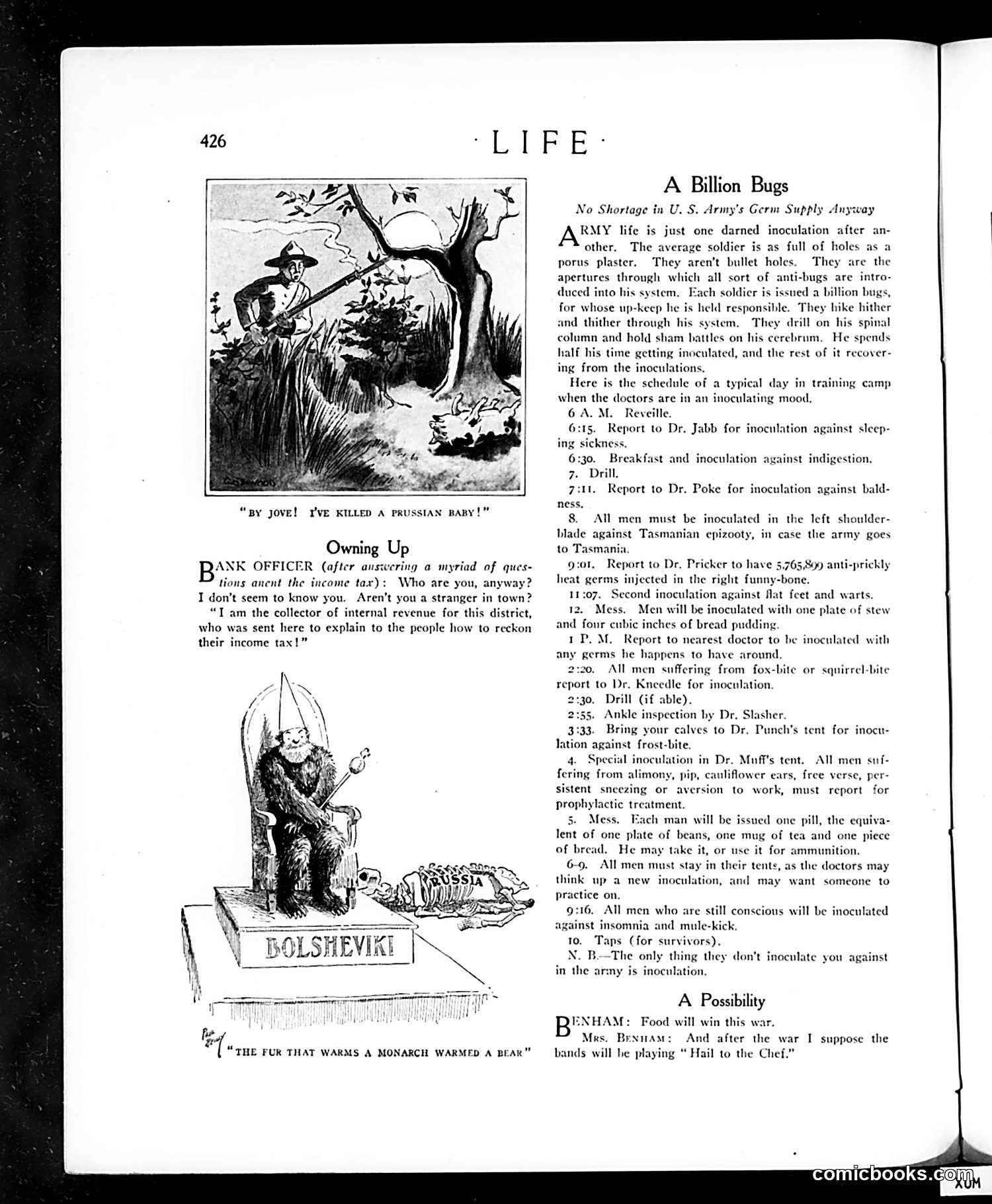
This page contains WWI-era American satire mocking military bureaucracy and procedures. **Top cartoon:** A soldier boasts of killing a "Prussian baby"—crude propaganda reflecting wartime dehumanization of the enemy. **"Owning Up":** A bank officer confronts an income tax collector, sarcastically questioning his identity. This references the newly-implemented federal income tax (1913), which was unpopular and unfamiliar to many Americans. The joke: the tax collector is so unknown/unwelcome that even a banker doesn't recognize him. **"A Billion Bugs":** This satirizes the Army's obsessive inoculation schedule. The detailed mock-schedule of medical procedures—with invented diseases like "Tasmanian epizooty" and "fox-bite"—exaggerates soldiers' complaints about constant vaccinations. The humor lies in the absurd accumulation and the final note that they don't inoculate against inoculation itself. **"A Possibility":** A brief joke predicting post-war social change, likely referencing evolving class dynamics.
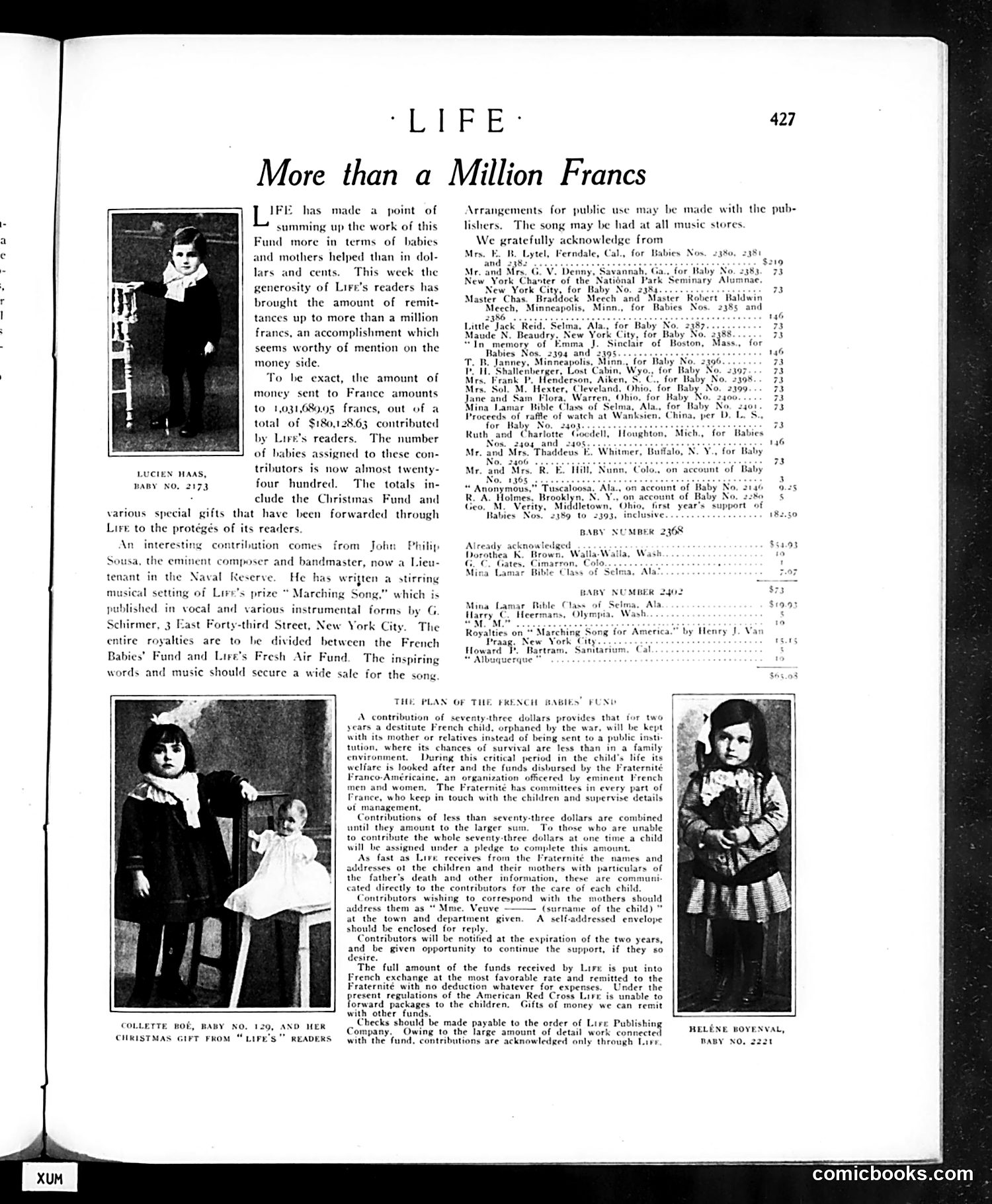
This page documents Life magazine's charitable fundraising campaign for French war orphans and their mothers during World War I. The publication has collected over one million francs ($180,128.63) from readers to support destitute French children orphaned by the war. The page lists individual and group contributors—churches, families, and organizations—who have "adopted" specific babies through the fund. Rather than placing children in institutions, the money keeps them with their mothers or relatives in France, where survival rates are better. A notable contribution comes from composer John Philip Sousa, who wrote a musical setting for Life's "Marching Song," with royalties split between the French Babies' Fund and Life's Fresh Air Fund. The photographs show beneficiary children. This represents Life's attempt to mobilize American generosity toward European civilian suffering caused by WWI through a tangible, emotionally compelling mechanism: readers could directly support named individual children.
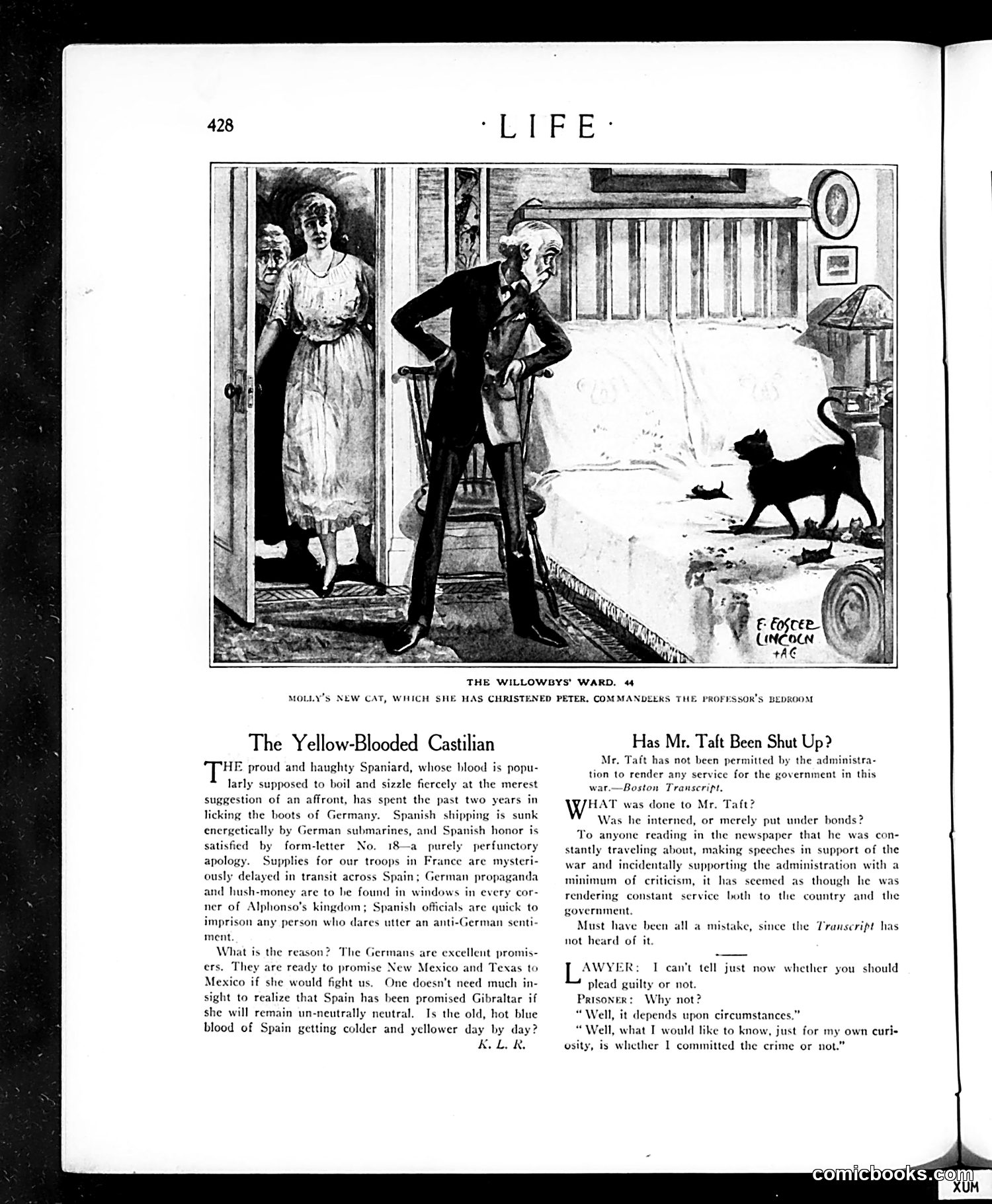
**The Cartoon:** "The Willowbys' Ward" depicts a domestic scene where a cat named Peter has taken over the professor's bedroom, with a woman (Molly) observing. This appears to be a humorous domestic comic strip installment unrelated to the political content below. **The Political Content:** Two articles address World War I-era issues: 1. **"The Yellow-Blooded Castilian"** satirizes Spain's supposed neutrality while favoring Germany. The author criticizes Spain for allowing German submarines to operate, delaying supplies to American troops in France, and accepting German propaganda and bribes—all while claiming neutrality. The phrase "yellow-blooded" suggests cowardice, mocking Spain's failure to maintain its proud reputation. Germany allegedly promises Spain Gibraltar and Mexico territorial gains as incentive. 2. **"Has Mr. Taft Been Shut Up?"** defends former President William Howard Taft against claims he was silenced by the administration, noting he actively campaigned supporting the war effort. Both pieces reflect American frustration with wavering allies and domestic political divisions during WWI.
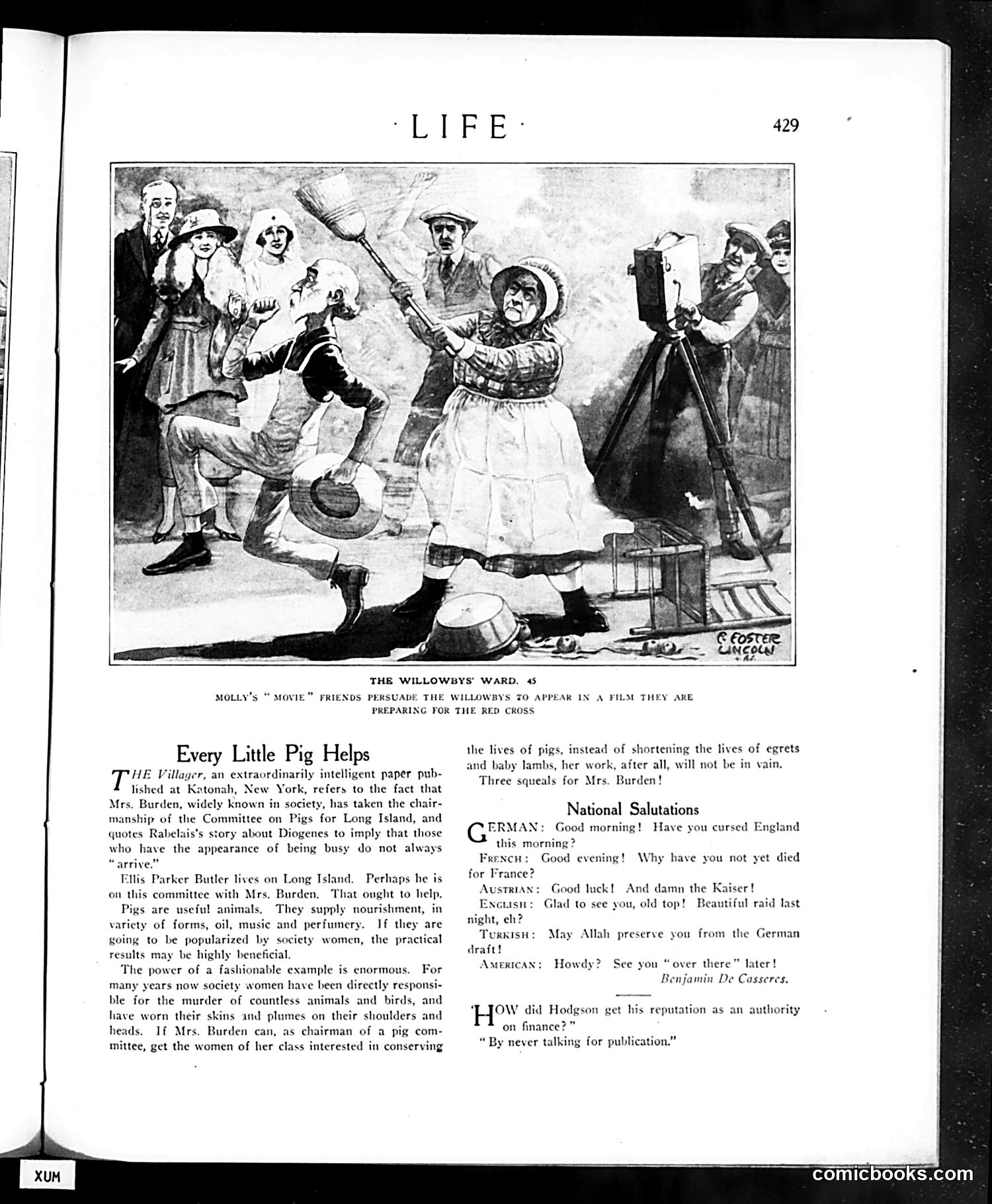
**Top Cartoon ("The Willowbys' Ward"):** A film comedy scene where Molly's movie-industry friends persuade a wealthy family (the Willowbys) to appear in a Red Cross benefit film. The satire targets society people's vanity—they're willing to participate in wartime charitable work primarily for the glamour and publicity of appearing in movies, not from genuine altruism. **"Every Little Pig Helps":** Satirizes high-society fashion trends' destructive impact. Mrs. Burden, a socialite, chairs a "Committee on Pigs for Long Island," promoting pig conservation. The author notes that wealthy women have historically killed countless animals for furs and feathers. The piece uses humorous exaggeration to suggest that if society women can be persuaded to protect pigs instead of slaughtering egrets and lambs for fashion, it would actually benefit conservation. **"National Salutations":** Comic wartime dialogue between soldiers of different nations (German, French, Austrian, English, Turkish, American), each offering sarcastic "greetings" referencing their respective wartime experiences and frustrations—a satirical comment on wartime tensions.
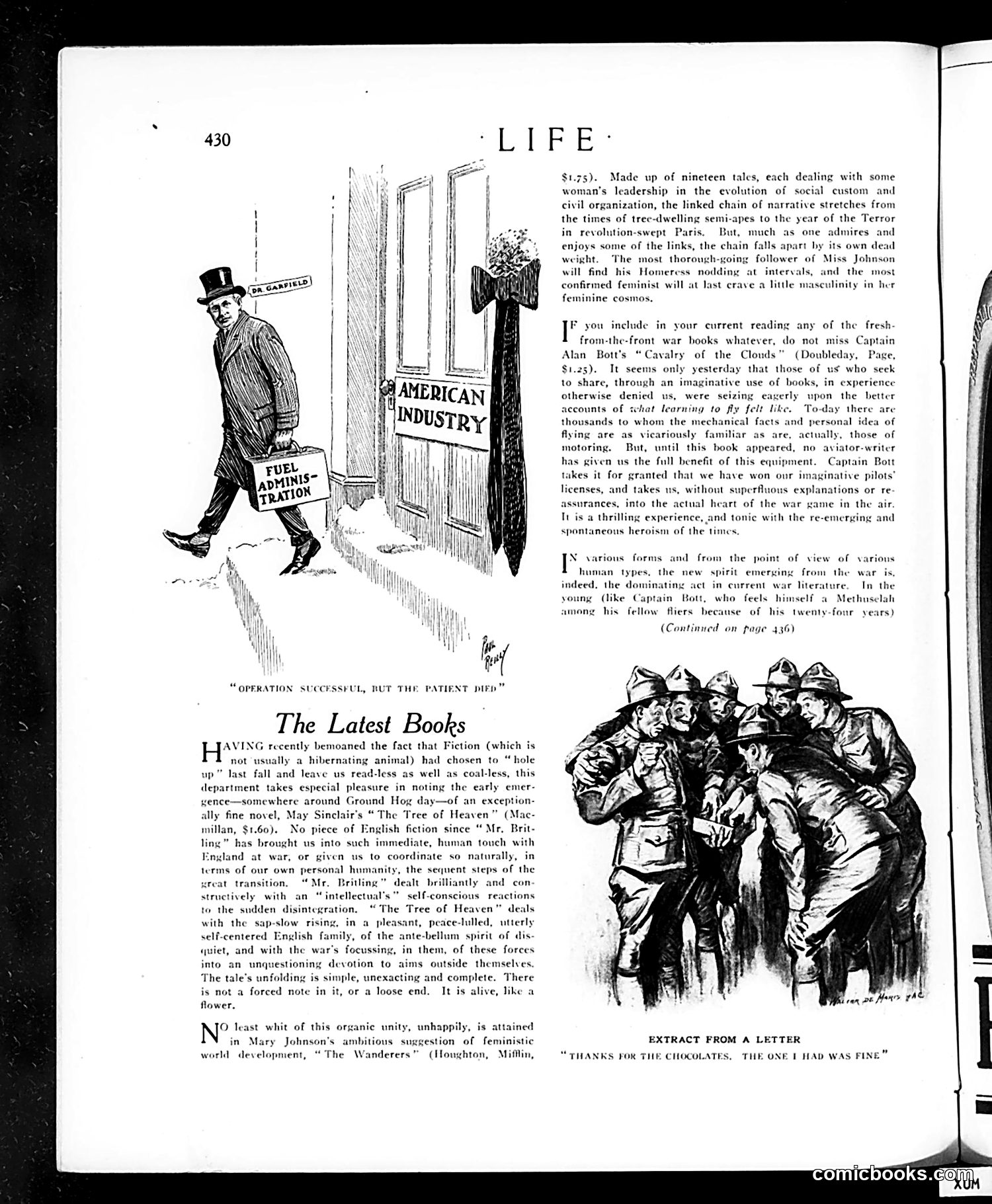
This cartoon satirizes American industrial management during wartime. The figure labeled "Fuel Administration" enters through a door marked "American Industry," appearing as a bureaucrat in a top hat—a visual symbol of authority and out-of-touch officialdom. The caption's dark joke suggests that while the government's intervention succeeded in its technical objectives, it ultimately damaged or destroyed the very industry it aimed to help. This reflects contemporaneous criticism of wartime federal agencies' heavy-handed control over production and resources. The implied target is likely the U.S. Fuel Administration (1917-1919), established to manage energy rationing during World War I. The cartoon criticizes government overreach: bureaucratic solutions that achieved measurable goals but harmed economic vitality through excessive regulation. The caption's grim humor—prioritizing procedural "success" while the patient dies—mirrors common Progressive-era anxieties about technocratic governance lacking practical wisdom.

This page from *Life* magazine is a straightforward advertisement for Republic Tires, manufactured by the Republic Rubber Corporation of Youngstown, Ohio. It promotes their proprietary "Prodium Process" for treating rubber, claiming it makes tires exceptionally durable and long-wearing—"more like steel than rubber." The ad features two tire images showing the "Staggard Tread" pattern and emphasizes benefits like even wear, increased mileage, and "maximum grip with minimum friction." The copywriting uses typical early 20th-century advertising rhetoric, appealing to consumers' record-keeping and testimonials to verify claims. There is no satire, no political commentary, and no cartoon. This is commercial marketing from an era when *Life* magazine mixed editorial content with paid advertisements.
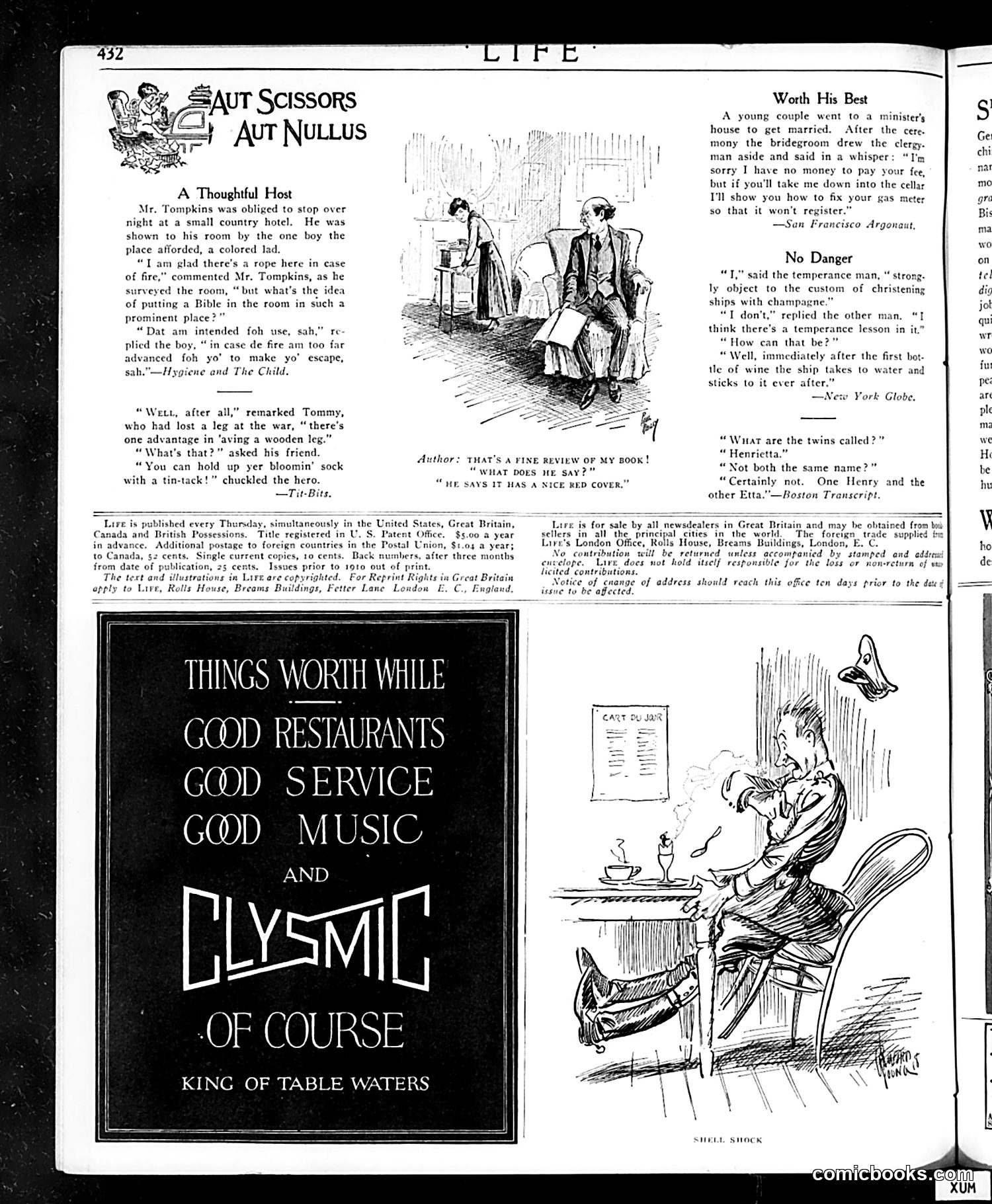
This page from *Life* magazine contains several short humorous anecdotes typical of early 20th-century American humor: **"A Thoughtful Host"**: A hotel clerk explains that a Bible in the guest's room serves as an escape aid during fires—a darkly comic commentary on poor hotel safety standards and the absurdity of relying on religious texts in emergencies. **"Well, After All"**: A disabled war veteran jokes that his wooden prosthetic leg allows him to hold up his sock with a tin-tack—gallows humor about post-WWI disability and making do with limitations. **"Worth His Best"**: A newlywed offers to repair the minister's gas meter without payment—satirizing both poverty and dishonesty in post-war economics. **"No Danger"**: A temperance advocate objects to christening ships with champagne; his friend counters that ships taking on water after drinking wine is itself a temperance lesson—mocking prohibition-era rhetoric. **The cartoon** (right) depicts a man reading the racing form at a café—likely commentary on gambling addiction. The advertisements emphasize fine dining and *Clysmic* mineral water as status symbols.
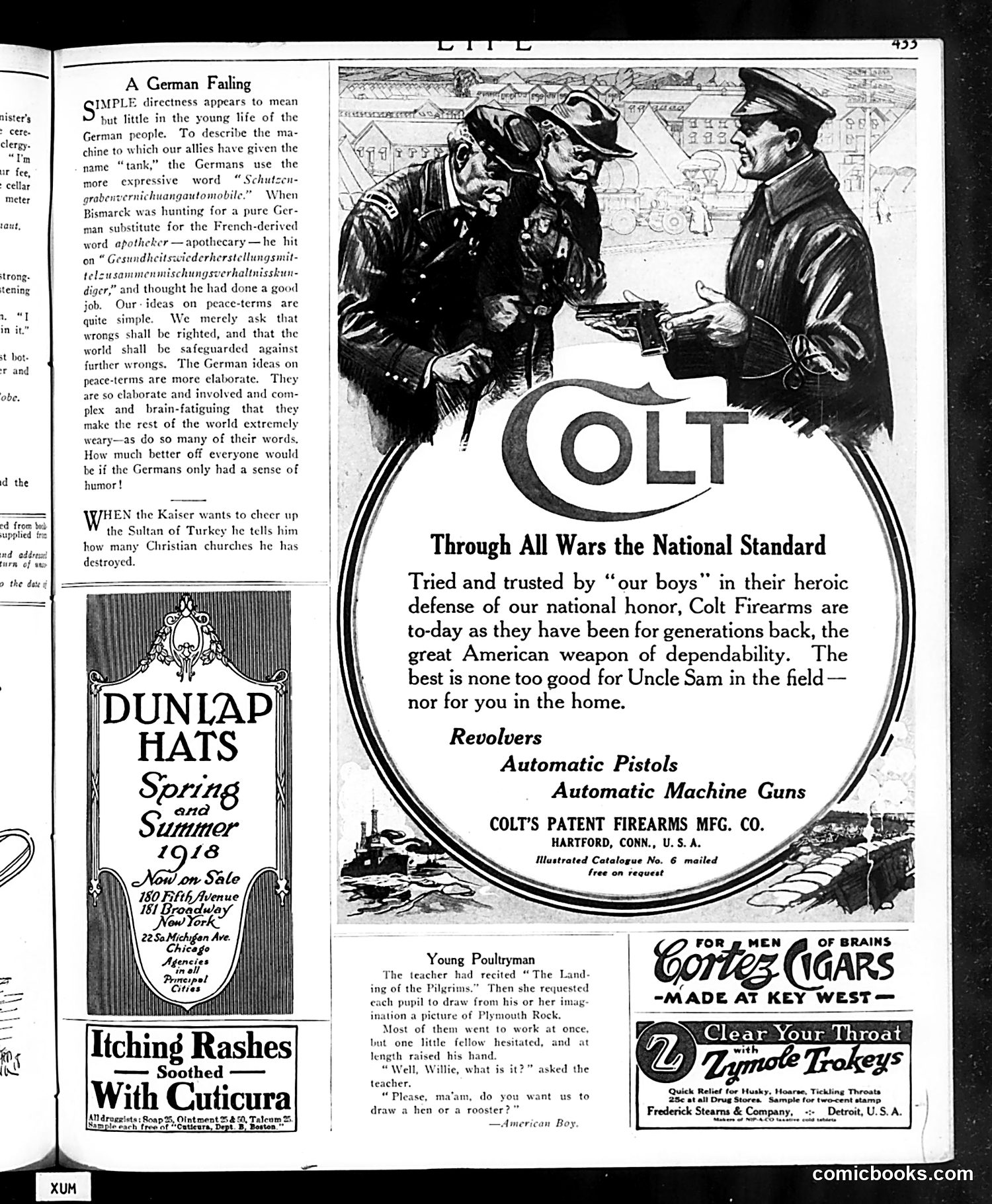
This wartime satire (appearing during WWI, given references to the Kaiser and peace terms) mocks German linguistic and diplomatic complexity. The text contrasts American straightforwardness with German elaborateness: while Americans simply request that "wrongs shall be righted," Germans produce impossibly long compound words like "Schutzengrabenvernichtungsautomobile" (for "tank") and invented terms like "Gesundheitswiederherstellungsmittel..." The cartoon illustrates this through two figures in discussion, likely representing American and German negotiators or leaders. The satire's point: German overthinking and verbose language—exemplified by their peace-term proposals being "so elaborate and involved and complex and brain-fatiguing"—make them exhausting negotiating partners. The piece concludes that Germans would be better served by humor and simplicity. A secondary jab at the Kaiser follows, joking he entertains Turkey's Sultan by boasting of destroyed Christian churches—suggesting German brutality and moral bankruptcy.
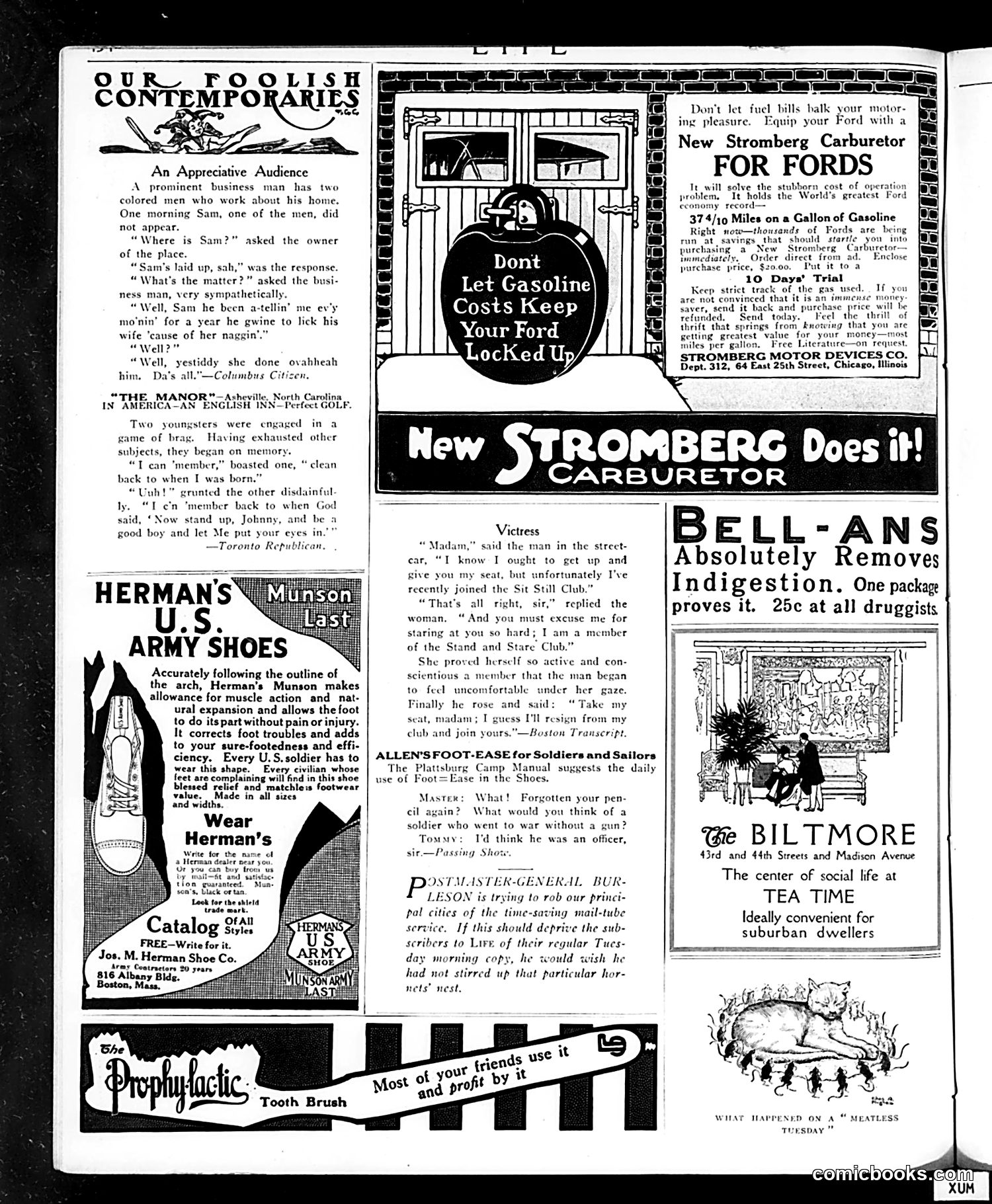
This page from Life magazine (appears to be from WWI era, based on references to Plattsburg Camp and mail-tube service) is primarily **advertising with minimal editorial content**. The few satirical pieces included are brief: 1. **"An Appreciative Audience"**: A dialect joke about a Black worker ("Sam") whose wife nags him, playing on racist stereotypes common to the period. 2. **"The Manor"**: A joke about children's memory, with one child claiming to remember back to God's creation—mild humor with no political content. 3. **Street-car vignette**: A joke about a man joining a "Sit Still Club" (apparently a etiquette movement), declining to give up his seat to a woman. The page is dominated by product advertisements (Stromberg Carburetors, Herman's Army Shoes, Bell-Ans indigestion remedy, Prophylactic toothbrushes) and a brief editorial item mocking Postmaster-General Burleson's proposed mail-tube system. **Overall**: This is primarily a commercial page rather than satirical commentary. The humor reflects early-20th-century attitudes without engaging significant political or social critique.
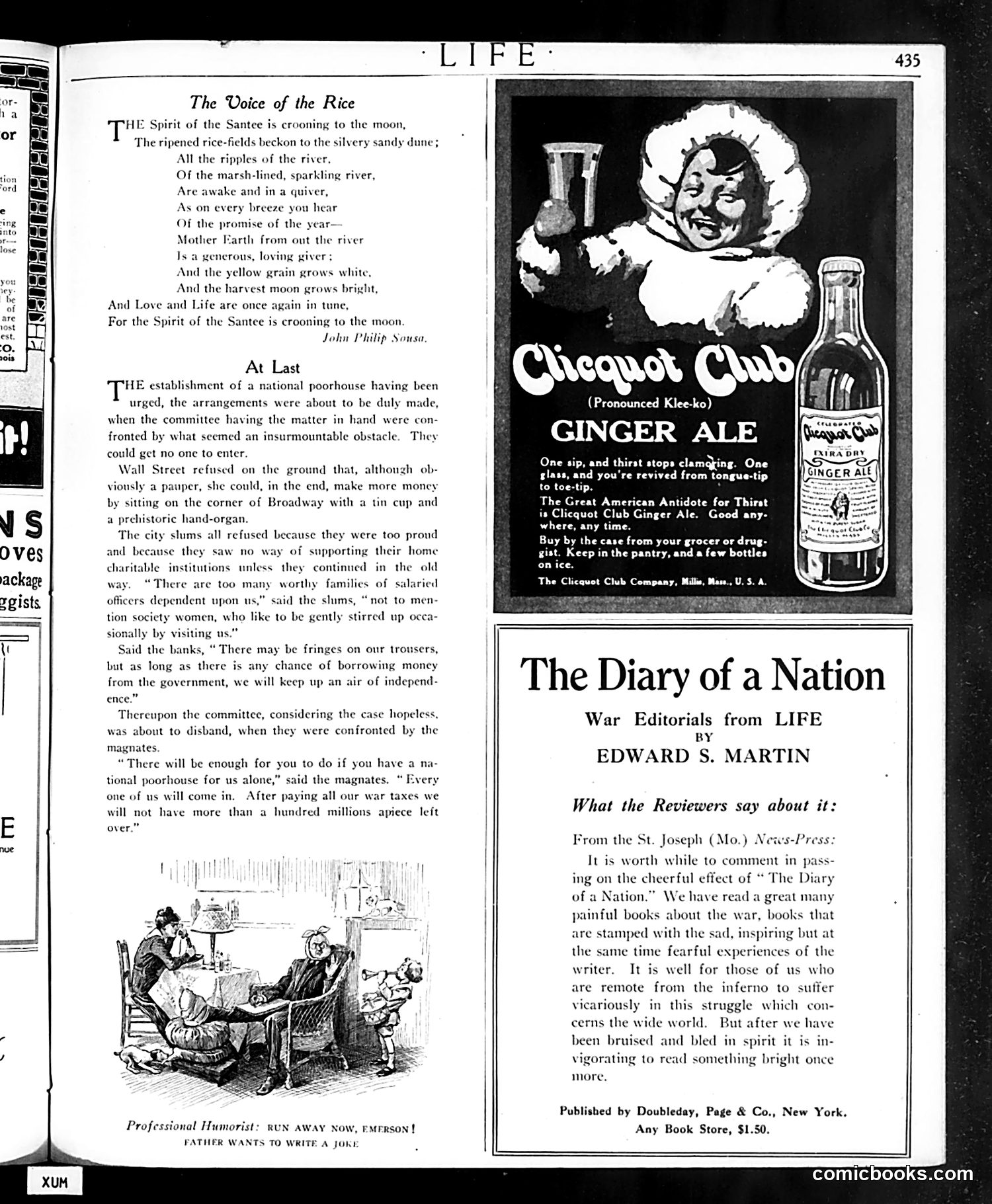
This satirical piece mocks the refusal of major American institutions to enter a proposed national poorhouse. Each group offers absurd excuses rooted in self-interest: - **Wall Street** claims poverty is profitable (begging on Broadway makes more money) - **City slums** refuse because they depend on wealthy visitors' charity donations to survive - **Banks** won't admit financial trouble, needing to appear solvent to borrow government funds - **Magnates** (wealthy industrialists) finally agree—but only if it's exclusively for the rich, claiming postwar taxes have left them with merely "a hundred millions apiece" The joke satirizes how every social class prioritizes profit and appearances over genuine welfare. The magnates' complaint about war taxes is particularly pointed: even the wealthiest claim poverty while retaining vast fortunes. This reflects early WWI-era American tensions over taxation and wealth inequality. The accompanying cartoon shows a father interrupting a child, presumably to explain the joke—meta-humor about the piece's complexity.
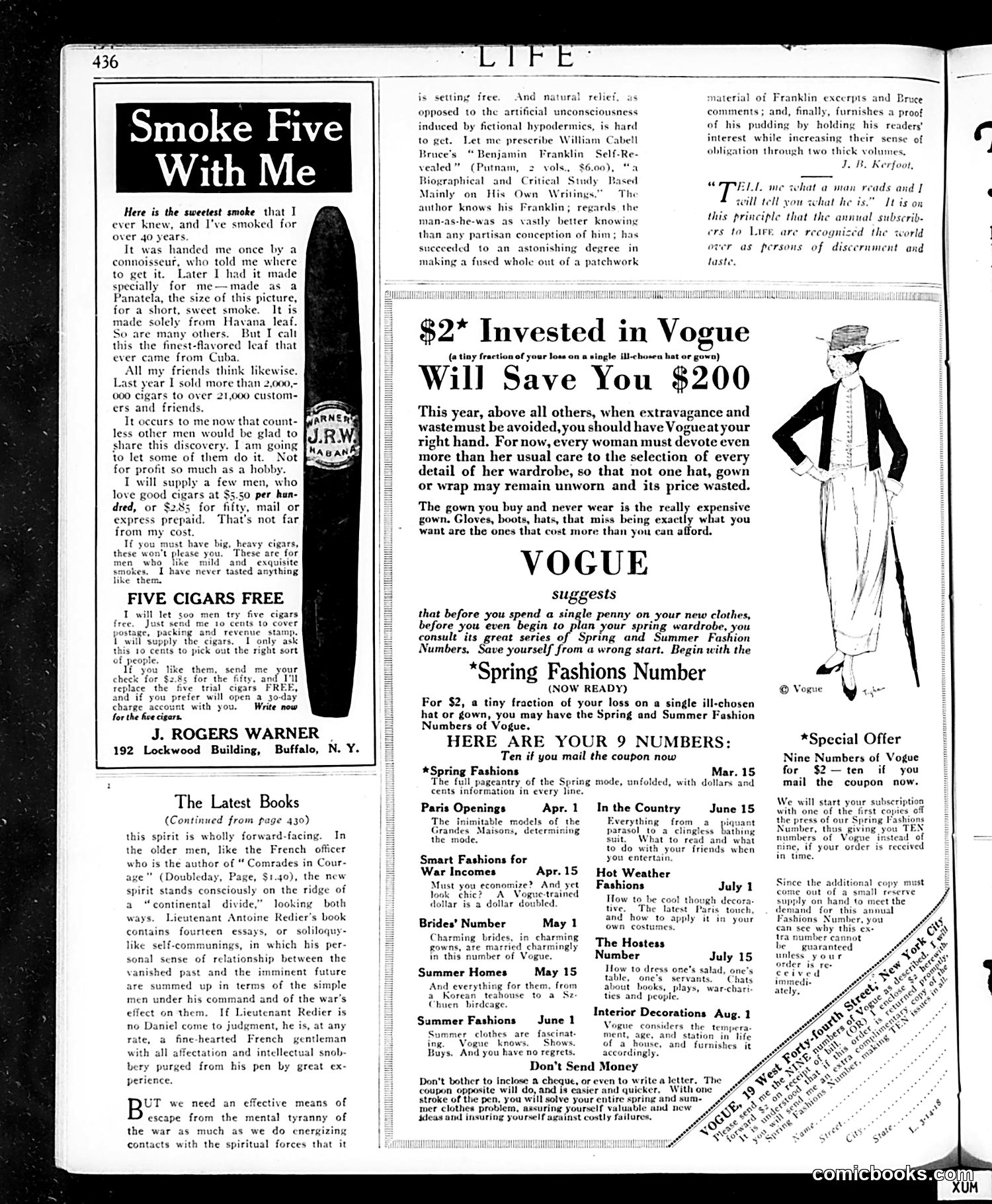
This page contains two distinct advertisements targeting different audiences during wartime (likely WWI era, based on references to "the war"). **Left side: Cigar advertisement** ("Smoke Five With Me") - J. Rogers Warner promotes premium Cuban Panatela cigars, claiming 40 years' smoking experience and 21,000 satisfied customers. He offers five free trial cigars for 10 cents postage, attempting to build a hobby business by word-of-mouth. The appeal is to male connoisseurs valuing quality and exclusivity. **Right side: Vogue magazine advertisement** - Positioned as wartime economy advice, it argues that a $2 Vogue subscription will save women $200 by preventing wasteful clothing purchases. The satirical premise: during economic constraints, consulting fashion magazines prevents buying unworn garments. The ad features a fashionable woman illustration and lists upcoming special issues on spring fashions, brides, summer homes, and interior decoration—essentially marketing aspirational lifestyle content as practical budgeting. The page reflects early-20th-century gender-divided consumer marketing: cigars for men's refined taste; fashion guidance for women's household economy.
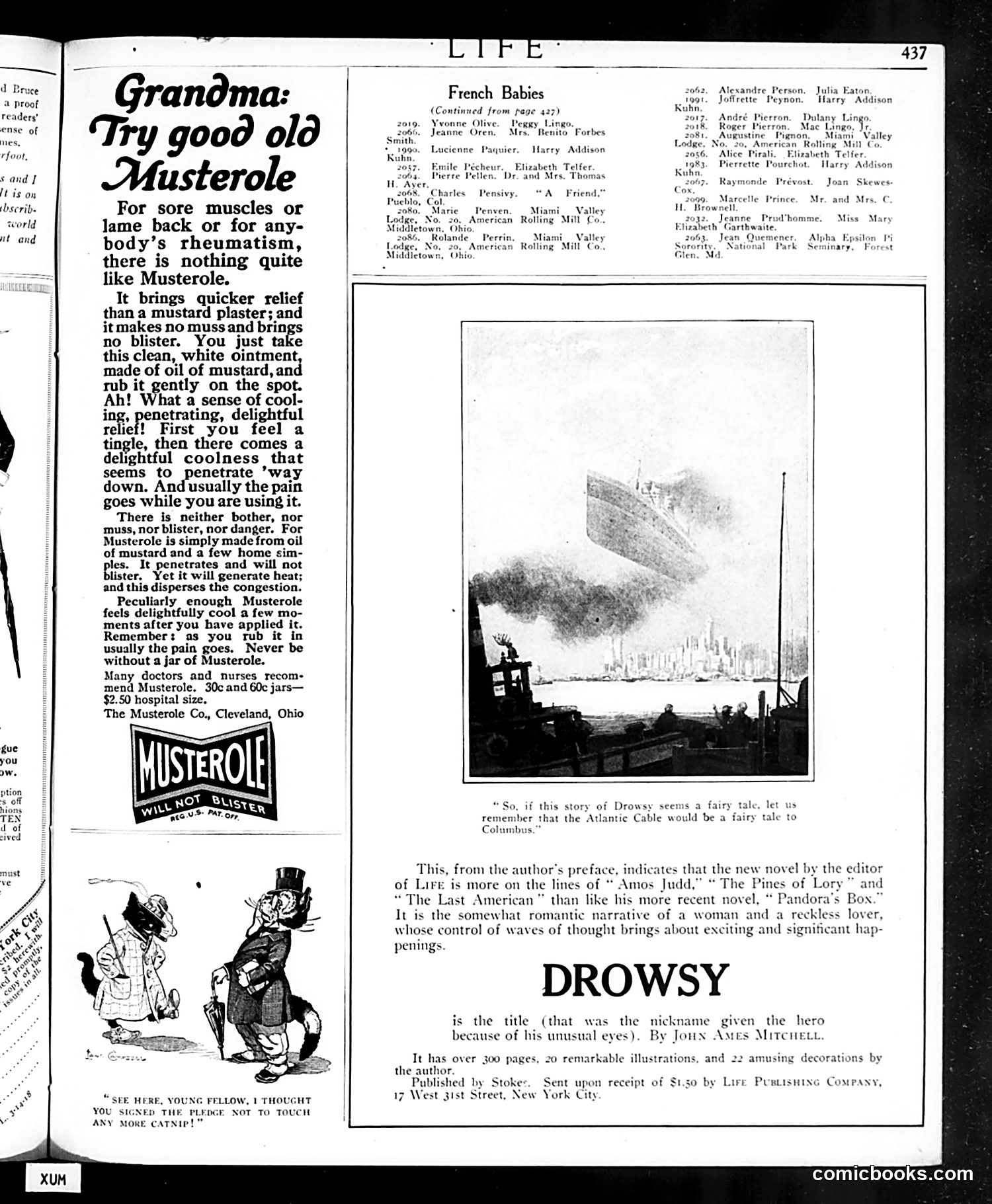
This page contains **primarily advertising and book promotion**, not political satire. The dominant content is a **Musterole advertisement**—a mustard-oil ointment marketed for muscle pain and rheumatism. The ad uses period-typical copy explaining the product's soothing properties and includes a small cartoon showing two figures (appearing to be children or caricatures) with the caption about not touching catnip, which is simply humorous product-adjacent imagery. The page's other major element promotes **"Drowsy," a novel by John Ames Mitchell**. The publisher uses a prefatory quote comparing the book's romantic narrative to how the Atlantic Cable would have seemed impossible to Columbus—positioning it as a modern marvel of storytelling. The small illustrations and French babies listings appear to be continuation of editorial content from page 427. This is fundamentally a **commercial page** rather than one containing political or social satire requiring historical context.
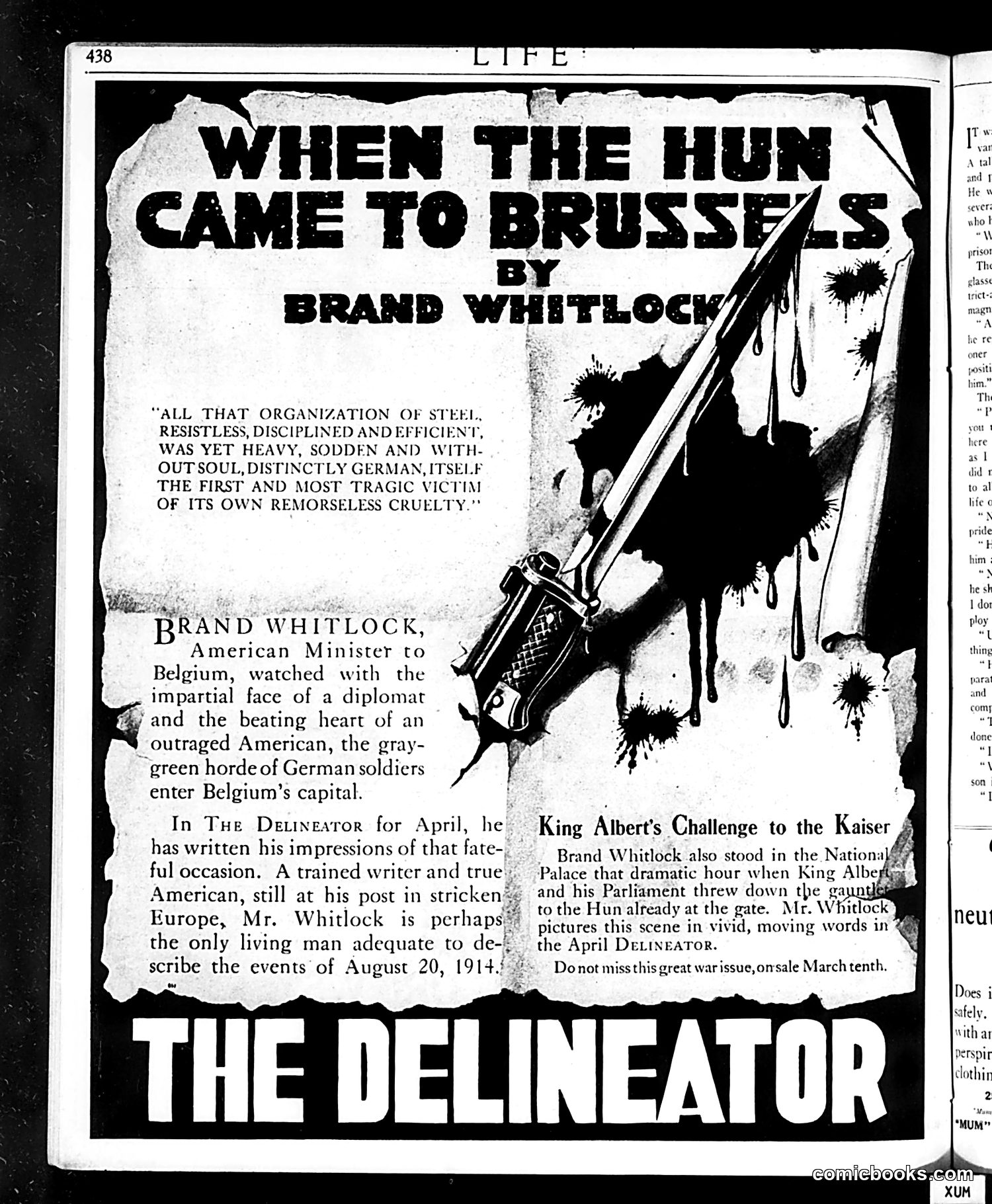
This is a **magazine advertisement** for *The Delineator* (April issue), promoting an article by Brand Whitlock, the American Minister to Belgium during World War I. The ad references the **German invasion of Belgium in August 1914**—a pivotal early WWI event that shocked American opinion. The dramatic imagery (a revolver dripping blood over a map) emphasizes German brutality during the invasion. Whitlock, described as a "trained writer and true American," witnessed the occupation of Brussels. The ad quotes his characterization of German forces as "soulless" and "distinctly German," contrasting their mechanical efficiency with their moral emptiness. The ad also references **King Albert of Belgium** and Parliament's defiant stand against the advancing Germans—portraying Belgian resistance as heroic. For 1915 American readers, this framed Germany as barbaric and Belgium as a tragic victim, potentially influencing pro-Allied sentiment before U.S. entry into the war (1917).
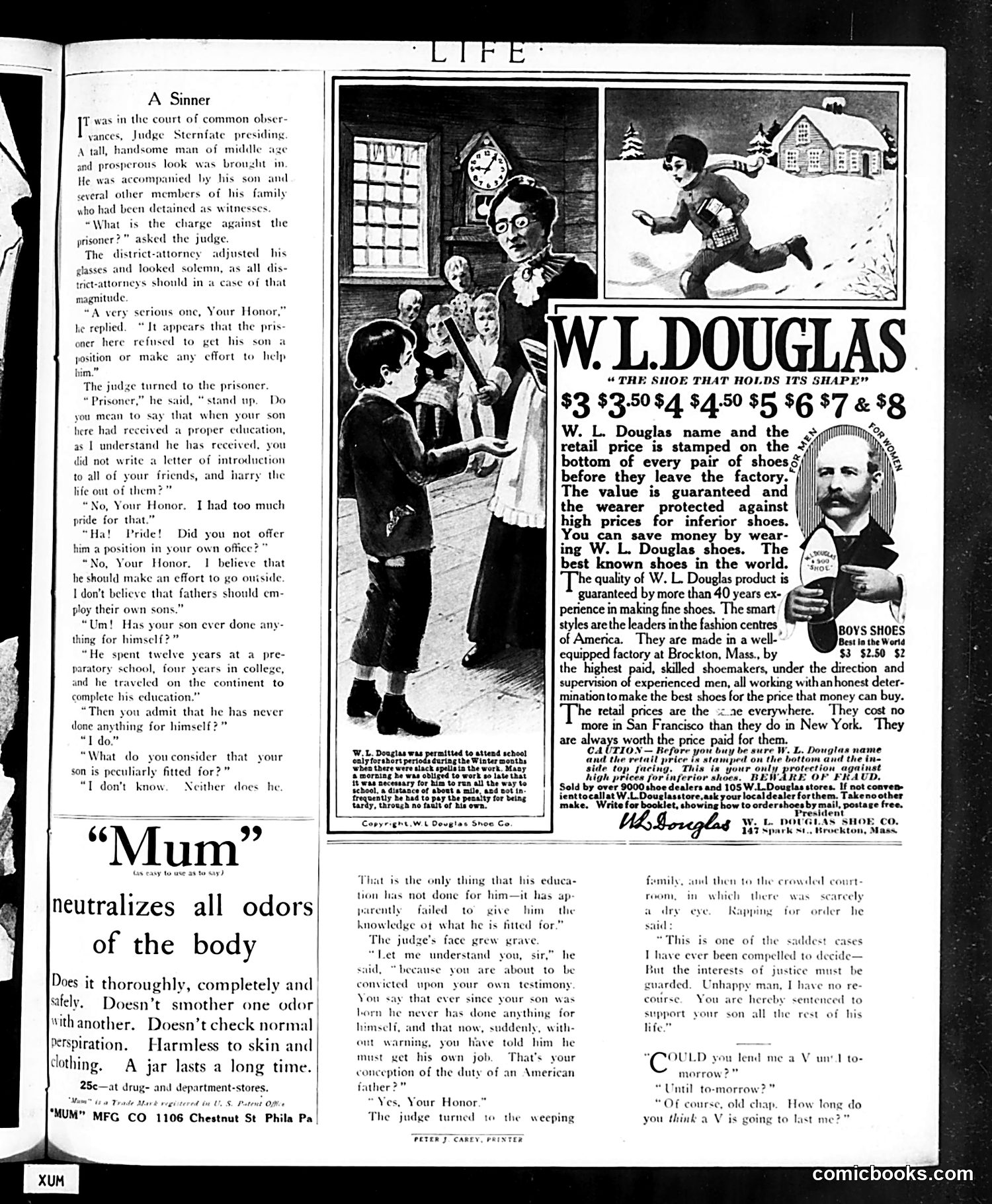
This satirical story critiques **wealthy parents who fail to use their privilege to advance their sons' careers**. A prosperous man is brought to court, charged with refusing to secure his son a job or write letters of introduction despite the boy's excellent education (prep school, college, continental travel). The father claims he wanted his son to succeed independently, citing "pride." The judge—representing society's expectations—treats this as criminal negligence. He exposes the father's hypocrisy: the son has never actually *done* anything for himself; his entire advantages came from paternal resources. The father has simply withdrawn crucial social capital (networking, connections) while providing everything else. **The satire's point**: Wealthy fathers of this era (appears to be early 1900s) are expected to leverage their social position for their sons. Refusing to do so isn't noble independence—it's a betrayal of class privilege. The "sinner" is guilty not of spoiling his son, but of withholding the insider advantages that wealth and status provide.
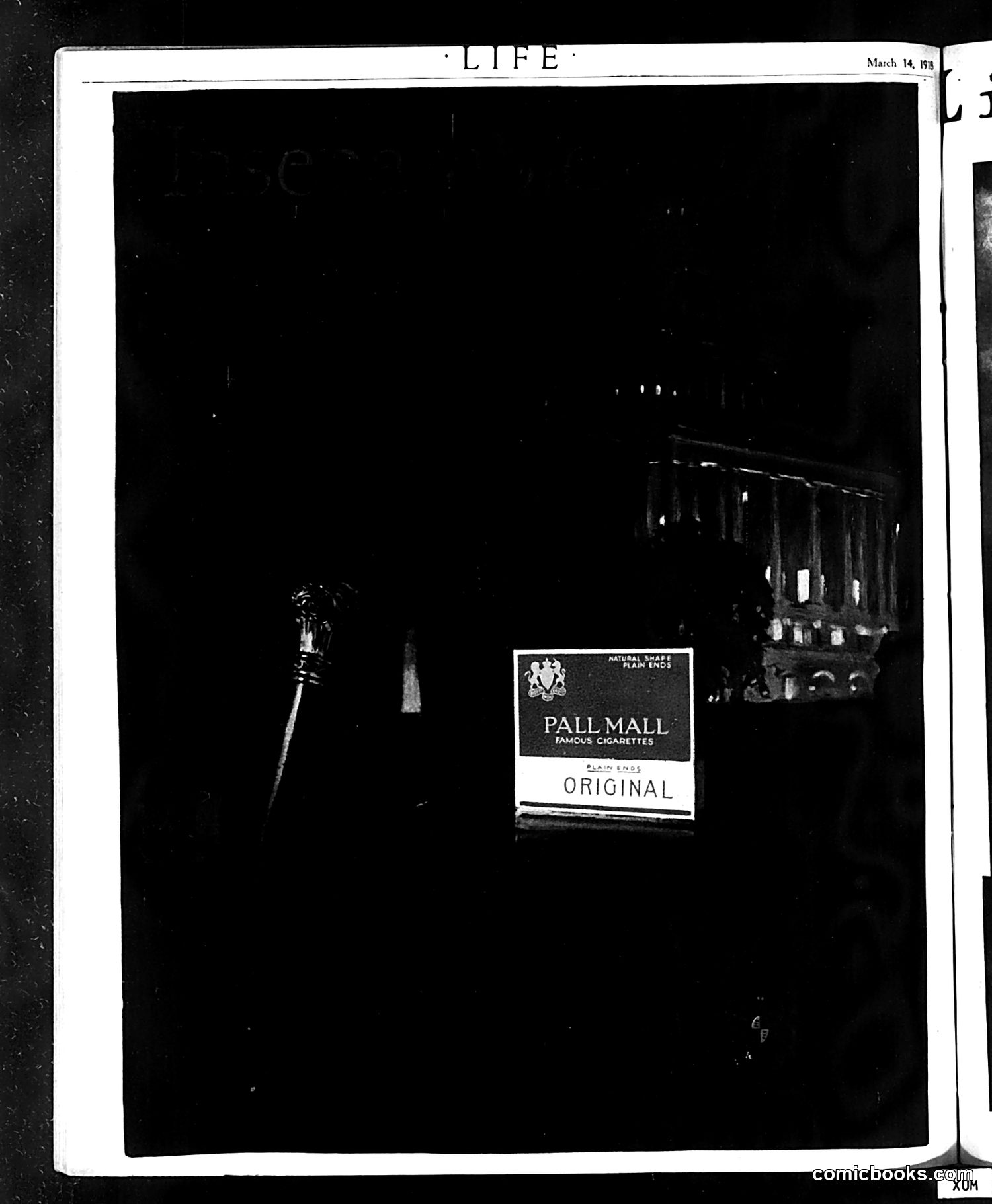
This appears to be primarily an **advertisement page** from Life magazine (March 14, 1918) rather than editorial content or political satire. The visible content shows a **Pall Mall cigarettes advertisement** featuring their "Original" product line. The ad uses nighttime urban imagery—a lit cigarette in the foreground and an illuminated building in the background—to create atmospheric product promotion. There is **no discernible political cartoon or satire** on this page. The layout and branding suggest this is a commercial advertisement positioned within the magazine, which was common in early 20th-century publications. Without additional context about the surrounding editorial content, the satirical or social commentary purpose—if any—cannot be determined from this image alone.