
Life, 1918-03-14 · page 16 of 40
Life — March 14, 1918 — page 16: what you’re looking at
What you’re looking at
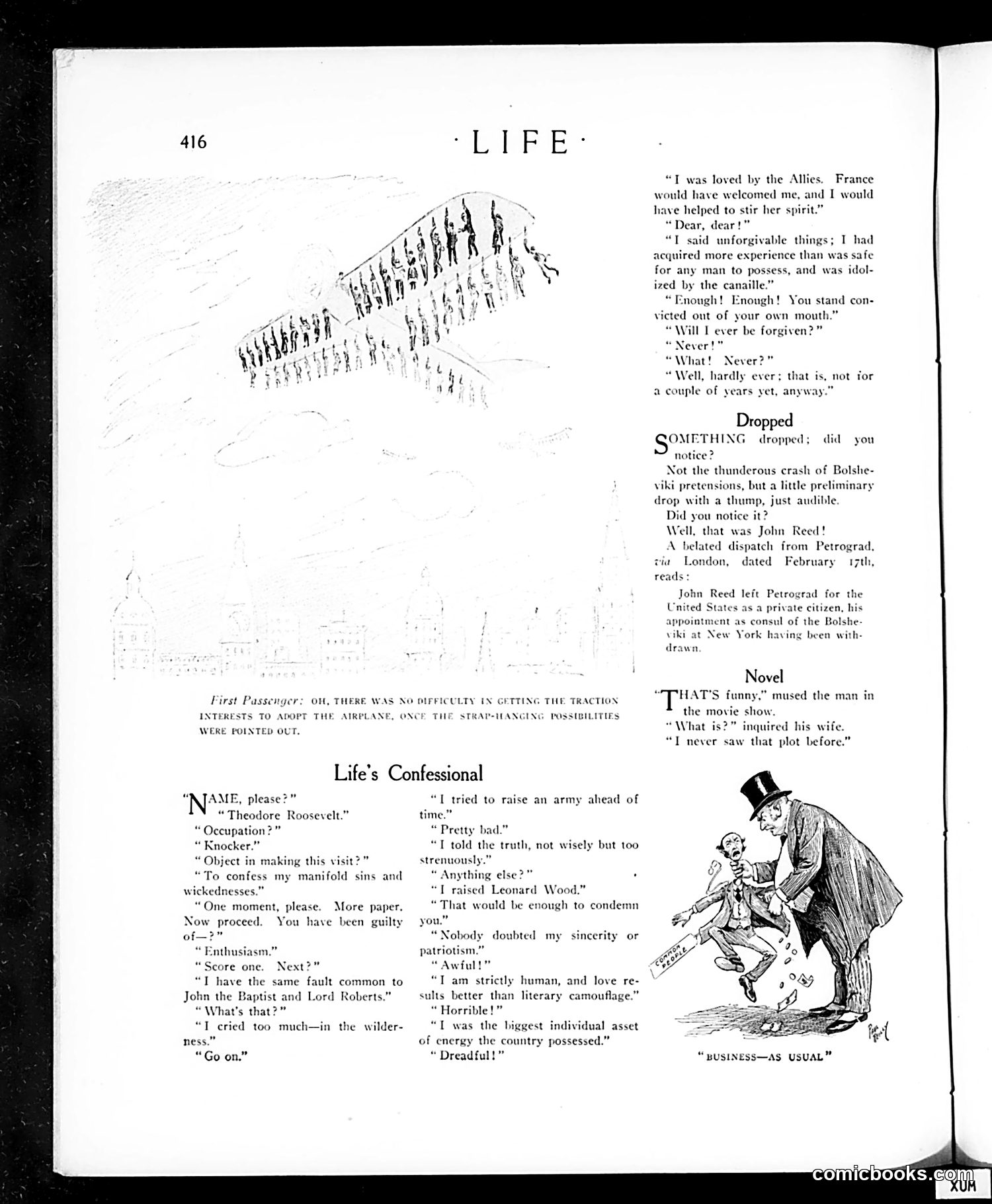
This page contains three satirical pieces targeting prominent figures from the World War I era: **"Life's Confessional"** mocks Theodore Roosevelt through a mock-confession format. Roosevelt admits to being a "knocker" (critic) who raised armies, spoke too strenuously about truth, and was idolized by "the canaille" (common people). The satire suggests Roosevelt was a self-aggrandizing warmonger whose main "sin" was excessive enthusiasm and influence—criticisms common among his detractors during and after WWI. **"Dropped"** references John Reed, the American journalist and communist sympathizer who left Petrograd (Leningrad) after his appointment as Bolshevik consul to New York was withdrawn. The item sarcastically presents his departure as a minor, barely-noticed event rather than significant news. **"Novel"** is a brief joke about movie plots being unoriginal. The cartoons satirize American political figures and events of the post-WWI period, targeting Roosevelt's interventionism and Reed's communist associations—reflecting the magazine's skeptical, satirical perspective on American public figures and radical politics.
📄 Transcribed text from this page (OCR, searchable)
Machine-transcribed from the original scan — historical spelling and the odd misread are preserved.
First Passenger INTERESTS TO ADOPT THE WERE POINTED OUT. AIRPLANE, OM, THERE WAS NO DIFFICULTY IN GETTING THE one TRACTION THE STRAP*UANGING POSSIBILITIES Life’s Confessional “AJAME, please “Theodore Roosevelt.” “ Occupation?” “ Knocker.” “ Object in making this visit?” ‘0 confess my manifold sins and wickednesses.” “One moment, please. More paper. Now proceed. You have been guilty nthusiasm, Score one. Next? “T have the same fault common to John the Baptist and Lord Roberts.” “What's that?” “T cried too much—in ness.” “Go on.” the wilder- “TL tried to raise an army ahead of time.” “Pretty bad.” “T told the truth, not wisely but too strenuously.” “ Anything “T raised Leonard Wood.” “That would be enough to condemn you.” “Nobody doubted my sincerity or patriotism.” “Awful!” “Tam strictly human, and love re- sults better than literary camoufla; “ Horrible!” “Twas the biggest individual asset of energy the country possessed “ Dreadful!” else “T was loved by the Allies. France would have welcomed me, and I would have helped to stir her spirit.” Dear, dear!” I said unforgivable things; T had acquired more experience than was safe for any man to possess, and was idol- ized by the canaille.’ “Enough! Enough! You stand con- victed out of your own mouth.” “Will L ever be forgiven?” Never!" “What! Never?” “Well, hardly ever; that is, not for a couple of years yet, anyway. Dropped OMETHING notice? Not the thunderous crash of Bolshe- Viki pretensions, but a little preliminary drop with a thump, just audible Did you notice it? Well, that was John Reed! A belated dispatch from Petrograd, London, dated February 17th, reads: John Reed left Petrograd for t United States as a private citizen, his appointment as consul of the Bolshe Viki at New York having been with- dropped; did you via Novel HAT’S funny,” mused the man in the movie show. “What is?” inquired his wife. “T never saw that plot before.” “BUSINESS—AS USUAL”