
Life, 1918-03-14 · page 14 of 40
Life — March 14, 1918 — page 14: what you’re looking at
What you’re looking at
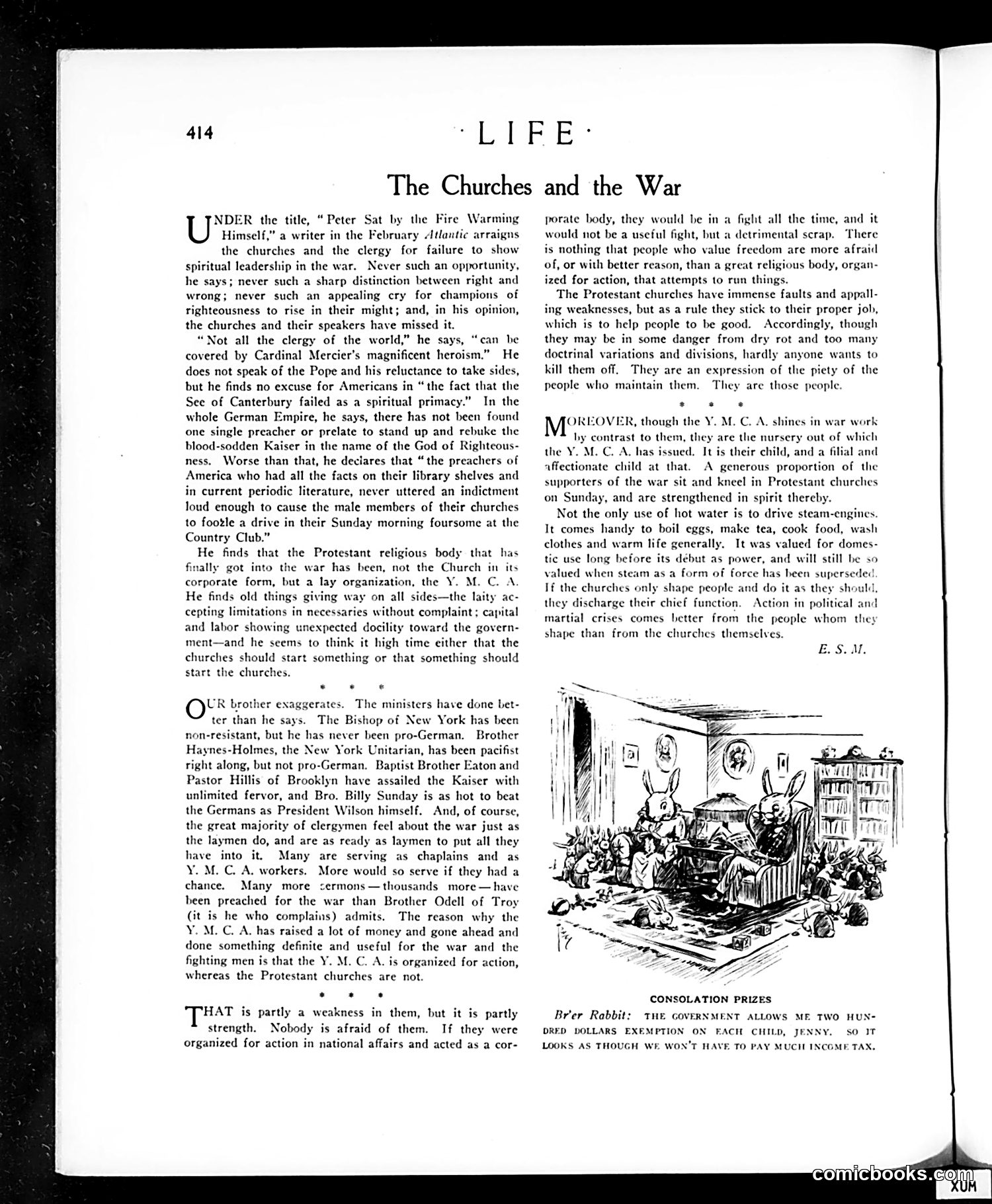
This single-panel cartoon depicts a rabbit in a study, surrounded by books and religious iconography (portraits on walls). The caption reads: "The government allows me two hundred dollars exemption on each child, Jenny, so it looks as though we won't have to pay much income tax." The satire targets religious exemptions from taxation during wartime (likely WWI era, based on the article context discussing churches and war). The joke criticizes how families—represented by this rabbit—could exploit child tax exemptions to avoid contributing financially to the war effort, even as churches debated their patriotic duties. The cartoon mocks the irony of religious institutions claiming pacifism while their members benefit from tax loopholes meant to support families, not dodge national obligations.
📄 Transcribed text from this page (OCR, searchable)
Machine-transcribed from the original scan — historical spelling and the odd misread are preserved.
“LIUFE- The Churches Peter Sat by the Fire Warming elf,” a writer in the February Atantic arraigns the churches and the clergy for failure to show spiritual leadership in the war. Never such an opportunity, he says; never such a sharp distinction between right and wrong; never such an appealing cry for champions of righteousness to rise in their might; and, in his opinion, the churches and their speakers have missed it. “Not all the clergy of the world,” he say can be covered by Cardinal Mercier’s magnificent heroism.” He does not speak of the Pope and his reluctance to take sides, but he finds no excuse for Americans in “the fact that the See of Canterbury failed as a spiritual primacy.” In the whole German Empire, he says, there has not been found one single preacher or prelate to stand up and rebuke the blood-sodden Kaiser in the name of the God of Righteous- ness. Worse than that, he deciares that “the preachers of America who had all the facts on their library shelves and in current periodic literature, never uttered an indictment loud enough to cause the male members of their churches to footle a drive in their Sunday morning foursome at the Country Club.” He finds that the Protestant religious body that has finally got into the war has been, not the Church in its corporate form, but a lay organization, the Y. M. C. A He finds old things giving way on all sides—the laity ac- cepting limitations in necessaries without complaint; capital and labor showing unexpected docility toward the govern- ment—and he seems to think it high time either that the churches should start something or that something should start the churches. UR brother exaggerates. The ministers have done bet- ter than he says. The Bishop of New York has been non-resistant, but he has never been pro-German. Brother Haynes-Holmes, the New York Unitarian, has been pacifist right along, but not pro-German. Baptist Brother Eaton and Pastor Hillis of Brooklyn have assailed the Kaiser with unlimited fervor, and Bro. Billy Sunday is as hot to beat the Germans as President Wilson himself. And, of course, the great majority of clergymen feel about the war just as the laymen do, and are as ready as laymen to put all they ve into it. Many are serving chaplains and as Y. M. C. A. workers. More would so serve if they had a chance. Many more cermons—thousands more —have been preached for the war than Brother Odell of Tro (it is he who complains) admits. The reason why the Y. M. C. A. has raised a lot of money and gone ahead and done something definite and useful for the war and the fighting men is that the Y. M. C. A. is organized for action, whereas the Protestant churches are not. o 2 6 THAT is partly a weakness in them, but it is partly strength. Nobody is afraid of them. If they were organized for action in national affairs and acted as a cor- and the War porate body, they would be in a fight all the time, and it would not be a useful fight, but a detrimental scrap. There is nothing that people who value freedom are more afraid of, or with better reason, than a great religious body, organ- ized for action, that attempts to run things. The Protestant churches have immense faults and appall- ing weaknesses, but as a rule they stick to their proper job, which is to help people to be good. Accordingly, though they may be in some danger from dry rot and too many doctrinal variations and divisions, hardly anyone wants to kill them off. They are an expression of the piety of the people who maintain them. They are those people. s 8 6 . A. shines in war work y re the nursery out of which the Y. M.C. has issued. It is their child, and a filial and affectionate child at that. A generous proportion of the supporters of the war sit and kneel in Protestant churches on Sunday, and are strengthened in spirit thereby. Not the only use of hot water is to drive steam-engines. It comes handy to boil eggs, make tea, cook food, wash clothes and warm life generally. It was valued for domes- tic use long before its début as power, and will still be so valued when steam as a form of force has heen supersede: If the churches only shape people and do it as they should, they discharge their chief function. Action in political and martial crises comes better from the people whom they shape than from the churches themselves. E..S.AL, CONSOLATION PRIZES Br'er Rabbit: tne Gor DRED DOLLARS EXEMPTION ON EACH CHILD, JENNY, SO IT LOOKS AS THOUGH WE WON'T HAVE TO PAY MUCIL INCOME TAX,