
Life, 1918-03-14 · page 23 of 40
Life — March 14, 1918 — page 23: what you’re looking at
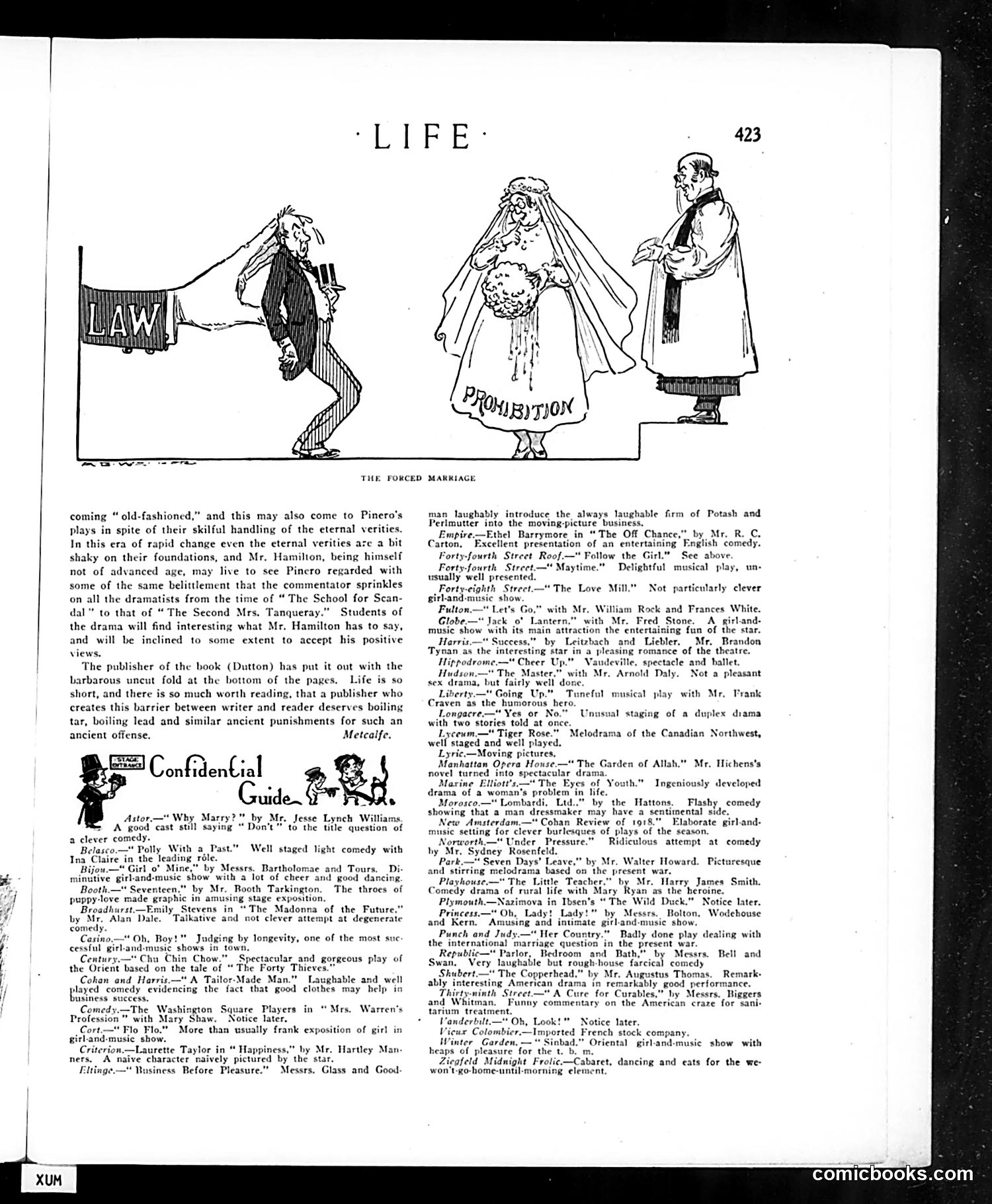
What you’re looking at
This cartoon satirizes **Prohibition's impact on marriage**. The image shows three figures: on the left, "Law" (labeled) forcibly pushing a man in a suit; in the center, a bride labeled "Prohibition" being married off; on the right, a clergy member conducting the ceremony. The satire suggests that Prohibition legislation was being "forced" into an unwanted union with traditional American institutions—specifically marriage and social customs. The joke plays on the notion that Prohibition, like an arranged marriage, was an unpopular, coercive measure being imposed by legal authority rather than accepted willingly by the public. This reflects early 20th-century tensions around Prohibition's passage and enforcement, treating the law as an unwanted "spouse" forced upon the American people through legal compulsion rather than democratic consent.
📄 Transcribed text from this page (OCR, searchable)
Machine-transcribed from the original scan — historical spelling and the odd misread are preserved.
THE FORCED coming “old-fashioned,” and this may also come to Pinero's plays in spite of their skilful handling of the eternal verities. In this era of rapid change even the eternal verities are a bit shaky on their foundations, and Mr, Hamilton, being himself not of advanced age, may live to see Pincro regarded with some of the same belittlement that the commentator sprinkles on all the dramatists from the time of “ The School for Scan- dal” to that of “The Second Mrs, Tanqueray.” Students of the drama will find interesting what Mr. Hamilton has to say, and will be inclined to some extent to accept his positive views. The publisher of the book (Dutton) has put it out the Darbarous uncut fold at the bottom of the pages. Life is so short, and there is so much worth reading, that a publisher who creates this barrier between writer and reader deserves boiling tar, boiling lead and similar ancient punishments for such an ancient offense. Metcalfe. ConfidenCial Cin OE, Astor.—* Why Marry?" by Mr. Jesse Lynch Williams, = A good cast still saying “Don't to the title question of a clever comedy. Belasco.—* Polly With a, Past." Ina Claire in the leading réle. Bij 1 o' Mine,” by Messrs. Bartholomae and Tours. Di- minttive girland-musie show with a lot of cheer and good dancing Booth.—" Seventeen.” by Mr. Rooth Tarkington. The throes of puppy-love made graphic in amusing stage exposition. Broadhurst-—Emily Stevens in “The Madonna of the Future.” by Mr. Alan Dale. kative ot clever attempt at degenerate Well staged 1; comedy with comedy. Casino.—" Ob, Boy!" Judging by longevity, one of the most suc: cessful girland: shows in town, Century.—" Chu Chin Chow.” Spectacular and gorgeous play of the Orient based on the tale of “The Forty Thieves.” Cohan and Herris.—" A Tailor-Made Man.” Laughable and well layed comedy evidencing the fact that good clothes may help in musiness success. Comedy.—The Profession Washin on Square Players in “ Mrs. Warren's haw. Notice later. ‘ Cort. More than usually frank exposition of girl in girl-and-mu Criteri in “ Happiness," by Mr. Hartley Man- ner ely pictured by the star. Elt “Business Before Pleasure.” Messrs, Glass and Good: MARKIAGE man laughably introduce the always laughable firm of Potash and Perlmutter into the moving-picture business, Empire-—Ethel Barrymore in “The Off Chance,” by Mr. R. C. Carton, Excellent presentation of an entertaining’ English comedy, Forty-fourth Street Roof —" Follow the Girl." See above. Forty-fourth Street—" Maytime.” Delightful musical play, un- usually well presented. Forty-eighth Street.—" The Love Mill.” girland-music show Fulton. —" Let's Go,” with Mr. William Rock and Frances White. Globe —" Jacko’ Lantern,” with Mr. Fred Stone. A. girl-and- music show with its main attraction the entertaining fun of the star. Harris.—" Success.” by Leitzbach and Liebler. Mr. Brandon ‘Tynan as the interesting star in a pleasing romance of the theatre, Hippodrome.—" Cheer Up." Vaudeville, spectacle and ballet. Hudson.—" The Master,” with Mr. Arnold Daly, Not a pleasant sex drama, but fairly well’ do Liberty.—" Going Up." Tuneful music: Craven as the humorous hero. Longacre.—" Yes or No.” with two stories told at once. Lyceum.—" Tiger Rose.” Melodrama of the Canadian Northwest, well staged and well played. Lyric-—Moving pictures, Manhattan Opera House —* The Garden of Allah. novel turned into spectacular drama Marine Eltiott’s.—" The Eyes of Youth.” drama of a woman's problem in life, Morosco.— Lombardi, Ltd.” by the Hattons. Flashy comedy showing that a man dressmaker may have a sentiinental side, ‘ew Amsterdam.—* Cohan Review of 1918." Elaborate girl-and- music setting for clever burlesques of plays of the season. Norworth—" Under Pressure.” Ridiculous attempt at comedy hy Mr. Sydney Rosenfeld. Not particularly clever jay with Mr. Prank Unusual staging of a duplex drama Mr. Hichens's Ingeniously developed Park.—" Seven Days’ Leave,” by Mr. Walter Howard. Picturesque and stirring melodrama based ‘on the present war. Playhouse-—" The Little Teacher.” by Mr. Harry James Smith. Comedy drama of rural life with Mary Ryan ay the heroine. Plymouth,—Nazimova in Ibsen's “The Wild Duck.” Notice later. Princess.—* Oh, Lady! Lady!" by Messrs. Bolton, Wodehouse and Kern, Amusing and intimate girl-and-music show. Punch and Judy.—" Her Country.” Badly done play the international marriage question in the present war Republic—" Parlor, Bedroom and Bath,” by Messrs. Bell and Swan, Very laughable but rough-house farcical comedy Shubert —* The Copperhead,” by Mr. Augustus Thomas, Remark: ably interesting American drama in remarkably good performance. Thirty-ninth Street-—" A Cure for Curables,” by Messrs. Diggers and Whitman. "Funny commentary on the American craze for sani- tarium treatment, Vanderbilt.—" Oh, Look!" Notice later. Vieux Colombier.—Imported French stock company Winter Garden, —“ Sinbad.” Oriental girl-and-music show with heaps of pleasure for the t. b. m. Zicafeld Midnight Frotic.—Cabaret, dancing and eats for the we- won't-go-home-until-morning element. comicbooks.com