
Life, 1918-03-14 · page 30 of 40
Life — March 14, 1918 — page 30: what you’re looking at
What you’re looking at
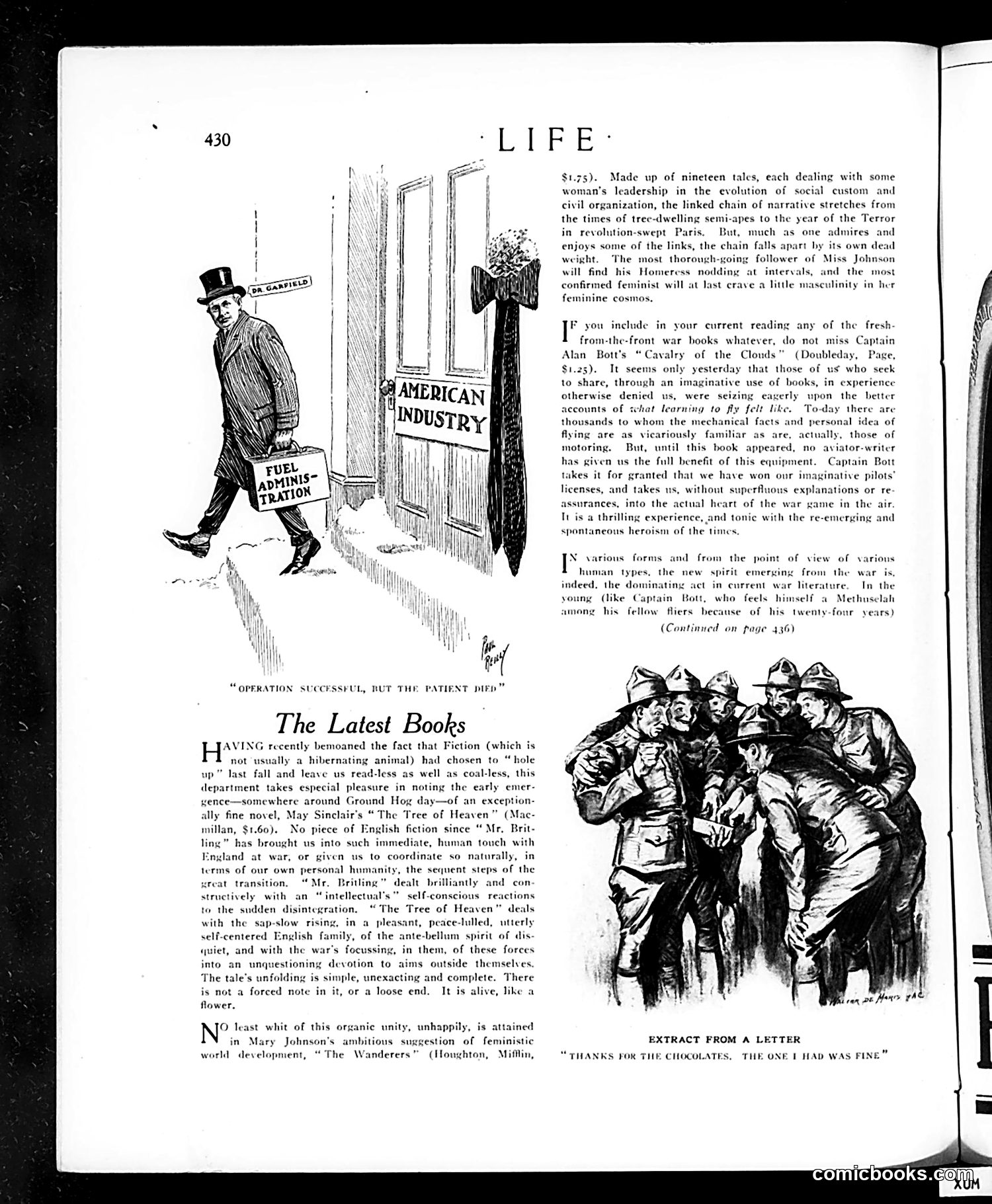
This cartoon satirizes American industrial management during wartime. The figure labeled "Fuel Administration" enters through a door marked "American Industry," appearing as a bureaucrat in a top hat—a visual symbol of authority and out-of-touch officialdom. The caption's dark joke suggests that while the government's intervention succeeded in its technical objectives, it ultimately damaged or destroyed the very industry it aimed to help. This reflects contemporaneous criticism of wartime federal agencies' heavy-handed control over production and resources. The implied target is likely the U.S. Fuel Administration (1917-1919), established to manage energy rationing during World War I. The cartoon criticizes government overreach: bureaucratic solutions that achieved measurable goals but harmed economic vitality through excessive regulation. The caption's grim humor—prioritizing procedural "success" while the patient dies—mirrors common Progressive-era anxieties about technocratic governance lacking practical wisdom.
📄 Transcribed text from this page (OCR, searchable)
Machine-transcribed from the original scan — historical spelling and the odd misread are preserved.
“LIFE: $1.75). Made up of nineteen tales, each dealing with some woman's leadership in the evolution of social custom and civil organization, the linked chain of narrative stretches from the times of tree-dwelling semi-apes to the year of the Terror in revolution-swept Paris. But, much as one admires and enjoys some of the links, the ch: nl) weight. The most thorouzh-going follower of Miss Johnson will find his Homeress nodding at intervals, and the most confirmed feminist will at last et feminine cosmos, in falls apart by its own di ave a little mase: inity in her you include in your current reading any of the fresh- from-the-front war books whatever, do not miss Captain Alan Bott's “Cavalry of the Clouds" (Doubleday $1.25). It seems only yesterday that those of us who seck to share, through an imaginative use of books, in experience otherwise denied us upon the better accounts of wh ay there a were seizing thousands to whom the mechan’ flying are as vicariously ar as are, actually, those of motoring. But, until this book appeared, no aviator-writer } lM has given us the full benefit of this equipment. Captain Bott | takes it for granted that we have won our imaginative pilots’ i licenses, and takes us, without superfluous explanations of re ! assurances, into the actual heart of the war in the air, } I is a thrilling experience, and tonic with the re-emerging and t spontaneous heroism of the times, } fi n types, the new spi forms and the point of view of various it emerging from the war is, indeed, the dominating act in current war literature, In the if young (like Captain Bott, who feels himself a Methuselah Wty among his fellow fliers because of his twenty-four years) (Continued on page 436) “OPERATION SUCCESSFUL, BUT THE PATIENT DIRD” The Latest Books AVING recently bemoaned the fact that Fietion (which is ally a hibernating animal) had chosen to “hole fall and leave us read-less as well as coal-less, this department takes especial pleasure in noting the early emer- yence—somewhere around Ground Hog da ally fine novel, May Sinclair's “The Tree of Heaven” (Mac- , $1.60). No piece of English fiction since “ Mr, Brit- has brought us into such immediate, human touch with sland at war, or given us to coordinate so naturally, in y—of an exception- terms of our own personal humanity, the sequent steps of the reat transition. “Mr. Britling structively with an “intellectual's self-conscious reactions to the sudden disintegration, “The Tree of Heaven with the sap-slow rising, in a pleasant, pcace-lulled, utterly self-centered English family, of the ante-bellum spirit of dis- quiet, and with the war's focussing, in them, of these forces stioning devotion to aims outside themselves. The tale’s unfolding is simple, unexacting and complete. There is not a forced note in it, or a loose end. It is alive, like a flower. dealt brilliantly and con deals into an unq) ‘O least whit of this organic unity, unhappily, is attained in Mary Johnson's mbitious suggestion of feministic EXTRACT FROM A LETTER world development, “The Wanderers” (Honghton, Mifflin, “THANKS FOR THE CHOCOLATES, THE ONE E HAD WAS FINE” Comicbooks.