
Life, 1918-03-14 · page 39 of 40
Life — March 14, 1918 — page 39: what you’re looking at
What you’re looking at
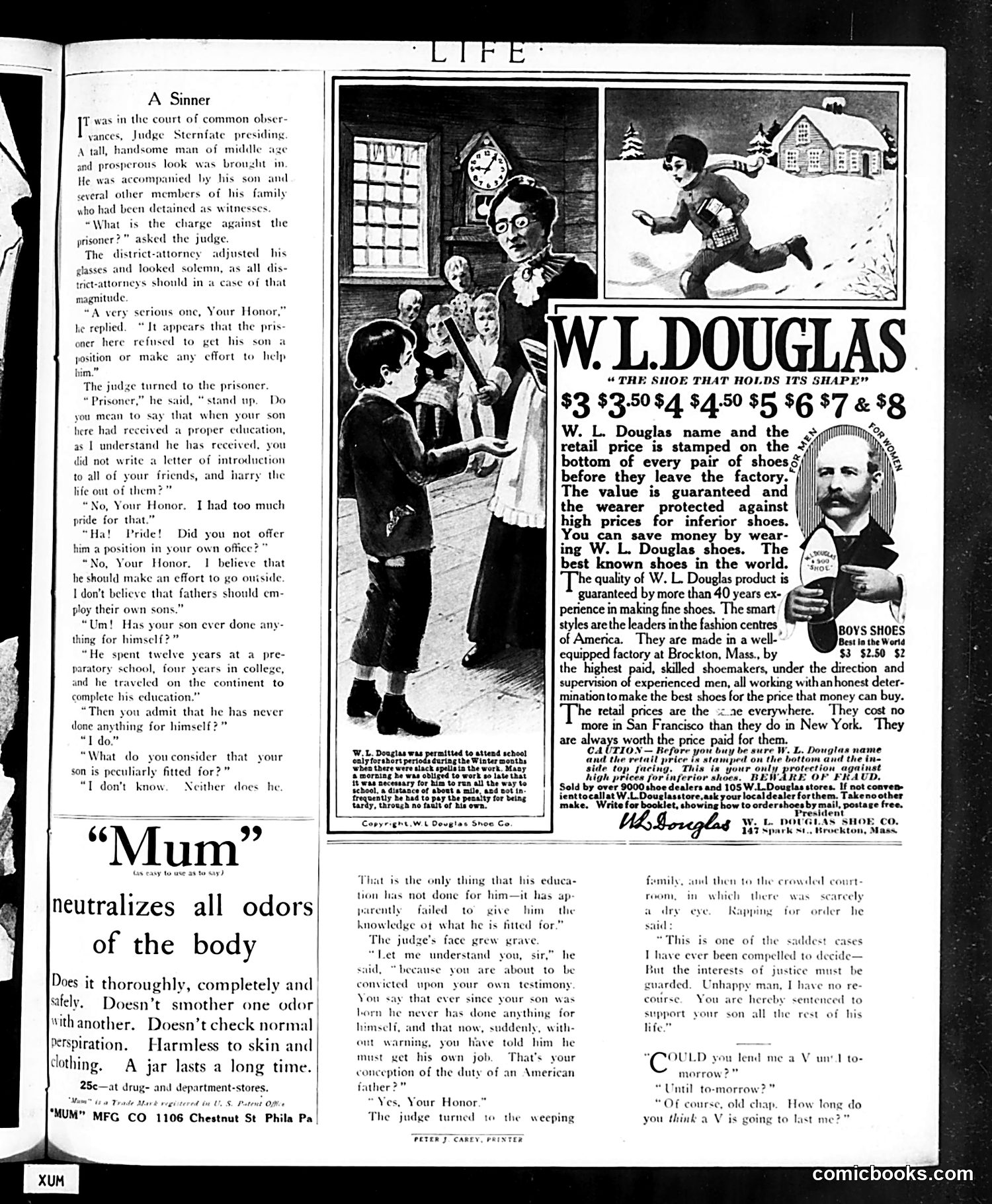
This satirical story critiques **wealthy parents who fail to use their privilege to advance their sons' careers**. A prosperous man is brought to court, charged with refusing to secure his son a job or write letters of introduction despite the boy's excellent education (prep school, college, continental travel). The father claims he wanted his son to succeed independently, citing "pride." The judge—representing society's expectations—treats this as criminal negligence. He exposes the father's hypocrisy: the son has never actually *done* anything for himself; his entire advantages came from paternal resources. The father has simply withdrawn crucial social capital (networking, connections) while providing everything else. **The satire's point**: Wealthy fathers of this era (appears to be early 1900s) are expected to leverage their social position for their sons. Refusing to do so isn't noble independence—it's a betrayal of class privilege. The "sinner" is guilty not of spoiling his son, but of withholding the insider advantages that wealth and status provide.
📄 Transcribed text from this page (OCR, searchable)
Machine-transcribed from the original scan — historical spelling and the odd misread are preserved.
A Sinner T was in the court of common obser- ee Judge Sternfate presiding \ tall, handsome man of middle age and prosperous look was brought in He was accompanied by his son and <everal other members of his family who had been detained as witnesses. “What is the charge against the prisoner?” asked the judge. The district-attorney adjusted his glasses and looked solemn, as all dis- trict-attorneys should in a case of that magnitude ‘A very serious one, Your Honor,” he replied. “It appears that the pris oner here refused to get his son a josition or make any effort to help him.” The judge turned to the prisoner. “Prisoner,” he said, “stand up. Do you mean to say that when your son here had received a proper education, as | understand he has received. you did not write a letter of introduction to all of your friends, and harry the life out of them?” “No, Your Honor. I had too much pride for that.” “Ha! Pride! Did you not offer him a position in your own office? “No, Your Honor, 1 believe that he should make an effort to go oniside, I don't believe that fathers should em- ploy their own sons.” “Um! Has your son ever done any- thing for himself?” “He spent twelve years at a pre- paratory school, four years in college, and he traveled on the continent to complete his education.” “Then you admit that he has never done anything for himself?” “Ido.” “What do youconsider that your son is peculiarly fitted for?” “T don't know. Neither does he “Mum” neutralizes all odors of the body Does it thoroughly, completely and ately. Doesn’t smother one odor with another. Doesn’t check normal verspiration. Harmless to skin and clothing. A jar lasts a long time. 25ce—at drug- and department-s “Mew” tsa Trade Abare registered in Up S. Patent Oe “MUM” MFG CO 1106 Chestnut St Phila Pa| SW. L.DOUGLAS “ THE SHOE THAT HOLDS ITS SHAPE” $3 $3.50 $4 $4.50 $5 $6 87 «& $8 W. L. Douglas name and the retail price is stamped on the + bottom of every pair of shoes Sf before they leave the factory. The value is guaranteed and the wearer protected against high prices for inferior shoes. ‘ou can save money by wear- ing W. L. Douglas shoes. The best known shoes in the world. Te quality of W. L. Douglas product guaranteed by more than 40 years ex- 4% perience in making fine shoes. The smart styles are the leaders in the fashion centres erica. They are made in a well-* equipped factory at Brockton, Mass., by $3 $2.50 $2 the highest paid, skilled shoemakers, under the direction and supervision of experienced men, all working withanhonest deter- mination to make the best shoes for the price that money can buy. Ts Wb, Depetas was permitted to attend schon eniy forshort per ¢ Winter months ea there were alach spells is the werk, Susy erning be was obliged to work so late tbat retail prices are the :z.ae everywhere. They cost no re in San Francisco than they do in New York. They are always we worth the price paid for them. Befobe you buy be sure We Ee D poy oe 1 price ix stamped on the bottom and the in gide top facing. This is your only protection against prices for inferior shoes. BE D. emery Se ae rene - slap en 1 9000 shoe dealers and 105 W.L.Douglas stores. If not convens Bel, ently be b tardy, through: if his own. make. hat is the only thing that his educa- vhas not done for him—it has ap parently failed to give him the hnowledge of what he is fitted for.” The judge's face grew grave “Let me understand you, sir,” he said, “because you are about to be convicted upon your own testimony You say that ever since your son was horn he never has done anything for himseli, and that now, suddenly, with- out warning, you have told him he must get his own job. That's your conception of the duty of an American iather?” “Yes, Your Honor.” The judge turned to the weeping PETER J CAREY, PRINTER jenttocallat W.L_Douglasstore,ask your local dealer forthem. Takenoother Write for booklet, showing how to ordershoes by m: Presid fomily, and then to the crowded court- room, in which there was scarcely dry eye. Rapping for order he his is one of the st cases I have ever been compelled to decide— But the interests of justice must be guarded. Unhappy man, I have no re cotirse. You are hereby sentenced to support your son all the rest of his life.” C IULD you lend me a Vo une to- morrow?" “Until to-morrow “OF course, old chap. How long do you think a V is going to last me comicbooks.com