
Life, 1918-03-14 · page 22 of 40
Life — March 14, 1918 — page 22: what you’re looking at
What you’re looking at
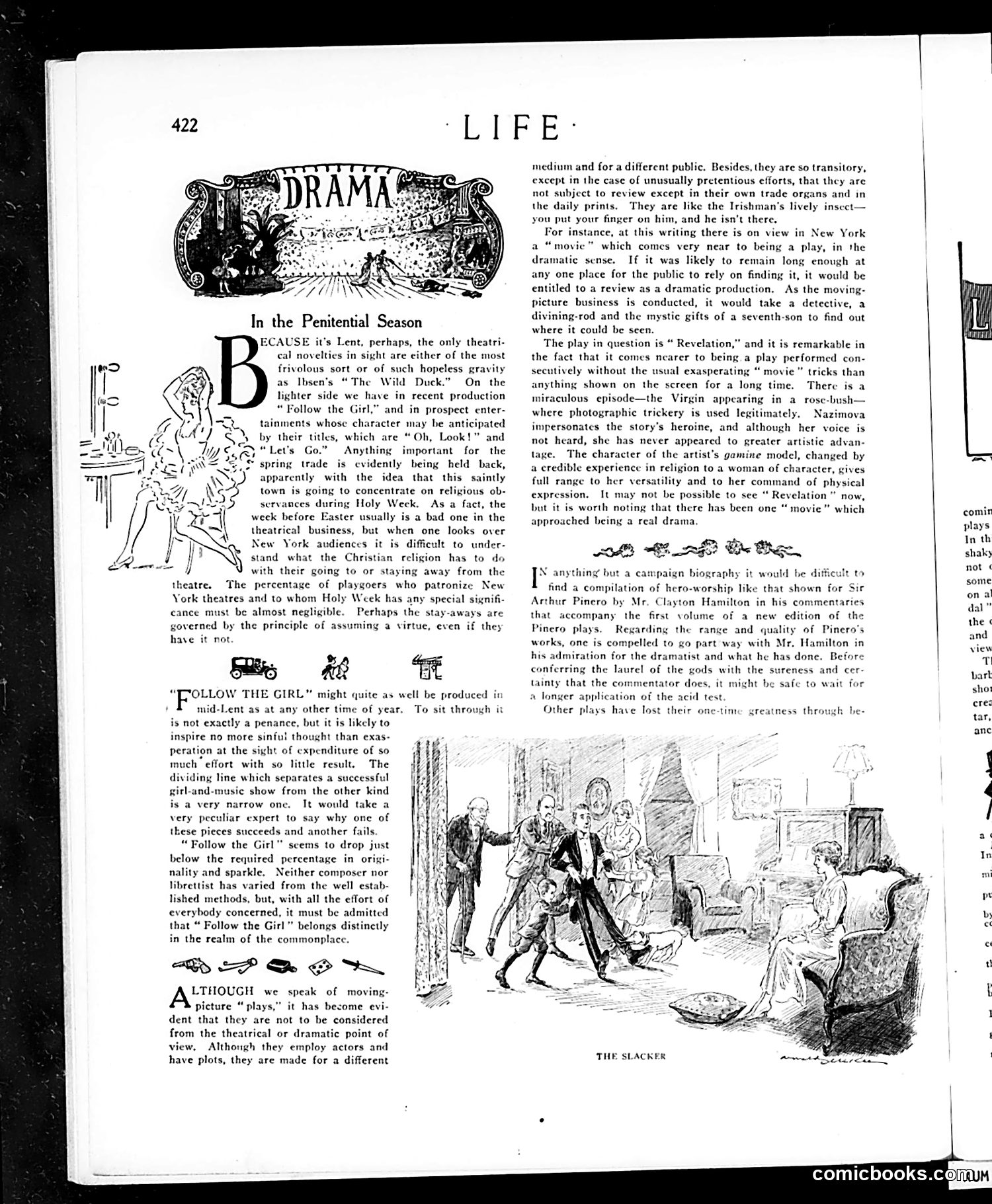
This page critiques theatrical offerings during Lent in New York. The main points: **"In the Penitential Season"**: The author notes that theaters offer mostly frivolous comedies ("Follow the Girl," "Oh, Look!") or heavy dramas (Ibsen's "The Wild Duck") during Lent, with important productions held for later. He sarcastically observes that New York audiences likely aren't actually staying away for religious reasons—suggesting theatergoers aren't particularly devout despite the city's pretensions. **"Follow the Girl"**: A mediocre musical comedy lacking originality and sparkle, representing the forgettable, commonplace entertainment that fails to distinguish itself. **Moving Pictures**: The author argues films shouldn't be reviewed as theater—they're a different medium for different audiences, and their transitory nature makes them difficult to even locate for review. **"Revelation"**: A notable film exception featuring actress Nazimova, with unusually coherent narrative structure and legitimate artistic merit rather than cheap "movie tricks." The satirical tone criticizes both theatrical mediocrity and the pretense of religious observance.
📄 Transcribed text from this page (OCR, searchable)
Machine-transcribed from the original scan — historical spelling and the odd misread are preserved.
In the Penitential Season ECAUSE it's Lent, perhaps, the only theatri- cal novelties in sight are either of the most frivolous sort or of such hopeless gravity as Ibsen's “The Wild Duck.” On the lighter side we have in recent production How the Girl,” and in prospect enter- tainments whose character may be anticipated by their titles, which are “Oh, Look!” and “Let's Go.” Anything important for the spring trade is evidently being held back, apparently with the idea that this saintly town is going to concentrate on religious ob- servances during Holy Week. As a fact, the week before Easter usually is a bad one in the theatrical business, but when one looks over New York audiences it is difficult to under- stand what the Christian religion has to do with their going to or staying away from the theatre. The percentage of playgoers who patronize New York theatres and to whom Holy Week has any special signifi- cance must be almost negligible. Perhaps the stay-aways are governed by the principle of assuming a virtue, even if they is BR “TOLLOW THE GIRL" might quite as well be produced iv mid-Lent as at any other time of year. To sit through it is not exactly a penance, but it is likely to inspire no more sinful thought than exas- Peration at the sight of expenditure of so much ‘effort with so little result. The dividing line which separates a successful girl-and-music show from the other kind a very narrow one. It would take a very peculiar expert to say why one of these pieces succeeds and another fails Follow the Girl" scems to drop just below the required percentage in origi- nality and sparkle, Neither composer nor librettist has varied from the well estab- lished methods, but, with all the effort of everybody concerned, it must be admitted that “ Follow the Girl” belongs distinctly in the realm of the commonplace. FD EP He OM LTHOUGH we speak of moving: picture “plays,” it has become evi- dent that they are not to be considered from the theatrical or dramatic point of view, Although they employ actors and have plots, they are made for a different “LIP E ° medium and for a different public. Besides, they are so transitory, except in the case of unusually pretentious efforts, that they are not subject to review except in their own trade organs and in the daily prints. They are like the Irishman’s lively inscet— you put your finger on him, and he isn’t there. ‘or instance, at this writing there is on view in New York a “movie” which comes very near to being a play, in the atic sense. If it was likely to remain long enough at any one place for the public to rely on finding it, it would be entitled to a review as a dramatic production. As the moving- picture business is conducted, it would take a detective, a divining-rod and the mystic gifts of a seventh-son to find out where it could be seen. The play in question is “ Revelation,” and it is remarkable in the fact that it comes nearer to being.a play performed con- secutively without the usual exasperating “ movie" tricks than anything shown on the screen for a long time. There is a miraculous episode—the Virgin appearing in a rose-bush— where photographic trickery is used legitimately. Nazimova impersonates the story’s heroine, and although her voice is not heard, she has never appeared to greater artistic advan- tage. The character of the artist’s gamine model, changed by a credible experience in religion to a woman of character, gives full range to her versatility and to her command of physical expression. It may not be possible to see “ Revelation” now, but it is worth noting that there has been one “ movie" which approached being a real drama AB AAG Ue Che ing but a campaign biography it would be di ult to find a compilation of hero-worship like that shown for Sir Arthur Pinero by Mr. Clayton Hamilton in his commentaries that accompany the first volume of a new edition of the Pinero plays. Regarding the range and quality of Pinero's works, one is compelled to go part way with Mr. Hamilton in his admiration for the dramatist and what he has done. Before rring the laurel of the gods with the sureness and cer con tainty that the commentator does, it might be safe to wait for a longer application of the acid test Other p ys have lost their one-time greatness through be- THE SLACKER comir plays In th shaky not « some onal dal” the | and view Tv Dart sho cre: tar, ane comicbooks.comm