
Life, 1918-03-14 · page 35 of 40
Life — March 14, 1918 — page 35: what you’re looking at
What you’re looking at
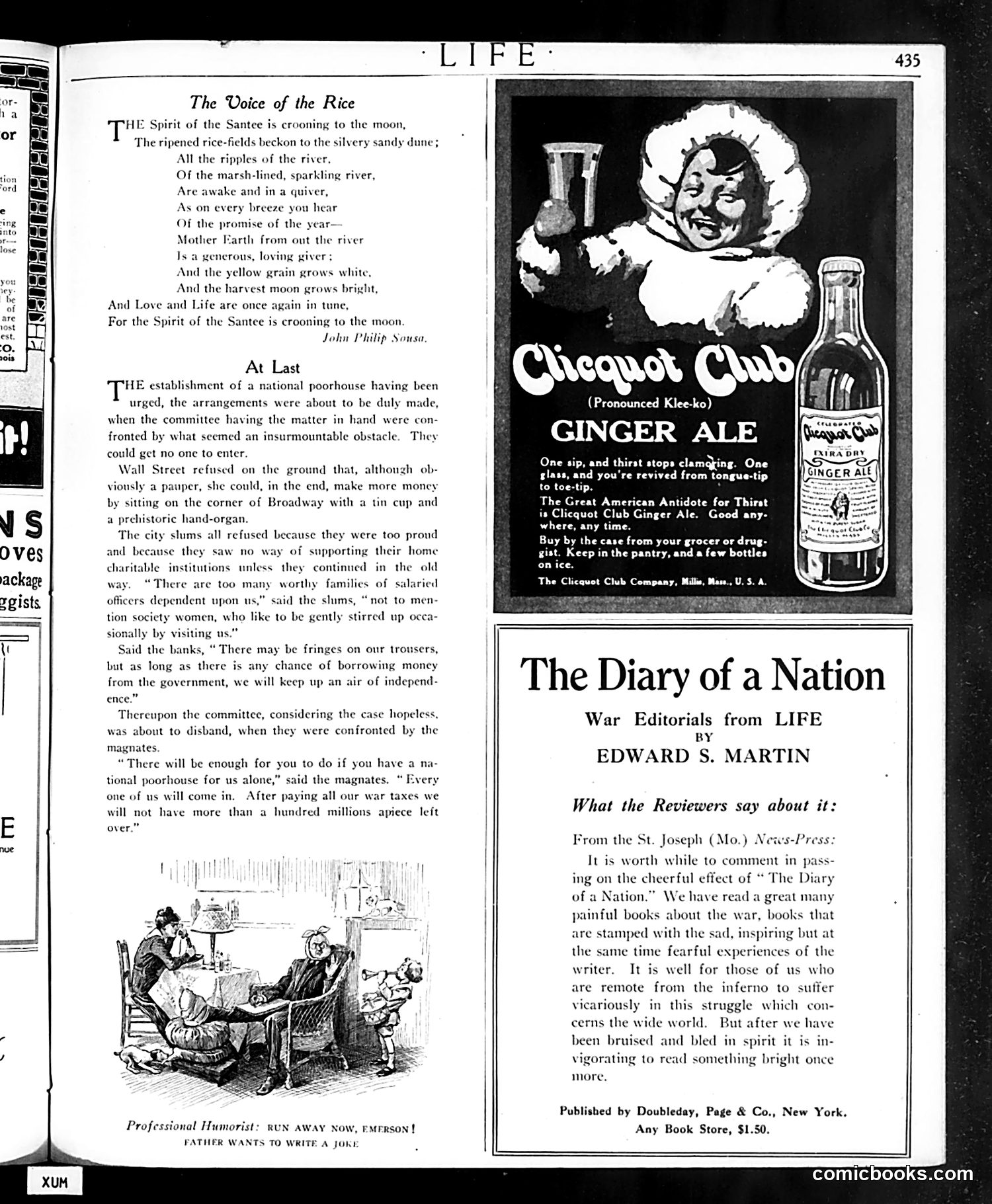
This satirical piece mocks the refusal of major American institutions to enter a proposed national poorhouse. Each group offers absurd excuses rooted in self-interest: - **Wall Street** claims poverty is profitable (begging on Broadway makes more money) - **City slums** refuse because they depend on wealthy visitors' charity donations to survive - **Banks** won't admit financial trouble, needing to appear solvent to borrow government funds - **Magnates** (wealthy industrialists) finally agree—but only if it's exclusively for the rich, claiming postwar taxes have left them with merely "a hundred millions apiece" The joke satirizes how every social class prioritizes profit and appearances over genuine welfare. The magnates' complaint about war taxes is particularly pointed: even the wealthiest claim poverty while retaining vast fortunes. This reflects early WWI-era American tensions over taxation and wealth inequality. The accompanying cartoon shows a father interrupting a child, presumably to explain the joke—meta-humor about the piece's complexity.
📄 Transcribed text from this page (OCR, searchable)
Machine-transcribed from the original scan — historical spelling and the odd misread are preserved.
The Voice of the Rice HE Spirit of the Santee is crooning to the moon, The ripened rice-fields beckon to the silvery sandy dune; All the ripples of the river, Of the marsh-lined, sparkling river, Are awake and in a quiver, As on every breeze you hear Of the promise of the year— Mother Earth from out the river Is a generous, loving giver: And the yellow grain grows white, And the harvest moon grows bright, And Love and Life are once again in tune, For the Spirit of the Santee is crooning to the moon John Philip Sousa At Last HE establishment of a national poorhouse having been urged, the arrangements were about to be duly made, when the committee having the matter in hand were con- fronted by what seemed an insurmountable obstacle. They could get no one to enter. Wall Street refused on the ground that, although o viously a pauper, she could, in the end, make more money by sitting on the corner of Broadway with a tin cup and a prehistoric hand-organ. The city slums all refused because they were too proud and because they saw no way of supporting their home charitable institutions unless they continued in the old way, “There are too many worthy families of salaried officers di ndent upon us,” said the slums, “not to men- tion society women, who like to be gently stirred up occa sionally by visiting us.” Said the banks, “ There may be fringes on our trousers, but as long as there is any chance of borrowing money from the government, we will keep up an air of independ- ence. Thereupon the committee, considering the case hopeless, was about to disband, when they were confronted by the magnates “There will be enough for you to do if you have a n:; tional poorhouse for us alone,” said the magnates. “ FE one of us will come in. After paying all our war taxes we will not have more than a hundred millions apiece left over.” Professional Humorist: rRuN Away Now, EMERSON! FATHER WANTS TO WRITE A JOKE (Pronounced Klee-ko) GINGER ALE One sip, and thirst stops clamating. One glass, and you're revived from tongue-tip to toe-tip. $ Antidote for Thirst ger Ale. Good any- eapands EXTRA DRY Buy by the case from your grocer or drug- gist. Keep in the pantry, and a few bottles on ice. The Clicquot Club Company, Milli, Mase., U.S. A. LL The Diary of a Nation War Editorials from LIFE BY EDWARD S. MARTIN What the Reviewers say about it: From the St. Joseph (Mo.) News-Pre It is worth while to comment in pa ing on the cheerful effect of “* The Diary of a Nation.” We have read a great many painful books about the war, books that are stamped with the sad, inspiring but at the same time fearful experiences of the writer. It is well for those of us who are remote from the inferno to sutfer vicariously in this struggle which con- cerns the wide world. But after we have been bruised and bled in spirit it is in- vigorating to read something bright once more. Published by Doubleday, Page & Co., New York. Any Book Store, $1.50. comicbooks.com