
A complete issue · 40 pages · 1918
Life — February 28, 1918
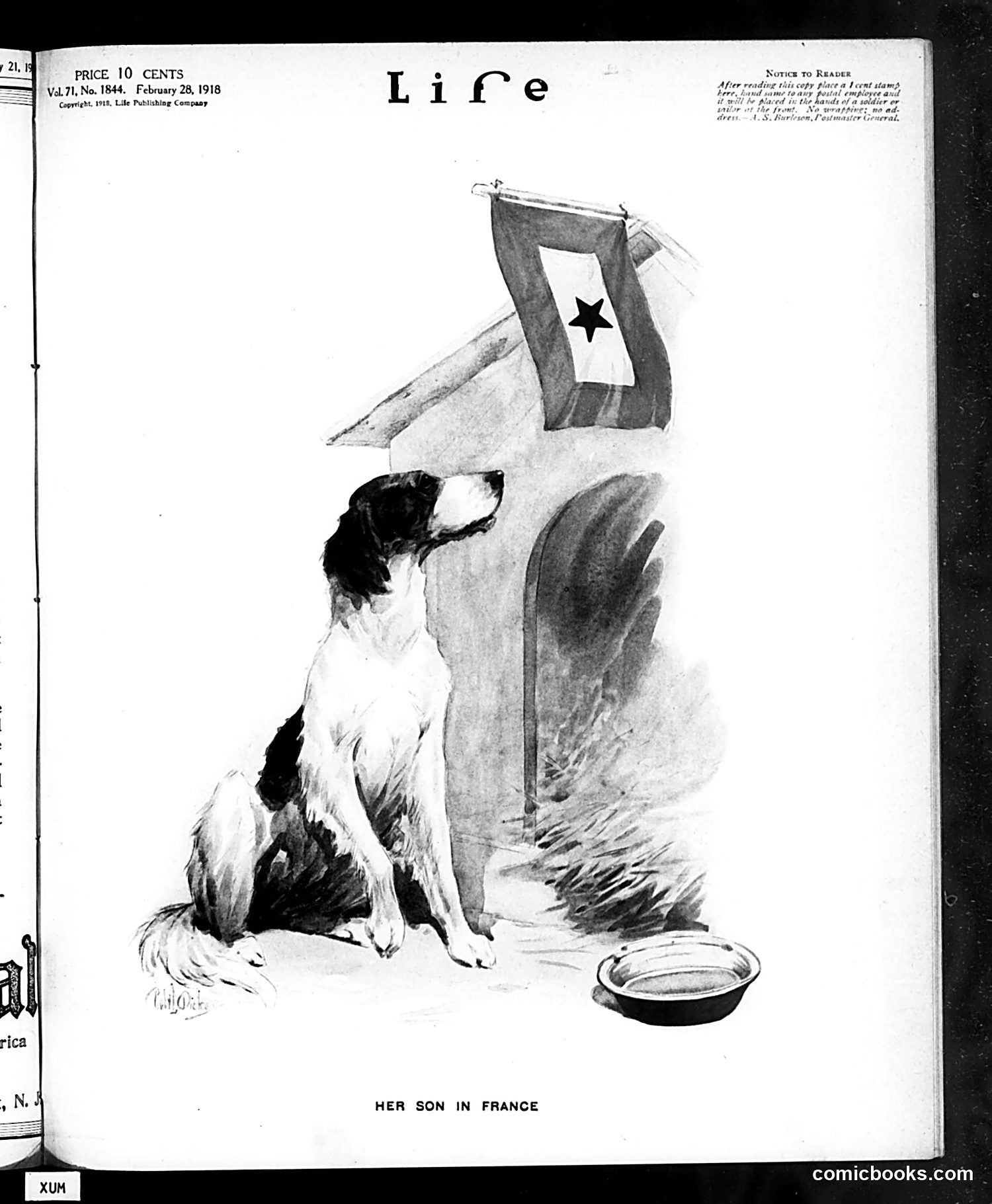
This February 1918 *Life* magazine cover depicts an American mother dog holding a French flag while gazing upward, with a military helmet and empty food bowl nearby. The title "Her Son in France" creates emotional resonance around American mothers whose sons were fighting in World War I. The image satirizes American patriotism and sacrifice during the war. The dog anthropomorphically represents mothers anxiously supporting the war effort while their children faced danger abroad. The French flag references America's alliance with France against Germany. The empty bowl suggests domestic deprivation—the home front's material sacrifice. This wartime cover appeals to national sentiment and the anxiety families experienced with soldiers deployed to European battlefields, making patriotic duty and maternal worry central to American war support.
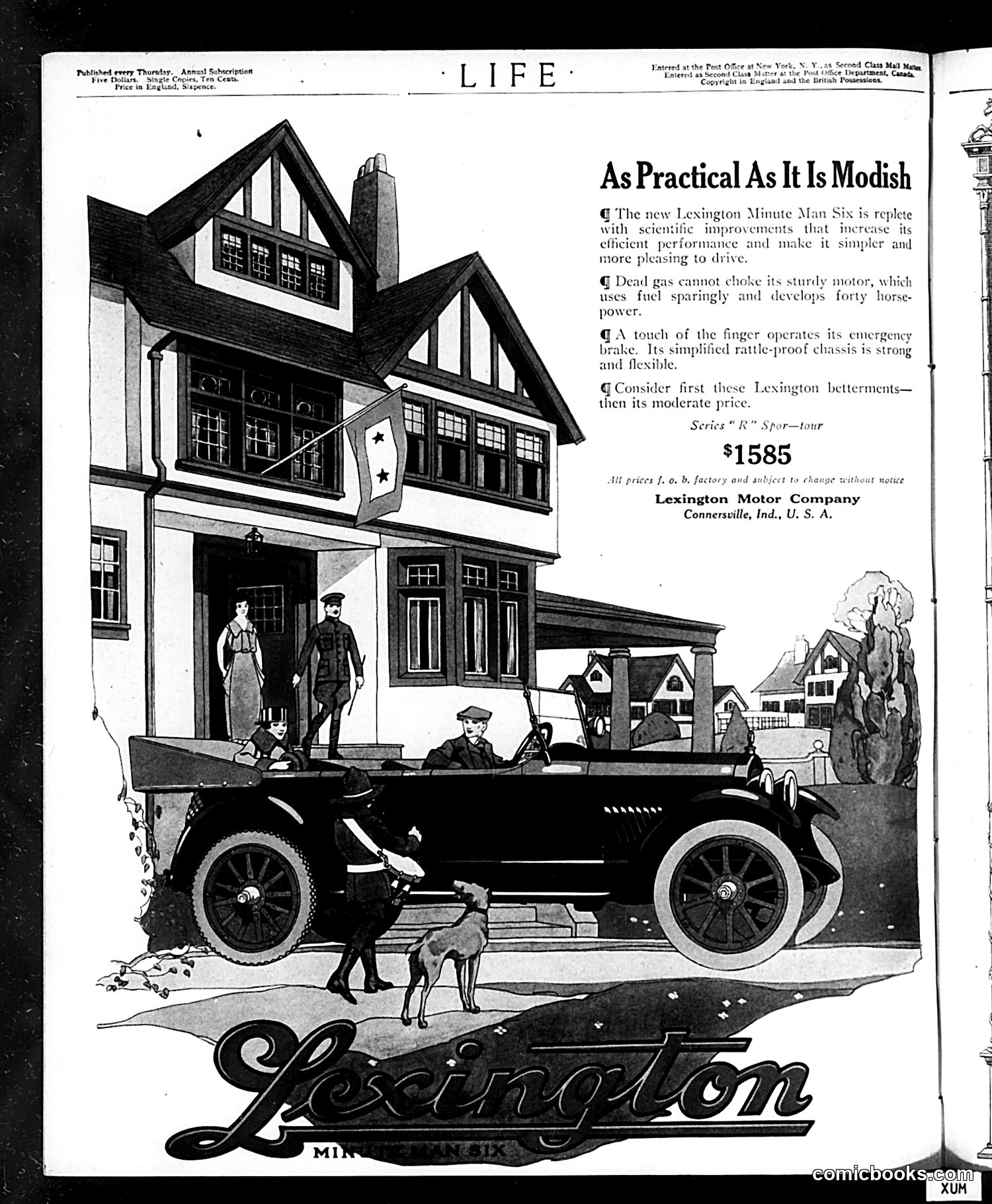
This is **not a political cartoon, but rather a car advertisement** from Life magazine. The page advertises the Lexington Minute Man Six automobile, priced at $1585. The illustration depicts a domestic scene showing the car parked in front of a Tudor-style home. Figures include a woman, a man, a child, a dog, and a driver in the vehicle. The composition emphasizes the car as central to suburban family life. The advertisement's headline—"As Practical As It Is Modish"—emphasizes that the vehicle combines utility with contemporary style. Technical details mention fuel efficiency, engine power, and brake performance, targeting practical-minded buyers. This is essentially branded content promoting automobiles to American consumers during what appears to be the 1920s.
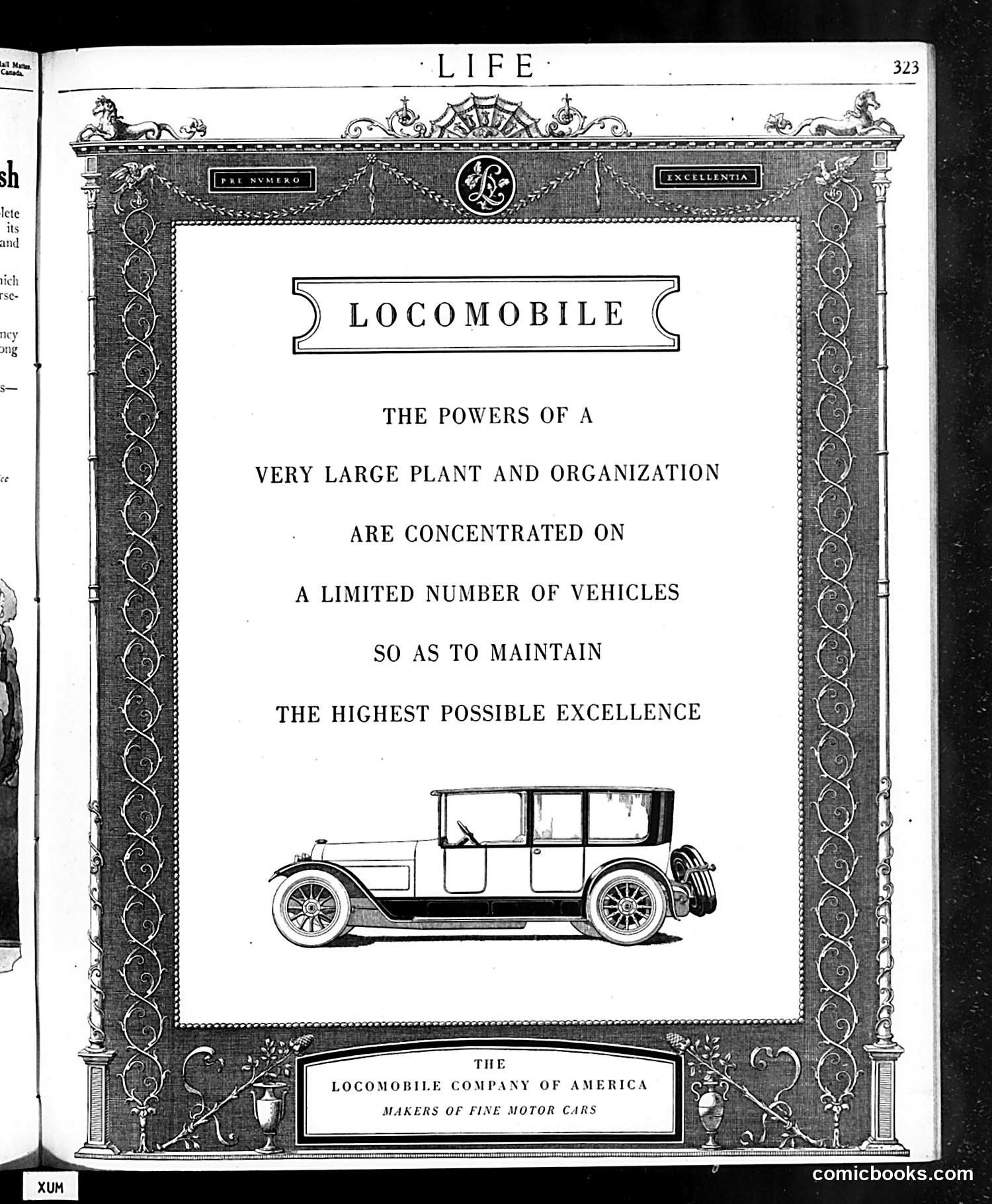
This page is **not a cartoon or satire**—it's a **period advertisement** for the Locomobile Company of America, makers of fine motor cars. The ad uses the decorative border and prestigious LIFE magazine placement typical of early 20th-century luxury automotive advertising. The text emphasizes exclusivity through a quality-over-quantity strategy: the company deliberately limits production to maintain "the highest possible excellence." The accompanying vehicle illustration shows a high-end touring car of the era. This "scarcity marketing" approach was common for luxury brands positioning themselves as superior to mass-produced competitors (implicitly, Ford's Model T). There is no political or social satire present—this is straightforward, elegant advertising targeting wealthy consumers.
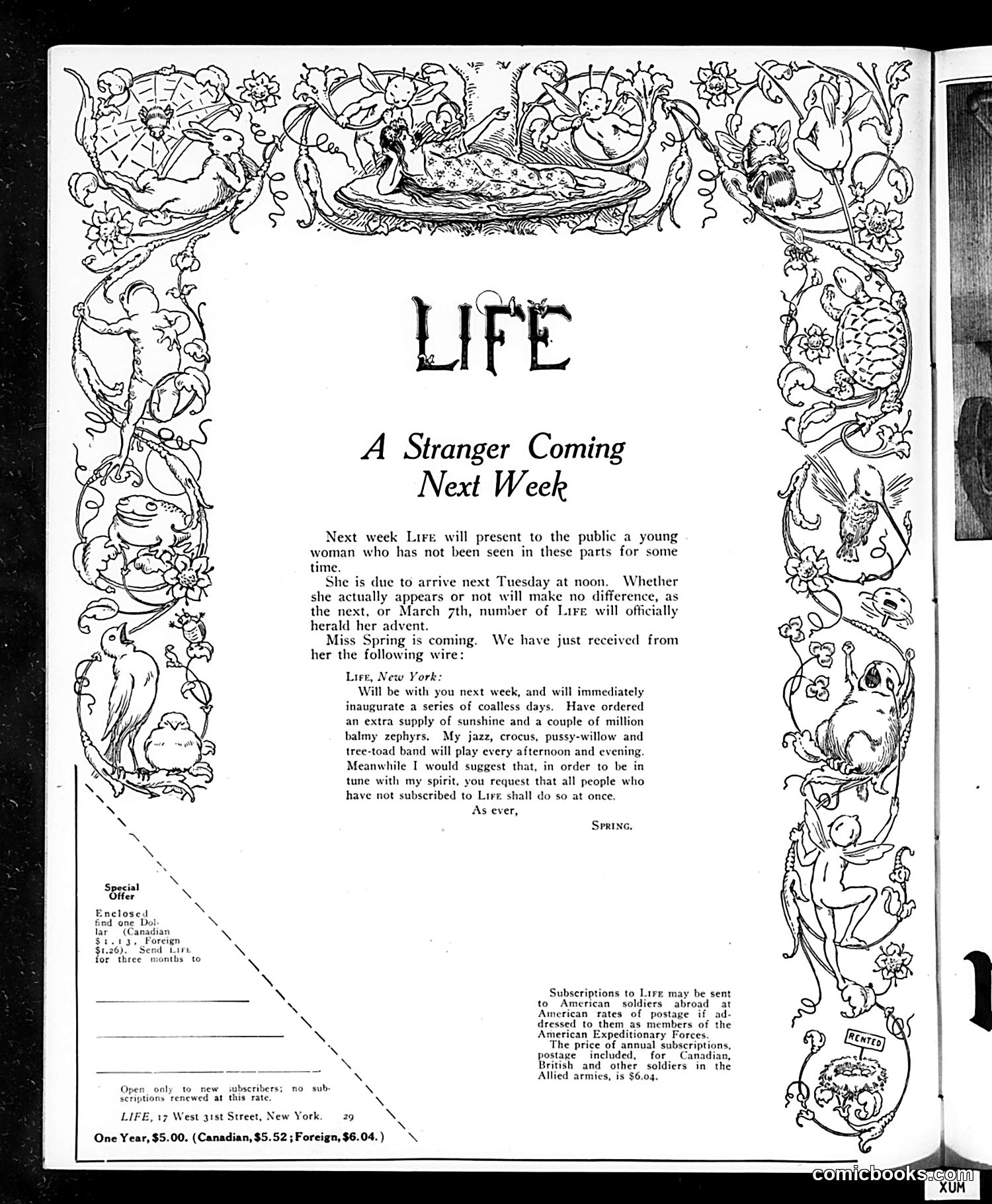
This page primarily contains **promotional advertising** for Life magazine itself, not political satire. The headline "A Stranger Coming Next Week" announces an upcoming featured article about "a young woman who has not been seen in these parts for some time," arriving Tuesday at noon. The text reveals this is a tongue-in-cheek teaser: whether the woman actually appears is irrelevant—Life will declare her arrival anyway. A mock wire from "Spring" suggests the magazine's playful, self-aware humor. The elaborate decorative border features cherubs and seasonal imagery (flowers, fauna), typical of Life's ornate design aesthetic of this era. The lower section contains subscription information and rates for American soldiers abroad. This appears to be **self-promotion rather than political commentary**, showcasing Life's characteristic irreverent humor about its own editorial practices.
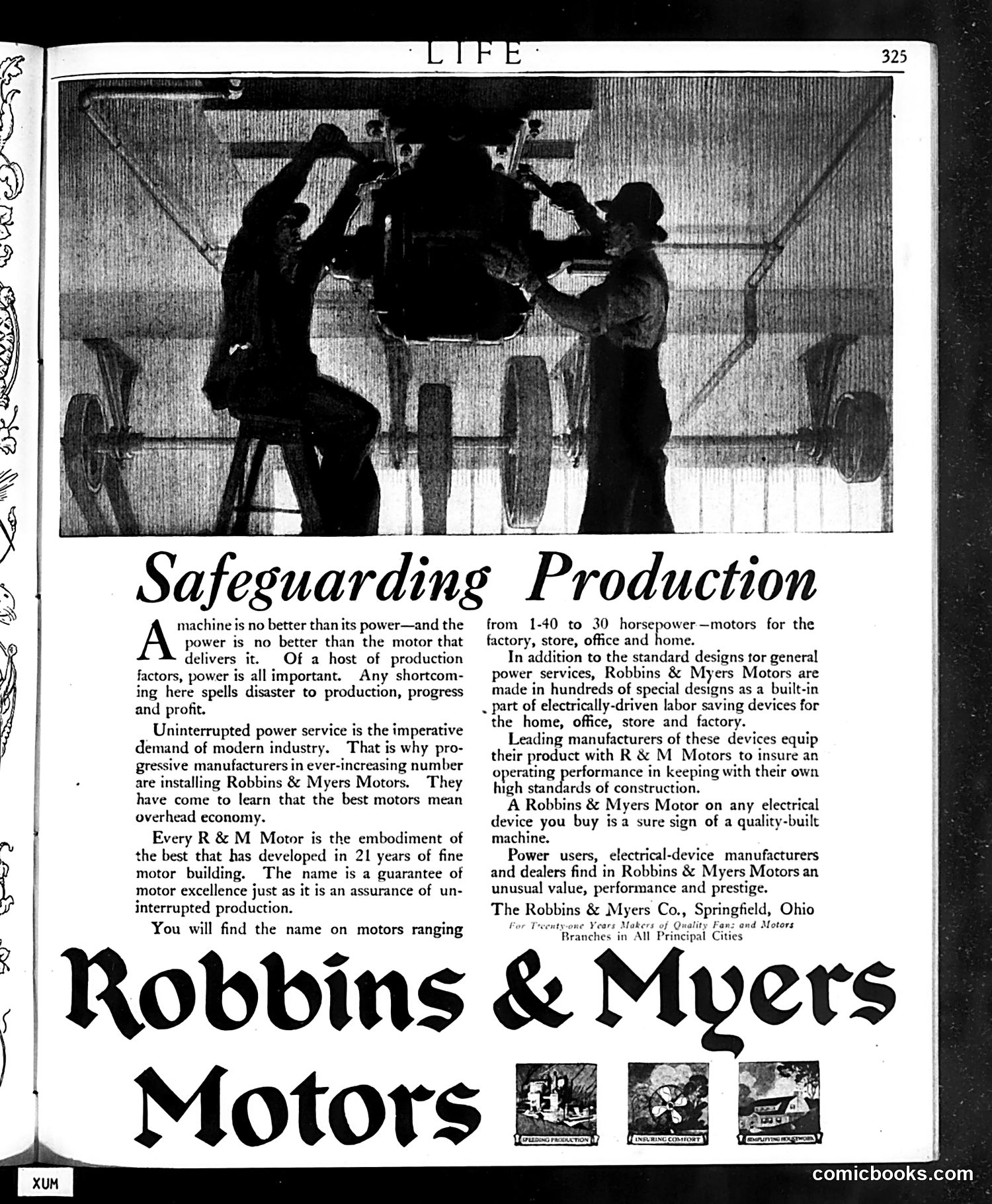
This page is primarily **advertising**, not satire or political commentary. It features a full-page advertisement for Robbins & Myers Motors, a manufacturer based in Springfield, Ohio. The image shows silhouetted industrial workers operating machinery in a factory setting, illustrating the text's emphasis on "uninterrupted power service" and reliable motors for manufacturing. The visual emphasizes factory production and labor. The advertisement's message is straightforward: Robbins & Myers Motors are essential for industrial efficiency because they provide dependable power. The copy claims that leading manufacturers trust their motors, and that buying R&M Motors guarantees "quality-built" equipment. This represents typical early-20th-century industrial advertising targeting factory owners and managers, emphasizing reliability and economy.
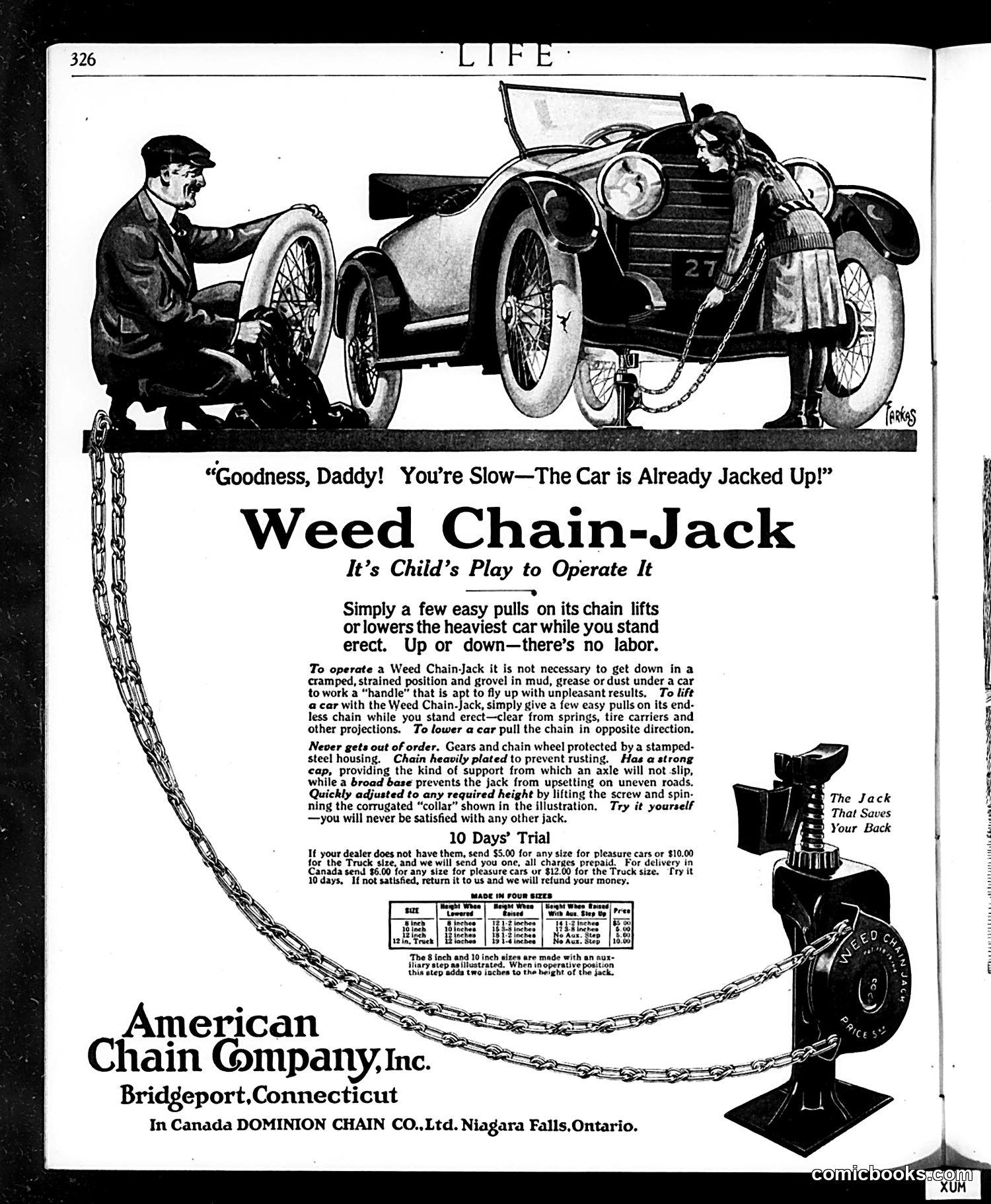
This page is primarily a **product advertisement**, not satire. It promotes the "Weed Chain-Jack," a mechanical lifting device for automobiles manufactured by American Chain Company in Bridgeport, Connecticut. The advertisement's humor comes from the caption: "Goodness, Daddy! You're Slow—The Car is Already Jacked Up!" The illustration shows a man manually changing a tire while a woman operates the chain-jack effortlessly, emphasizing the product's ease of use. The ad's selling point is that the device requires minimal physical effort—"It's Child's Play to Operate It"—allowing users to lift heavy cars by simply pulling a chain while standing upright. This represents early 20th-century marketing that combined practical innovation with gentle mockery of traditional manual labor.
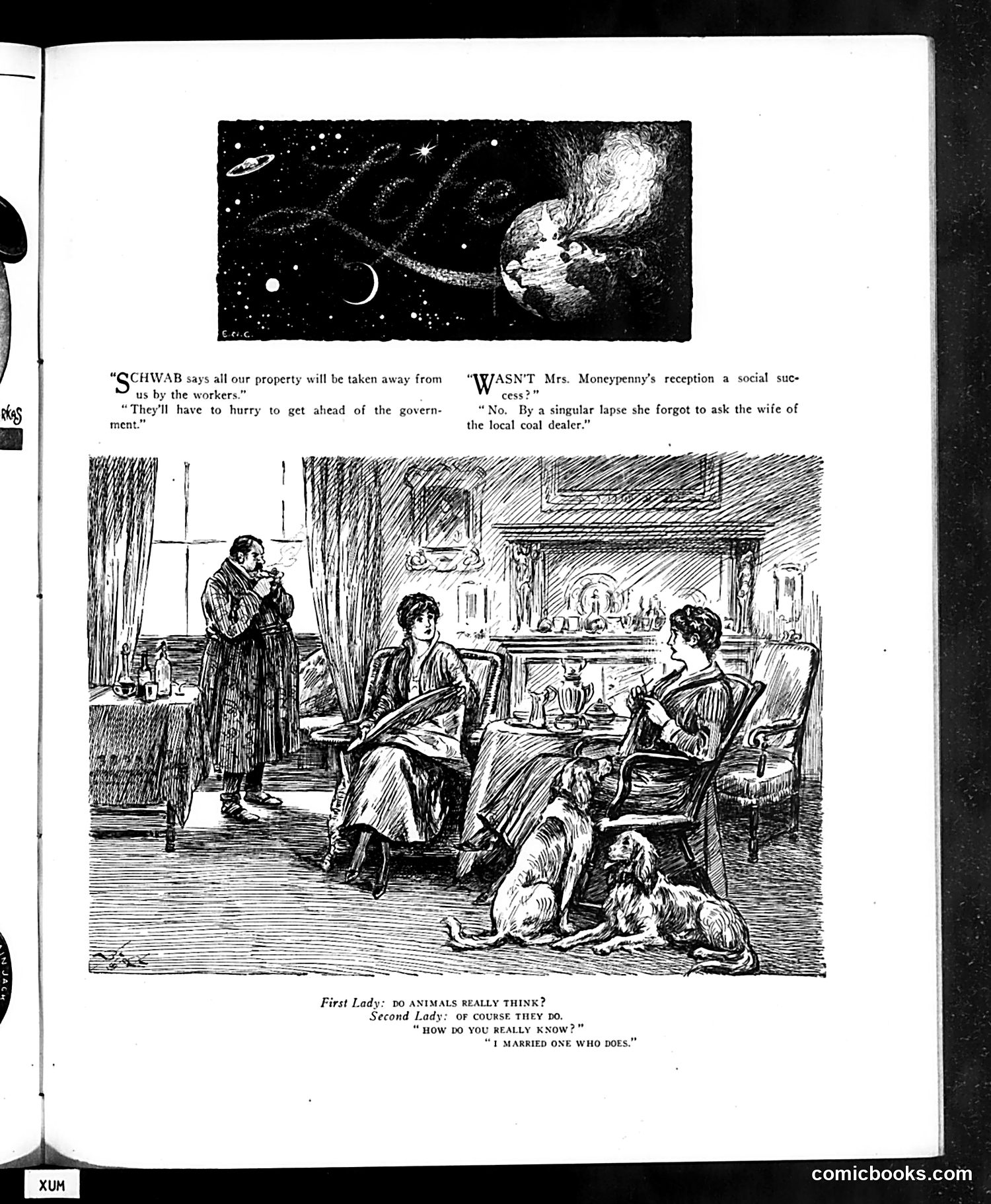
This page contains two satirical cartoons from *Life* magazine: **Top cartoon:** A cosmic scene depicting a figure blowing Earth away like a dandelion seed, illustrating anxieties about catastrophic world destruction—likely referencing early 20th-century fears about war, technology, or social upheaval. **Bottom cartoon:** A domestic scene where a First Lady asks a Second Lady whether animals really think. The Second Lady responds affirmatively, claiming she "married one who does"—a cutting insult suggesting the First Lady's husband lacks intelligence. This satirizes upper-class social pretension and marital dynamics, using the device of a woman's pointed insult delivered in polite company to mock either a specific political figure or types of society wives. Both reflect *Life's* tradition of biting social and political satire.
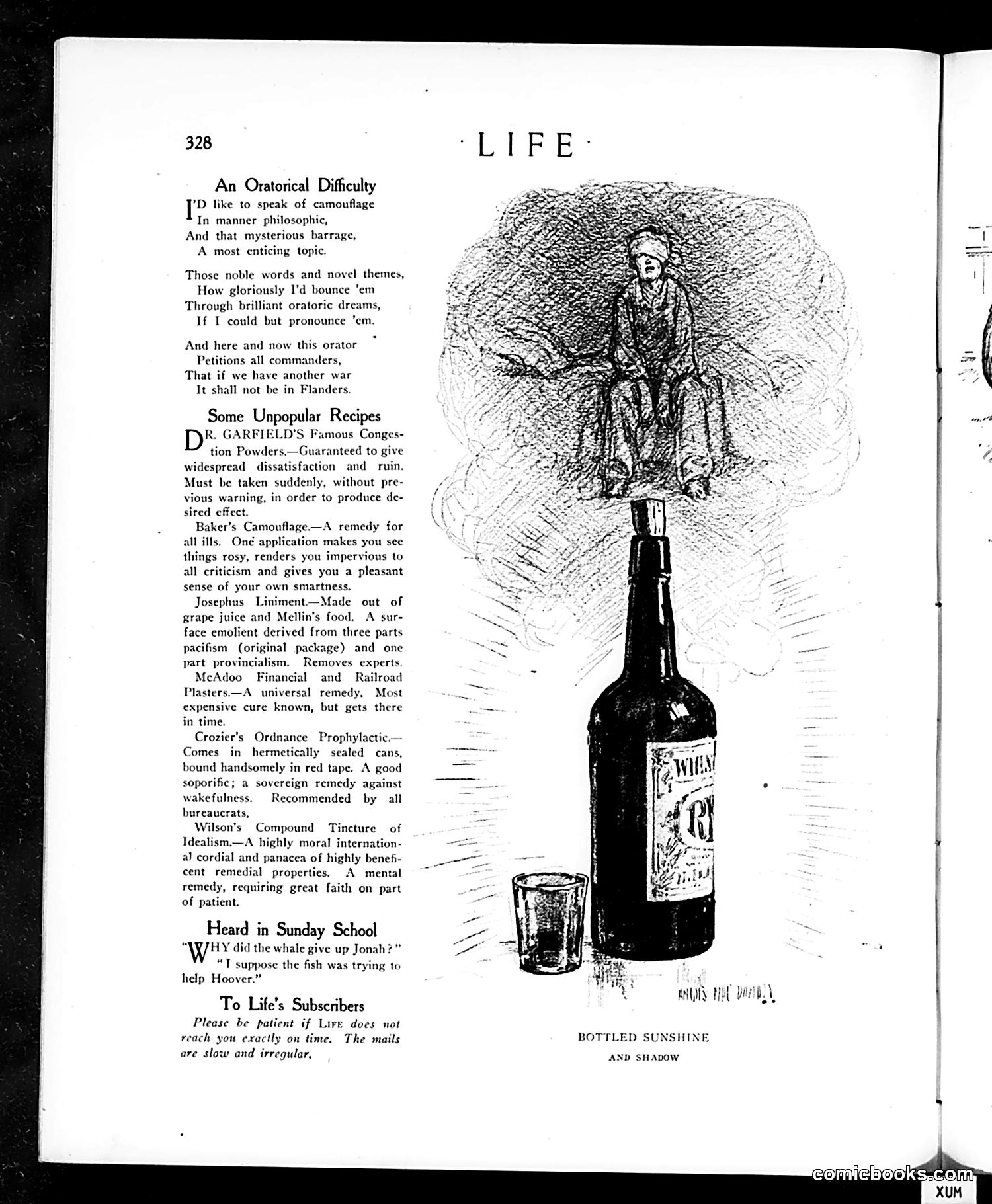
This page is primarily **satirical advertising parody**. The right side features a detailed sketch of a bottle labeled "Bottled Sunshine and Shadow" with a glass beside it, captioned as such. The left side contains mock product testimonials titled "Some Unpopular Recipes," listing absurd fake remedies like "Baker's Camouflage" and "Wilson's Compound Tincture of Idealism." These appear to satirize patent medicines and dubious commercial products popular in the early 20th century. The bottle itself likely represents alcohol (particularly whiskey, given the style), making this a satirical commentary on Prohibition-era "medicinal" liquor sales or pre-Prohibition drinking culture. The humor lies in presenting obvious alcoholic beverages as legitimate health remedies—a common reality before modern consumer protection laws.
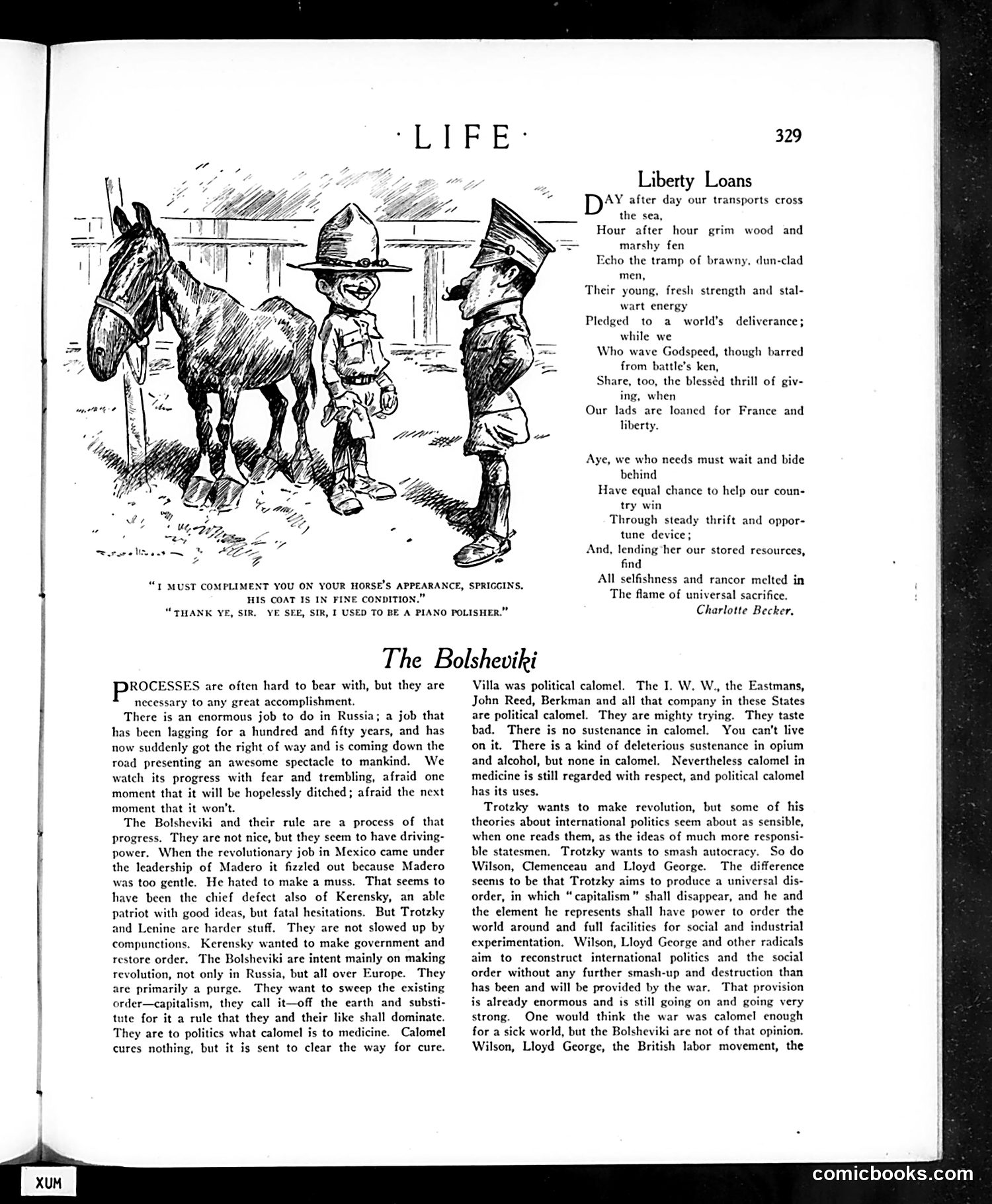
The cartoon shows two military figures inspecting a horse, with one saying he must compliment the horse's appearance and that "his coat is in fine condition," to which the other replies "Thank ye, sir. We, sir, I used to be a piano polisher." This is **wartime satire** mocking military recruitment and resource allocation. The joke satirizes how soldiers are being pressed into service regardless of their civilian skills—a piano polisher is now caring for military horses. It's a gentle jab at the army's need for manpower during what appears to be WWI, suggesting absurd reassignments of untrained personnel to essential military tasks. The facing article on "The Bolsheviki" discusses Russian revolutionary politics critically, referencing figures like Trotsky, Lenin, and Madero, contextualizing this as anti-revolutionary American commentary from the war period.
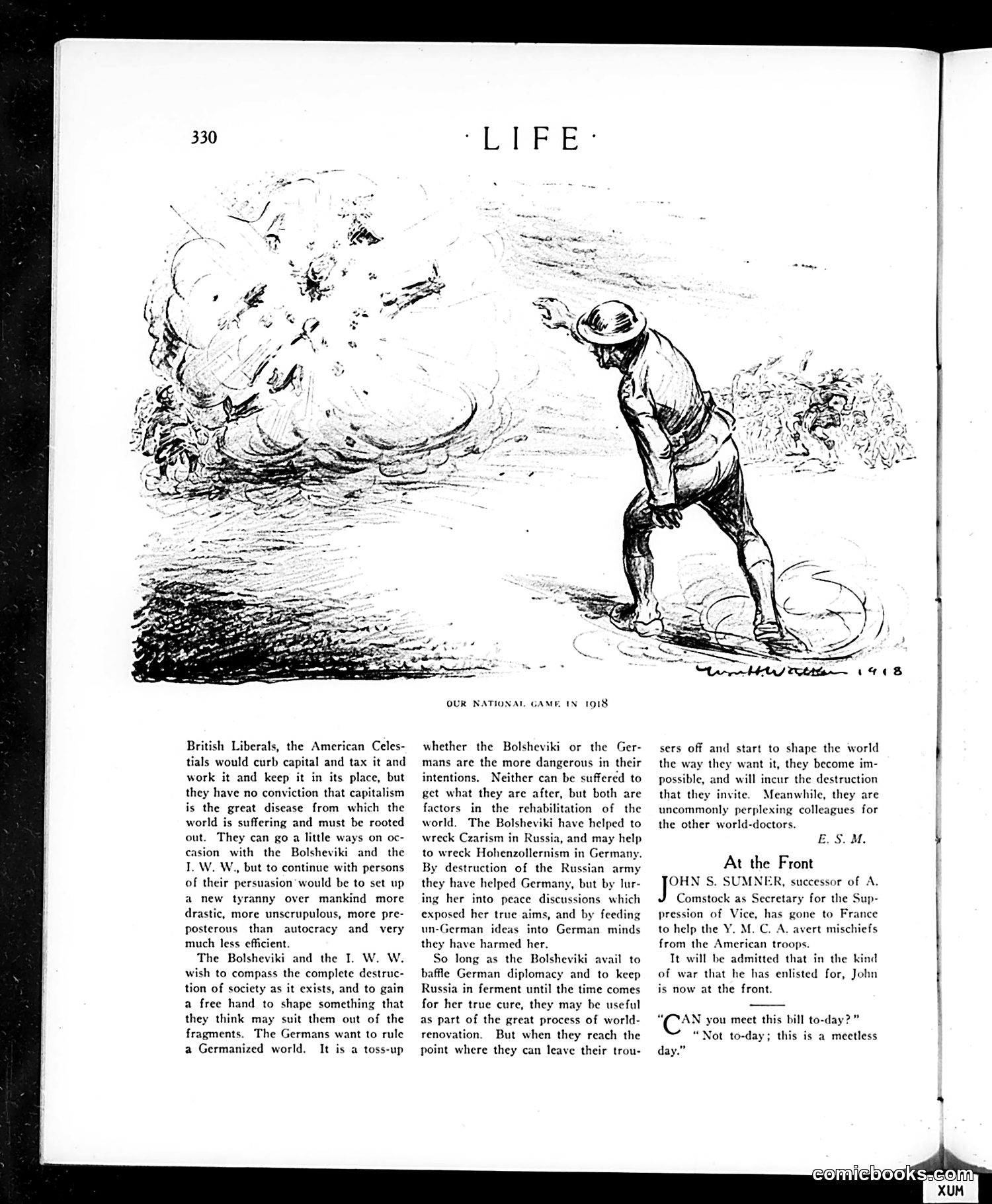
This cartoon depicts a baseball player attempting to hit a ball labeled with explosive imagery, likely representing military conflict. The caption and surrounding text reference the Bolsheviki (Russian Communists), Germans, and debates over American intervention in World War I. The satire suggests that American political leaders—represented by the batter—are playing a dangerous "game" by engaging with both Russian revolutionaries and Germans, when they should focus on clear military objectives. The text criticizes those who would negotiate with Bolsheviks or Germans rather than decisively defeating them. The "national game" metaphor mocks treating serious wartime decisions as casual sport, suggesting American leadership is recklessly gambling with national security by entertaining multiple ideological threats simultaneously during WWI.
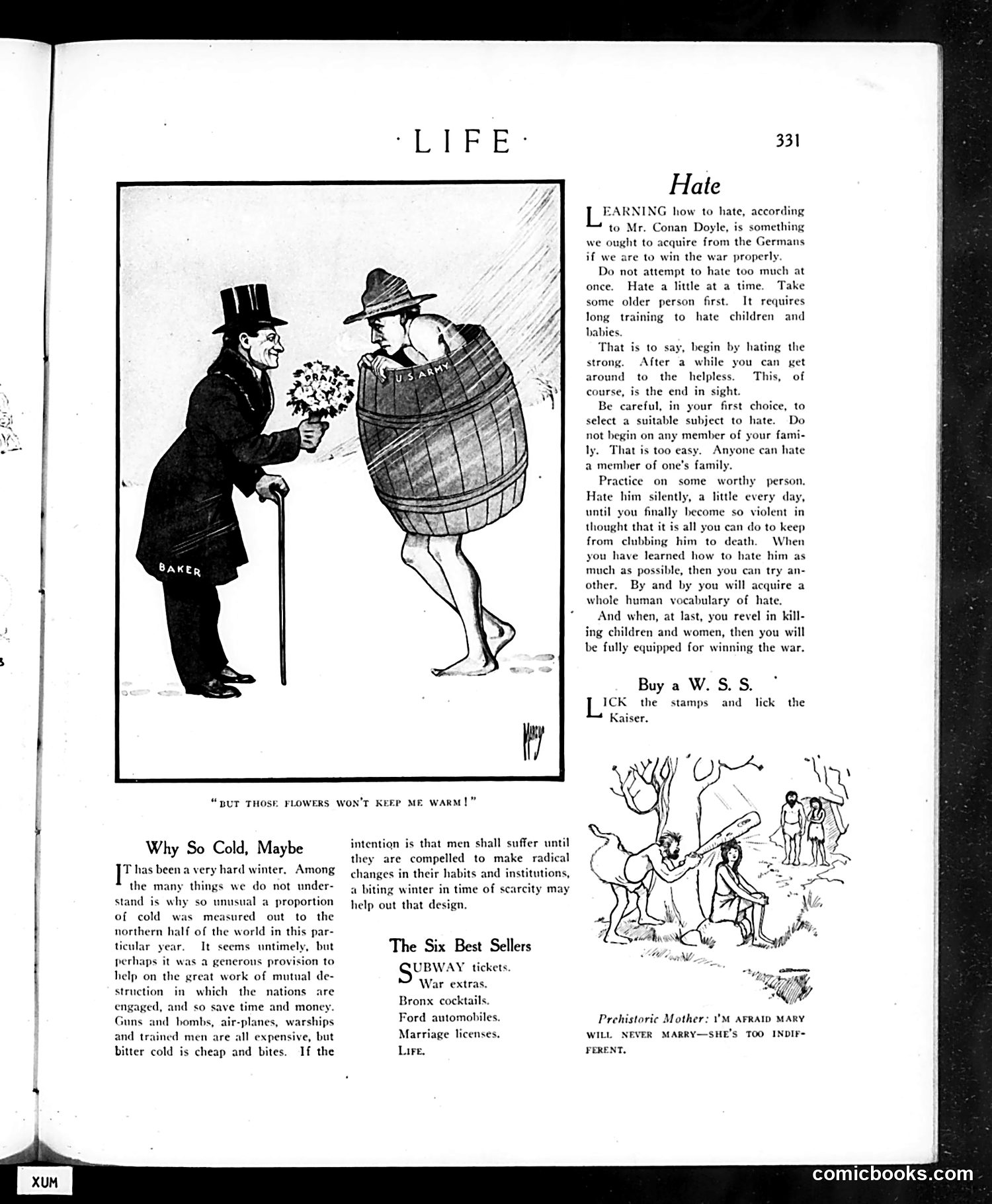
**Main Cartoon ("But Those Flowers Won't Keep Me Warm!"):** Shows a thin man labeled "BAKER" offering flowers to a large, barrel-shaped figure labeled "U.S. ARMY." The satire critiques inadequate provisions for soldiers during a harsh winter—flowers are useless against cold. The barrel shape likely represents military supplies or provisions, sarcastically suggesting the army is "bloated" yet soldiers remain cold and underfed. **Accompanying Article "Hale":** Attributes to Conan Doyle a proposal to "learn hatred" as war preparation, advising readers to practice hating enemies progressively. This reflects WWI-era psychological warfare rhetoric. **"The Six Best Sellers":** A satirical list mocking wartime commercialism: subway tickets, war bonds, cocktails, Ford automobiles, marriage licenses, and *Life* magazine itself—suggesting cynical profiteering amid global conflict.
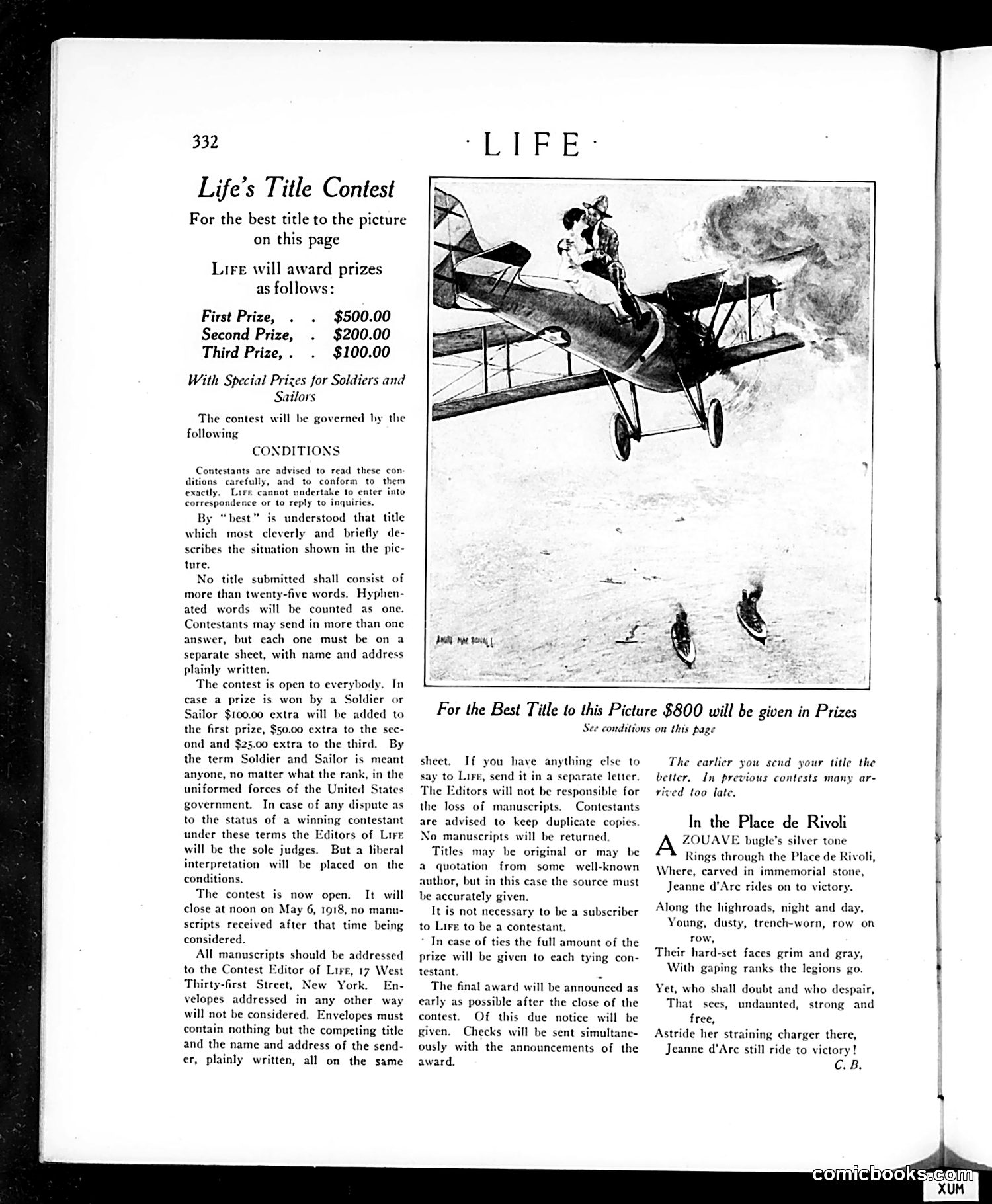
This page announces a contest for readers to submit witty captions for the featured photograph. The image shows an early airplane (appears to be World War I era) with two figures aboard, flying low over soldiers on the ground below. The contest offers $800 in total prizes ($500 first prize) with special bonuses for soldiers and sailors—suggesting this was published during or shortly after WWI. The photograph itself appears designed to evoke humor through the contrast between the fragile, novelty aircraft and the ground troops beneath it. The accompanying poem "In the Place de Rivoli" references Jeanne d'Arc and continues the military/patriotic theme. The satire likely plays on the relatively new and still-remarkable nature of aviation technology during wartime.
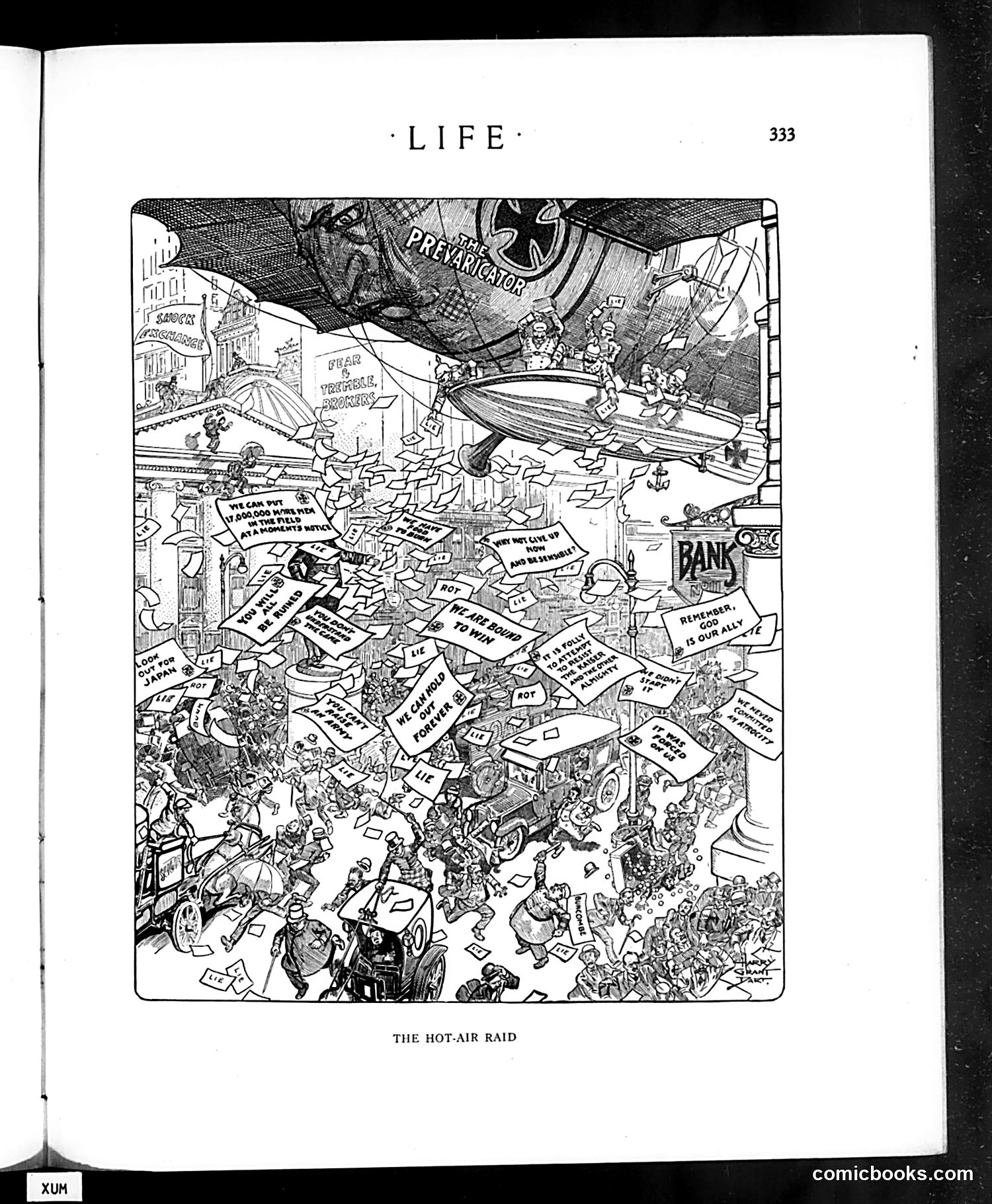
This satirical cartoon depicts a chaotic urban scene under aerial bombardment—but the "bombs" are actually inflated hot-air balloons labeled with financial/economic messages. The cartoon criticizes what appears to be speculative or fraudulent financial schemes raining down on a city's population and institutions. Visible signs reference banks, financial instruments, and market activities. The metaphor suggests that economic mismanagement or false financial promises are as destructive as military bombing. Citizens and buildings scatter in panic as these balloons descend. The artwork likely satirizes 1920s financial speculation, market bubbles, or fraudulent investment schemes that harmed ordinary people. Without clearer text visibility, the specific targets remain somewhat unclear, but the message equates bad economics with wartime destruction—a serious indictment.
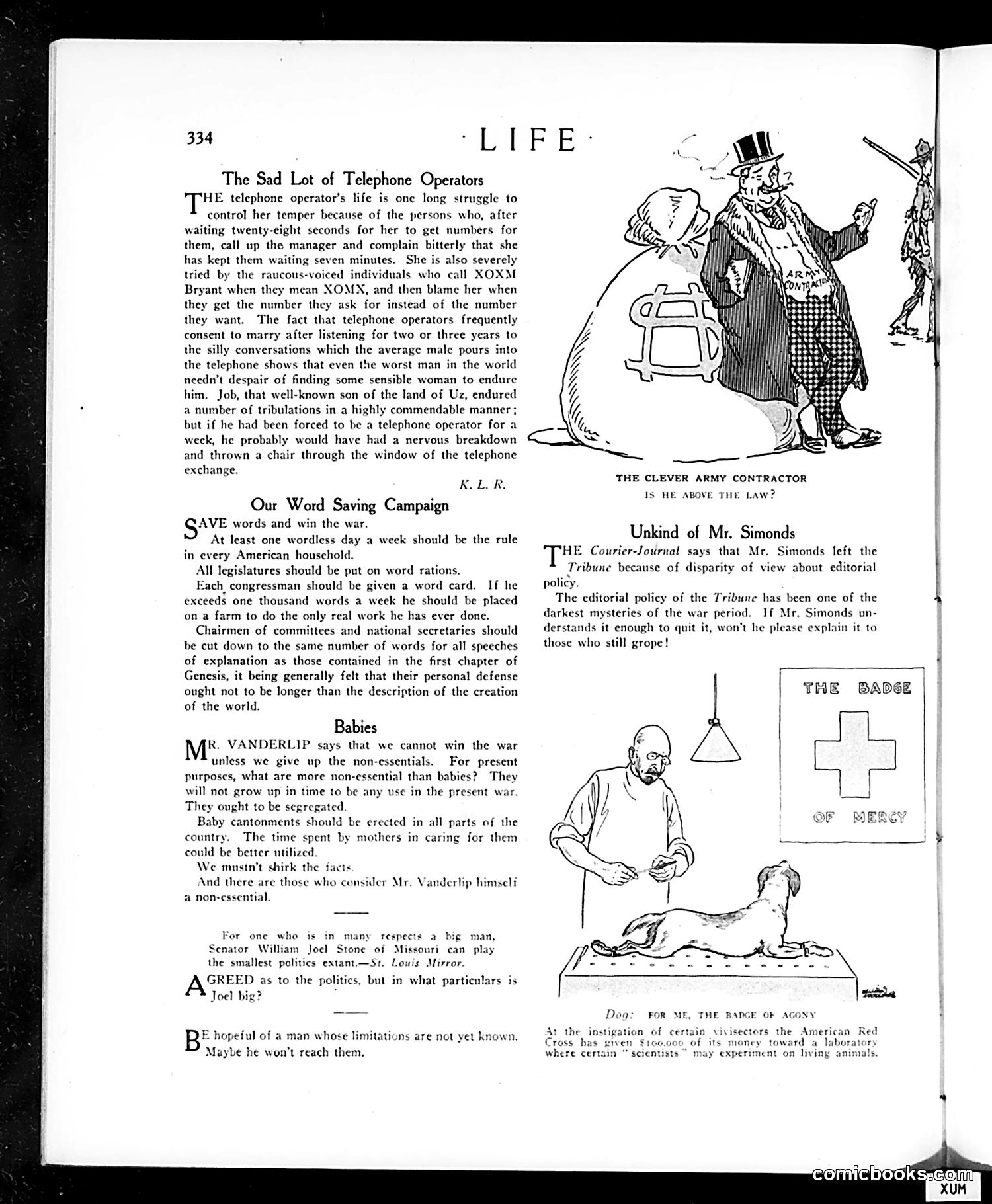
This page contains several satirical pieces from WWI-era *Life* magazine: **"The Sad Lot of Telephone Operators"** mocks the frustrations telephone operators (predominantly women) endured—long waits, rude callers, and absurd conversations. The humor lies in exaggerating their suffering and suggesting they'd marry anyone willing to listen to their complaints. **"The Clever Army Contractor"** cartoon (top right) appears to satirize military procurement corruption, questioning whether contractors operated above the law. **"The Badge of Mercy"** cartoon depicts a dog receiving the Red Cross badge, sardonically commenting that the American Red Cross funded laboratory experiments on animals for war-related research. The remaining text pieces discuss wartime economy measures and Mr. Vanderbilt's views on essential versus non-essential goods during the war effort.
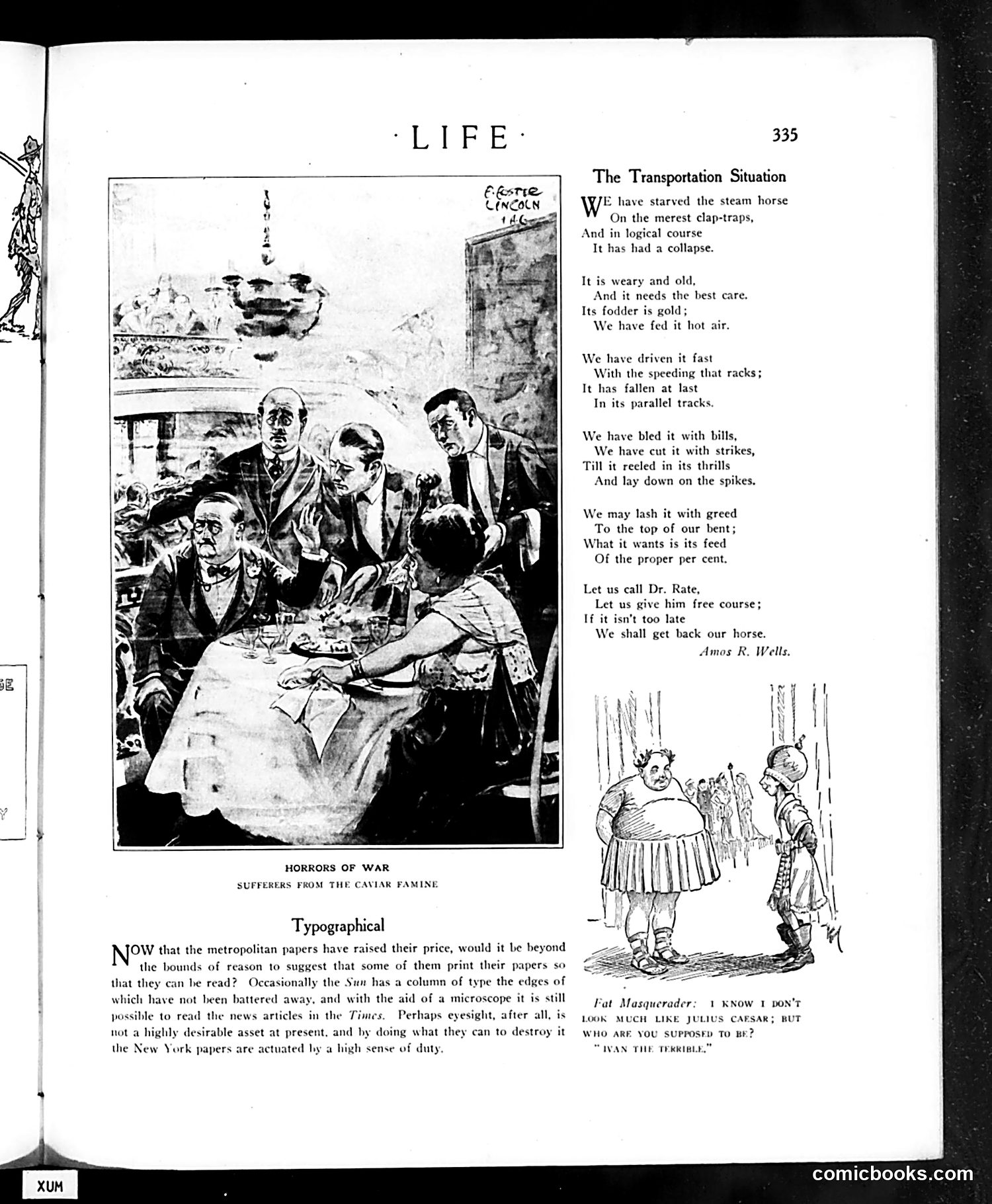
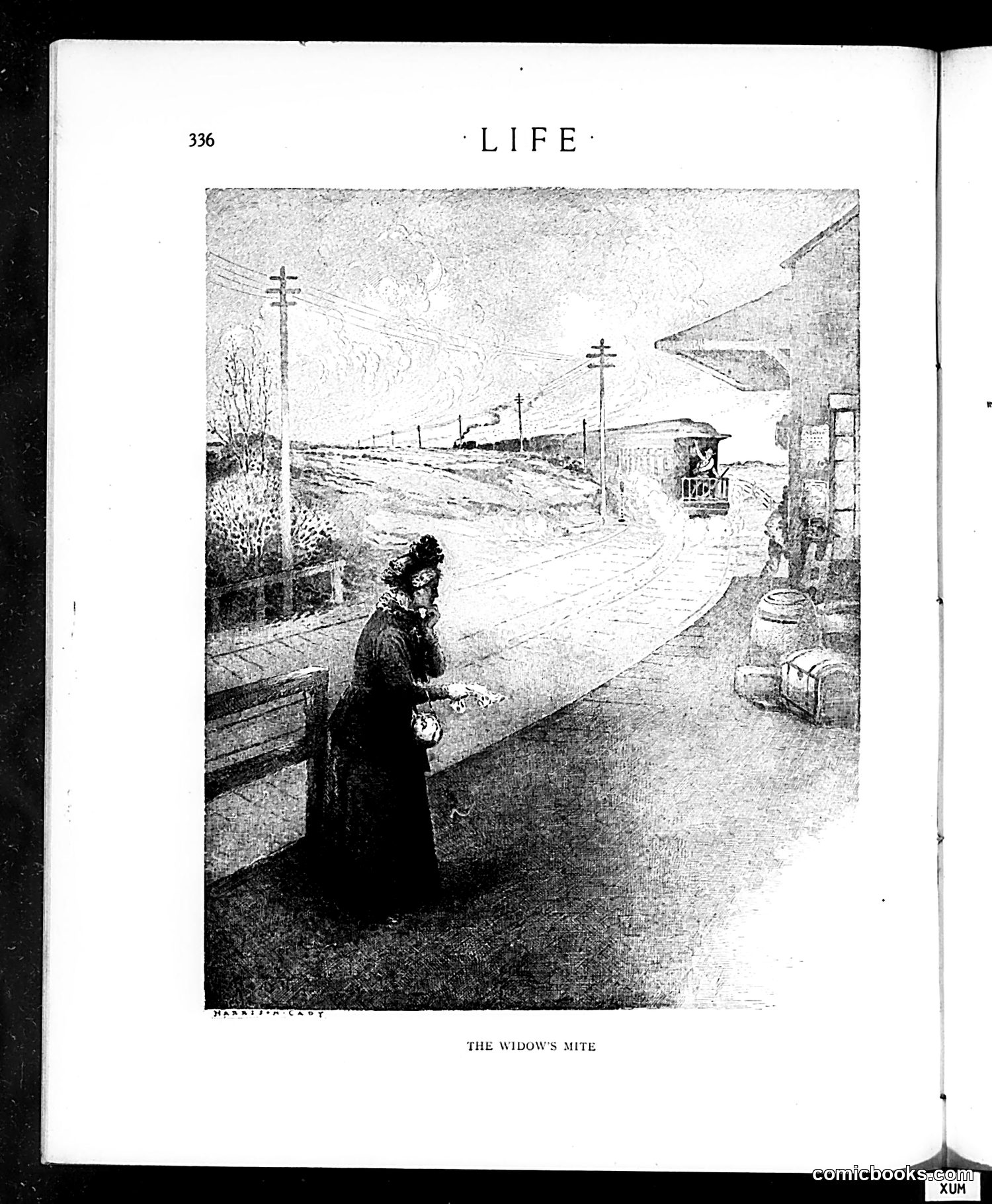
This illustration depicts a woman in dark clothing standing alone on a rural road, holding what appears to be a small coin or offering. The title references the biblical parable of the widow's mite (Mark 12:41-44), where a poor widow gives her last small coin to the temple treasury. The satire likely critiques **economic inequality or the burden placed on poor people to give charitably**. The isolated, humble figure contrasts sharply with the industrialized landscape behind her—telegraph poles, a train, and buildings suggesting economic development and progress that apparently doesn't benefit her. The image suggests irony: while society modernizes and accumulates wealth, the poorest citizens are still expected to contribute what little they have. This was a common Progressive Era critique of wealth disparity and the moral expectations placed on the working poor.
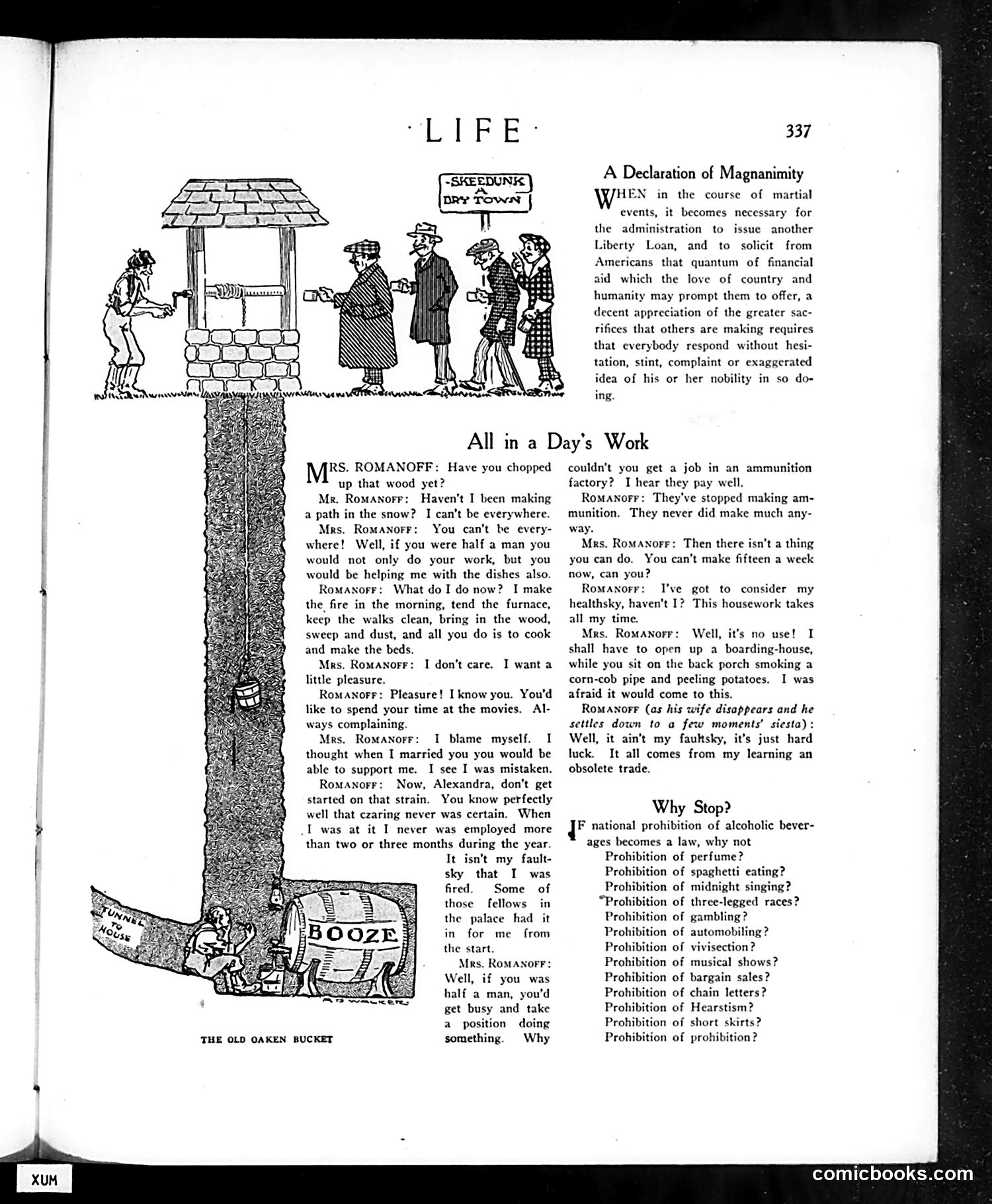
This page contains two distinct satirical pieces from Life magazine: **"The Old Oaken Bucket"** depicts a married couple named Mr. and Mrs. Romanoff—Russian names used satirically. Mr. Romanoff is a lazy, unemployed man who blames his joblessness on bad luck and his "obsolete trade," while his exasperated wife does housework and suggests he find work in an ammunition factory. The satire mocks working-class men who shirk domestic and wage-earning responsibilities, blaming fate rather than effort. His repeated reference to "czaring" suggests he's a Russian émigré, adding immigrant-stereotype humor. **"Why Stop?"** critiques the logic of Prohibition by sarcastically proposing other activities the government might ban—from spaghetti to short skirts. The final line, "Prohibition of prohibition?" poses the ultimate logical absurdity. This piece opposes Prohibition's passage (evidently recent when published), questioning why alcoholic beverages specifically warrant banning when other "vices" don't. Both pieces reflect post-WWI American anxieties: economic instability, gender roles, immigration, and government overreach.
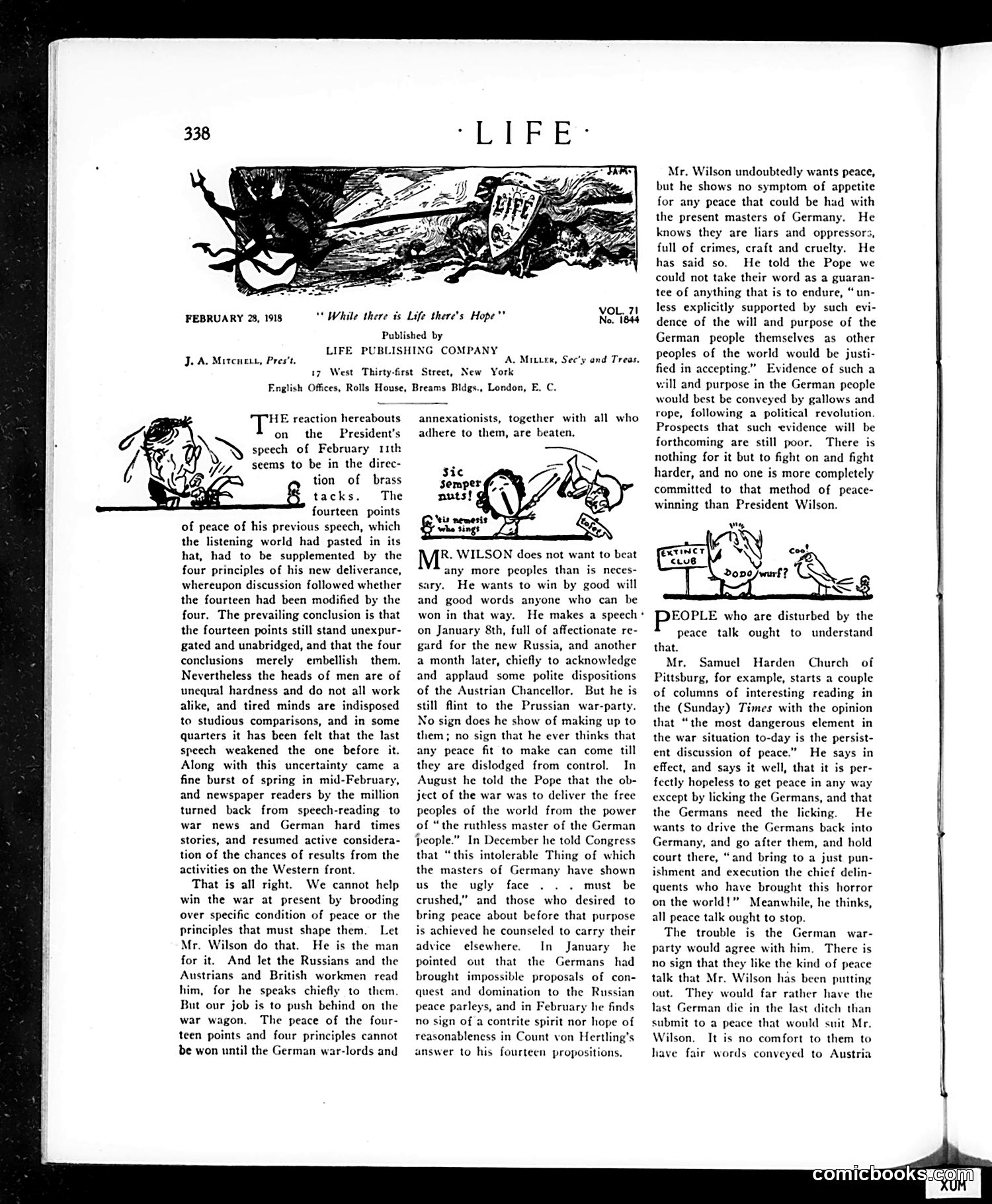
This editorial page defends President Wilson's peace strategy during World War I. The main cartoon (top) depicts a skeletal, demonic figure—representing German militarism or the "Prussian war-party"—being confronted by an armed figure (likely representing Allied forces or Wilson's resolve). The text argues that Wilson's Fourteen Points and subsequent Four Principles for peace are not contradictory but complementary. The editorial emphasizes that Wilson genuinely seeks peace but refuses any settlement with Germany's current leadership, whom he views as liars, oppressors, and warmongers. Wilson, the author argues, is correctly targeting only German military leaders and annexationists, not the German people themselves. The piece critiques those who worry Wilson's speeches weaken American resolve, instead positioning his diplomatic messaging as appropriately directed at potential allies (Russians, Austrians, British workers) while remaining "flint" toward Prussian militarism. The message: victory must precede peace negotiations.
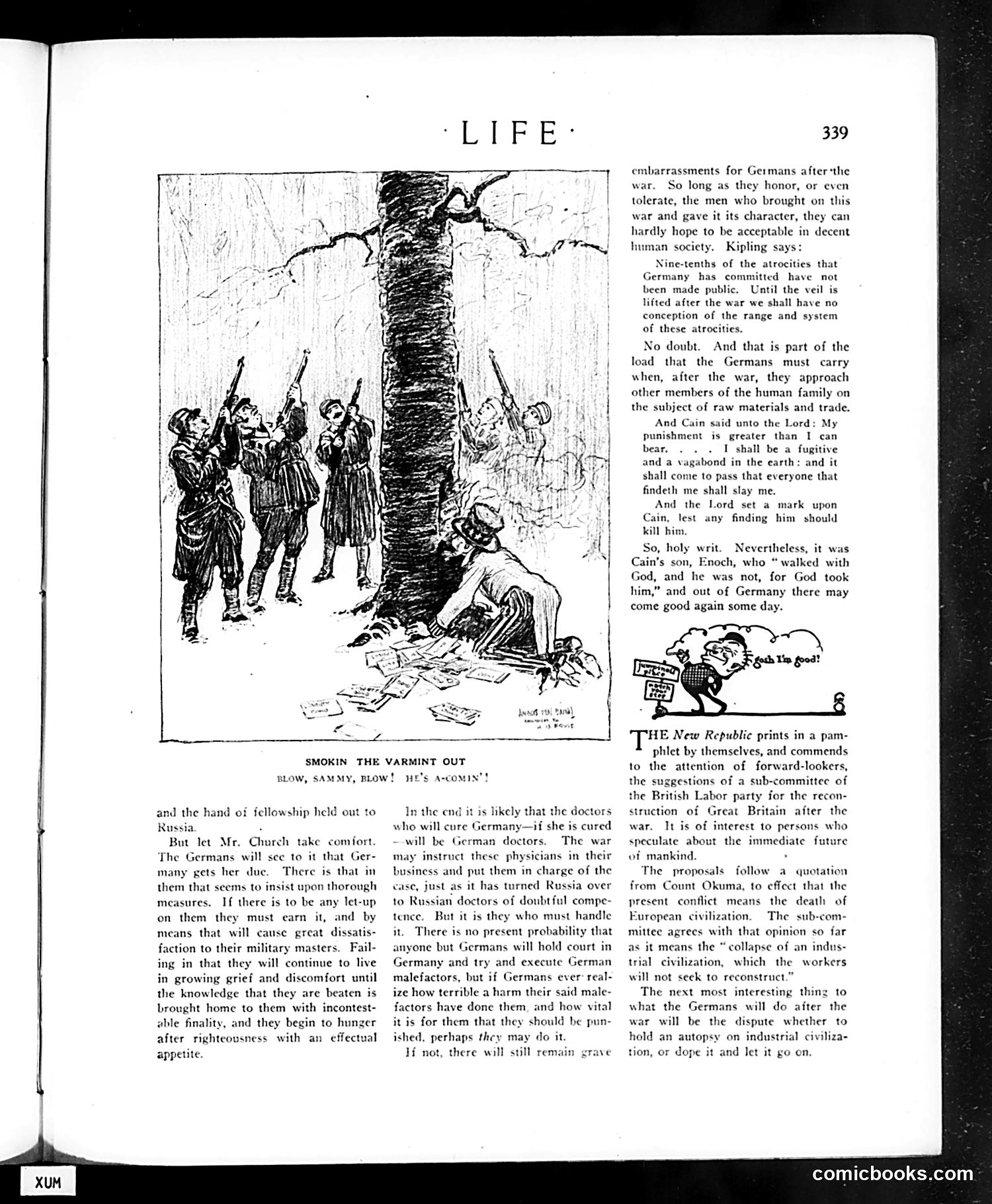
This WWI-era cartoon depicts Allied soldiers (labeled "Sammy," likely representing American forces) using a large cannon or gun to force Germans out of a fortified position—the "varmint" being routed out like an animal from a burrow. The surrounding text argues that Germany must face severe postwar consequences for its wartime atrocities and conduct. The author contends that only Germans themselves can truly reform their nation and punish war criminals, comparing Germany's moral burden to the biblical curse of Cain. The piece emphasizes that until Germany's leadership acknowledges and atones for "nine-tenths" of unrevealed atrocities, the nation faces lasting international isolation and economic hardship. The cartoon reinforces this message: Germany must be forcibly ejected from power, and its people must reckon with what their leaders have done.
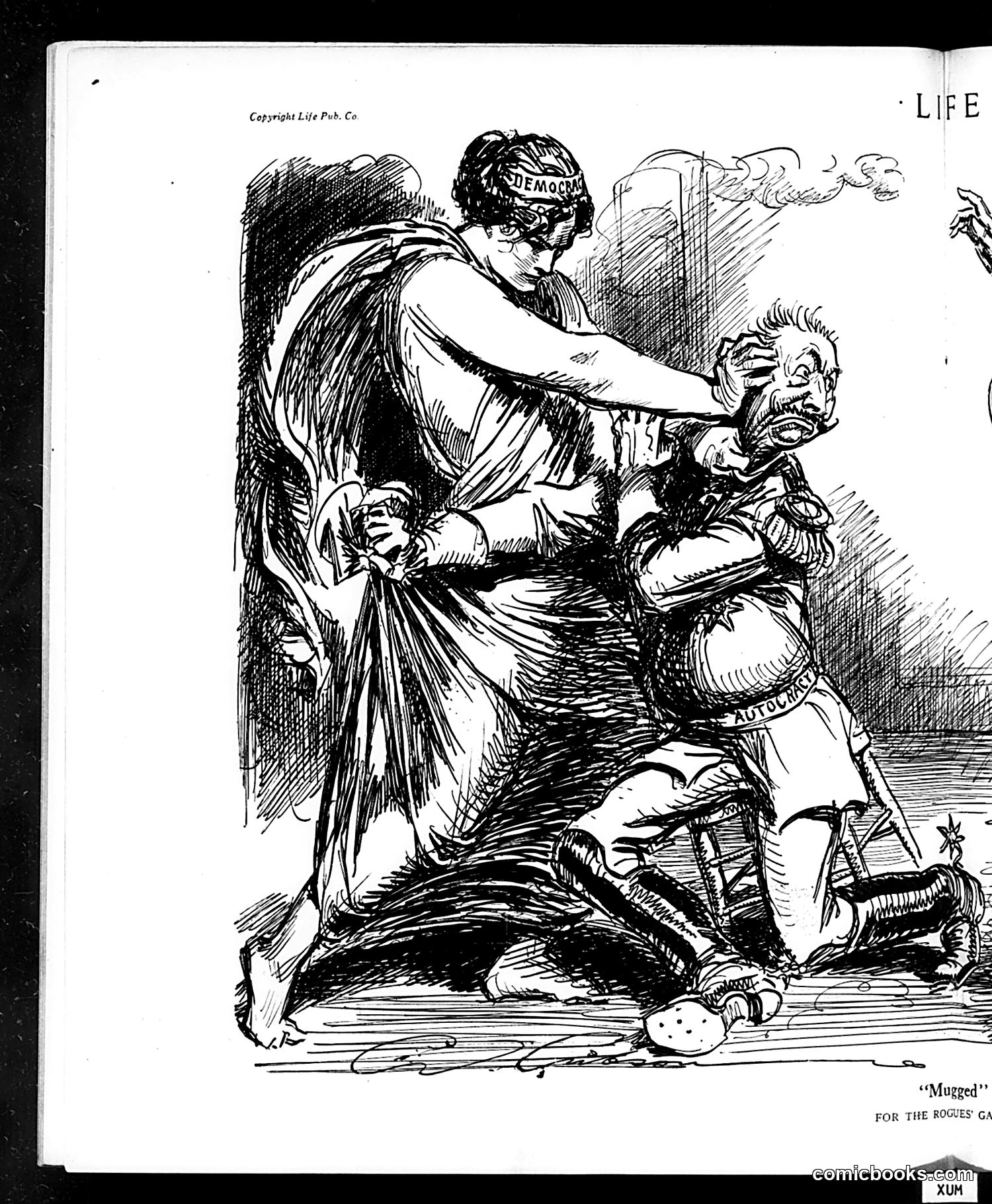
This is a political cartoon titled "Mugged" from *Life* magazine. It depicts an angelic or allegorical figure (likely representing Justice, Liberty, or America) being physically assaulted and robbed by a smaller, grotesque figure (appearing to represent a criminal or corrupt politician). The angel figure is being "mugged"—both literally attacked and having valuables stolen. The cartoon satirizes corruption or criminality targeting American institutions or values. The reference to "Rogues' Gallery" (a police collection of criminal photographs) reinforces this interpretation. Without the specific historical date visible, the exact political target remains unclear, but the image critiques how dishonest figures exploit or victimize American ideals through violence and theft.
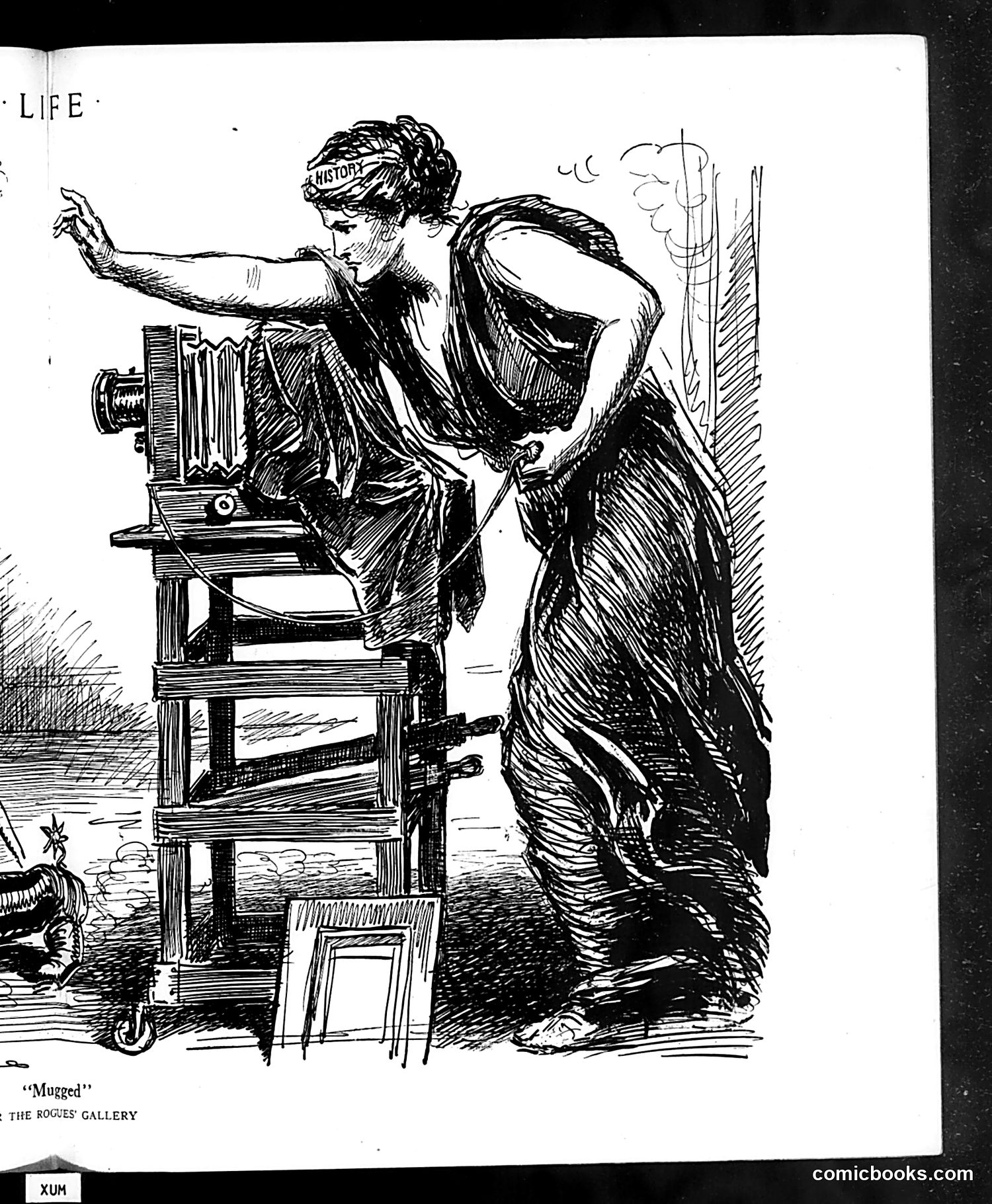
This cartoon from *Life* magazine satirizes photography and portraiture. The title "Mugged" is a pun: it refers both to having one's photograph taken (a "mug shot") and to being robbed or assaulted. The image depicts a photographer with an old large-format camera mounted on a tripod, positioned aggressively toward a distressed subject. The photographer's intense, predatory posture—leaning forward menacingly—suggests violence rather than a friendly portrait session. The subject appears alarmed and defensive. The satire targets either portrait photographers' aggressive commercial tactics or the invasive nature of photography itself during this era. The "Rogues' Gallery" subtitle reinforces the criminal connotation, suggesting photographers are thieves stealing subjects' dignity or likenesses. The visual exaggeration mocks the theatrical intensity some photographers brought to their work.
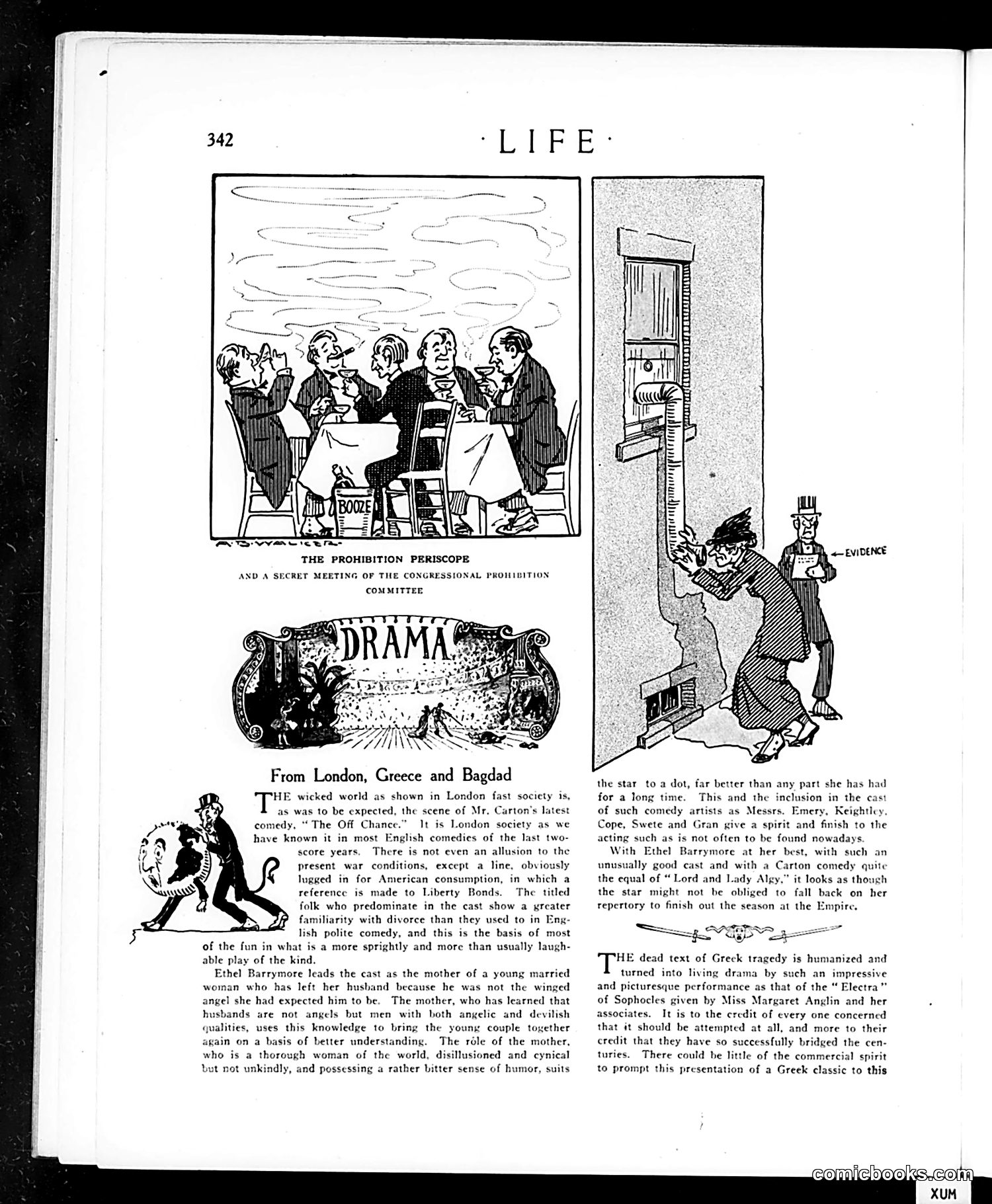
The top cartoon satirizes Prohibition enforcement by depicting a "periscope" — a secret Congressional committee meeting viewed through a keyhole by a figure labeled "EVIDENCE," suggesting hidden deliberations about alcohol policy. The page primarily reviews theatrical productions: Mr. Carton's comedy "The Off Chance" featuring Ethel Barrymore in a London society play about divorce and marriage, and a production of Sophocles' "Electra" by Margaret Anglin. The satire's point appears to be the ironic contrast between public Prohibition policy and the "wicked world" of London high society depicted in the play — suggesting that while Congress secretly debates alcohol prohibition, the wealthy continue their dissolute ways. The periscope image mocks the futility of hiding such hypocrisy.
This page from *Life* magazine contains theater reviews and a satirical commentary on theatrical production standards. The main article critiques the Winter Garden's "Sinbad" production, praising its Oriental scenery (whose designer goes uncredited in the program—a pointed joke) while finding the show thin on originality and humor. The reviewer notes that even star Al Jolson cannot supply enough entertainment to sustain the lengthy show. The "Confidential Guide" section lists current Broadway productions with brief assessments. A separate review praises a classical Greek production of "Electra" at Carnegie Hall for its artistic merit, despite acknowledging it appeals only to sophisticated audiences, not the general public. The overall tone reflects *Life*'s role as an arbiter of theatrical taste, distinguishing between commercial spectacle and genuine artistic achievement—a tension central to early 20th-century American entertainment criticism.
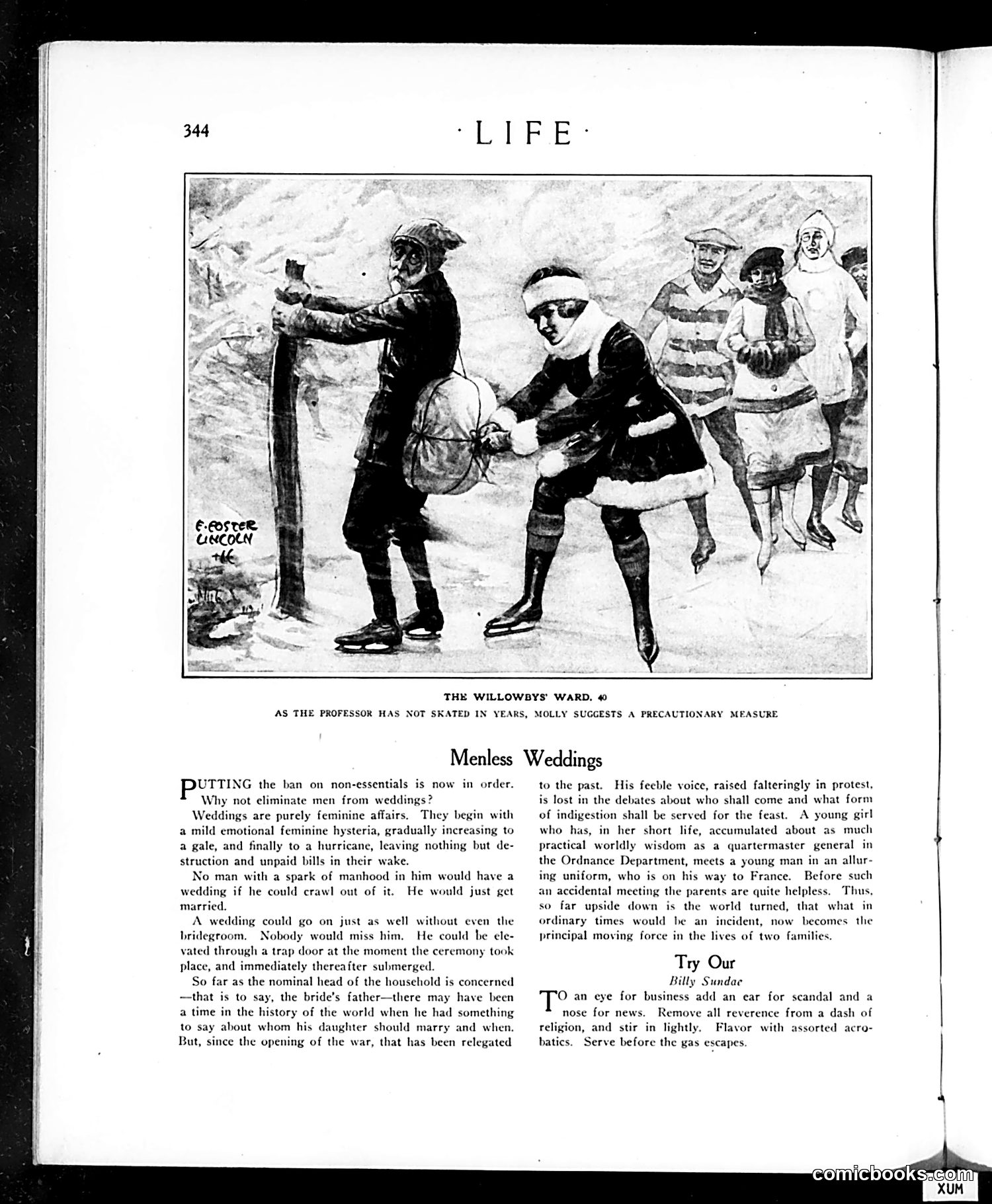
**The Cartoon ("The Willowbys' Ward"):** Shows a professor attempting to ice skate while onlookers watch. The caption jokes that since he hasn't skated "in years," his ward Molly "suggests a precautionary measure"—likely implying he needs protection or assistance, playing on the physical comedy of an elderly/rusty skater's inevitable mishap. **"Menless Weddings" Article:** This satirical piece argues weddings should exclude men entirely. Written during World War I (referenced explicitly), it mocks how wartime has shifted wedding dynamics: young women now marry soldiers heading to France based on romance rather than parental approval. The author argues fathers have lost all say in whom daughters marry, and that weddings are chaotic, expensive affairs that men wouldn't voluntarily participate in anyway. The satire targets both women's newfound independence in marriage choices and the disruption of traditional family authority caused by wartime. **"Billy Sundae" Section:** An irreverent recipe for yellow journalism—cynically advising combining business interest with scandal-mongering, removing moral restraint, and serving sensationalism before "the gas escapes" (likely a crude joke about public attention/awareness fading).
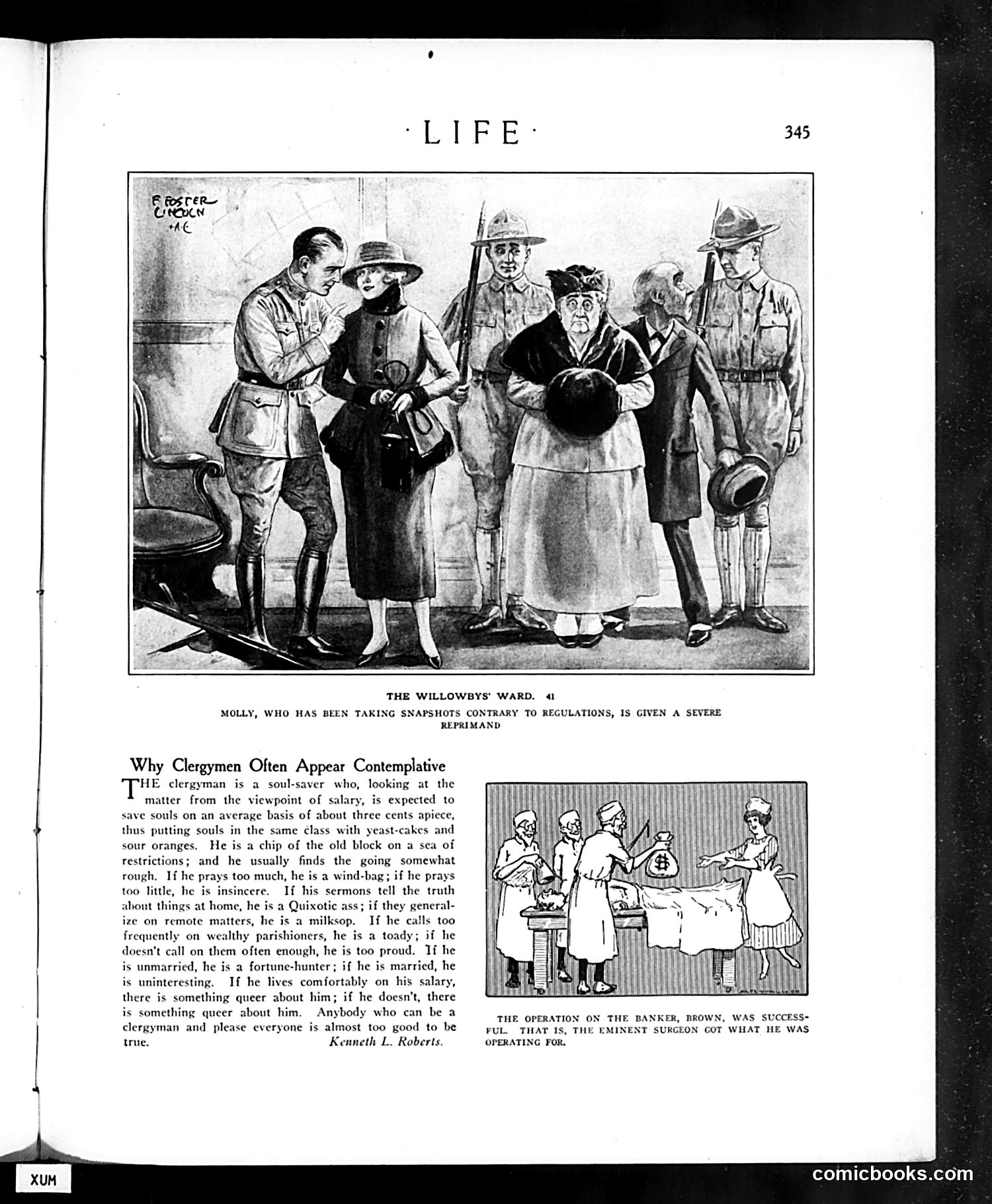
**Top Cartoon - "The Willowbys' Ward":** Shows a military officer sternly reprimanding a young woman (Molly) in front of soldiers for taking unauthorized photographs. The satire critiques rigid military regulations and the harsh treatment of minor infractions—the severe punishment for merely taking snapshots suggests military bureaucracy is absurdly inflexible. **Main Article - "Why Clergymen Often Appear Contemplative":** By Kenneth L. Roberts, this piece satirizes the impossible social position of clergymen. They face contradictory expectations: if they pray much, they're "wind-bags"; if little, "insincere." Whether they visit wealthy parishioners or don't, whether married or unmarried, whether comfortable or struggling financially—all invite criticism. The humor lies in cataloging these logical impossibilities, suggesting the clergy cannot win regardless of their choices. **Bottom Panel:** A brief joke about a surgeon successfully operating on a banker—the surgeon "got what he was operating for," implying corruption (the surgeon's real goal was financial gain rather than medical care).
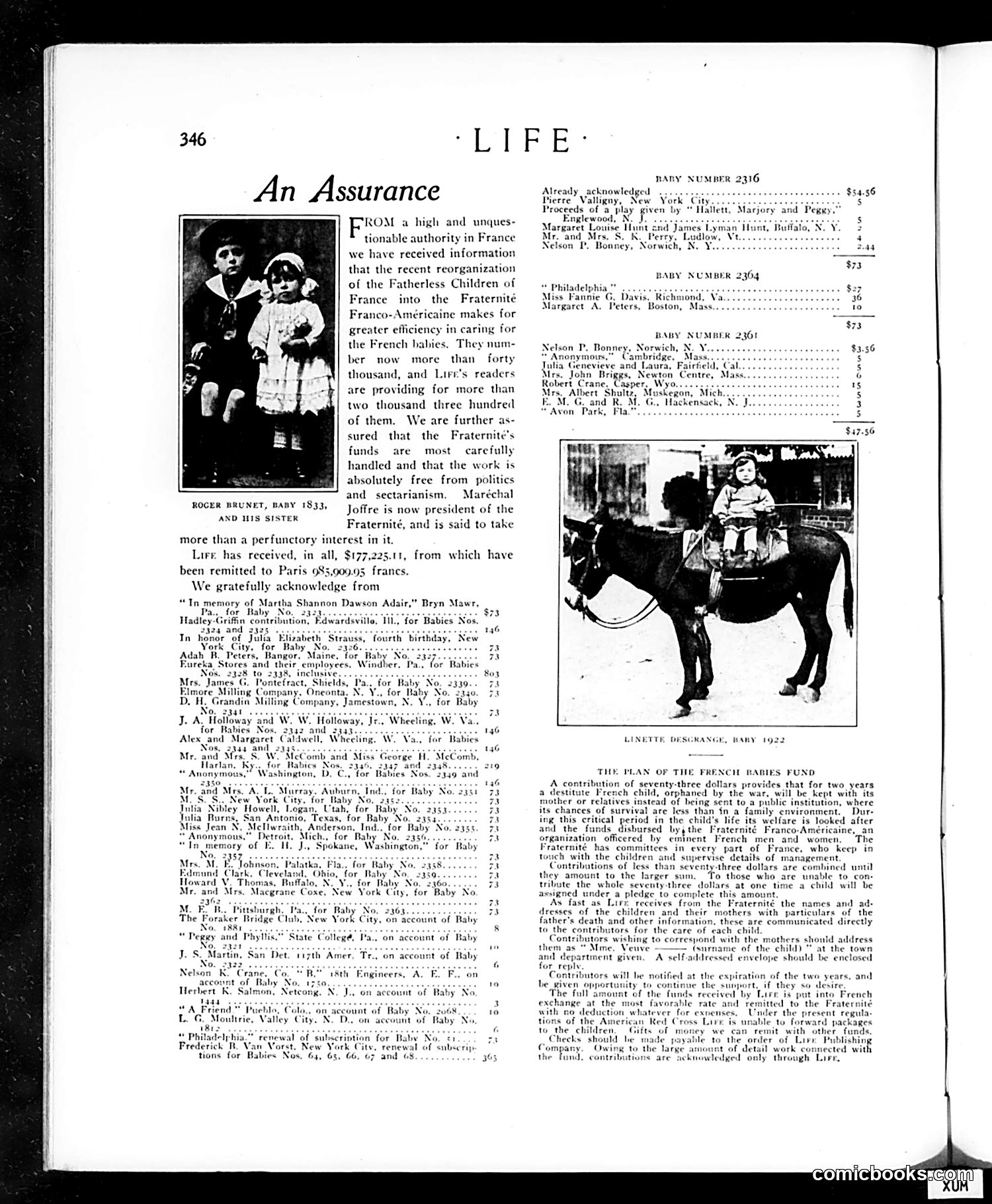
This page promotes Life magazine's fundraising campaign for French war orphans through the "Fraternité Franco-Américaine" (Franco-American Fraternity). The text announces that this organization now cares for over 40,000 fatherless children in France, with Life readers supporting more than 2,300 of them. The campaign leverages prestige by noting that Marshal Joffre (the French WWI general) serves as president. The page lists hundreds of contributors' names and donation amounts, functioning as both acknowledgment and social pressure—demonstrating that respectable Americans are supporting this cause. The two photographs show children being cared for, including one labeled "Roger Brunet, Baby 1833, and His Sister." This personalizes the abstract need for aid. The detailed explanation of "The Plan of the French Babies Fund" emphasizes that children remain with mothers or relatives rather than institutions, appealing to Progressive-era humanitarian concerns about child welfare during the postwar period.
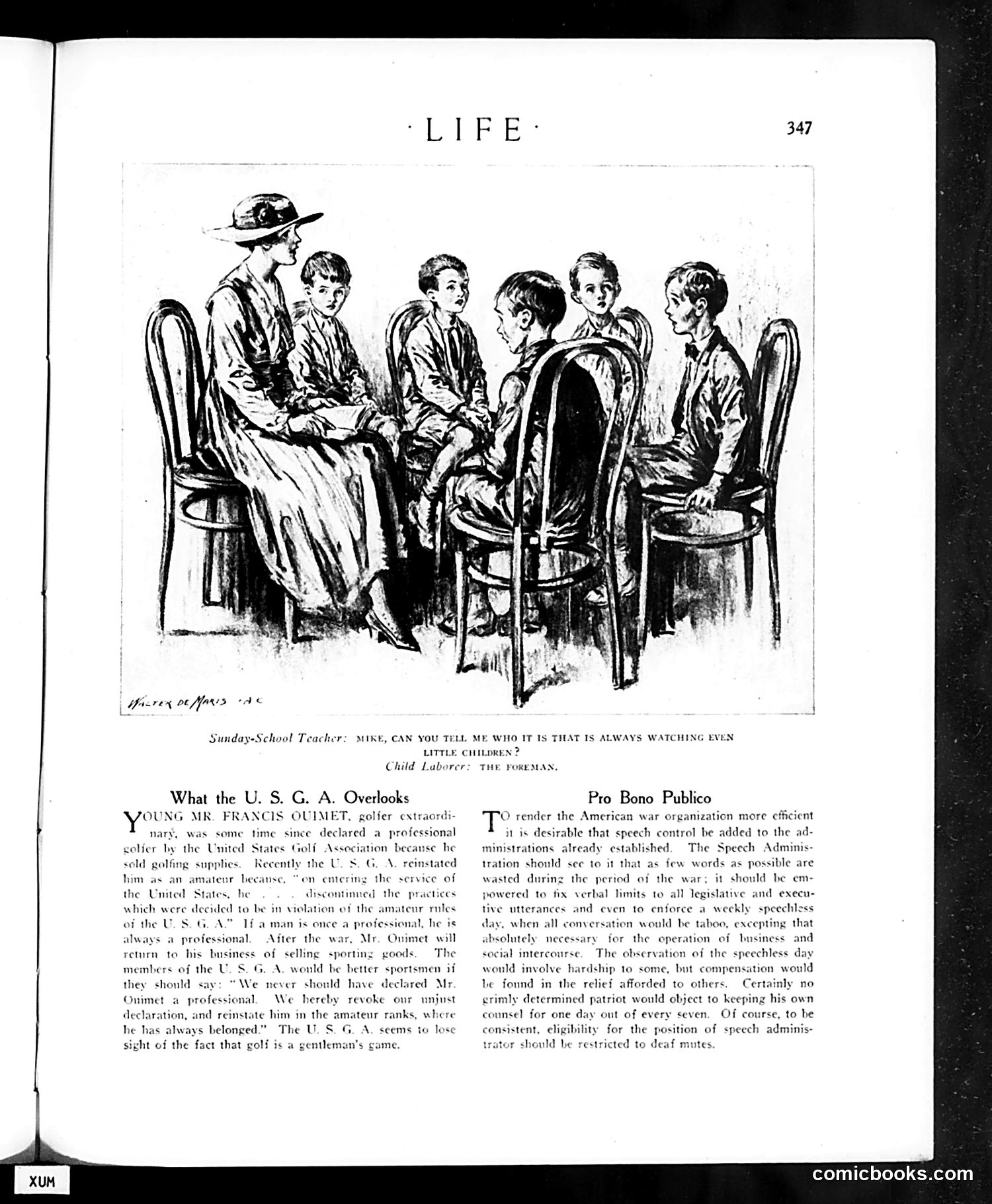
**Top Cartoon:** A Sunday school teacher asks a child laborer "Who is it that is always watching even little children?" The child answers "The foreman"—a bitter joke about child labor conditions. The contrast between the teacher's religious setting and the child's grim reality satirizes American hypocrisy: society professes to care for children while industrial exploitation continues unchecked. **Bottom Left - "What the U.S.G.A. Overlooks":** Criticizes the United States Golf Association's inconsistent treatment of golfer Francis Ouimet. The USGA declared him a professional for selling golf supplies, then reinstated him as an amateur after his military service. The satire mocks the association's arbitrary rules and its blindness to golf being fundamentally a gentleman's game, not a moral battleground. **Bottom Right - "Pro Bono Publico":** A tongue-in-cheek proposal for government "Speech Administration" to ration wartime words and enforce weekly silence to conserve language. The joke's punchline: only deaf-mutes should administer it—satirizing how absurdly bureaucratic wartime restrictions had become.
This satirical dialogue mocks the hypocrisy of marital "honesty." Mr. Hopeson proposes absolute transparency between spouses—then immediately confesses he plans to get drunk at his club dinner, come home at 3 AM in unknown condition, and may need to be put to bed. Mrs. Hopeson cheerfully accepts this arrangement, offering to supervise his drunken return "personally." The joke is that Hopeson's demand for "perfect frankness" actually means he wants permission to misbehave while claiming moral superiority. His wife's willing compliance suggests she has her own confession coming—implying she too has been concealing things. The cartoon captures early 20th-century gender dynamics: husbands claiming authority through appeals to principle while pursuing self-indulgence, and wives navigating marriage through strategic acquiescence.
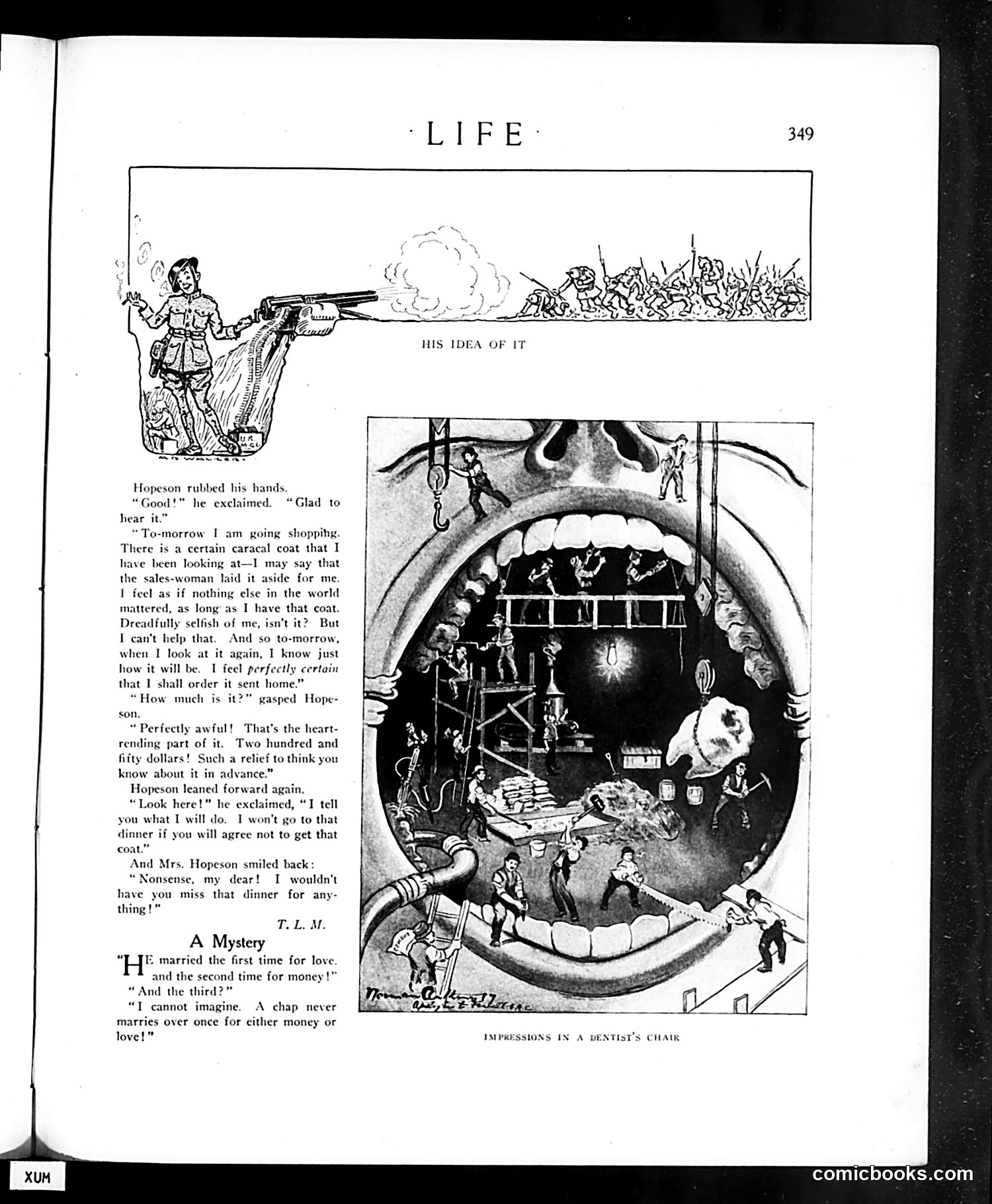
This page contains two distinct satirical pieces about marriage and desire: **"His Idea of It"** (top): A husband and wife negotiate consumption. Mrs. Hopeson obsesses over a $250 caracal coat, feeling "nothing else in the world mattered." Her husband Hopeson attempts a trade—he'll skip a dinner if she forgoes the coat—but she refuses, revealing the futility of his bargaining. The satire mocks both spousal materialism and the husband's naive hope to control his wife's spending through negotiation. The elaborate fantasy illustration above suggests the coat represents an impossible dream. **"A Mystery"** (bottom): A brief joke about marriage patterns: first marriage for love, second for money, third—incomprehensible. The satire suggests marriage calculations become increasingly mercenary with experience, implying even practical remarriages eventually exhaust logical motivation. Both pieces satirize early-20th-century marriage dynamics, particularly women's consumer desires and the transactional nature couples develop over time.
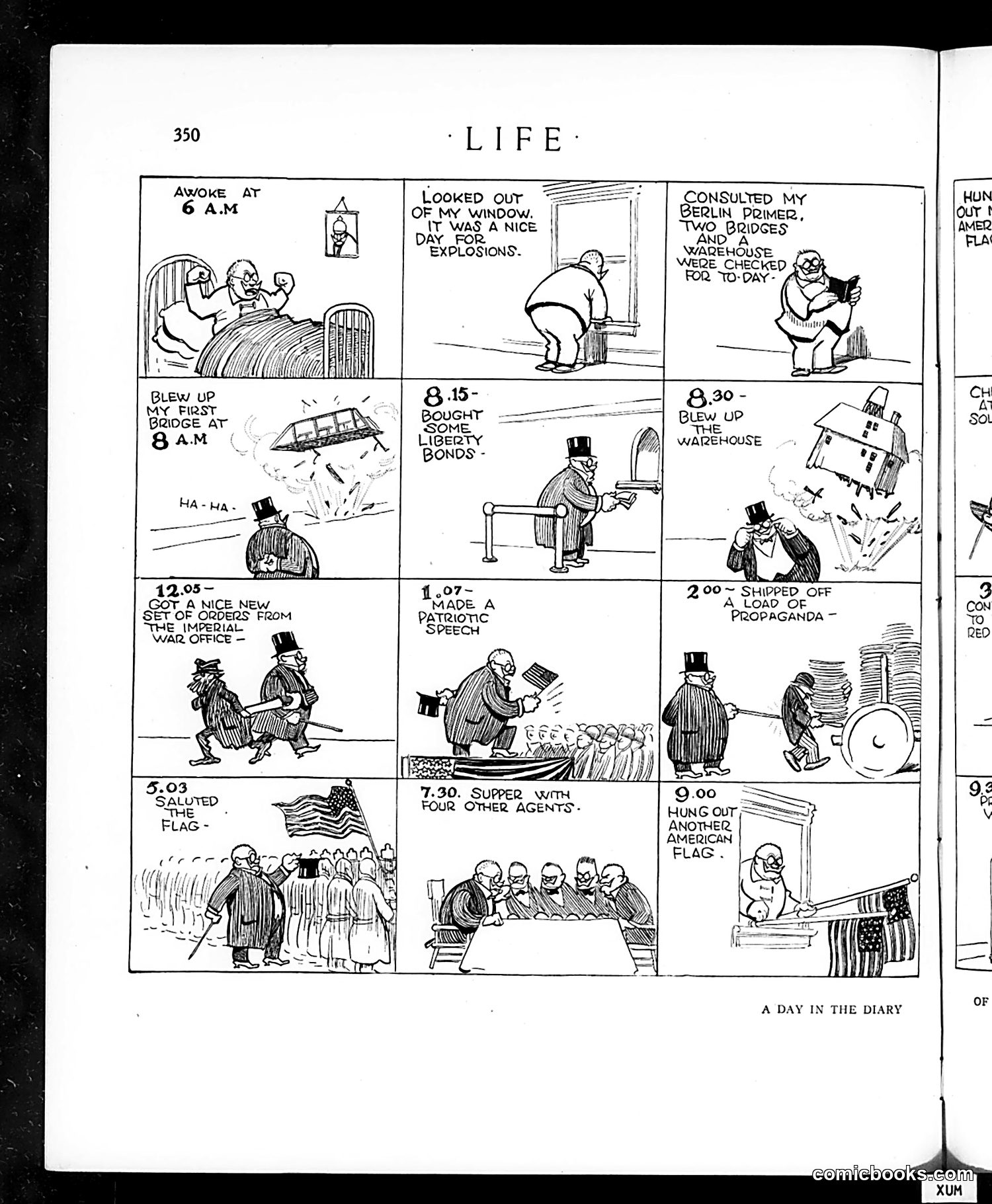
This comic strip mocks a German spy or saboteur's daily routine during World War I. The figure systematically documents destructive acts: blowing up bridges, consulting a "Berlin Primer" (suggesting German intelligence guidance), buying Liberty Bonds as cover, making patriotic speeches, and distributing propaganda while simultaneously conducting sabotage. The satire targets suspected German agents operating in America during WWI—a period of widespread espionage fears and anti-German sentiment. The humor derives from the absurdity of openly documenting treason while maintaining a façade of patriotism (flag-saluting, bond-purchasing). The "Berlin Primer" reference suggests official German direction. The cartoonist portrays the spy as methodically working through a checklist, treating massive destruction with casual mundanity ("nice day for explosions"). This reflects American anxieties about hidden enemy operatives undermining the war effort from within.
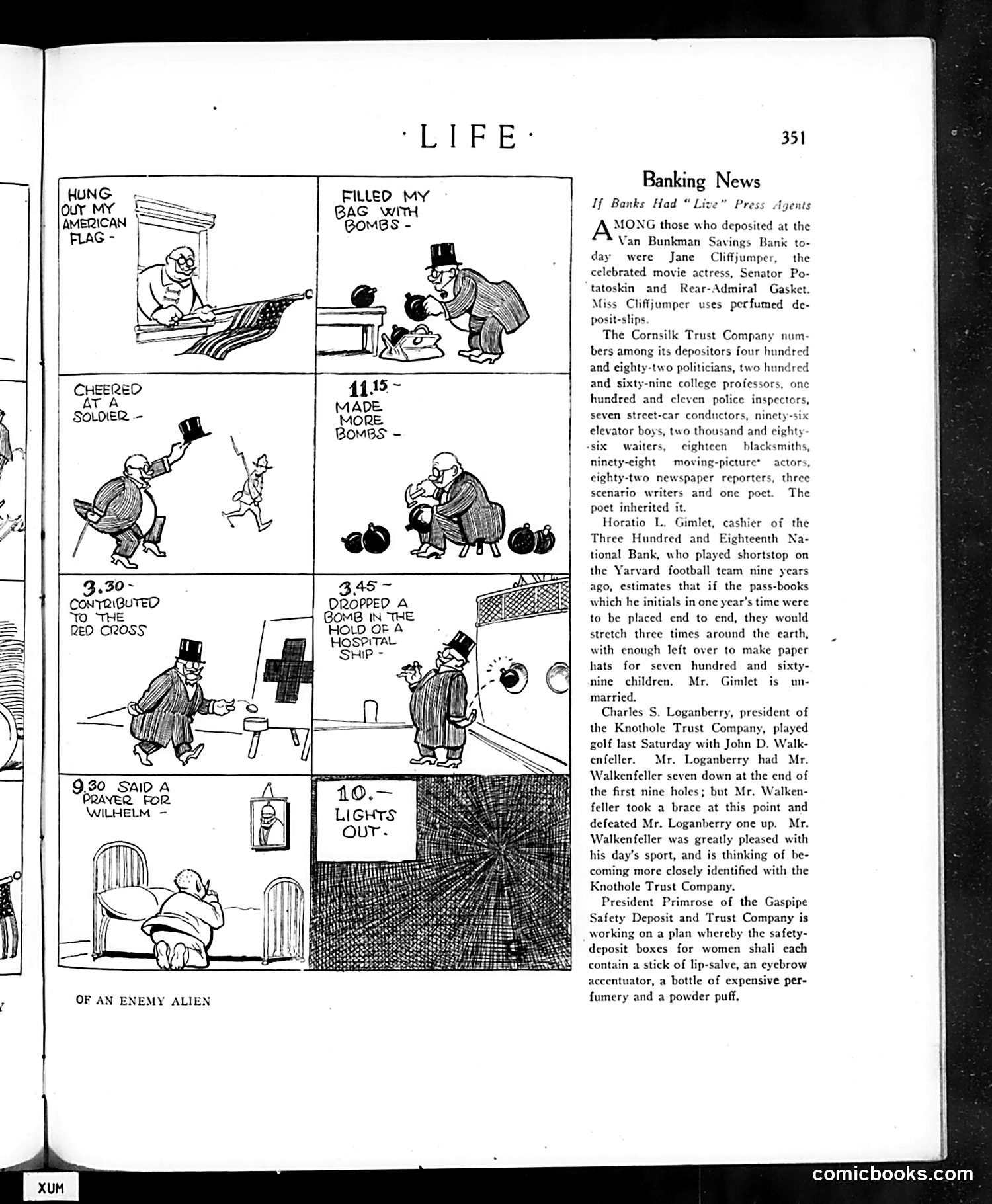
This WWI-era satirical comic mocks German immigrants and domestic German sympathizers during wartime. The sequence chronicles a supposed German spy's activities: hanging an American flag as cover, filling bombs, cheering at a soldier's death, and finally being caught ("Lights Out"). The title "Of an Enemy Alien" reflects the paranoia of 1917-1918 America toward German-Americans, many branded as potential saboteurs. The progression from patriotic facade (the flag) to revealed treachery (bomb-making) satirizes public fears about hidden enemy agents. The "Banking News" section is satirical commentary on banks' self-promotional press agents, humorously listing depositors by occupation and inventing absurd statistics—mocking the grandiose advertising banks used to attract customers. Both sections employ Life magazine's characteristic ironic humor targeting both genuine concerns (wartime security) and corporate hype (banking publicity).
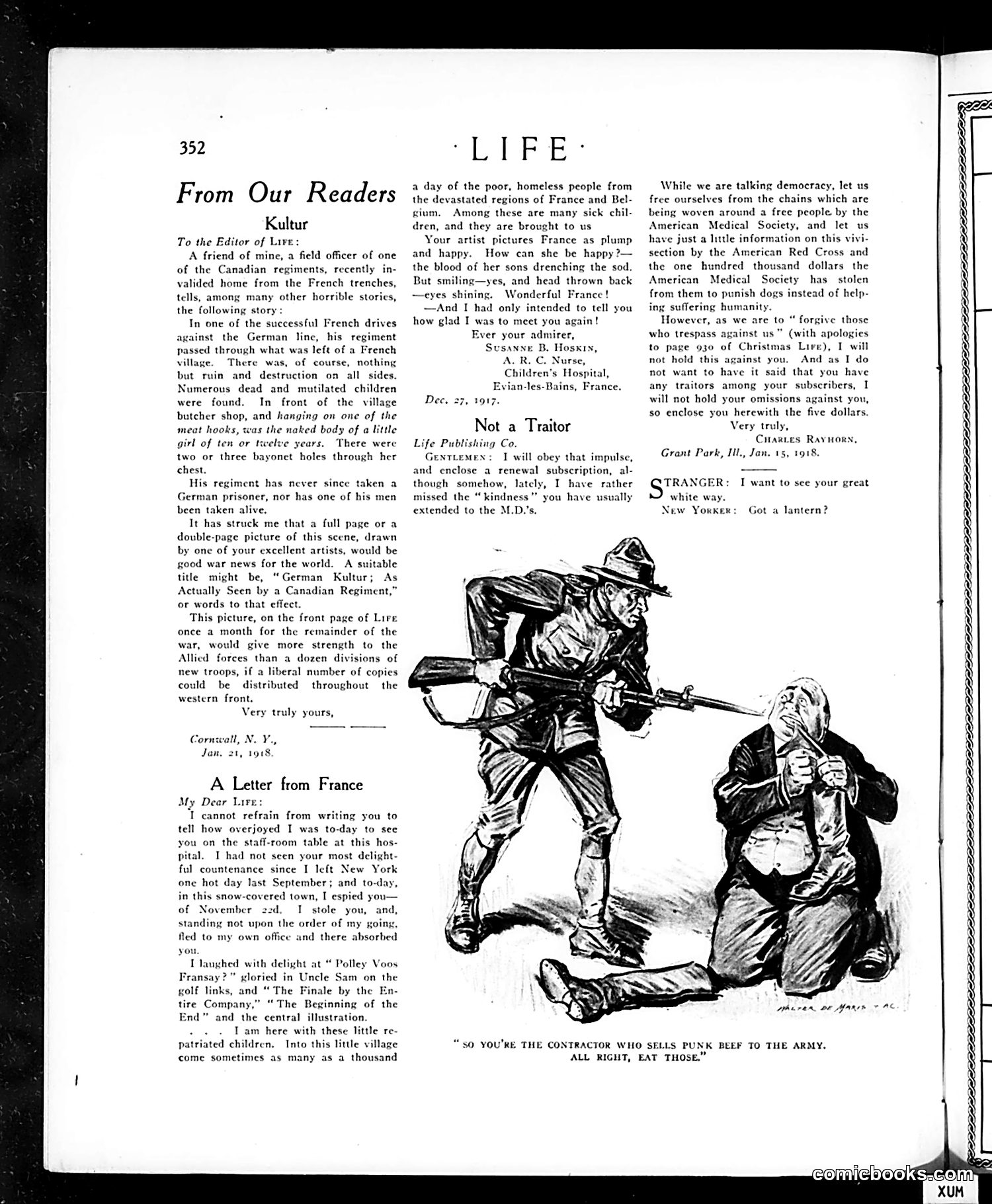
This WWI-era cartoon satirizes **wartime profiteering and food fraud**. The image depicts a confrontation between an armed soldier and a civilian contractor caught red-handed selling substandard ("punk") beef to the military. The soldier's aggressive stance with bayonet suggests the rage of front-line troops who received spoiled or poor-quality provisions while risking their lives. The cartoon targets **corrupt defense contractors** who exploited the war effort for profit, a widespread scandal during 1914-1918. It reflects public anger at the disconnect between soldiers' sacrifices and home-front greed. The phrase "punk beef" refers to tainted or low-grade meat supplies—a documented problem in WWI armies that contributed to disease and morale problems among troops. The satire appeals to patriotic outrage: while soldiers died in trenches, businessmen profited from providing them garbage.
This is **not a cartoon or satire**, but rather a **wartime advertisement** for Packard automobiles. The page appears from Life magazine during World War I or II (likely WWI, given the "19 years" reference suggesting early 1910s founding). **The Message:** Packard justifies reduced civilian car production by claiming their factory now prioritizes government war material and motors—a patriotic sacrifice. However, the ad reassures buyers that the limited Twin Six cars they *do* produce maintain Packard's legendary quality standards and represent continued automotive leadership. **The Rhetorical Strategy:** Rather than apologize for scarcity, Packard reframes it as evidence of patriotic duty while maintaining brand prestige. The phrase "Cars of Character" emphasizes that even wartime production reflects Packard's values and superiority. This is corporate wartime messaging designed to keep the Packard brand visible and positive during rationing, not satire mocking the company.
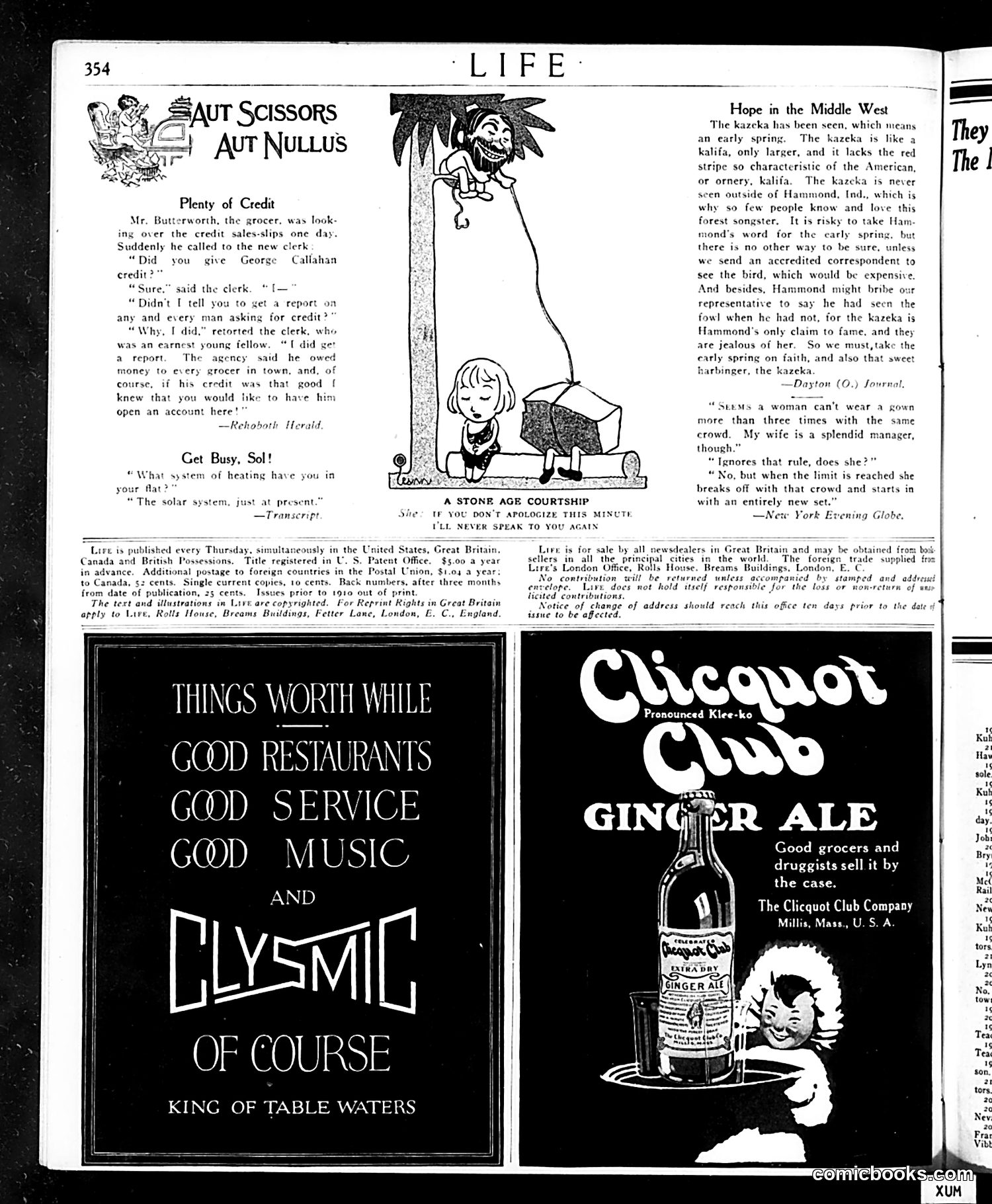
This page contains three distinct items: **"Plenty of Credit"** and **"Get Busy, Sol!"** are brief humorous anecdotes. The first jokes about a grocery clerk who gave credit to someone despite orders not to—he'd obtained a report approving the customer but didn't understand the boss wanted *him* to decide. The second is a pun: when asked what heating system he has, a man answers "the solar system"—a play on words since he apparently has no actual heat. **"Hope in the Middle West"** is a satirical piece mocking regional pride and journalistic credibility. It claims Hammond, Indiana is spreading false information about seeing a "kazeka" (an invented bird) to claim an early spring and boost local fame. The satire suggests small towns will fabricate natural omens and even bribe reporters to validate their dubious claims—commentary on exaggeration and boosterism. The page also contains period advertisements for restaurants and ginger ale. The overall tone reflects *Life* magazine's satirical approach to American pretension, bureaucratic confusion, and local self-promotion circa 1910s.
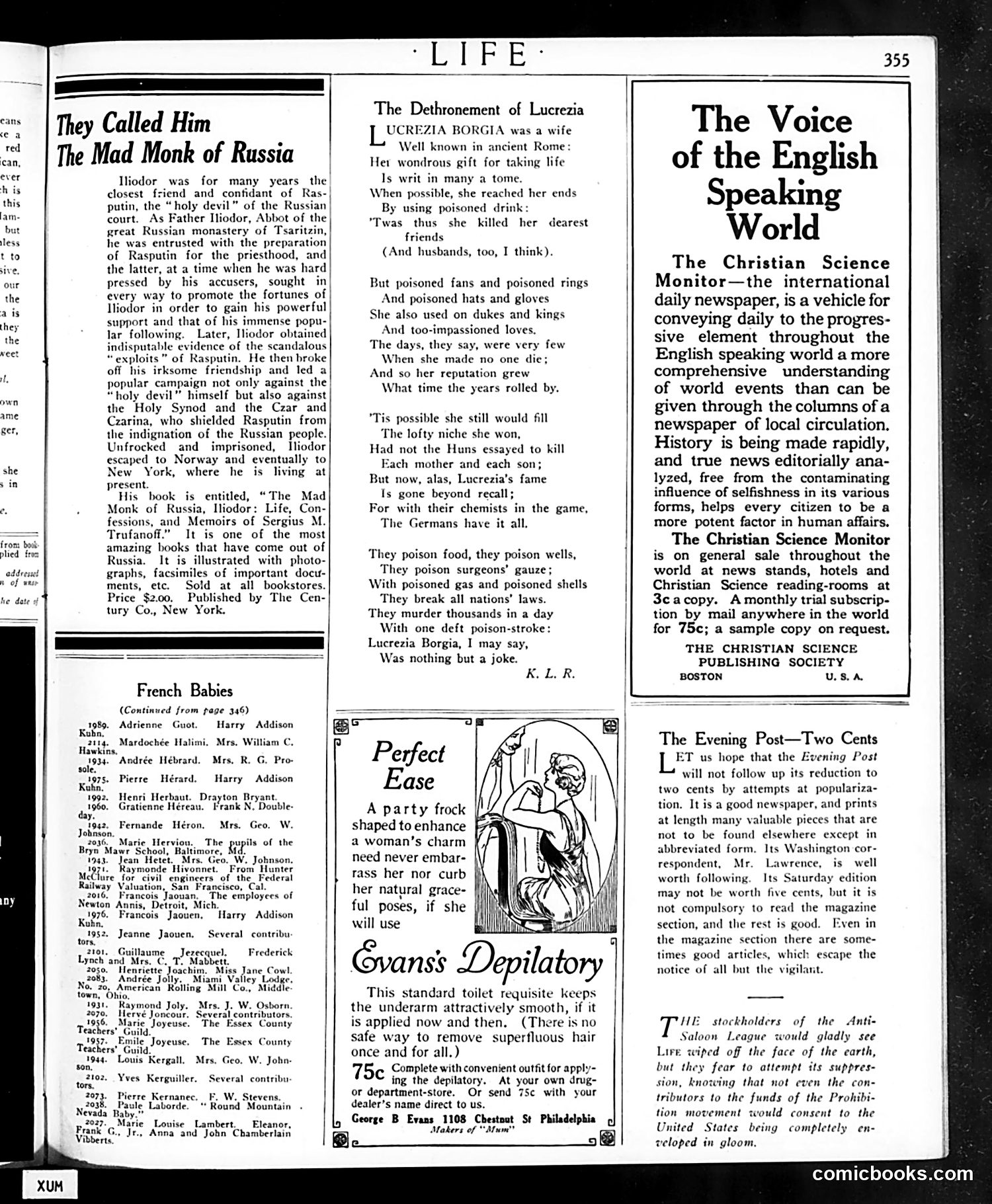
This page contains three distinct sections: **"The Mad Monk of Russia"** announces Iliodor's book about Rasputin, the infamous "holy devil" of the Russian imperial court. Iliodor, a Russian Orthodox monk, was Rasputin's friend but later exposed his scandalous behavior and turned against him. The text notes Iliodor eventually fled Russia—first to Norway, then New York—after being unfrocked and imprisoned for his campaign against Rasputin and the Czar's protection of him. **"The Dethronement of Lucrezia Borgia"** is a satirical poem comparing the historical Renaissance poisoner to modern Germany during World War I. It claims Lucrezia's reputation for poisoning is now eclipsed by German chemical weapons and poison gas used in warfare—a bitter commentary on WWI's chemical weapons. The remaining content consists of advertisements and notices for *The Christian Science Monitor* and *The Evening Post*, plus a continuation of an article on French babies.
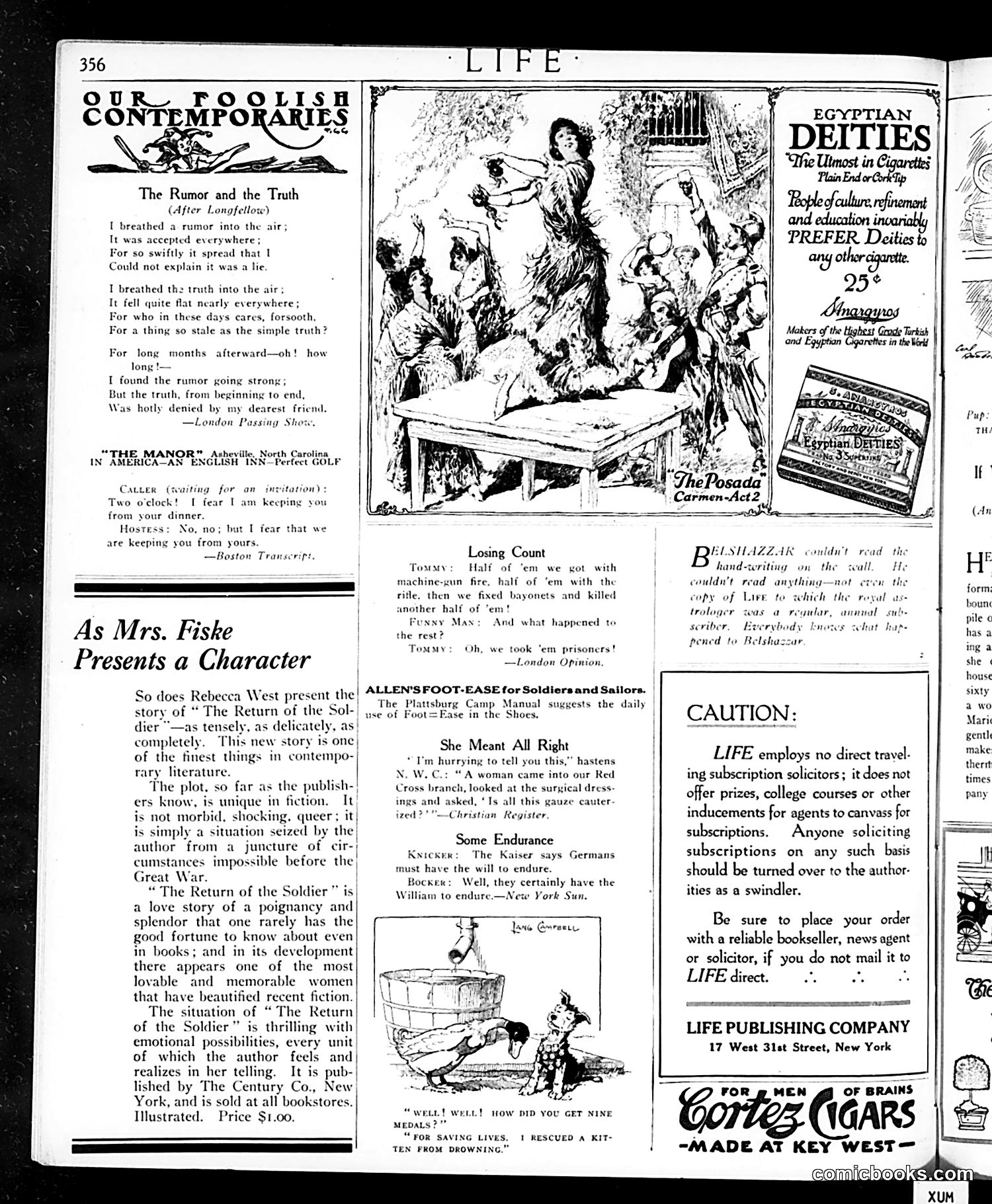
This satirical page contains several distinct pieces: **"The Rumor and the Truth"** adapts Longfellow's poem to mock how lies spread faster than truth. The satire suggests that in wartime society, falsehoods gain immediate acceptance while factual corrections are dismissed—a commentary on propaganda and public credulity during WWI. **"Losing Count"** is a dark military joke about casualty figures. Soldiers discuss inflating numbers of enemy killed versus captured, with the punchline implying the arithmetic becomes absurd when exaggerating combat success. **"The Manor"** satirizes British hospitality conventions, playing on awkward dinner-time formality between American guest and English hostess. **The Belshazzar reference** alludes to the biblical king who couldn't read the "writing on the wall"—here used to criticize someone's inability to understand obvious warnings or signs. The advertisements (Egyptian Deities cigarettes, Allen's Foot-Ease, Corlez Cigars) are typical period marketing, while the caution about subscription fraud addresses common magazine-sales scams. Overall: wartime cynicism about truth, military casualties, and social pretension.
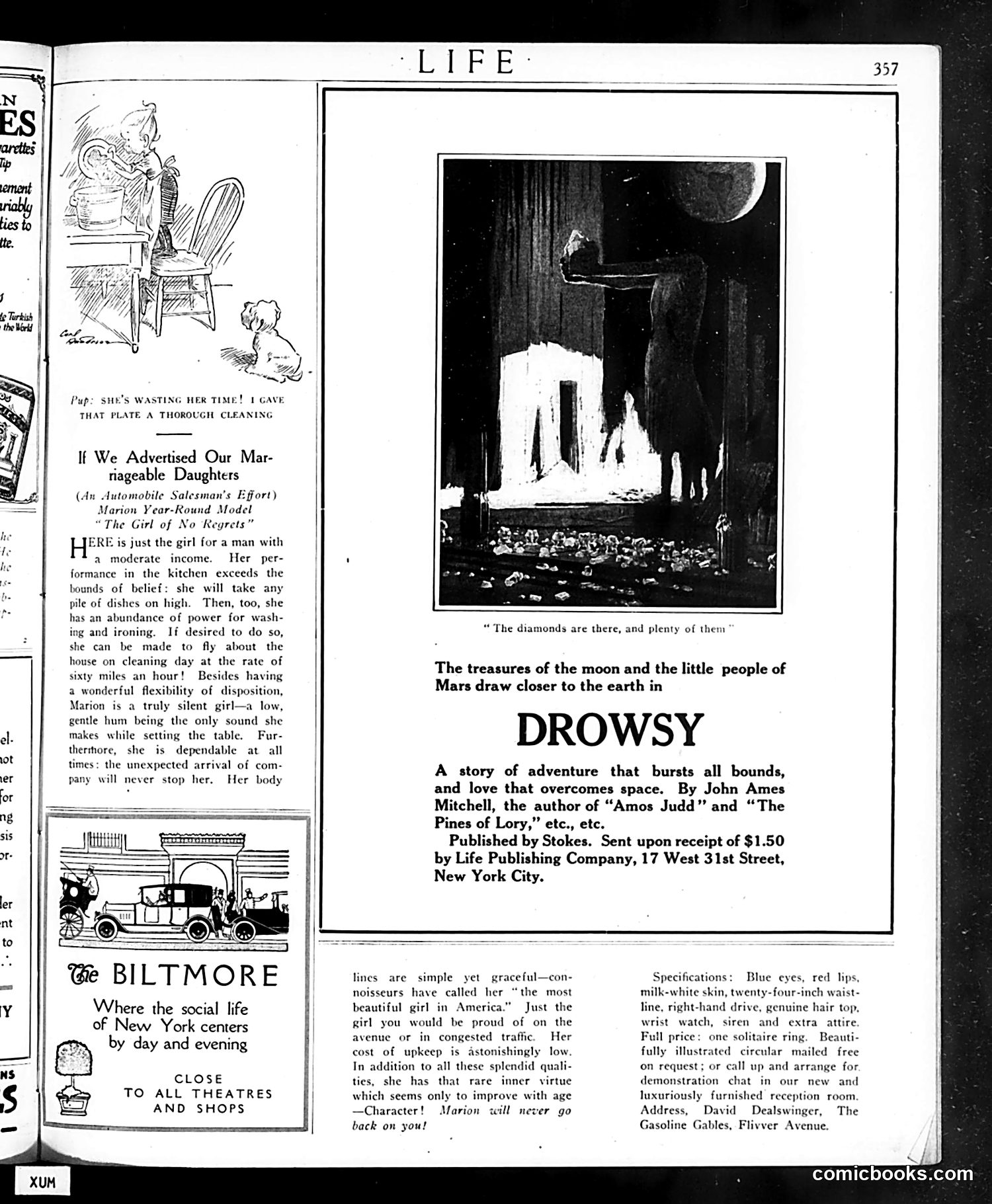
This page contains satirical advertisements treating marriageable women as automobiles. The main cartoon compares a daughter ("Marion Year-Round Model") to a car being sold by an automobile salesman, using automotive language: she has "performance," "power," makes a "gentle hum," and requires low "upkeep." The joke mocks 1920s dating culture and commercial advertising excess by literalizing the era's tendency to reduce women to commodities. "Marion" is marketed with specifications like "genuine hair top" and "right-hand drive," treating her as interchangeable merchandise rather than a person. The small cartoon at top shows a husband and wife with dishes, establishing domestic labor as the "product" being sold. This reflects satirical criticism of both consumerism and women's limited social roles during this period—they were expected to excel primarily as housekeepers and wives.
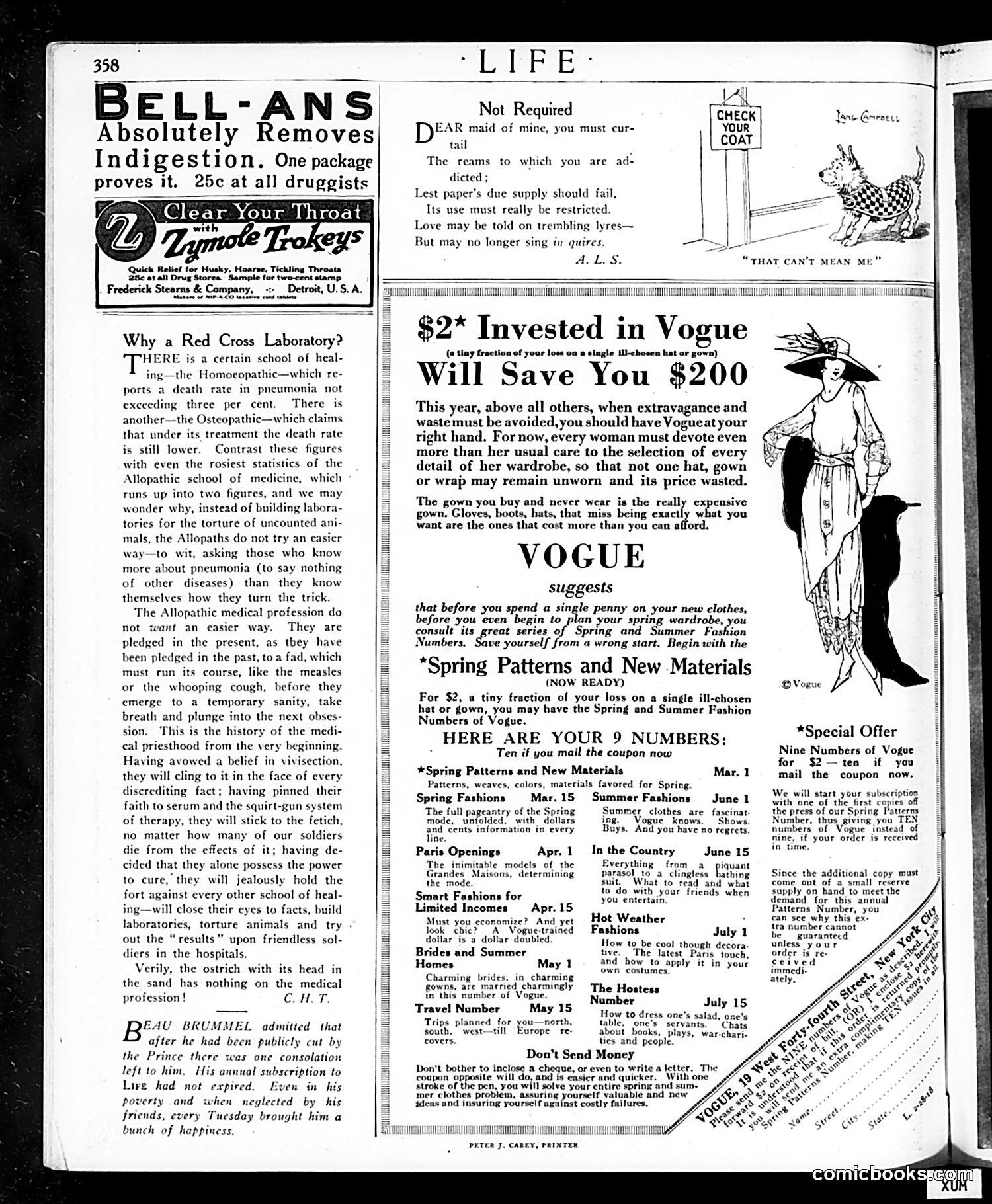
**The Cartoons:** The page contains one cartoon ("That Can't Mean Me") showing a dog being told to "check your coat," a mild visual joke about a dog's literal interpretation of human language. **The Main Content:** This is primarily **advertising and editorial**, not political satire. Key sections include: 1. **Medical School Critique**: An essay attacking "Allopathic" (conventional) medicine, praising Homeopathic and Osteopathic alternatives, and criticizing vivisection (animal testing). This reflects early 20th-century skepticism toward mainstream medicine. 2. **Vogue Advertisement**: A $2 subscription offer claiming to save readers $200 by helping them make better wardrobe choices during wartime austerity—appealing to women to avoid wasteful purchases. 3. **Beau Brummell Reference**: A brief anecdote about the famous dandy, noting even in poverty his *Life* magazine subscription brought him happiness. The page reflects **WWI-era concerns**: wartime economy, medical controversies, and fashion practicality for women managing household budgets during scarcity.
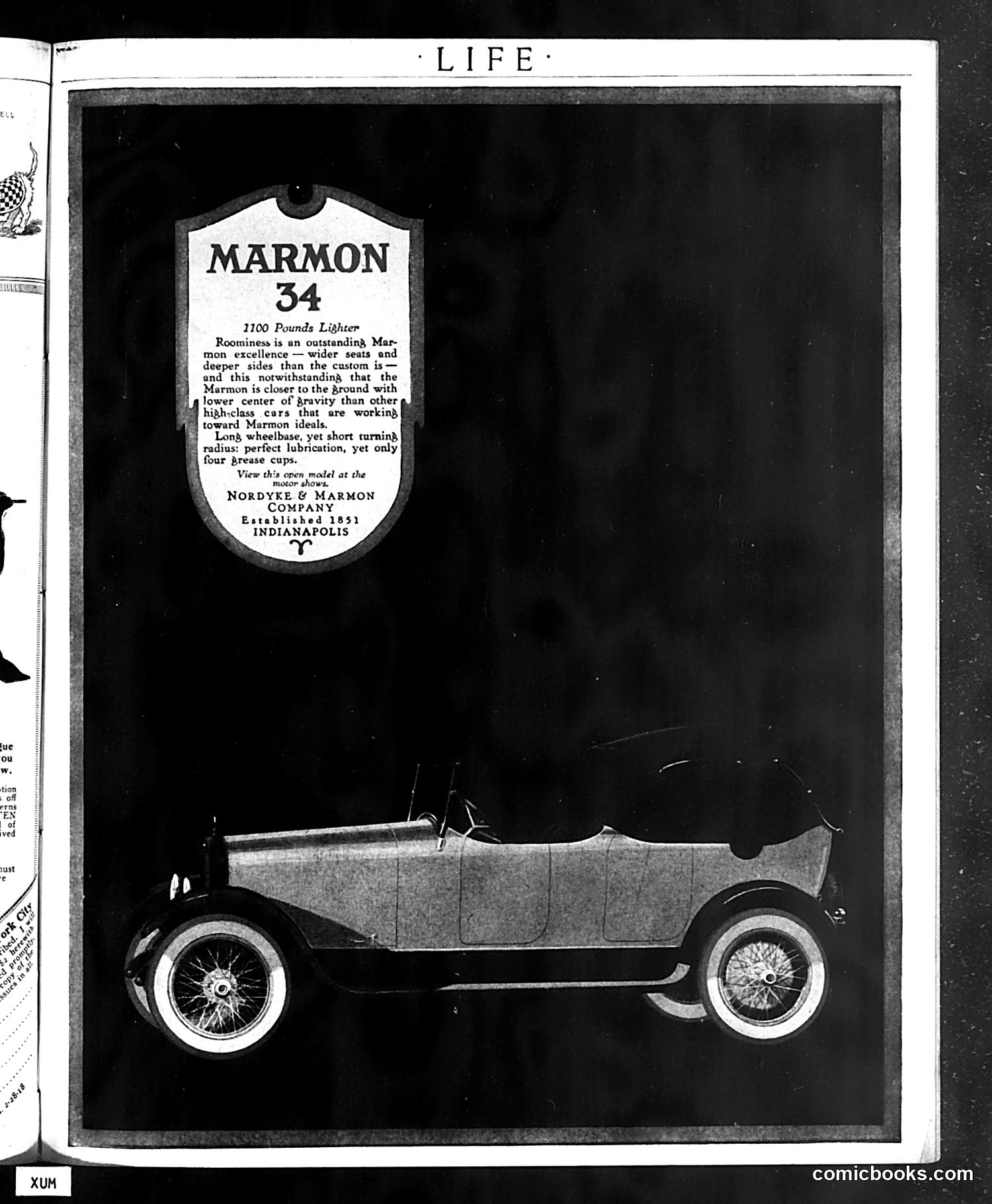
This is **not a political cartoon or satire**—it's a straightforward automobile advertisement from *Life* magazine. The page advertises the **Marmon 34**, a luxury automobile manufactured by Nordyke & Marmon Company of Indianapolis (established 1851). The advertisement highlights engineering features appealing to affluent buyers of the era: roominess despite being 1100 pounds lighter than competitors, wider seats, deeper sides, a low center of gravity, long wheelbase with tight turning radius, and efficient lubrication requiring only four grease cups. The image shows a side-view illustration of the open-air roadster model. The advertisement notes the vehicle can be viewed at motor shows. There is no satirical commentary or political reference present—this is period commercial advertising typical of early-to-mid 20th-century *Life* magazine content.
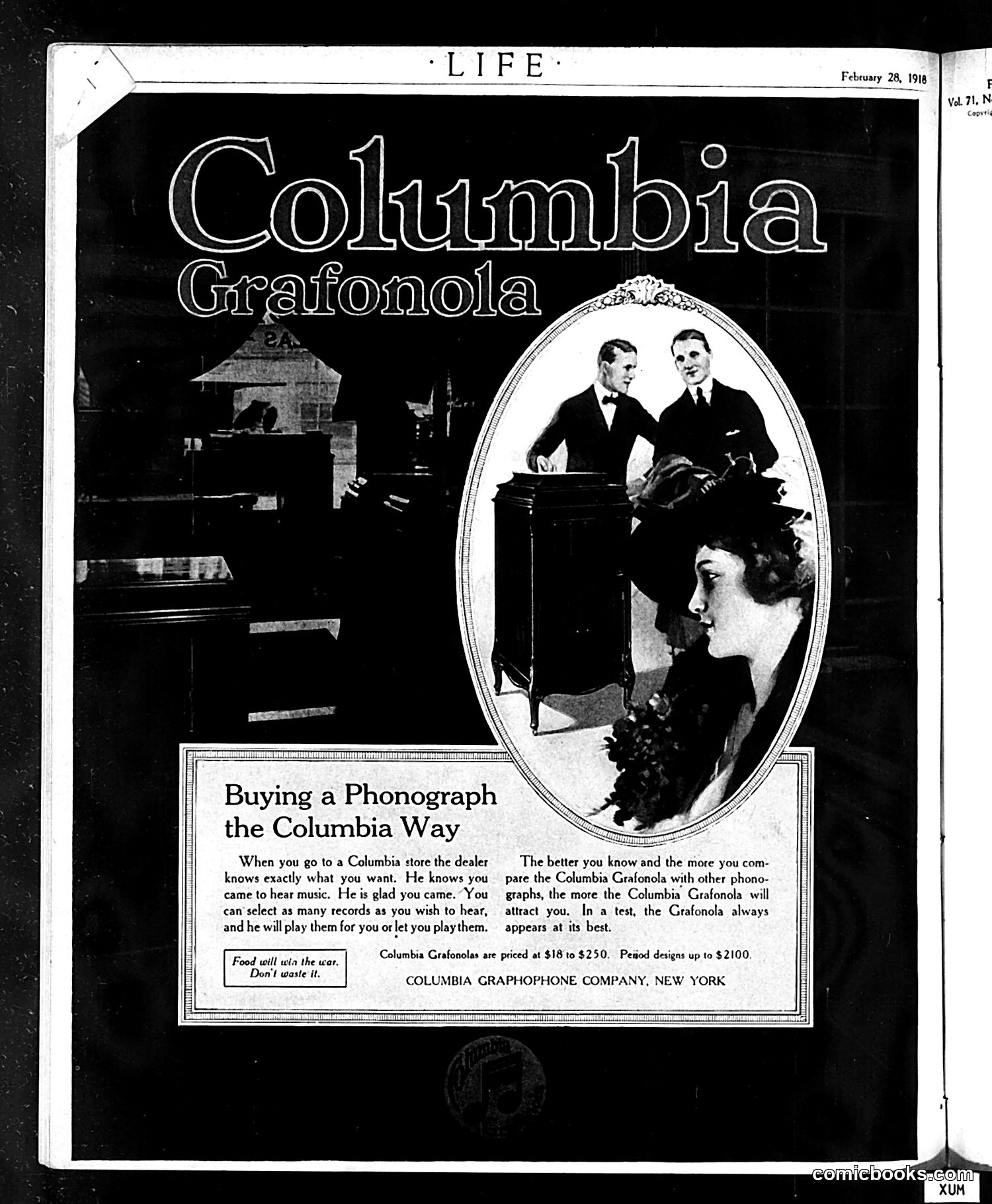
This is a **product advertisement**, not political satire. Published in *Life* magazine (February 28, 1918), it promotes Columbia's Grafonola phonograph. The page depicts a luxurious sales experience: a well-dressed woman (in profile, shown as elegant and refined) observes two gentlemen examining a phonograph at a Columbia dealer's showroom. The ad emphasizes the dealer's customer service—he lets you audition multiple records before purchasing. The messaging targets affluent buyers: Columbia positions itself as superior through direct comparison and a premium showroom experience. Prices ranged from $18 to $2,100, indicating models for different wealth levels. The tagline "Food will win the war. Don't waste it" reflects 1918 wartime messaging (U.S. entered WWI in 1917), suggesting even luxury advertising acknowledged national priorities. This is straightforward commercial promotion, not satirical commentary.