
Life, 1918-02-28 · page 9 of 40
Life — February 28, 1918 — page 9: what you’re looking at
What you’re looking at
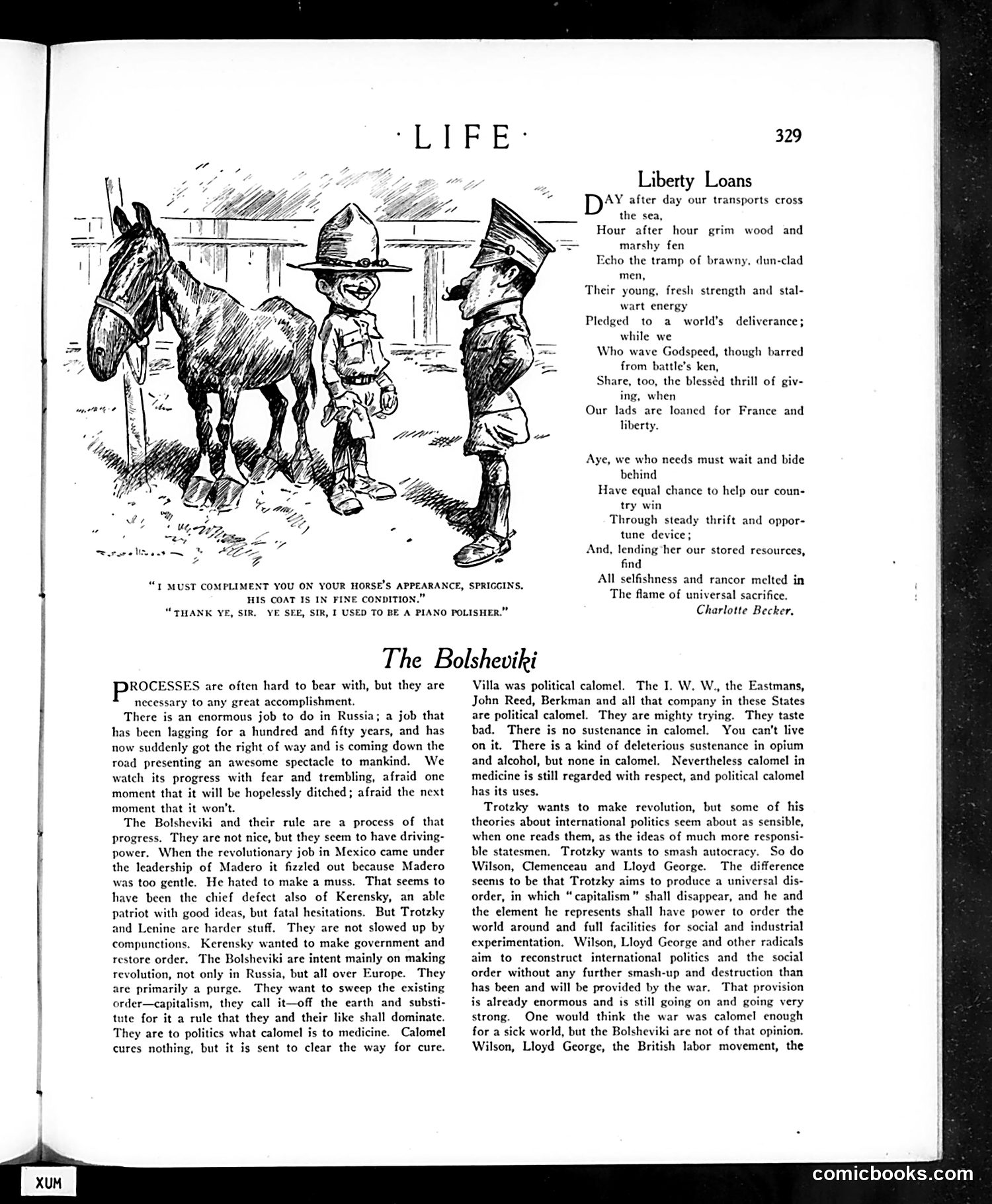
The cartoon shows two military figures inspecting a horse, with one saying he must compliment the horse's appearance and that "his coat is in fine condition," to which the other replies "Thank ye, sir. We, sir, I used to be a piano polisher." This is **wartime satire** mocking military recruitment and resource allocation. The joke satirizes how soldiers are being pressed into service regardless of their civilian skills—a piano polisher is now caring for military horses. It's a gentle jab at the army's need for manpower during what appears to be WWI, suggesting absurd reassignments of untrained personnel to essential military tasks. The facing article on "The Bolsheviki" discusses Russian revolutionary politics critically, referencing figures like Trotsky, Lenin, and Madero, contextualizing this as anti-revolutionary American commentary from the war period.
📄 Transcribed text from this page (OCR, searchable)
Machine-transcribed from the original scan — historical spelling and the odd misread are preserved.
———— EE . HIS COAT IS IN FINE CONDITION.” “THANK YE, SIR, YE SEE, SIR, I USED TO BE A PIANO POLISHER.” The Bolsheviki are often hard to bear with, but they are ‘y to any great accomplishment. There is an enormous job to do in Russia; a job that has been lagging for a hundred and fifty years, and has now suddenly got the right of way and is coming down the road presenting an awesome spectacle to mankind. We watch its progress with fear and trembling, afraid one moment that it will be hopelessly ditched; afraid the next moment that it won't. The Bolsheviki and their rule are a process of that progress. They are not nice, but they seem to have driving- power, When the revolutionary job in Mexico came under the leadership of Madero it fizzled out because Madero was too gentle. He hated to make a muss. That seems to have been the chief defect also of Kerensky, an able patriot with good ideas, but fatal hesitations. But Trotzky and Lenine are harder stuff. They are not slowed up by compunctions. Kerensky wanted to make government and restore order. The Bolsheviki are intent mainly on making revolution, not only in Russia, but all over Europe. They are primarily a purge. They want to sweep the existing order—capitalism, they call it—off the earth and substi- tute for it a rule that they and their like shall dominate. They are to politics what calomel is to medicine. Calomel cures nothing, but it is sent to clear the way for cure. ST COMPLIMENT YOU ON YOUR HORSE'S APPEARANCE, SPRIGGINS. 329 Liberty Loans D*’ after day our transports cross the sea, Hour after hour grim wood and marshy fen Echo the tramp of brawny, dun-clad men, Their young, fresh strength and stal- wart energy Pledged to a world’s deliverance; while we Who wave Godspeed, though barred from battle’s ken, Share, too, the blesséd thrill of giv- ing, when Our lads are loaned for France and liberty. Aye, we who needs must wait and bide behind Have equal chance to help our coun- try win Through steady thrift and oppor- tune device; And, lending her our stored resources, find All selfishness and rancor melted in The flame of universal sacrifice. Charlotte Becker, Villa was political calomel. The I. W. W., the Eastmans, John Reed, Berkman and all that company in these States are political calomel. They are mighty trying. They taste bad. There is no sustenance in calomel. You can't live on it. There is a kind of deleterious sustenance in opium and alcohol, but none in calomel. Nevertheless calomel in medicine is still regarded with respect, and political calomel has its uses. Trotzky wants to make revolution, but some of his theories about international politics seem about as sensible, when one reads them, as the ideas of much more responsi- ble statesmen. Trotzky wants to smash autocracy. So do Wilson, Clemenceau and Lloyd George. The difference seems to be that Trotzky aims to produce a universal dis- order, in which “capitalism” shall disappear, and he and the element he represents shall have power to order the world around and full facilities for social and industrial experimentation. Wilson, Lloyd George and other radicals aim to reconstruct international politics and the social order without any further smash-up and destruction than has been and will be provided by the war. That provision is already enormous and is still going on and going very strong. One would think the war was calomel enough for a sick world, but the Bolsheviki are not of that opinion. Wilson, Lloyd George, the British labor movement, the comicbooks.com