
Life, 1918-02-28 · page 14 of 40
Life — February 28, 1918 — page 14: what you’re looking at
What you’re looking at
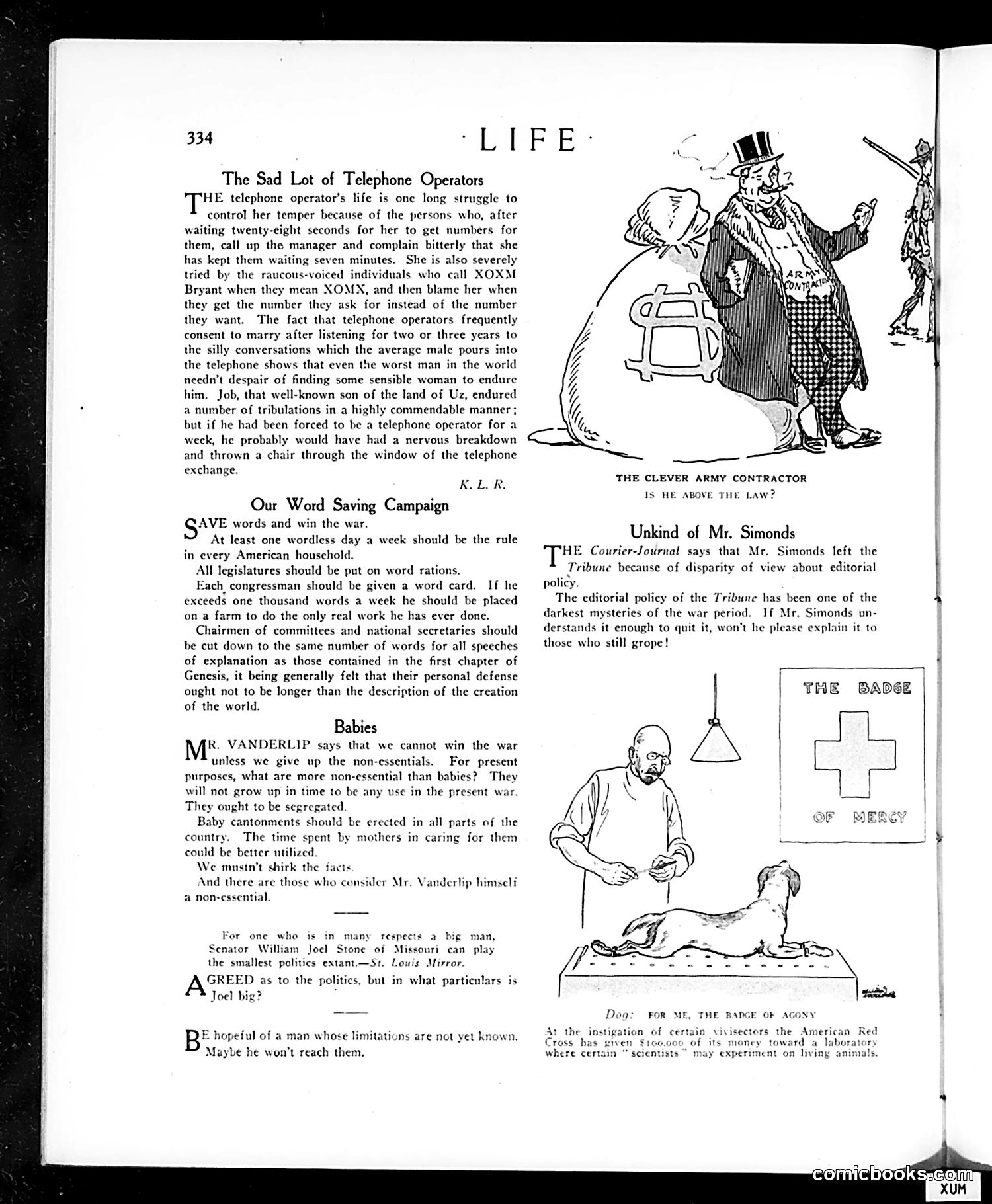
This page contains several satirical pieces from WWI-era *Life* magazine: **"The Sad Lot of Telephone Operators"** mocks the frustrations telephone operators (predominantly women) endured—long waits, rude callers, and absurd conversations. The humor lies in exaggerating their suffering and suggesting they'd marry anyone willing to listen to their complaints. **"The Clever Army Contractor"** cartoon (top right) appears to satirize military procurement corruption, questioning whether contractors operated above the law. **"The Badge of Mercy"** cartoon depicts a dog receiving the Red Cross badge, sardonically commenting that the American Red Cross funded laboratory experiments on animals for war-related research. The remaining text pieces discuss wartime economy measures and Mr. Vanderbilt's views on essential versus non-essential goods during the war effort.
📄 Transcribed text from this page (OCR, searchable)
Machine-transcribed from the original scan — historical spelling and the odd misread are preserved.
24 “LIFE: The Sad Lot of Telephone Operators THE telephone operator’s life is one long struggle to control her temper because of the persons who, after waiting twenty-eight seconds for her to get numbers for them, call up the manager and complain bitterly that she has kept them waiting seven minutes. She is also severely tried by the raucous-voiced individuals who call XOXM Bryant when they mean XOM ind then blame her when they get the number they ask for instead of the number they want. The fact that telephone operators frequently consent to marry after listening for two or three years to the silly conversations which the average male pours into the telephone shows that even the worst man in the world needn't despair of finding some sensible woman to endure him. Job, that well-known son of the land of Uz, endured a number of tribulations in a highly commendable manner ; but if he had been forced to be a telephone operator for a week, he probably would have had a nervous breakdown and thrown a chair through the window of the telephone exchange. K.L.R. Our Word Saving Campaign AVE words and win the war. At least one wordless day a week should be the rule in every American household. All legislatures should be put on word rations. Each congressman should be given a word card. If he exceeds one thousand words a week he should be placed on a farm to do the only real work he has ever done. Chairmen of committees and national secretaries should be cut down to the same number of words for all speeches of explanation as those contained in the first chapter of Genesis, it being generally felt that their personal defense ought not to be longer than the description of the creation of the world. Babies R. VANDERLIP says that we cannot win the war unless we give up the non-essentials. For present purposes, what are more non-essential than babies? They will not grow up in time to be any use in the present war They ought to be segregated Baby cantonments should be crected in all parts of the country. The time spent by mothers in caring for them could be better utilized We mustn’t shirk the facts And there are those who consider Mr. Vanderlip himself a non-essential. For one who is in many Senator William Joel Stone of Missouri can play the smallest politics extant.—St. Louis Mirror. GREED as to the politics, but in what particulars is Joel big? respects a big. man, E hopeful of a man whose limitations are not yet known. Maybe he won't reach them, THE CLEVER ARMY CONTRACTOR IS HE ABOVE THE LAW? Unkind of Mr. Simonds HE Courier-Journal says that Mr. Simonds left the Tribune because of disparity of view about editorial policy. The editorial policy of the Tribune has been one of the darkest mysteries of the war period. If Mr. Simonds un- derstands it enough to quit it, won't he please explain it to those who still grope! Dog: FOR ME, THE BADGE OF AGONY on of certain vivisectors the American Red ooo of its money toward a 7 expe nt on living a Cross has give: where certain “