
Life, 1918-02-28 · page 18 of 40
Life — February 28, 1918 — page 18: what you’re looking at
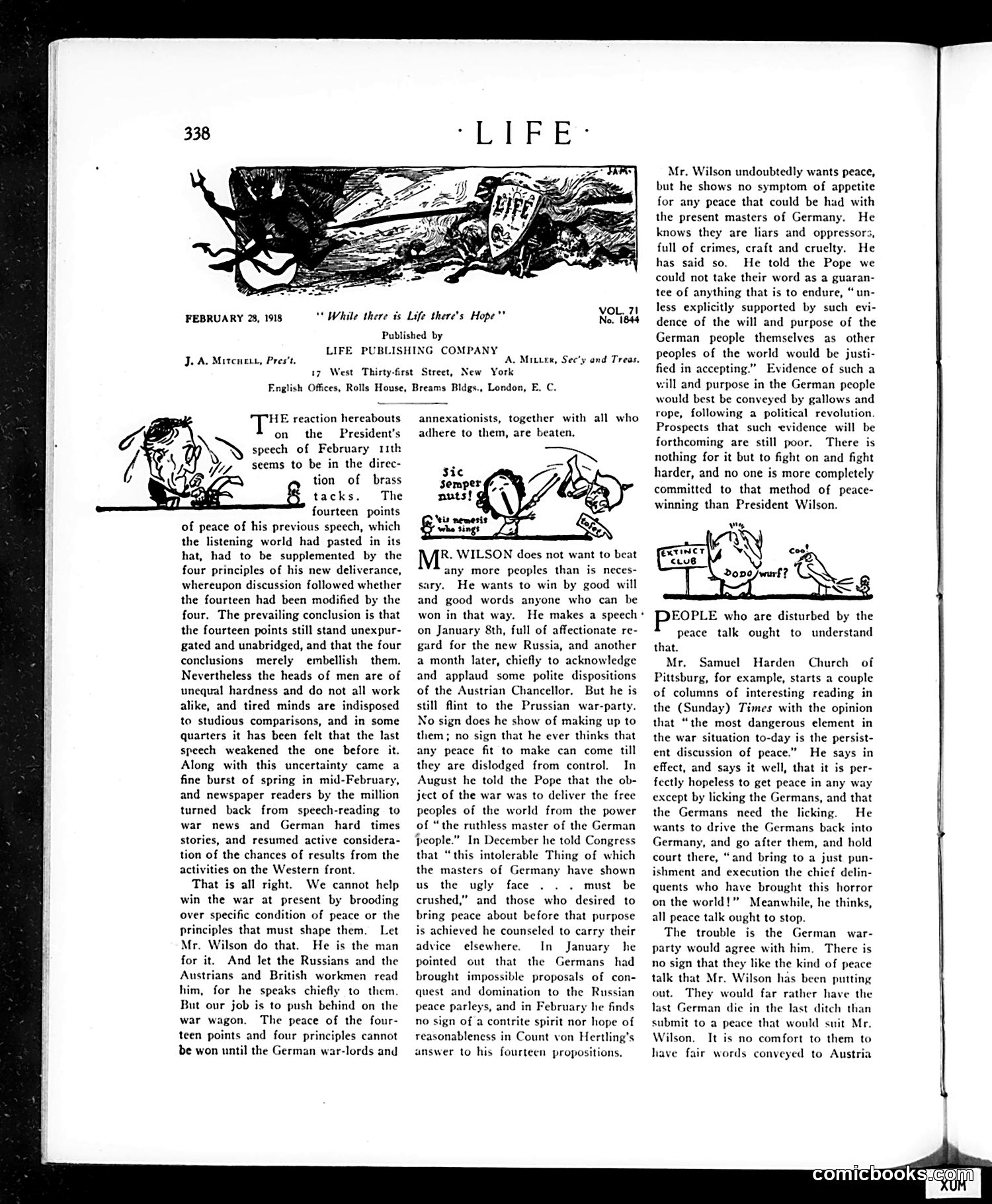
What you’re looking at
This editorial page defends President Wilson's peace strategy during World War I. The main cartoon (top) depicts a skeletal, demonic figure—representing German militarism or the "Prussian war-party"—being confronted by an armed figure (likely representing Allied forces or Wilson's resolve). The text argues that Wilson's Fourteen Points and subsequent Four Principles for peace are not contradictory but complementary. The editorial emphasizes that Wilson genuinely seeks peace but refuses any settlement with Germany's current leadership, whom he views as liars, oppressors, and warmongers. Wilson, the author argues, is correctly targeting only German military leaders and annexationists, not the German people themselves. The piece critiques those who worry Wilson's speeches weaken American resolve, instead positioning his diplomatic messaging as appropriately directed at potential allies (Russians, Austrians, British workers) while remaining "flint" toward Prussian militarism. The message: victory must precede peace negotiations.
📄 Transcribed text from this page (OCR, searchable)
Machine-transcribed from the original scan — historical spelling and the odd misread are preserved.
FEBRUARY 23, 1918 “While there is Life there's Hope"” No. 1844 Published by LIFE PUBLISHING COMPANY JA. Mircnent, Pres't. A. Mutter, Sec’y and Treas. 17 West Thirty-first Street, New York English Offices, Rolls House, Breams Bldgs., London, E. C. HE reaction hereabouts on the President's speech of February 11th seems to be in the direc- tion of brass tacks. The fourteen points of peace of his previous speech, which the listening world had pasted in its hat, had to be supplemented by the four principles of his new deliverance, whereupon discussion followed whether the fourteen had been modified by the four. The prevailing conclusion is that the fourteen points still stand unexpur- gated and unabridged, and that the four conclusions merely embellish them. Nevertheless the heads of men are of unequal hardness and do not all work alike, and tired minds are indisposed to studious comparisons, and in some quarters it has been felt that the last speech weakened the one before it. Along with this uncertainty came a fine burst of spring in mid-February, and newspaper readers by the million turned back from speech-reading to war news and German hard times stories, and resumed active considera- tion of the chances of results from the activities on the Western front. That is all right. We cannot help win the war at present by brooding over specific condition of peace or the principles that must shape them. Let Mr. Wilson do that. He is the man for it. And let the Russians and the Austrians and British workmen read him, for he speaks chiefly to them. But our job is to push behind on the war wagon. The peace of the four- teen points and four principles cannot be won until the German war-lords and YL annexationists, together with all who adhere to them, are beaten, R. WILSON does not want to beat any more peoples than is neces- sary. He wants to win by good will and good words anyone who can be won in that way. He makes a speech on January 8th, full of affectionate re- gard for the new Russia, and another a month later, chiefly to acknowledge and applaud some polite dispositions of the Austrian Chancellor, But he is still flint to the Prussian war-party. No sign does he show of making up to them; no sign that he ever thinks that any peace fit to make can come till they are dislodged from control. In August he told the Pope that the ob- ject of the war was to deliver the free peoples of the world from the power of “the ruthless master of the German people.” In December he told Congress that “this intolerable Thing of which the masters of Germany have shown us the ugly face . must be crushed,” and those who desired to bring peace about before that purpose is achieved he counseled to carry their advice elsewhere. In January he pointed out that Germans had brought impossible proposals of con- quest and domination to the Russian peace parleys, and in February he finds no sign of a contrite spirit nor hope of reasonableness in Count von Hertling’s answer to his fourteen propositions. the Mr. Wilson undoubtedly wants peace, but he shows no symptom of appetite for any peace that could be had with the present masters of Germany. He knows they are liars and oppressors, full of crimes, craft and cruelty, He has said so. He told the Pope we could not take their word as a guaran- tee of anything that is to endure, “ un- less explicitly supported by such evi- dence of the will and purpose of the German people themselves as other peoples of the world would be justi- fied in accepting.” Evidence of such a will and purpose in the German people would best be conveyed by gallows and rope, following a political revolution. Prospects that such evidence will be forthcoming are still poor. There is nothing for it but to fight on and fight harder, and no one is more completely committed to that method of peace- winning than President Wilson. i nabs PPOPLE who are disturbed by the peace talk ought to understand that. Mr. Samuel Harden Church of Pittsburg, for example, starts a couple of columns of interesting reading in the (Sunday) Times with the opinion that “the most dangerous element in the war situation to-day is the persist- ent discussion of peace.” He says in effect, and says it well, that it is per- fectly hopeless to get peace in any way except by licking the Germans, and that the Germans need the licking. He wants to drive the Germans back into Germany, and go after them, and hold court there, “and bring to a just pun- ishment and execution the chief delin- quents who have brought this horror on the world!” Meanwhile, he thinks, all peace talk ought to stop. The trouble is the German war- party would agree with him. There is no sign that they like the kind of peace talk that Mr. Wilson has been putting out. They would far rather have the last German die in the last ditch than submit to a peace that would suit Mr. Wilson. It is no comfort to them to have fair words conveyed to Austria