
A complete issue · 40 pages · 1918
Life — February 7, 1918
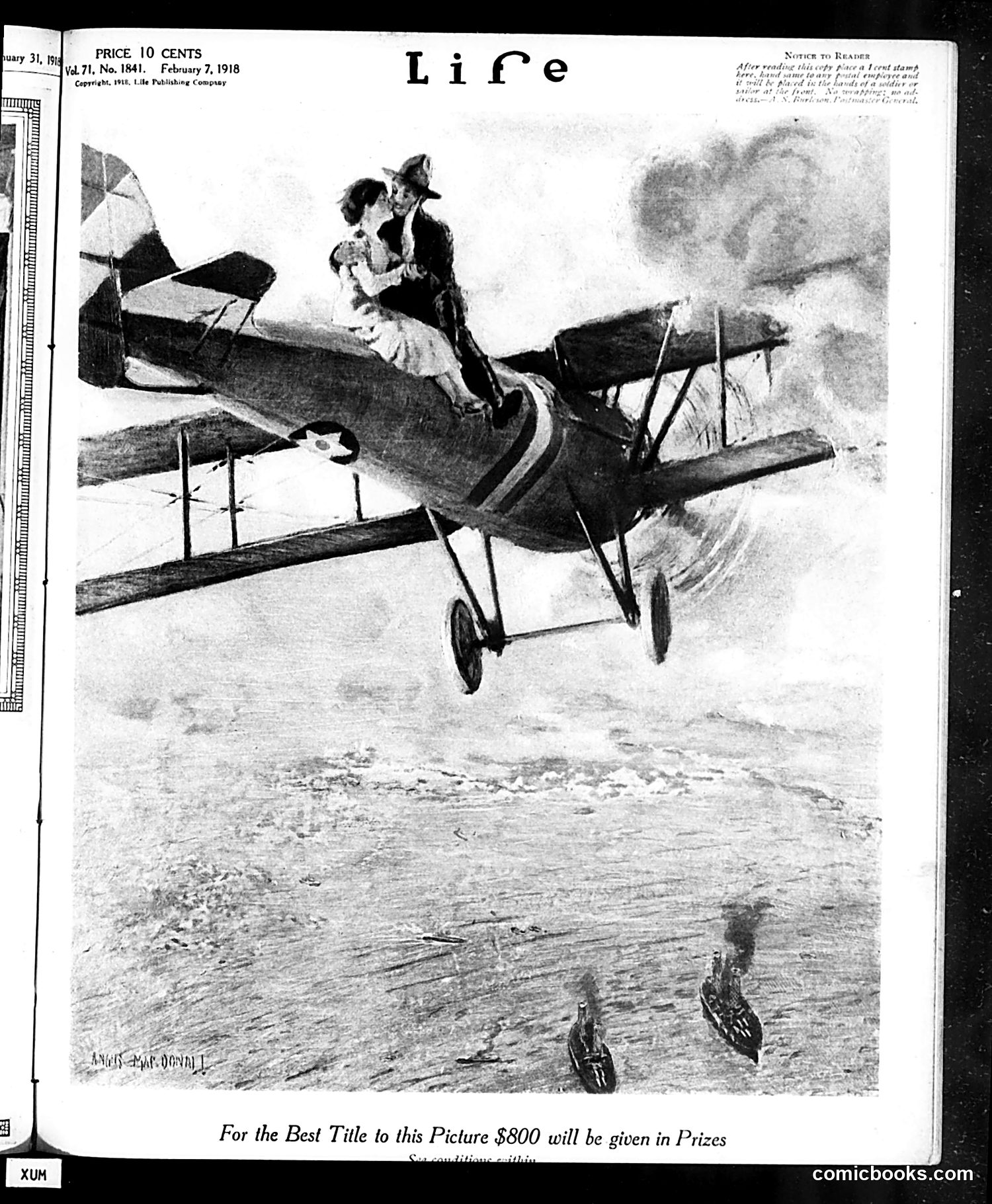
This is a satirical illustration depicting a romantic couple in a WWI-era biplane mid-flight. The man appears to be piloting while the woman sits beside him, and they're embracing or kissing. Below, two other planes are visible, seemingly in pursuit or formation. The satire likely plays on the romance and adventure associated with aerial combat during World War I—a relatively new and glamorous theater of warfare. The magazine is inviting readers to submit witty titles for the image (offering $800 in prizes), suggesting the humor comes from the incongruity or irony of the romantic scene against the deadly backdrop of aerial warfare. This reflects how WWI aviation captured American public imagination as both dangerous and thrilling.
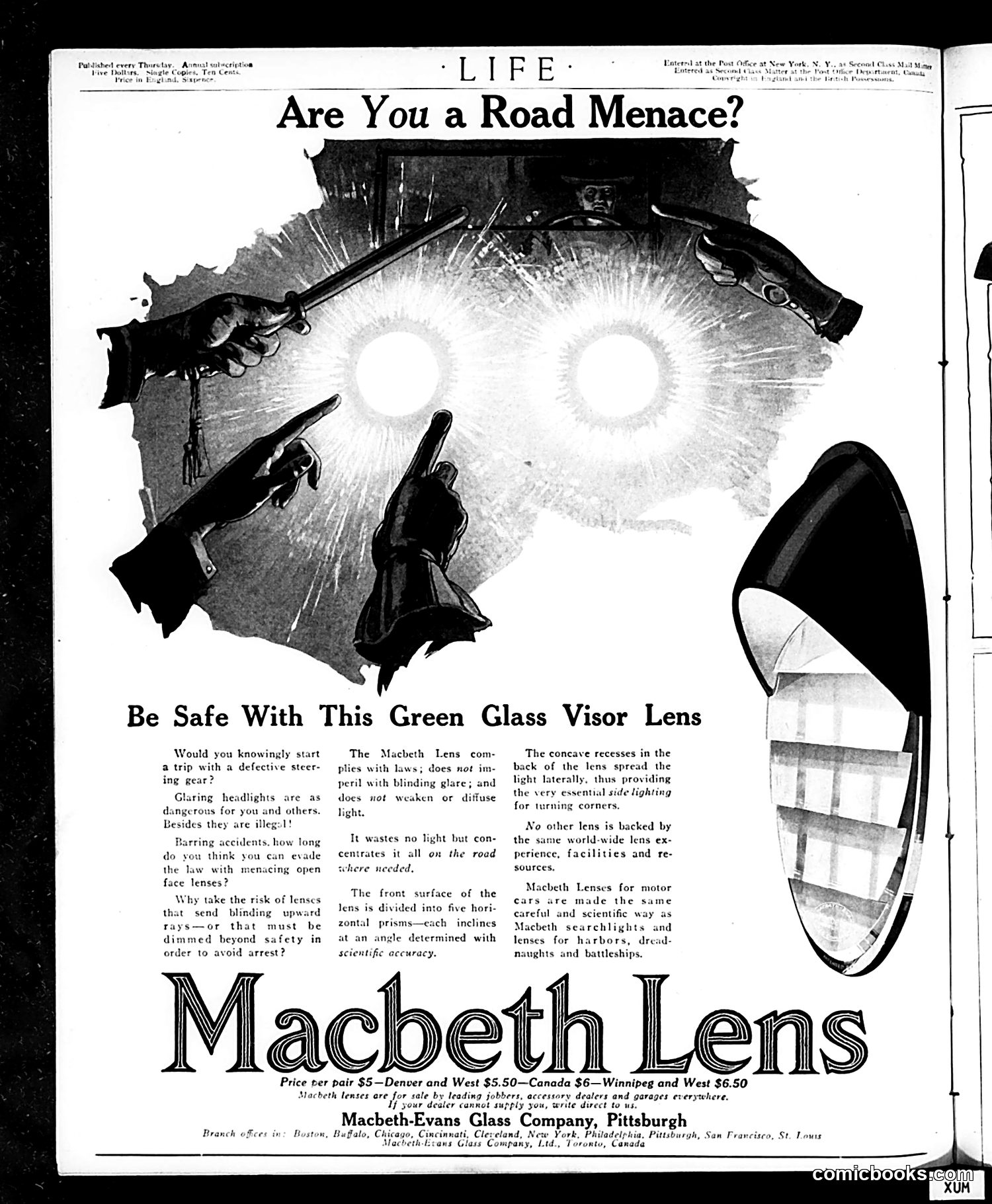
This page is primarily **advertising**, not satire or political commentary. It's a Macbeth Lens Company advertisement for automobile safety goggles. The headline "Are You a Road Menace?" uses fear-based marketing, suggesting that drivers without proper eye protection endanger themselves and others. The dramatic illustration shows a menacing face composed of traffic hazards—guns, knives, and other weapons—designed to scare readers into purchasing the product. The advertisement emphasizes that Macbeth's green glass visor lenses provide "side-lighting for turning corners" and reduce glare from headlights, promoting safer driving. The product positioning suggests this was an era when eye protection while driving was novel and needed marketing justification. This reflects early 20th-century automobile safety concerns.
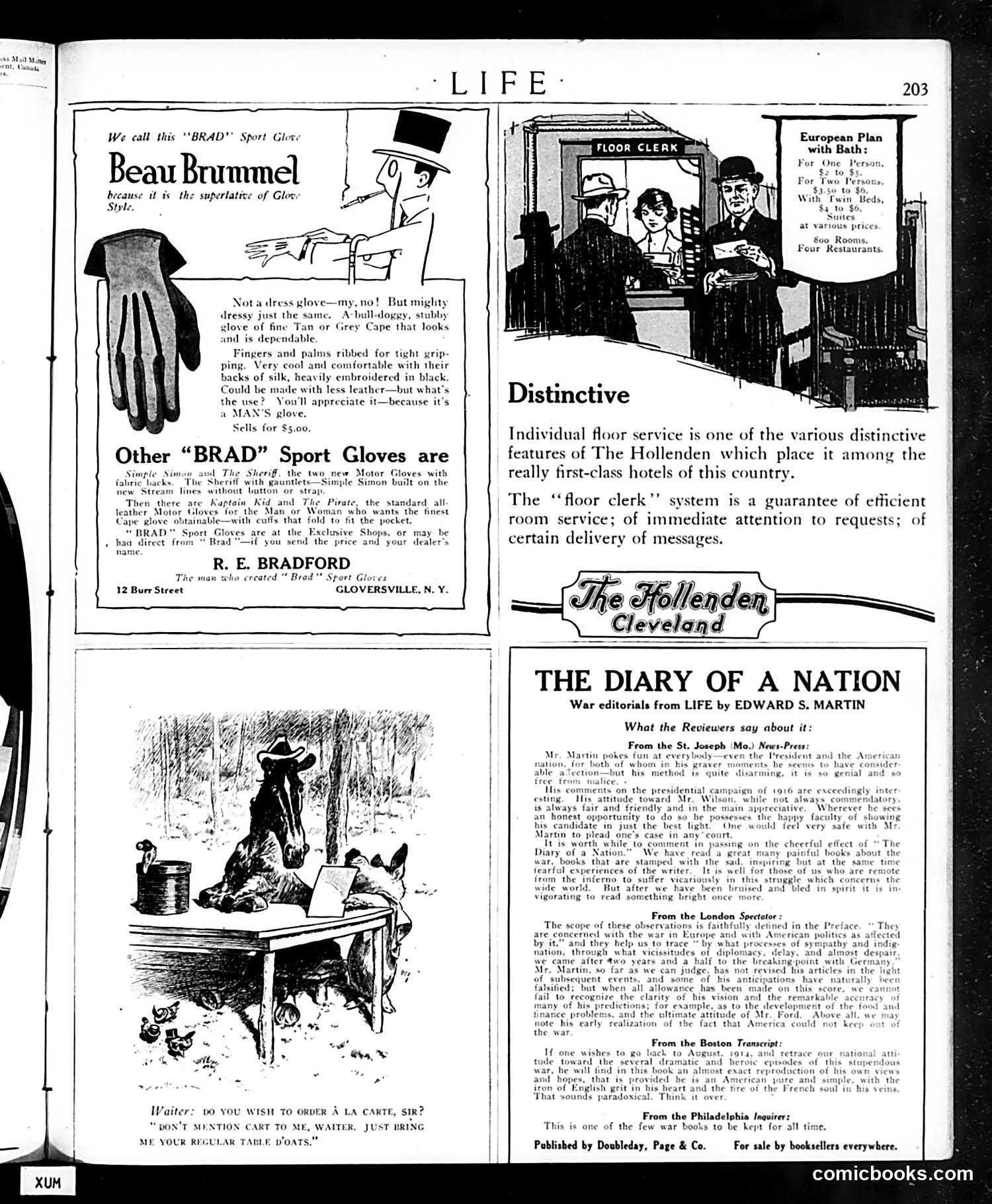
**Advertisements dominate this page.** The top left features "Beau Brummel" sport gloves by R.E. Bradford, emphasizing durability and style—a straightforward product ad. The right side advertises The Hollenden hotel in Cleveland, highlighting its "floor clerk" system for efficient room service. **The single cartoon** (lower left) shows a waiter at a table with a diner, captioned with dialogue about not ordering à la carte. The joke relies on a pun: the waiter misinterprets "à la carte" as something resembling "cart," leading to absurd wordplay. **Content note:** The lower right section previews "The Diary of a Nation," a war editorial series by Edward S. Martin, referencing World War I commentary. This page is primarily **commercial rather than satirical.**
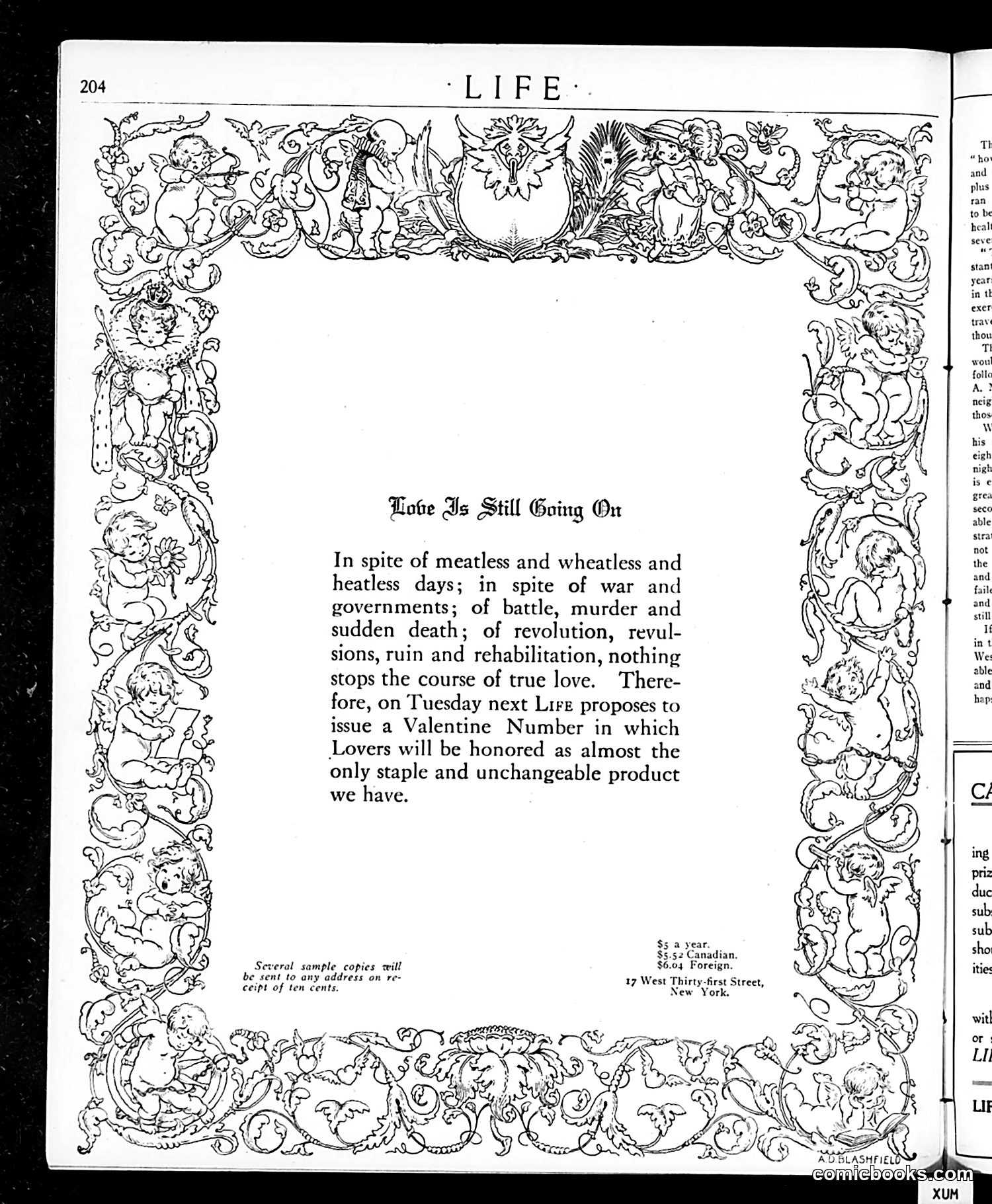
This page is primarily an **advertisement for Life magazine's upcoming Valentine's Day issue**, not a political cartoon. The ornate border features cherubs and romantic imagery—appropriate for the subject matter. The text announces that Life will publish a Valentine Number celebrating love as "the only staple and unchangeable product we have," despite contemporary hardships: "meatless and wheatless and heatless days; in spite of war and governments of battle, murder and sudden death; of revolution, revulsions, ruin and rehabilitation." This references **World War I-era conditions**—rationing, combat, and post-war instability. The advertisement frames love as humanity's enduring constant amid chaos, using wartime deprivation to underscore its message about timeless romance.
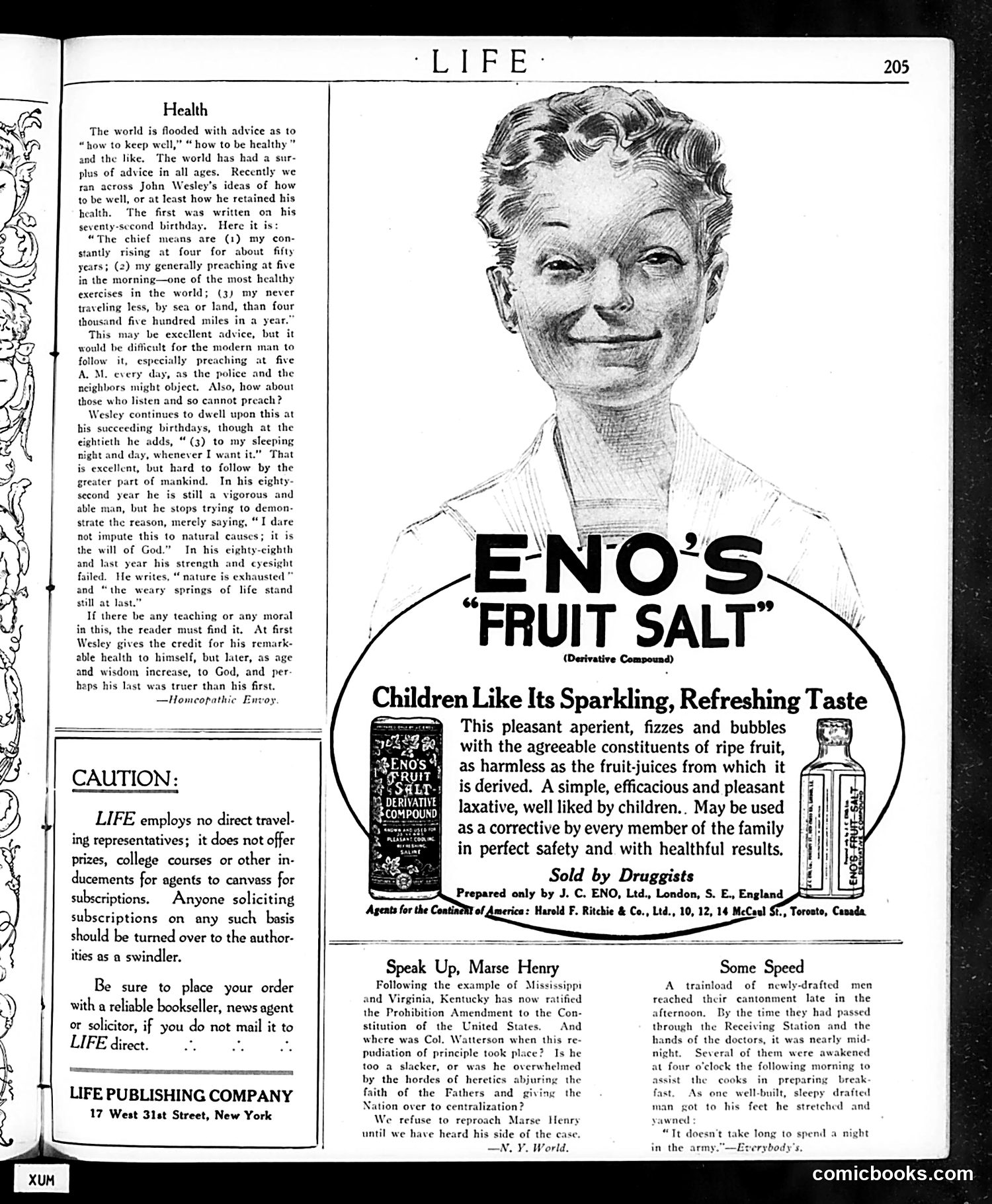
This page is primarily **advertising**, not political satire. The dominant content is a large advertisement for "Eno's Fruit Salt," a commercial laxative product marketed as safe for children. The ad features a sketch of what appears to be an elderly man and promises the product "fizzes and bubbles" pleasantly while promoting bowel regularity. The left column contains a biographical article about John Wesley's health practices, written on his 72nd birthday, describing his regimen of early rising and travel. Below that is a **caution notice** warning readers about subscription fraud, and information for the Life Publishing Company. The page reflects early 20th-century advertising practices, where patent medicines and laxatives received prominent placement in magazines.
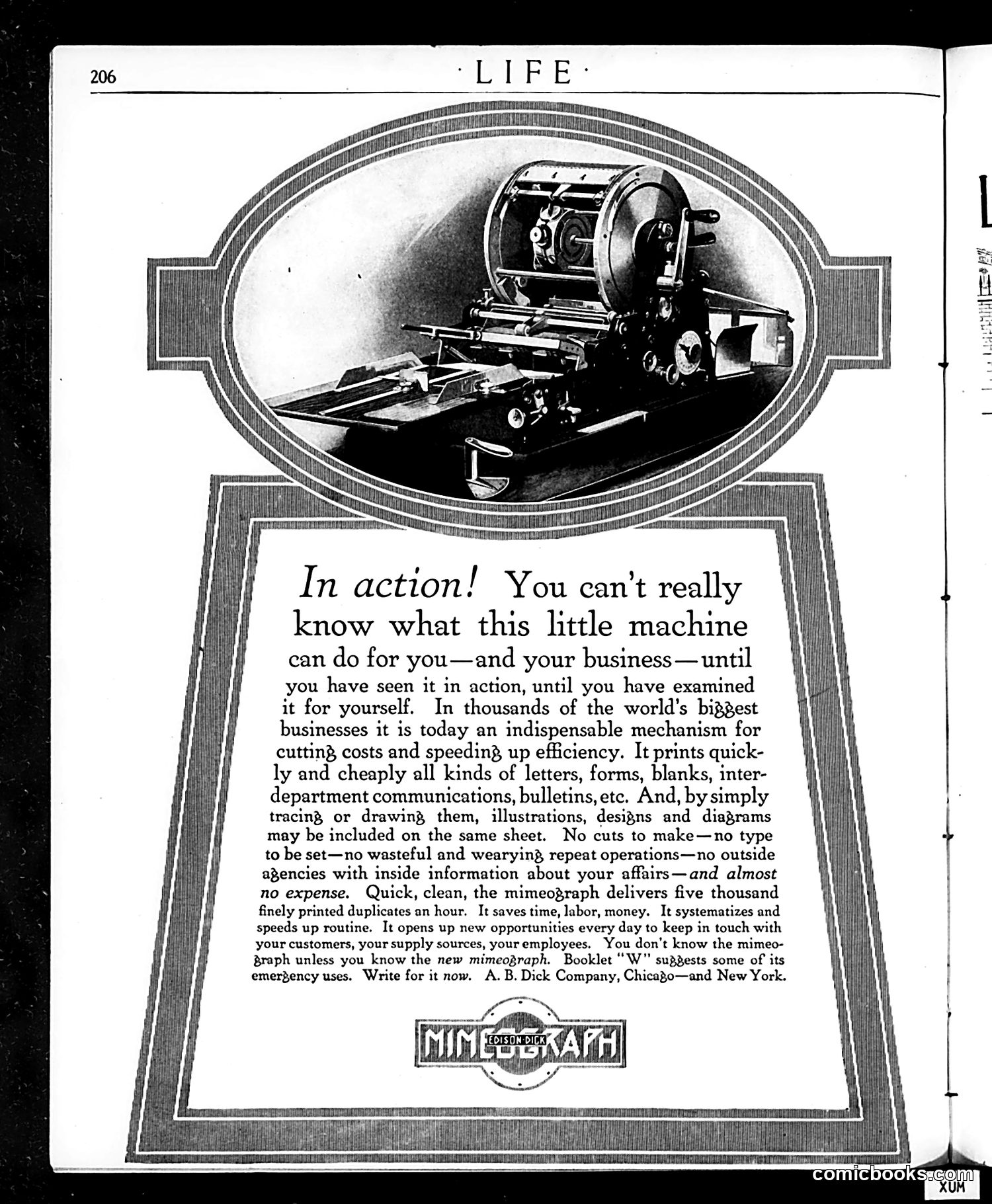
This is **not a political cartoon or satirical content**—it's a **vintage advertisement** for the Mimeograph machine by A.B. Dick Company (Chicago and New York). The ad uses the heading "In action!" to showcase the device's capabilities. Rather than satire, it's straightforward business marketing, targeting company managers and business owners. The text emphasizes the mimeograph's practical benefits: printing letters, forms, and documents cheaply and quickly, saving time and money while maintaining internal business communications. The ad promises efficiency gains and cost-cutting—key selling points for early 20th-century business technology. There is no political commentary or social satire present; this is purely industrial-era product promotion.
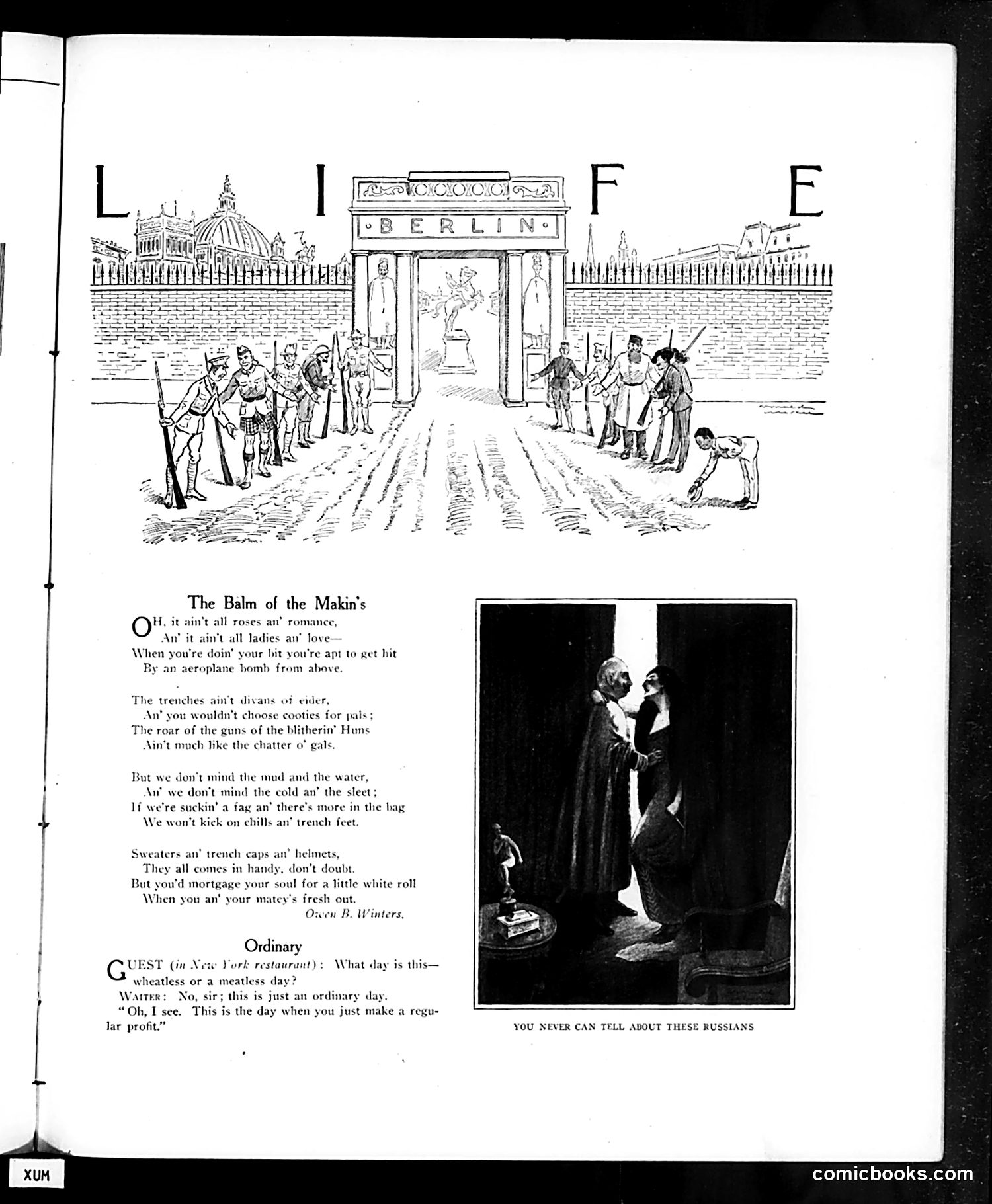
**Top illustration:** A satirical scene labeled with letters L, I, F, E showing the Brandenburg Gate in Berlin. Soldiers stand guard at a gate marked "BERLIN" while civilians interact nearby. This appears to reference post-WWI Berlin during occupation or a period of military control. **"The Balm of the Makin's"** is a poem by Owen B. Winters mocking soldiers' experiences in trenches during WWI—describing mud, cold, artillery fire, and modest comforts like cigarettes and sweaters. It's darkly humorous verse about enduring wartime hardships. **"Ordinary"** presents a brief restaurant joke contrasting a guest's question about "ordinary" meals with the waiter's sardonic reply about profit margins—likely satirizing wartime or post-war economic adjustments and inflation. The page reflects American satirical commentary on WWI consequences and contemporary social conditions.
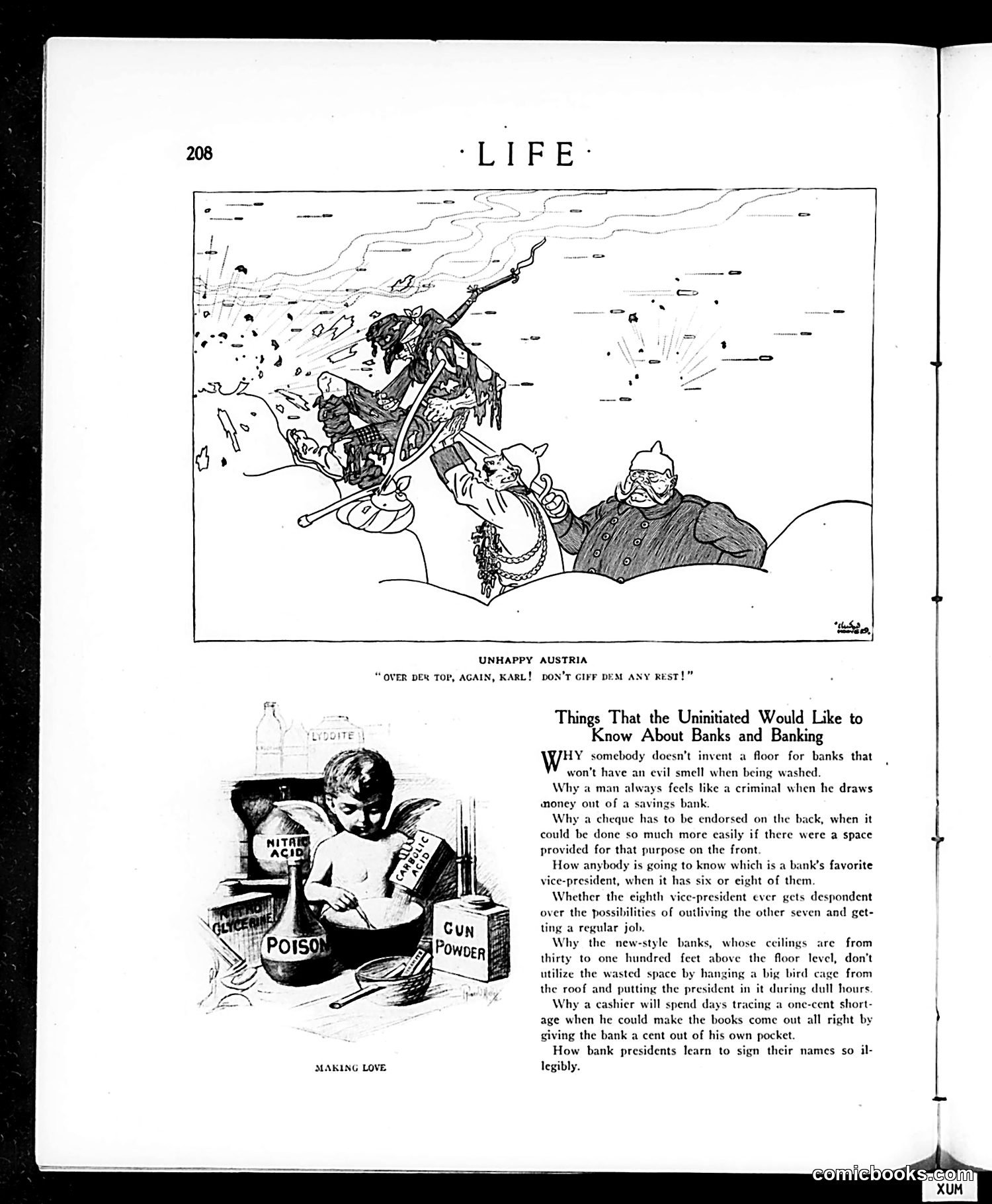
**Top Cartoon: "Unhappy Austria"** This depicts Austria after World War I, showing a skeletal, war-ravaged figure being instructed "Over den top, again, Karl! Don't gift dem any rest!" The cartoon satirizes Austria's continued hardship and instability during the post-war period, suggesting the nation faces endless demands and suffering without respite. **Bottom Cartoon: "Making Love"** A child surrounded by dangerous household items (poison, gun powder, nitric acid) illustrates darkly humorous social commentary about parenting or societal negligence. **Text Section: "Things That the Uninitiated Would Like to Know About Banks and Banking"** A satirical list of rhetorical questions mocking banking practices, inefficiencies, and the absurdities of banking operations—critiquing everything from architectural wastefulness to poor customer service.
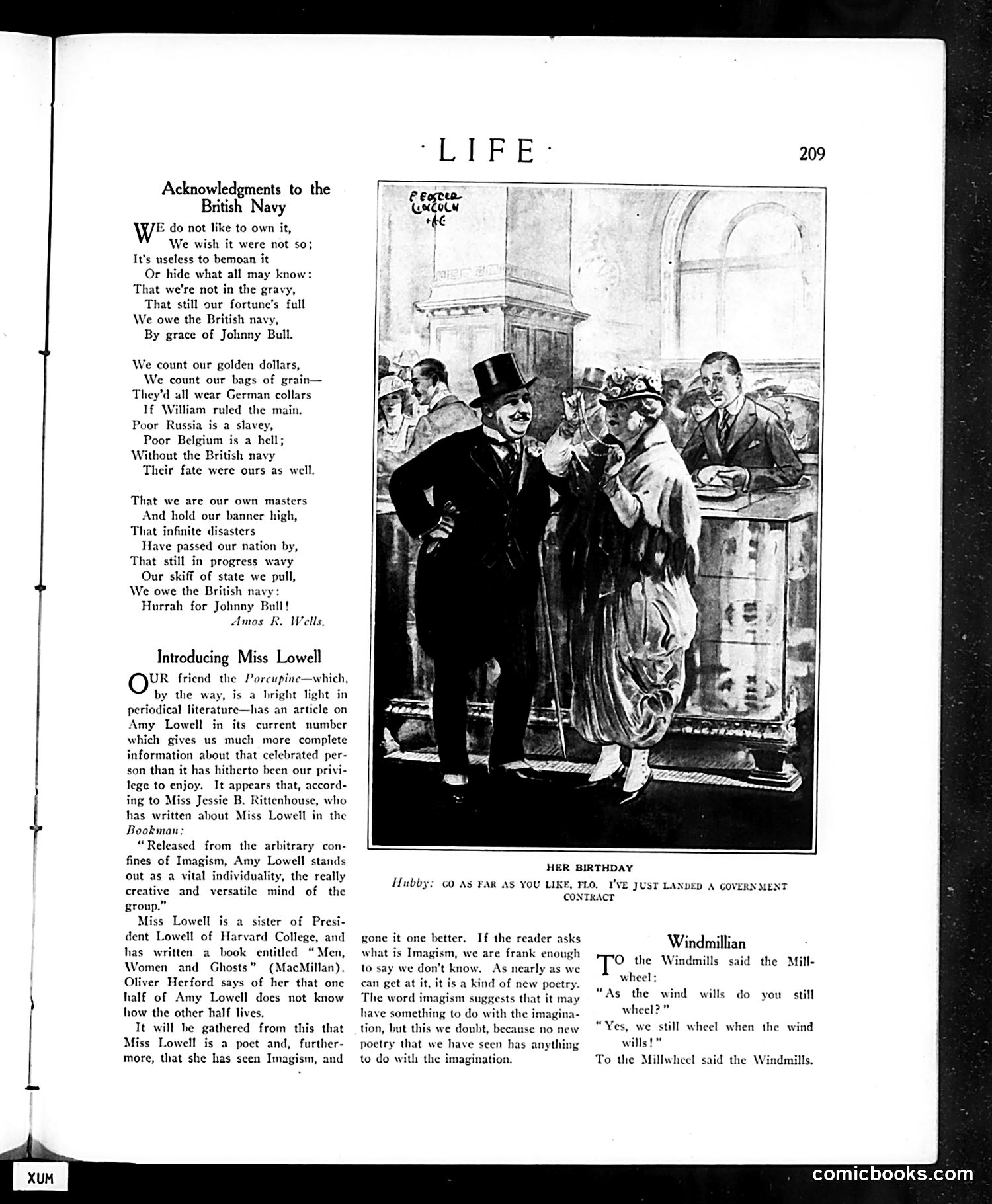
The main illustration titled "Her Birthday" depicts a social scene where a man in formal attire (top hat and coat) presents what appears to be a government contract to a woman. The caption indicates this is satirizing romantic or matrimonial entanglement with bureaucratic paperwork—"Go as far as you like, Flo. I've just landed a government contract." The humor centers on the contrast between personal relationships and official business: a suitor uses a government contract as a romantic offering, suggesting either that official connections have become a form of currency in courtship, or that bureaucratic matters have absurdly intruded into intimate life. The page also includes "Acknowledgments to the British Navy" (a patriotic poem) and an introduction to writer Amy Lowell, but these are separate editorial content unrelated to the cartoon's satire.
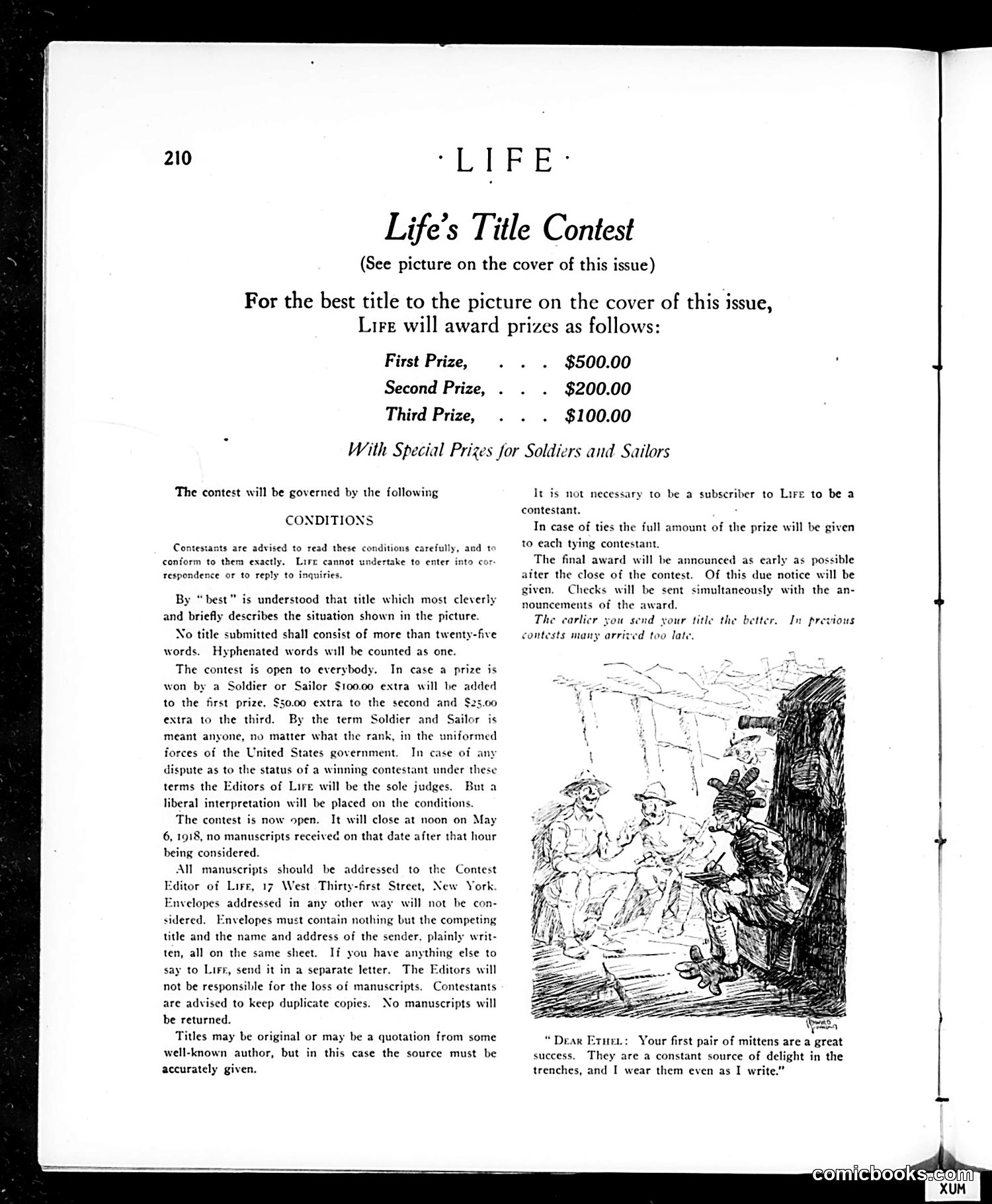
This page announces a title-writing contest for a cover illustration visible elsewhere in the issue. The contest offers $500 for first prize, with smaller amounts for second and third place, plus special bonuses for soldiers and sailors. The accompanying sketch shows soldiers in a trench during World War I, with one soldier writing home. The caption reads: "DEAR ETHEL: Your first pair of mittens are a great success. They are a constant source of delight in the trenches, and I wear them even as I write." The joke appears to contrast domestic comfort (homemade mittens) with the brutal reality of trench warfare. It's gentle humor about soldiers maintaining morale through small gestures from home—a common satirical theme during WWI when Life frequently addressed wartime experiences.
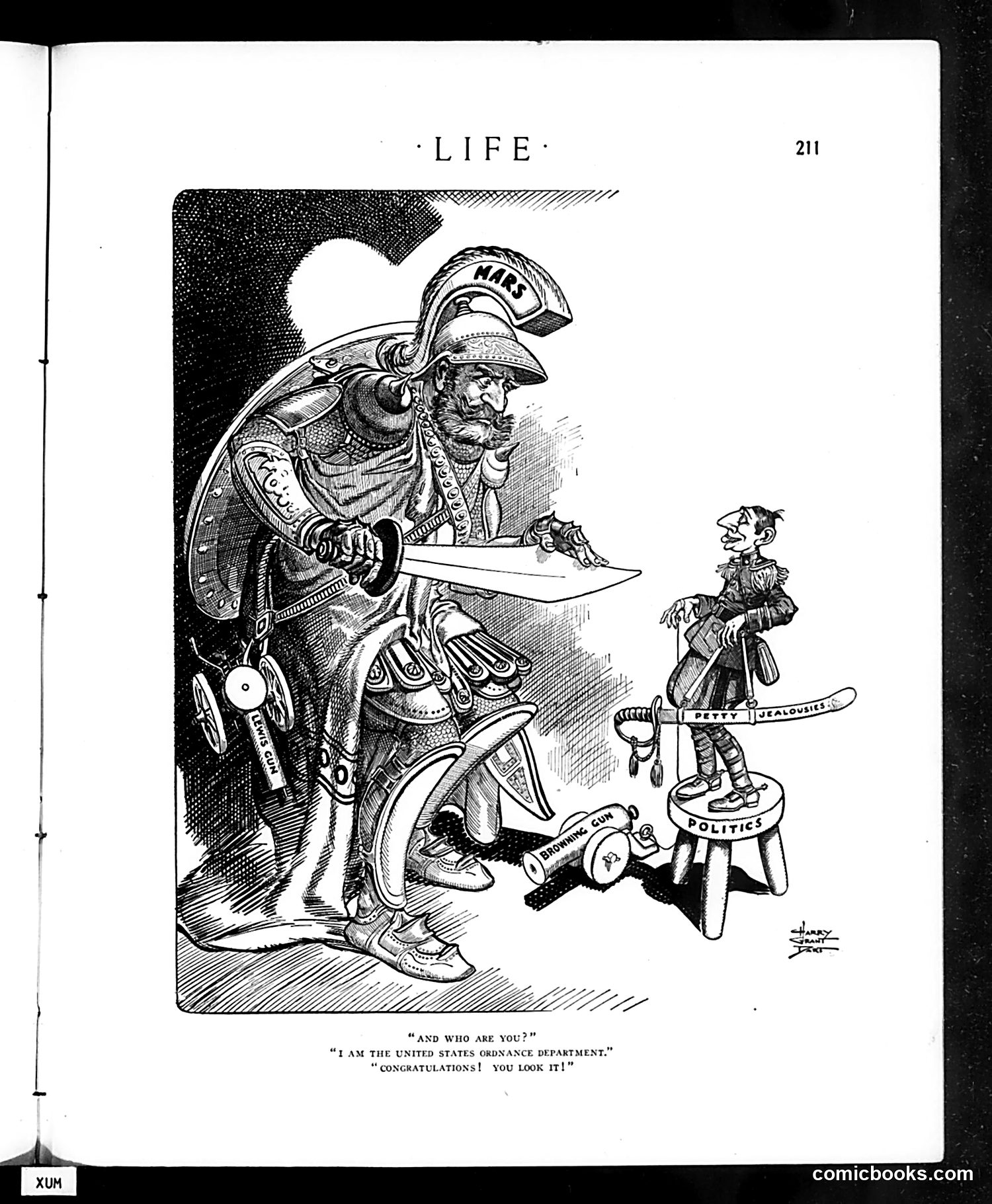
This is a satirical cartoon from *Life* magazine (page 211) depicting a large military or naval officer labeled "MRS" confronting a small child riding a toy. The child's toys are labeled "PETTY JEALOUSIES" and "POLITICS," positioned on what appears to be a platform labeled "BROWNING CLUB." The officer says: "AND WHO ARE YOU?" and "I AM THE UNITED STATES ORDNANCE DEPARTMENT. CONGRATULATIONS! YOU LOOK IT!" The satire appears to mock either excessive militarism or government overspending on weapons/ordnance, contrasting the massive military establishment with trivial civilian concerns (petty jealousies, politics). The cartoon criticizes disproportionate military resources or the military's dominance in American policy, suggesting the vast defense apparatus dwarfs more modest civilian pursuits. The specific historical context and target remain unclear without additional dating information.
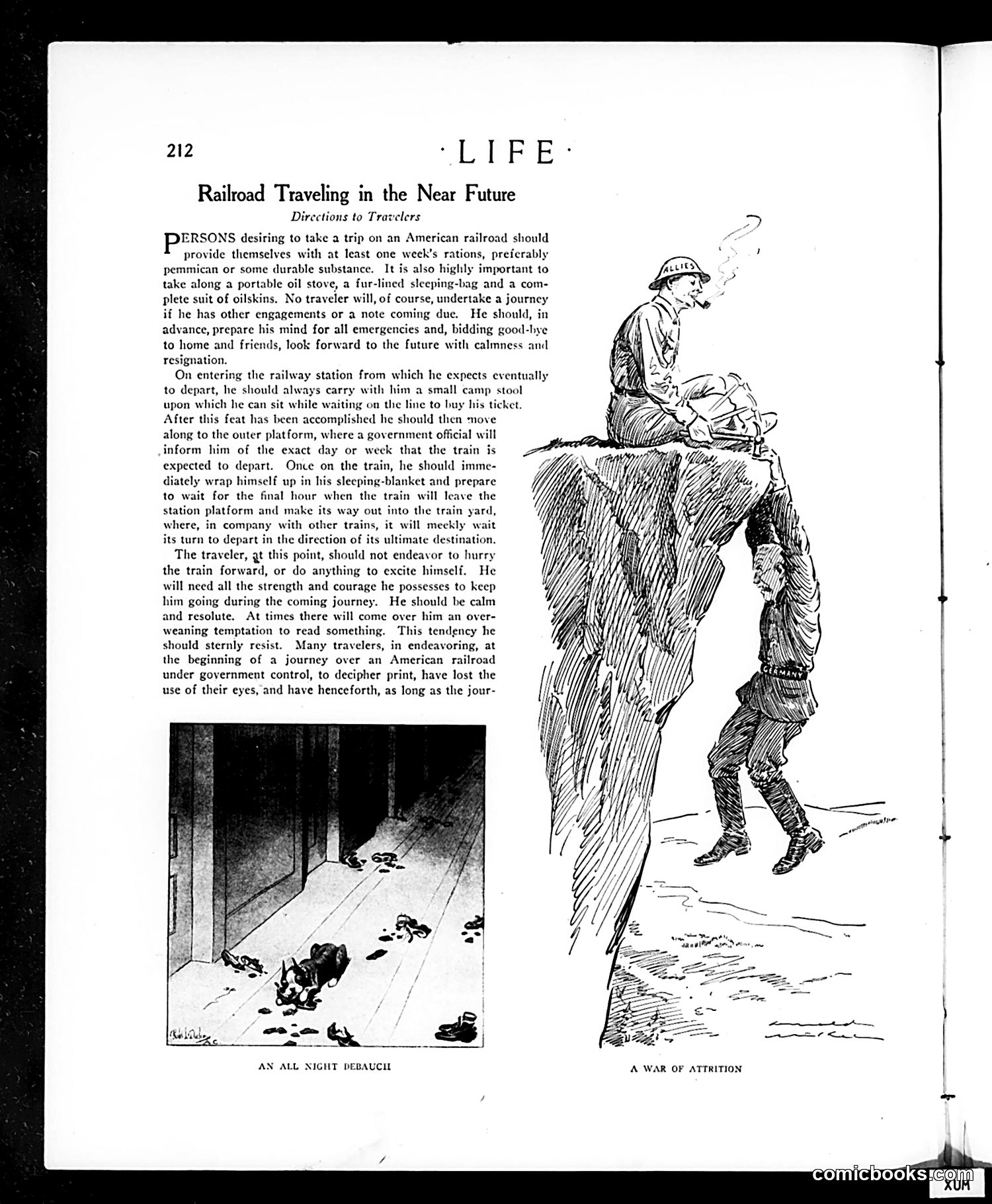
This page satirizes railroad travel conditions through two captioned illustrations. "An All Night Debauch" (left) shows shoes and debris scattered on a train floor, mocking the chaos of overnight rail journeys. "A War of Attrition" (right) depicts a man clinging desperately to a train's exterior, struggling against wind and motion—likely satirizing the difficulty of boarding or remaining aboard moving trains. The accompanying text offers mock-serious "directions to travelers," humorously advising passengers to prepare extensively (sleeping bags, portable stoves, rations) as if embarking on wilderness expeditions rather than train rides. The satire targets poor railroad conditions, unreliability, and the physical ordeal of rail travel in this era, treating routine journeys as epic endurance tests.
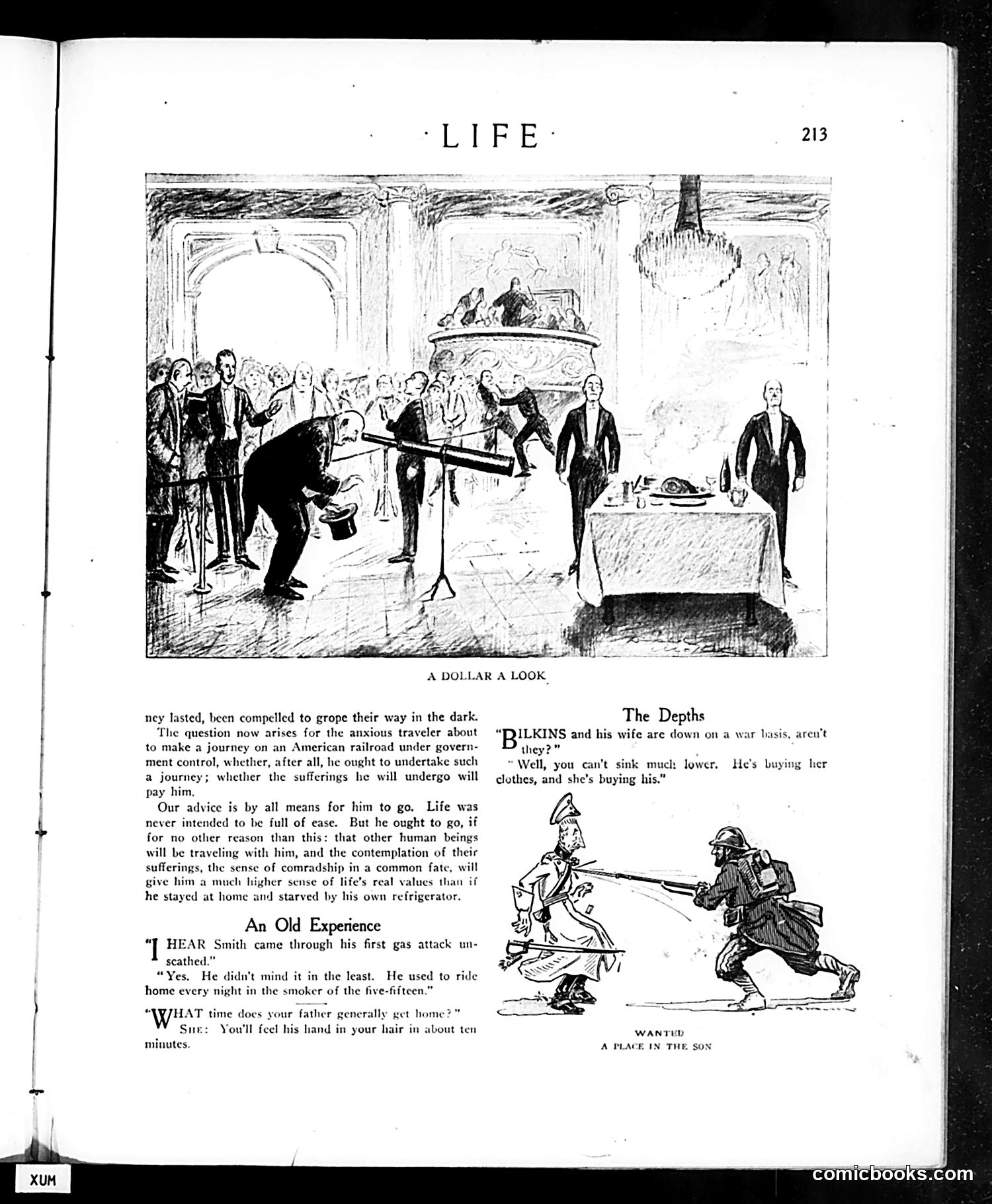
**Top Cartoon: "A Dollar a Look"** This satirizes a carnival or sideshow setup where spectators pay to view something unusual. The scene depicts formal, well-dressed observers gathered to gawk at what appears to be a novelty attraction—likely mocking the public's appetite for sensationalism or voyeurism dressed up as entertainment. **Bottom Cartoon: "A Place in the Sun"** Two soldiers engage in combat. The caption suggests military ambition or competition for position/status, using "a place in the sun" (a phrase meaning desirable position). This likely comments on WWI-era militarism or soldiers' desperation for advancement. **Text Sections:** The prose passages discuss travel concerns and wartime experiences, referencing gas attacks and commute times, contextualizing the cartoons within broader WWI-era anxieties about combat and displacement.
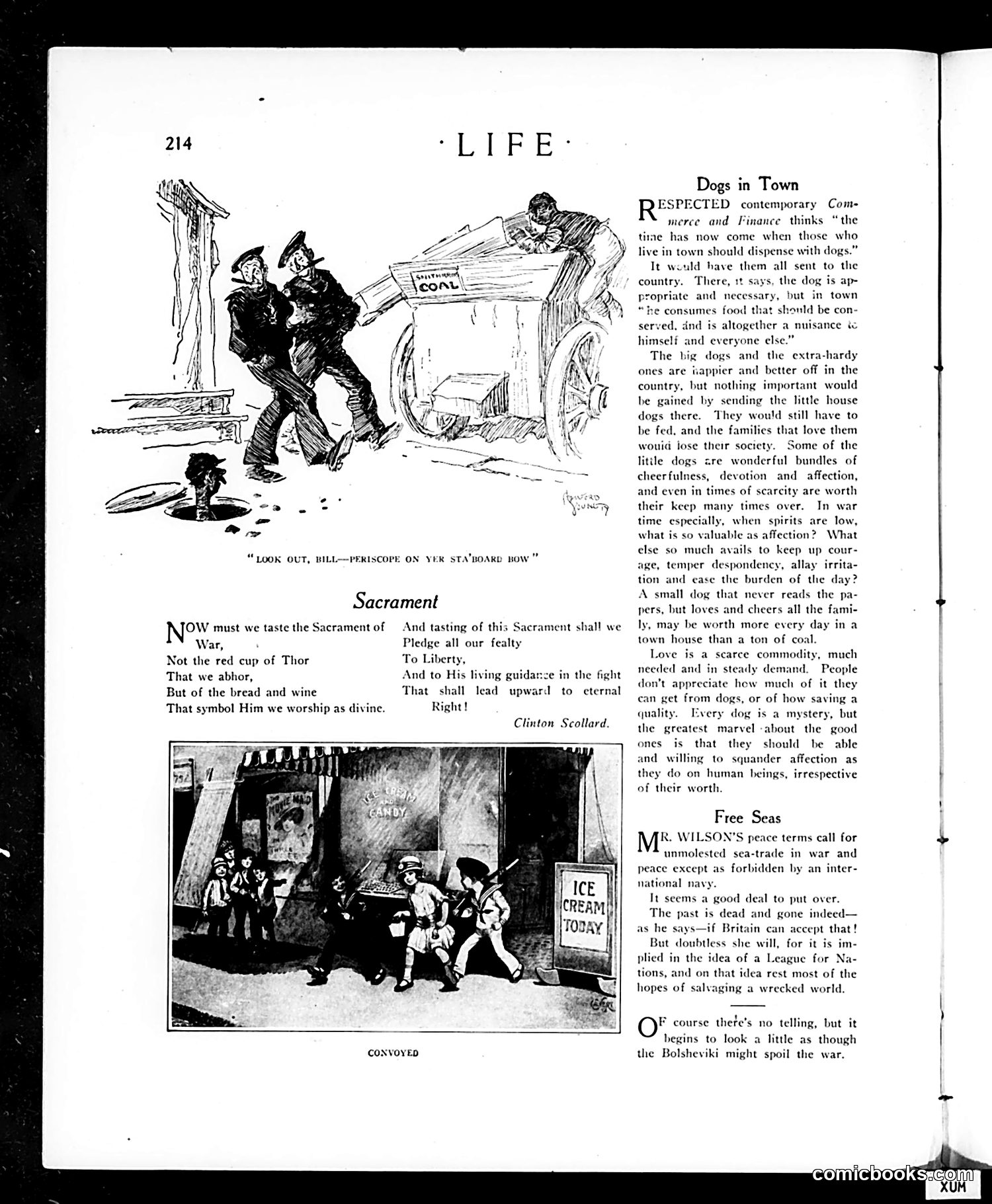
**Top Cartoon ("Look out, Bill—periscope on yer starboard bow"):** Shows two men loading coal onto a cart while a small dog watches. The "periscope" joke references German U-boat submarine warfare during WWI—a contemporary threat. The humor comes from treating the dog as if it were a submarine threat, absurdly comparing a pet to an actual wartime danger. **"Sacrament" Poem:** A patriotic poem by Clinton Scollard about war as a sacred duty, using religious communion imagery to frame military sacrifice as spiritually necessary. **"Dogs in Town" and "Free Seas" sections:** Argumentative essays addressing wartime debates: one defends keeping small dogs in cities as emotionally valuable, the other discusses Wilson's peace terms and League of Nations concepts—both WWI-era concerns.
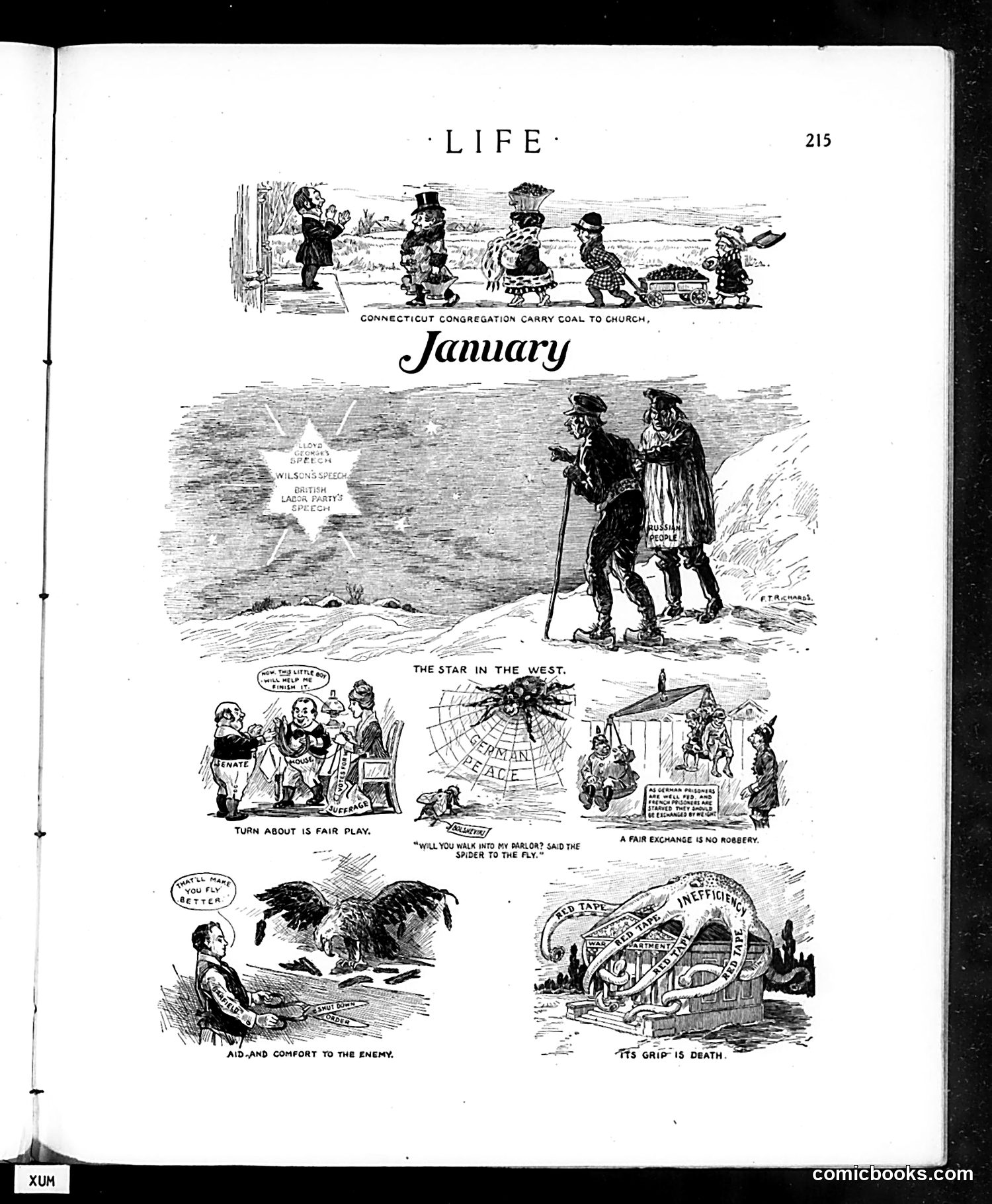
This page presents six January-themed political cartoons. The top cartoon shows a Connecticut congregation carrying coal to church—satirizing cold winters and religious duty. "The Star in the West" depicts two figures following a star, likely referencing the Three Wise Men but applied to American westward expansion or political movement. "Turn About is Fair Play" shows Senate figures, suggesting legislative maneuvering or political reciprocity. "Will You Walk Into My Parlor?" references the spider-and-fly poem, depicting someone (possibly a political figure) as a predator. "A Fair Exchange is No Robbery" and "Aid and Comfort to the Enemy" comment on questionable political dealings. "Its Grip is Death" shows a mechanical trap or device, likely symbolizing a dangerous political or economic threat of the era. The specific political figures and events remain unclear without additional context.
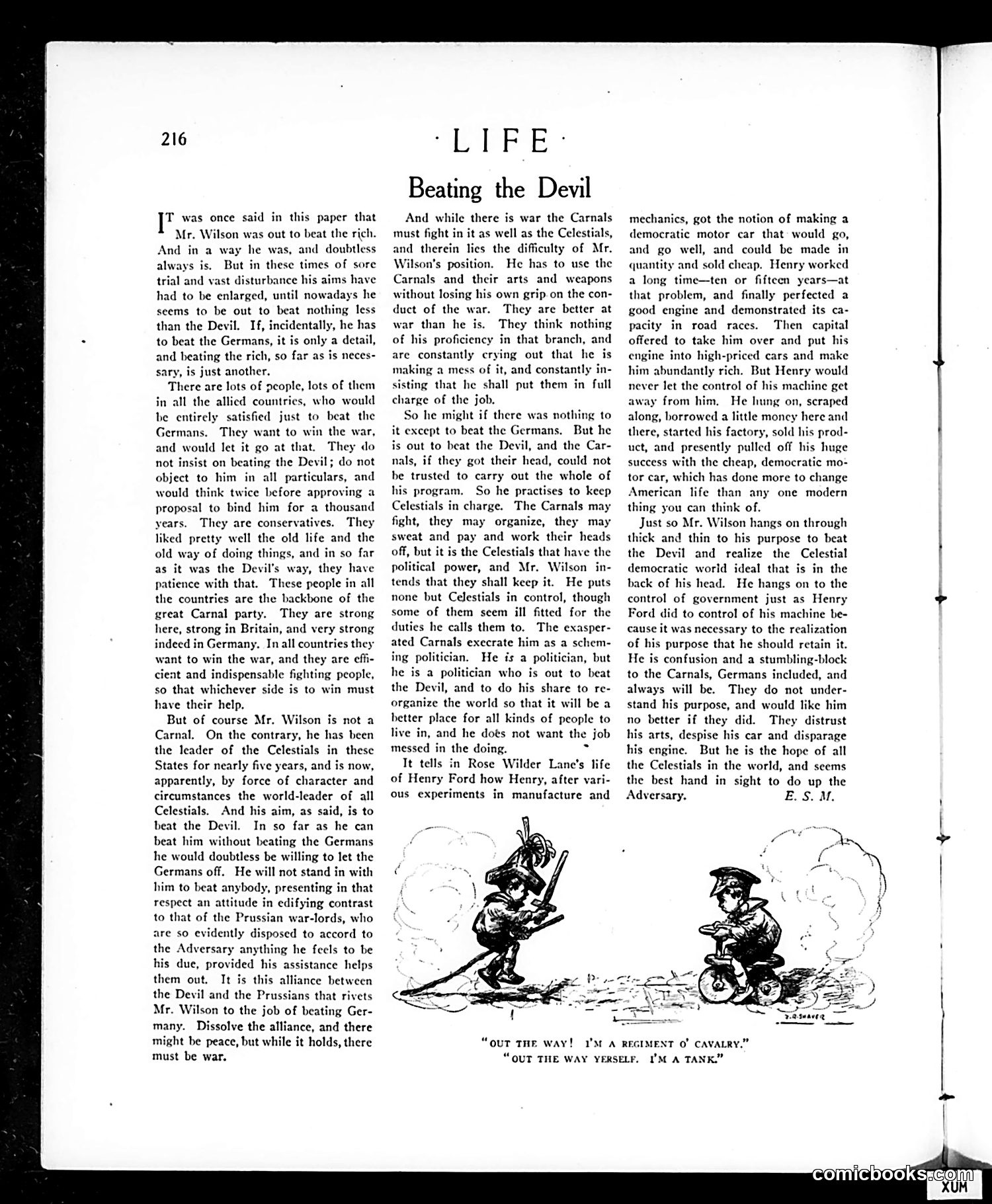
This article defends President Wilson's wartime leadership during World War I, using religious allegory. The text distinguishes between "Carnals" (practical, conservative military/business interests) and "Celestials" (Wilson's idealistic reformers). The cartoon below depicts a military confrontation—likely representing the tension between Wilson's idealistic war aims and military pragmatism. One figure appears to be a soldier or officer declaring allegiance ("I'm a regiment of cavalry"), while another responds differently ("I'm a tank"). **The satire's point:** Wilson insists on maintaining moral/idealistic control of the war effort against Germany (allied with "the Devil") rather than letting traditional military powers dominate strategy. The Carnals want to simply win militarily; Wilson wants to reshape the world order. The cartoon illustrates this friction between different approaches to warfare and post-war reconstruction.
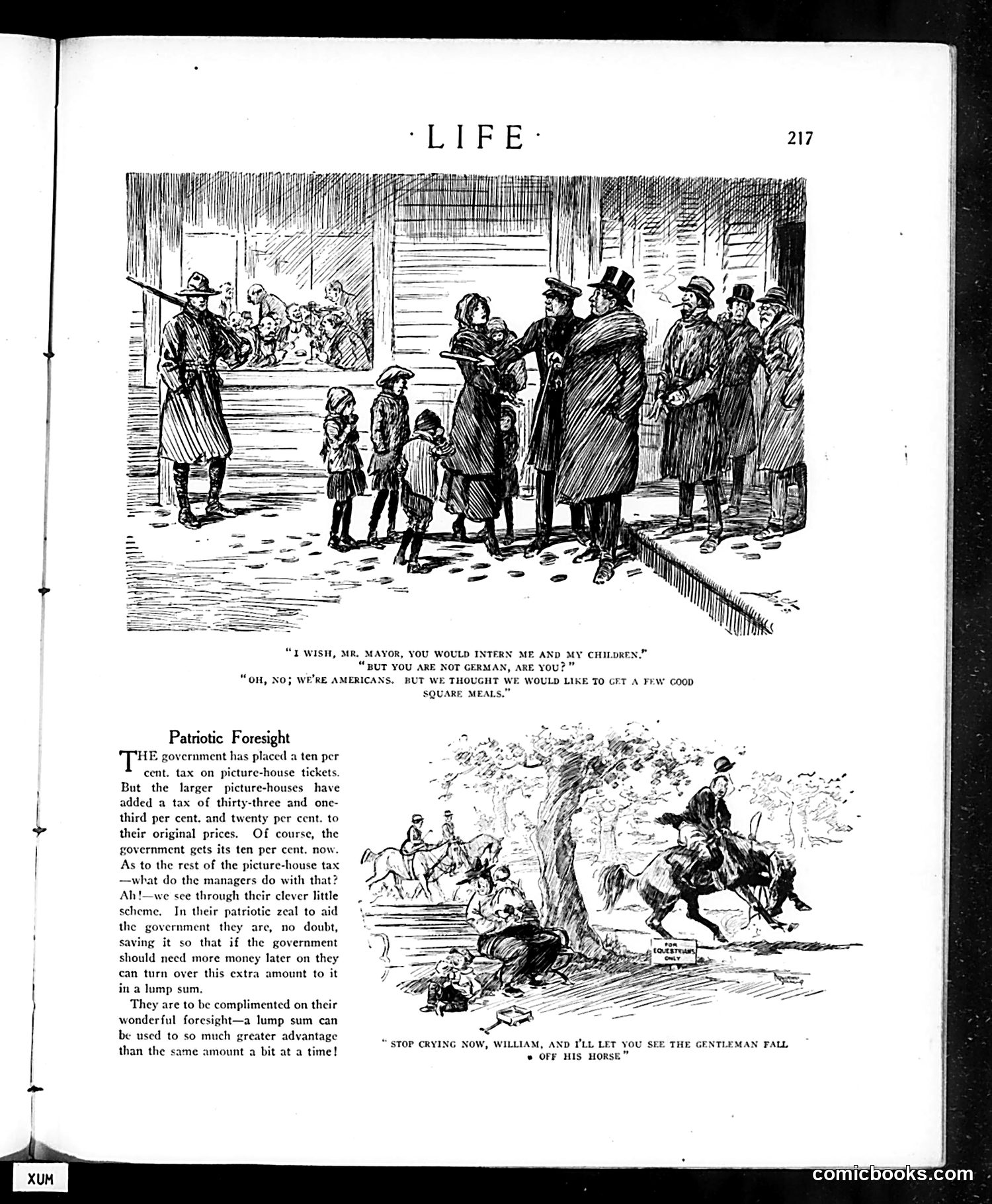
**Top cartoon:** A man (appears to be an immigrant or foreign national) requests the mayor intern him and his children, citing they're not German. The mayor refuses, noting they're American but mentions wanting "good square meals." This satirizes anti-German sentiment during WWI-era America—likely referencing internment of German-Americans or immigrants. The joke appears to be on the desperation of poverty: even facing potential internment seems preferable to hunger. **"Patriotic Foresight" article with bottom cartoon:** This mocks picture-house (cinema) owners' patriotism. The government taxed movie tickets 10%, but theaters added 33% and 20% surcharges, claiming they'd eventually donate excess profits to the government. The satire exposes this as transparent profiteering disguised as patriotism—the owners are clearly pocketing the money, not saving it. The bottom cartoon (man falling from horse) appears illustrative rather than directly connected.
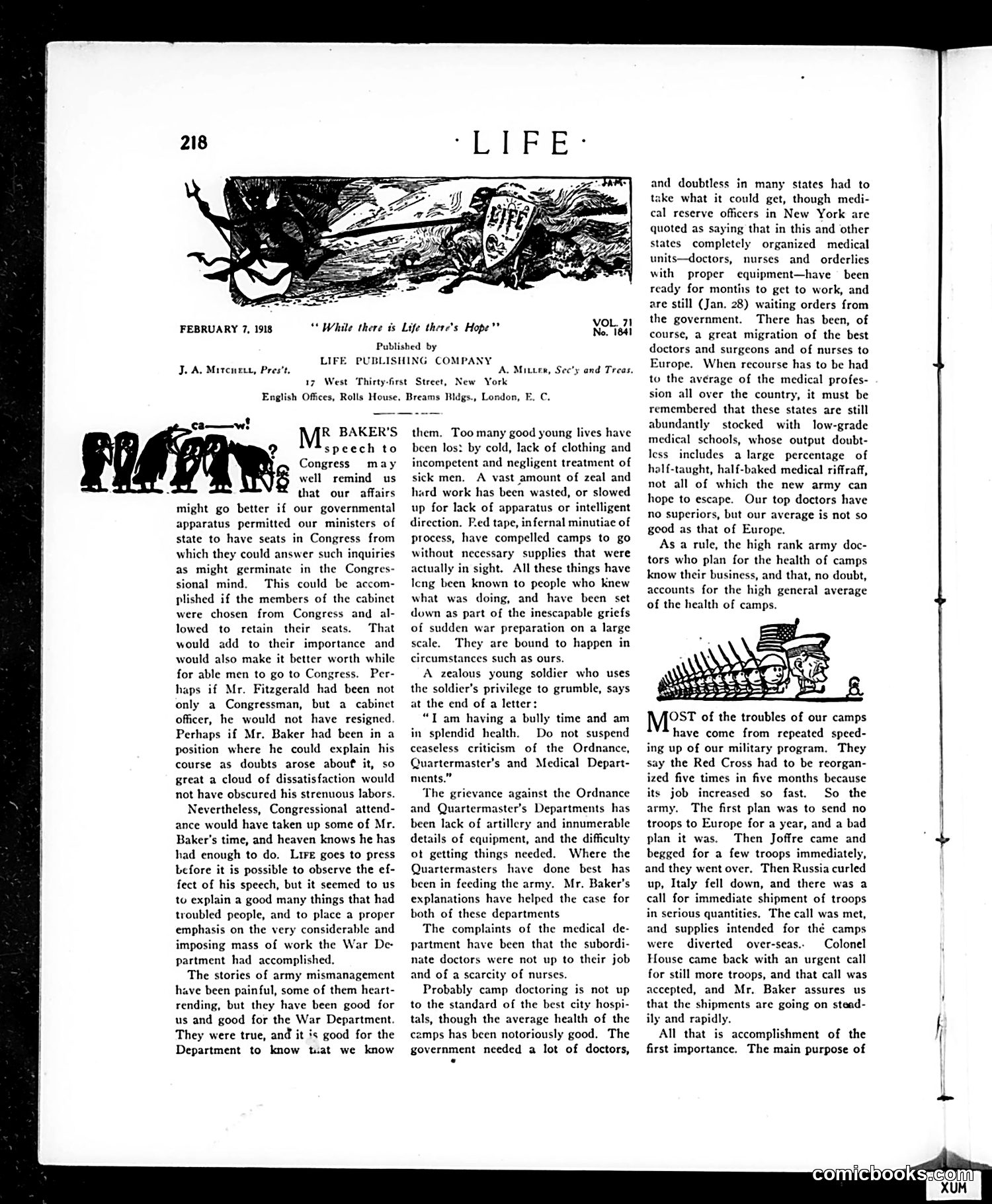
This February 1918 *Life* magazine page discusses Secretary of War Newton D. Baker's Congressional speech defending the War Department's management during America's WWI mobilization. **The Cartoon:** The header image shows a skeletal Death figure driving a military ambulance—a dark commentary on wartime casualties and medical failures. **The Satire's Point:** The article criticizes Army mismanagement while defending Baker. It acknowledges real problems: soldiers died from cold, poor clothing, medical negligence, bureaucratic red tape, and equipment shortages. However, it frames these as inevitable in rapid wartime mobilization rather than Baker's fault. **Key Reference:** The text mentions a soldier's letter saying "Do not suspend ceaseless criticism" of supply departments—illustrating how even soldiers recognized systemic failures while maintaining morale. **The Irony:** *Life* simultaneously blames the failures and absolves Baker, arguing the problems were widespread enough to be unavoidable. This reflects 1918 wartime tensions between holding officials accountable and supporting the war effort.
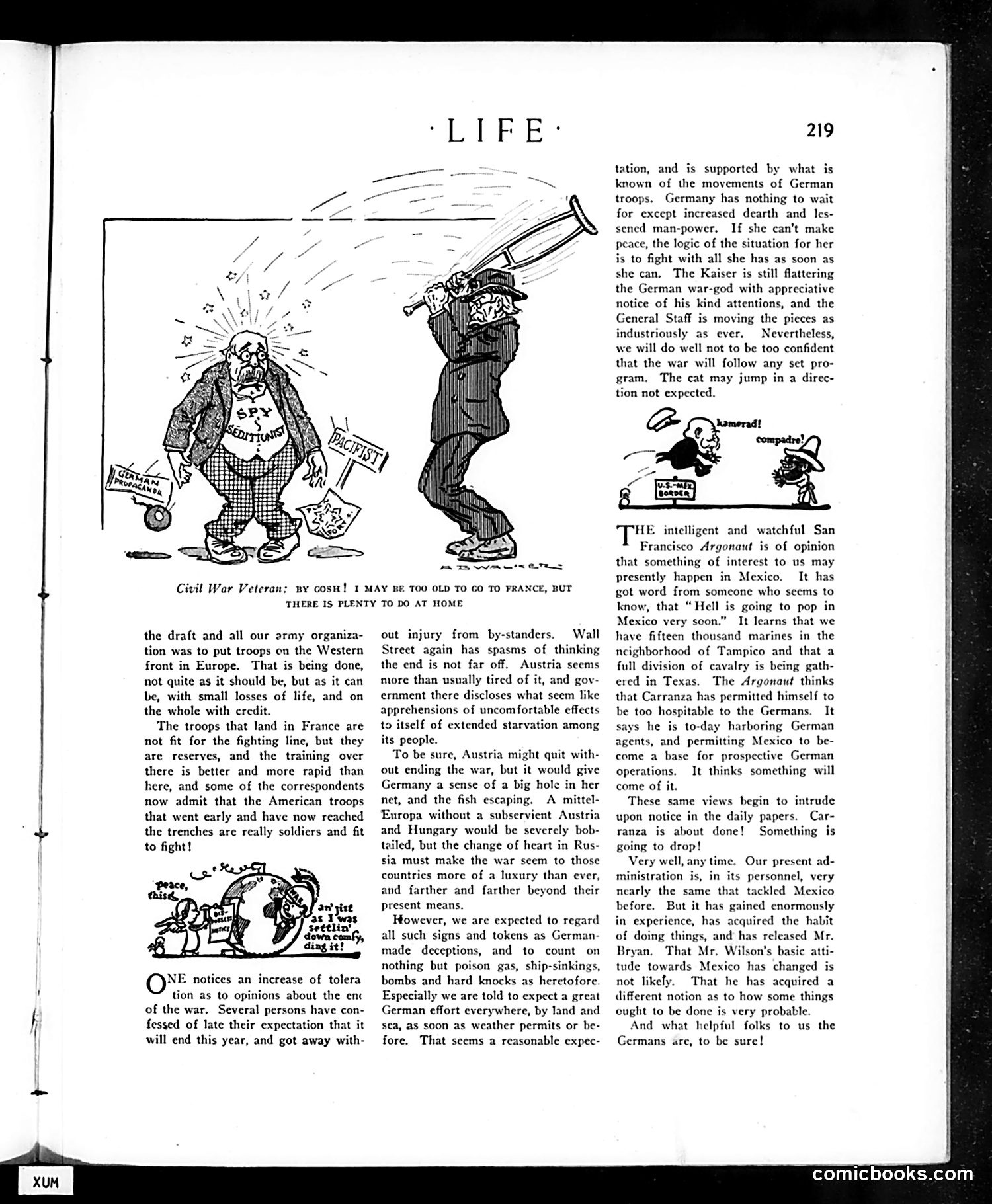
## Main Cartoon The top illustration depicts an elderly Civil War veteran (identifiable by his uniform and weathered appearance) declaring he's too old for France but ready to serve at home. This satirizes debates over military service during World War I—specifically tensions between those advocating overseas deployment versus domestic support roles. ## Context The page discusses American troop deployment to Europe and speculates about war's end. It addresses Austria's apparent exhaustion, German military capability, and—significantly—potential instability in Mexico. The text warns that Mexico may become a German base for operations, mentioning 15,000 Marines near Tampico and cavalry gathering in Texas. ## Satire The cartoon mocks older Americans' patriotic posturing while acknowledging age limitations. It reflects contemporary anxiety about manpower needs and competing visions of how Americans could contribute to the war effort—a debate that remained contentious throughout U.S. involvement in WWI.
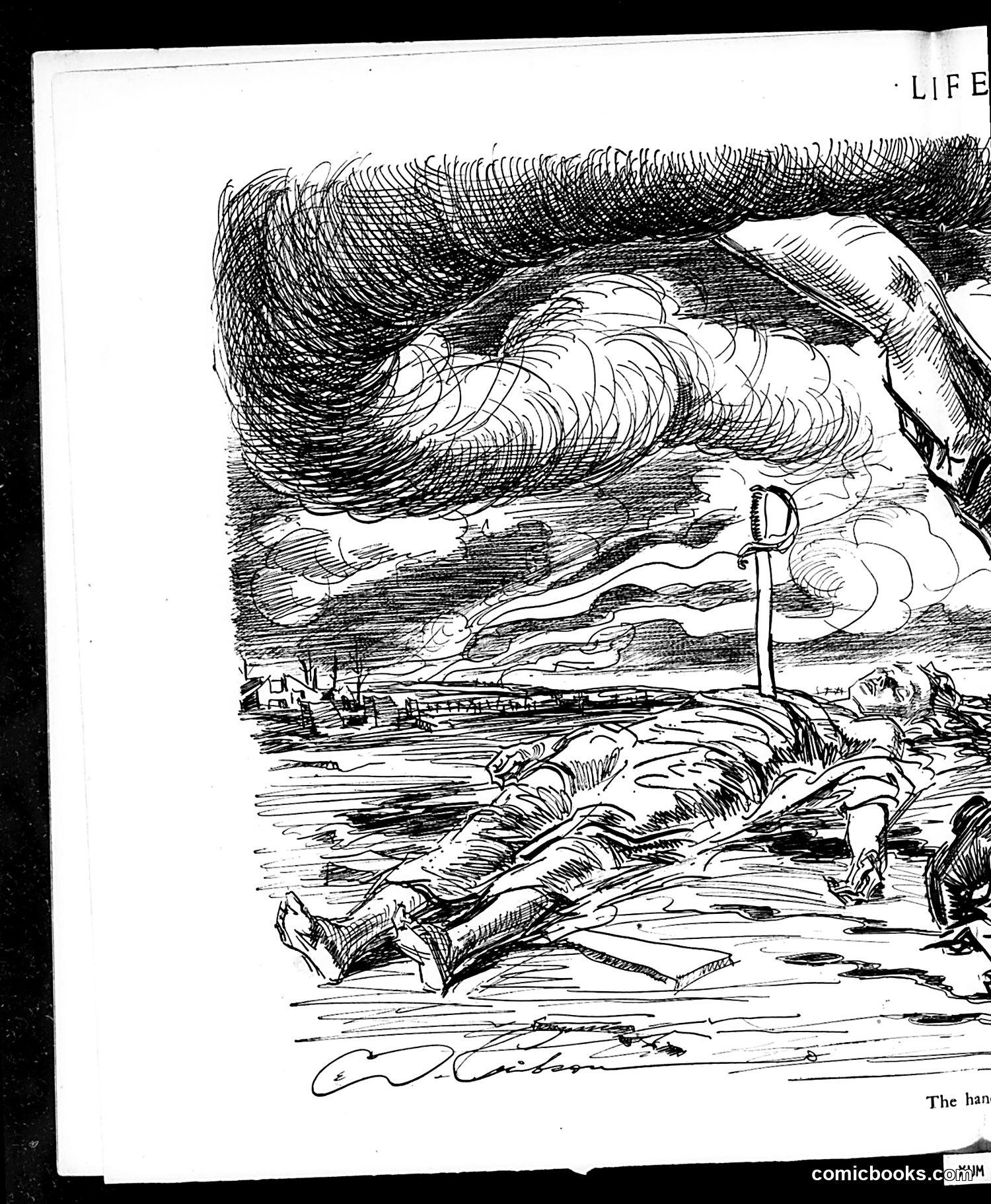
This appears to be a WWI-era illustration from *Life* magazine showing a dramatic wartime scene. The image depicts a soldier lying dead or wounded on the ground in the foreground, with military installations and activity visible in the background—including what appears to be a flag pole and industrial/military structures across a landscape scarred by conflict. The stark, expressionistic line work emphasizes the human cost of warfare. Without visible caption text (the OCR shows only "The han[...]"), the exact satirical message is unclear, but the composition suggests commentary on war's brutality and the sacrifice of individual soldiers. The artist's signature is visible at bottom left.
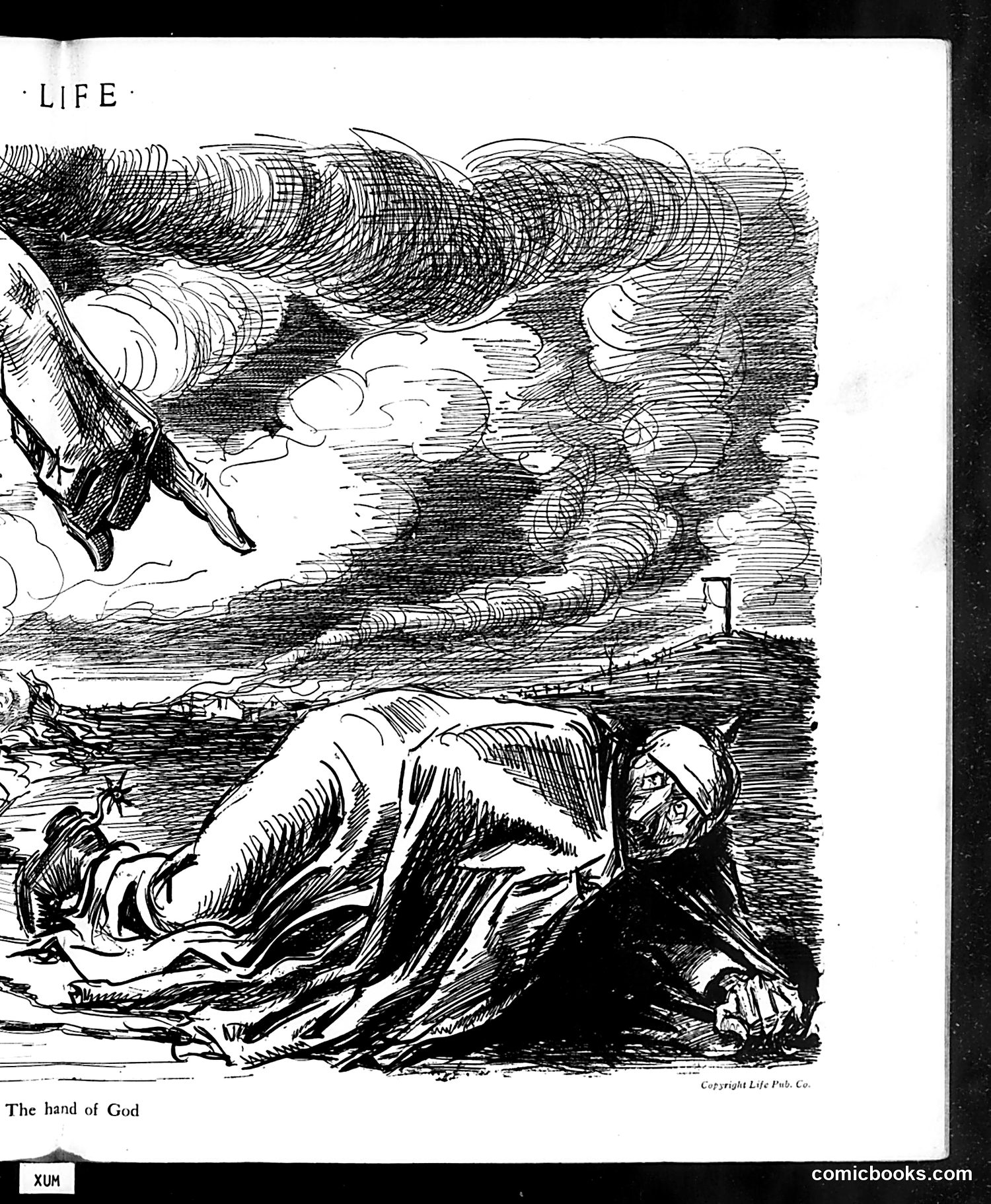
This political cartoon depicts a dramatic scene where a figure lies prone on the ground while a divine hand emerges from storm clouds above, appearing to strike or intervene. The kneeling figure looks upward with apparent distress or supplication. The title "The Hand of God" suggests divine judgment or intervention in human affairs. Without additional context about the publication date, the specific identity of the prone figure remains unclear—it could reference a political leader, military figure, or represent a broader social commentary about divine retribution or moral consequence. The engraving style and composition evoke classical religious imagery, repurposing sacred iconography for satirical political commentary, which was typical of Life magazine's editorial approach during its early satirical period.
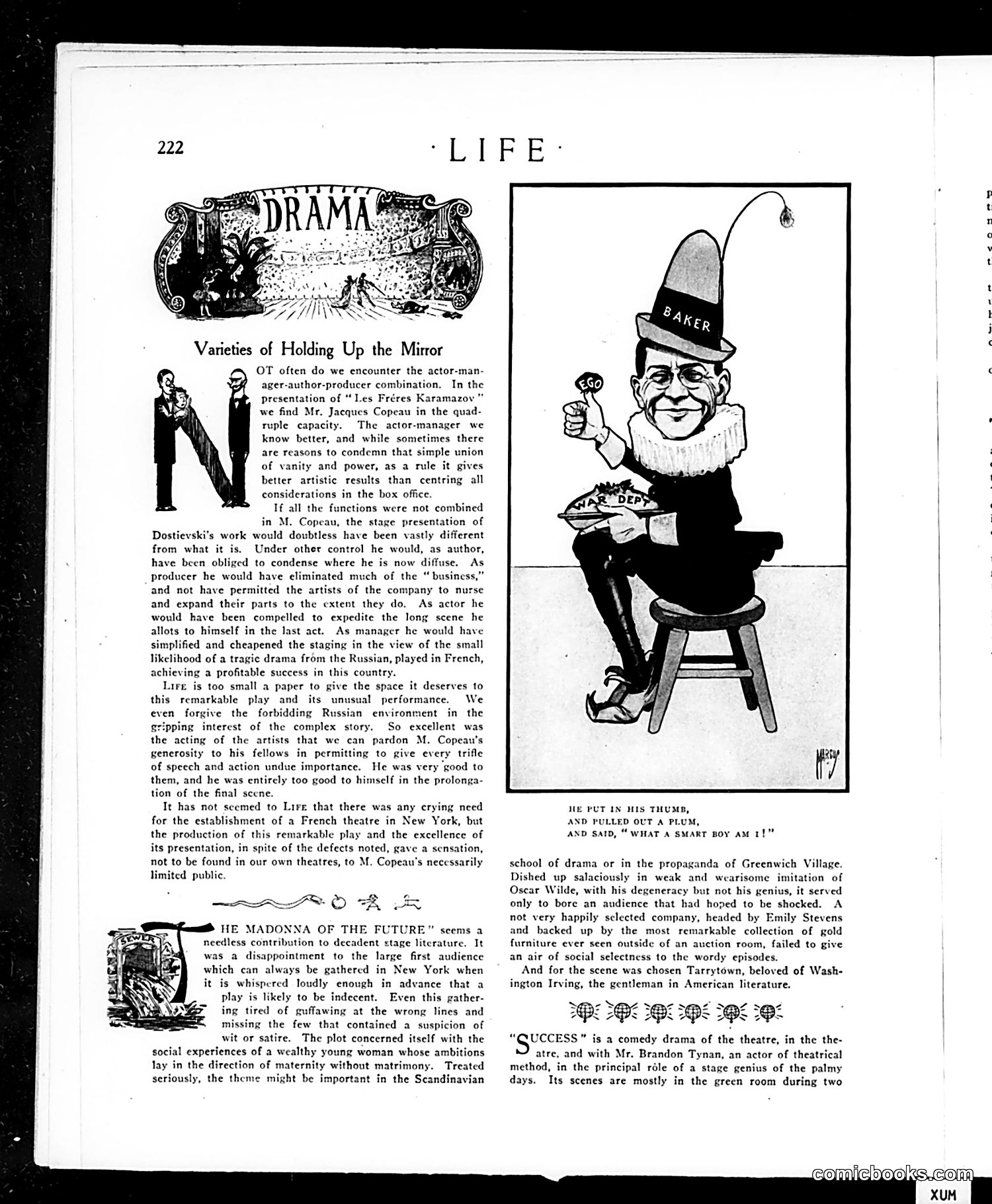
This page reviews theatrical productions, with one prominent cartoon on the right. The cartoon depicts a baker character in a tall hat, sitting contentedly while holding a pie and a thumbs-up gesture labeled "$60." Below reads the nursery rhyme reference: "HE PUT IN HIS THUMB, AND PULLED OUT A PLUM, AND SAID, 'WHAT A SMART BOY AM I!'" **The satire**: This caricature likely mocks a specific baker or food-industry figure of the era who profited handsomely (the $60 figure suggests significant earnings) from wartime conditions or price-gouging—a common complaint during WWI-era America. The nursery rhyme allusion mocks his self-satisfied attitude about his windfall profit, implying he did nothing skillful to deserve it, merely stuck his hand in and extracted wealth. The page's text reviews Jacques Copeau's production of *Les Frères Karamazov* and critiques *The Madonna of the Future*, praising one while condemning the other's shallow imitation of Oscar Wilde.
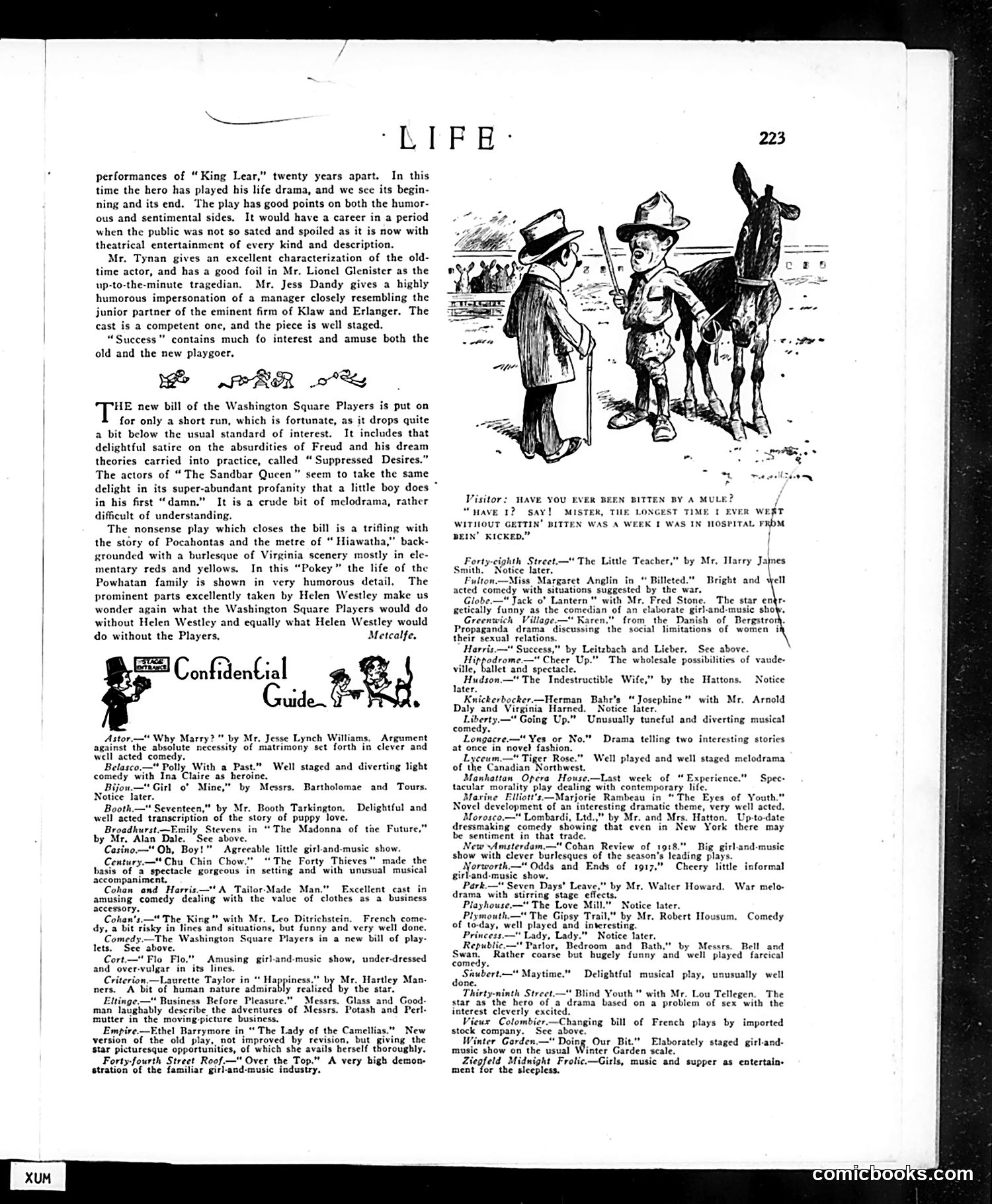
This page contains theater reviews and a single cartoon illustration. The main image shows two men with a mule—one in a cowboy hat, the other in formal dress—with a caption about a mule bite. This appears to be a humorous illustration accompanying reviews of Washington Square Players productions, likely satirizing the contrast between rural/comic and urban/sophisticated theatrical traditions. The page primarily reviews current Broadway productions ("King Lear," "Why Marry?", "Chu Chin Chow," etc.). A notable review discusses the Washington Square Players' bill, which includes satire on Freudian psychology ("Suppressed Desires")—referencing the then-popular but often-mocked psychoanalytic theories. The reviews praise actress Helen Westley repeatedly. The theatrical listings suggest this is from the 1910s, when elaborate musical spectacles and light comedies dominated Broadway alongside classical revivals.
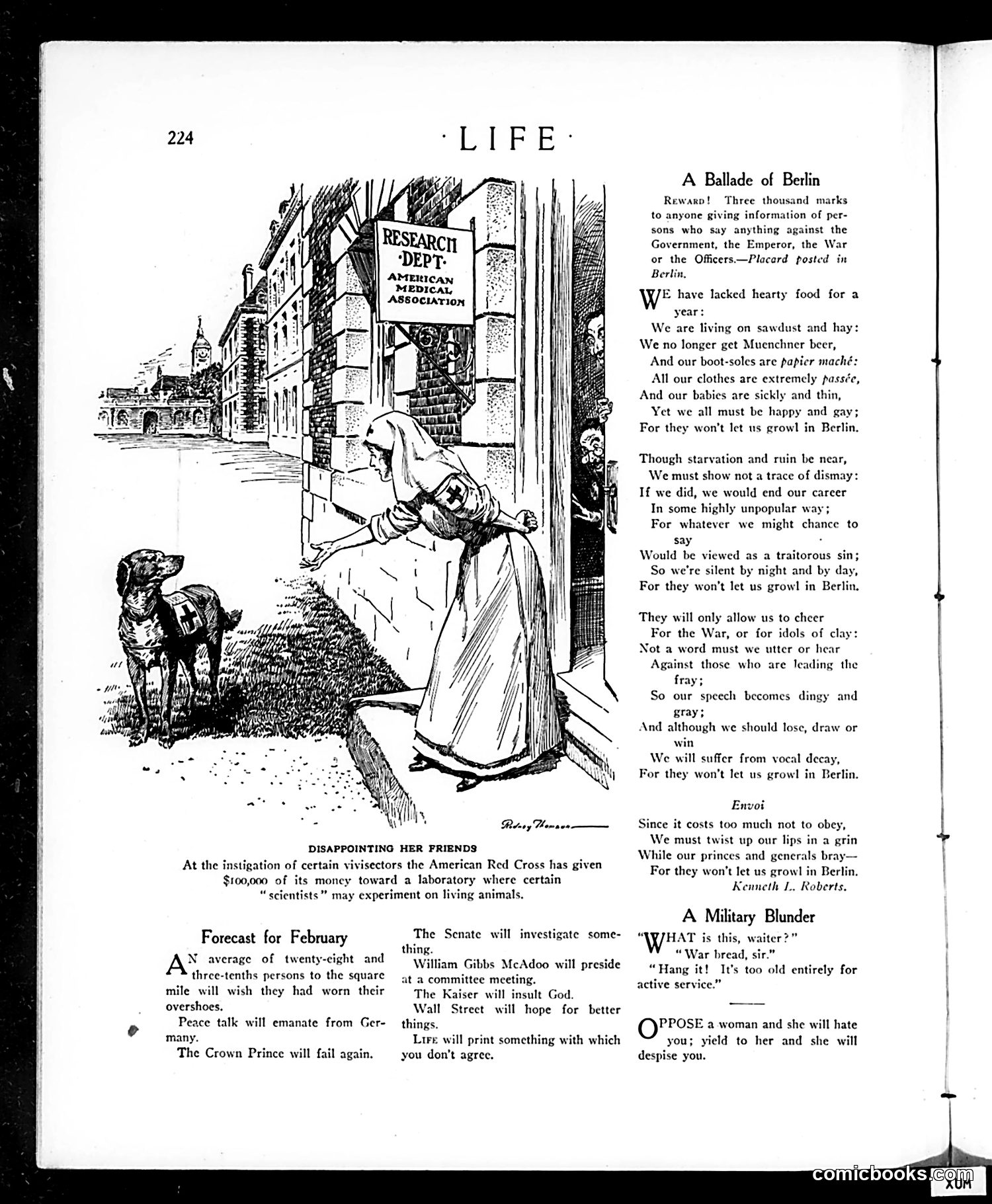
This page contains American political satire from World War I, mocking Germany's situation and policies. **"Disappointing Her Friends"** (left cartoon): Criticizes the American Red Cross for donating $100,000 to fund animal experimentation by scientists, depicting this as a betrayal of humanitarian principles. **"Forecast for February"**: Satirical predictions about post-war conditions, including peace talks from Germany and the Kaiser "insulting God"—mocking German leadership's hubris. **"A Ballade of Berlin"** (main poem): A biting critique of German civilian oppression during WWI. It describes starvation, poor conditions, and a reward for informants reporting disloyalty—reflecting actual German censorship laws. The refrain "they won't let us growl in Berlin" emphasizes suppression of free speech. Civilians must appear happy despite suffering, or face accusations of treason. **"A Military Blunder"**: A joke where a waiter serves old "war bread" too deteriorated for active service—mocking Germany's food shortages and poor provisions. The page overall satirizes German wartime hardship, authoritarian control, and military failure.
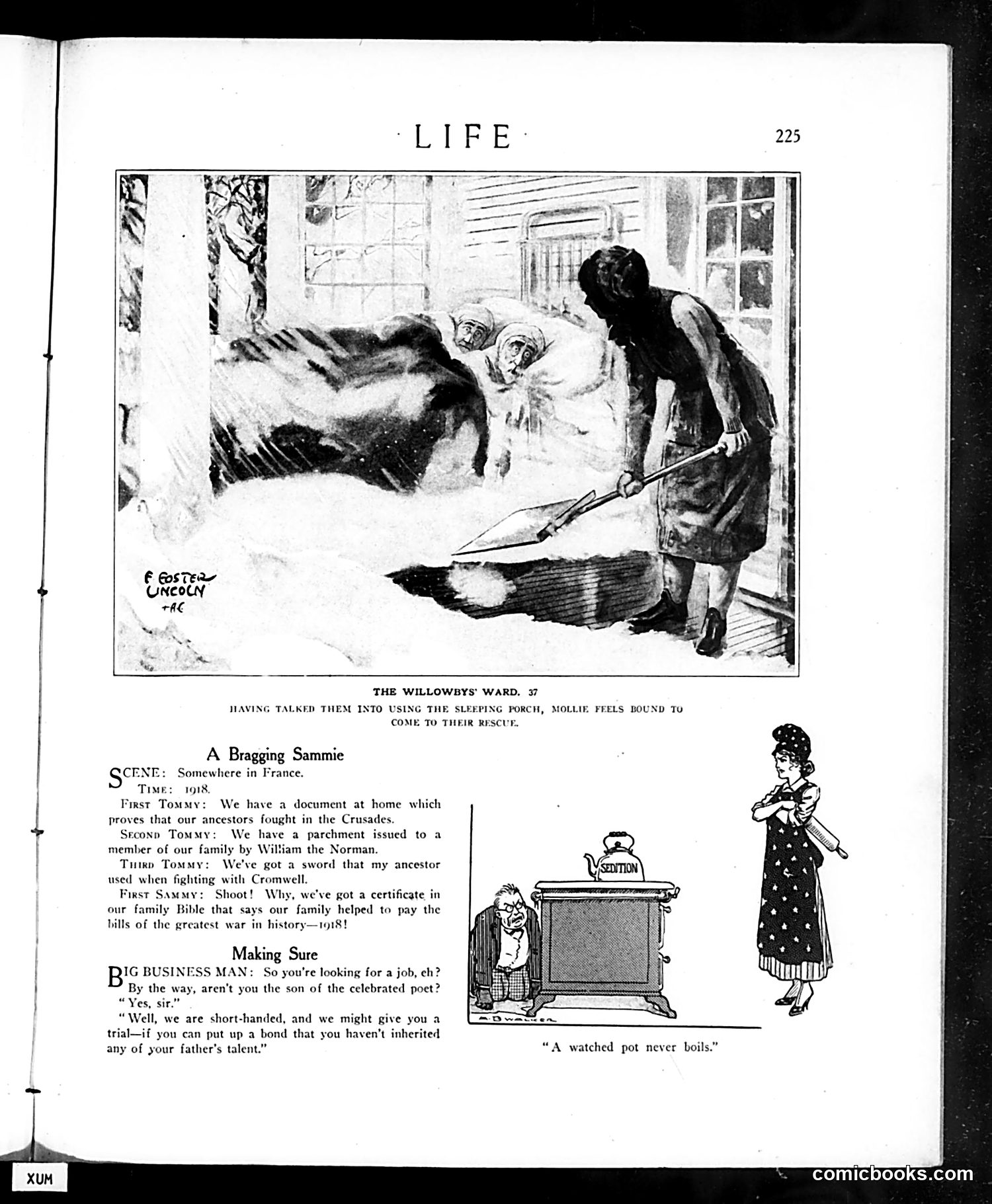
This 1918 page from *Life* contains three separate satirical pieces: **"The Willowbys' Ward"** (top): A domestic comedy strip showing a woman rescuing people from a sleeping porch, likely poking fun at the era's health fad of outdoor sleeping. **"A Bragging Sammie"** (middle): Set in France during WWI, this mocks American soldiers ("Sammie" was slang for American GIs). British soldiers boast of ancestral military pedigree, while an American brags that his family merely *paid* war bills—satirizing Americans' perceived newness and lack of old-world heritage, while implying American wealth financed the war effort. **"Making Sure"** (bottom): An employer interviews a job applicant who claims to be a poet's son. The employer agrees to hire him only if he can prove he hasn't "inherited any of your father's talent"—mocking the notion that mediocrity runs in families and suggesting poets are professionally useless. The "watched pot" proverb appears unconnected to surrounding content.
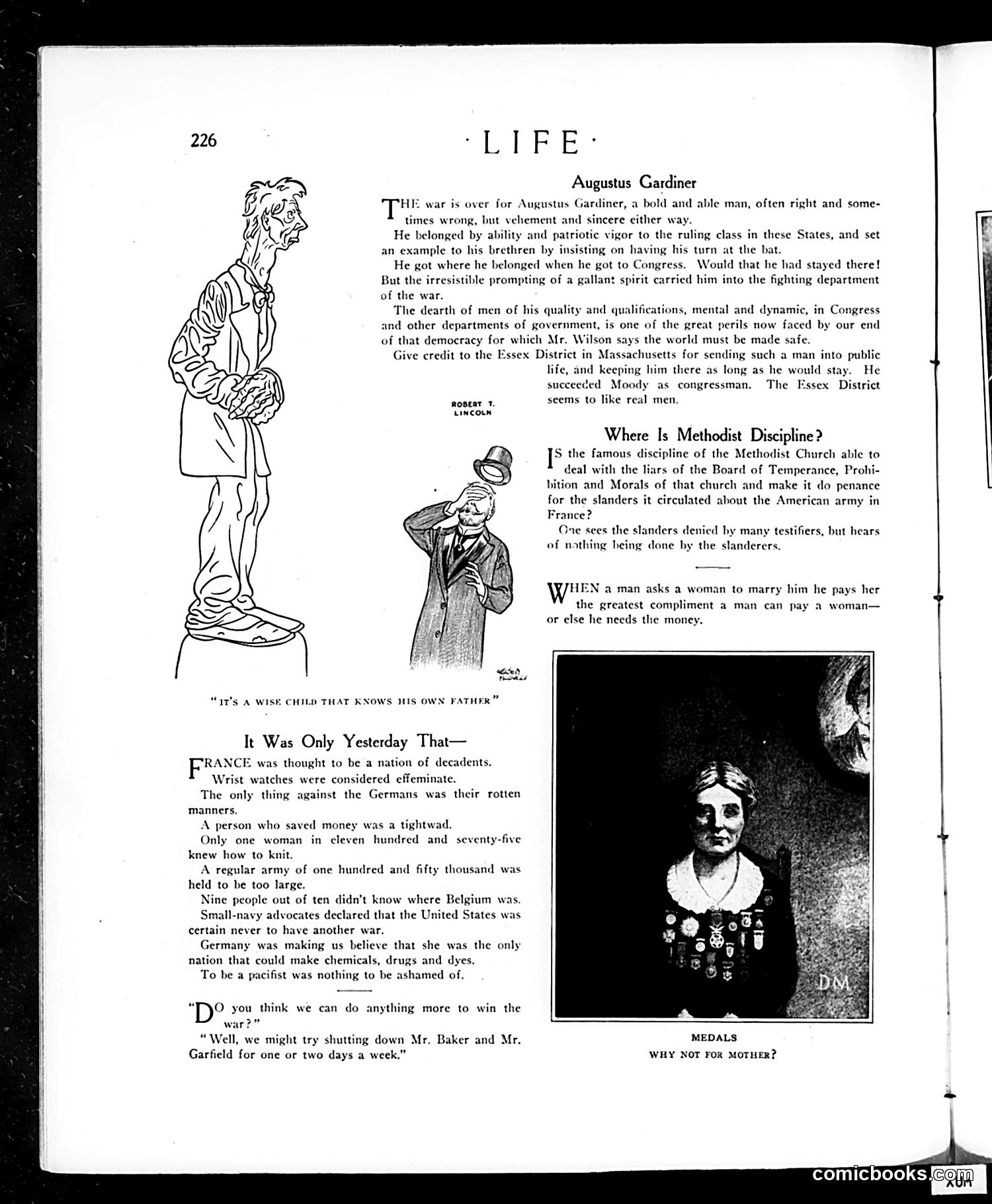
This WWI-era Life page contains satire about American unpreparedness and social attitudes. **Top section ("It Was Only Yesterday That")**: Mocks pre-war American complacency—France was thought decadent, Germans superior in chemistry, pacifism acceptable, the Navy too small. The joke: America believed these things *yesterday*, exposing embarrassing naïveté now that war has arrived. **Augustus Gardiner piece**: Praises a congressman from Essex District, Massachusetts who left Congress to serve in the military—contrasting his patriotic sacrifice against the broader shortage of qualified men in government during wartime. **"Methodist Discipline" section**: Criticizes the Methodist Church's Board of Temperance and Prohibition for spreading false "slanders" about American troops in France. The satire questions whether church discipline will punish these accusers—implying it won't. **"Medals—Why Not for Mother?" photo**: Shows a woman with military medals, sarcastically questioning why mothers aren't decorated for their sacrifices during war. Overall, the page critiques American institutional failures and hypocrisy during WWI mobilization.
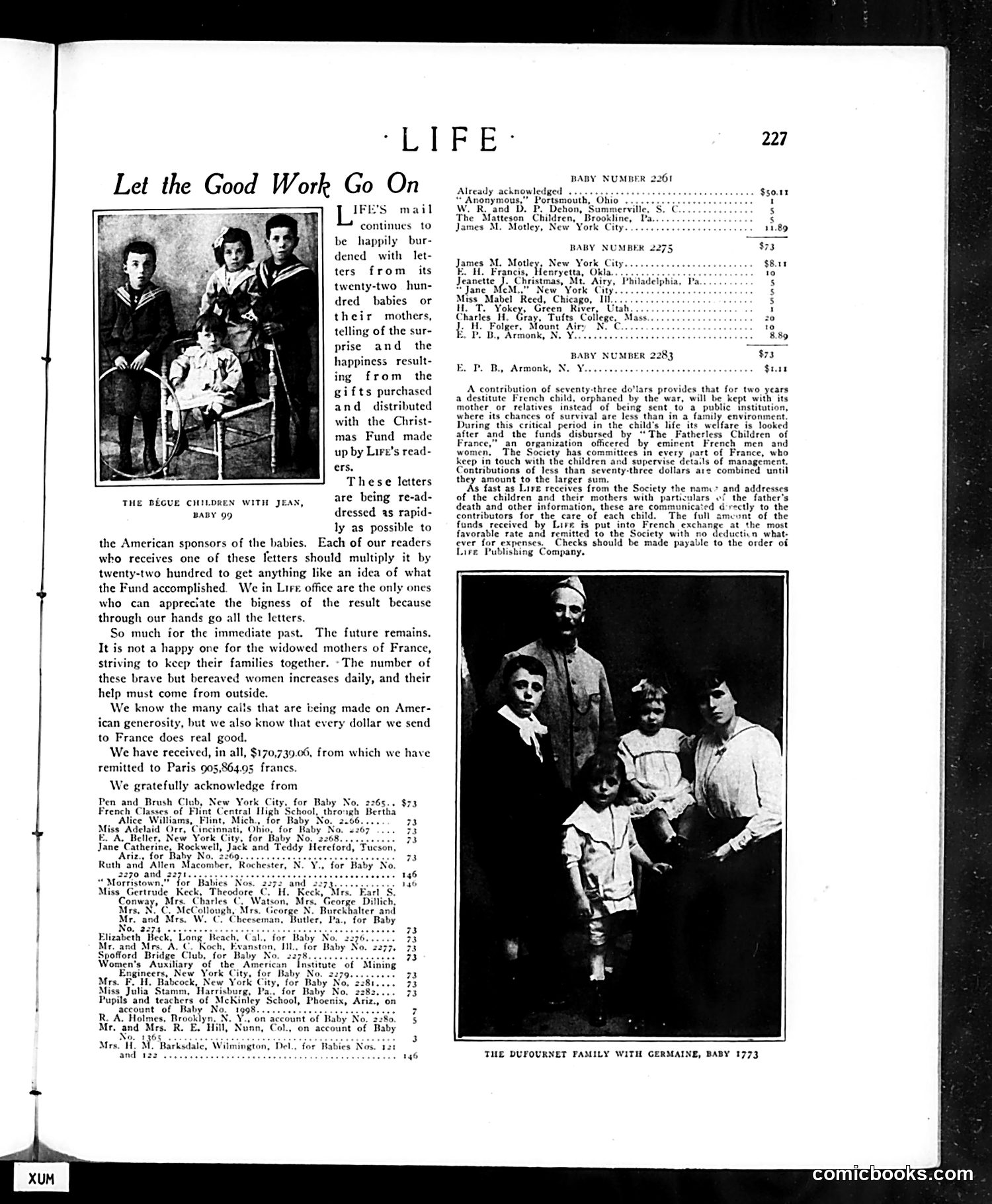
This page documents Life magazine's charitable Christmas Fund supporting war orphans in France following World War I. The main content is not a political cartoon but rather a fundraising appeal with photographs and donor acknowledgments. The page shows two images: "The Begue Children with Jean, Baby 99" and "The Dufournet Family with Germaine, Baby 1273"—French families receiving aid. The text explains that Life readers sponsor French orphans, with contributions funding their care with relatives rather than in institutions. The appeal emphasizes American generosity's impact: readers who donated should multiply their contribution by 2,200 to understand the Fund's total accomplishment. Life reports collecting $170,739.06 and remitting nearly 904,000 francs to Paris. The page lists donors—schools, clubs, and individuals—demonstrating broad American support for post-war French humanitarian relief. This reflects the significant charitable focus on European reconstruction in the 1920s following WWI's devastation.
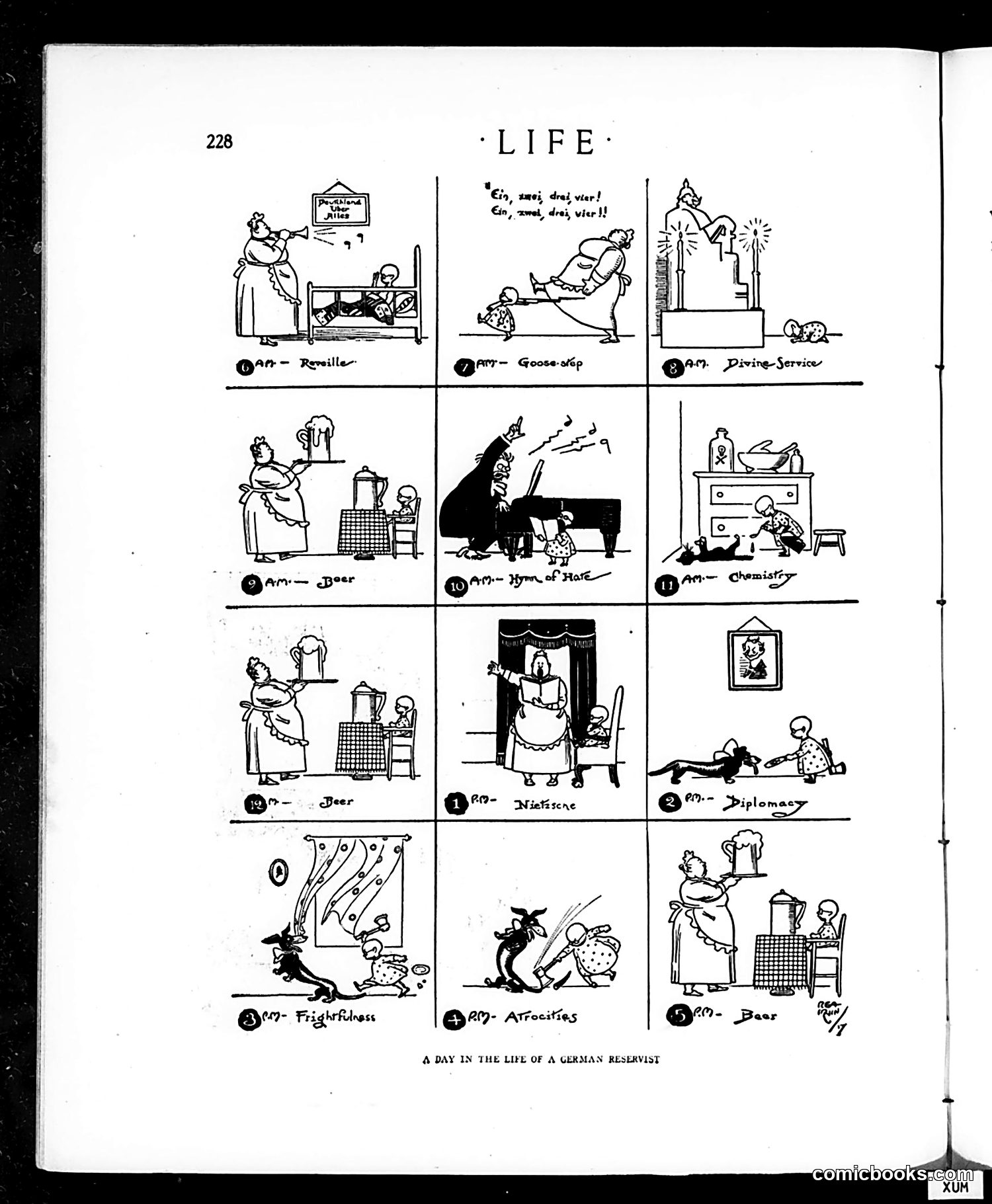
This is a satirical comic strip titled "A Day in the Life of a German Reservist," likely from World War I era. It depicts a German military reservist's daily routine through 15 numbered panels showing various domestic and military activities. The title's German counting ("Ein, zwei, drei, vier") emphasizes the subject's German identity. The strip satirizes German militarism by portraying how military discipline and warlike behavior supposedly permeate everyday civilian life—from breakfast preparations to child-rearing to interactions with pets and family. Panels labeled "Frightfulness" and "Atrocities" suggest the cartoon is mocking German military practices by depicting them as extending into ordinary home life, reflecting American wartime propaganda characterizing German culture as inherently aggressive and brutal. The humor derives from exaggerating supposed German militaristic values infiltrating domestic scenes.
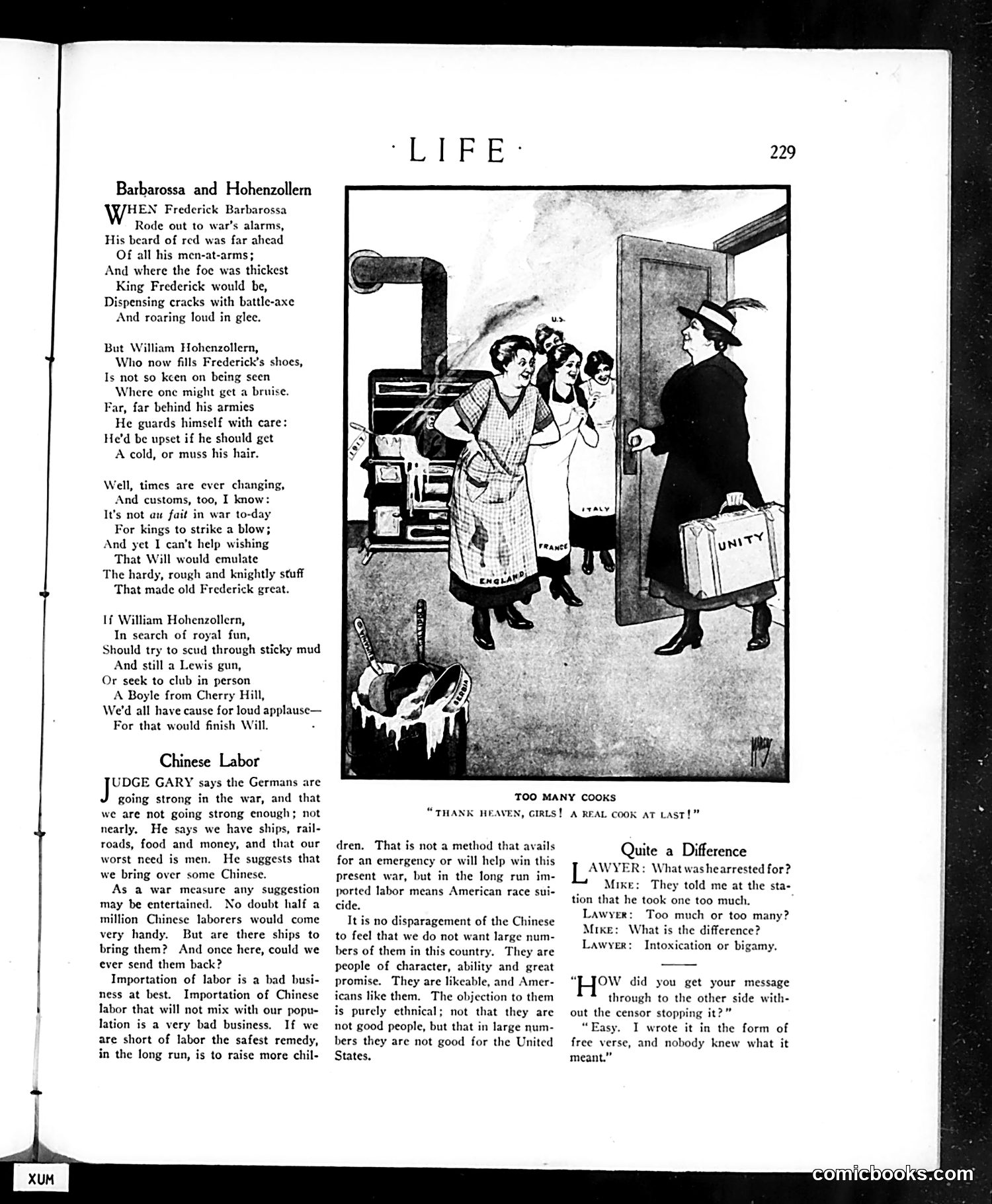
**"Barbarossa and Hohenzollern"** compares medieval German King Frederick Barbarossa (depicted as bold and battle-ready) with Kaiser Wilhelm II (current German ruler during WWI). The satire mocks Wilhelm for staying safely behind lines, avoiding danger like colds or mussed hair, unlike his legendary predecessor. This reflects contemporary criticism of WWI military leadership. **"Too Many Cooks"** cartoon shows women (likely representing Allied nations—labeled "France," "England," "Italy," and "Unity") celebrating finding a "real cook," satirizing hope that unified leadership will improve the war effort. **"Chinese Labor"** section discusses importing Chinese workers to address American labor shortages during WWI, but argues against it due to "race suicide"—reflecting 1910s xenophobic concerns about ethnic mixing and demographic change. The lighter jokes about "free verse" and "bigamy" provide comic relief unrelated to war content.
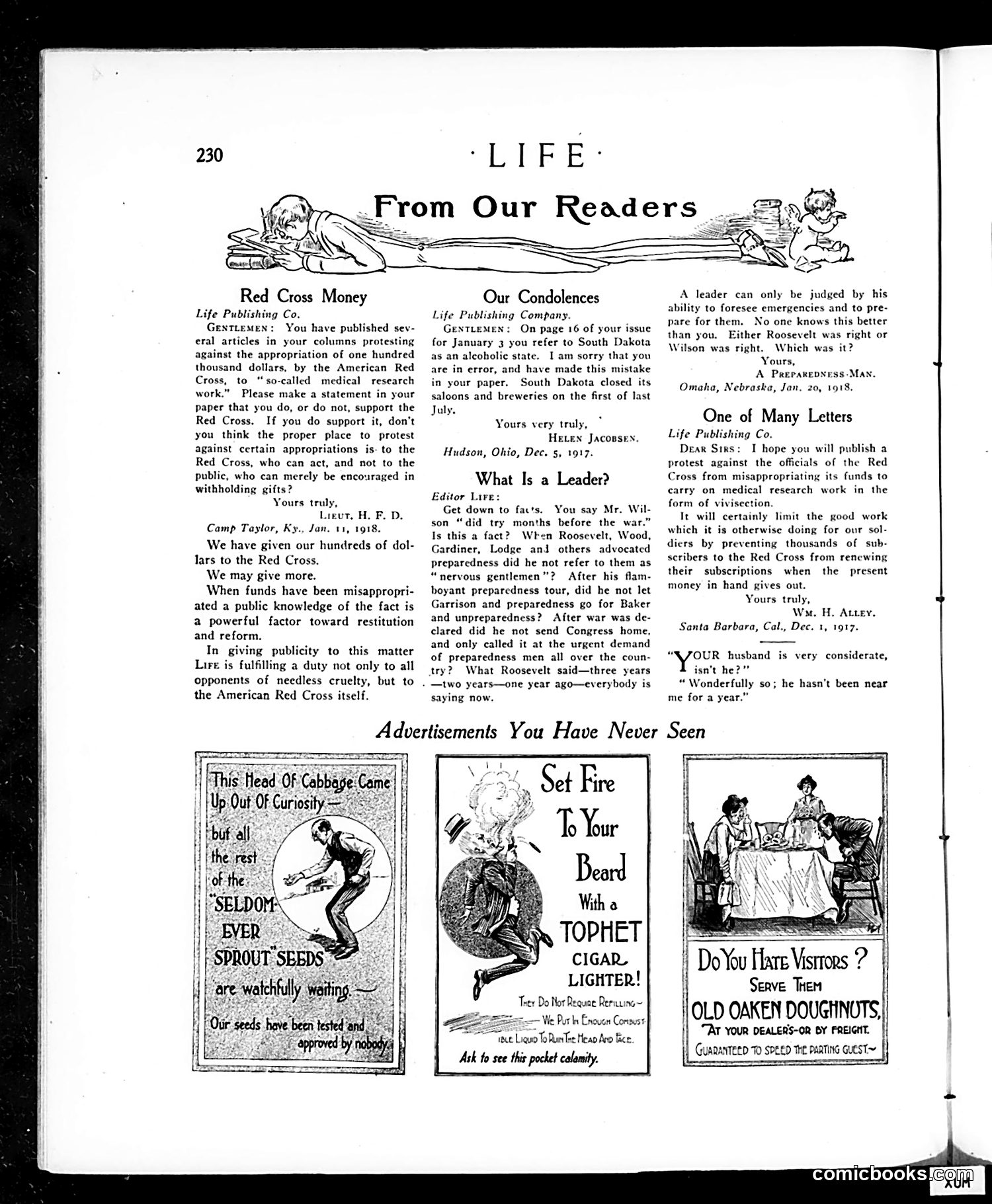
This page features readers' letters to *Life* magazine addressing three serious WWI-era issues: **Red Cross Controversy**: A correspondent defends the Red Cross's medical research funding; *Life's* editors counter that publicizing misappropriation serves reform. This reflects contemporary debates over vivisection (animal testing) in medical research. **Wilson vs. Preparedness**: A letter criticizes President Wilson for underestimating military preparedness before US entry into WWI (April 1917), contrasting his caution with Theodore Roosevelt's earlier warnings. The writer questions Wilson's leadership foresight. **South Dakota Correction**: A reader corrects *Life's* error about South Dakota's alcohol status, reflecting Prohibition's progression (the state went dry in July 1917, before national Prohibition in 1920). The advertisements below are period curiosities: seed packets, novelty cigar lighters, and doughnut promotions—typical early 20th-century marketing. The page reflects serious wartime concerns mixed with editorial corrections and nostalgic period advertising.
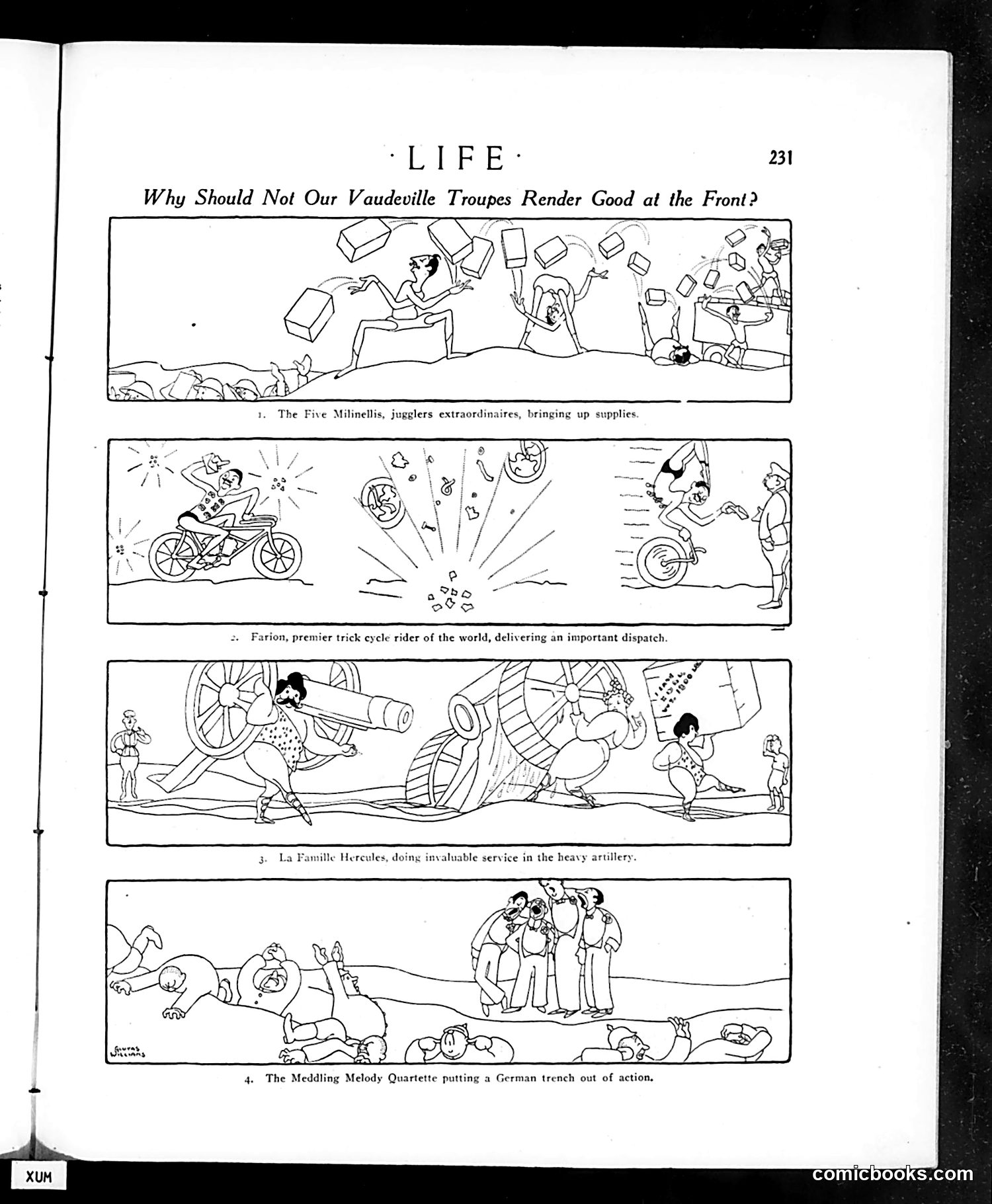
This is a satirical cartoon from Life magazine mocking the idea that American vaudeville performers could contribute meaningfully to World War I. The page's title asks sarcastically: "Why Should Not Our Vaudeville Troupes Render Good at the Front?" The four panels depict absurd scenarios where entertainers (jugglers, a trick cyclist, acrobats, and a singing quartet) supposedly aid the war effort. Panel 4 shows "The Meddling Melody Quartette putting a German trench out of action"—implying their singing could disable enemy forces. The satire critiques both the impracticality of entertainers in combat and likely the war enthusiasm of the era. The cartoonist is mocking the notion that vaudeville acts had any legitimate military value, while simultaneously commenting on Americans' sometimes naive optimism about WWI contribution.
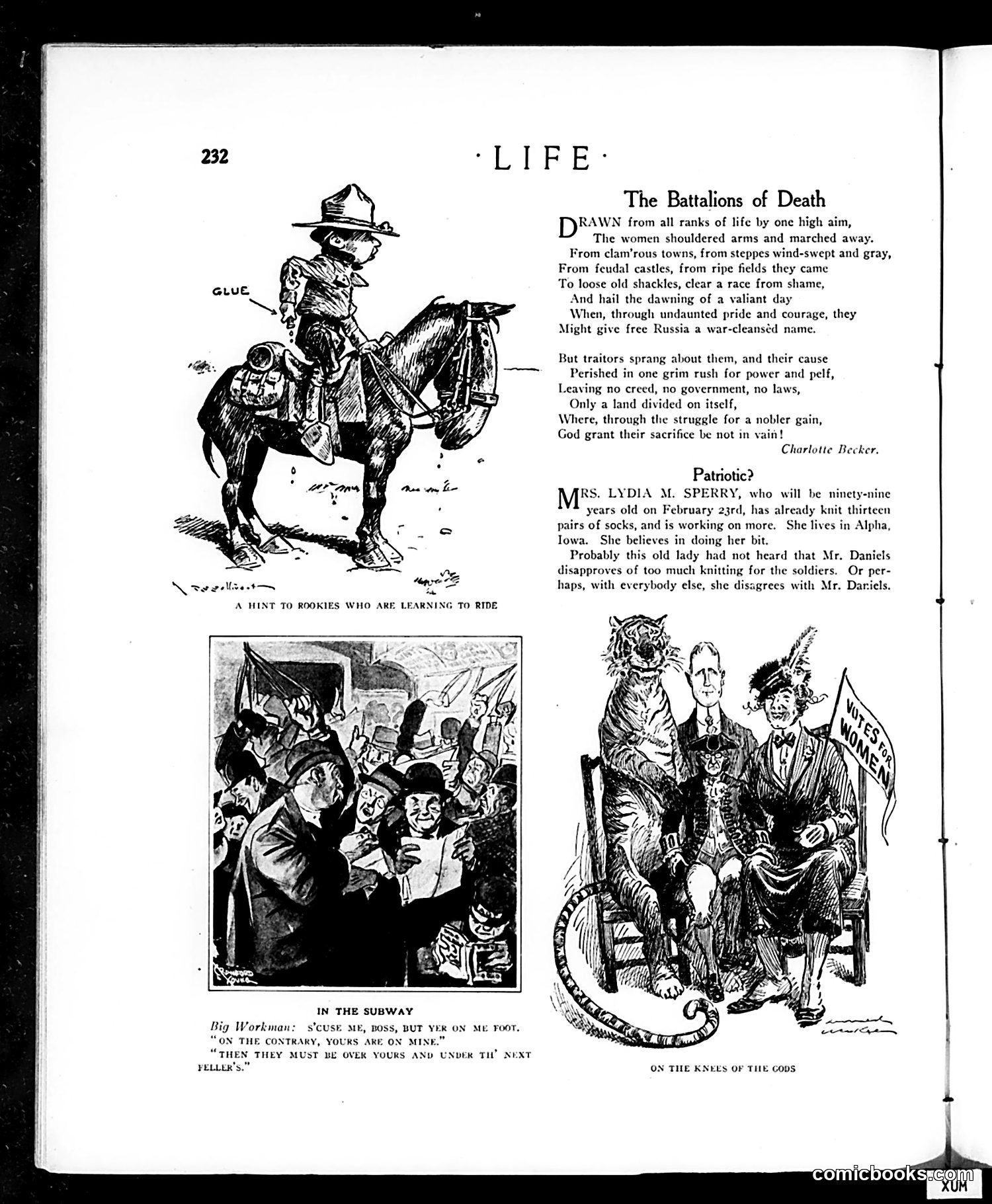
This Life magazine page satirizes WWI-era American attitudes. The top cartoon shows a mounted soldier instructing rookies—typical military recruitment humor. The centerpiece is a poem "Battalions of Death" about Russian women soldiers who fought in WWI, celebrating their patriotism while lamenting that their sacrifice was squandered by traitors pursuing "power and pelf" (wealth)—likely referencing the Russian Revolution's chaos and the Bolshevik seizure of power. The "Patriotic?" section mocks the government's inconsistent messaging: Secretary of the Navy Daniels apparently discouraged knitting socks for soldiers, yet 99-year-old Mrs. Sperry knits anyway. The satire suggests bureaucratic absurdity—the government simultaneously wants civilian support for troops while micromanaging that support. The bottom cartoon's caption about "knees of the gods" remains unclear without fuller context, but appears political commentary on wartime governance.
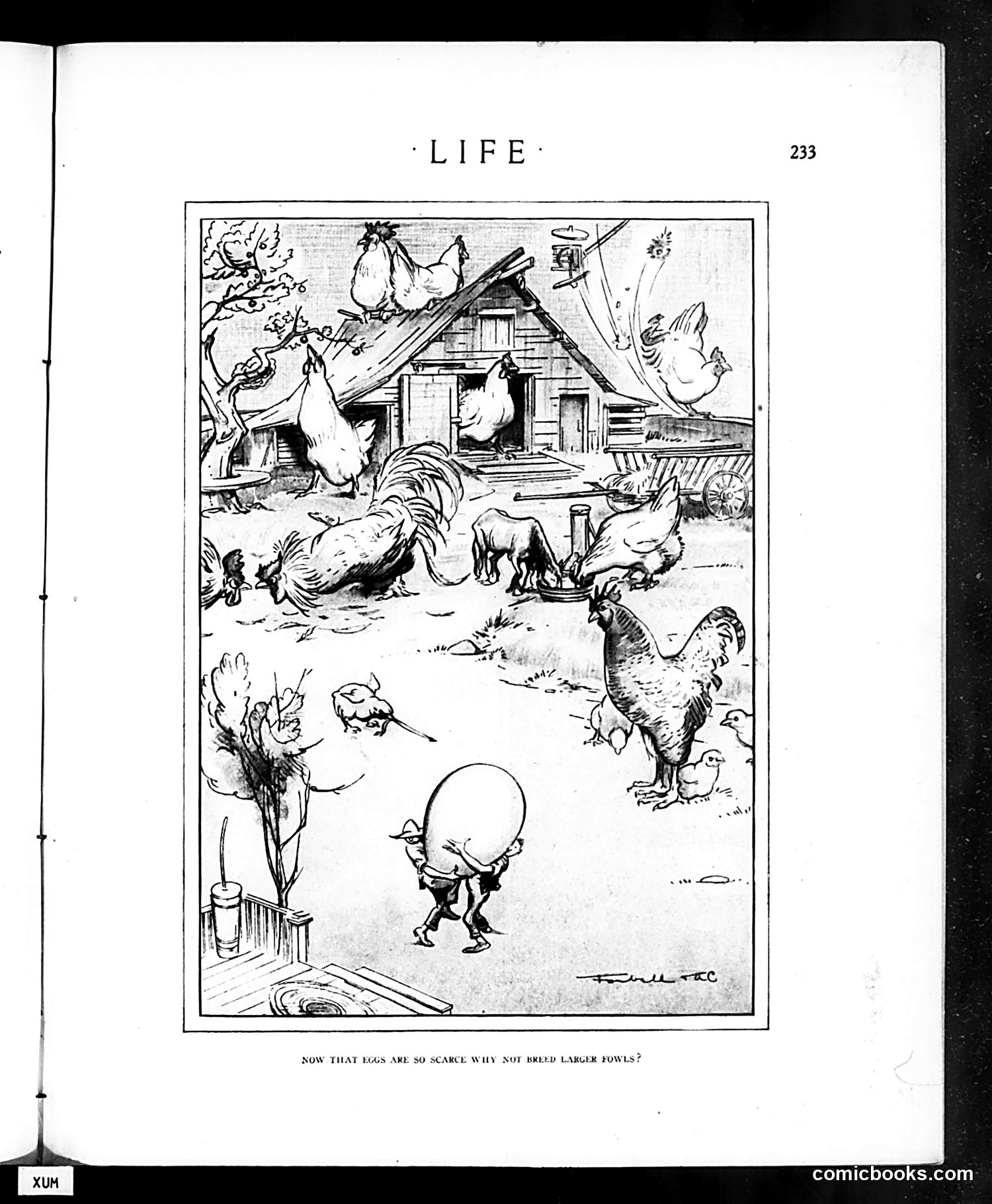
This is a humorous cartoon about egg scarcity, likely from a period of agricultural shortage (possibly WWI-era or similar wartime rationing). The cartoon depicts a farmyard scene with various poultry and a bald man carrying an enormous egg. **The joke:** The caption proposes a practical solution to egg shortages—breeding larger fowls to produce bigger eggs, thus yielding more food per bird. **The satire:** The cartoon mocks this "solution" by showing it taken to absurd extremes: the egg is comically oversized, and the man struggles to carry it. The visual exaggeration implies that while the idea sounds logical on paper, it's impractical and ridiculous in reality. The farmyard setting includes roosters, hens, and typical rural elements, emphasizing the agricultural focus of the commentary.
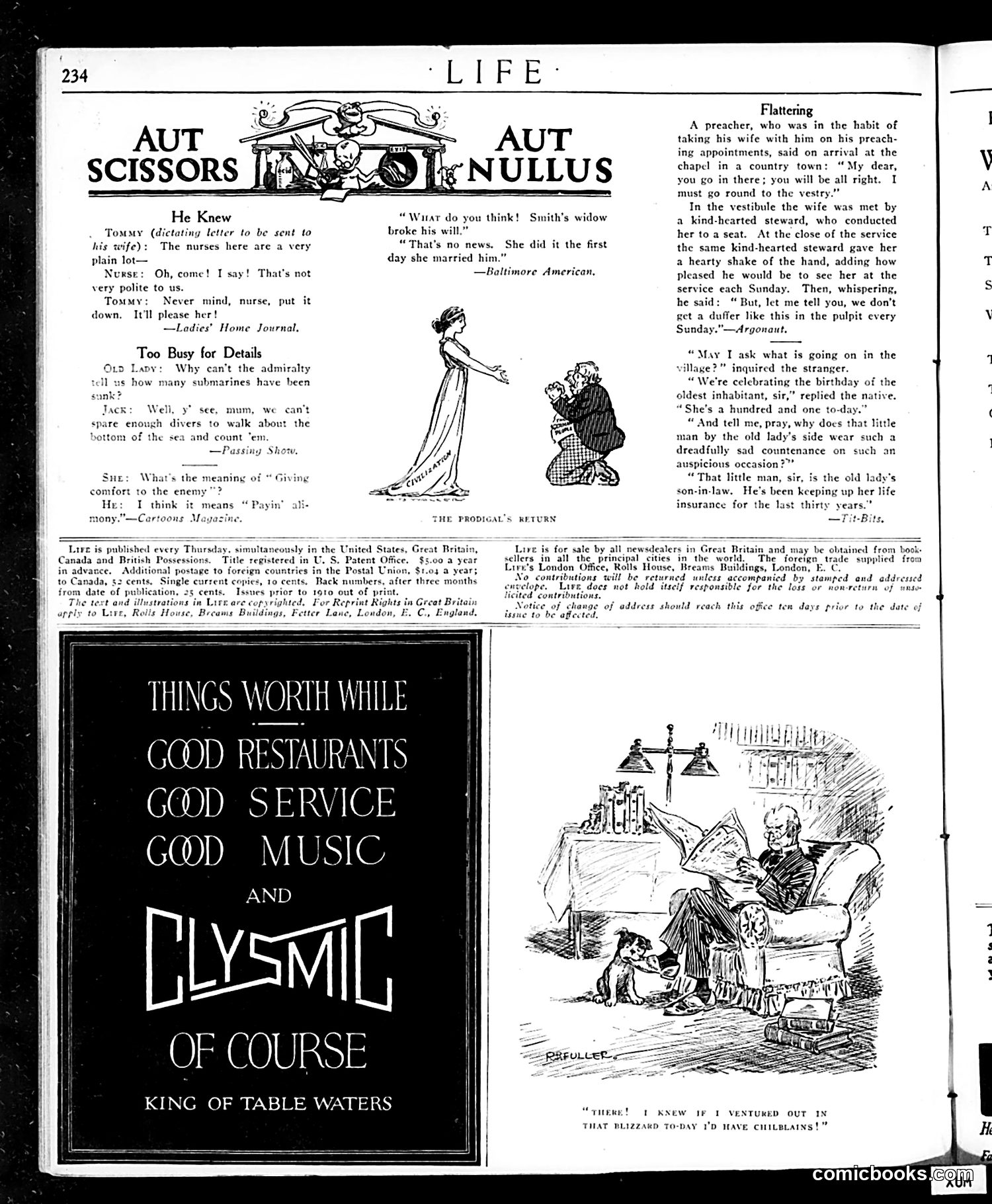
This page contains three humor items typical of early 20th-century American satirical magazines: **"He Knew"** mocks a nurse who corrects a child's impolite remark about a woman breaking her husband's will, only to have the child innocently suggest the comment will "please her"—implying wives commonly dominate marriages. **"Too Busy for Details"** jokes about wartime submarine counting: a naval officer explains the Admiralty can't tally submarines because divers are too busy walking the ocean floor "counting 'em"—absurdist humor about military incompetence or bureaucratic confusion. **"Flattering"** presents an anecdote where a preacher's wife attends church and a steward later whispers he's never seen such a "duffer" in the pulpit—the joke being her presence makes the sermon seem worse by contrast, though it's framed as flattery. The page also includes an advertisement for Elysmic table water emphasizing refined dining establishments. These items reflect period concerns about marriage dynamics, wartime logistics, and genteel social pretense.
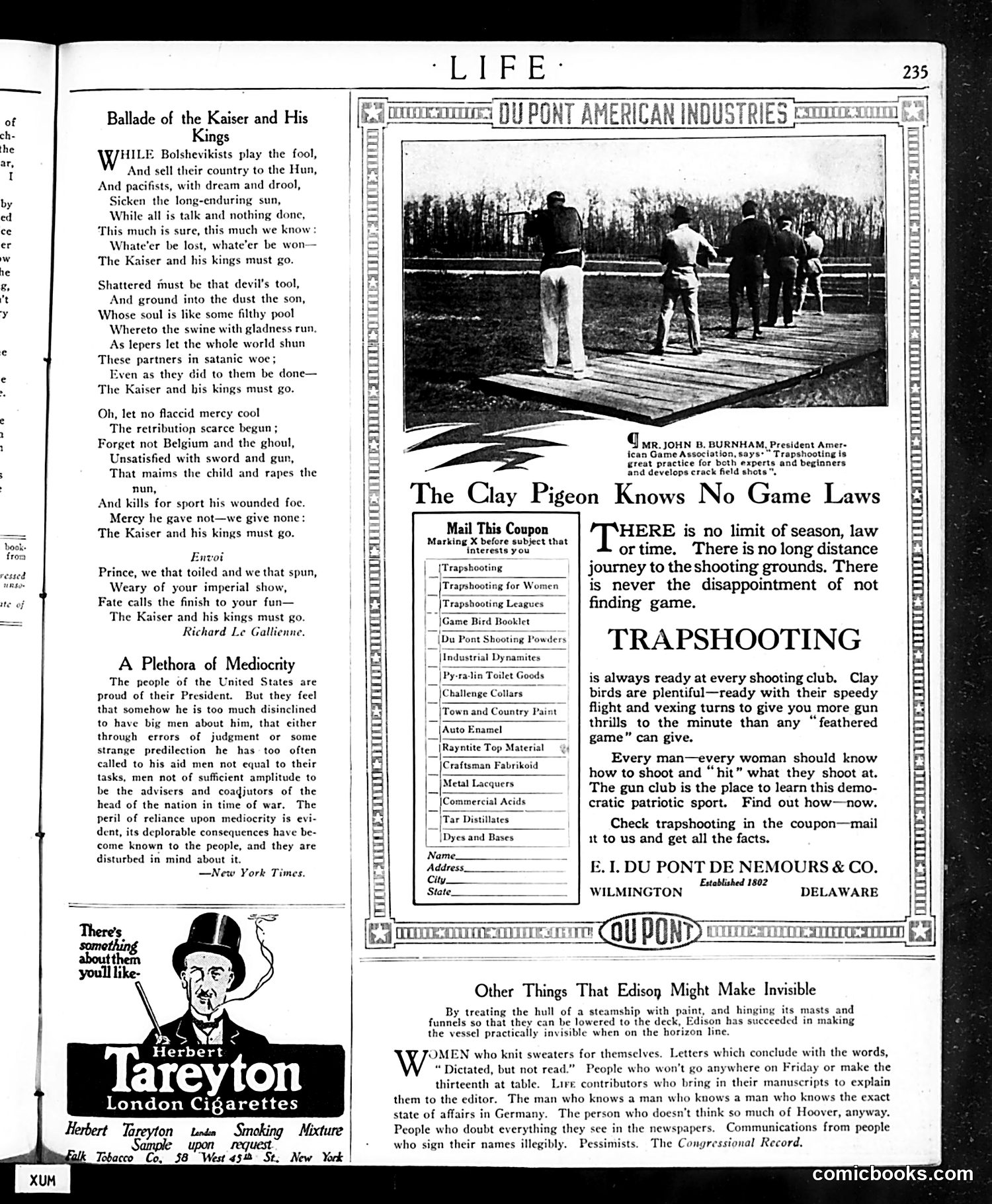
This page contains **anti-German WWI propaganda** alongside advertisements. The "Ballade of the Kaiser and His Kings" (left column) is a wartime poem condemning Kaiser Wilhelm II and demanding his removal—a common refrain during American involvement in World War I. It attacks "Bolshevikists" and "pacifists" alongside the German leader, reflecting American anxieties about both enemies and domestic opposition to the war. "A Plethora of Mediocrity" (lower left) criticizes President Woodrow Wilson for surrounding himself with insufficiently capable advisers during wartime—a contemporary political complaint questioning his leadership. The right page features a **Du Pont advertisement** promoting trapshooting as patriotic sport-training, capitalizing on wartime interest in marksmanship and military preparedness. The bottom section's "Other Things That Edison Might Make Invisible" offers satirical social commentary on various groups (women knitting sweaters, people avoiding Friday), unrelated to the political content above. The overall page reflects Life magazine's role promoting American war effort while critiquing domestic leadership.
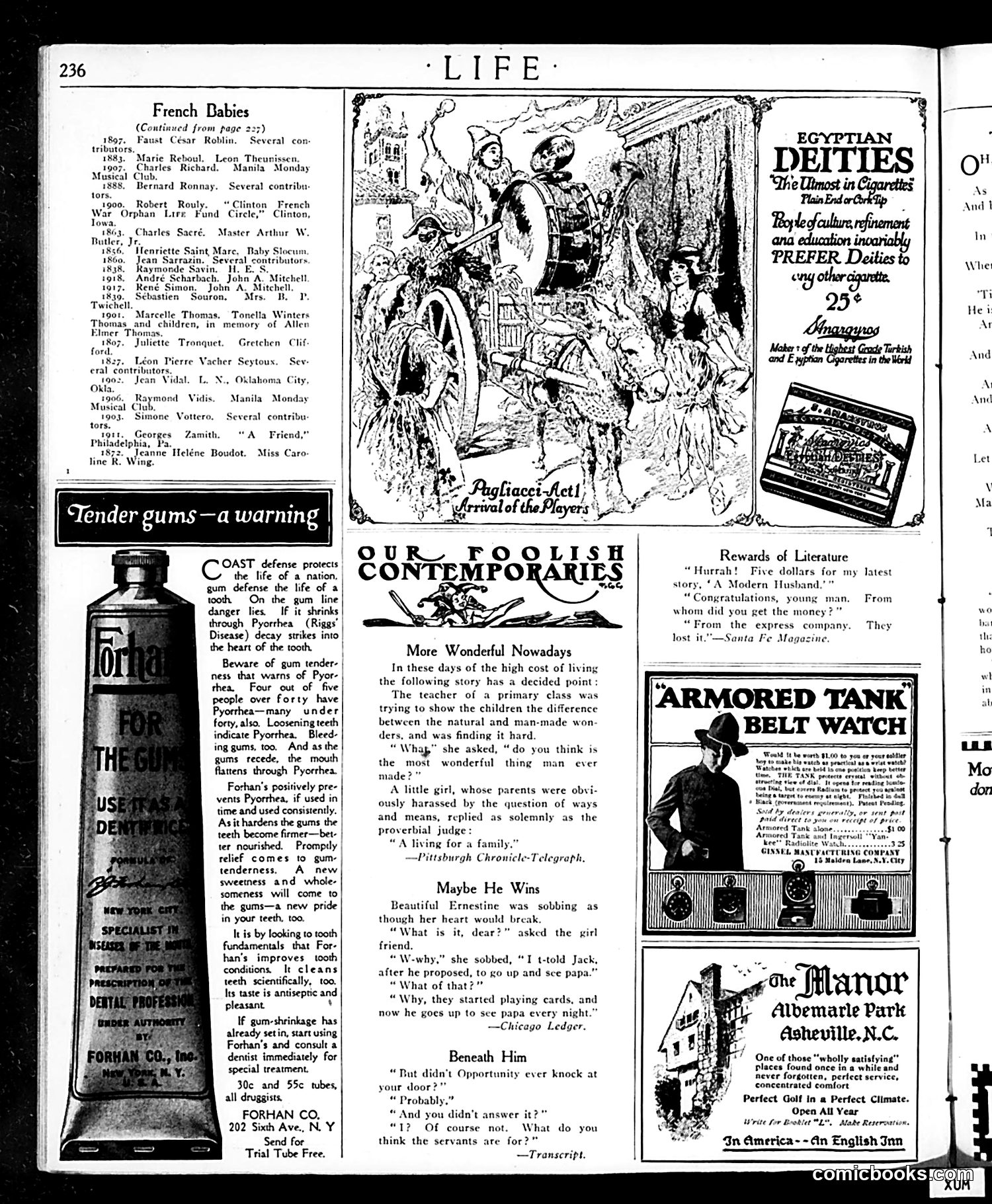
This page is primarily **advertising and humor columns**, not political cartoons. The content includes: **Main Features:** - A list of French baby charity contributors (continuation from previous page) - Three brief humorous anecdotes under "Our Foolish Contemporaries": 1. A teacher asking students what man's greatest wonder is; a poor child answers "a living for a family" (satirizing economic hardship of the era) 2. A woman upset her suitor now visits her father nightly to play cards instead of courting her 3. A man claiming he never answered Opportunity's knock because he has servants to do it (mocking laziness/entitlement) **Advertisements:** - Forhan's toothpaste (promoting gum disease prevention) - Egyptian Cigarettes - Armored Tank Belt Watch - The Manor hotel in Asheville, NC The humor reflects early 20th-century concerns: poverty, gender relations, and class pretension. No identifiable political figures appear.
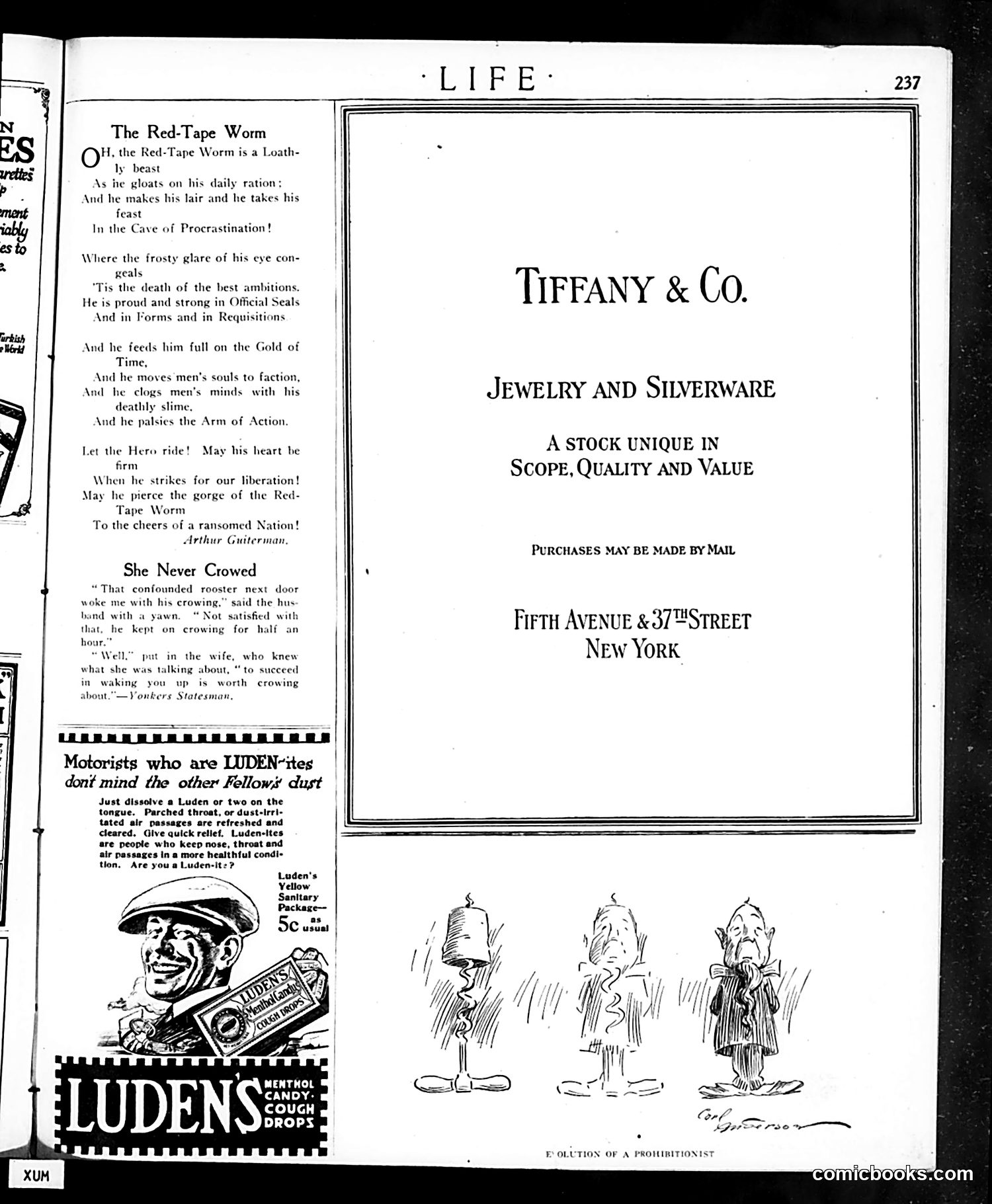
This page combines satirical poetry, advertising, and a cartoon commentary on Prohibition. **The Poetry**: "The Red-Tape Worm" by Arthur Guiterman is a scathing allegory attacking bureaucratic obstruction. The "worm" represents government red tape and procedural delays that kill ambition, paralyze action, and corrupt institutions. It's a call for heroic action to cut through this suffocating bureaucracy. **The Cartoon**: Titled "Evolution of a Prohibitionist," the three figures at bottom likely show the moral "progression" of someone supporting Prohibition—appearing increasingly worn, depleted, and desperate. This satirizes Prohibitionists as hypocrites or mentally/physically deteriorating zealots. The cartoon mocks the Prohibition movement that was active during Life's publication period. **The Advertising**: Tiffany & Co. jewelry and Luden's cough drops occupy much of the page—standard commercial content. The overall message: bureaucracy strangles progress, and Prohibition advocates are portrayed as misguided extremists.
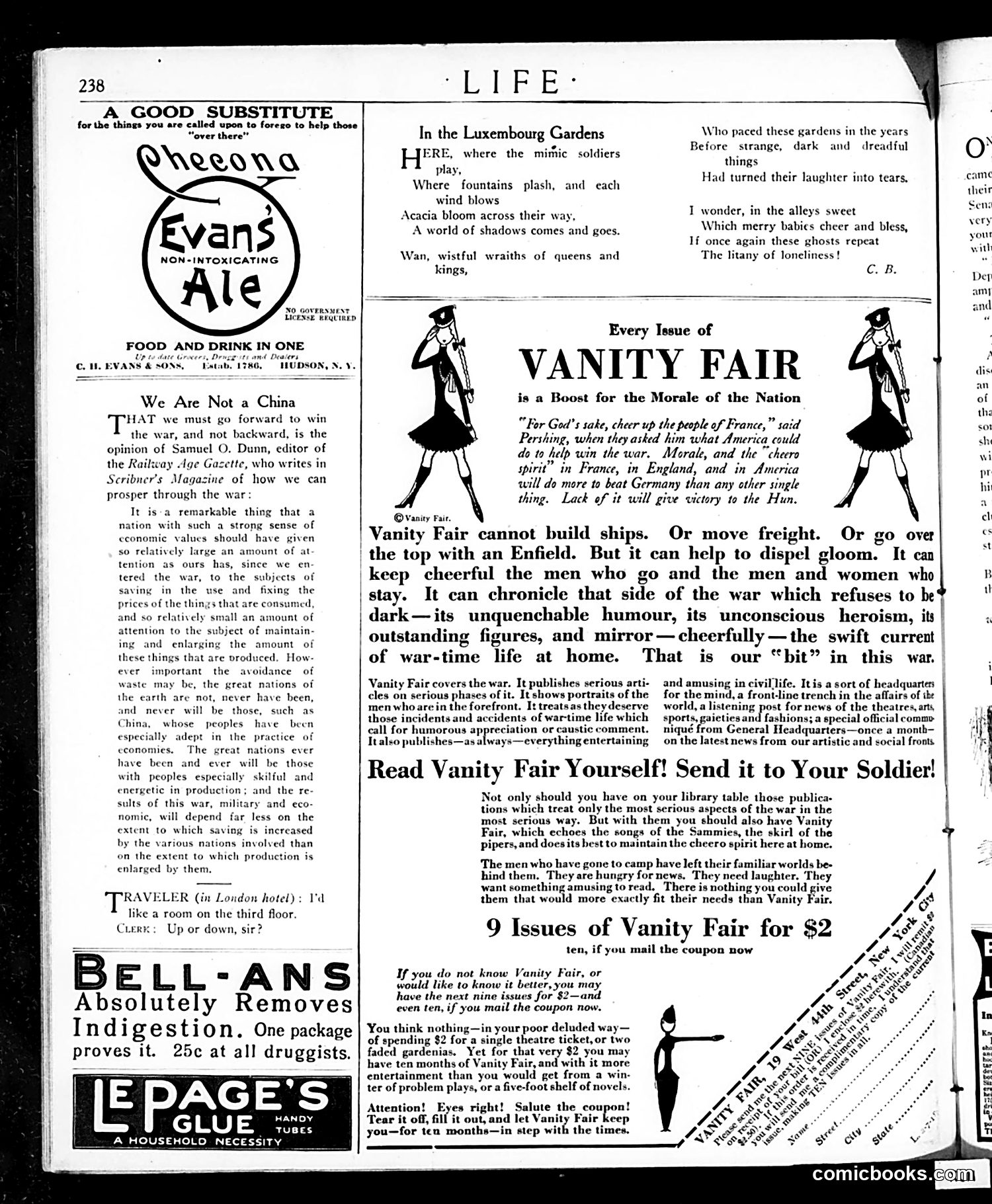
This page comprises advertisements and war-related editorial content from World War I-era Life magazine (likely 1917-1918). **Main Content:** The central feature is a **Vanity Fair advertisement** framed as patriotic messaging. It argues that Vanity Fair serves the war effort by maintaining civilian morale—citing General Pershing's statement that American support should "cheer up the people of France." The ad claims the magazine provides humor and human interest stories that sustain spirits at home and among soldiers. **Supporting Material:** - A poem "In the Luxembourg Gardens" reflects nostalgically on pre-war Paris, noting how conflict has transformed civilian life - An editorial by Samuel O. Dunn argues America must prioritize *production* over mere conservation to win the war - Side advertisements for non-intoxicating ale and other consumer goods frame themselves as patriotic substitutes **The Satire:** The implicit irony: a luxury magazine positioned itself as essential war support through morale-boosting rather than material contribution—a clever marketing angle that elevated entertainment to patriotic duty during wartime scarcity.
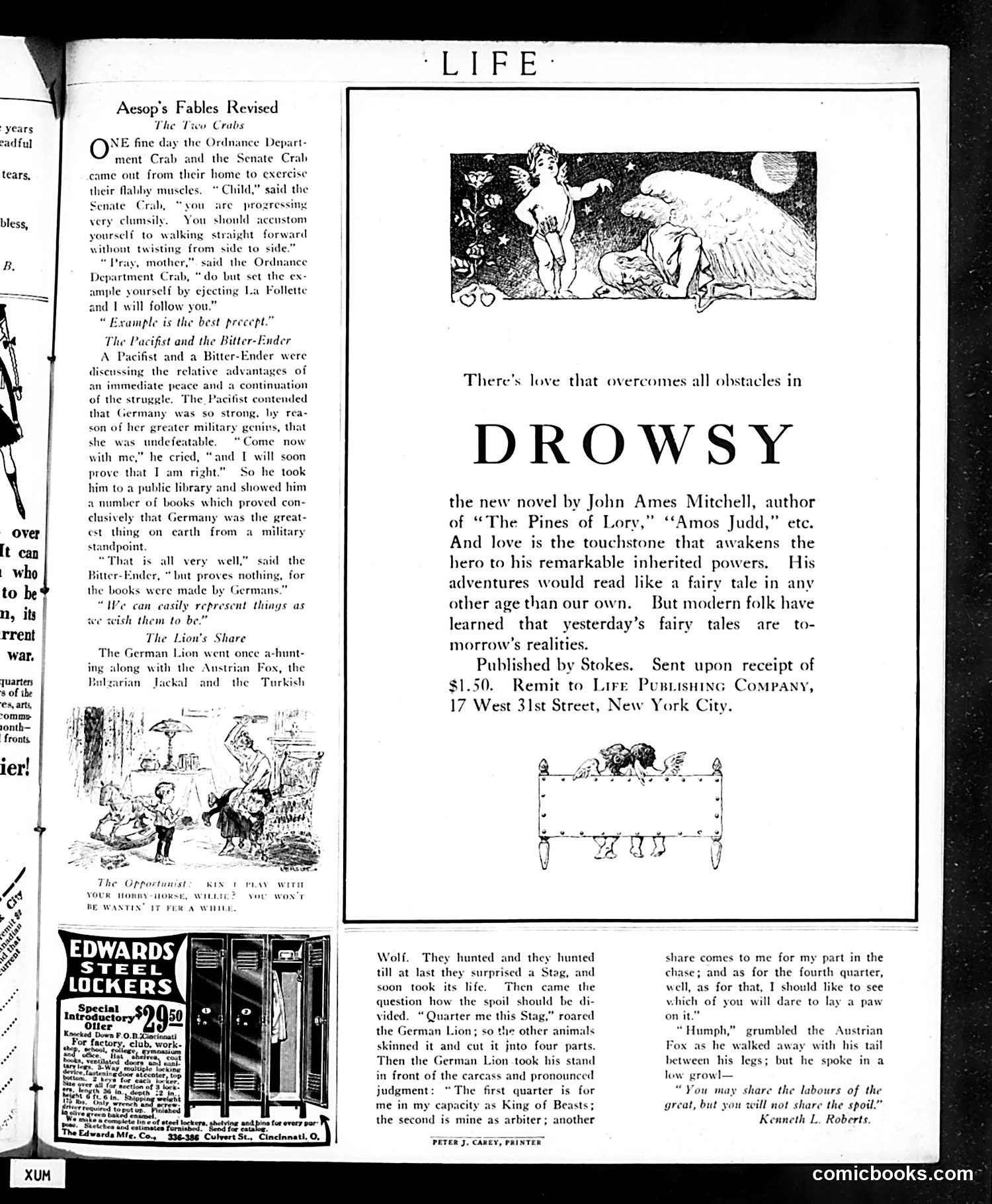
This page contains three revised Aesop's fables satirizing American politics during World War I: **"The Two Crabs"** mocks Senate hypocrisy: the Senate Crab criticizes the Ordnance Department for poor "progress" (likely military preparedness), but when challenged to remove Senator La Follette (a prominent anti-war isolationist), refuses—exposing the Senate's own contradictions. **"The Pacifist and the Bitter-Ender"** ridicules pacifist arguments. The Pacifist uses German-authored books proving Germany's military superiority to argue for peace; the Bitter-Ender dismisses this by noting the books are "made by Germans"—propaganda, not truth. **"The Lion's Share"** allegorizes WWI's aftermath: Germany (the Lion) and Austria, Bulgaria, and Turkey (other Central Powers) hunt together, but Germany seizes all spoils, leaving weaker allies (the Fox) with nothing—predicting post-war resentment. The page primarily advertises novelist John Ames Mitchell's book *Drowsy* below these fables.
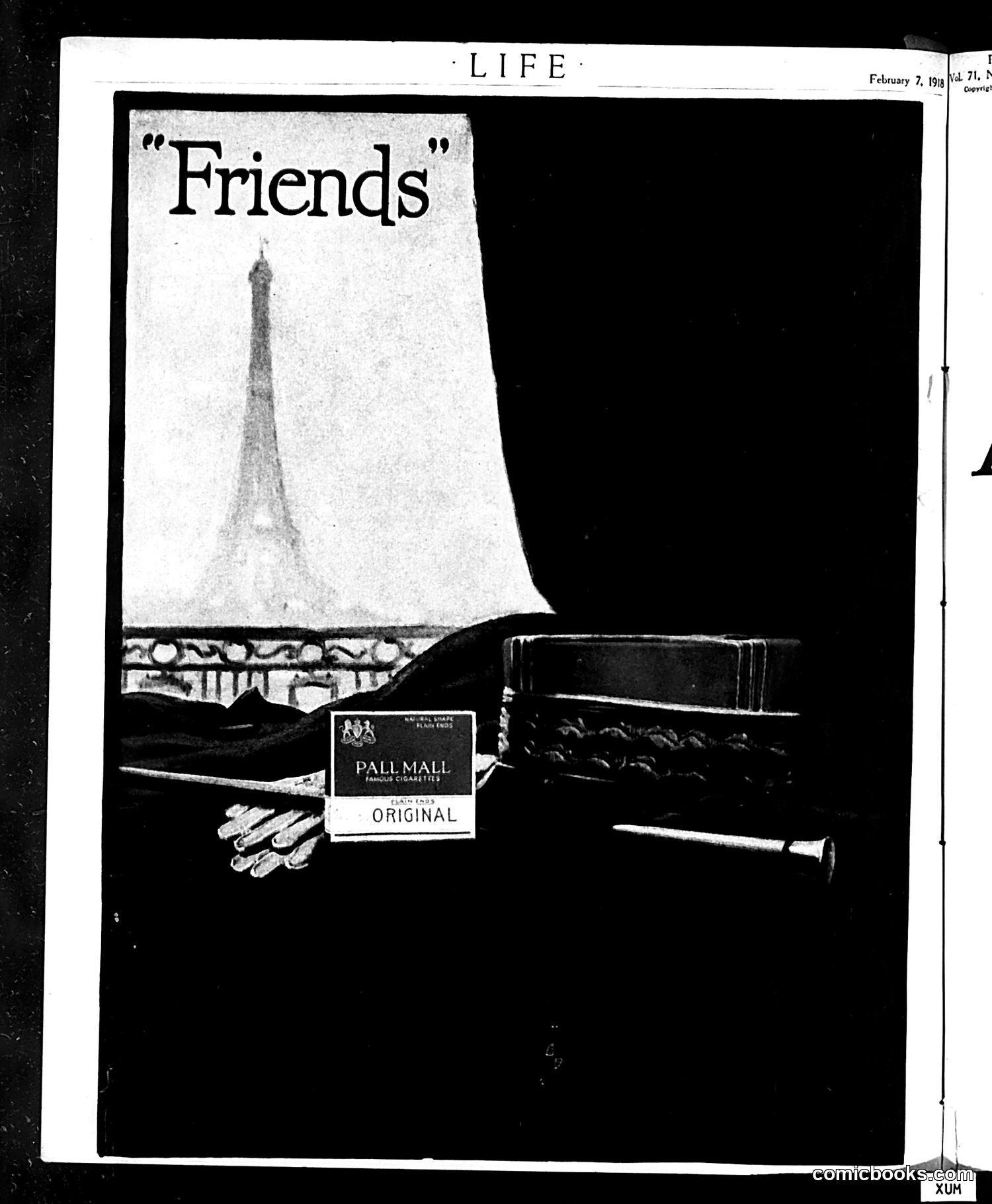
This is a vintage cigarette advertisement from Life magazine (February 7, 1918). The ad depicts a romantic Paris scene—the Eiffel Tower visible through a window with curtains—meant to evoke sophistication and continental glamour. In the foreground sits a Pall Mall cigarette package labeled "Original," surrounded by cigarettes and what appears to be a pipe. The single word "Friends" suggests the advertisement is playing on companionship and leisure. The ad targets early 20th-century consumers by associating cigarettes with worldly sophistication, romance, and refined tastes. The Parisian setting was particularly resonant during World War I, when American soldiers were stationed in France. This type of aspirational advertising was common before modern restrictions on tobacco marketing.