
Life, 1918-02-07 · page 26 of 40
Life — February 7, 1918 — page 26: what you’re looking at
What you’re looking at
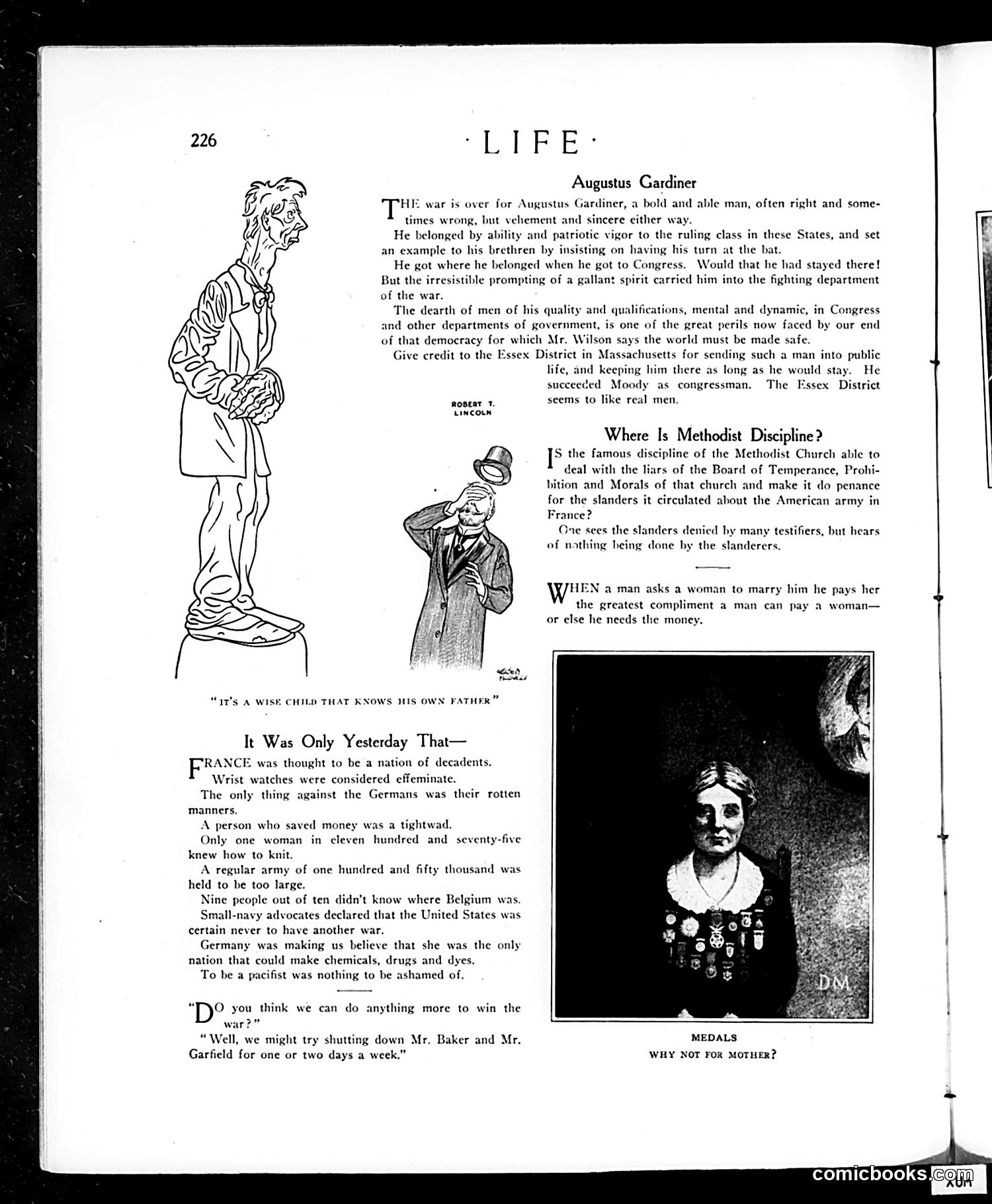
This WWI-era Life page contains satire about American unpreparedness and social attitudes. **Top section ("It Was Only Yesterday That")**: Mocks pre-war American complacency—France was thought decadent, Germans superior in chemistry, pacifism acceptable, the Navy too small. The joke: America believed these things *yesterday*, exposing embarrassing naïveté now that war has arrived. **Augustus Gardiner piece**: Praises a congressman from Essex District, Massachusetts who left Congress to serve in the military—contrasting his patriotic sacrifice against the broader shortage of qualified men in government during wartime. **"Methodist Discipline" section**: Criticizes the Methodist Church's Board of Temperance and Prohibition for spreading false "slanders" about American troops in France. The satire questions whether church discipline will punish these accusers—implying it won't. **"Medals—Why Not for Mother?" photo**: Shows a woman with military medals, sarcastically questioning why mothers aren't decorated for their sacrifices during war. Overall, the page critiques American institutional failures and hypocrisy during WWI mobilization.
📄 Transcribed text from this page (OCR, searchable)
Machine-transcribed from the original scan — historical spelling and the odd misread are preserved.
of the war. Roseat 1. It Was Only Yesterday That— was thought to be a nation of decadents. RANC Wrist watches were considered effeminate. The only thing against the Germans was th manners. A person who saved money was a tightwad. Only one woman in eleven hundred and_ seventy-five knew how to knit. A regular army of one hundred and fifty thousand was held to be too large. Nine people out of ten didn’t know where Belgium was. Small-navy advocates declared that the United States wa certain never to have another war. Germany was making us believe that she was the only nation that could make chemicals, drugs and dyes. To be a pacifist was nothing to be ashamed of. rotten s ‘D° you think we can do anything more to win the war?” “Well, we might try shutting down Mr. Baker and Mr. Garfield for one or two days a week.” “LIFE Augustus Gardiner HE. war is over for Augustus Gardiner, a bold and able man, often right and some- times wrong, but vehement and sincere either way. He belonged by ability and patriotic vigor to the ruling class in these States, and set an example to his brethren by insisting on having his turn at the bat. He got where he belonged when he got to Congress. Would that he had stayed there! But the irresistible prompting of a gallant spirit carried him into the fighting department The dearth of men of his quality and qualifications, mental and dynamic, in Congress and other departments of government, is one of the great perils now faced by our end of that democracy for which Mr. Wilson say Give credit to the Essex District in Massachusetts for sending such a man into public fe. the world must be made s life, and keeping him there as long as he would stay. He succeeded Moody as congressman. The Essex District seems to like real men. Where Is Methodist Discipline? i the famous discipline of the Methodist Church able to deal with the liars of the Board of Temperance, Prohi- bition and Morals of that church and make it do penance for the slanders it circulated about the American army in France? One sees the slanders denied by many testifiers, but hears. of nothing heing done by the slanderers. HE the greatest compliment a man can pay a woman— or else he needs the money. a man asks a woman to marry him he pays her MEDALS WHY NOT FOR MOTHER? =| comicbooks