
Life, 1918-02-07 · page 14 of 40
Life — February 7, 1918 — page 14: what you’re looking at
What you’re looking at
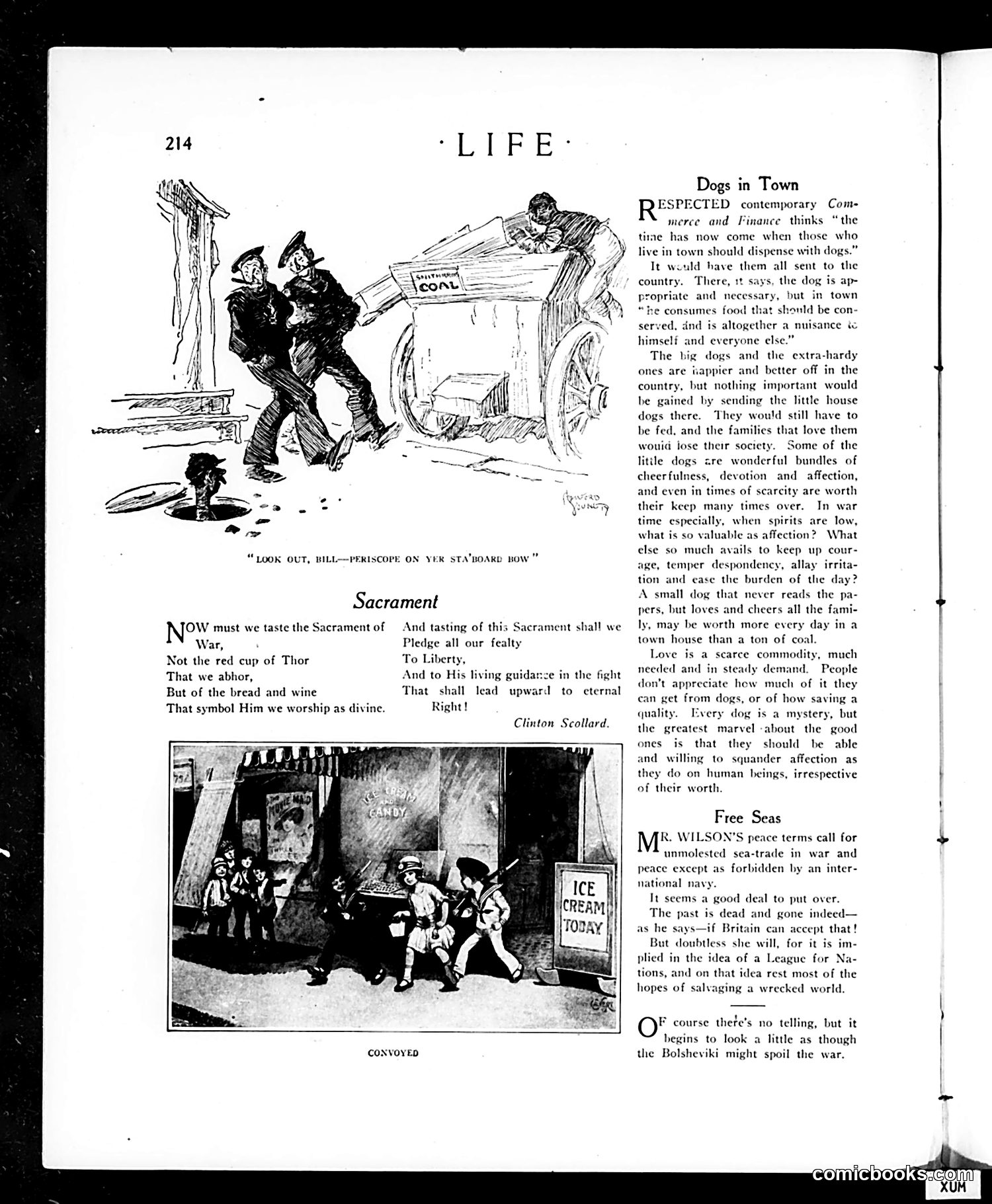
**Top Cartoon ("Look out, Bill—periscope on yer starboard bow"):** Shows two men loading coal onto a cart while a small dog watches. The "periscope" joke references German U-boat submarine warfare during WWI—a contemporary threat. The humor comes from treating the dog as if it were a submarine threat, absurdly comparing a pet to an actual wartime danger. **"Sacrament" Poem:** A patriotic poem by Clinton Scollard about war as a sacred duty, using religious communion imagery to frame military sacrifice as spiritually necessary. **"Dogs in Town" and "Free Seas" sections:** Argumentative essays addressing wartime debates: one defends keeping small dogs in cities as emotionally valuable, the other discusses Wilson's peace terms and League of Nations concepts—both WWI-era concerns.
📄 Transcribed text from this page (OCR, searchable)
Machine-transcribed from the original scan — historical spelling and the odd misread are preserved.
“LOOK OUT, BILL—PERISCOPE ON YER STA'BOARD BOW” Sacrament ‘OW must we taste the Sacrament of — And tasting of this Sacrament shall we War, Pledge all our fealty Not the red cup of Thor To Liberty, That we abhor, And to His living guidance in the fight But of the bread and wine That shall lead upward to eternal That symbol Him we worship as divine. Right! Clinton Scollard. CONVOYED Dogs in Town R SPECTED contemporary Com- merce and Finance thinks “the time has now come when those who live in town should dispense with dogs.” It would have them all sent to the s, the dog is ap- ry, but in town There, tt s ‘¢ and neces “he consumes food that should be con- dis altogether a nuisance tc nd everyone else. The hig dogs and the extra-hardy ones are iappier and better off in the country, but nothing important would be gained by sending the little house dogs there. They would still have to be fed, and the families that love them wouid jose their society. Some of the served himself a little dogs are wonderful bundles of cheerfulness, devotion and affection, and even in times of scarcity are worth their keep many times over. In war time especially, when spirits are low, what is so valuable as affection? What else so much avails to keep up cour- temper despondency, allay irrita- tion and case the burden of the day? A small dog that never reads the pa- pers, but loves and cheers all the fami- ly, may be worth more every day in a town house than a ton of coal. Love is a scarce commodity, much needed and in steady demand. People don’t appreciate how much of it they can get from dogs, or of how saving a quality. Every dog is a mystery, but the greatest marvel -about the good ones is that they should be able and willing to squander affection as they do on human beings, irrespective of their worth. Free Seas R. WILSON’S peace terms call for unmolested sea-trade in war and peace except as forbidden by an inter- national navy. ms a good deal to put over. tis dead and gone indeed— says—if Britain can accept that! But doubtless she will, for it is im- plied in the idea of a League for Na- tions, and on that idea rest most of the hopes of salvaging a wrecked world. course thefe’s no telling, but it begins to look a little as though the Bolsheviki might spoil the war. ———