
Life, 1918-02-07 · page 23 of 40
Life — February 7, 1918 — page 23: what you’re looking at
What you’re looking at
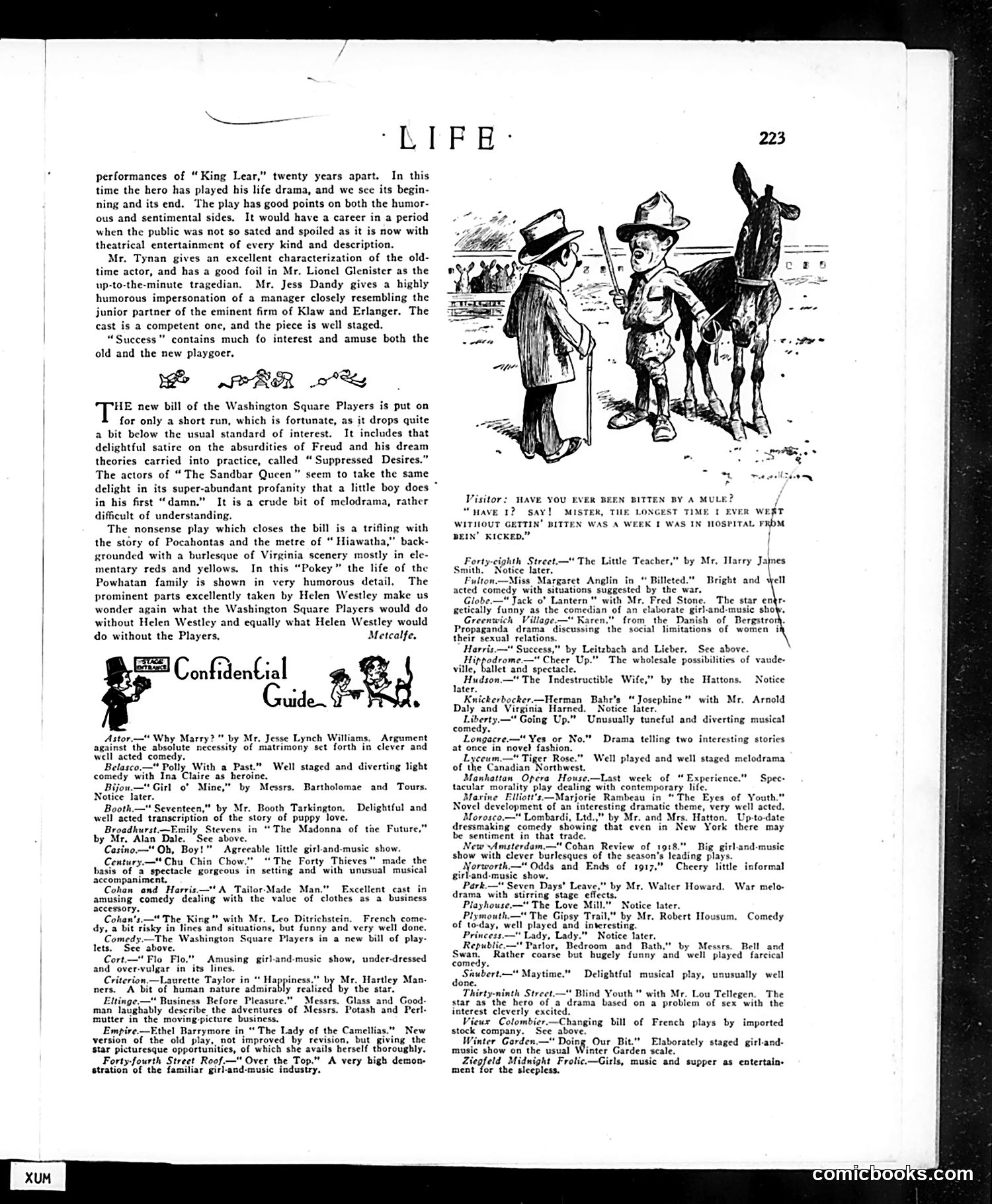
This page contains theater reviews and a single cartoon illustration. The main image shows two men with a mule—one in a cowboy hat, the other in formal dress—with a caption about a mule bite. This appears to be a humorous illustration accompanying reviews of Washington Square Players productions, likely satirizing the contrast between rural/comic and urban/sophisticated theatrical traditions. The page primarily reviews current Broadway productions ("King Lear," "Why Marry?", "Chu Chin Chow," etc.). A notable review discusses the Washington Square Players' bill, which includes satire on Freudian psychology ("Suppressed Desires")—referencing the then-popular but often-mocked psychoanalytic theories. The reviews praise actress Helen Westley repeatedly. The theatrical listings suggest this is from the 1910s, when elaborate musical spectacles and light comedies dominated Broadway alongside classical revivals.
📄 Transcribed text from this page (OCR, searchable)
Machine-transcribed from the original scan — historical spelling and the odd misread are preserved.
“REFE: performances of “King Lear,” twenty years apart. In this time the hero has played his life drama, and we sce its begin- ning and its end, ‘The play has good points on both the humor- ous and sentimental sides, It would have a career in a period when the public was not so sated and spoiled as it is now with theatrical entertainment of every kind and description. Mr, Tynan gives an excellent characterization of the old- time actor, and has a good foil in Mr. Lionel Glenister as the up-to-the-minute tragedian. Mr, Jess Dandy gives a highly humorous impersonation of a manager closely resembling the junior partner of the eminent firm of Klaw and Erlanger. The cast is a competent one, and the piece is well staged. “Success” contains much (o interest and amuse both the old and the new playgoer. > PAR 0 SH HE new bill of the Washington Square Players is put on for only a short run, which is fortunate, as it drops quite a bit below the usual standard of interest. It includes that delightful satire on the absurdities of Freud and his dream theories carried into practice, called “ Suppressed Desires.” The actors of “The Sandbar Queen” seem to take the same delight in its super-abundant profanity that a little boy does in his first “damn.” It is a crude bit of melodrama, rather difficult of understanding. The nonsense play which closes the bill is a trifling with the story of Pocahontas and the metre of “ Hiawatha,” back- grounded with a burlesque of Virginia scenery mostly in ele- mentary reds and yellows. In this “Pokey” the life of the Powhatan family is shown in very humorous detail. The prominent parts excellently taken by Helen Westley make us wonder again what the Washington Square Players would do without Helen Westley and equally what Helen Westley would do without the Players, Metcalfe, Confident al Cine CEH, Astor.—* Why Marry?" by Mr. Jesse Lynch Williams, Argument against the absolute necessity of matrimony set forth in clever and well acted comedy, Belasco.— Polly With a Past.” Well staged and diverting light comedy with Ina Claire as heroine. Bijou.—" Girl 0’ Mine,” by Messrs. Bartholomae and Tours. Notice later. Booth.—" Seventeen,” by Mr. Booth Tarkington. Delightful and well acted transcription of the story of puppy love. Broadhurst-—Fmily Stevens in “The Madonna of the Future,” by Mr, Alan Dale, See above. Casino.—" Oh, Boy!" Agrecable little girl-and-music show. Century.— Chu Chin Chow.” “The Forty Thieves" made the basis of ‘a spectacle gorgeous in setting and with unusual musical accompaniment. Cohan and Harris. amusing comedy deal accessory. Cohan's.—" The King" with Mr. Leo Ditrichstein. French come- dy, a bit risky in lines and situations, but funny and very well done. Comedy.—The Washington Square Players in a new bill of play- lets. See above. Cort.— Flo Flo.” Amusing girl-and-music show, under-dressed and over-vulgar in its lines. Criterion Laurette Taylor in Happiness.” by Mr, Hartley Man- ners. A bit of human nature admirably realized by the star. :tinge.—" Business Refore Pleasure.” Messrs. Glass and Good- man laughably describe the adventures of Messrs. Potash and Perl- mutter in the moving-picture business. Empire.—Ethel Barrymore in “The Lady of the Camellias.” New version of the old play, not improved by revision. but giving the star picturesque opportunities, of which she avails herself thoroughly. Forty-fourth Street Roof —" Over the Top.” A very high demon- stration of the familiar girl-and-music industry. A Tailor-Made Man." Excellent cast in ng with the value of clothes as a business Visitor: WAVE YOU EVER BEEN BITTEN BY A MULE? / “wave 1?) Say! MISTER, THE LONGEST TIME 1 EVER WERT WITHOUT GETTIN’ BITTEN WAS A WEEK 1 WAS IN HOSPITAL FRDM REIN’ KICKED.” | Forty-cighth Street." The Little Teacher," by Mr, Harry James Smith.” Notice later. \ Fulton.—Miss Margaret Anglin in “ Billeted.” Bright and Yell acted comedy with situations suggested by the war. Globe—“ Jack 0” Lantern" with Mr. Fred Stone. The star entr- getically funny as the comedian of an claborate girl-and-music show. Greenwich Village.—" Karen." from the Danish of Bergstro Propaganda drama discussing the social limitations of women i their sexual relation: Harris.—" Success," by Leitzbach and Lieber. See above. Hingodrome—" Cheer Up.” The wholesale possibilities of vaude- ville, ballet and spectacle. adftdson—" The Indestructible Wife," by the Hattons. Notice ater. Knickerbocker—Herman Bahr's “Josephine” with Mr, Arnold Daly and Virginia Harned. Notice later. Liberty.—" Going Up.” Unusually tuneful and diverting musical comedy. Longacre.—" Yes or No." Drama telling two interesting stories at once in novel fashion. Lyceum.—" Tiger Rose.” Well played and well staged melodrama of the Canadian Northwest. Manhattan Opera House.—Last week of “Experience.” Spee- tacular morality play dealing with contemporary life. Marine Elliott’s—Marjorie Rambeau in “The Eyes of Youth.” vel development of an interesting dramatic theme, very well acted. Morosco.—" Lombardi, Ltd.,” by Mr. and Mrs. Hatton. Up-to-date dressmaking comedy showing that even in New York there may be sentiment in that trade. New sAmsterdam.—" Cohan Review of 1918." Big gitl-and-musie show with clever burlesques of the season's leading plays. _Norworth—" Odds and Ends of 1917." Cheery little informal girland-music show. Park.—" Seven Days’ Leave," by Mr. Walter Howard. War melo- drama with stirring stage effec Playhouse —" The Love Mill Plymouth.— The Gipsy Trail," by Mr. Robert Housum. Comedy of today, well played and interesting. Princess.—" Lady, Lady.” Notice later. Republic.—* Parlor, Bedroom and Bath," by Messrs. Bell and Swan, Rather coarse but hugely funny and well played farcical comedy. Shubert. done. Thirty-ninth Street—" Blind Youth " with Mr. Lou Tellegen. The star as the hero of a drama based on a problem of sex with the interest cleverly excited. Vieux Cotombier.—Changing bill of French plays by imported stock company. See above. Winter Gorden._—" Doig. Our Bit," Elaborately staged girland- show on the usual Winter Garden scale. feld Midnight Frolic.—Girls, music and supper as entertain- ment for the sleepless. Notice later. “* Maytim Delightful musical play, unusually well