
Life, 1918-02-07 · page 22 of 40
Life — February 7, 1918 — page 22: what you’re looking at
What you’re looking at
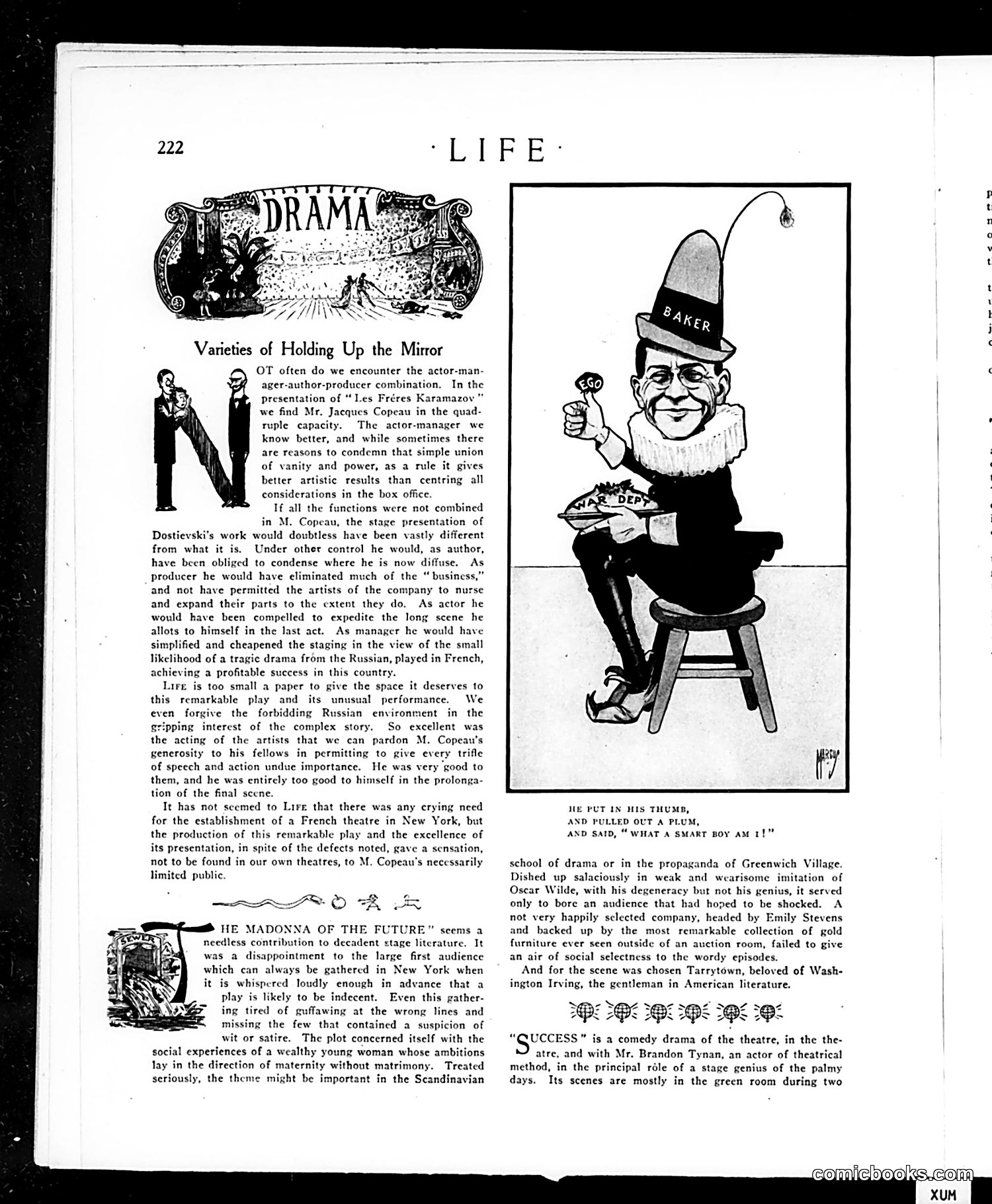
This page reviews theatrical productions, with one prominent cartoon on the right. The cartoon depicts a baker character in a tall hat, sitting contentedly while holding a pie and a thumbs-up gesture labeled "$60." Below reads the nursery rhyme reference: "HE PUT IN HIS THUMB, AND PULLED OUT A PLUM, AND SAID, 'WHAT A SMART BOY AM I!'" **The satire**: This caricature likely mocks a specific baker or food-industry figure of the era who profited handsomely (the $60 figure suggests significant earnings) from wartime conditions or price-gouging—a common complaint during WWI-era America. The nursery rhyme allusion mocks his self-satisfied attitude about his windfall profit, implying he did nothing skillful to deserve it, merely stuck his hand in and extracted wealth. The page's text reviews Jacques Copeau's production of *Les Frères Karamazov* and critiques *The Madonna of the Future*, praising one while condemning the other's shallow imitation of Oscar Wilde.
📄 Transcribed text from this page (OCR, searchable)
Machine-transcribed from the original scan — historical spelling and the odd misread are preserved.
Varieties of Holding Up the Mirror OT often do we encounter the actor-man- ager-author-producer combination. In the presentation of “Les Fréres Karamazov” we find Mr. Jacques Copeau in the quad- ruple capacity. The actor-manager we know better, and while sometimes there are reasons to condemn that simple union of vanity and power, as a rule it gives better artistic results than centring all considerations in the box office. If all the functions were not combined in M. Copeau, the stage presentation of Dostievski’s work would doubtless have been vastly different from what it is. Under other control he would, as author, have been obliged to condense where he is now diffuse. As producer he would have eliminated much of the “business,” and not have permitted the artists of the company to nurse and expand their parts to the extent they do, As actor he would have been compelled to expedite the long scene he allots to himself in the last act. As manager he would have simplified and cheapened the staging in the view of the small likelihood of a tragic drama from the Russian, played in French, achieving a profitable success in this country. Lire is too small a paper to give the space it deserves to this remarkable play and its unusual performance. We even forgive the forbidding Russian environment in the gripping interest of the complex story. So excellent was the acting of the artists that we can pardon M. Copeau's generosity to his fellows in permitting to give every trifle of speech and action undue importance. He was very good to them, and he was entirely too good to himself in the prolon; tion of the final scene. It has not seemed to Lire that there was any crying need for the establishment of a French theatre in New York, but the production of this remarkable play and the excellence of its presentation, in spite of the defects noted, gave a sensation, not to be found in our own theatres, to M. Copeau’s necessarily limited public OO RA LR HE MADONNA OF THE FUTURE” seems a needless contribution to decadent stage literature. It was a disappointment to the large first audience which can always be gathered in New York when it is whispered loudly enough in advance that a play is likely to be indecent. Even this gather- ing tired of guffawing at the wrong lines and missing the few that contained a suspicion of wit or satire. The plot concerned itself with the social experiences of a wealthy young woman whose ambitions lay in the direction of maternity without matrimony. Treated seriously, the theme might be important in the Scandinavian Me PUT IN MIs THUMB, AND PULLED OUT A PLUM, AND SAID, “ WHAT A SMART Boy aM 1!” school of drama or in the propaganda of Greenwich Village. Dished up salaciously in weak and wearisome imitation of Oscar Wilde, with his degeneracy but not his genius, it served only to bore an andience that had hoped to be shocked. A not very happily sclected company, headed by Emily Stevens and backed up by the most remarkable collection of gold furniture ever seen outside of an auction room, failed to give an air of social selectness to the wordy episodes. And for the scene was chosen Tarrytown, beloved of Wash- ington Irving, the gentleman in American literature. “i: YX Tex teal Tees ree BE 3 KS BE BPS DDE 2S S" is a comedy drama of the theatre, in the the- atre, and with Mr. Brandon Tynan, an actor of theatrical method, in the principal réle of a stage genius of the palmy days. Its scenes are mostly in the green room during two