
Life, 1918-02-07 · page 18 of 40
Life — February 7, 1918 — page 18: what you’re looking at
What you’re looking at
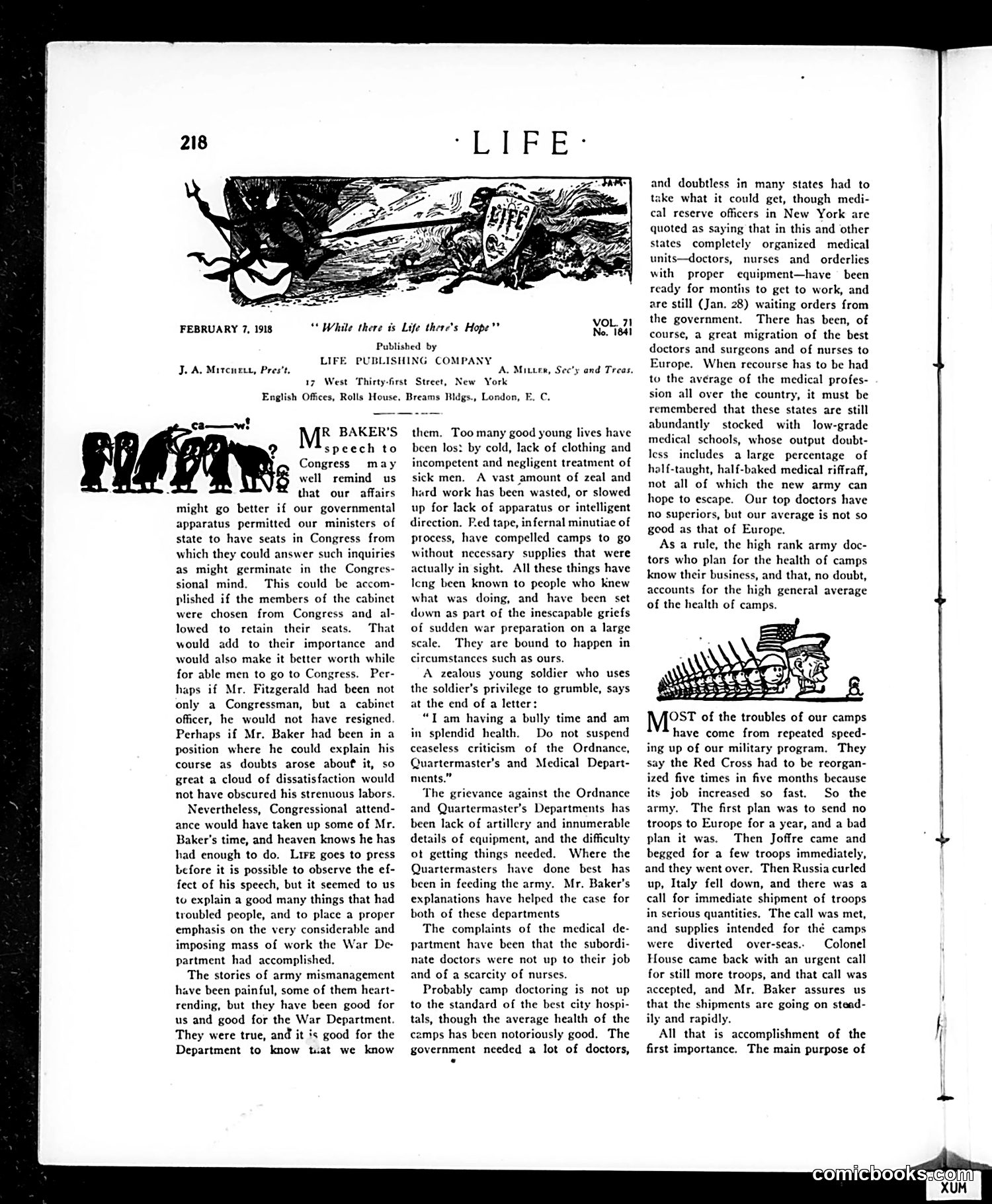
This February 1918 *Life* magazine page discusses Secretary of War Newton D. Baker's Congressional speech defending the War Department's management during America's WWI mobilization. **The Cartoon:** The header image shows a skeletal Death figure driving a military ambulance—a dark commentary on wartime casualties and medical failures. **The Satire's Point:** The article criticizes Army mismanagement while defending Baker. It acknowledges real problems: soldiers died from cold, poor clothing, medical negligence, bureaucratic red tape, and equipment shortages. However, it frames these as inevitable in rapid wartime mobilization rather than Baker's fault. **Key Reference:** The text mentions a soldier's letter saying "Do not suspend ceaseless criticism" of supply departments—illustrating how even soldiers recognized systemic failures while maintaining morale. **The Irony:** *Life* simultaneously blames the failures and absolves Baker, arguing the problems were widespread enough to be unavoidable. This reflects 1918 wartime tensions between holding officials accountable and supporting the war effort.
📄 Transcribed text from this page (OCR, searchable)
Machine-transcribed from the original scan — historical spelling and the odd misread are preserved.
FEBRUARY 7, 1918 J. A. Mitcnete, Pres’t, “* While there ts Life there's Hope” Published by PUBLISHING COMPANY A 17 West Thirty-first Street, New York English Offices, Rolls House, Breams Bldgs., London, E. C. R BAKER'S 9 speech to Y¥~ Congress may § well remind us that our affairs might go better if our governmental apparatus permitted our ministers of state to have seats in Congress from which they could answer such inquiries as might germinate in the Congres- sional mind. This could be accom- plished if the members of the cabinet were chosen from Congress and al- lowed to retain their seats. That would add to their importance and would also make it better worth while for able men to go to Congress. Per- haps if Mr. Fitzgerald had been not only a Congressman, but a cabinet officer, he would not have resigned Perhaps if Mr. Baker had been in a position where he could explain his course as doubts arose abouf it, so great a cloud of dissatisfaction would not have obscured his strenuous labors. Nevertheless, Congressional attend- ance would have taken up some of Mr. Baker's time, and heaven knows he has had enough to do. Lire goes to press Lefore it is possible to observe the ef- fect of his speech, but it seemed to us to explain a good many things that had troubled people, and to place a proper emphasis on the very considerable and imposing mass of work the War De- partment had accomplished, The stories of army mismanagement have been painful, some of them heart- rending, but they have been good for us and good for the War Department. They were true, and it ‘s good for the Department to know tuat we know them. Too many good young lives have been los: by cold, lack of clothing and incompetent and negligent treatment of sick men. A vast amount of zeal and hard work has been wasted, or slowed up for lack of apparatus or intelligent direction. P.ed tape, infernal minutiae of process, have compelled camps to go without necessary supplies that were actually in sight. All these things have Icng been known to people who Knew what was doing, and have been set down as part of the inescapable griefs of sudden war preparation on a large scale. They are bound to happen in circumstances such as ours. A zealous young soldier who uses the soldier's privilege to grumble, says at the end of a letter: “Iam having a bully time and am in splendid health. Do not suspend ceaseless criticism of the Ordnance, Quartermaster’s and Medical Depart- ments.” The grievance against the Ordnance and Quartermaster’s Departments has been lack of artillery and innumerable details of equipment, and the difficulty ot getting things needed. Where the Quartermasters have done best has been in feeding the army. Mr. Baker's explanations have helped the case for both of these departments The complaints of the medical de- partment have been that the subordi- nate doctors were not up to their job and of a scarcity of nurses. Probably camp doctoring is not up to the standard of the best city hospi- tals, though the average health of the camps has been notoriously good. The government needed a lot of doctors, . Lier, Sec’y and Treas. and doubtless in many states had to take what it could get, though medi- cal reserve officers in New York are quoted as saying that in this and other states completely organized medical units—doctors, nurses and orderlies with proper equipment—have been ready for months to get to work, and are still (Jan. 28) waiting orders from the government. There has been, of course, a great migration of the best doctors and surgeons and of nurses to Europe. When recourse has to be had to the average of the medical profes- sion all over the country, it must be remembered that these states are still abundantly stocked with low-grade medical schools, whose output doubt- Iess includes a large percentage of half-taught, half-baked medical riffraff, not all of which the new army can hope to escape. Our top doctors have no superiors, but our average is not so geod as that of Europe. As a rule, the high rank army doc- tors who plan for the health of camps know their business, and that, no doubt, accounts for the high general average of the health of camps. OST of the troubles of our camps have come from repeated speed- ing up of our military program. They say the Red Cross had to be reorgan- ized five times in five months because its job increased so fast. So the army. The first plan was to send no troops to Europe for a year, and a bad plan it was. Then Joffre came and begged for a few troops immediately, and they went over. Then Russia curled up, Italy fell down, and there was a call for immediate shipment of troops in serious quantities. The call was met, and supplies intended for thé camps were diverted over-seas.. Colonel House came back with an urgent call for still more troops, and that call was accepted, and Mr. Baker assures us that the shipments are going on stead- ily and rapidly. All that is accomplishment of the first importance. The main purpose of