
Life, 1918-02-07 · page 38 of 40
Life — February 7, 1918 — page 38: what you’re looking at
What you’re looking at
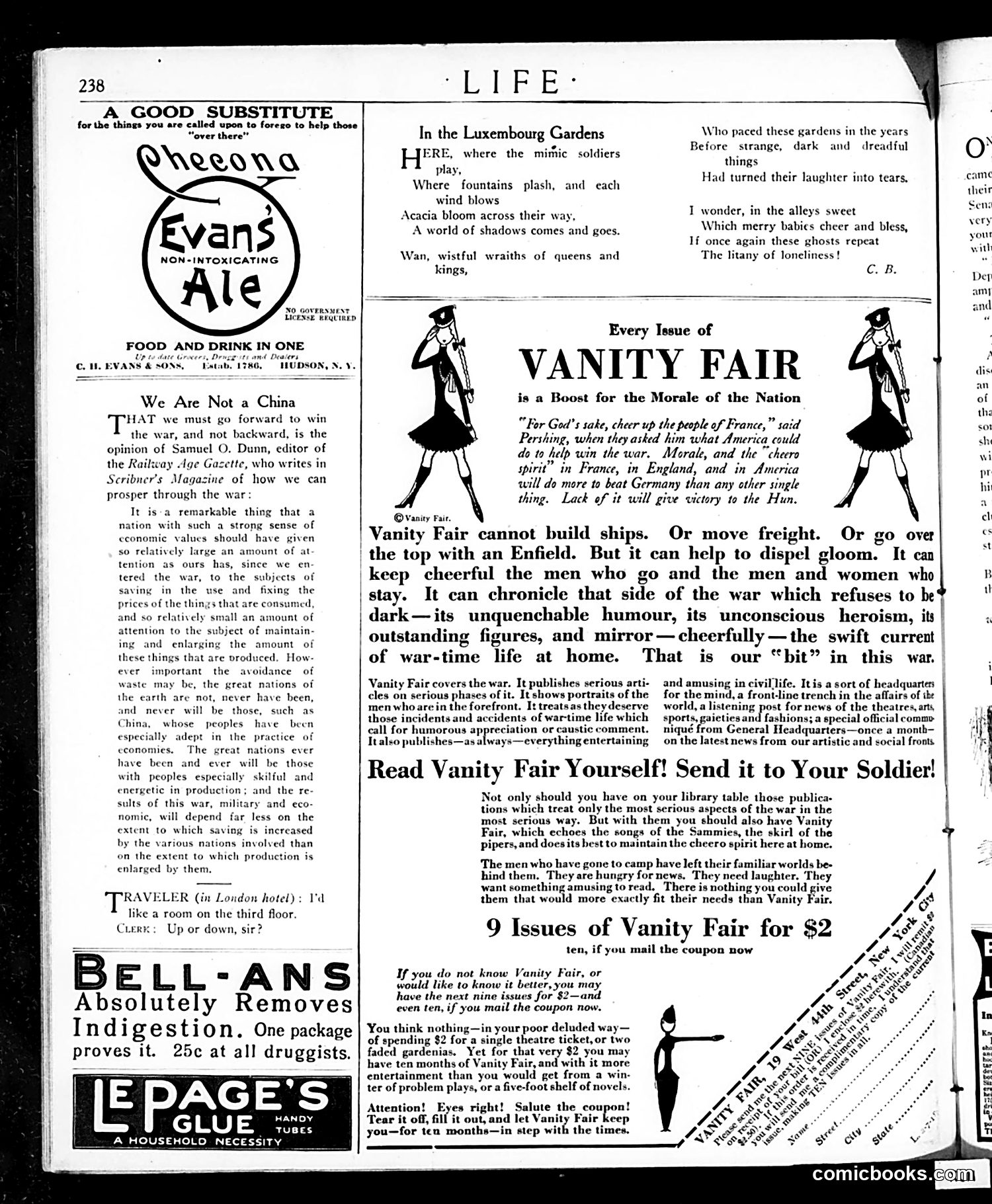
This page comprises advertisements and war-related editorial content from World War I-era Life magazine (likely 1917-1918). **Main Content:** The central feature is a **Vanity Fair advertisement** framed as patriotic messaging. It argues that Vanity Fair serves the war effort by maintaining civilian morale—citing General Pershing's statement that American support should "cheer up the people of France." The ad claims the magazine provides humor and human interest stories that sustain spirits at home and among soldiers. **Supporting Material:** - A poem "In the Luxembourg Gardens" reflects nostalgically on pre-war Paris, noting how conflict has transformed civilian life - An editorial by Samuel O. Dunn argues America must prioritize *production* over mere conservation to win the war - Side advertisements for non-intoxicating ale and other consumer goods frame themselves as patriotic substitutes **The Satire:** The implicit irony: a luxury magazine positioned itself as essential war support through morale-boosting rather than material contribution—a clever marketing angle that elevated entertainment to patriotic duty during wartime scarcity.
📄 Transcribed text from this page (OCR, searchable)
Machine-transcribed from the original scan — historical spelling and the odd misread are preserved.
238 A GOOD SUBSTITUTE for the things you are called upon to forego to help those No Goversstext LICENSE REQUIRED FOOD AND DRINK IN ONE Up 0 We Are Not a China HAT we must go forward to win the war, and not backward, is the opinion of Samuel O. Dunn, editor of the Railway Age Gazette, who writes in Scribner's Magazine of how we can ! prosper through the war: Tt is-a remarkable thing that a nation with such a strong sense of economic values should have given so relatively large an amount of at tention as ours has, since we en tered the war, to the subjects of saving in the use and fixing the | prices of the things that are consumed, and so relatively s jount of attention to the subject of ing and enlarging the unt of these things that are vroduced. How- ever important the avoidance of waste may be, the great nations of the earth are not, never have been, and never will be those, such as China, whose peoples have been especially adept in the practice of economies. The great nations ever and ever will be those with peoples especially skilful and energetic in production; and the re- ary and eco- have been sults of this war, n less on the extent to which saving is increased by the various nations involved than on the extent to which production is enlarged by them, nomic, will depend fi “LIFE: In the Luxembourg Gardens ERE, play, Where fountains plash, and each wind blows Acacia bloom across their way, A world of shadows comes and goes. Who paced these gardens in the years Before strange, dark and dreadful things Had turned their laughter into tears, where the mimic soldiers I wonder, in the alleys sweet Which merry babies cheer and bless, If once again these ghosts repeat Wan, wistful wraiths of queens and The litany of loneliness! kings, CB. Every Issue of VANITY FAIR is a Boost for the Morale of the Nation "For God’s sake, cheer up the people of France,” said Pershing, when they asked him what America could do to help win the war. Morale, and the “cheero spirit” in France, in England, and in America will do more to beat Germany than any other single thing. Lack of it will give victory to the Hun. ©Vanity Fair. Vanity Fair cannot build ships. Or move freight. Or go ove i s, * . | the top with an Enfield. But it can help to dispel gloom. It can | keep cheerful the men who go and the men and women who stay. It can chronicle that side of the war which refuses to be dark—its unquenchable humour, its unconscious heroism, its | outstanding figures, and mirror — cheerfully —the swift current of war-time life at home. That is our “bit” in this war. covers the war. It publishes serious arti- us phases of it. It shows portraits of the e forefront. It treatsas they deserve those dents and accidents of wartime life which call for humorous appreciation or caustic comment. Italso publishes—as always—everything entertaining Read Vanity Fair Yourself! Send it to Your Soldier! Not only should you have on your library table those publica- a and amusing in civil life. It is a sort of headquarters for the mind, a front-line trench in the affairs of ibe world, a listening Fee for news of the theatres, arty, sports, gaicties and fashions; a special official commo- niqué from General Headquarters—once a month- on the latest news from our artistic and social fronts most serious way. But with them you should also have Vanity Fair, which echoes the songs of the Sammies, the pipers, and does its best to maintain the cheero spirit here at home. The men who have gone to camp have left their familiar worlds be- RAVELER (in London hotel): I'd like a room on the third floor. Crerx: Up or down, sir? BELL-ANS Absolutely Removes Indigestion. One package proves it. 25c at all druggists. ruses A _HOUSEHOLO NECESSITY hind them. They are hungry for news. They need laughter. They / want something amusing to read. ‘There is nothing you could give 7 them that would more exactly fit their needs than Vanity Fair. 7 ‘Ss . a xe 9 Issues of Vanity Fair for $2 4% ten, if you mail the coupon now Zo SSS If you do not know Vanity Fair, or would like to know it better, you may have the next nine issues for $2—and even ten, if you mail the coupon now. You think nothing—in your poor deluded way— of spending $2 for a single theatre ticket,or two faded gardenias. Yet for that very $2 you may have ten months of Vanity Fair, and with it more entertainment than you would get from a win- ter of problem plays, or a five-foot shelf of novels. Attention! Eyes right! Salute the coupon! Tear it off, fill it out, and let Vanity Fair keep you—for ten months—in step with the times, tions which treat only the most serious aspects of the war in the | skirl of the bd comicbooks.