
A complete issue · 40 pages · 1918
Life — January 10, 1918
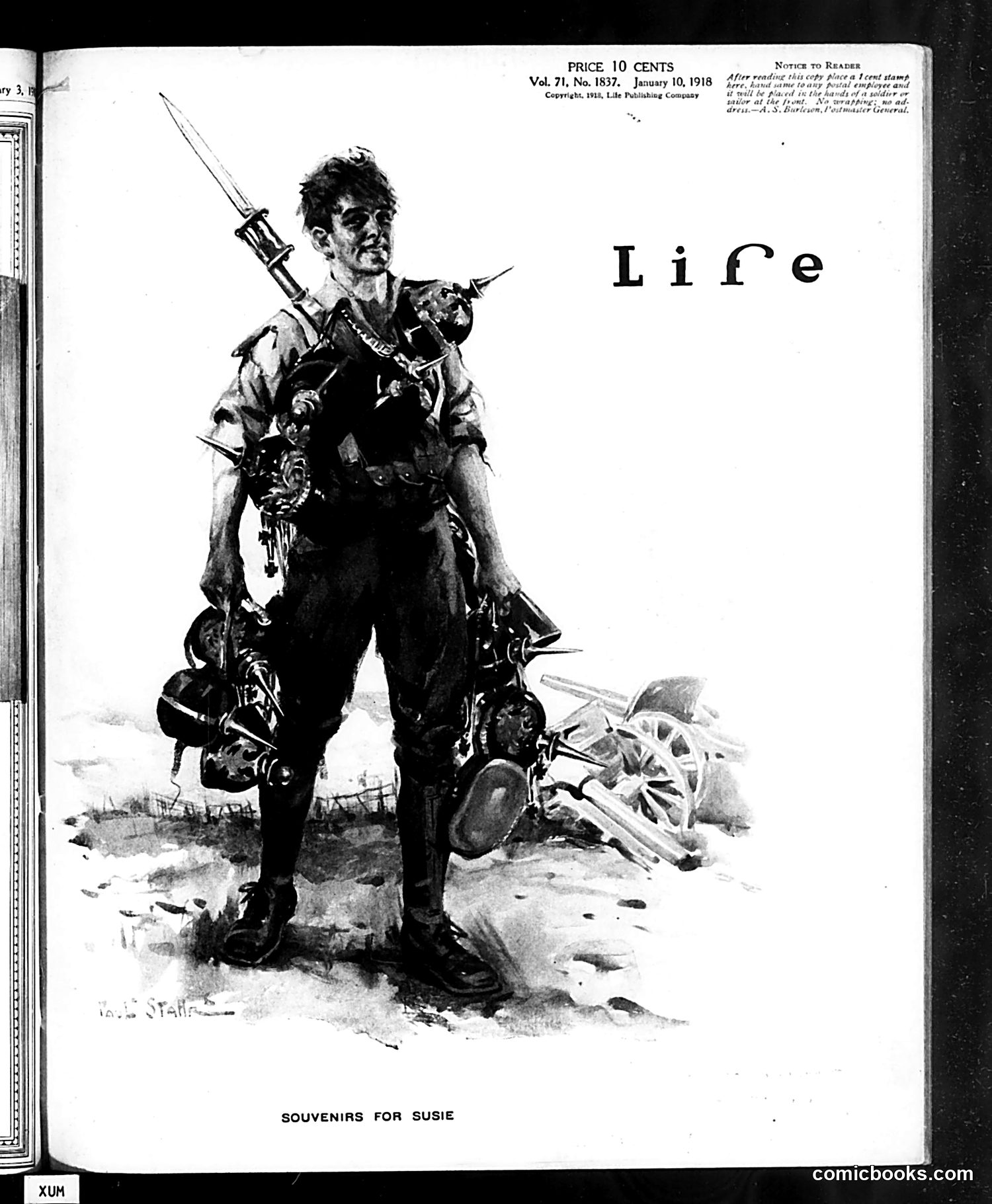
This WWI-era illustration depicts a heavily armed American soldier standing amid battlefield wreckage, holding weapons and military equipment. The caption "Souvenirs for Susie" suggests he's collecting war trophies—likely weapons and gear—to send home to a female companion. The cartoon satirizes the common practice of soldiers gathering souvenirs from combat zones. The contrast between the brutal reality of trench warfare (shown by the damaged artillery in the background) and the sentimental framing of collecting "souvenirs" for a sweetheart creates dark humor. It mocks both the romanticization of war at home and soldiers' attempts to maintain romantic connections amid combat's horrors. The illustration reflects American involvement in the final year of World War I.
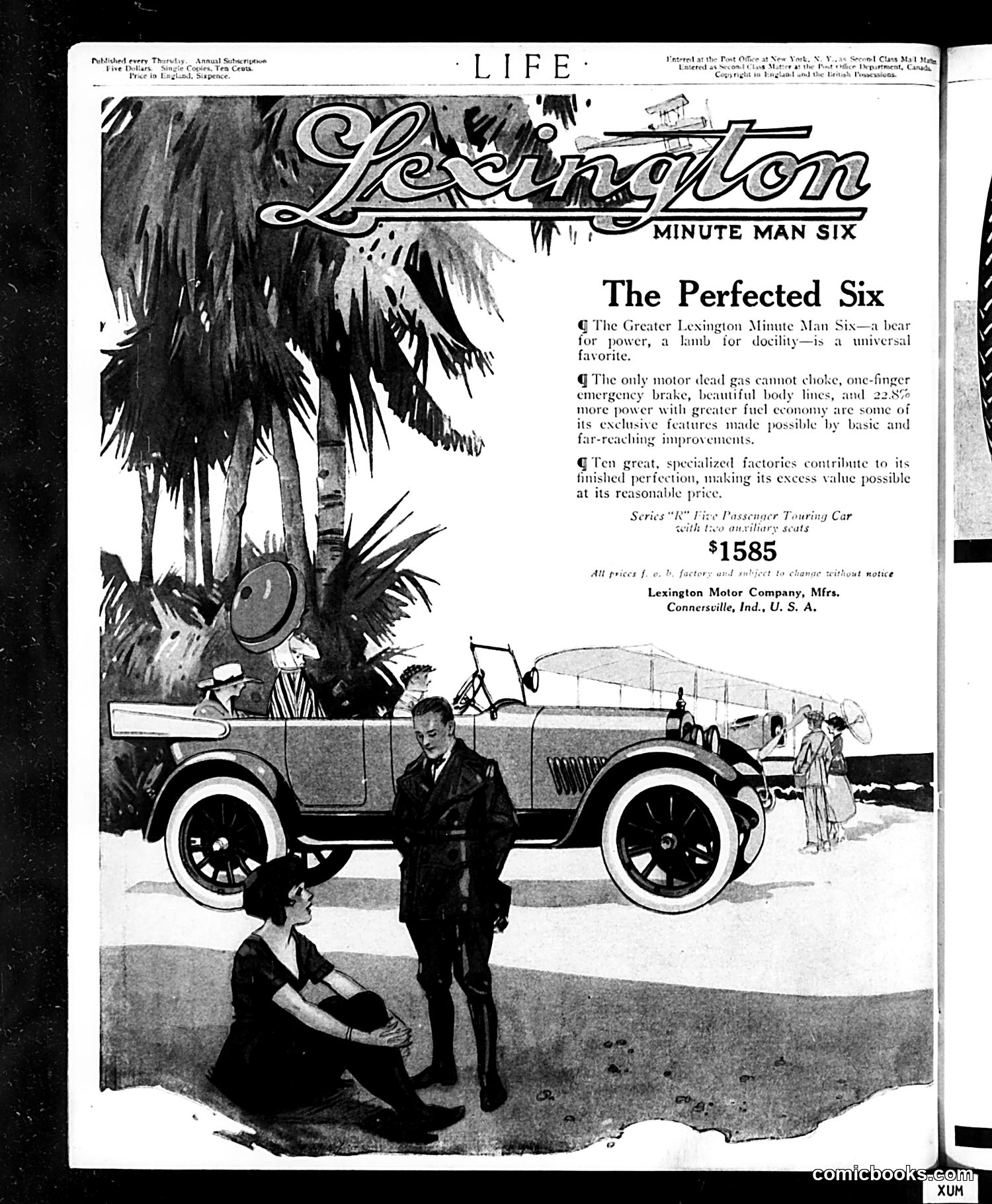
This page is primarily a **car advertisement**, not political satire. It advertises the Lexington automobile's "Minute Man Six" model, priced at $1,585. The ad uses patriotic American imagery—a colonial-era minuteman monument with palm trees—to evoke reliability and American craftsmanship. The marketing copy emphasizes technical features: a motor requiring no choke, emergency brake, and fuel economy. The illustration shows a well-dressed couple admiring the car in a tropical setting, suggesting luxury and leisure. This appears to be **straightforward commercial advertising** leveraging nationalist symbolism to market automobiles during what seems to be the 1920s era, when such patriotic branding was common. The "Minute Man" name itself references American Revolutionary readiness—implying the car's immediate availability and reliability.
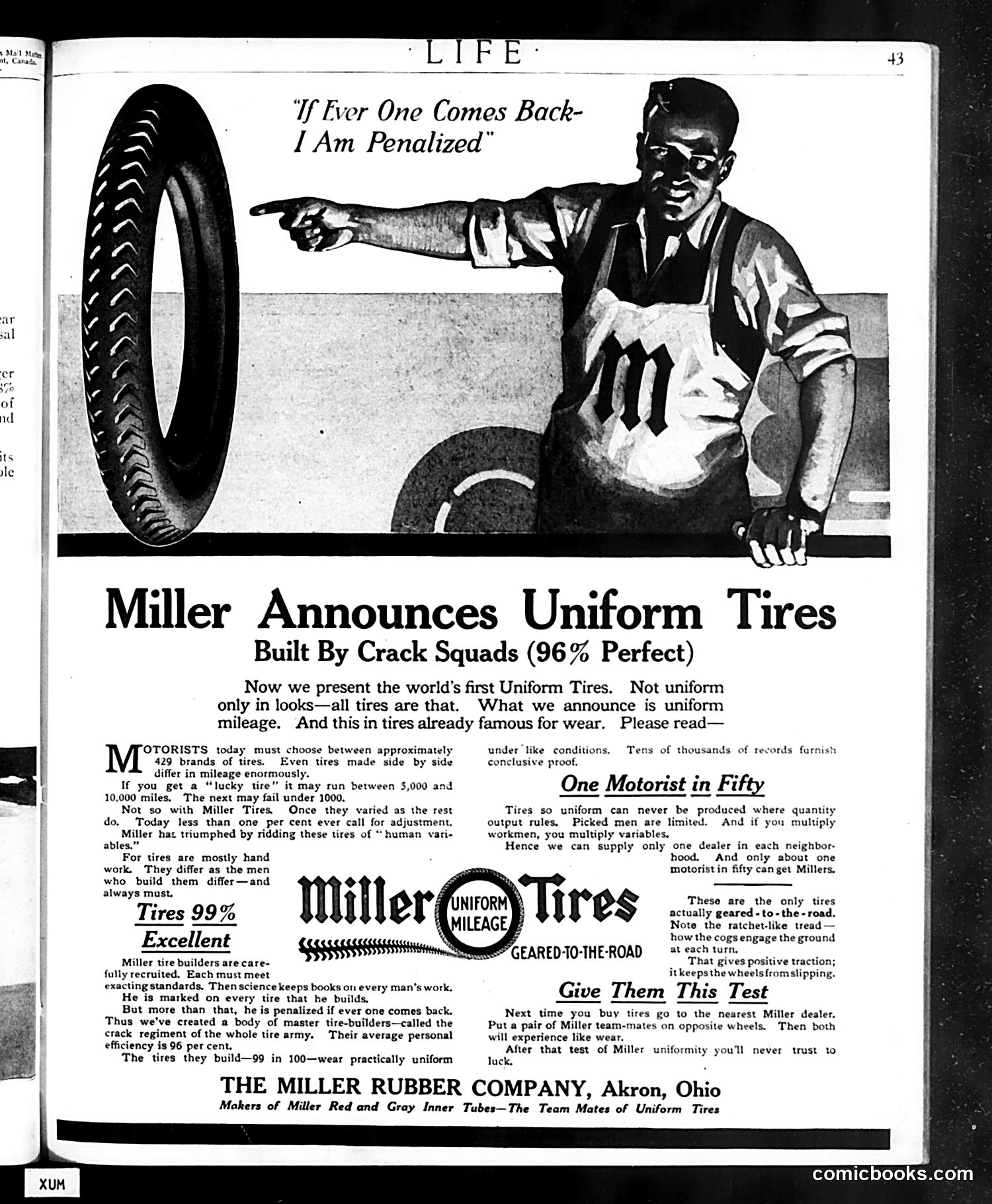
This page is primarily a **vintage tire advertisement**, not political satire. It's a 1920s-era ad for Miller Uniform Tires by The Miller Rubber Company of Akron, Ohio. The illustration shows a factory worker in an apron pointing at a tire, with the quote "If Ever One Comes Back—I Am Penalized." This reflects the ad's central claim: Miller tires are built with such consistent quality ("96% Perfect") that workers face penalties if defective tires are returned. The ad emphasizes **standardized manufacturing** and quality control as selling points—revolutionary concepts for the era. The "Crack Squads" reference appears to mean skilled production teams. The marketing targets motorists frustrated by tire variability, promising uniform mileage and reliability. This is commercial advertising, not political commentary.
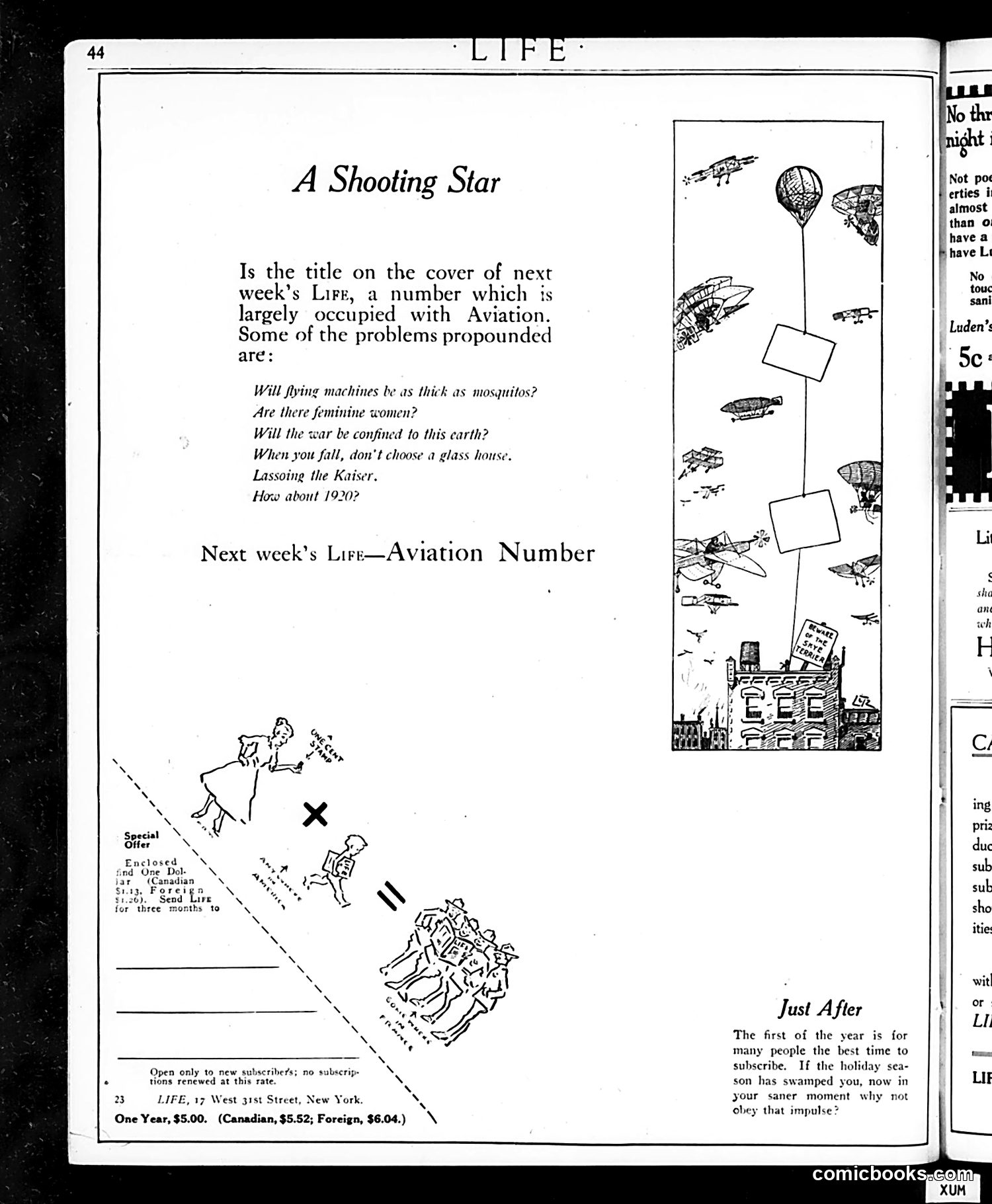
This page announces next week's Aviation-themed issue with satirical questions about flying's future: **The cartoon illustrations** show figures being thrown about by explosive forces (marked with "X" and "II" symbols), depicting people falling or tumbling through the air—likely satirizing the dangers and unpredictability of early aviation. **The key questions posed** include absurdist predictions: "Will flying machines be as thick as mosquitos?" and "When you fall, don't choose a glass house," suggesting anxiety about crowded skies and crash dangers. **The right illustration** shows various aircraft hovering over a city building, reinforcing this vision of aerial congestion. This reflects 1920s-era skepticism about aviation's rapid development and public nervousness about whether air travel would become commonplace yet remain inherently risky.
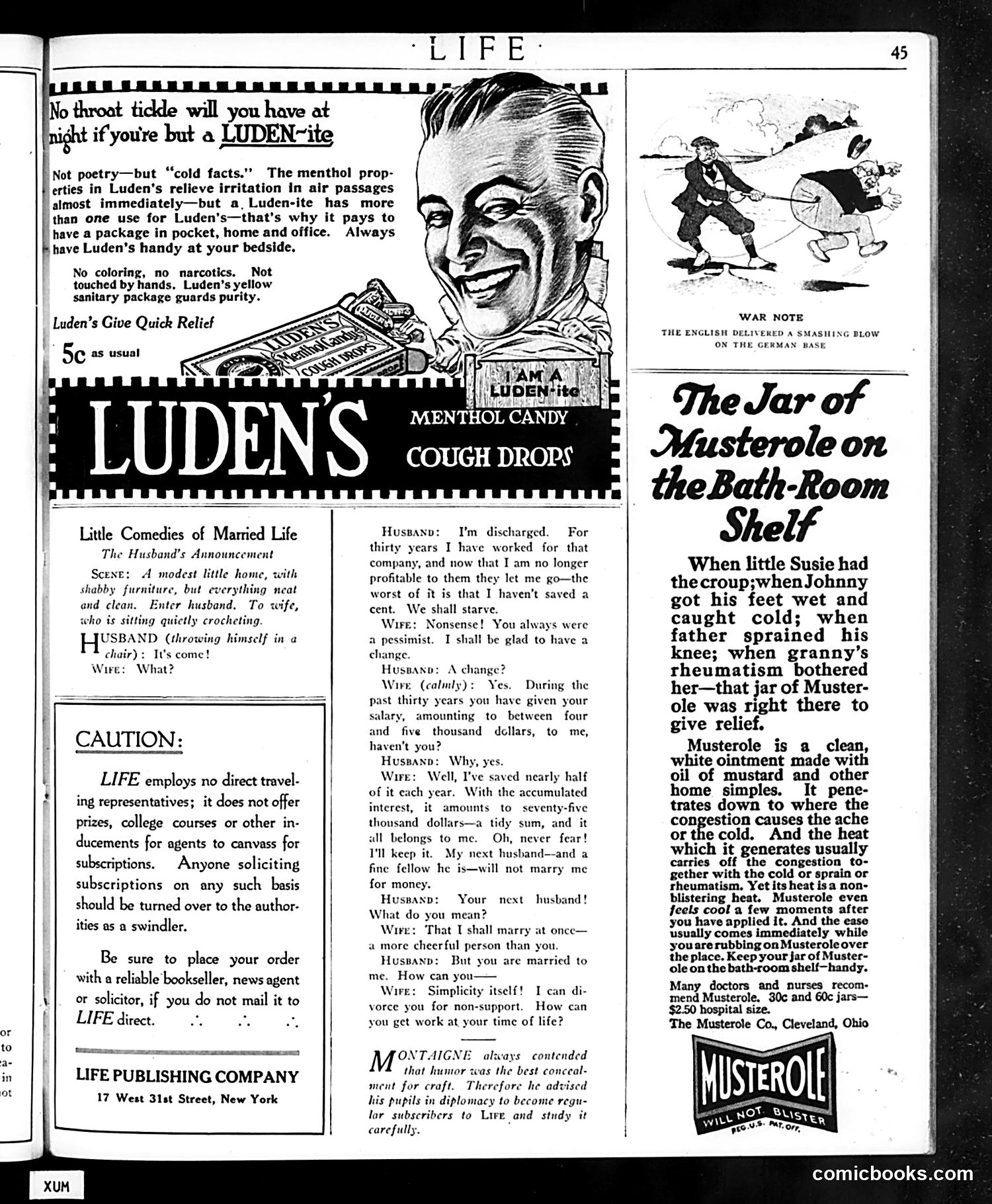
This page is primarily **advertising and humor content** rather than political satire. The main feature is a "Little Comedies of Married Life" sketch depicting marital discord: a husband announces his discharge after thirty years of employment, having saved nothing. His wife responds sarcastically, eventually threatening divorce for non-support. The joke relies on period-typical gender dynamics and economic anxiety during what appears to be an employment crisis. The page also includes advertisements for **Luden's cough drops** and **Musterole ointment**, typical commercial products of the era. A small illustration captioned "War Note" shows British soldiers engaged in combat on a German base—a contemporary reference to WWI operations. The content reflects early 20th-century concerns about employment security, domestic relations, and wartime activity.
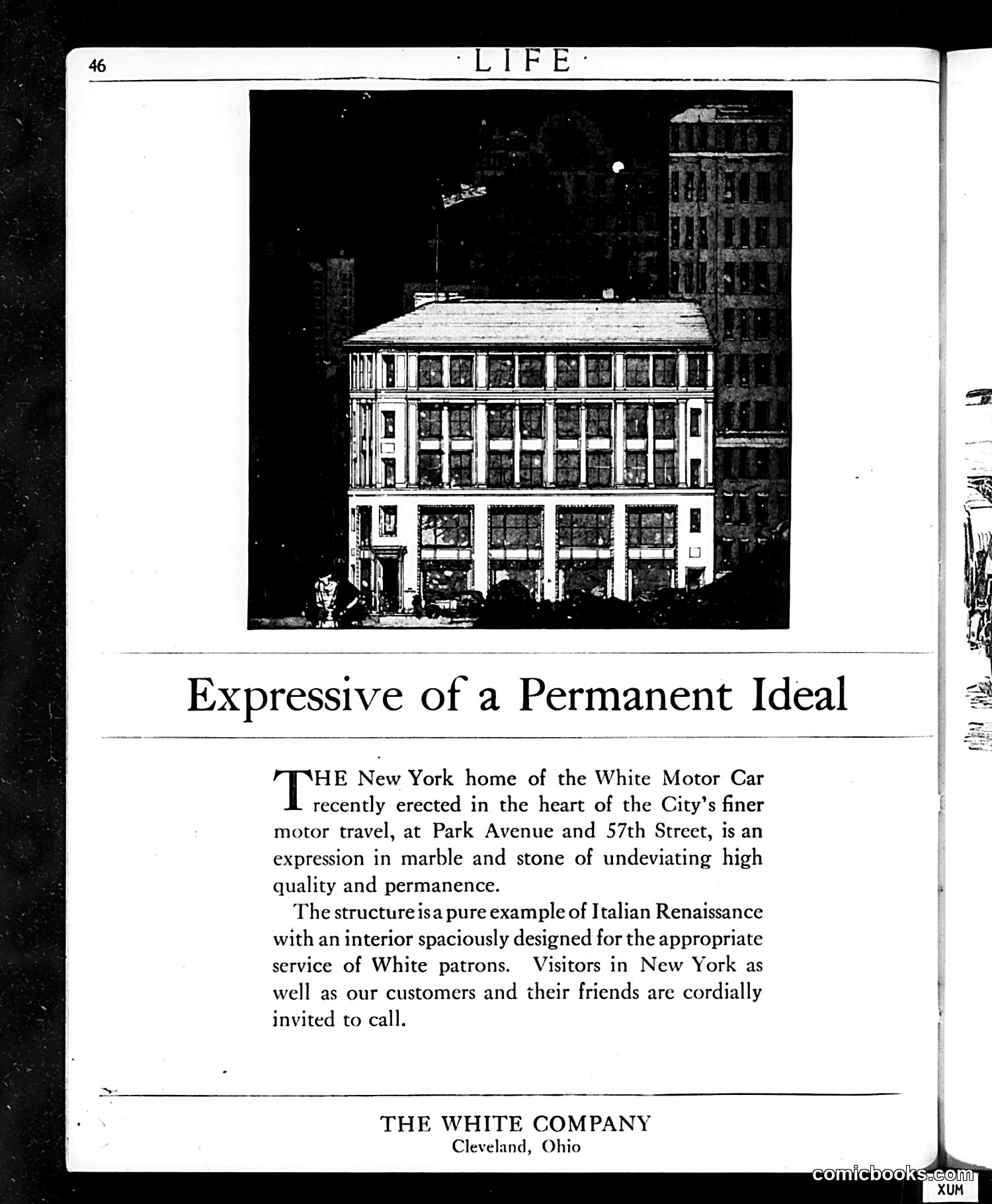
This is **not a cartoon or satirical content**—it's a straightforward advertisement for the White Motor Car Company's New York showroom, located at Park Avenue and 57th Street. The image shows the building's nighttime photograph, described as Italian Renaissance architecture in marble and stone. The text presents it as a permanent, high-quality establishment serving White automobile customers and New York visitors. The phrase "Expressive of a Permanent Ideal" emphasizes the company's stability and prestige through its architectural choice. This appears in *Life* magazine because the publication carried paid advertisements alongside its satirical content. There is no satire or political commentary here—simply a luxury car company establishing its credibility through impressive real estate.
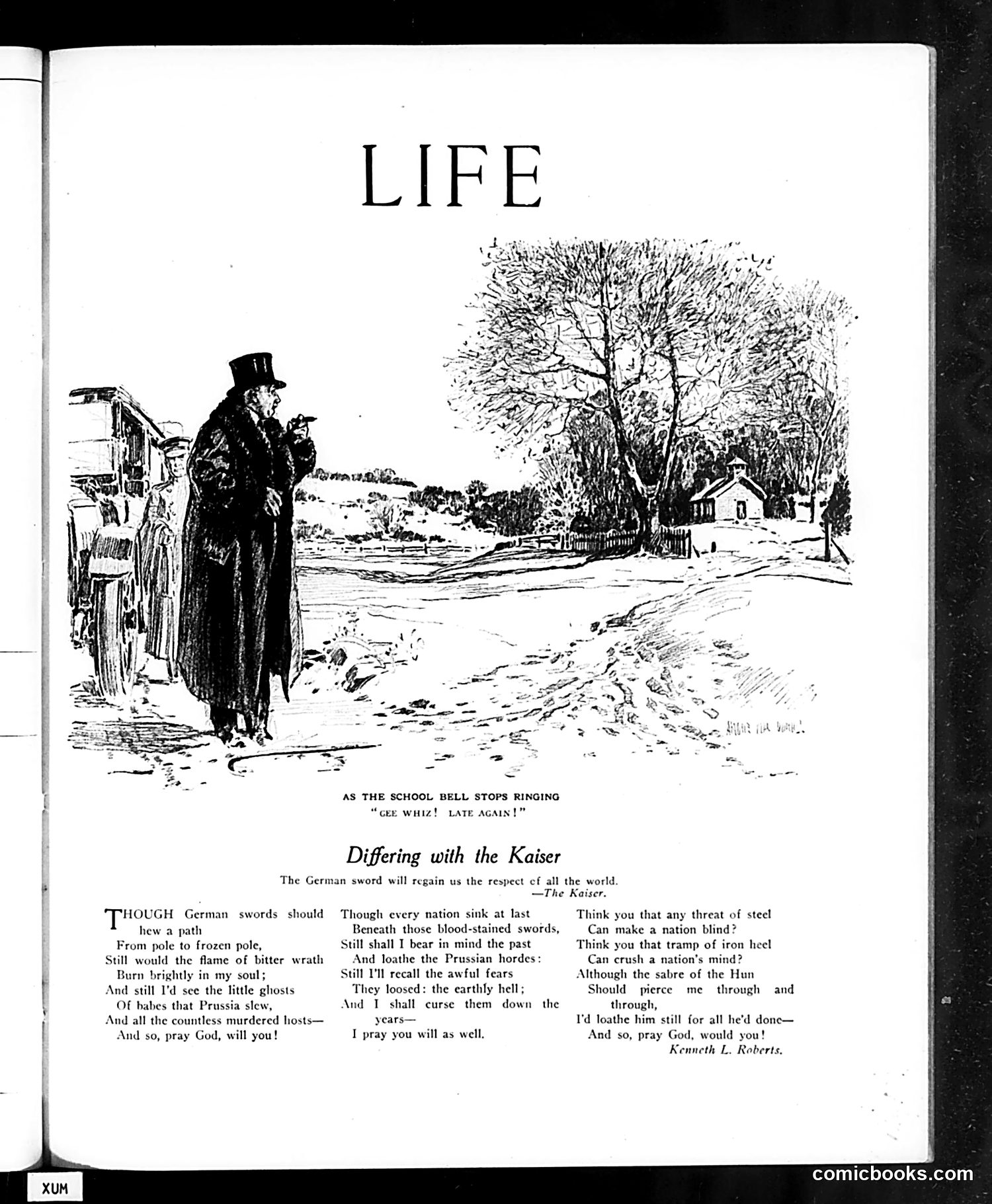
This is a title page for an article titled "Differing with the Kaiser." The illustration shows a man in formal dress and top hat standing beside what appears to be a rural schoolhouse, with the caption "As the school bell stops ringing 'Gee Whiz! Late Again!'" The poem by Kenneth L. Roberts that follows expresses anti-German sentiment during what appears to be World War I era. It references "German swords," "Prussian hordes," and "blood-stained swords," while calling for prayers against German threats to the nation. The juxtaposition of an ordinary American scene (late student, rural school) with fierce anti-Kaiser rhetoric suggests the satire: contrasting American innocence and everyday life with the perceived threat posed by Germany's military leadership under Kaiser Wilhelm II.
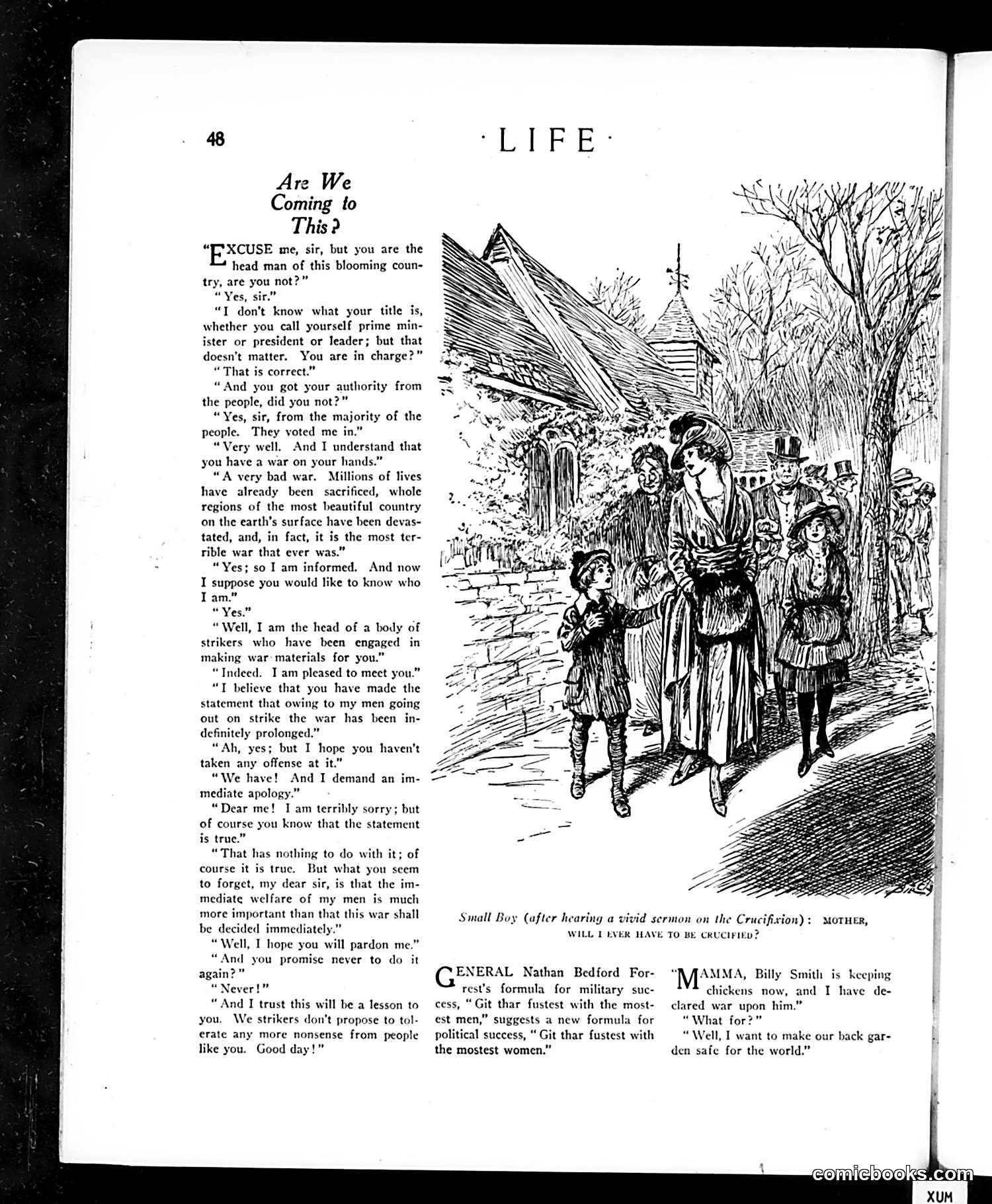
This page satirizes **labor strikes during wartime**. The dialogue on the left shows a confrontation between a government official and a strike leader who claims authority from "the majority of the people." The official argues that prolonging strikes during a devastating war prioritizes strikers' immediate welfare over national necessity. The illustration depicts **children walking past a church**, with the caption referencing a "vivid sermon on the Crucifixion" and asking if "small boys" will "ever have to be crucified?"—suggesting the moral weight of wartime sacrifice. The bottom section mocks **General Nathan Bedford Forrest's military maxim** ("Get thar fustest with the mostest men"), proposing a political parallel about success requiring "the mostest women." The satire critiques both strike justifications and questions wartime priorities.
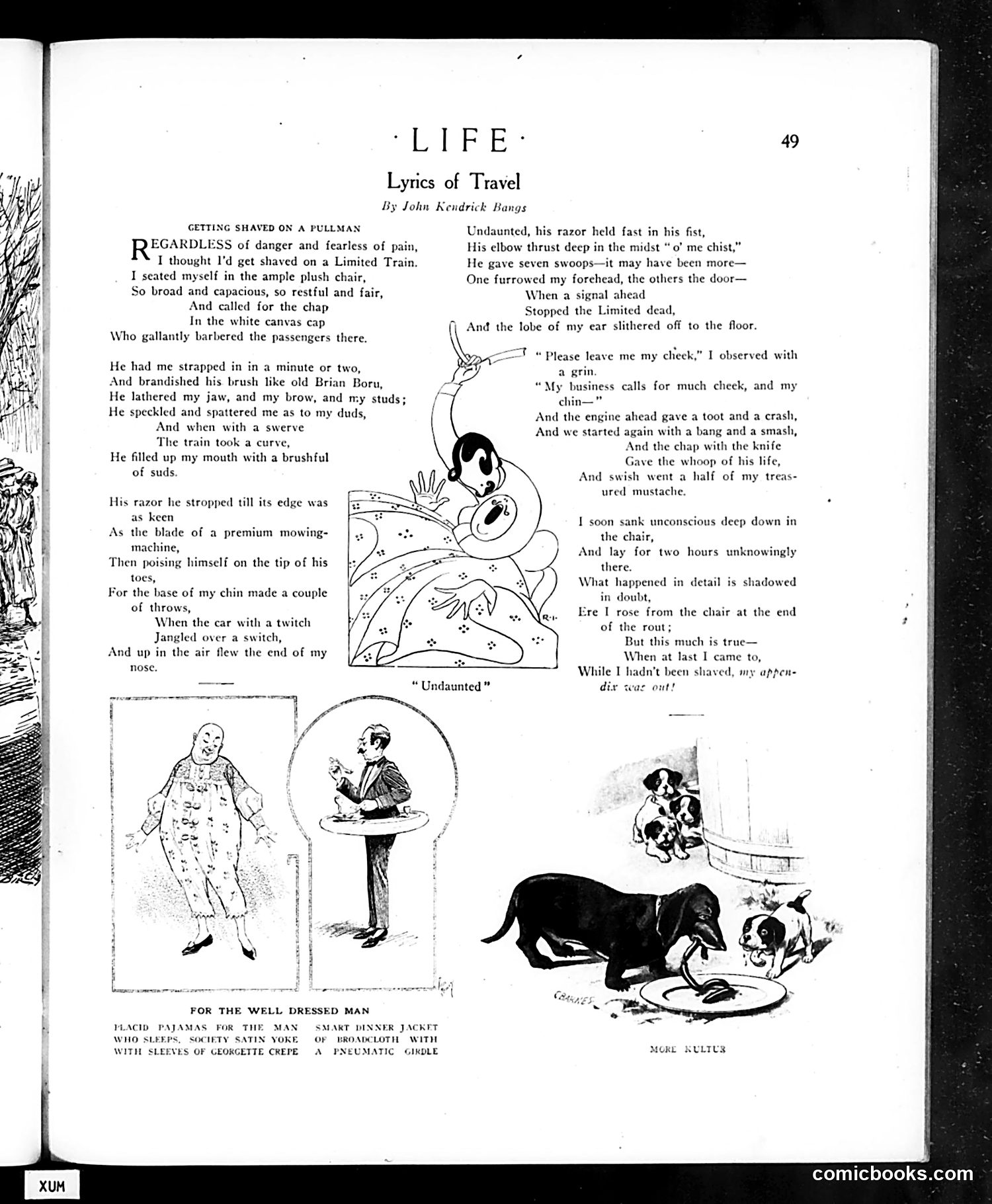
This humorous poem by Bangs recounts a chaotic train-station shave. The barber carelessly nicks the narrator repeatedly—his razor is dull, his technique reckless—causing blood, pain, and comic indignity. The narrator loses part of his mustache and nearly his ear. The accompanying illustrations show the barber's wild movements and the narrator's suffering. Below, smaller cartoons mock fashion ("For the Well Dressed Man") and show contrasting domestic scenes—one of a well-dressed man, and another of dogs begging at a dinner table. The satire targets incompetent service workers and the indignities of travel itself—a common theme in early 20th-century humor magazines mocking modern inconveniences and poorly-trained service providers.
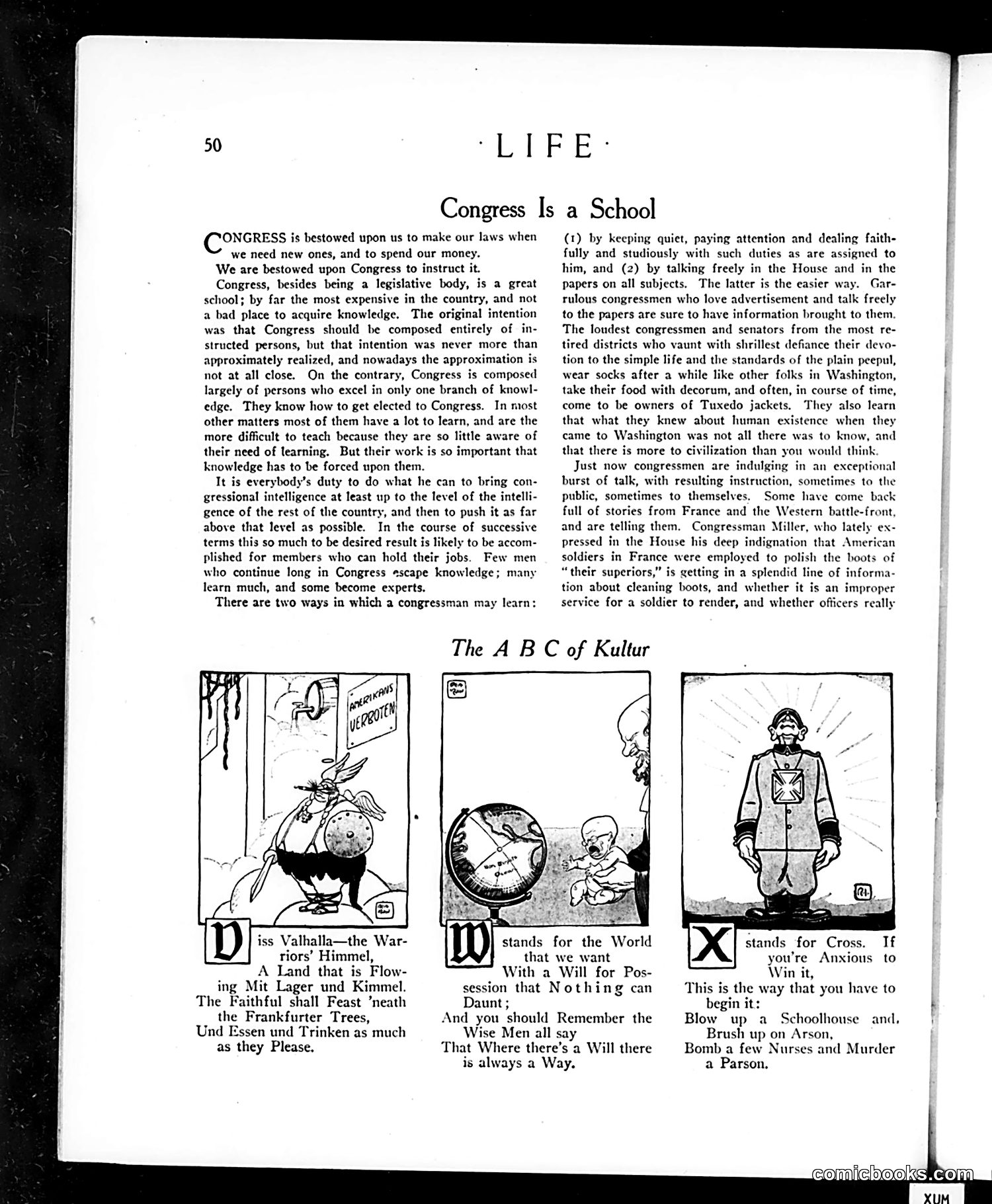
This page satirizes German militarism and culture during World War I through dark humor. "The ABC of Kultur" presents three illustrated panels mocking German values: - **D** depicts Valhalla (Norse warrior heaven), referencing German romantic glorification of warfare - **W** shows a globe with possessive language ("the World that we want / With a Will for Possession"), critiquing German imperial ambitions - **X** displays a military figure labeled "Cross," with text joking about bombing schoolhouses, brushing up on arson, and murdering nurses and parsons—sarcastically listing atrocities attributed to German conduct The cartoon equates German "Kultur" (culture) with militarism, imperialism, and violence against civilians. This reflects American wartime propaganda portraying Germany as barbaric, published before U.S. entry into WWI (1917).
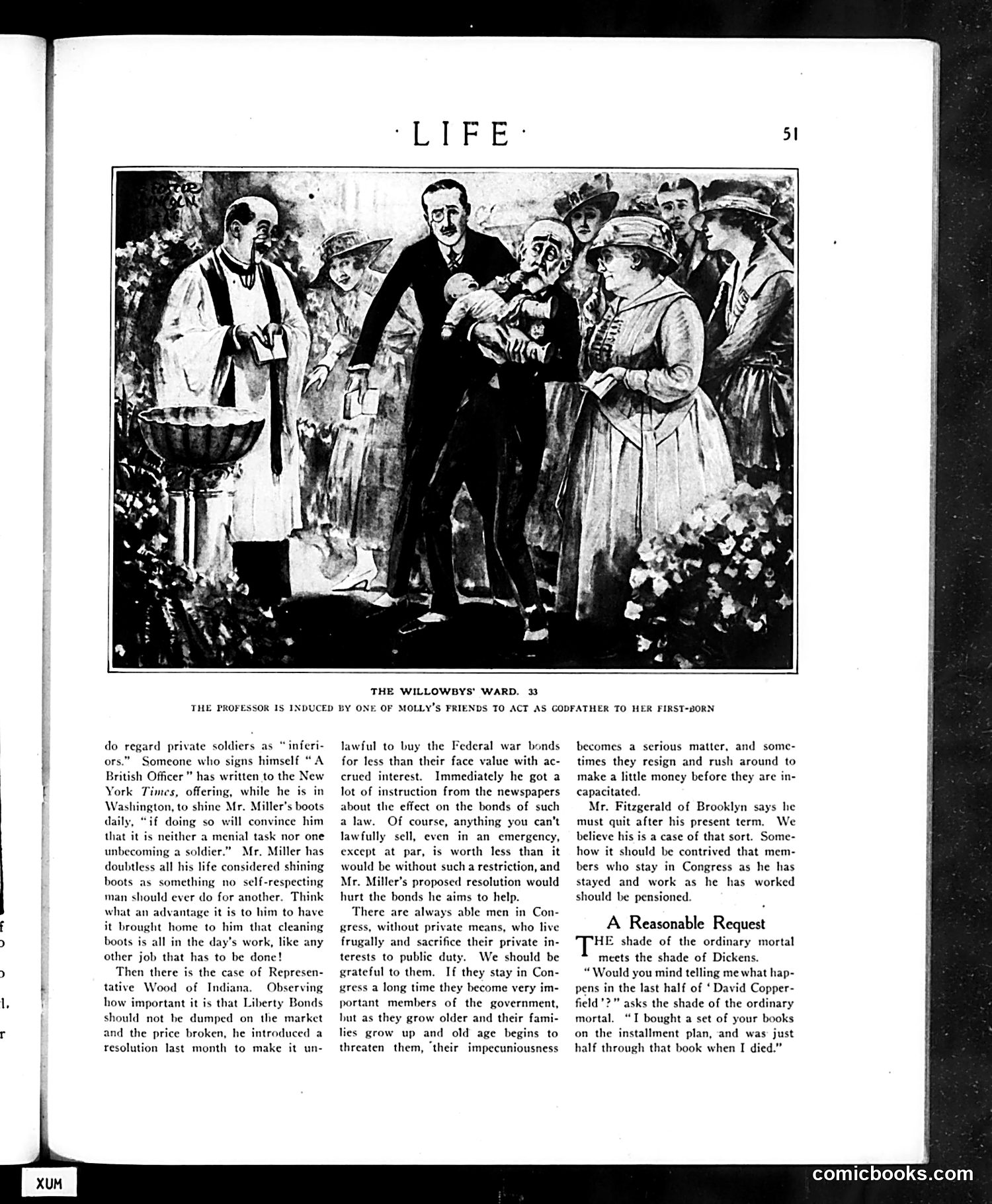
This illustration from Life magazine shows a christening or baptism scene. The caption indicates "The Professor is induced by one of Molly's friends to act as godfather to her first-born." The accompanying text discusses Liberty Bonds during what appears to be World War I era. It critiques how some people view military service, quoting someone who dismisses "private soldiers as 'inferiors.'" The article argues against this class-based attitude, advocating that those serving in Congress should face financial sacrifice equal to ordinary citizens. The satire appears to mock social pretension—the scene shows formally dressed characters at a religious ceremony, likely illustrating how class distinctions persist even in solemn family moments. The juxtaposition with the Liberty Bonds discussion suggests commentary on unequal war sacrifice based on social status.
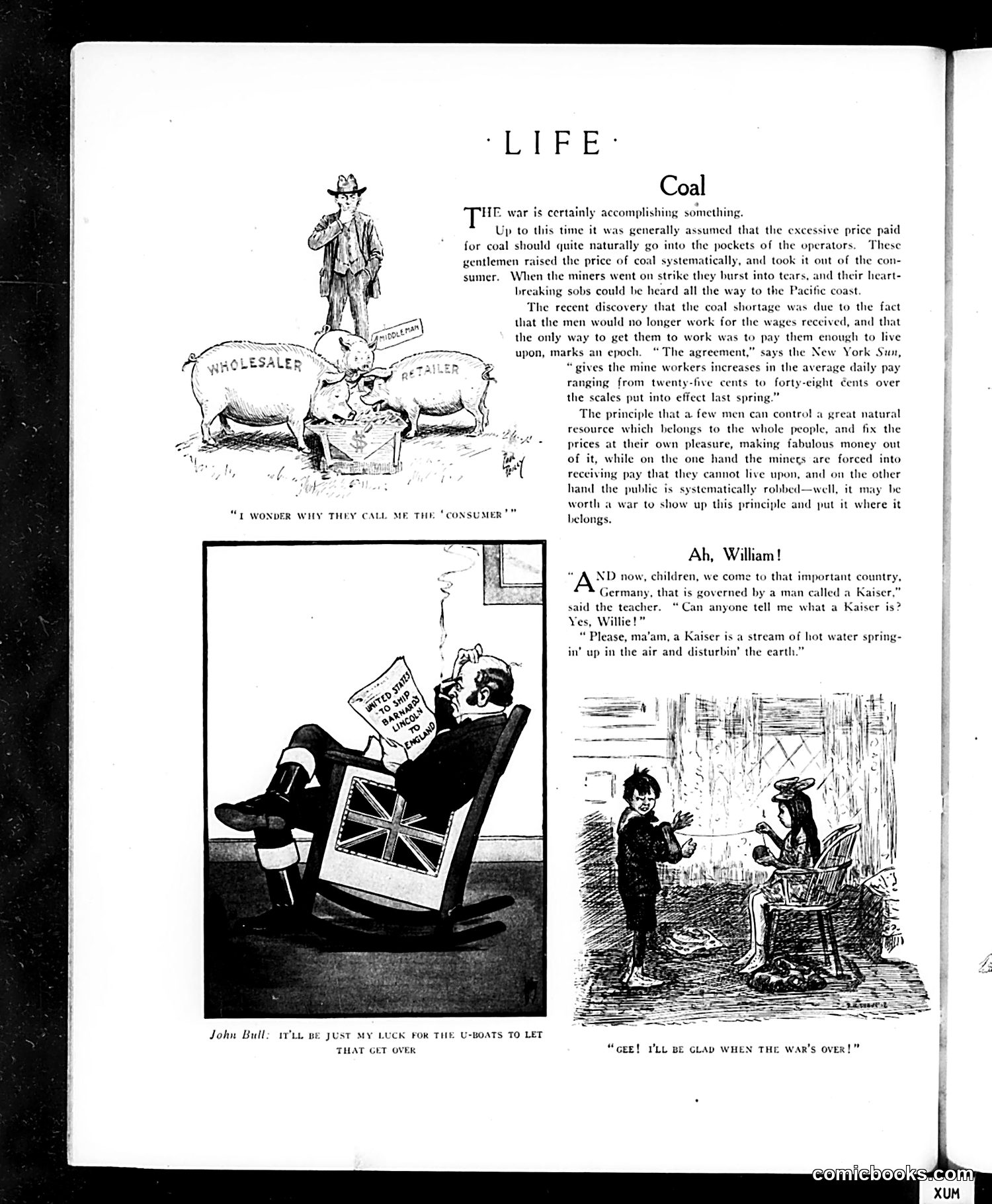
This page satirizes WWI-era economic issues. The top cartoon critiques coal pricing: a figure labeled "wholesaler" and "retailer" stands over consumers, illustrating how middlemen profit while miners work for inadequate wages. The caption "I wonder why they call me the 'consumer'" suggests consumers bear the cost burden. The lower left cartoon shows "John Bull" (Britain, represented by the Union Jack chair) hoping U-boats will "let that get over"—referencing German submarine warfare threatening British supply lines. The right section features a dialogue where a teacher explains Germany is governed by a "Kaiser" (German emperor), defining it as "a stream of hot water springin' up in the air and disturbin' the earth"—mocking both Kaiser Wilhelm II and the war's destabilizing effects. A child responds hopefully that the war will soon end.
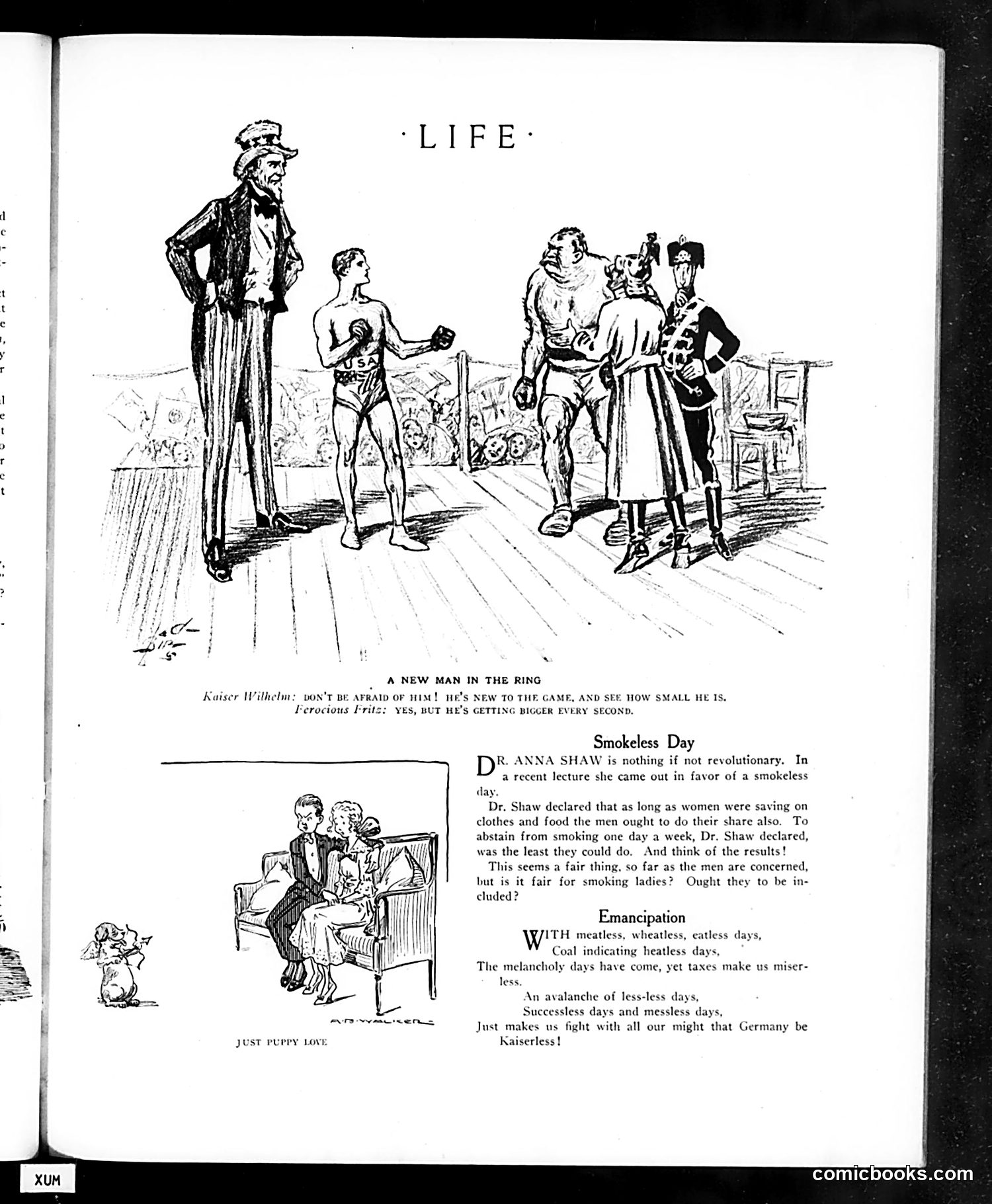
**Top Cartoon: "A New Man in the Ring"** This depicts boxing as metaphor for war. Kaiser Wilhelm (German emperor) warns boxer Ferocious Fritz not to fear a new opponent, noting "he's new to the game, and see how small he is" — but adds he's "getting bigger every second." This likely references American entry into World War I (1917), sarcastically suggesting the U.S. would grow stronger as a combatant, contradicting German expectations. **"Smokeless Day" Section** Dr. Anna Shaw advocated for a weekly smokeless day as women's contribution to wartime conservation. The satirist questions whether this "fair thing" should apply to women too, highlighting the gendered nature of wartime sacrifice. **"Emancipation" Poem** Anti-war satire about "meatless, wheatless" rationing days, expressing frustration with wartime restrictions and taxes, sarcastically proposing Germany become "Kaiserless" instead.
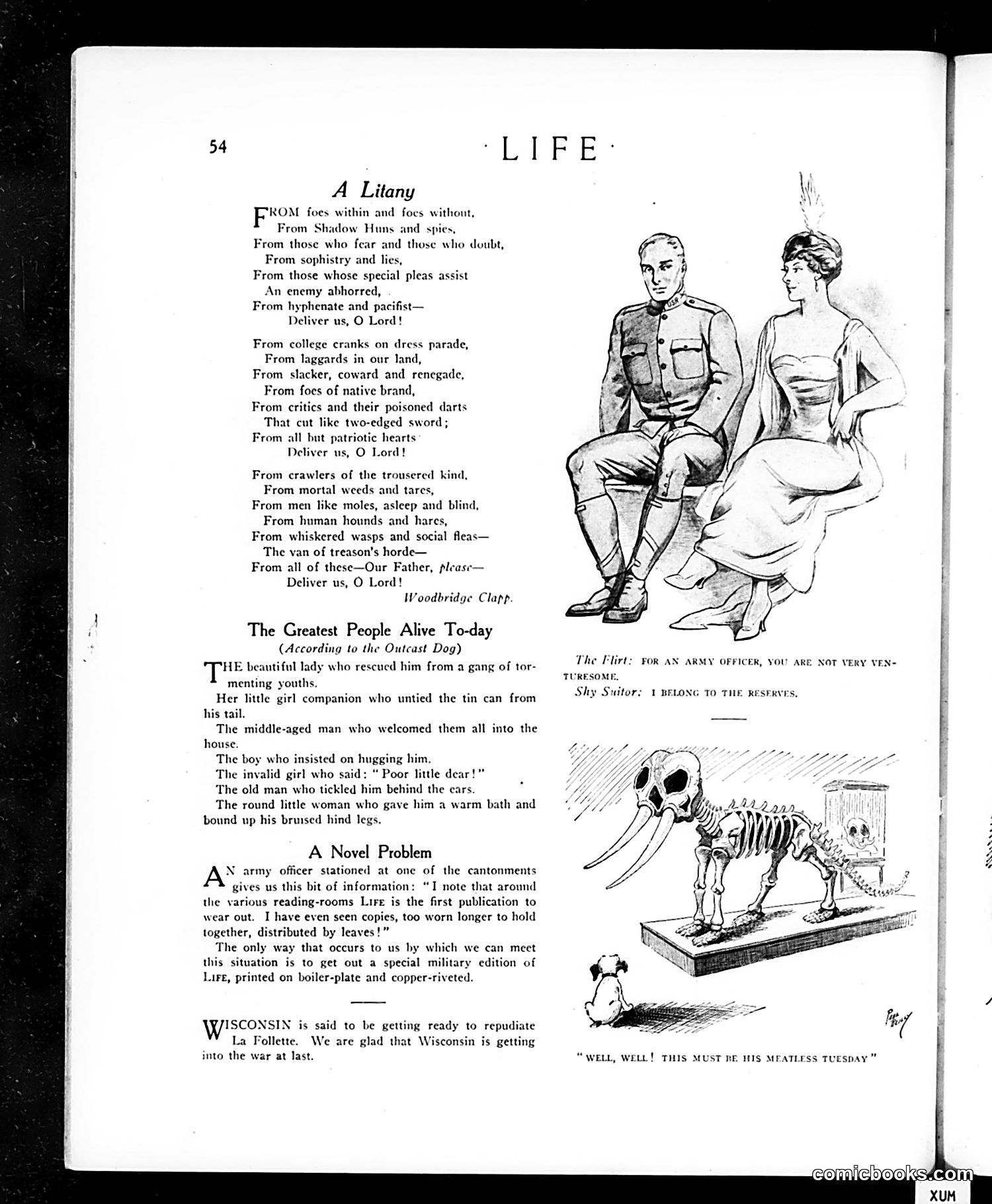
This page contains war-era satirical content from WWI. "A Litany" is a prayer-poem by Woodbridge Clapp seeking divine protection from various social threats—cowardice, corruption, and dishonest critics. The illustration shows a soldier and woman, captioned about an army officer being "not very venturesome." "The Greatest People Alive To-day" humorously lists who a dog considers most important: the lady who rescued it, her girl companion, the welcoming man, a hugging boy, and the girl who said "Poor little dear!"—satirizing human sentimentality toward pets. "A Novel Problem" describes an army officer distributing Life magazines to soldiers in cantonments, noting copies fall apart quickly—essentially advertising Life's durability and appeal to troops. The skeleton cartoon at bottom remains unclear without caption context.
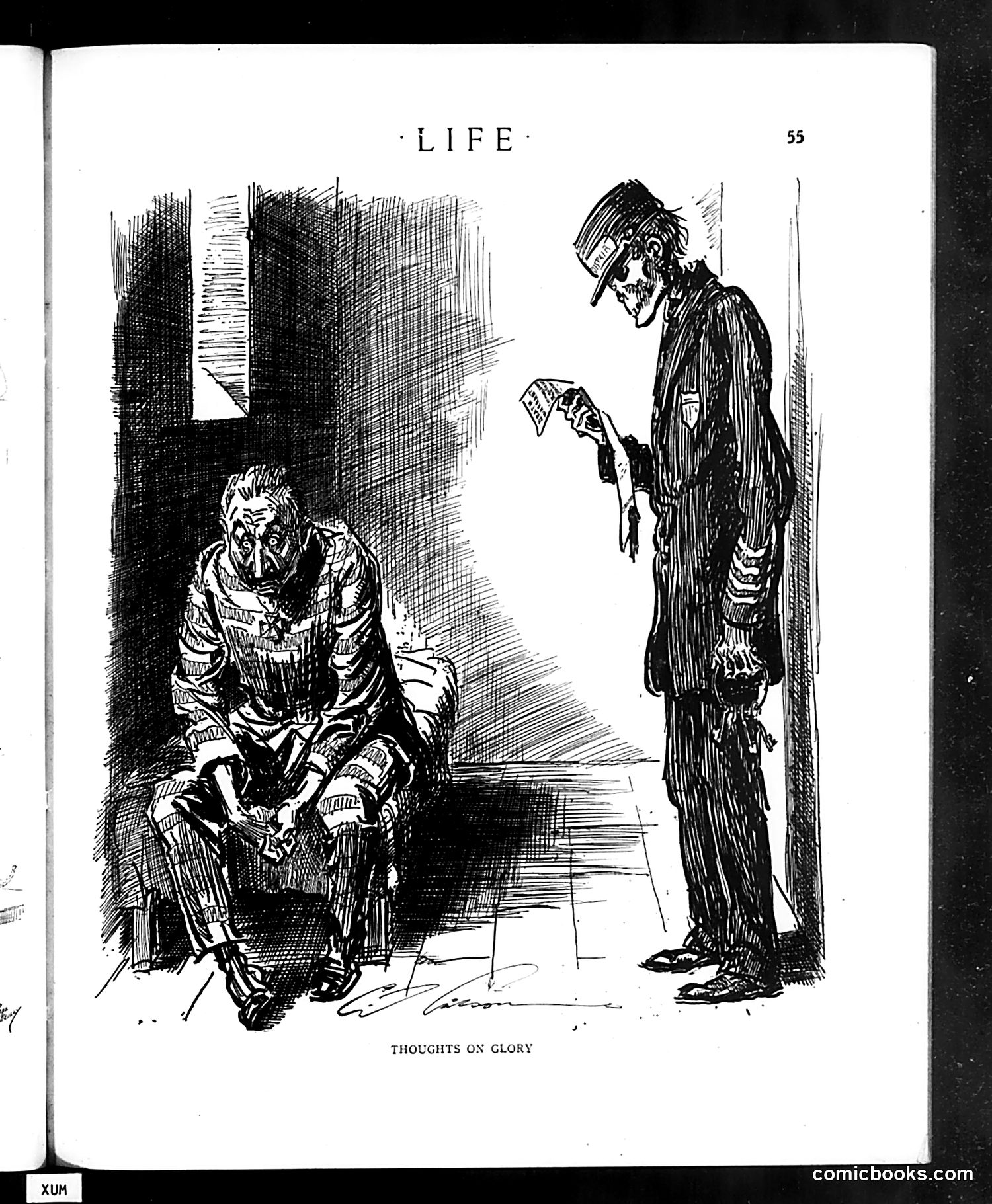
This cartoon depicts two figures in what appears to be a military or institutional setting. On the left sits a disheveled, distressed soldier or serviceman in tattered uniform, looking troubled or defeated. On the right stands a skeletal, death-like figure in a long coat, appearing to offer something (possibly money or papers) to the seated man. The title "Thoughts on Glory" suggests ironic commentary on military service and its rewards. The contrast between the gaunt, skeletal figure and the suffering soldier likely critiques how military glory or honor is presented to soldiers versus the grim reality they face—poverty, injury, or disillusionment. The skeleton may represent death itself, suggesting the hollow nature of wartime promises or glorification.
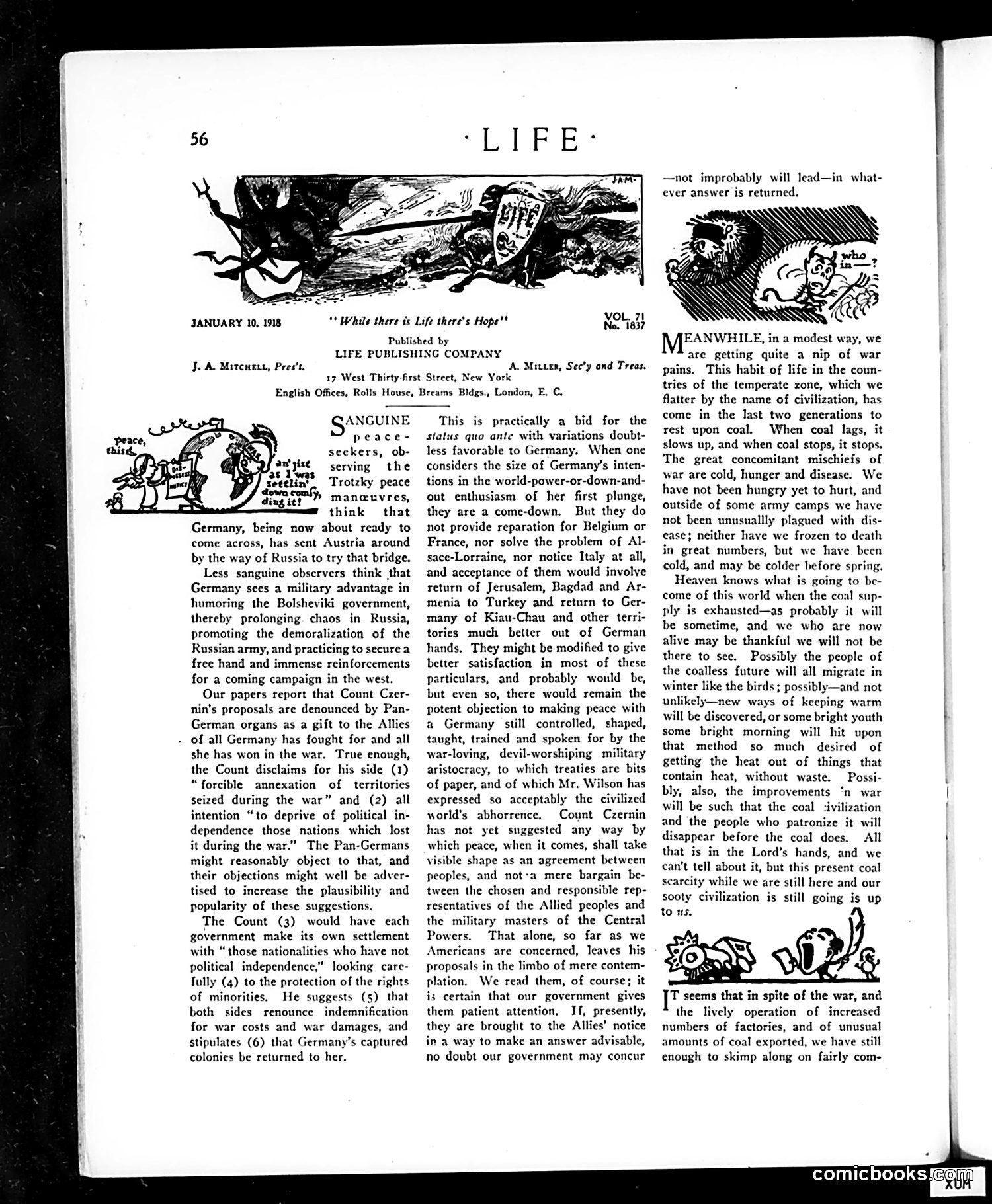
This page discusses peace negotiations during World War I, specifically Count Czernin's (Austria-Hungary's foreign minister) peace proposals. The text skeptically analyzes his six-point plan, which appears moderate but leaves major issues unresolved—Belgium, France, Alsace-Lorraine remain unaddressed, and territories taken from Turkey and Germany are not returned. The cartoon at top-left depicts **Trotsky** (identifiable by the label) as a skeletal death figure, mocking the Bolshevik leader and Russia's chaotic withdrawal from the war. The satire suggests Germany is exploiting Russian turmoil to its advantage. The page's central argument: Count Czernin's proposals, while less extreme than German war aims, fundamentally fail because they preserve Germany's militaristic aristocracy—the root cause of the war. True peace requires not just territorial compromise but fundamental political change in Germany itself, a position aligned with President Wilson's stated war objectives. The darker illustrations represent war's hardships: cold, hunger, and disease afflicting soldiers and civilians.
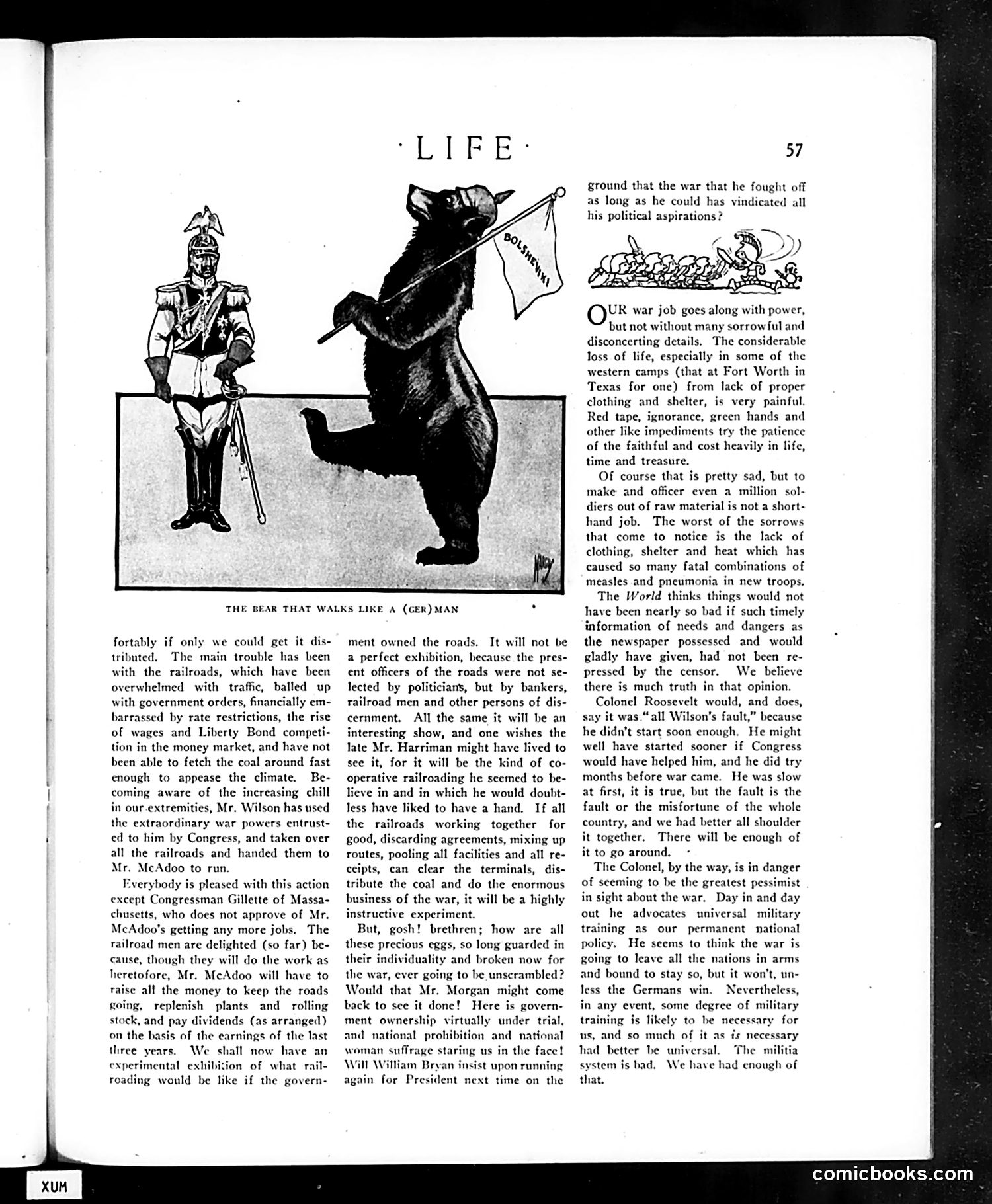
The cartoon depicts a bear labeled "BOLSHEVISM" standing upright on hind legs, mimicking human posture while holding a flag. A German military officer stands nearby observing. The caption's pun—"(Ger)man"—suggests the bear's human-like walk is actually German influence. **Context:** This is WWI-era satire warning that Bolshevism (Russian communism) is being weaponized or manipulated by Germany. The image suggests Germany is using revolutionary communist ideology as a tool, much as a bear might be trained to perform. **Historical reference:** The accompanying text discusses President Wilson's wartime nationalization of American railroads under William McAdoo, suggesting government control of industry. The cartoon likely warns that such government takeovers, combined with revolutionary ideology spreading during wartime chaos, could lead to communist infiltration—a common anti-Bolshevik anxiety in 1918 America.
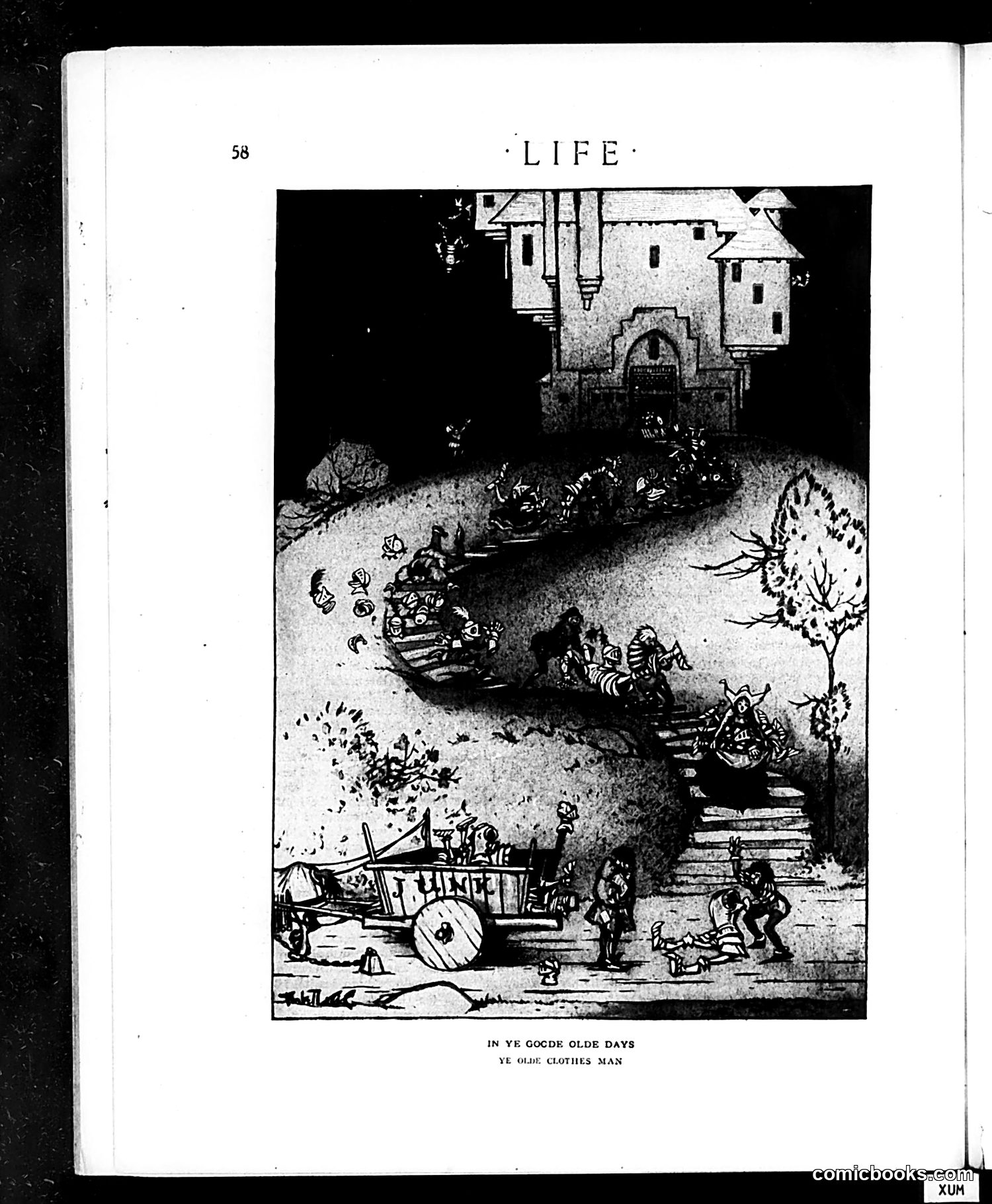
This is a satirical illustration titled "In Ye Gocde Olde Days / Ye Olde Clothes Man," depicting a medieval or Renaissance-era scene. The cartoon shows various figures in period costume engaged in activities around a castle or fortified building. The "ye olde clothes man" appears to be a merchant or tradesperson dealing in garments, shown with period-appropriate dress and setting. The satire likely mocks the romanticized nostalgia for "the good old days"—a common target of Life magazine's humor. By presenting an idealized historical scene, the cartoonist probably critiques contemporary readers' tendency to glamorize the past while ignoring its actual hardships, disorder, or commercial hustling. Without clearer context about Life's publication date or specific contemporary references, the precise satirical target remains somewhat unclear, though the general theme appears to be deflating sentimental views of history.
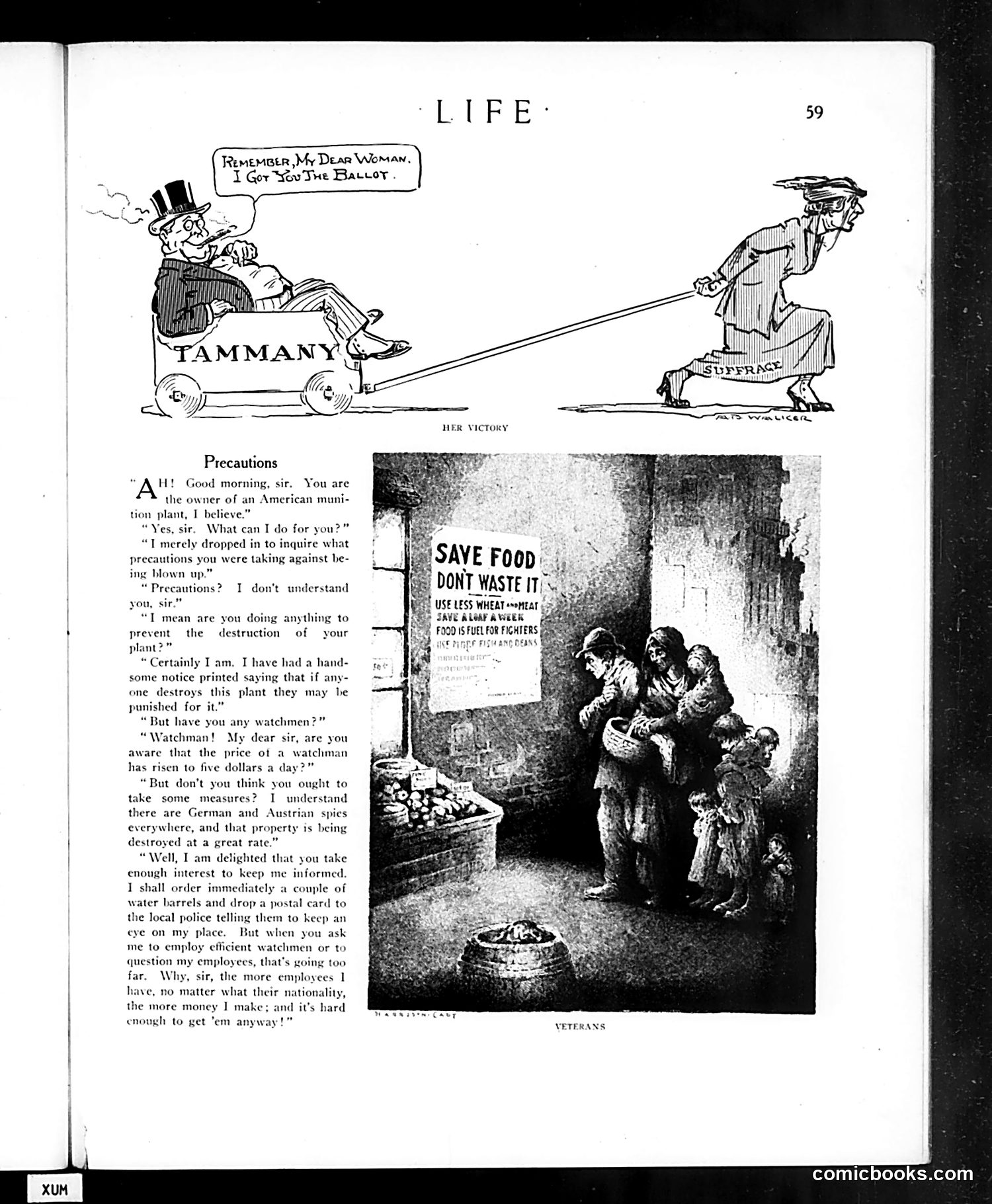
This wartime satire (likely WWI era, given references to German and Austrian spies) mocks industrial negligence disguised as patriotism. A factory owner, confronted by an inspector about sabotage risks, reveals his priorities: he's posted a *notice* threatening punishment for destruction but refuses to hire actual watchmen because they cost five dollars daily. The joke targets capitalist shortsightedness during national crisis. The owner won't invest in security despite acknowledged enemy threats, dismisses concerns about foreign nationals among employees (prioritizing cheap labor over safety), and resists any measure that cuts profits—even when property destruction is "at a great rate." The cartoon above shows "Tammany" (political corruption) being pulled by "Suffrage" (women's voting rights), labeled "Her Victory," suggesting concurrent social/political struggles. The "Save Food" poster contextualizes wartime rationing campaigns meant to support military efforts.
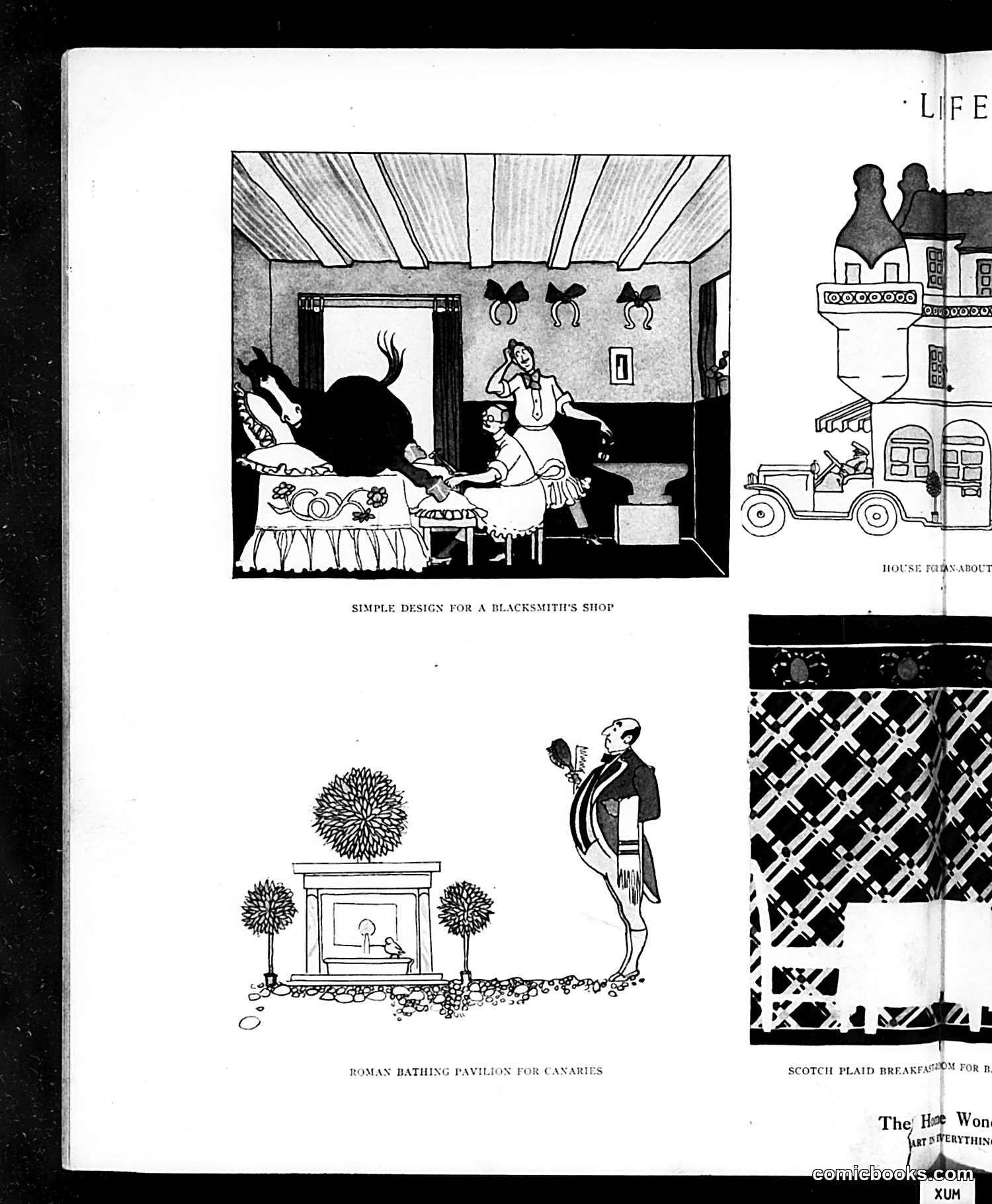
This page contains three unrelated satirical illustrations typical of Life magazine's humorous content. The top illustration, "Simple Design for a Blacksmith's Shop," depicts an interior with a woman and children, apparently using domestic space as a blacksmith's workshop—likely satirizing poor urban living conditions or makeshift work arrangements of the era. The middle illustration, "Roman Bathing Pavilion for Canaries," shows a man presenting an elaborate ornamental structure, mocking excessive or absurd luxury goods marketed to wealthy pet owners. The right side shows "House for About" (partially visible) and what appears to be textile pattern designs below. These appear to be general humor pieces rather than political commentary, reflecting Life's characteristic satirical approach to contemporary consumer culture and domestic life, though without a specific publication date visible, precise historical context remains unclear.
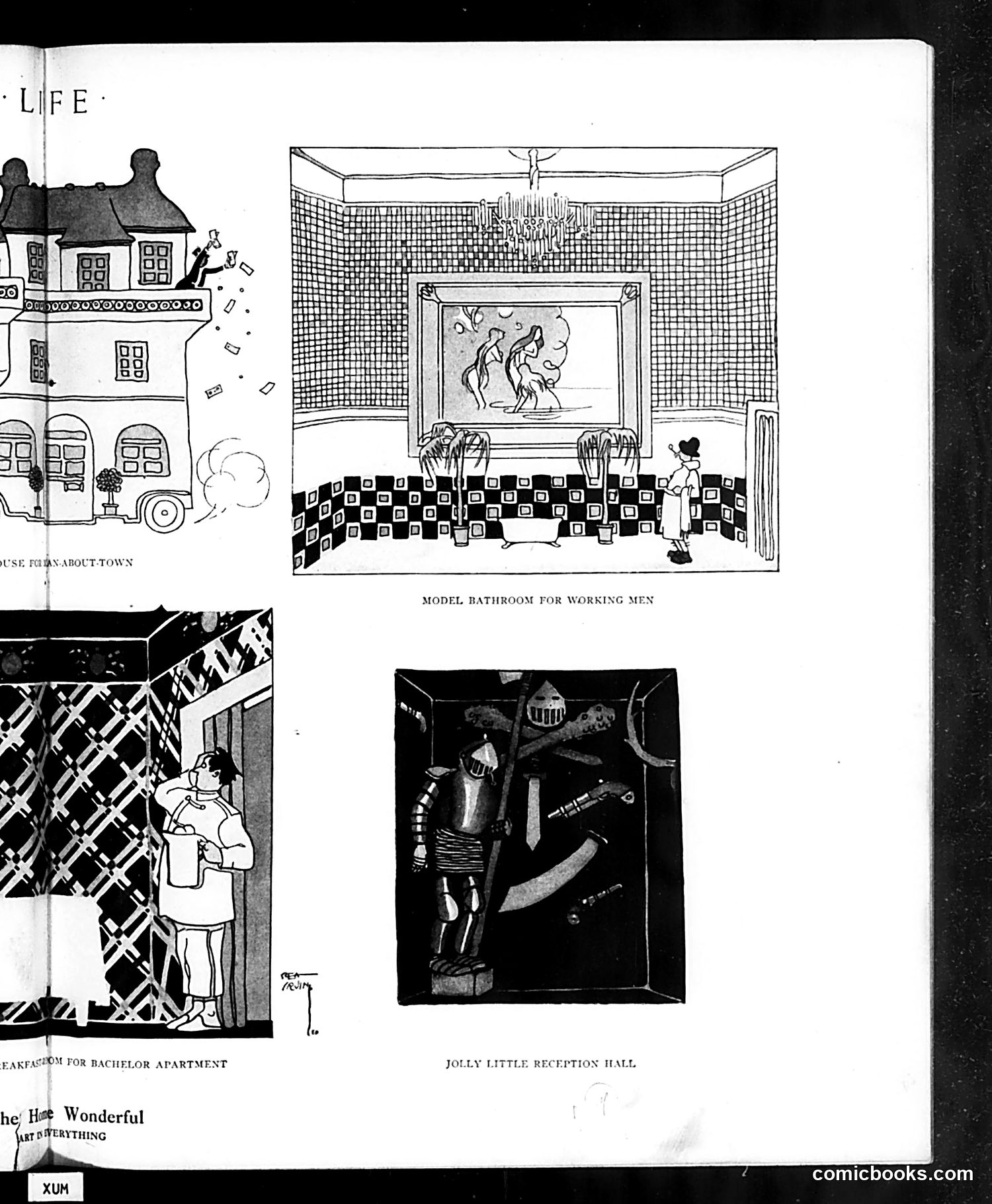
This page satirizes modern luxury design trends through three illustrated scenarios. "Model Bathroom for Working Men" depicts an ornate, mosaic-tiled bathroom with a chandelier—absurdly fancy for laborers. "Breakfast Room for Bachelor Apartment" shows a similarly overdecorated space. "Jolly Little Reception Hall" presents an eclectic display of hunting trophies and exotic weapons. The satire mocks the aspirational design culture of the early 20th century, where mass-produced goods and magazines promoted lavish aesthetics for ordinary people. The exaggeration suggests the disconnect between working-class means and upper-class styling being marketed to them. The juxtaposition of "model" spaces with their actual intended users creates the humor—these grandiose designs are impractical and pretentious for their stated purposes. The page critiques consumerism and manufactured desires through visual comedy.
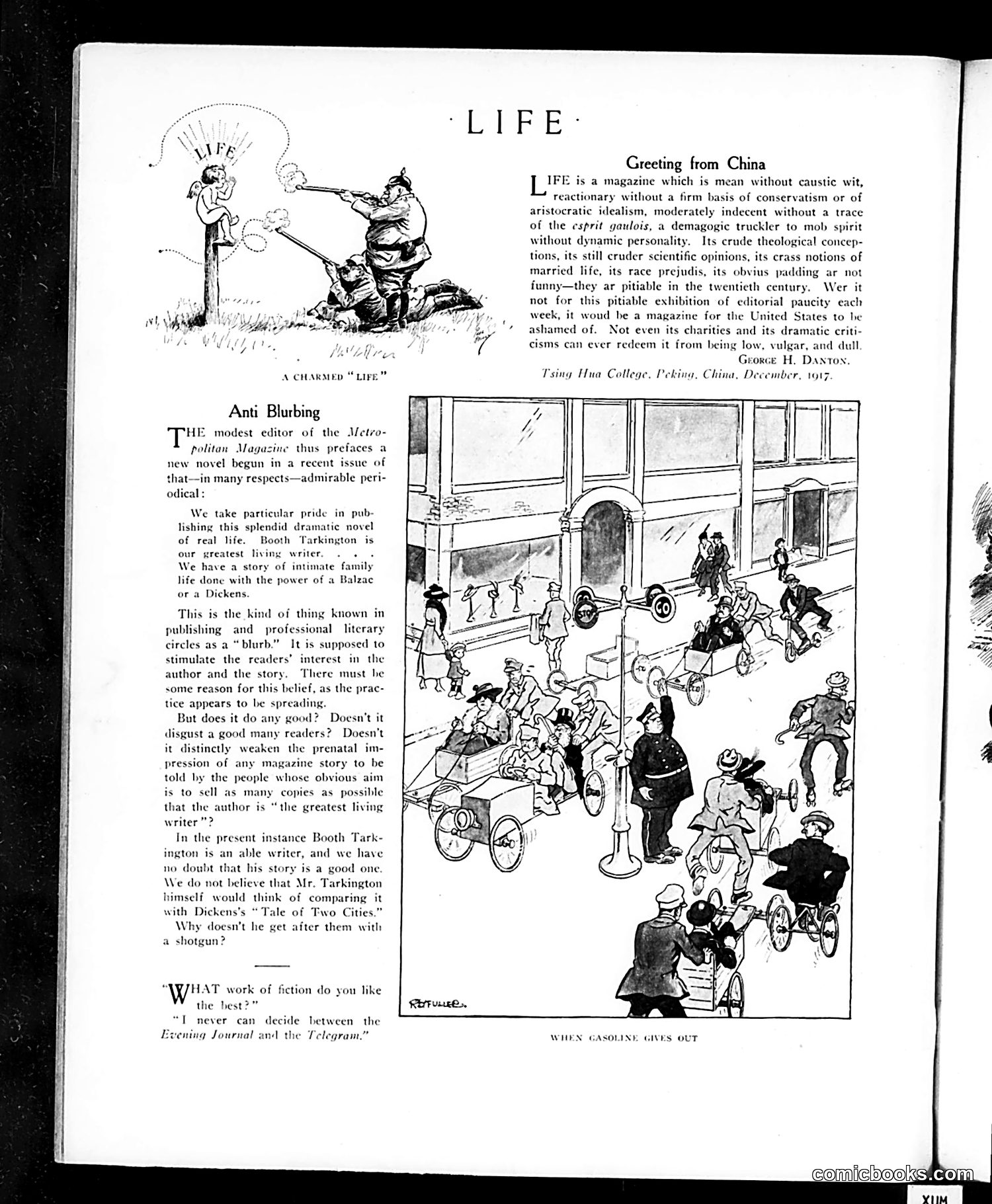
This page contains three distinct satirical pieces: **"A Charmed Life" (top cartoon):** A figure labeled "LIFE" is being attacked by two assailants with clubs. The accompanying "Greeting from China" is a scathing critique from George H. Danton at Tsing Hua College, condemning *Life* magazine itself as mean-spirited, unscientific, racially prejudiced, and vulgar—essentially a self-aware roasting of the magazine's own editorial approach and sensibilities. **"Anti Blurbing":** Criticizes the publishing industry practice of "blurbs"—promotional praise written by editors to boost book sales. The article mocks inflated comparisons (calling Booth Tarkington comparable to Dickens) and questions whether such obvious salesmanship actually persuades readers or instead alienates them. **"When Gasoline Gives Out" (large illustration):** Shows a street scene where a car has apparently run out of fuel, creating chaos as pedestrians, cyclists, and children scatter. The satire likely comments on automobile dependency or fuel shortages—possibly relevant to WWI rationing concerns in 1917. All three pieces employ *Life*'s trademark satirical style attacking contemporary foibles.
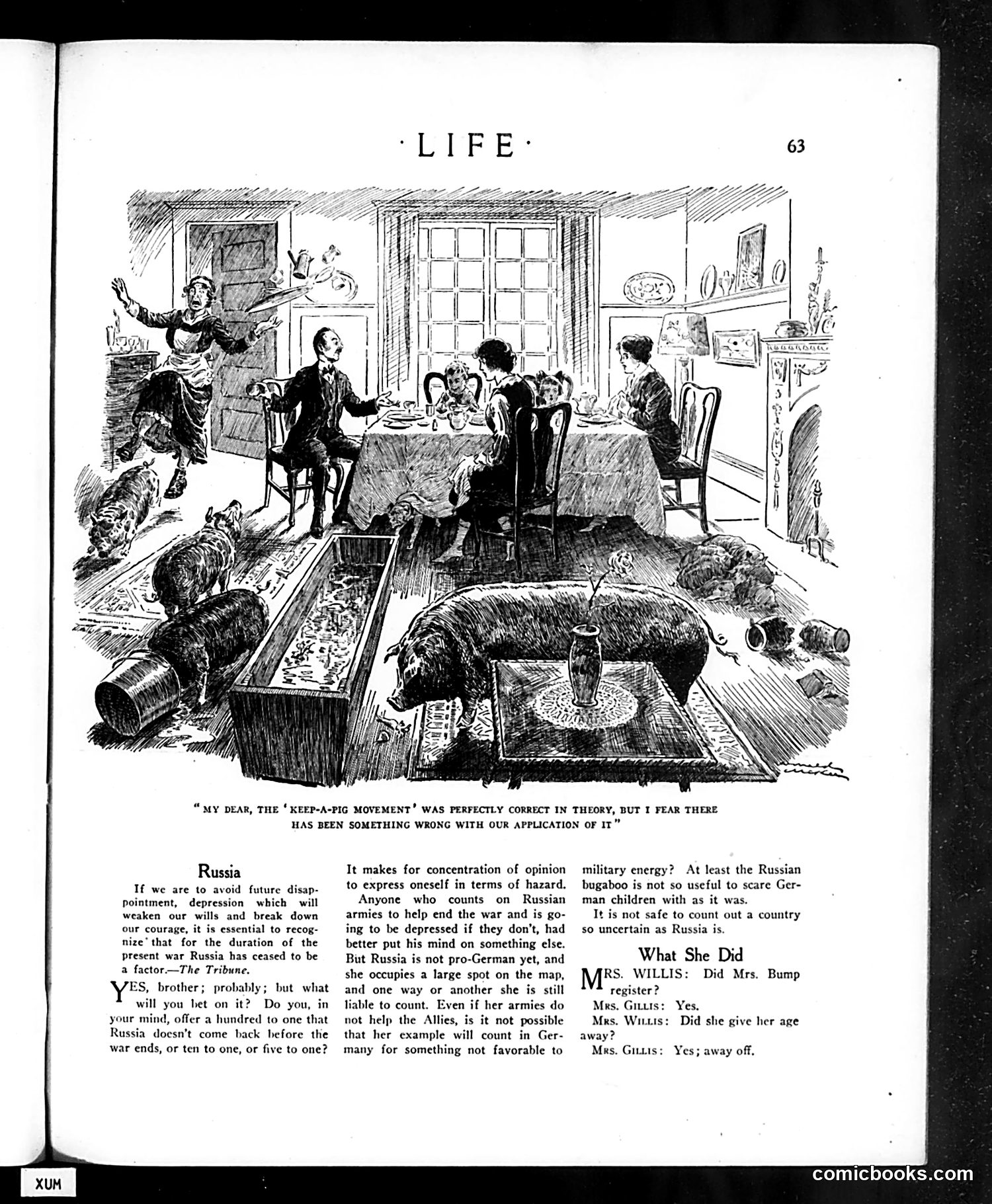
The main cartoon satirizes the "Keep-a-Pig Movement"—a WWI-era food conservation effort encouraging home pig-raising. The joke: a wealthy family has taken the directive literally, filling their formal dining room with actual pigs during dinner. The caption suggests their application of the patriotic policy has gone comically wrong. The accompanying text discusses Russia's role in WWI. A Tribune article dismisses Russia as a spent force; the magazine's response argues this is premature pessimism. Russia, though weakened, remains strategically significant and unpredictable—potentially still valuable to the Allies or even destabilizing to Germany internally. The secondary humor ("What She Did") is a brief domestic joke about Mrs. Bump's reluctance to register her age. Context: This reflects American anxieties about Russia's uncertain commitment to the Allied cause during the war.
This page contains theater reviews from Life magazine's "Drama" section, critiquing holiday theatrical offerings. The content addresses contemporary plays and their modernization efforts. **Key Reviews:** 1. **"Why Marry?"** - Praised as timely and prophetic for exploring women's economic independence and freedom from traditional marriage expectations. The reviewer notes the play's humor and suggests this social question may become obsolete within a generation. 2. **"Camille"** - Criticized for attempting to update Alexandre Dumas's classic 1800s melodrama with 1918 "pep" (modernization). The reviewer argues this damages the play's sentimental atmosphere, comparing it to adding modern car engines to a historic carriage. Ethel Barrymore's performance is called "unusually sweet" but not tearfully moving. 3. **"Lord and Lady Algy"** - Praised as an excellent English comedy featuring Faversham and Maxine Elliott, with strong supporting performances capturing upper-class sporting society. The reviews reflect early-20th-century theatrical criticism and debates about tradition versus modernization in drama.
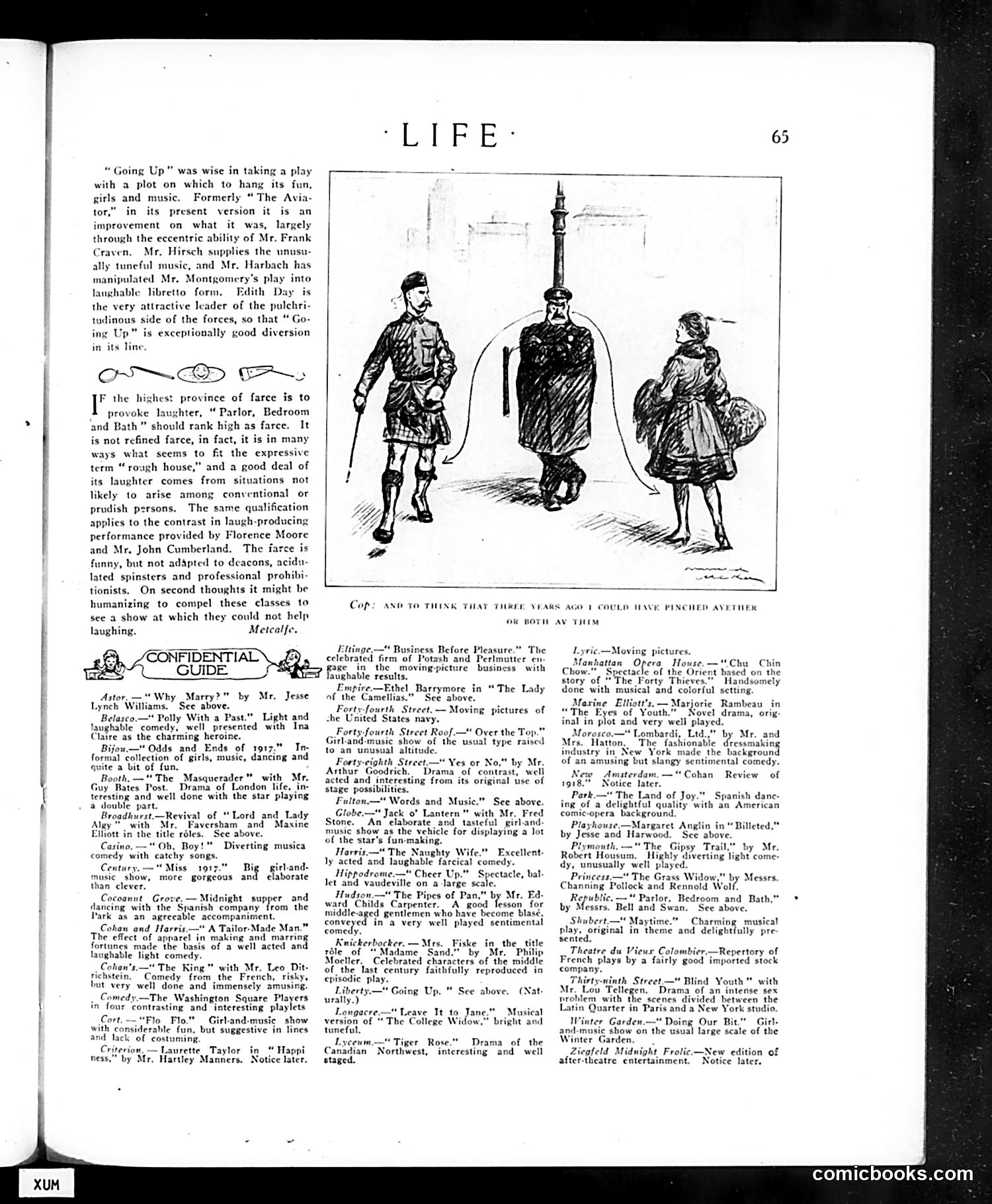
This page contains theater reviews from Life magazine's "Confidential Guide" section, critiquing Broadway shows of approximately 1917. The single cartoon depicts a policeman confronting two figures (likely representing different eras or types of people), with the caption "And to think that three years ago I could have pinched a vetier or both at them." The cartoon's satire concerns changing social standards and police enforcement. The joke suggests that what was once illegal or arrestable conduct has become socially acceptable, reflecting the rapid cultural shifts of the World War I era. The specific behavior referenced is unclear from the image alone, but likely refers to women's changing dress, behavior, or public conduct during this progressive period. The surrounding text reviews theatrical productions, noting which shows appeal to refined versus "rough" audiences, with particular commentary on farce and its potentially scandalous content—contextualizing the cartoon's theme of evolving social propriety.
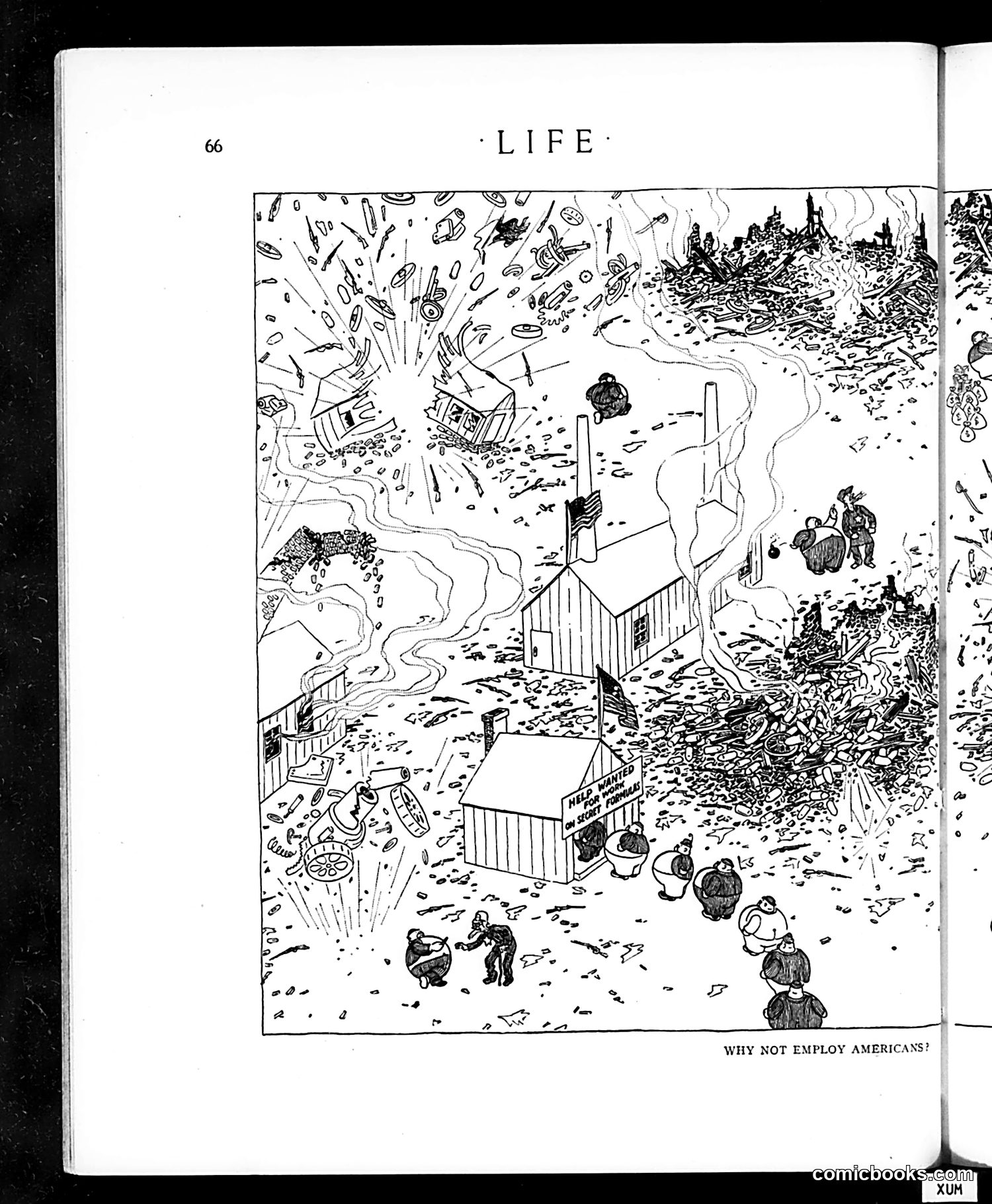
This is a satirical cartoon criticizing the employment of foreign workers or immigrants instead of American citizens. The illustration depicts a chaotic industrial or construction scene with debris, explosions, and scattered debris everywhere. Multiple figures are shown working amid the destruction. The caption "Why Not Employ Americans?" is sarcastic—suggesting that foreign workers are being hired despite the availability of American labor. The cartoon likely critiques either: 1. Employers hiring cheaper immigrant labor during an economic period when Americans needed jobs, or 2. Foreign nationals working in America while Americans remained unemployed The chaotic, destructive nature of the scene may imply that foreign workers are incompetent or dangerous, a common xenophobic trope of early 20th-century American satire. The specific historical context—whether referencing a particular labor dispute or immigration wave—remains unclear without additional dating information.
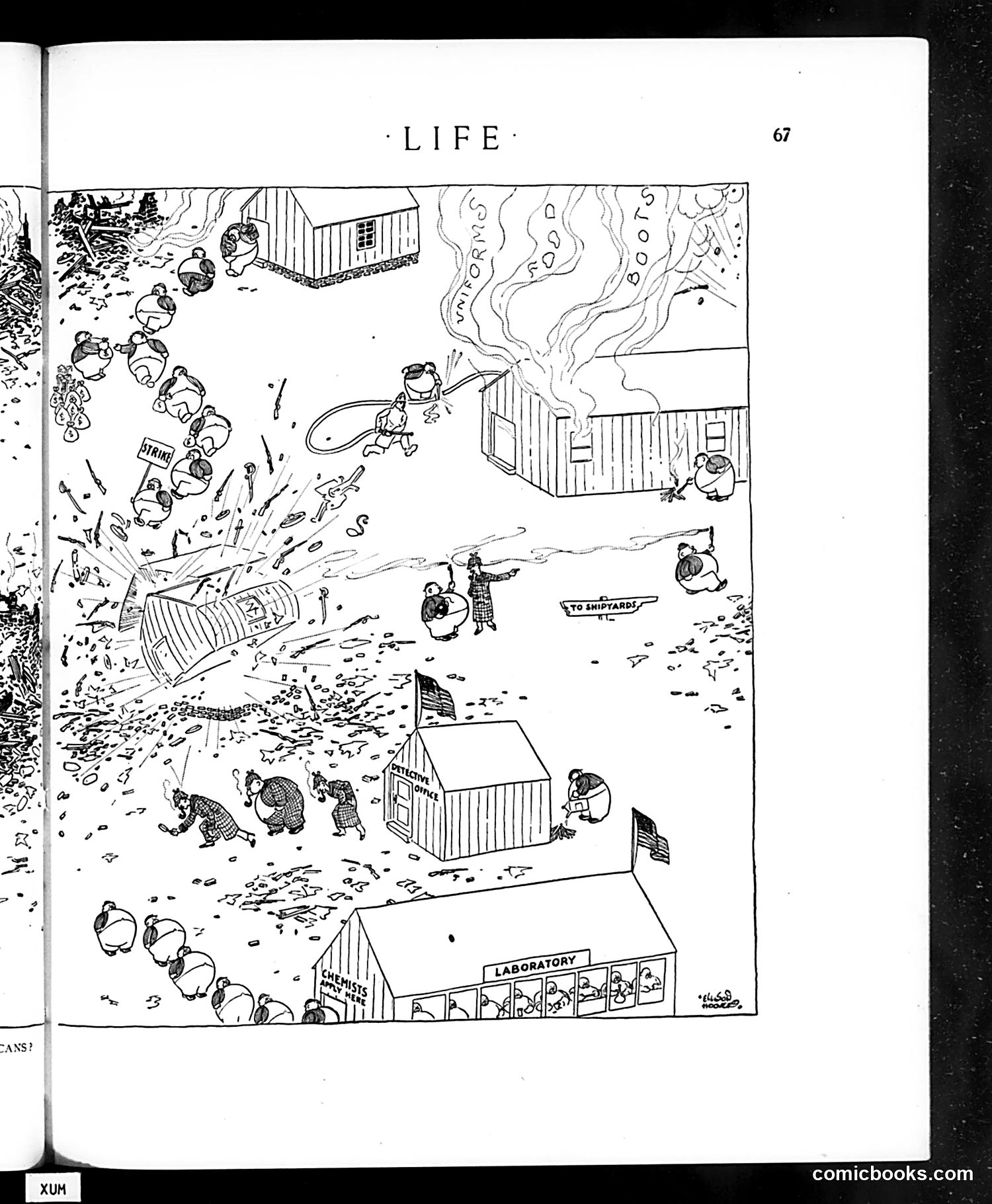
This is a single-panel cartoon depicting what appears to be a chaotic seaside or beach settlement scene. The illustration shows multiple small wooden structures (buildings/shacks), American flags, and numerous figures engaged in various activities. There's a "Laboratory" building labeled at the bottom, and text indicating "TO SHIPYARDS" visible in the scene. The satire appears to target wartime industrial activity or possibly a military/naval facility during a mobilization effort. The frantic activity, proliferation of hastily-constructed buildings, and American flags suggest commentary on rapid wartime expansion and the disorder or inefficiency that accompanied such growth. The specific historical context—whether this references WWI or WWII mobilization, or a particular shipyard operation—cannot be determined with certainty from the image alone. The cartoonist's intent seems critical of the chaotic nature of rushed wartime construction and organization.
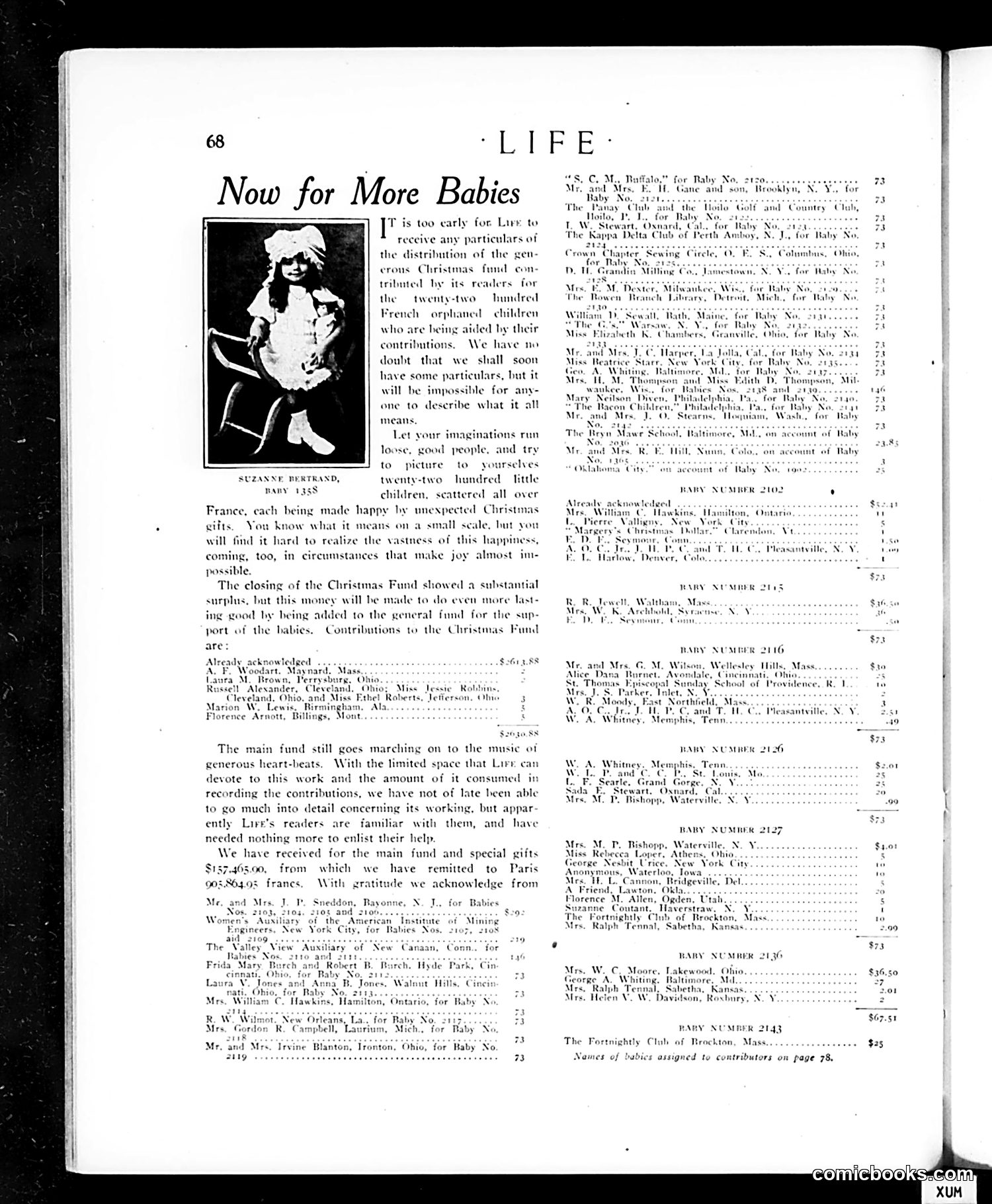
This page documents Life magazine's charitable fundraising campaign for French orphaned children following World War I. The prominent photograph shows **Suzanne Bertrand**, a French orphan child who serves as the human face of the appeal. The article explains that Life readers have contributed over $157,000 to support 2,200 French orphan children through Christmas gifts and ongoing aid. The text asks readers to imagine the joy these "unexpected Christmas gifts" bring to impoverished children "in circumstances that make joy almost impossible." The bulk of the page lists donor names and baby numbers they've sponsored—a common practice in early 20th-century charitable campaigns where donors would "adopt" individual children by number. The satire is gentle: Life is appealing to American readers' sentimentality about children while documenting their generosity through these donor lists, essentially publicizing both the need and the response to encourage further contributions.
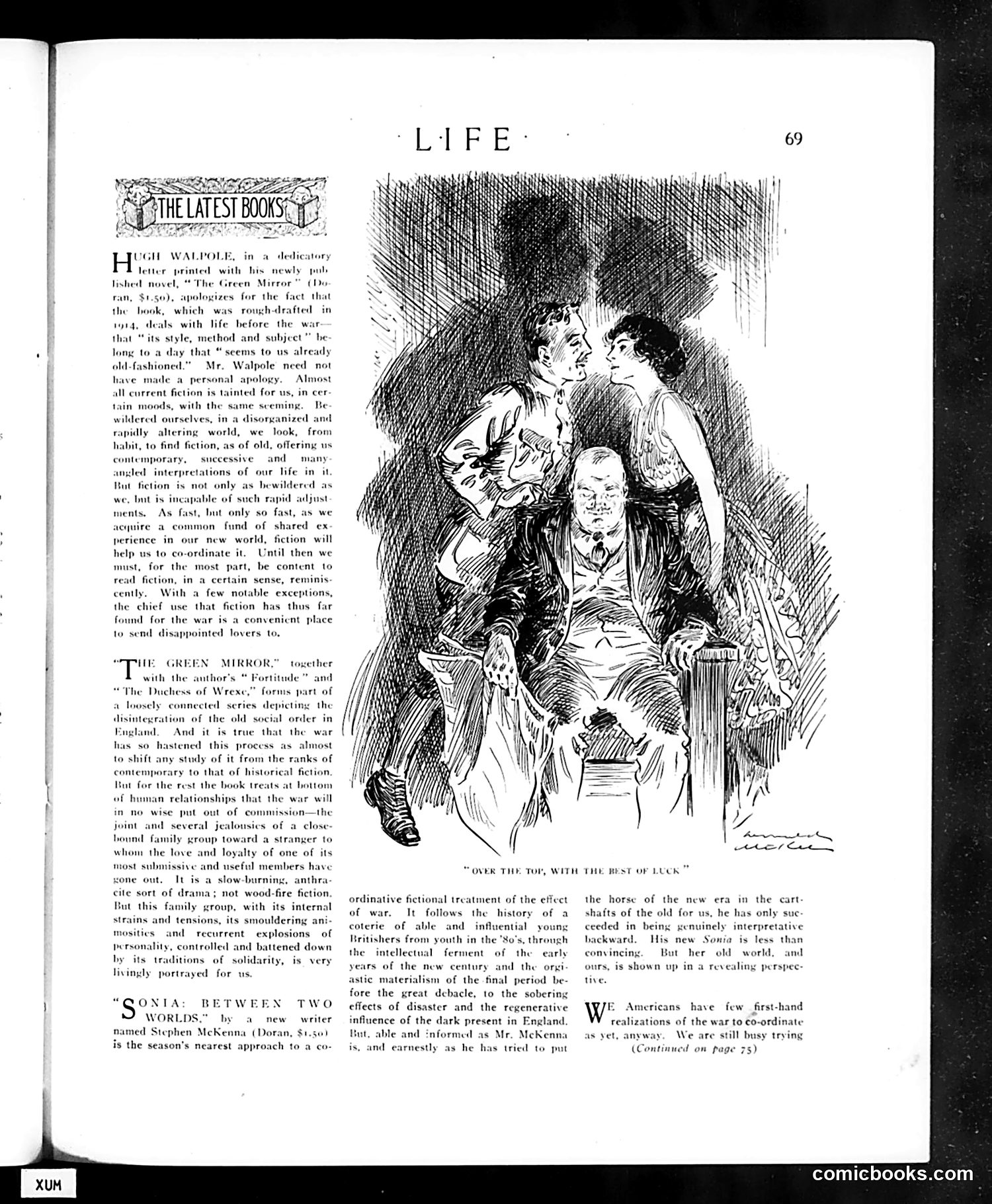
This page reviews contemporary fiction dealing with World War I's social impact. The illustration shows a well-dressed family group in an interior setting, captioned "Over the Top, With the Best of Luck"—a sardonic reference to soldiers going into battle. The reviews discuss novels by Hugh Walpole ("The Green Mirror") and Stephen McKenna ("Sonia: Between Two Worlds"), both depicting the disintegration of England's old social order caused by the war. The critic argues that while WWI has accelerated social change so dramatically that contemporary fiction now reads as "historical fiction," these authors struggle to convincingly portray their characters' psychological responses to this upheaval. The satire lies in the gap between the war's profound social disruption and fiction's limited ability to capture it authentically. The cartoon's caption suggests dark irony about civilians' optimistic detachment from battlefield reality—they wish soldiers "the best of luck" while remaining safely removed from war's actual consequences.
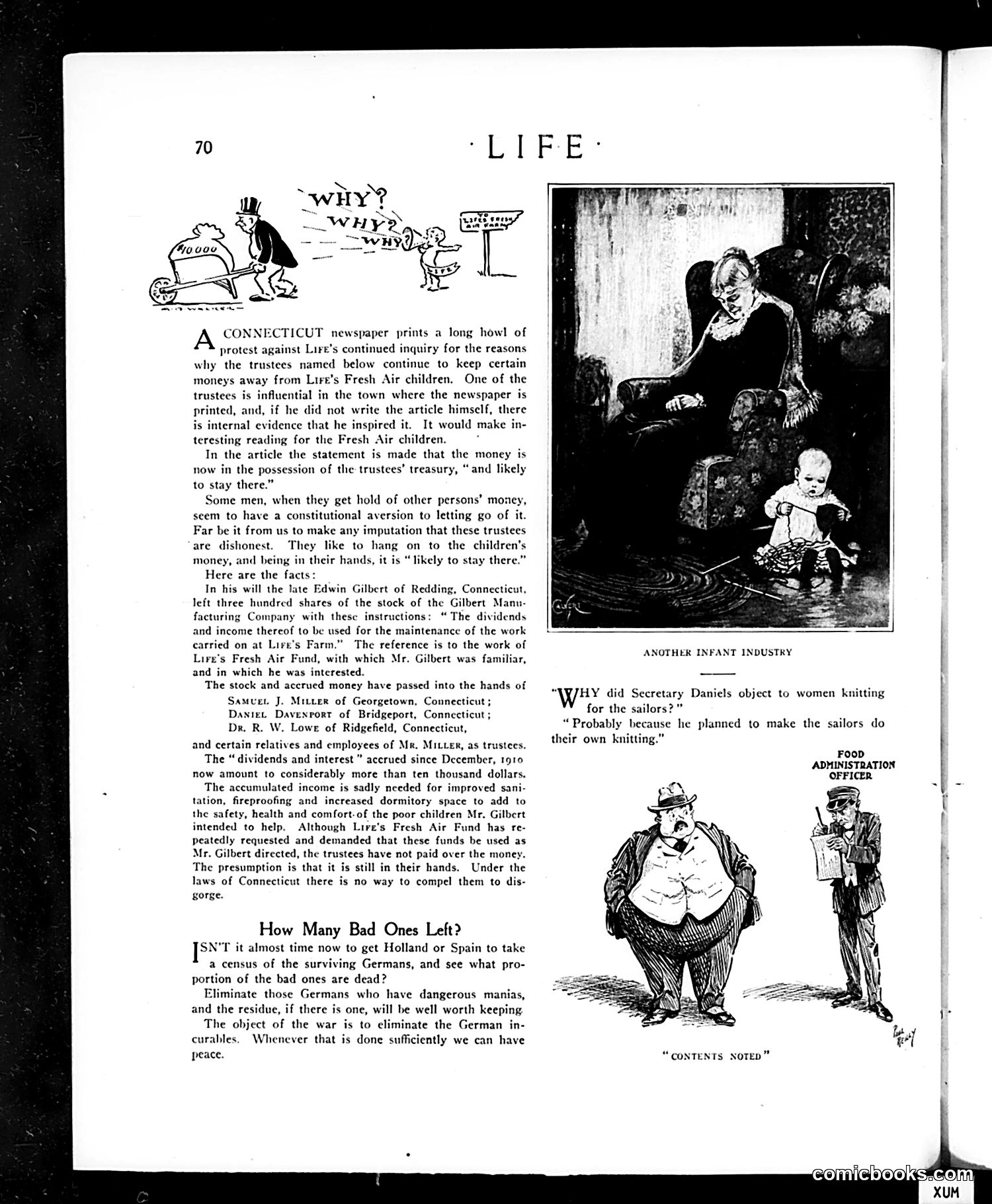
This page satirizes institutional corruption and post-WWI attitudes. **Main Article**: Life exposes Connecticut trustees (Samuel J. Miller, Daniel Davenport, Dr. R.W. Lowe) who are withholding funds from Lire's Fresh Air Fund—a children's charity. Per a deceased donor's (Edwin Gilbert's) will, stock dividends worth over $10,000 should support the fund, but trustees refuse to release the money, claiming it will "stay there." Life ridicules their dishonesty by noting a newspaper connected to an influential trustee conveniently protested Life's inquiry. **"How Many Bad Ones Left?"**: A dark joke proposing a post-WWI census of surviving Germans to eliminate "dangerous" ones—reflecting harsh attitudes toward defeated Germany. **"Another Infant Industry"**: A quip about Secretary of the Navy Daniels objecting to women knitting for sailors, suggesting he wanted sailors to knit themselves—satirizing wartime bureaucracy. **Cartoon**: Shows a Food Administration Officer noting "contents" while a portly administrator sits beside him—likely mocking food rationing enforcement.
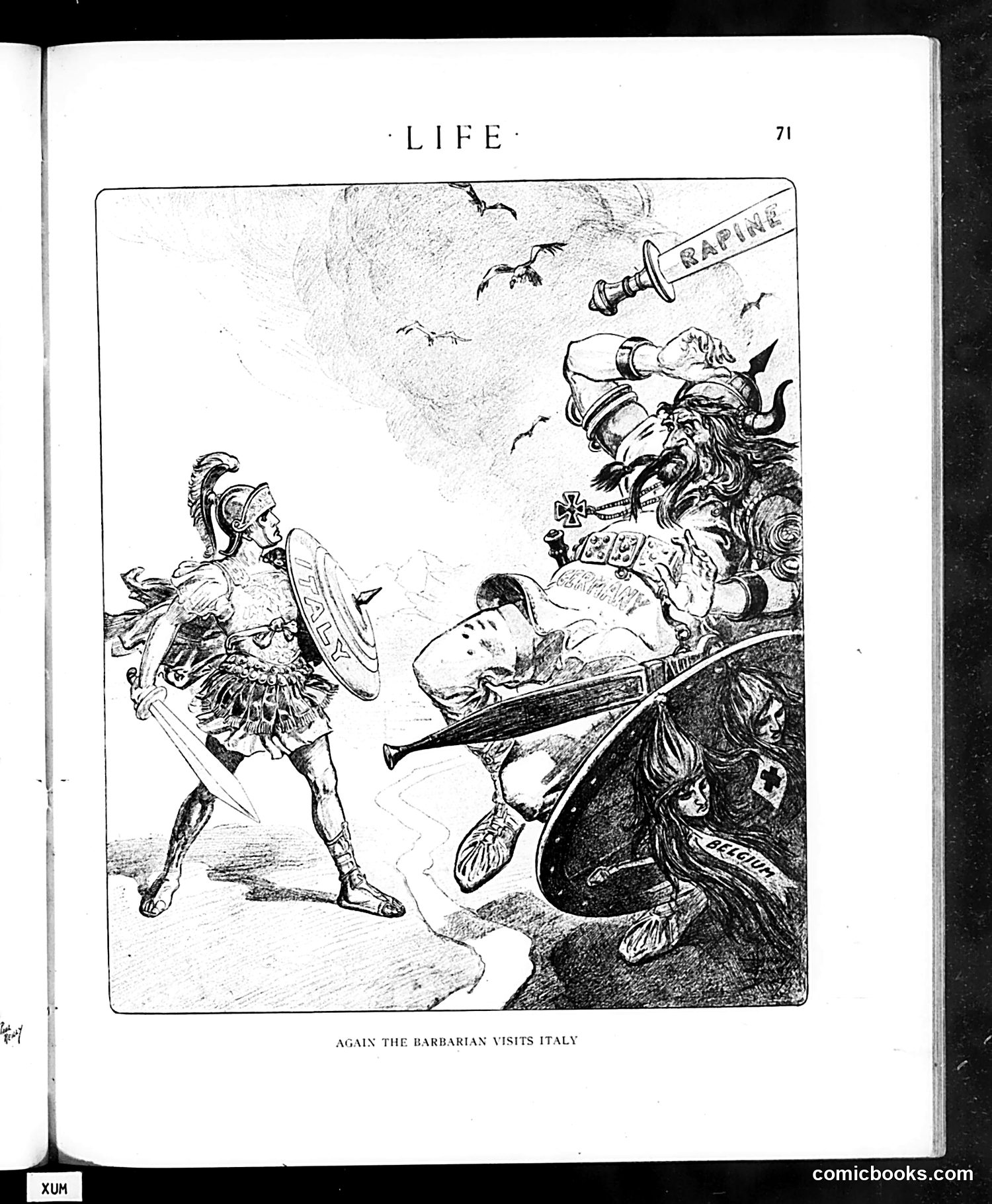
This satirical cartoon depicts a Roman soldier (left, in classical armor with shield and sword) confronting a threatening barbarian figure (right, wild-haired and fierce). The barbarian wields a large club and appears to be descending from above with rapine/plunder weapons. The title references historical invasions of Italy by barbarian forces. The cartoon likely satirizes contemporary military threats or aggression toward Italy—possibly German or Austro-Hungarian ambitions during the early 20th century period when *Life* magazine published such content. The "civilized" Roman versus "uncivilized" barbarian contrast was a common rhetorical device for depicting conflict between established European powers and perceived threats. Without a specific date visible, the exact historical event referenced remains unclear.
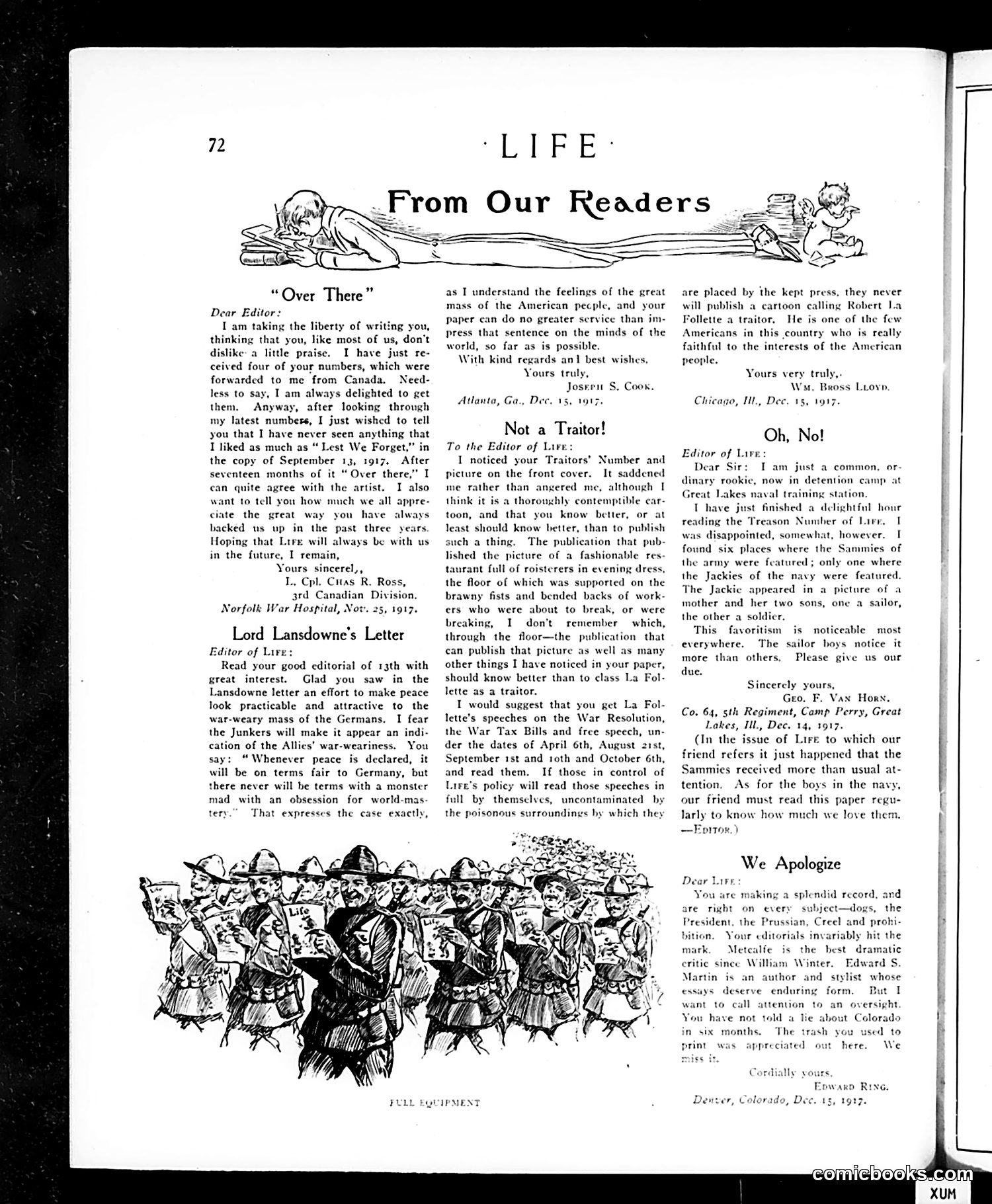
This page collects reader letters responding to Life's recent "Traitors' Number" issue, which apparently featured caricatures and criticism of political opponents to American World War I efforts. **Key letters and their context:** - **"Over There"**: A Canadian soldier praises Life for supporting the war effort. - **"Lord Lansdowne's Letter"**: A reader supports Life's editorial framing of peace negotiations as unattractive to Germans, fearing they'd interpret it as Allied weakness. - **"Not a Traitor!"**: A reader defends Senator Robert La Follette (Wisconsin progressive) against Life's apparent characterization as a traitor, citing his actual voting record on war resolutions and taxes. This reflects the heated debates over anti-war progressives during WWI. - **"Oh, No!"** and **"We Apologize"**: Readers complain about editorial coverage bias—one noting insufficient naval representation, another regarding Colorado content. The cartoon "Full Equipment" depicts soldiers in full combat gear, reinforcing wartime themes.
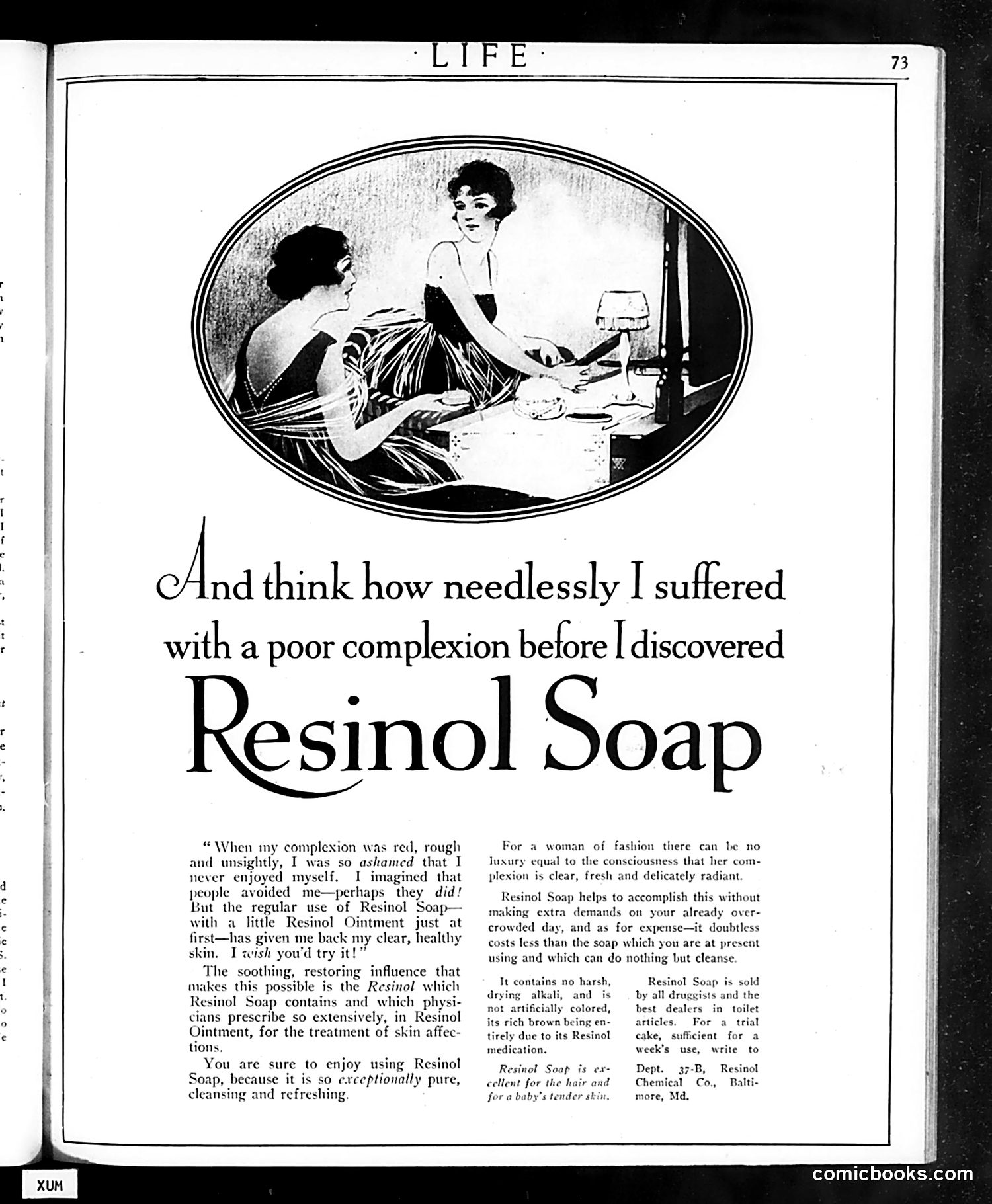
This is a **full-page advertisement**, not satire or political content. It promotes Resinol Soap to female readers circa early 1900s. The illustration shows two fashionable women at a vanity table, one seated and one standing. The ad uses a testimonial format: a woman confesses she suffered from a "red, rough and unsightly" complexion that made her self-conscious and caused social avoidance. After using Resinol Soap and Ointment, her skin cleared. The pitch emphasizes that clear skin equals social acceptance and feminine desirability—a luxury for "a woman of fashion." The product is marketed as affordable, pure, and convenient compared to other soaps, requiring no extra effort for an "already over-crowded day." It claims medical credibility by noting physicians prescribe Resinol Ointment for skin conditions. This reflects period attitudes equating female beauty and social worth with flawless complexion, and normalizes skin anxiety as marketing strategy.
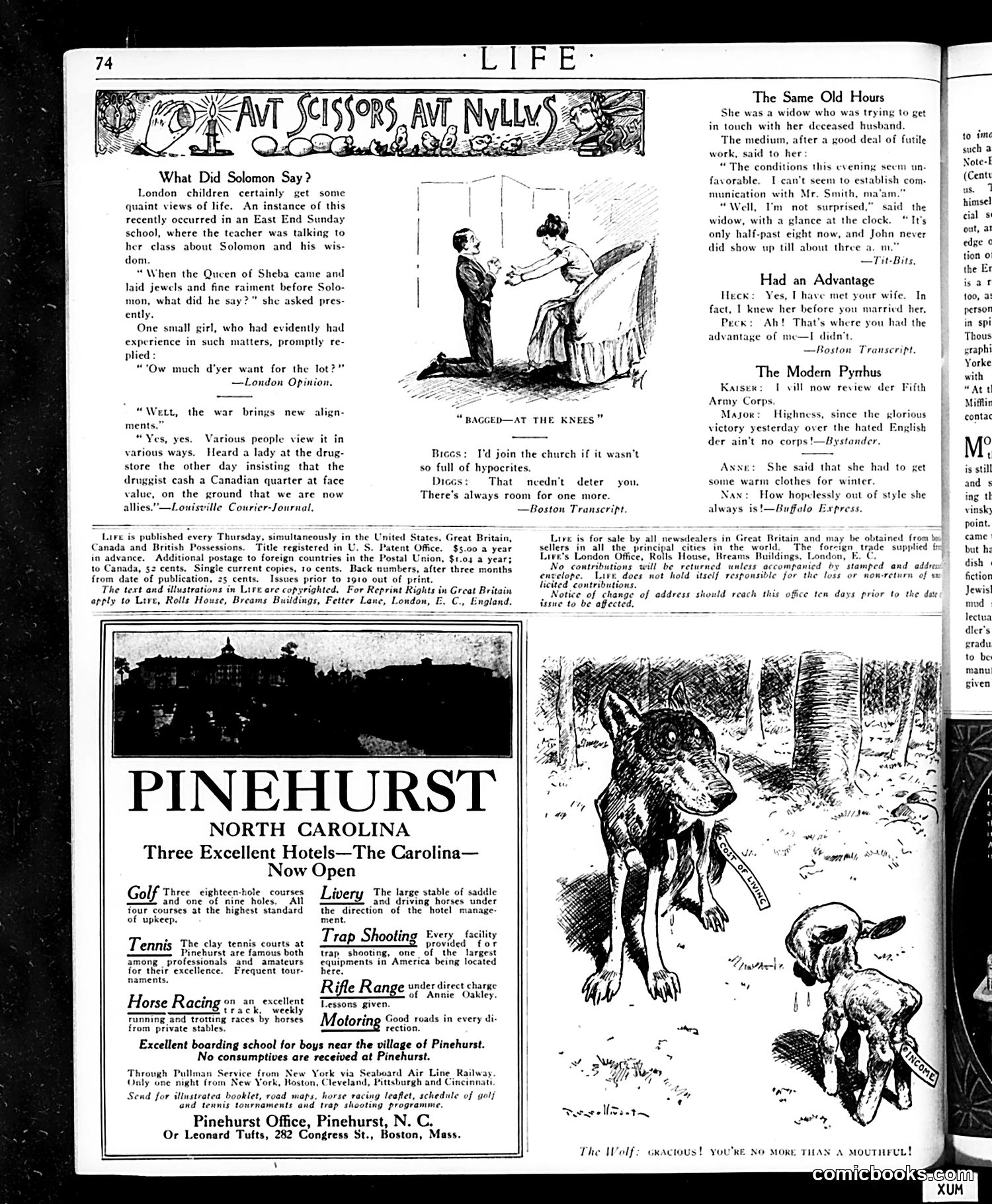
This page contains several brief satirical pieces typical of early 20th-century Life magazine humor: **Main cartoons/jokes:** 1. **"What Did Solomon Say?"** — A London Sunday school anecdote where a working-class East End girl, asked what King Solomon said upon receiving gifts from the Queen of Sheba, replies with practical street vernacular: "How much d'yer want for the lot?" The satire mocks both children's naïve materialism and the gap between biblical idealism and working-class reality. 2. **"The Same Old Hours"** — A widow attempting séance communication with her deceased husband explains his 3 a.m. no-show by noting he never appeared before then when alive. Jokes about marital neglect and habit. 3. **"The Modern Pyrrhus"** — References the Kaiser reviewing the Fifth Army Corps after yesterday's victory, with a play on the word "corps" (army unit) and "corpse" (the defeated enemy). 4. **Pinehurst advertisement** — Takes up substantial page space promoting North Carolina resort amenities. The humor reflects WWI-era anxieties and pre-war class commentary typical of Life's satirical approach.
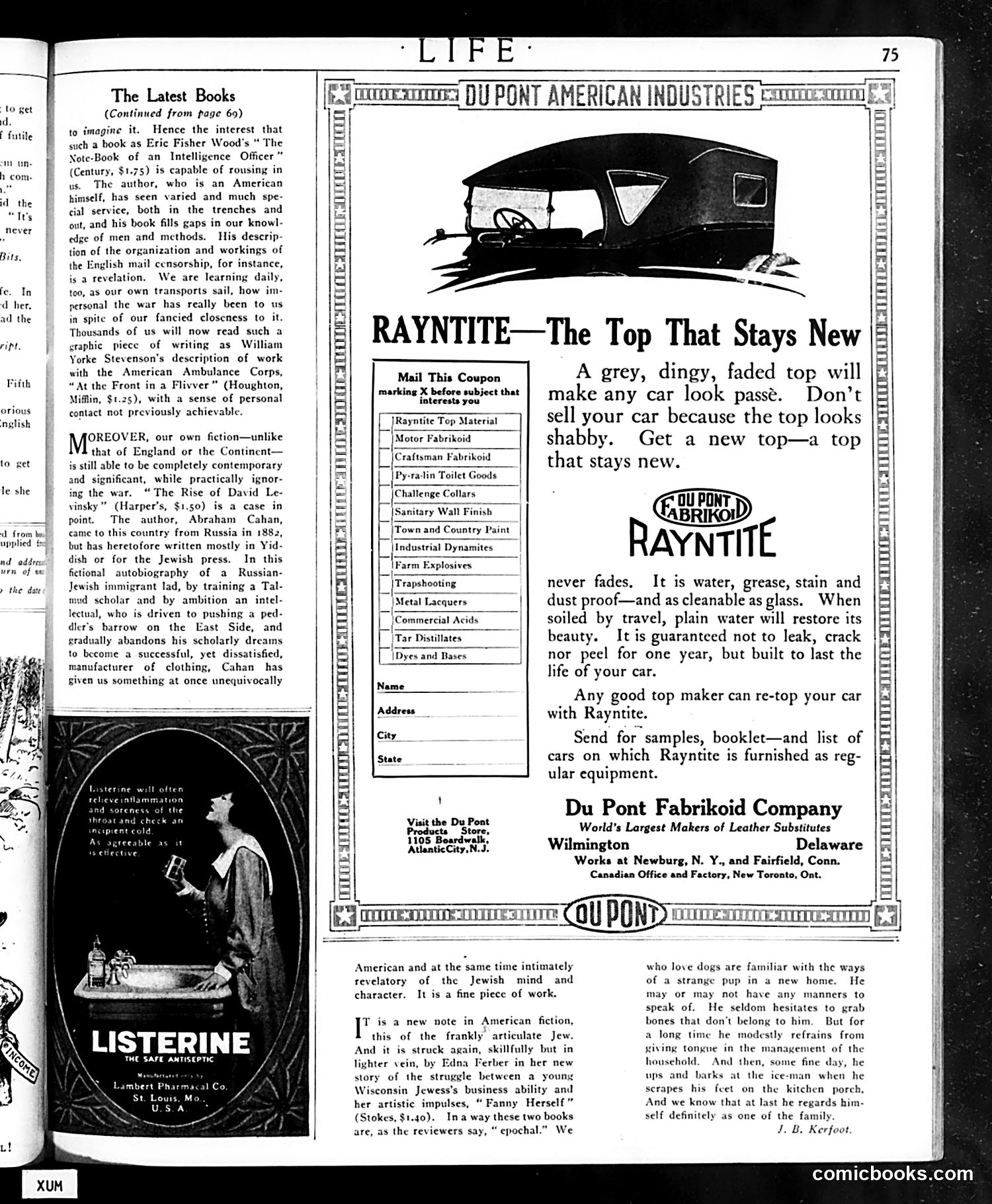
This page from *Life* magazine mixes book reviews with advertisements, reflecting early 20th-century magazine format. **The Book Review Section** discusses contemporary American fiction, notably Abraham Cahan's "The Rise of David Levinsky"—a semi-autobiographical novel about a Russian-Jewish immigrant who abandons scholarly pursuits to become a successful but unfulfilled clothing manufacturer on New York's East Side. The reviewer praises Cahan for authentically capturing Jewish-American immigrant experience and the tension between intellectual ambition and economic survival. **The Advertisements** occupy the right half: a Listerine antiseptic mouthwash ad (left) and a large Du Pont Fabrikoid "Rayntite" automobile top advertisement (right). The Rayntite ad targets car owners concerned about vehicle appearance, promising a durable, cleanable, fade-resistant car top. No political cartoons or satire appear on this page. The content reflects post-World War I American society's interest in immigrant narratives and growing automobile ownership among middle-class consumers.
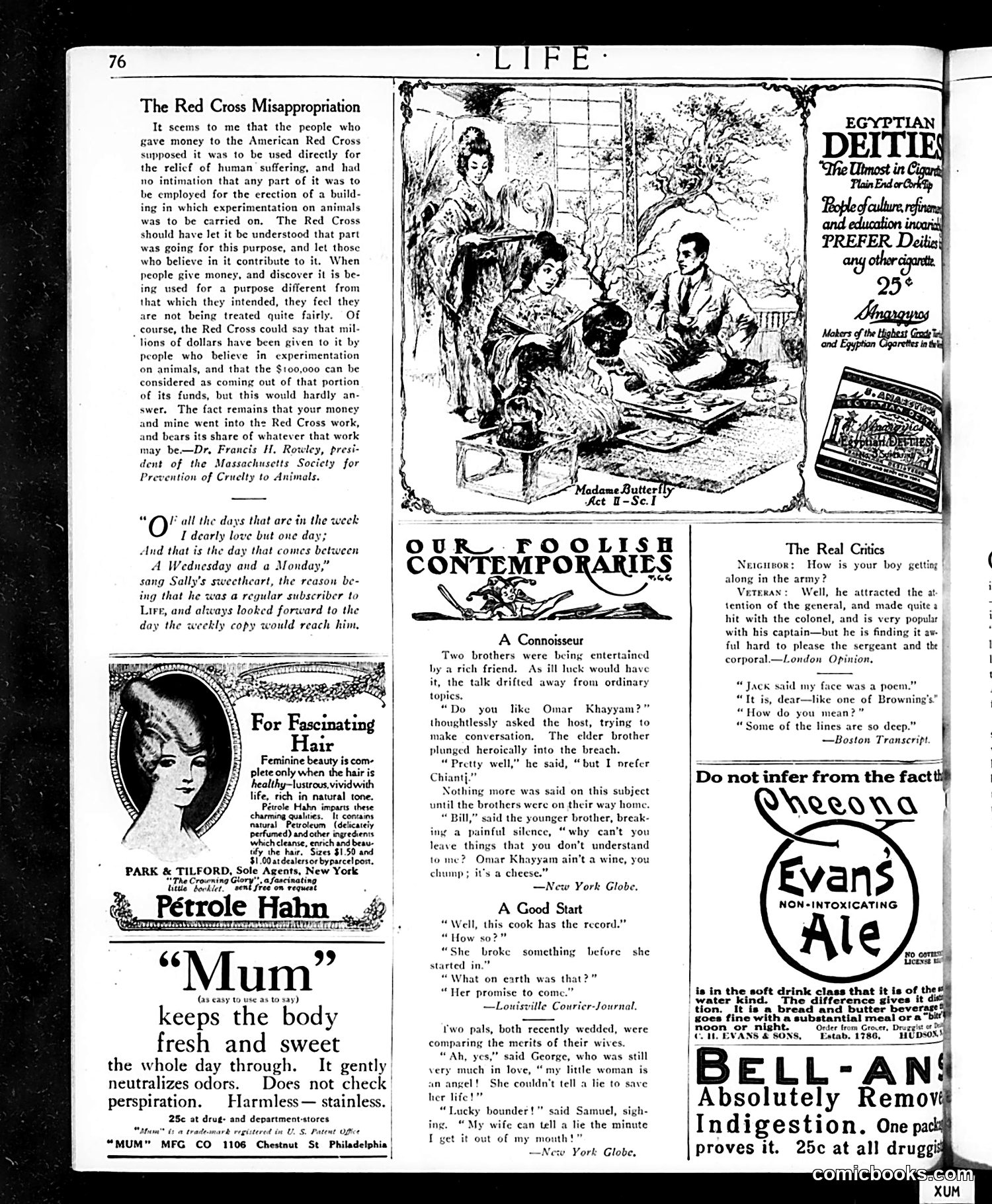
**Main Content:** This page primarily contains advertisements and humorous anecdotes rather than political cartoons. The centerpiece is "Our Foolish Contemporaries," a humor section featuring three brief jokes from newspapers. **Key Elements:** The opening article criticizes the Red Cross for allegedly using donor funds ($100,000) for animal experimentation without donor knowledge—attributed to Dr. Francis H. Rowley of the Massachusetts Society for Prevention of Cruelty to Animals. This reflects early 20th-century animal welfare concerns. "Our Foolish Contemporaries" includes jokes about confusing Omar Khayyam (the Persian poet) with cheese, a new bride breaking things, and a soldier struggling to impress sergeants despite impressing officers. **Advertisements** dominate the page, promoting Egyptian Deities cigarettes, Pétrole Hahn hair product, Park & Tilford, "Mum" deodorant, Cheeoa Evans Ale, and Bell-ans indigestion remedy. The page reflects Life's mix of social commentary, gentle satire, and commercial content typical of the era.
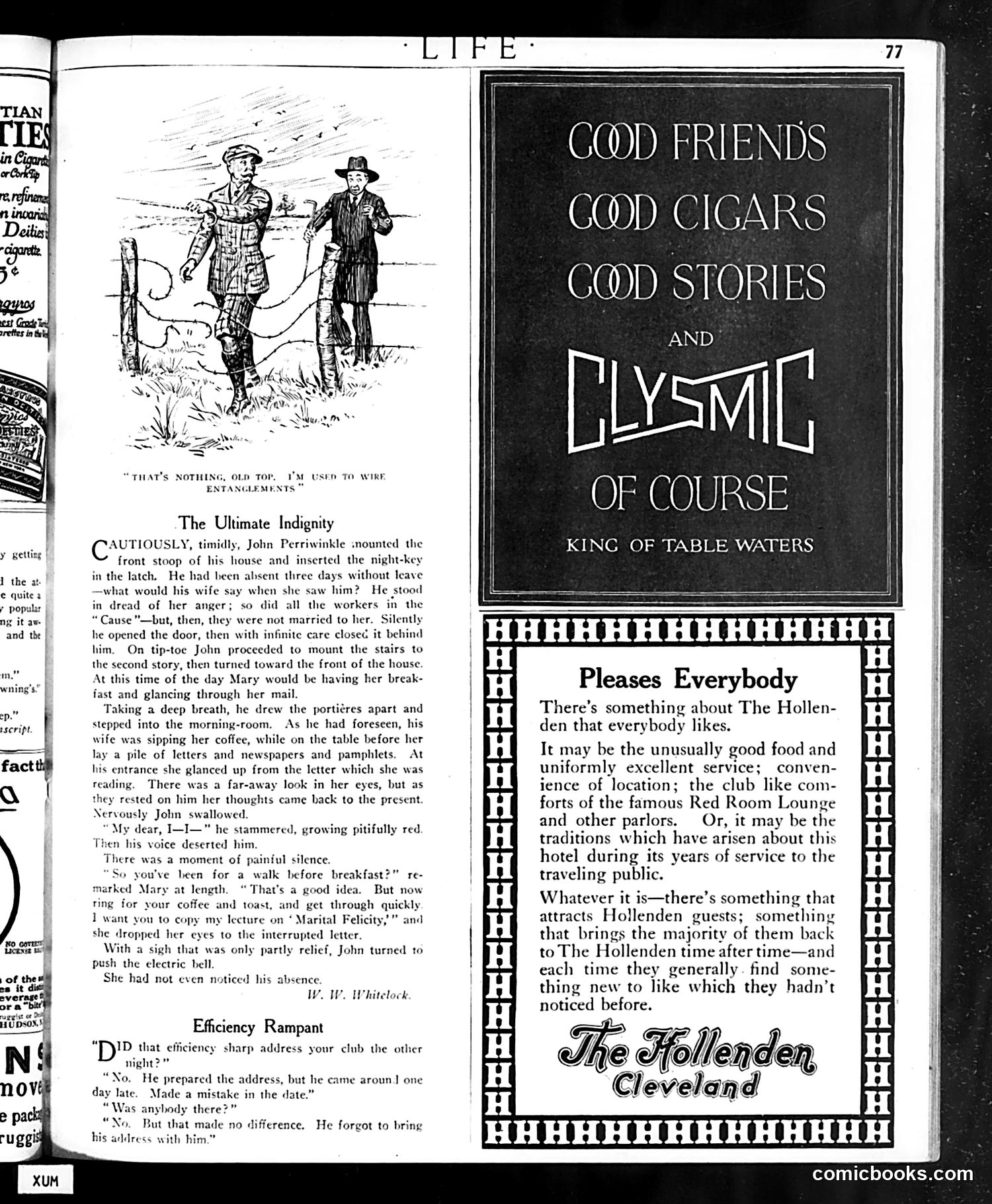
This page contains two satirical short stories mocking domestic and professional inefficiency in early 20th-century America. **"The Ultimate Indignity"** depicts a husband, John Perriwinkle, anxiously returning home after a three-day unauthorized absence, dreading his wife's anger. The joke's twist: his wife Mary is so absorbed in her mail and reading that she doesn't even notice he was gone, assuming he simply took an early morning walk. The satire targets how wives of this era wielded domestic authority—the husband's fear proves baseless because his wife is preoccupied with her own interests, inverting his expectation of marital discipline. **"Efficiency Rampant"** briefly mocks bureaucratic incompetence: a man prepares an address for his club but arrives a day late, yet it makes no difference because he forgot to bring the speech anyway. The joke critiques how efficiency-obsessed organizations still fail through basic human error. The cartoon at top shows two men discussing "wire entanglements," likely referencing WWI trench warfare, though context is limited. The right side is an advertisement for The Hollenden hotel in Cleveland.
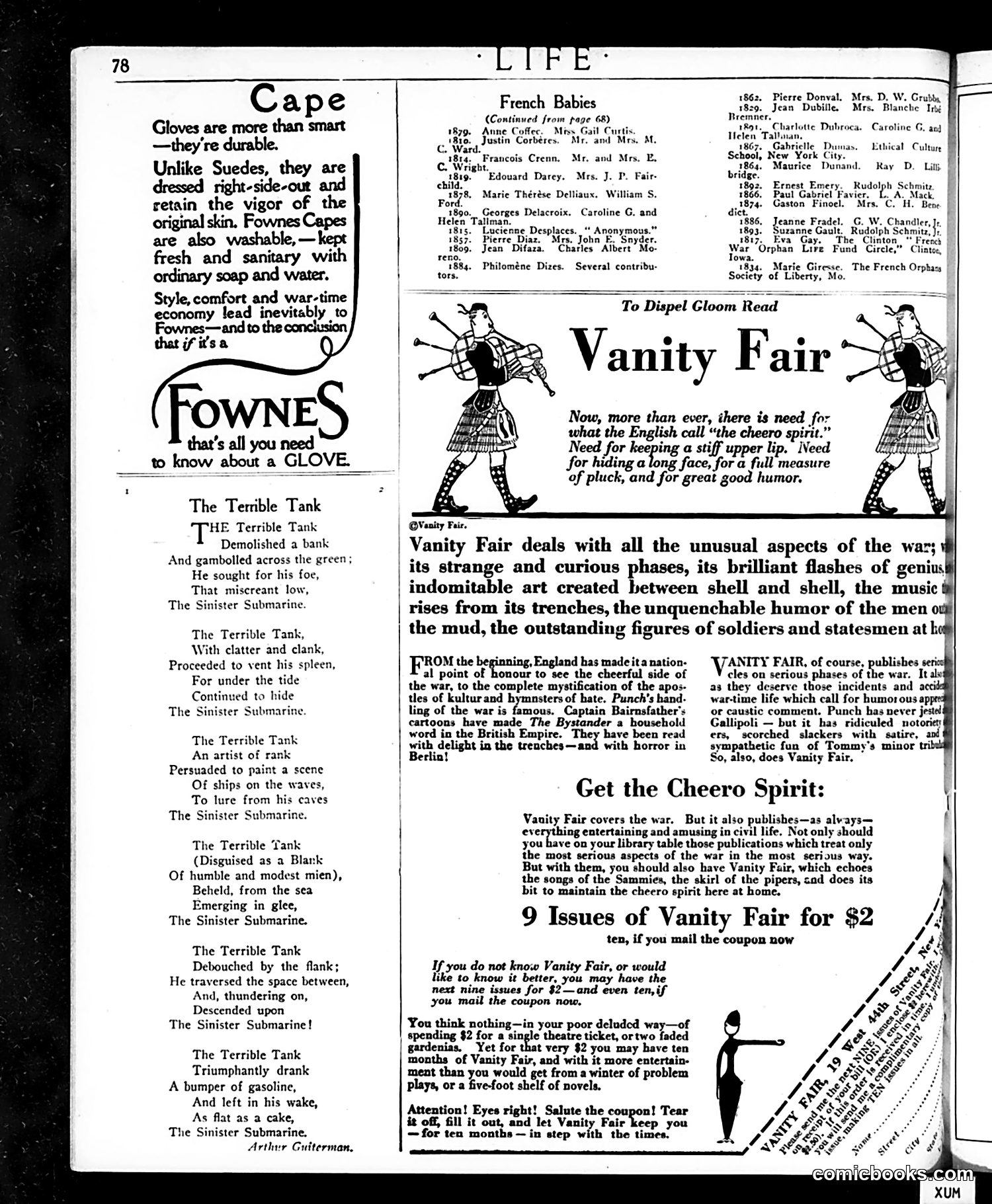
This page contains two elements: a humorous poem by Arthur Guiterman called "The Terrible Tank" and an advertisement for *Vanity Fair* magazine. **"The Terrible Tank"** is WWI-era satirical verse personifying the British tank as a warrior pursuing its nemesis, the German U-boat (submarine). The poem celebrates the tank's triumph, with the final image of it "triumphantly" drinking gasoline while the submarine lies "flat as a cake." The satirical point: the tank, a new military technology, heroically defeats the "Sinister Submarine"—reflecting British anxieties about German U-boat warfare and propaganda celebrating new weapons. **The Vanity Fair ad** argues the magazine provides essential morale-boosting humor during wartime. It references Captain Bairnsfather's famous cartoons (which appeared in *The Bystander*) and *Punch* magazine as precedents for satirical war coverage. The pitch: amid serious war reporting, readers need "the cheero spirit"—British pluck and good humor—which *Vanity Fair* supplies through irreverent commentary on military life and notable figures.
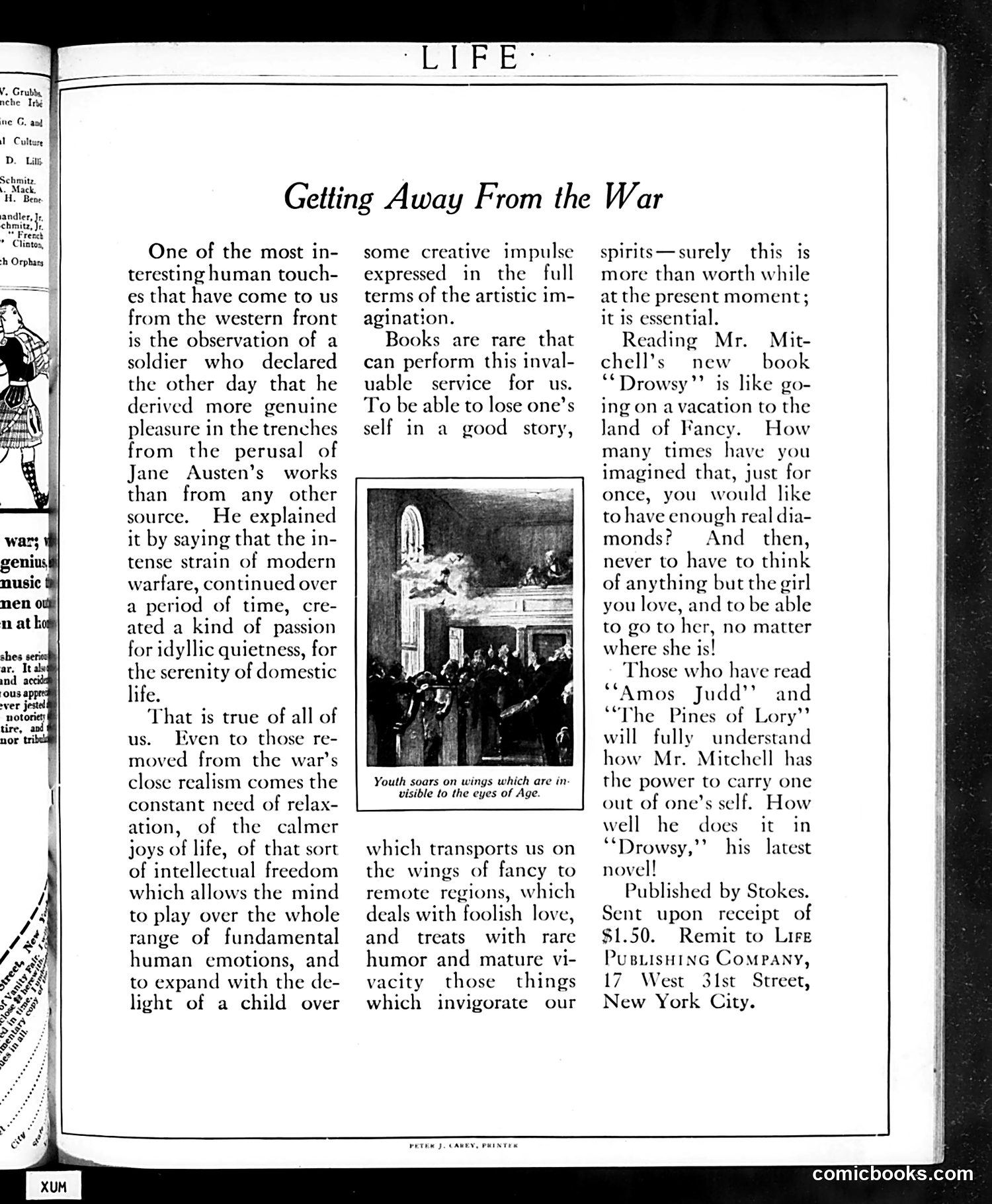
This is a **book review and advertisement**, not a political cartoon. The page discusses how soldiers and civilians during World War I seek escape through literature, particularly Jane Austen's works. The article argues that the psychological strain of modern warfare creates a desperate need for "idyllic quietness" and mental relaxation. It then reviews a novel called "Drowsy" by Mr. Mitchell (likely S. Weir Mitchell, a popular author of the era), praising its ability to transport readers to imaginative realms where they can forget about love and loss. The accompanying illustration shows **"Youth soars on wings which are invisible to the eyes of Age"**—a metaphorical image of young people in a romantic or fantastical setting, reinforcing the escapist theme. The review positions fiction as essential wartime relief—not frivolous entertainment, but psychological necessity for managing trauma.
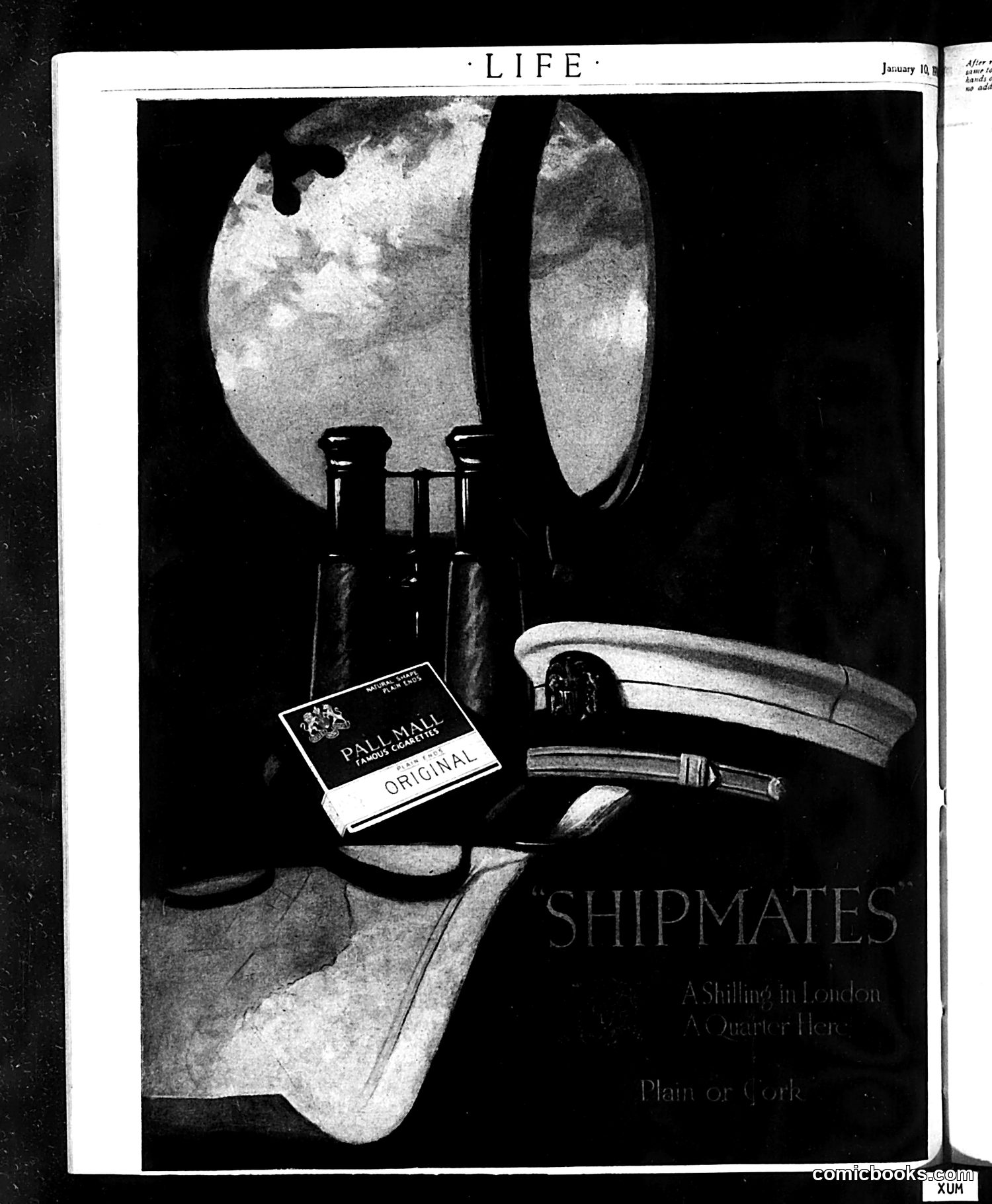
This appears to be a **Pall Mall cigarette advertisement** from Life magazine. The image uses nautical imagery—binoculars, a ship's bell, and what appears to be navigation tools—to evoke camaraderie among sailors or seafaring men. The text mentions "A Shilling in London" and "A Quarter Here," likely referring to pricing in different currencies/locations. The ad plays on the concept of "shipmates"—trusted companions—to position Pall Mall cigarettes as a reliable, companionable product. The sophisticated still-life arrangement and dramatic lighting suggest quality and prestige. This is primarily **commercial advertising** rather than political satire. The "satire" aspect of Life magazine would appear elsewhere on the page, not in this advertisement itself.