
Life, 1918-01-10 · page 16 of 40
Life — January 10, 1918 — page 16: what you’re looking at
What you’re looking at
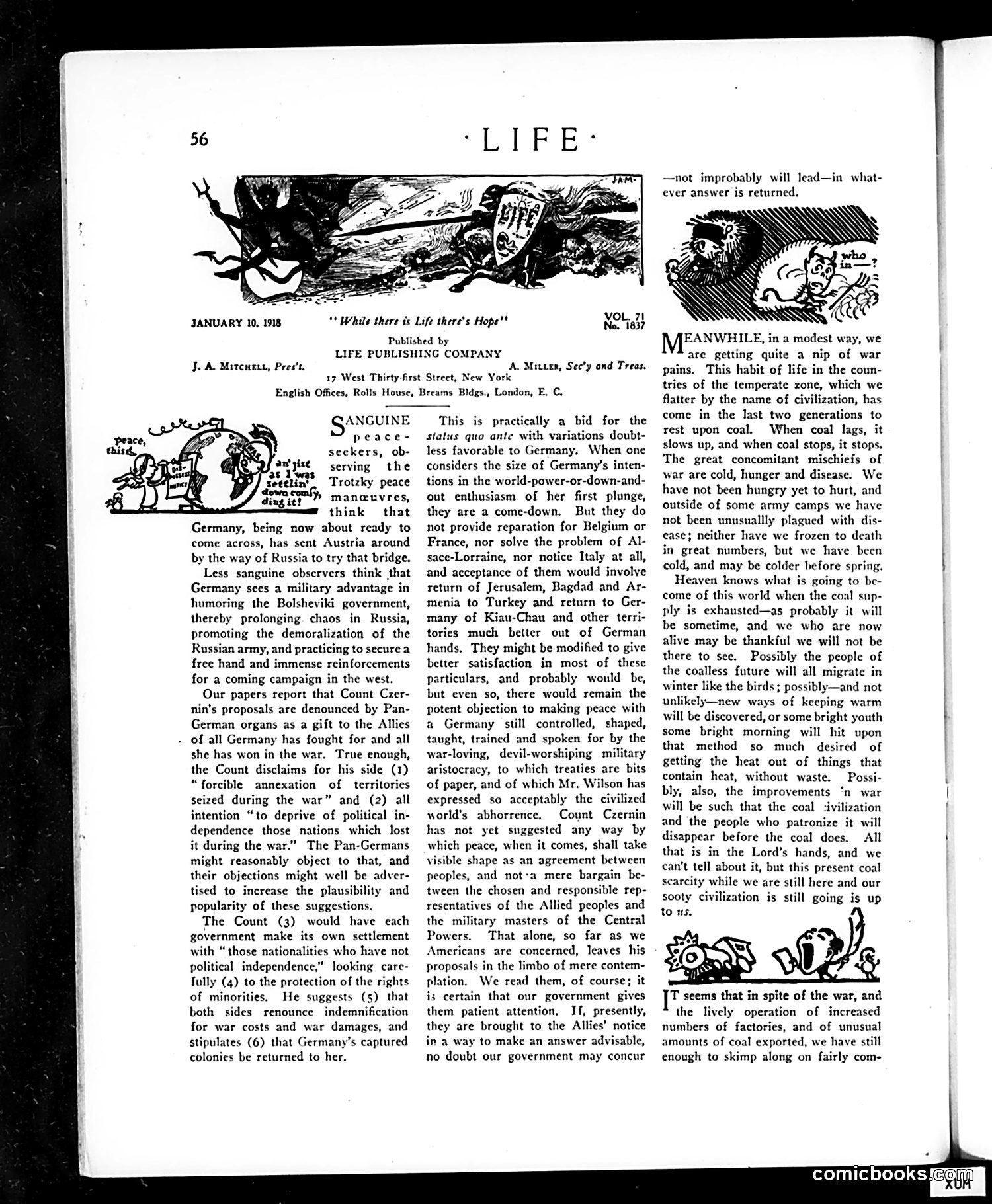
This page discusses peace negotiations during World War I, specifically Count Czernin's (Austria-Hungary's foreign minister) peace proposals. The text skeptically analyzes his six-point plan, which appears moderate but leaves major issues unresolved—Belgium, France, Alsace-Lorraine remain unaddressed, and territories taken from Turkey and Germany are not returned. The cartoon at top-left depicts **Trotsky** (identifiable by the label) as a skeletal death figure, mocking the Bolshevik leader and Russia's chaotic withdrawal from the war. The satire suggests Germany is exploiting Russian turmoil to its advantage. The page's central argument: Count Czernin's proposals, while less extreme than German war aims, fundamentally fail because they preserve Germany's militaristic aristocracy—the root cause of the war. True peace requires not just territorial compromise but fundamental political change in Germany itself, a position aligned with President Wilson's stated war objectives. The darker illustrations represent war's hardships: cold, hunger, and disease afflicting soldiers and civilians.
📄 Transcribed text from this page (OCR, searchable)
Machine-transcribed from the original scan — historical spelling and the odd misread are preserved.
JANUARY 10, 1918 ‘* While there is Life there's Hope" Published by LIFE PUBLISHING COMPANY J. A. Mircurit, Pres’t. A. Miter, Sec’y ond Treas. 17 West Thirty-first Street, New York English Offices, Rolls House, Breams Bldgs., London, E. C. SANGUINE Peace, peace- thise seckers, ob- anyise serving the ‘asi Settlin’, Trotzky peace down dingie? 7” Manauyres, think that Germany, being now about ready to come across, has sent Austria around by the way of Russia to try that bridge. Less sanguine observers think that Germany sees a military advantage in humoring the Bolsheviki_ government, thereby prolonging chaos in Russia, promoting the demoralization of the Russian army, and practicing to secure a free hand and immense reinforcements for a coming campaign in the west. Our papers report that Count Czer- nin’s proposals are denounced by Pan- German organs as a gift to the Allies of all Germany has fought for and all she has won in the war. True enough, the Count disclaims for his side (1) “forcible annexation of territories seized during the war” and (2) all intention “to deprive of political in- dependence those nations which lost it during the war.” The Pan-Germans might reasonably object to that, and their objections might well be adver- tised to increase the plausibility and popularity of these suggestions. The Count (3) would have each government make its own settlement with “ those nationalities who have not political independence,” looking care- fully (4) to the protection of the rights of minorities. He suggests (5) that both sides renounce indemnification for war costs and war damages, and stipulates (6) that Germany’s captured colonies be returned to her. This is practically a bid for the status quo ante with variations doubt- less favorable to Germany, When one considers the size of Germany’s inten- tions in the world-power-or-down-and- out enthusiasm of her first plunge, they are a come-down. But they do not provide reparation for Belgium or France, nor solve the problem of Al- sace-Lorraine, nor notice Italy at all, and acceptance of them would involve return of Jerusalem, Bagdad and Ar- menia to Turkey and return to Ger- many of Kiau-Chau and other terri- tories much better out of German hands. They might be modified to give better satisfaction in most of these particulars, and probably would be, but even so, there would remain the potent objection to making peace with a Germany still controlled, shaped, taught, trained and spoken for by the war-loving, devil-worshiping military aristocracy, to which treaties are bits of paper, and of which Mr. Wilson has expressed so acceptably the civilized world’s abhorrence, Count Czernin has not yet suggested any way by which peace, when it comes, shall take visible shape as an agreement between peoples, and not-a mere bargain be- tween the chosen and responsible rep- resentatives of the Allied peoples and the military masters of the Central Powers. That alone, so far as we Americans are concerned, leaves his proposals in the limbo of mere contem- plation. We read them, of course; it is certain that our government gives them patient attention, If, presently, they are brought to the Allies’ notice in a way to make an answer advisable, no doubt our government may concur —not improbably will lead—in what- ever answer is returned, EANWHILE, in a modest way, we are getting quite a nip of war pains. This habit of life in the coun- tries of the temperate zone, which we flatter by the name of civilization, has come in the last two generations to rest upon coal. When coal lags, it slows up, and when coal stops, it stops. The great concomitant mischiefs of war are cold, hunger and disease. We have not been hungry yet to hurt, and outside of some army camps we have not been unusuallly plagued with dis- ease; neither have we frozen to death in great numbers, but we have been cold, and may be colder before spring. Heaven knows what is going to be- come of this world when the coal sup- ply is exhausted—as probably it will be sometime, and we who are now alive may be thankful we will not be there to sce. Possibly the people of the coalless future will all migrate in winter like the birds; possibly—and not unlikely—new ways of keeping warm will be discovered, or some bright youth some bright morning will hit upon that method so much desired of getting the heat out of things that contain heat, without waste. Possi- bly, also, the improvements ‘n war will be such that the coal -ivilization and ‘the people who patronize it will disappear before the coal docs. All that is in the Lord’s hands, and we can’t tell about it, but this present coal scarcity while we are still here and our sooty civilization is still going is up 'T seems that in spite of the war, and the lively operation of increased numbers of factories, and of unusual amounts of coal exported, we have still enough to skimp along on fairly com- comicbooks Seyi