
Life, 1918-01-10 · page 17 of 40
Life — January 10, 1918 — page 17: what you’re looking at
What you’re looking at
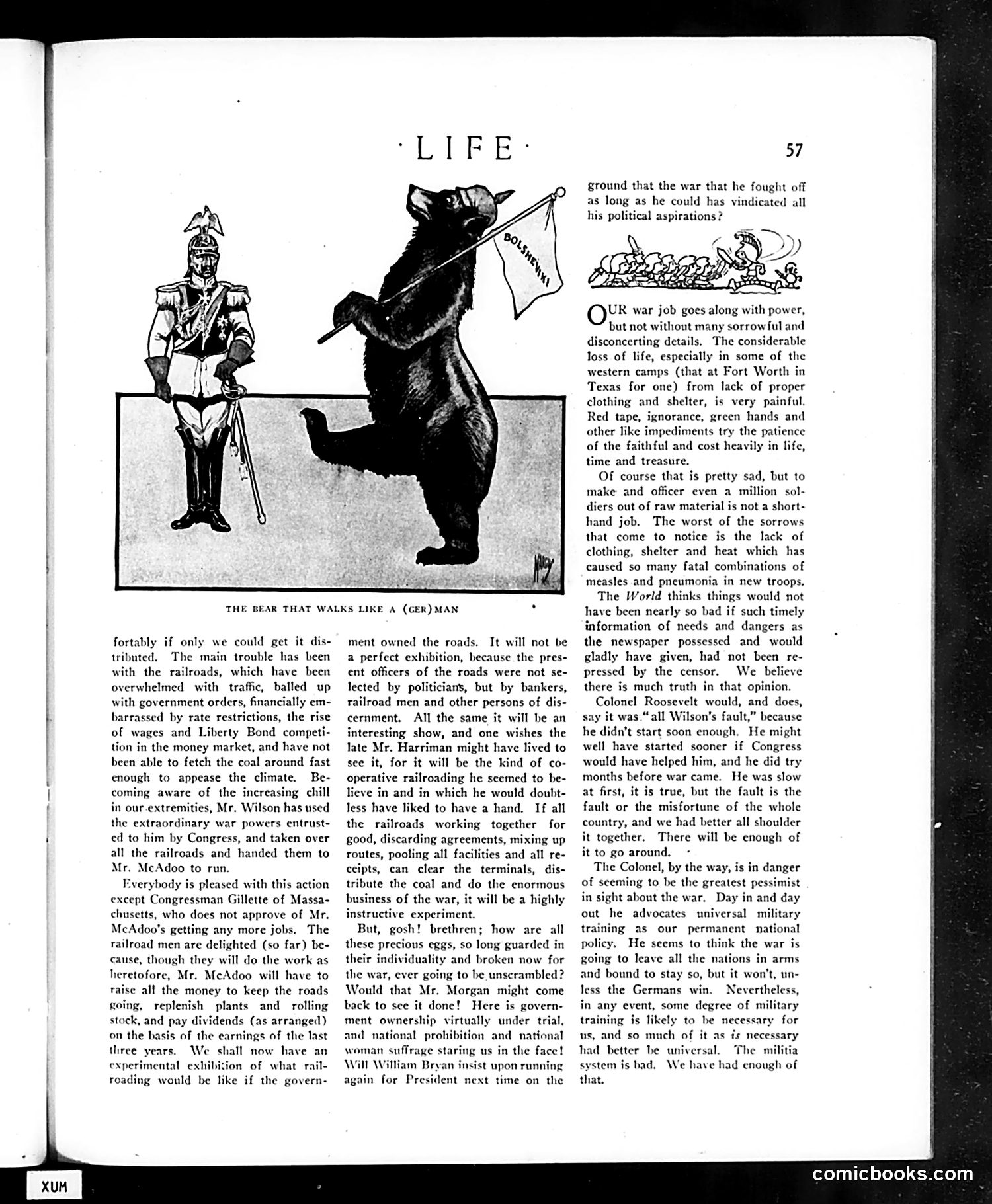
The cartoon depicts a bear labeled "BOLSHEVISM" standing upright on hind legs, mimicking human posture while holding a flag. A German military officer stands nearby observing. The caption's pun—"(Ger)man"—suggests the bear's human-like walk is actually German influence. **Context:** This is WWI-era satire warning that Bolshevism (Russian communism) is being weaponized or manipulated by Germany. The image suggests Germany is using revolutionary communist ideology as a tool, much as a bear might be trained to perform. **Historical reference:** The accompanying text discusses President Wilson's wartime nationalization of American railroads under William McAdoo, suggesting government control of industry. The cartoon likely warns that such government takeovers, combined with revolutionary ideology spreading during wartime chaos, could lead to communist infiltration—a common anti-Bolshevik anxiety in 1918 America.
📄 Transcribed text from this page (OCR, searchable)
Machine-transcribed from the original scan — historical spelling and the odd misread are preserved.
THE BEAR THAT WALKS LIKE A (GER) MAN fortably if only we could get it dis- tributed. The main trouble has been with the railroads, which have been overwhelmed with traffic, balled up with government orders, financially em- barrassed by rate restrictions, the rise of wages and Liberty Bond competi- tion in the money market, and have not been able to fetch the coal around fast enough to appease the climate. Be- coming aware of the increasing chill in our-extremities, Mr, Wilson has used the extraordinary war powers entrust- ed to him by Congress, and taken over all the railroads and handed them to Mr. McAdoo to run. erybody is pleased with this action except Congressman Gillette of Massa- chusetts, who does not approve of Mr. McAdoo’s getting any more jobs. The railroad men are delighted (so far) be- cause, though they will do the work as heretofore, Mr. McAdoo will have to raise all the money to keep the roads going, replenish plants and_ rolling stock, and pay dividends (as arranged) on the basis of the earnings of the last three years. We shall now have an experimental exhibision of what rail- roading would be like if the govern- ment owned the roads. It will not be a perfect exhibition, because the pres- ent officers of the roads were not se- lected by politicians, but by bankers, railroad men and other persons of dis- cernment. All the same it will be an interesting show, and one wishes the late Mr. Harriman might have lived to sce it, for it will be the kind of co- operative railroading he seemed to be- lieve in and in which he would doubt- less have liked to have a hand. If all the railroads working together for good, discarding agreements, mixing up routes, pooling all facilities and all re- ceipts, can clear the terminals, dis- tribute the coal and do the enormous business of the war, it will be a highly instructive experiment. But, gosh! brethren; how are all these precious eggs, so long guarded in their individuality and broken now for the war, ever going to be unscrambled? Would that Mr. Morgan might come back to see it done! Here is govern- ment ownership virtually under trial, and national prohibition and national woman suffrage staring us in the face! Will William Bryan insist upon running again for President next time on the 57 ground that the war that he fought off as long as he could has vindicated all his political aspirations? UR war job goes along with power, but not without many sorrowful and disconcerting details. The considerable loss of life, especially in some of the western camps (that at Fort Worth in Texas for one) from lack of proper clothing and shelter, is very painful. Red tape, ignorance, green hands and other like impediments try the patience of the faithful and cost heavily in life, time and treasure. Of course that is pretty sad, but to make and officer even a million sol- diers out of raw material is not a short- hand job. The worst of the sorrows that come to notice is the lack of clothing, shelter and heat which has caused so many fatal combinations of measles and pneumonia in new troops. The World thinks things would not have been nearly so bad if such timely information of needs and dangers as the newspaper possessed and would gladly have given, had not been re- pressed by the censor. We believe there is much truth in that opinion. Colonel Roosevelt would, and does, say it was.“ all Wilson's fault,” because he didn’t start soon enough. He might well have started sooner if Congress would have helped him, and he did try months before war came. He was slow at first, it is true, but the fault is the fault or the misfortune of the whole country, and we had better all shoulder it together. There will be enough of it to go around. The Colonel, by the way, is in danger of seeming to be the greatest pessimist in sight about the war. Day in and day out he advocates universal military training as our permanent national policy. He seems to think the war is going to leave all the nations in arms and bound to stay so, but it won't, un- less the Germans win. Nevertheless, in any event, some degree of military training is likely to be necessary for us, and so much of it as is necessary had better be universal. The militia system is bad. We have had enough of that. comicbooks.com