
Life, 1918-01-10 · page 24 of 40
Life — January 10, 1918 — page 24: what you’re looking at
What you’re looking at
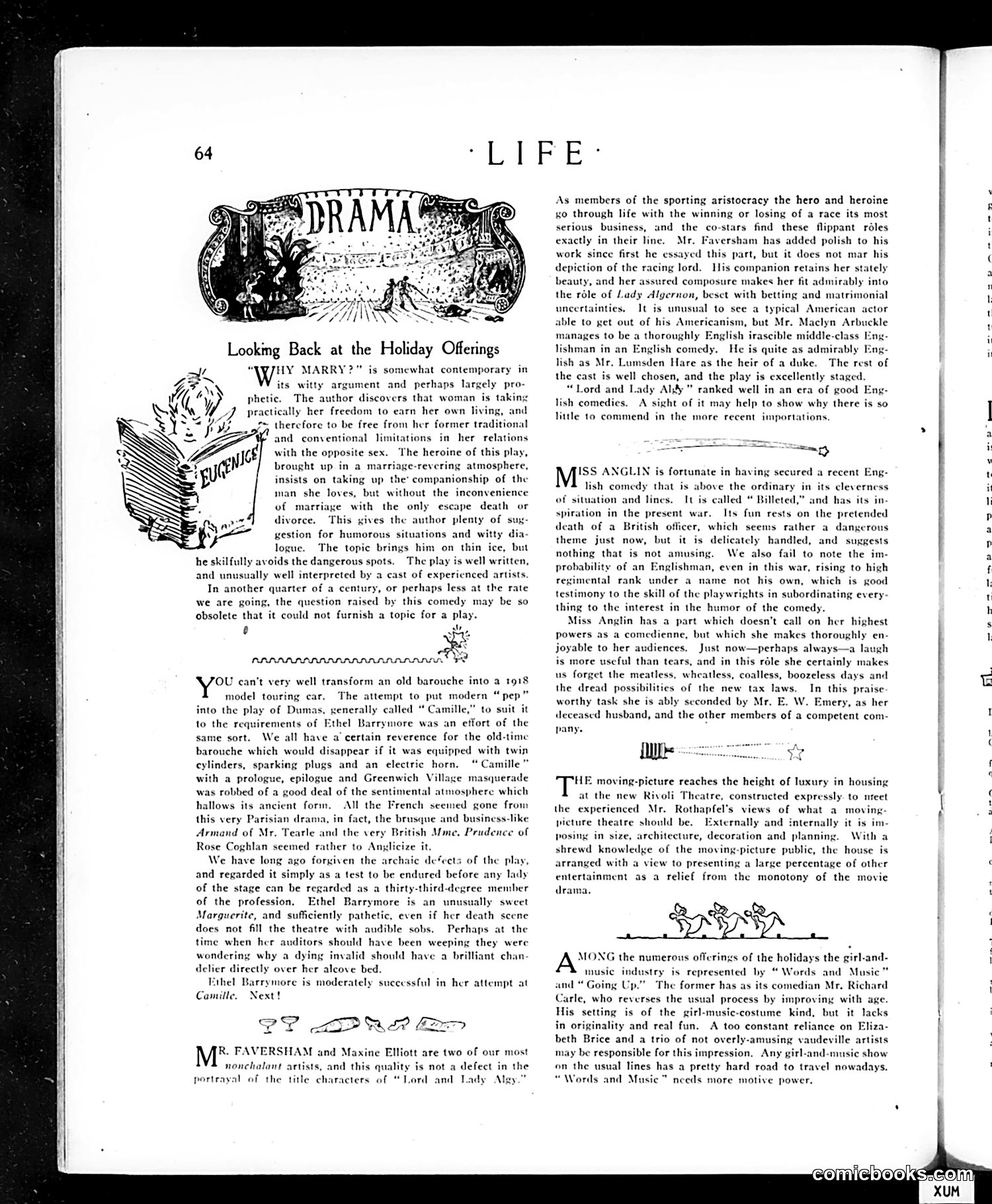
This page contains theater reviews from Life magazine's "Drama" section, critiquing holiday theatrical offerings. The content addresses contemporary plays and their modernization efforts. **Key Reviews:** 1. **"Why Marry?"** - Praised as timely and prophetic for exploring women's economic independence and freedom from traditional marriage expectations. The reviewer notes the play's humor and suggests this social question may become obsolete within a generation. 2. **"Camille"** - Criticized for attempting to update Alexandre Dumas's classic 1800s melodrama with 1918 "pep" (modernization). The reviewer argues this damages the play's sentimental atmosphere, comparing it to adding modern car engines to a historic carriage. Ethel Barrymore's performance is called "unusually sweet" but not tearfully moving. 3. **"Lord and Lady Algy"** - Praised as an excellent English comedy featuring Faversham and Maxine Elliott, with strong supporting performances capturing upper-class sporting society. The reviews reflect early-20th-century theatrical criticism and debates about tradition versus modernization in drama.
📄 Transcribed text from this page (OCR, searchable)
Machine-transcribed from the original scan — historical spelling and the odd misread are preserved.
Looking Back at the Holiday Offerings a “WWJHY MARRY?” is somewhat contemporary aN its witty argument and perhaps largely pro- ((’ yp phetic. The author discovers that woman is takin practically her freedom to earn her own living, te therefore to be free from her former traditional tions in her relations and conventional limi with the opposite sex. The heroine of this play, brought up in a marriage-revering atmosphere, insists on taking up the’ companionship of the man she loves, but without the inconvenience of marriage with the only escape death or divorce. This gives the author plenty of sux- gestion for humorous situations and witty dia- logue. The topic brings him on thin ice, but he skilfully avoids the dangerous spots. The play is well written, and unusually well interpreted by a cast of experienced artists. In another quarter of a century, or perhaps less at the rate we are going, the question raised by this comedy may be so obsolete that it could not furnish a topic for a play. 6 AARARAAARARARARAAAA ‘OU can't very well transform an old barouche into a 1918 model touring car. The attempt to put modern “pep” into the play of Dumas, generally called “ Camille,” to suit it to the requirements of Ethel Barrymore was an effort of the same sort. We all have a’certain reverence for the old-time barouche which would disappear if it was equipped with twin cylinders, sparking plugs and an electric horn. “Camille” with a prologue, epilogue and Greenwich Village masquerade was robbed of a good deal of the sentimental atmosphere which hallows its ancient form. All the French seemed gone frow this very Parisian drama, in fact, the brusque and business-like Armand of Mr. Tearle and the very British Mme, Prudence of Rose Coghlan seemed rather to Anglicize it. We have long ago forgiven the archaic defects of the pl and regarded it simply as a test to be endured before any lady of the stage can be regarded as a thirty-third-degree member of the profession, Ethel Barrymore is an unusually sweet Marguerite, and sufficiently pathetic, even if her death scene does not fill the theatre with audible sobs. Perhaps at the time when her auditors should have been weeping they were wondering why a dying invalid should have a brilliant chan dclier directly over her alcove bed. thel Barrymore is moderately successful in her attempt a Camille. Next! R. FAVERSHAM and Maxine Elliott are two nonchalant artists, and this quality is not a defect in the portrayal of the title ch and Lady Algy.” our most racters of “1 ~LIFE> As members of the sporting aristocracy the hero and heroine xo through life with the winning or losing of a race its most serious business, and the co-stars find these flippant réles exactly in their line, Mr, Faversham has added polish to his work since first he essayed this part, but it does not mar his depiction of the racing lord. His companion retains her stately akes her fit admirably into the réle of Lady Algernon, besct with betting and matrimoni uncertainties. It is unusual to see a typi ple to get out of his Americanism, but Mr. Maclyn Arbuckle ses to be a thoroughly English irascible middle-class Eng- lishman in an English comedy. He is quite as admirably Eng- lish as Mr. Lumsden Hare as the heir of a duke. The rest of the cast is well chosen, and the play is excellently staged. “Lord and Lady Aly” ranked well in an era of good Eng- lish comedies. A sight of it may help to show why there is so beauty, and her assured composure m al American actor mai little 10 commend in the more recent importations. Se is fortunate in having secured a recent Eng- lish comedy that is above the ordinary in its cleverness of situation and lines. It is called “ Billeted,” and has its in spiration in the present war. Its fun rests on the pretended death of a British officer, which seems rather a dangerous theme just now, but it is delicately handled, and suggests nothing that is not amusing. We also fail to note the im- probability of an Englishman, even in this war, rising to high regimental rank under a name not his own, which is good testimony to the skill of the pla thing to the interest in the humor of the comedy. Miss Anglin has a part which doesn’t call on her highest powers as a comedienne, but which she makes thoroughly en- joyable to her audiences. Just now—perhaps always—a laugh is more useful than tears, and in this réle she certainly makes us forget the meatless, wheatless, coalless, boozeless days and the dread possibilities of the new tax laws. In this praise worthy task she is ably seconded by Mr. E. W. Emery, as her deceased husband, and the other members of a competent com- _ || HE moving-picture reaches the height of luxury in housing at the new Rivoli Theatre, constructed expressly. to nteet the experienced Mr. Rothapfel’s views of what a moving- picture theatre should be. Externally and internally it is im- posing in size, architecture, decoration and planning. With a shrewd knowledge of the moving-picture public, the house is arranged with a view to presenting a large percenta entertainment as a relief from the monotony of the movie MONG the numerous offerings of the holidays the girl-and- music industry is represented by “Words and Music” and “Going Up.” The former has as its comedian Mr. Richard Carle, who reverses the usual process by improving with age. His setting is of the girl-music-costume kind, but it lacks in originality and real fun. A too constant reliance on Eliza- beth Brice and a trio of not overt; may be respon: on the usual Tines has a pretty hard road to travel nowadays. “Words and Musi ywrights in subordinating every- ge of other drama. musing vaudeville artists le for this impression, Any girl-and-music show needs more motive power.