
Life, 1918-01-10 · page 11 of 40
Life — January 10, 1918 — page 11: what you’re looking at
What you’re looking at
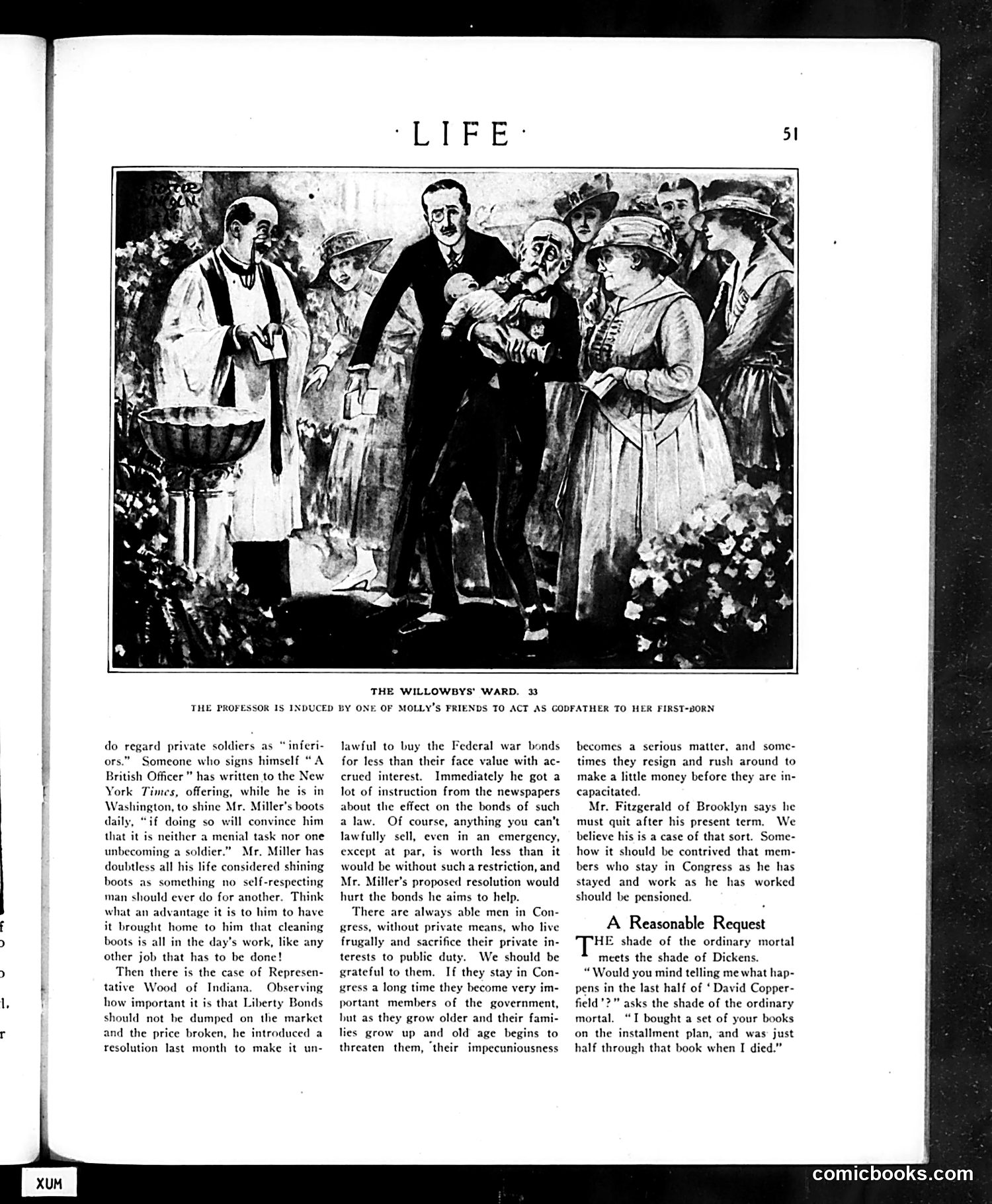
This illustration from Life magazine shows a christening or baptism scene. The caption indicates "The Professor is induced by one of Molly's friends to act as godfather to her first-born." The accompanying text discusses Liberty Bonds during what appears to be World War I era. It critiques how some people view military service, quoting someone who dismisses "private soldiers as 'inferiors.'" The article argues against this class-based attitude, advocating that those serving in Congress should face financial sacrifice equal to ordinary citizens. The satire appears to mock social pretension—the scene shows formally dressed characters at a religious ceremony, likely illustrating how class distinctions persist even in solemn family moments. The juxtaposition with the Liberty Bonds discussion suggests commentary on unequal war sacrifice based on social status.
📄 Transcribed text from this page (OCR, searchable)
Machine-transcribed from the original scan — historical spelling and the odd misread are preserved.
THE WILLOWBYS' WARD. 3 THE PROFESSOR IS INDUCED BY ONE OF MOLLY'S FRIENDS TO ACT AS GODFATHER TO HER FIRST-BORN do regard private soldiers as “ inferi- Someone who signs himself “ British Officer” has written to the New York nes, offering, while he is in Washington, to shine Mr. Miller's boots daily, “if doing so will convince him that it is neither a menial task nor one unbecoming a soldier.” Mr. Miller has doubtless all his life considered shining boots as something no self-respecting man should ever do for another. Think what an advantage it is to him to have it brought home to him that cleaning boots is all in the day’s work, like any other job that has to be done! Then there is the case of Represen- tative Wood of Indiana. Observing how important it is that Liberty Bonds. should not be dumped on the market and the price broken, he introduced a resolution last month to make it un- lawful to buy the Federal war bonds for less than their face value with ac- crued interest. Immediately he got a lot of instruction from the newspapers about the effect on the bonds of such a law. Of course, anything you can't lawfully sell, even in an emergency, except at par, is worth less than it would be without such a restriction, and Mr. Miller’s proposed resolution would hurt the bonds he aims to help. There are al able men in Con- gress, without private means, who live frugally and sacrifice their private in- terests to public duty. We should be grateful to them. If they stay in Con- gress a long time they become very im- portant members of the government, but as they grow older and their fami- lies grow up and old age begins to threaten them, ‘their impecuniousness becomes a serious matter, and some- times they resign and rush around to make a little money before they are in- capacitated. Mr. Fitzgerald of Brooklyn says he must quit after his present term. We believe his is a case of that sort. Some- how it should be contrived that mem- bers who stay in Congress as he has stayed and work as he has worked should be pensioned. A Reasonable Request HE shade of the ordinary mortal meets the shade of Dickens. “Would you mind telling mewhat hap- pens in the last half of ‘David Copper- field’? ” asks the shade of the ordinary mortal. “TI bought a set of your books on the installment plan, and was just half through that book when I died.” comicbooks.com