
Life, 1918-01-10 · page 39 of 40
Life — January 10, 1918 — page 39: what you’re looking at
What you’re looking at
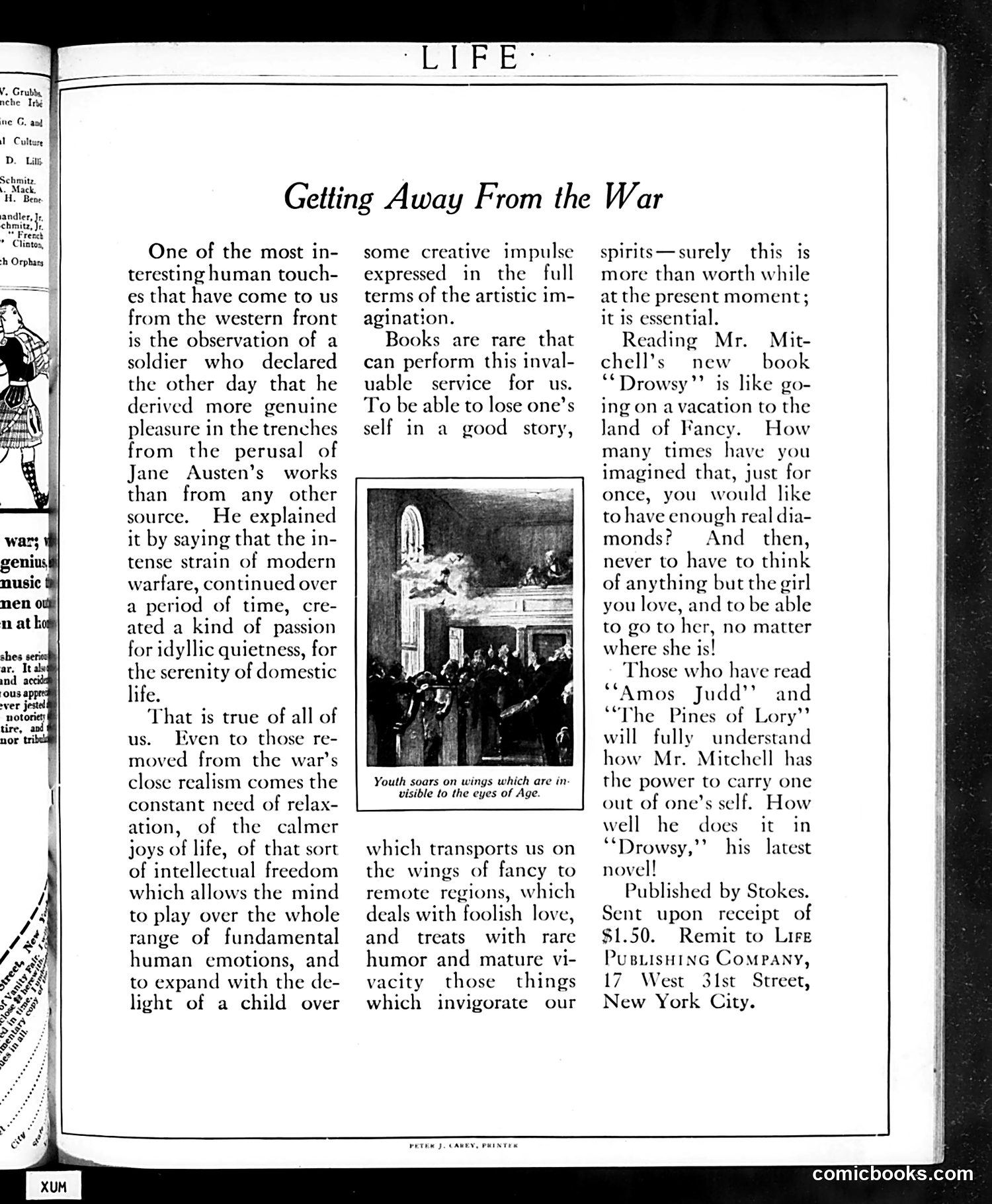
This is a **book review and advertisement**, not a political cartoon. The page discusses how soldiers and civilians during World War I seek escape through literature, particularly Jane Austen's works. The article argues that the psychological strain of modern warfare creates a desperate need for "idyllic quietness" and mental relaxation. It then reviews a novel called "Drowsy" by Mr. Mitchell (likely S. Weir Mitchell, a popular author of the era), praising its ability to transport readers to imaginative realms where they can forget about love and loss. The accompanying illustration shows **"Youth soars on wings which are invisible to the eyes of Age"**—a metaphorical image of young people in a romantic or fantastical setting, reinforcing the escapist theme. The review positions fiction as essential wartime relief—not frivolous entertainment, but psychological necessity for managing trauma.
📄 Transcribed text from this page (OCR, searchable)
Machine-transcribed from the original scan — historical spelling and the odd misread are preserved.
v. Grube nehe Tre ne G. al 1 Colter D. Lili. Schmitz \. Mack, H. Bene. k andler, ch: Getting Away From the War One of the most in- teresting human touch- es that have come to us from the western front is the observation of a soldier who declared the other day that he derived more genuine pleasure in the trenches from the perusal of Jane Austen’s works than from any other source. He explained it by saying that the in- tense strain of modern warfare, continued over a period of time, cre- ated a kind of passion for idyllic quietness, for the serenity of domestic life. That is true of all of us. Even to those re- moved from the war’s close realism comes the constant need of relax- ation, of the calmer joys of life, of that sort of intellectual freedom which allows the mind to play over the whole range of fundamental human emotions, and to expand with the de- light of a child over some creative impulse expressed in the full terms of the artistic im- agination. Books are rare that can perform this inval- uable service for us. To be able to lose one’s self in a good story, Youth soars on wings which are in- visible to the eyes of Age. which transports us on the wings of fancy to remote regions, which deals with foolish love, and treats with rare humor and mature vi- vacity those things which invigorate our spirits—surely this is more than worth while at the present moment; it is essential. Reading Mr. chell’s | new book “Drowsy”? is like go- ing on avacation to the land of Fancy. How many times have you imagined that, just for once, you would like to have enough real dia- monds? And _ then, never to have to think of anything but the girl you love, and to be able to go to her, no matter where she is! Those who have read ““Amos Judd’? and “The Pines of Lory” will fully understand how Mr. Mitchell has the power to carry one out of one’s self. How Mit- well he does it in “Drowsy,’’ his latest novel! Published by Stokes. Sent upon receipt of $1.50. Remit to Lire Pus.isHinG Company, 17 West 31st Street, New York City. comicbooks.com