
Life, 1918-01-10 · page 29 of 40
Life — January 10, 1918 — page 29: what you’re looking at
What you’re looking at
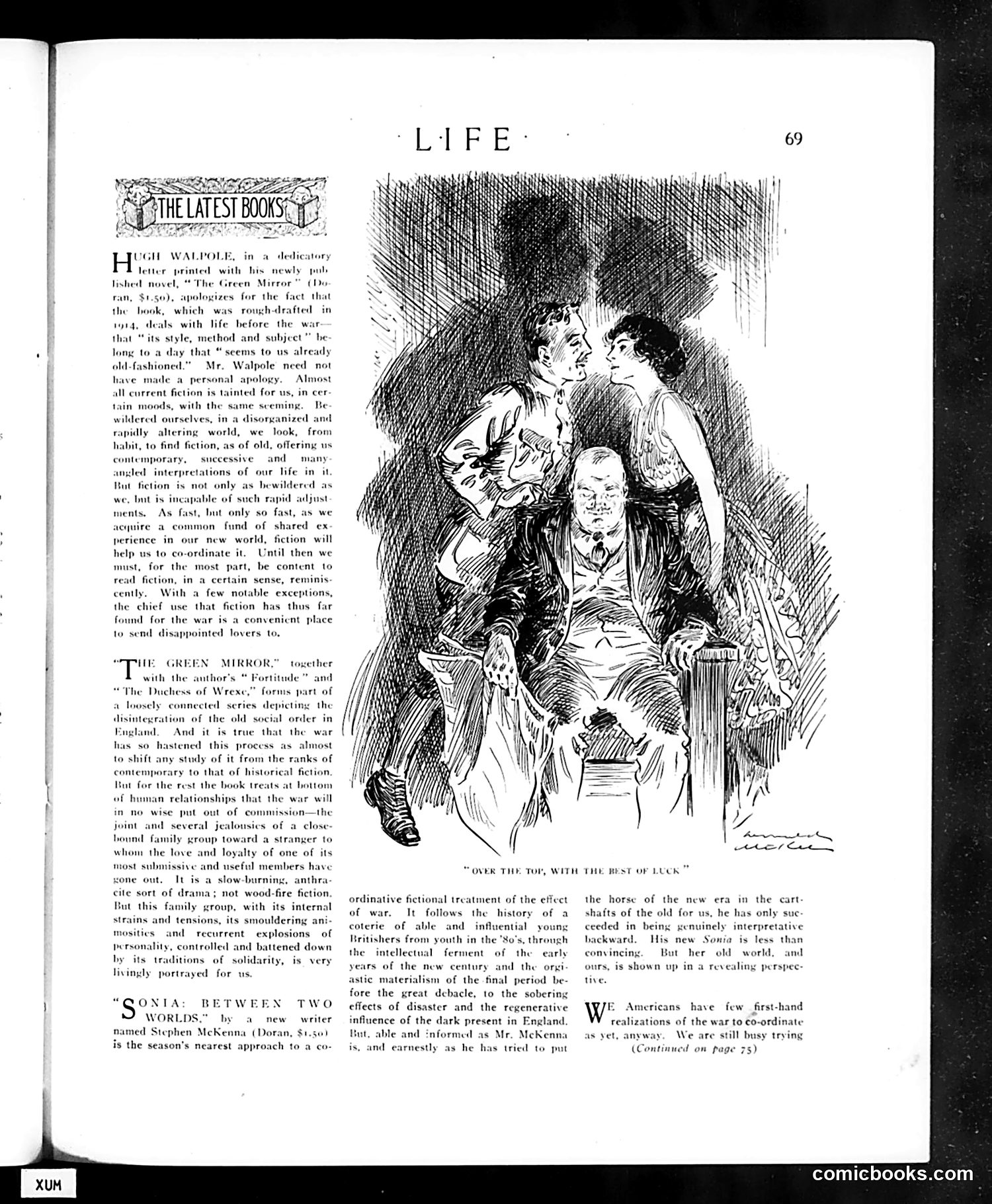
This page reviews contemporary fiction dealing with World War I's social impact. The illustration shows a well-dressed family group in an interior setting, captioned "Over the Top, With the Best of Luck"—a sardonic reference to soldiers going into battle. The reviews discuss novels by Hugh Walpole ("The Green Mirror") and Stephen McKenna ("Sonia: Between Two Worlds"), both depicting the disintegration of England's old social order caused by the war. The critic argues that while WWI has accelerated social change so dramatically that contemporary fiction now reads as "historical fiction," these authors struggle to convincingly portray their characters' psychological responses to this upheaval. The satire lies in the gap between the war's profound social disruption and fiction's limited ability to capture it authentically. The cartoon's caption suggests dark irony about civilians' optimistic detachment from battlefield reality—they wish soldiers "the best of luck" while remaining safely removed from war's actual consequences.
📄 Transcribed text from this page (OCR, searchable)
Machine-transcribed from the original scan — historical spelling and the odd misread are preserved.
ST BOOKS IP} UGIL WALPOLE, in letter printed with his newly pub novel, “ The Green Mirror” (De: a dedicatory . apologizes for the fact that which was rough-drafted in rong, deals with life before the w that “its style, method and subject long to a day that “seems to us already . Walpole need not nal apology. Almost all current fiction is tainted for us, in cer tain wildered ourselves, in a disorganized k, find fiction, as of old, offering us. old-fashioned joods, with the same seeming. Be rom altering world, we | mpors suecessive and — many ns of our life in it nly as bewildered as we, nt is incapable of such rapid adjust ments. As fast, but only so fast, as we acquire a common fund of shared ex perience in our new world, fiction will Until then we 1, be content to read fiction, in a certain sense, reminis help us to co-ordinate it must, for the most p cently, With a few notable exceptions, the chief use that fiction has thus far found for the war is a convenicnt place ty send disappointed lovers to. “CHE GREEN with the “The Duchess of Wrexe,” forms part of a loosely MIRROR.” tox hor's * Fortitude and nected series depicting the disintegration of the old social order in England. And it is true t has so hastened this process as almost to shift any study of it from the ranks of contemporary to that of historical fiction. ut the war Kut for the rest the book treats at bottom of hy in no wise put out of commission—the jan relationships that the war will joint and several jealousics of a close bound fa la stranger to whom the love and loyalty of one of its most submissive and useful members have kroup tow xone out, It is a slow-burning, anthra- cite sort of drama; not wood-fire fiction But this family group, with its internal strains and tensions, its smouldering ani- mosities and recurrent explosions of personality, controlled and battened down hy its traditions of solidarity, is. very livingly portrayed for us. TWO writer 1 new named Stephen Me! is the season's nearest na (Doran, “OVER THE Tor, WITH tive fictional treatment of the effect of war. It coterie of able and influ follows the history of a young Kritishers from youth in the the intellectual ferment of years of the new century and the orxi astic materialism of the final period be- fore the great debacle, 10 the sobering effects of disaster and the regenerative influence of the dark present in E: But, able and informed as Mr. Me is, and earnestly as he has tried to put and. enna THE BEST OF LUCK” the horse of the new era in the cart shafts of the old for us, he has only suc- ceeded in being genuinely interpretative backward. His new Sonia is less than convincing. But her old) world, and ours, is shown up in a revealing perspec tive. W Americans have few first-hand realizations of the war to ¢0-ordinate as yet, anyway, We are still busy trying (Continued on page 75) comicbooks.com