
A complete issue · 40 pages · 1917
Life — November 29, 1917
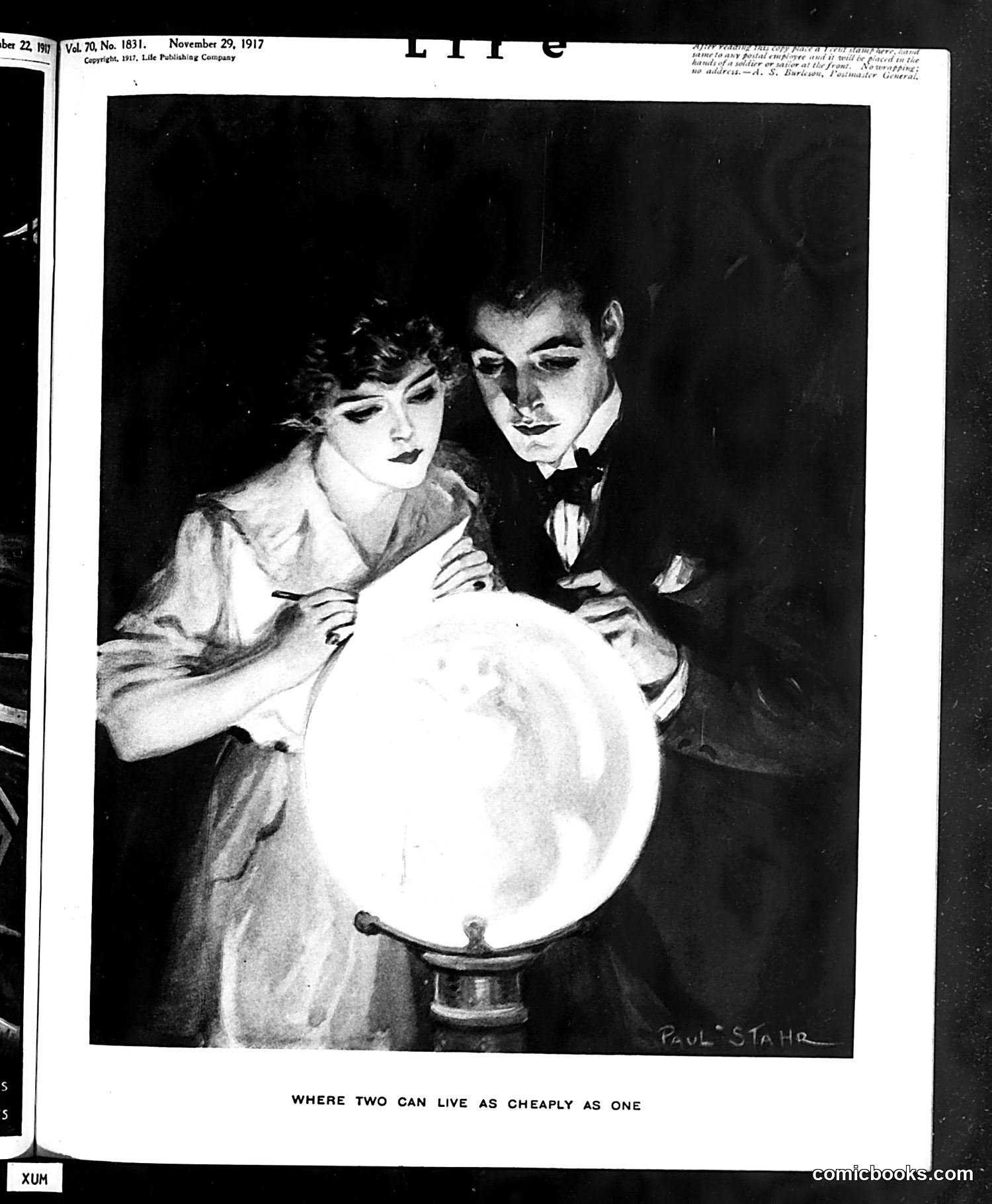
This appears to be a theatrical or cinematic still from 1917, not a political cartoon. The image shows two figures in formal attire gazing into a crystal ball, with the caption "WHERE TWO CAN LIVE AS CHEAPLY AS ONE." The satire targets the economics of marriage, particularly relevant during World War I when cost of living was rising. The couple consulting a fortune teller suggests young people seeking magical solutions to financial hardship rather than practical ones. The caption—a common saying about shared household expenses—is presented ironically: the crystal ball (literally obscuring their vision) implies they're deluded about marriage's financial realities. The photograph is credited to "Paul Stahr" at bottom. This is likely an advertisement or entertainment feature rather than direct political commentary.
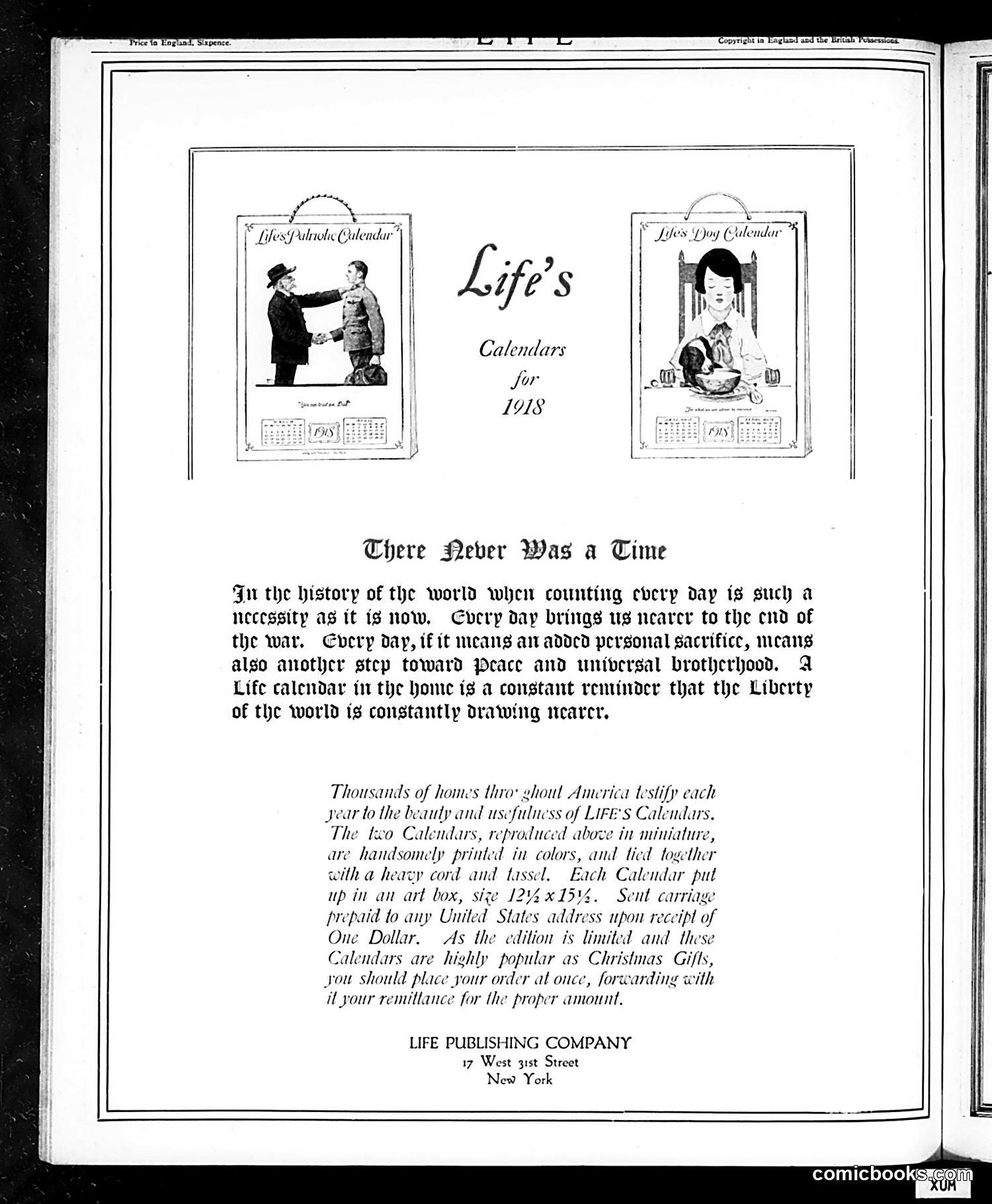
This page is primarily **advertising** for Life Publishing Company's calendar products, not political satire. The ad promotes two decorative calendars for 1918: "Life's Miracle Calendar" (showing two men shaking hands) and "Life's Day Calendar" (showing a woman with a child). The accompanying text uses **WWI messaging** to justify the calendars' importance—claiming that "counting every day" helps end the war and advance "Peace and universal brotherhood." This appeals to patriotic sentiment during America's involvement in World War I. The calendars cost one dollar, came in an art box, and were marketed as Christmas gifts. The ad emphasizes limited availability and urges immediate orders. This is straightforward commercial promotion leveraging wartime consciousness rather than satirical commentary.
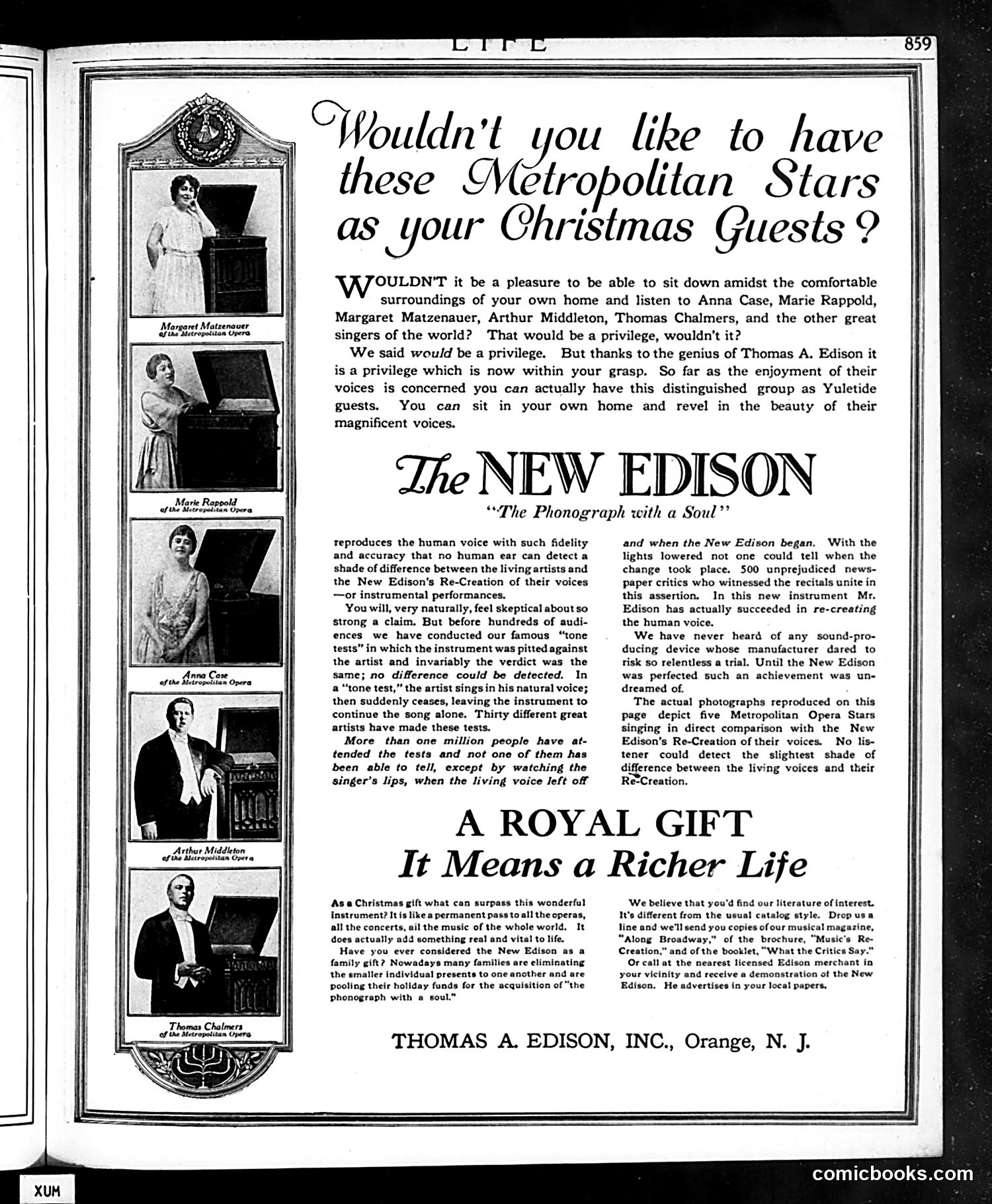
This is primarily a **product advertisement**, not satire or political commentary. Thomas A. Edison, Inc. advertised the "New Edison" phonograph as a Christmas gift by featuring Metropolitan Opera singers: Margaret Matzenauer, Marie Rappold, Anna Case, Arthur Middleton, and Thomas Chalmers. The ad's pitch claims the phonograph reproduces voices so faithfully that audiences cannot distinguish between live performers and the recorded "Re-Creation." It references past "tone tests" where the instrument supposedly fooled critics. The appeal targets affluent readers: owning this device means hosting famous opera singers as "Christmas guests" in your home. The tagline, "The Phonograph with a Soul," emphasizes emotional authenticity—a key Edison marketing claim distinguishing their product from competitors like Victrola.
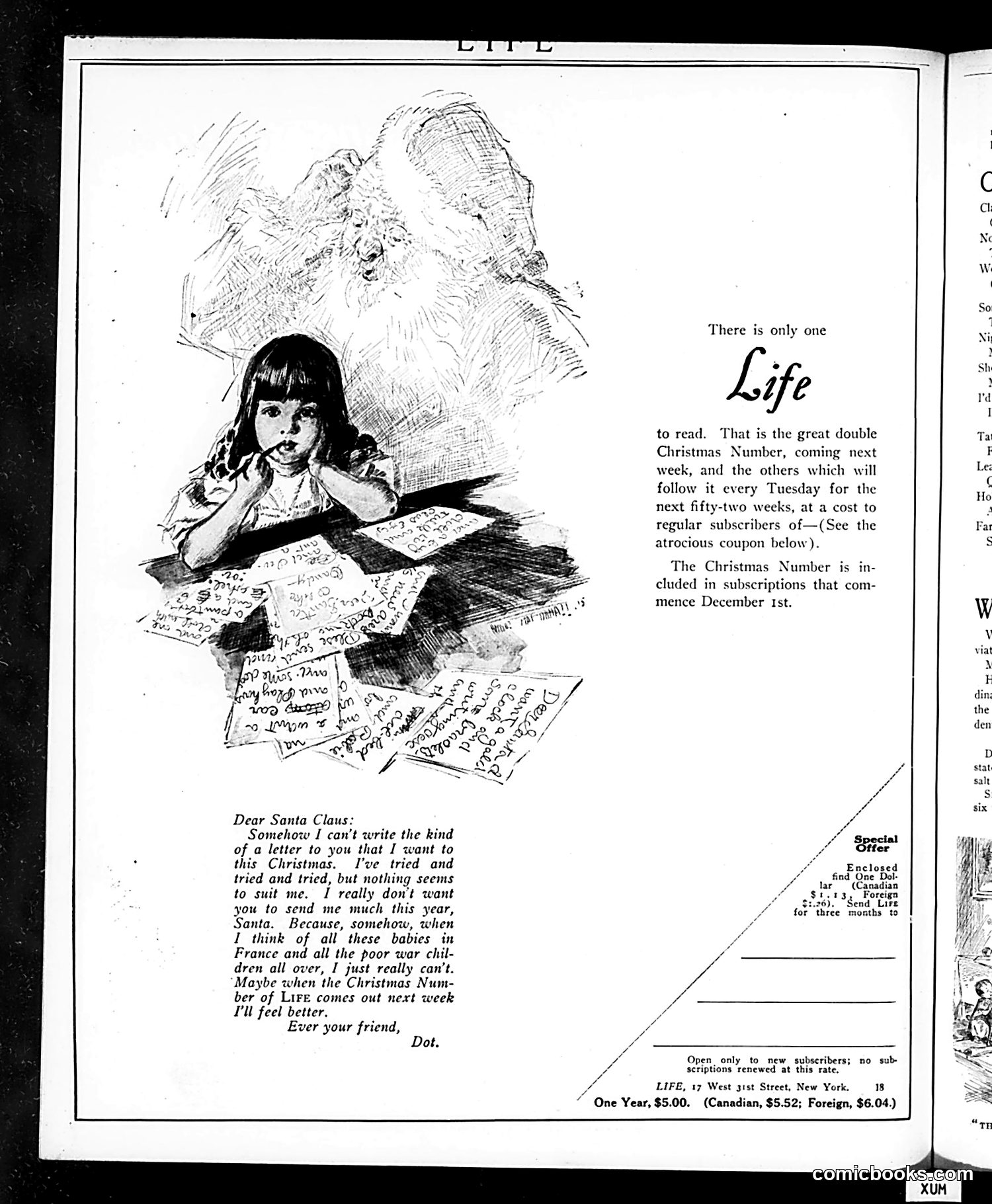
This page combines an advertisement for Life magazine subscriptions with a poignant letter to Santa Claus. The illustration shows a young girl reading or writing letters, with ghostly figures of suffering children hovering above her—likely representing war orphans. The letter, signed "Dot," expresses difficulty writing a cheerful Christmas message to Santa while thinking of "all these babies in France and all the poor war children all over." This references World War I's humanitarian crisis and the suffering of European civilian populations, particularly children. The advertisement positions Life's upcoming Christmas issue as offering comfort during wartime hardship. The juxtaposition suggests Life magazine positioned itself as providing meaningful content during a time of global suffering, connecting consumer entertainment to charitable consciousness.
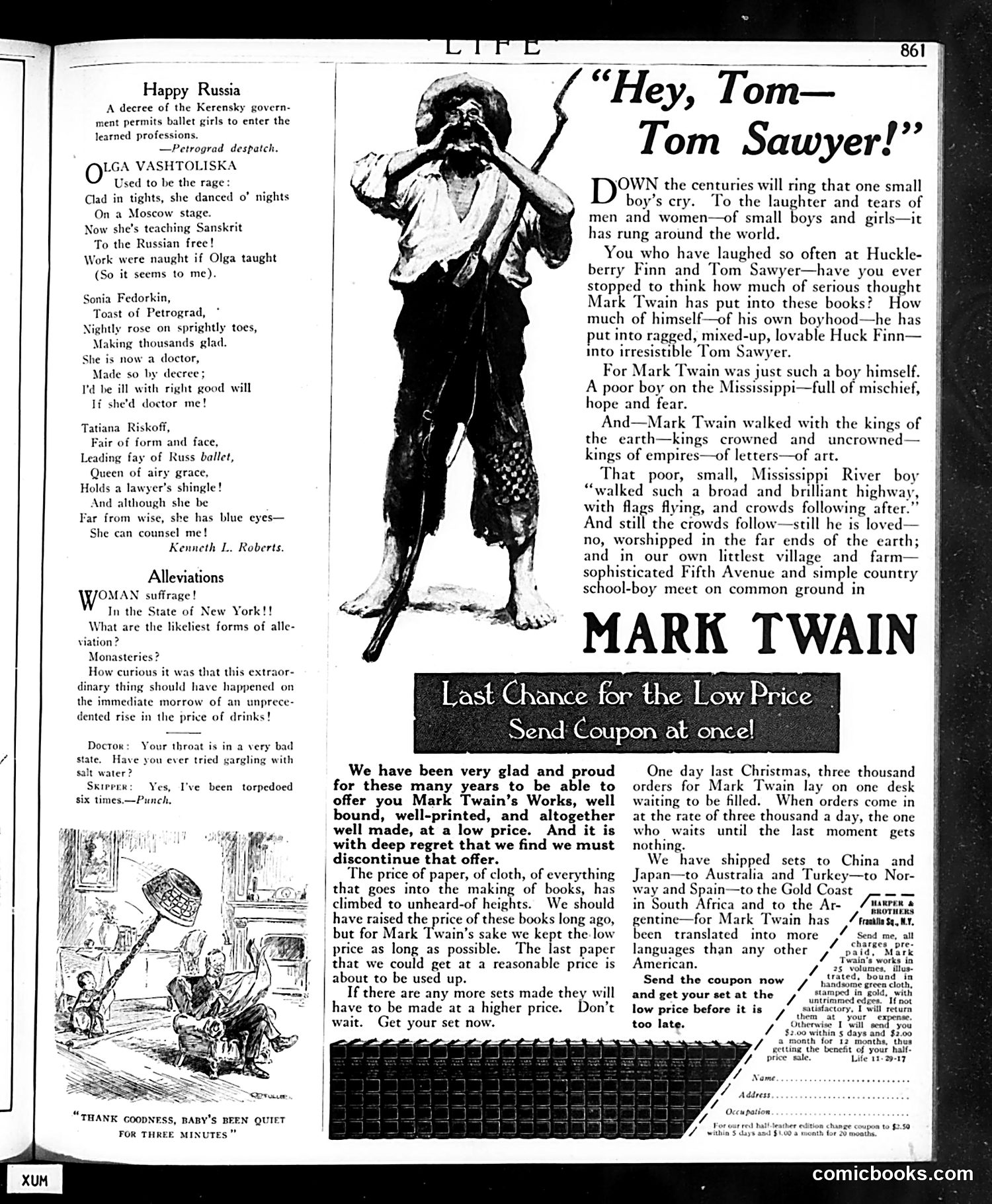
This page combines poetry, humor, and advertising. The left side features satirical verses mocking Russian dancers and society figures of the era (Olga Vashtoliska, Sonia Fiodorkin, Tatiana Riskoff). The "Alleviation" section is a brief comedic dialogue about an unusual medical treatment. The main content is a Mark Twain promotional advertisement. The illustration depicts a bearded figure (Twain) in casual dress. The ad emphasizes Twain's enduring global popularity—his works have sold thousands of copies daily and been translated into numerous languages. The publisher urges immediate purchase before prices rise due to increased production costs for paper and cloth binding. This is a time-sensitive sales pitch leveraging Twain's fame to push a collection while offering it at a "low price."
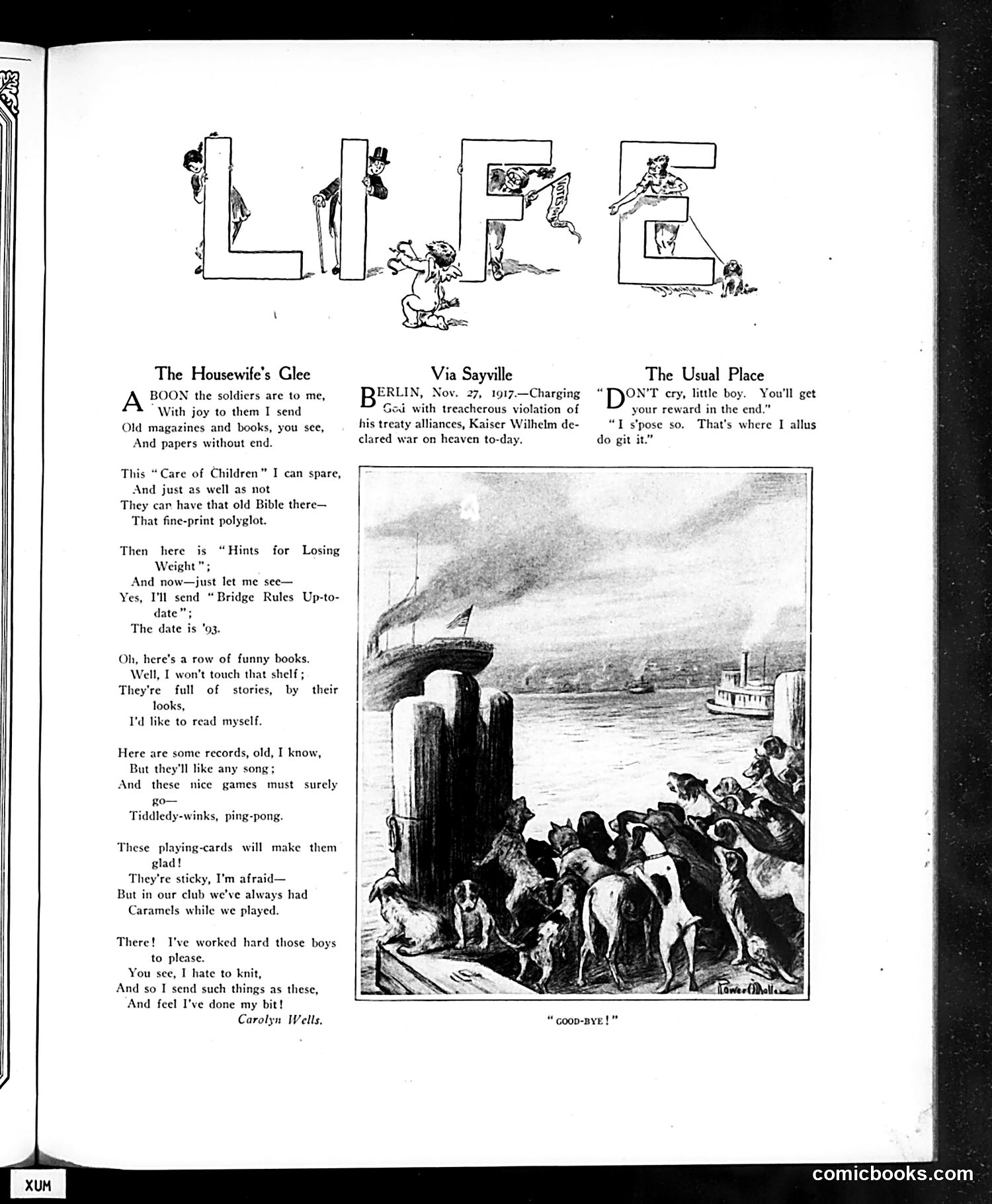
This page contains three short humorous pieces from 1917, arranged around a dramatic illustration of soldiers boarding a transport ship ("Good-bye!"). **"The Housewife's Glee"** (by Carolyn Wells) satirizes a woman's relief at finally having an excuse to send away old magazines, books, and unwanted household items by donating them to soldiers. **"Via Sayville"** references Berlin's November 27, 1917 declaration that Kaiser Wilhelm violated his treaty alliances—likely referring to Germany's submarine warfare campaign. **"The Usual Place"** depicts a child's interaction about punishment and reward. The central illustration shows soldiers departing for World War I, reflecting the page's wartime context. The content blends domestic humor with war-related references typical of American satirical magazines during the Great War period.
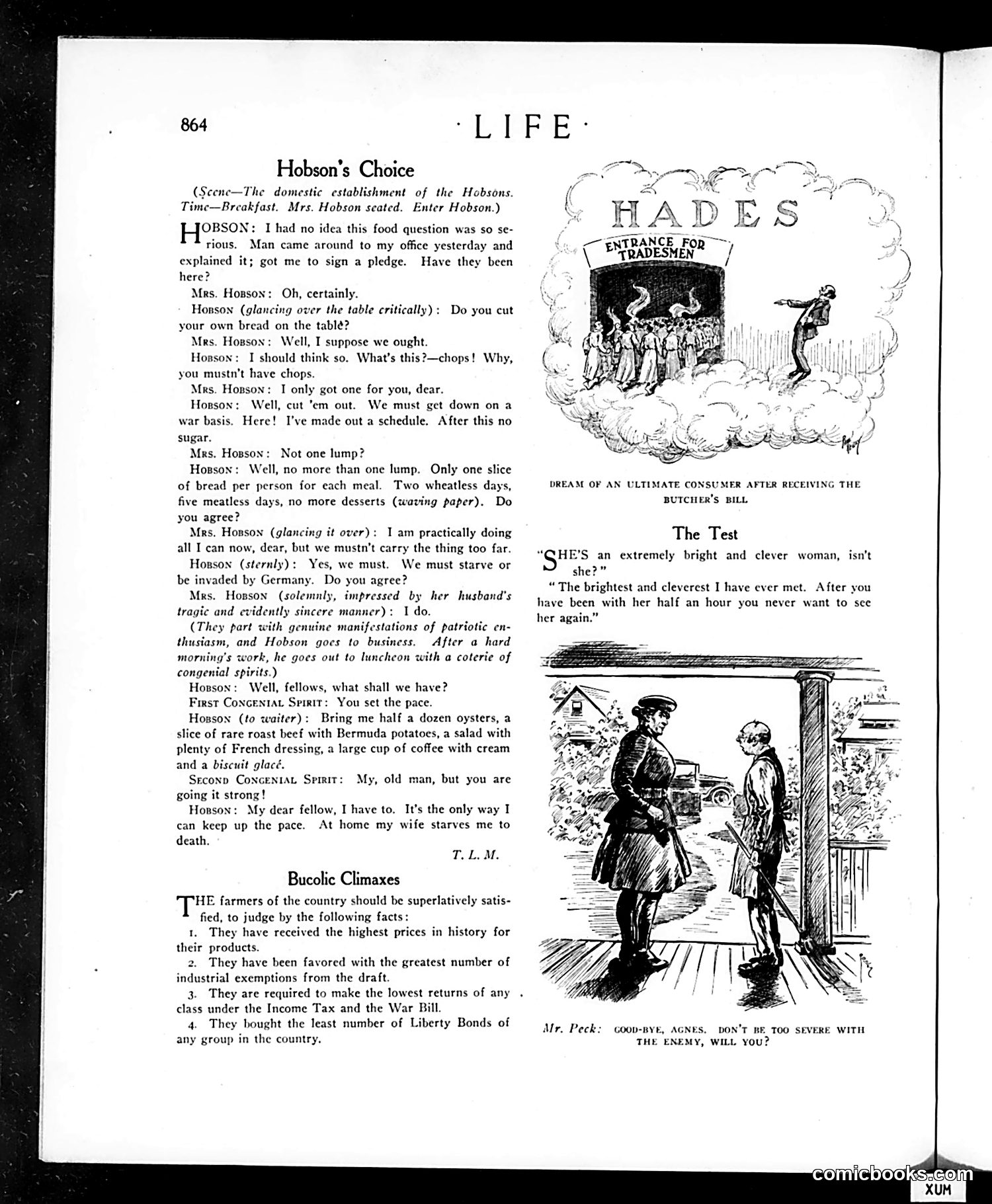
This page contains wartime satire about food rationing and sacrifice during what appears to be WWI (based on references to draft exemptions and Liberty Bonds). **"Hobson's Choice"** depicts a domestic argument where Mr. Hobson presents his wife with extreme rationing: one chop, minimal bread, no desserts, five meatless days. He justifies starvation as patriotic duty to avoid German invasion. The satire mocks both strict home rationing policies and husbands using patriotism to justify deprivation. **"The Test"** and accompanying sketch appear to critique class disparities—one illustration shows a well-dressed woman with a car, contrasting with rationing rhetoric. **"Bucolic Climaxes"** sarcastically praises farmers' wartime benefits: high prices, draft exemptions, low taxes, and bond purchases—suggesting farmers profited while civilians starved, exposing hypocrisy in "shared sacrifice."
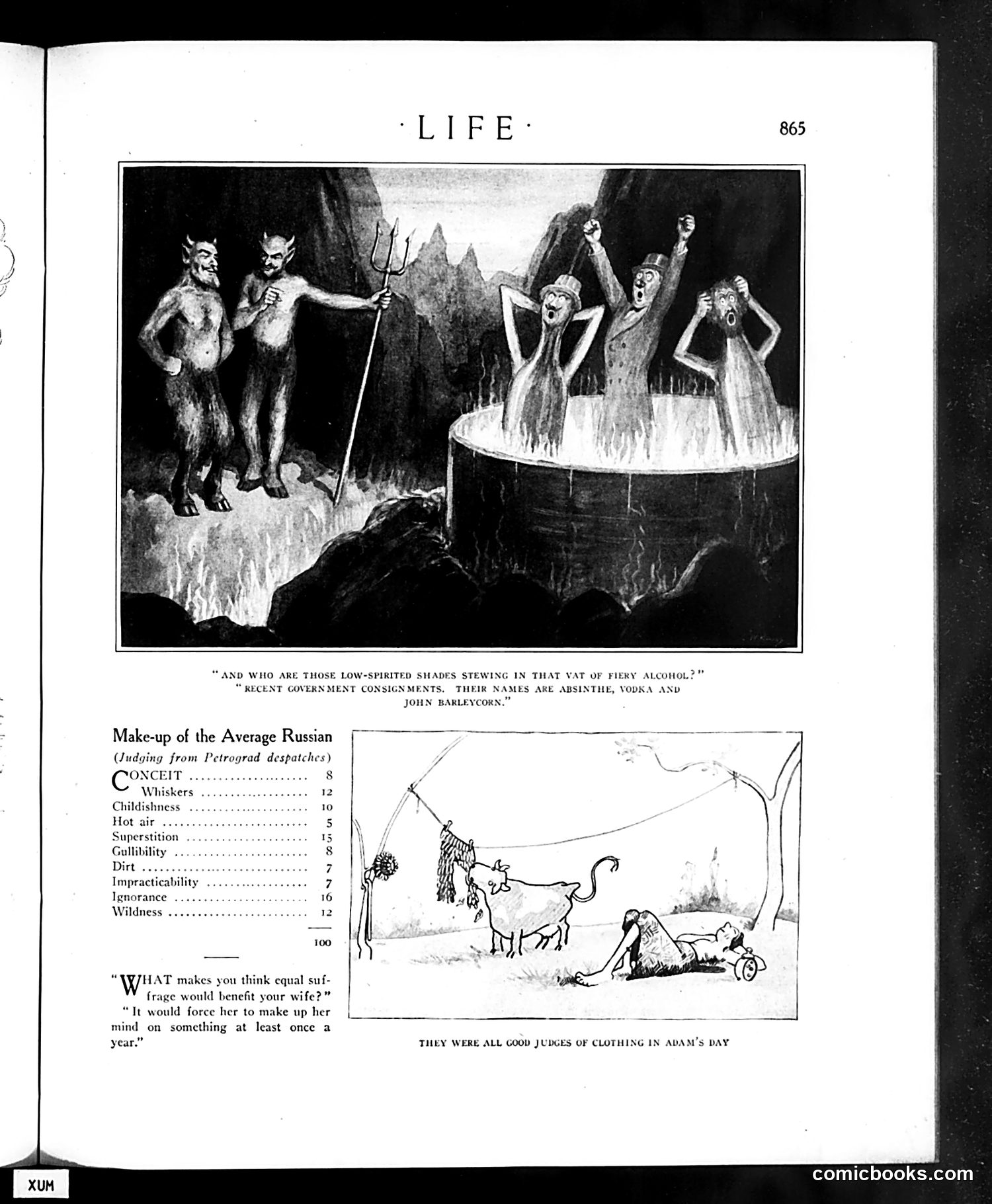
**Top Cartoon:** A satirical depiction of Russian government officials as demons stewing in a cauldron of "fiery alcohol." The caption names three Russian beverages—absinthe, vodka, and John Barleycorn (whiskey)—satirizing Russian drinking culture and corruption. The demonic figures represent low-spirited government officials consumed by vice. **Bottom Section:** "Make-up of the Average Russian" presents a numbered list of negative traits (conceit, whiskers, childishness, hot air, superstition, etc., totaling 100) meant as satirical character analysis. The accompanying cartoon shows Russian peasants with livestock, captioned "They Were All Good Judges of Clothing in Adam's Day," mocking Russian backwardness and primitiveness. **Context:** This reflects early 20th-century American stereotypes portraying Russia as corrupt, uncivilized, and alcoholic.
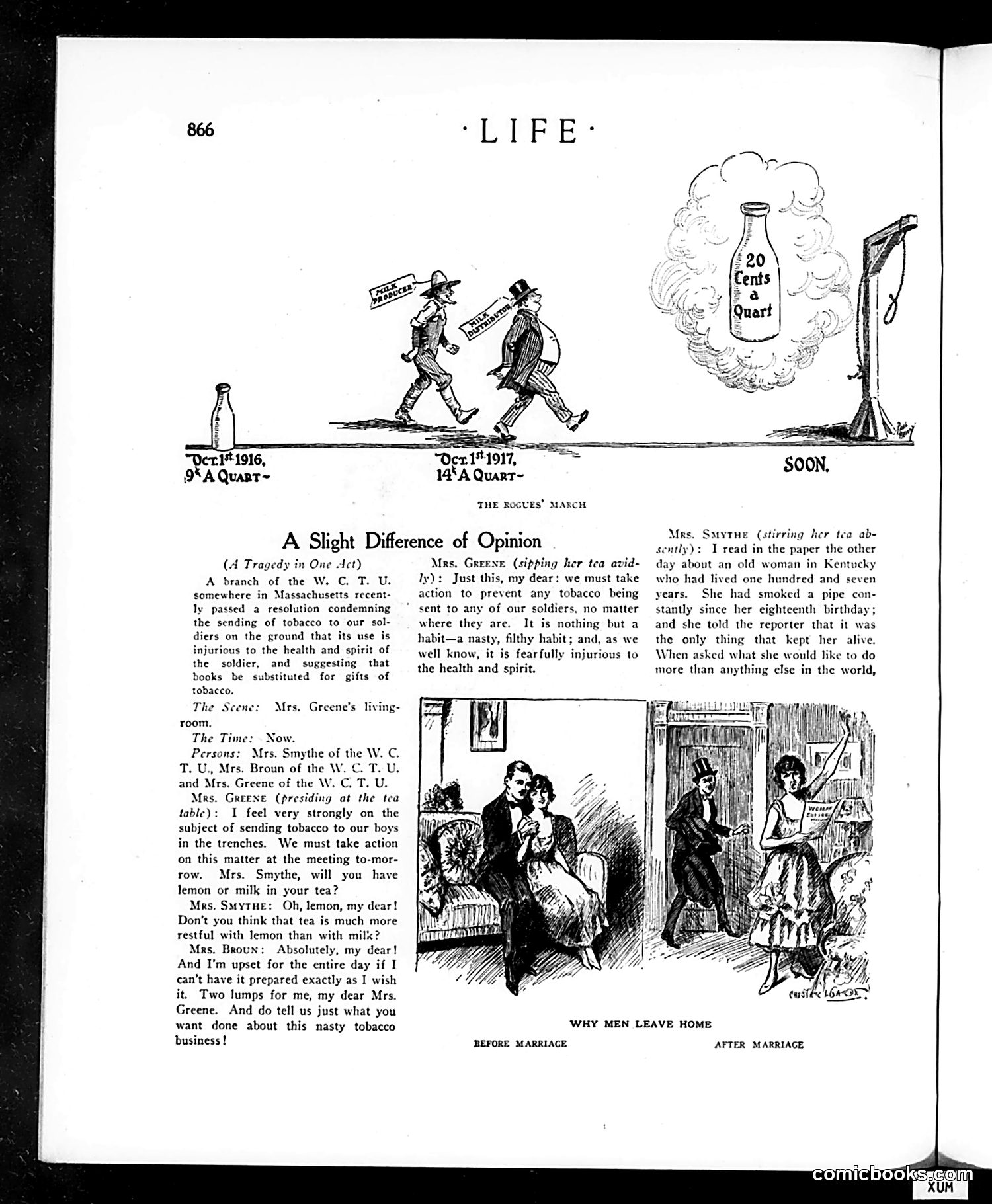
This one-act play satirizes women's anti-tobacco activism during World War I. Mrs. Greene (representing the Women's Christian Temperance Union) argues that tobacco sent to soldiers is harmful and immoral. Mrs. Smythe counters that denying soldiers this comfort is cruel. The joke mocks the disconnect between domestic reformers and soldiers' actual needs in wartime. The accompanying cartoon "Why Men Leave Home" contrasts a couple's domestic life before and after marriage—suggesting wives become controlling and demanding (the "nasty tobacco" subplot illustrates this). This reflects period anxiety about women's growing activism and power in shaping public morality through organizations like the WCTU.
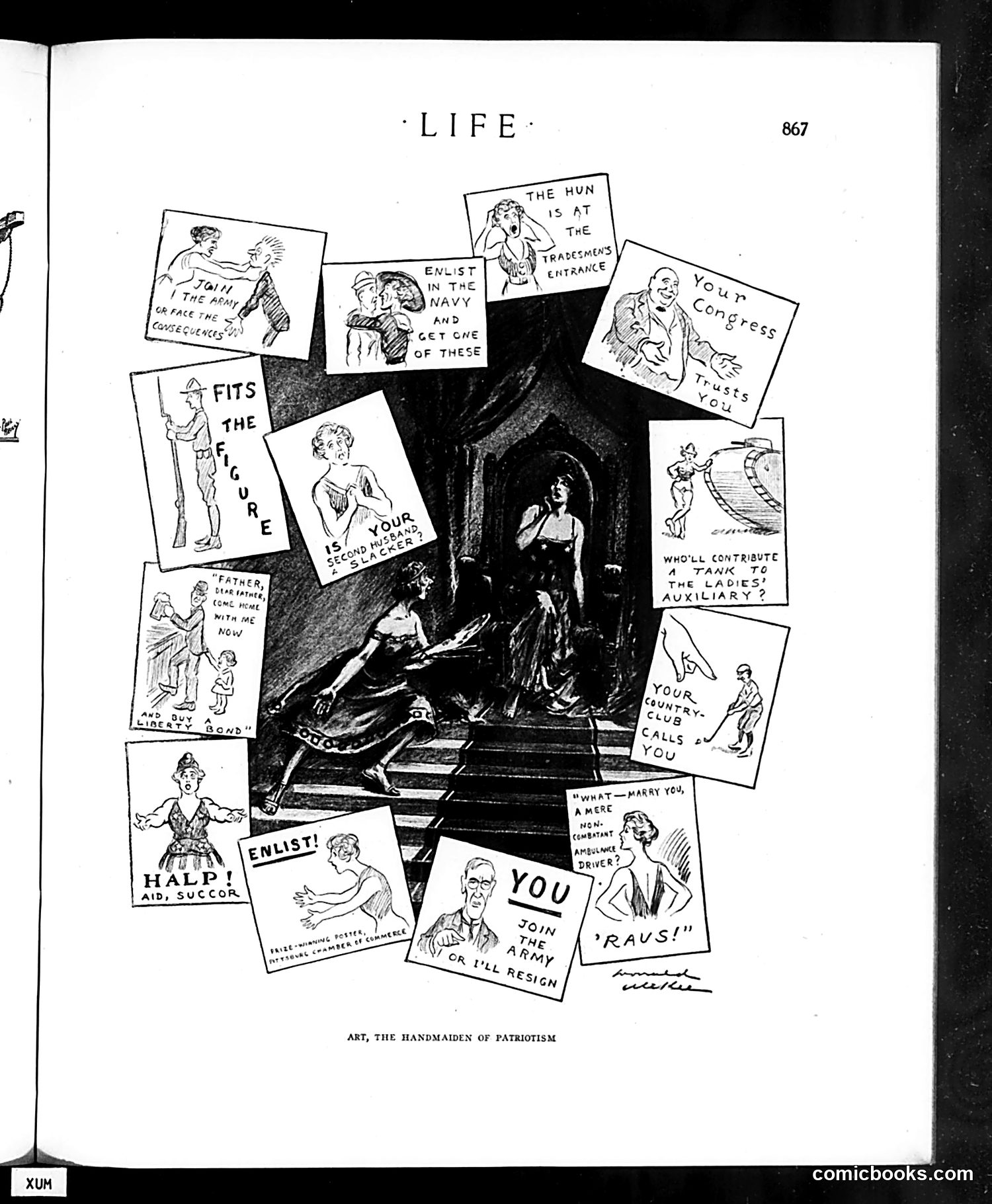
This is a WWI-era satirical cartoon titled "Art, the Handmaiden of Patriotism." A central female figure (likely representing "Art" or "Propaganda") sits surrounded by recruitment and patriotic posters, each making different appeals to enlist: - "Fits the Figure" (masculinity appeal) - "Enlist in the Navy" (military service) - "Help! Aid, Succor" (duty/patriotic obligation) - "You Join the Army or I'll Resign" (emotional manipulation) - Various other recruitment messages about Congress, country clubs, and marriage The cartoon satirizes how government and military used propaganda art to manipulate citizens into enlistment through emotional appeals—patriotism, masculine duty, romantic relationships, and social pressure. The woman distributing these messages symbolizes how art became a tool for wartime propaganda rather than independent creative expression.
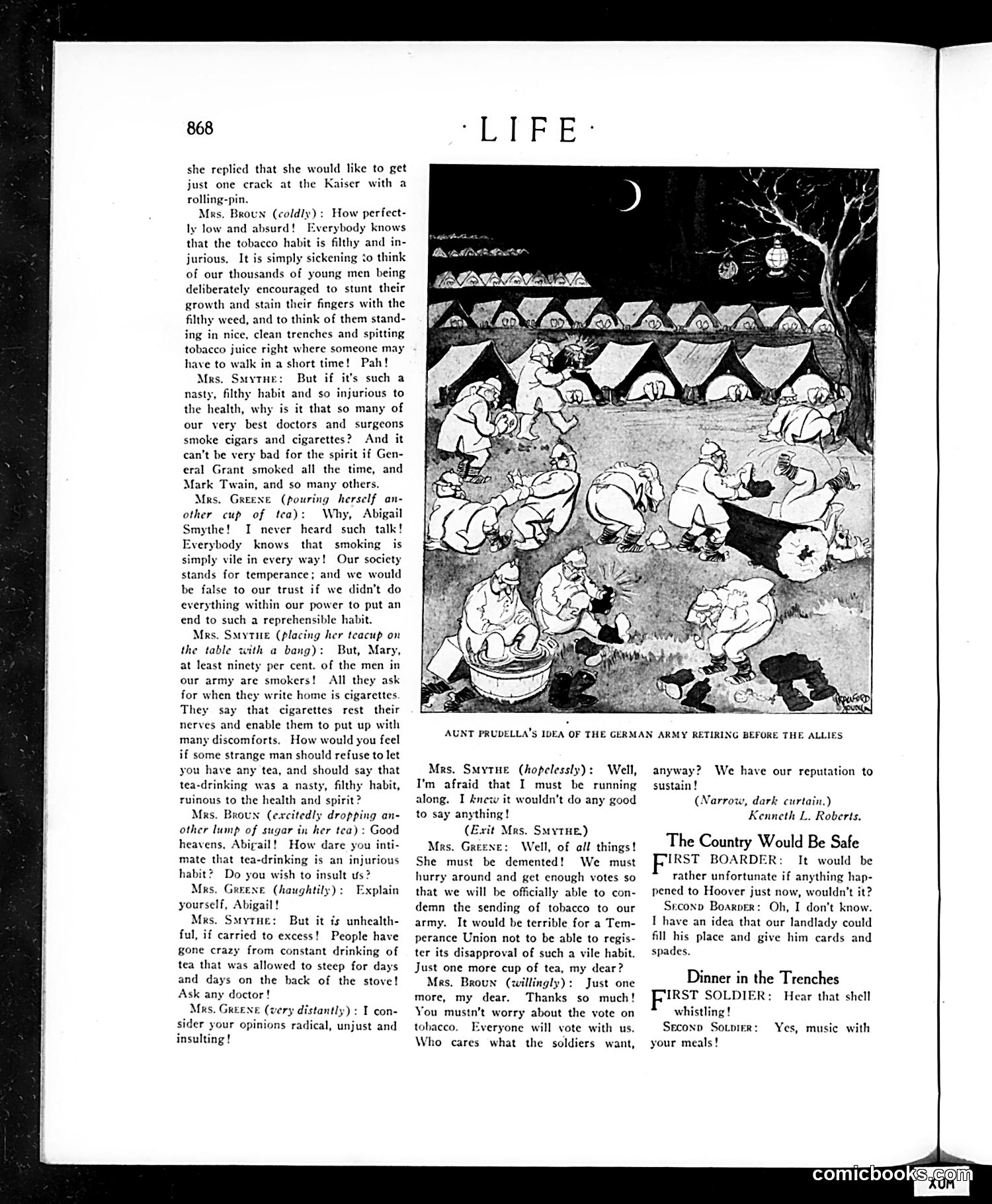
The main illustration depicts soldiers in a trench camp during WWI, captioned "AUNT PRUELLA'S IDEA OF THE GERMAN ARMY RETIRING BEFORE THE ALLIES." The accompanying dialogue is a satirical debate among women about whether soldiers should smoke tobacco. The characters argue that smoking is a filthy habit, yet paradoxically acknowledge that doctors smoke and soldiers find it comforting. The satire ridicules women's temperance activism and moralizing about soldiers' habits while simultaneously recognizing the practical reality that soldiers want and need cigarettes. The cartoon mocks the disconnect between reform-minded civilians' ideals and battlefield realities—suggesting that demanding soldiers abandon smoking is both unrealistic and insulting to their needs.
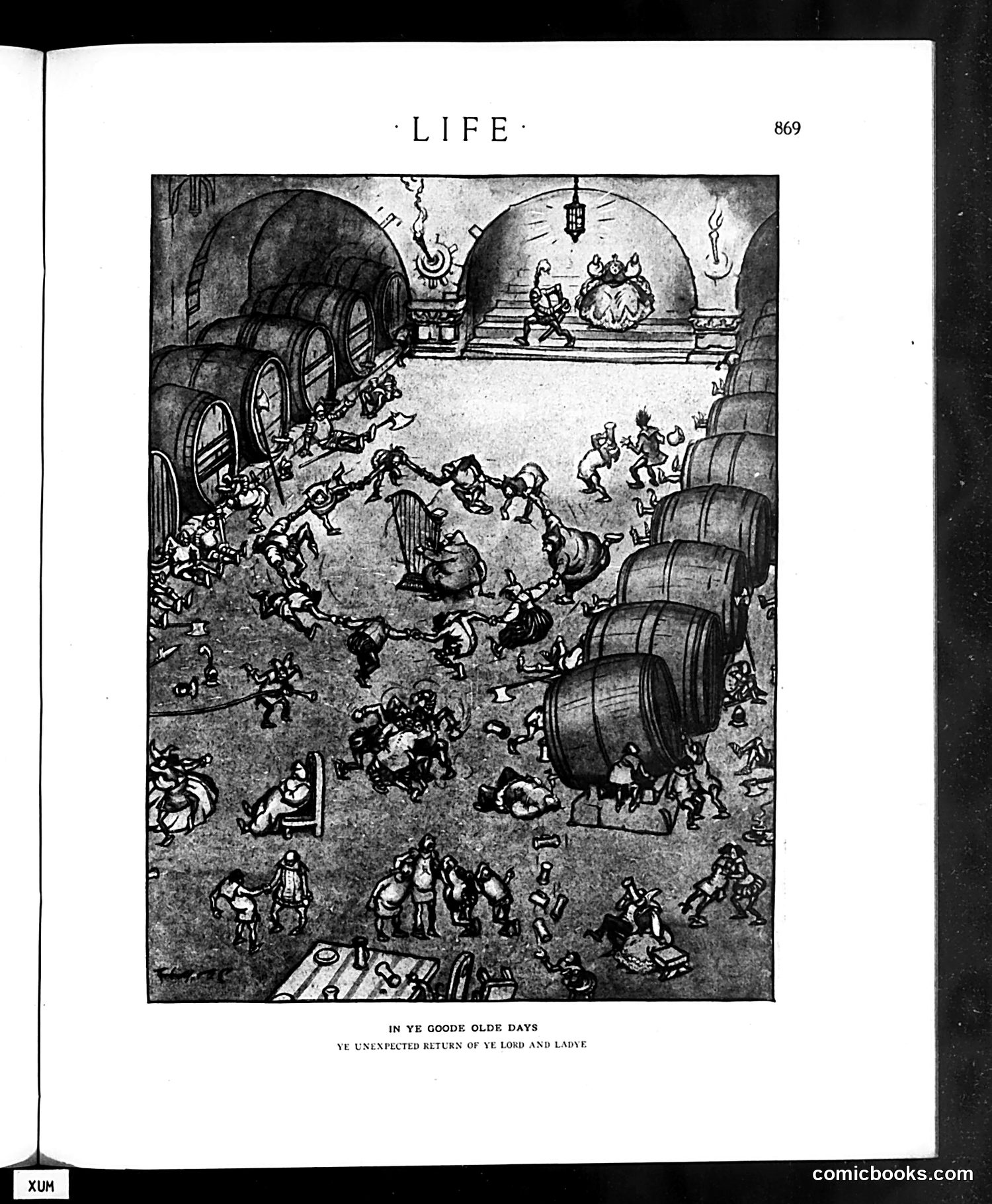
This is a satirical cartoon depicting a chaotic medieval or fantasy banquet scene. Titled in mock-archaic language, it shows the "unexpected return" of nobility ("ye lord and layde") to what appears to be their hall—causing pandemonium among servants and revelers. The joke centers on the contrast between the formal setting (throne, grand architecture, barrels of provisions) and the disorder of the inhabitants' reaction to the lords' arrival. Servants scatter, wine spills, and general mayhem ensues—suggesting either incompetence during the masters' absence or the staff's guilty conscience about their negligent behavior. The satire likely mocks pretensions to nobility or medieval romanticism popular in early 20th-century culture.
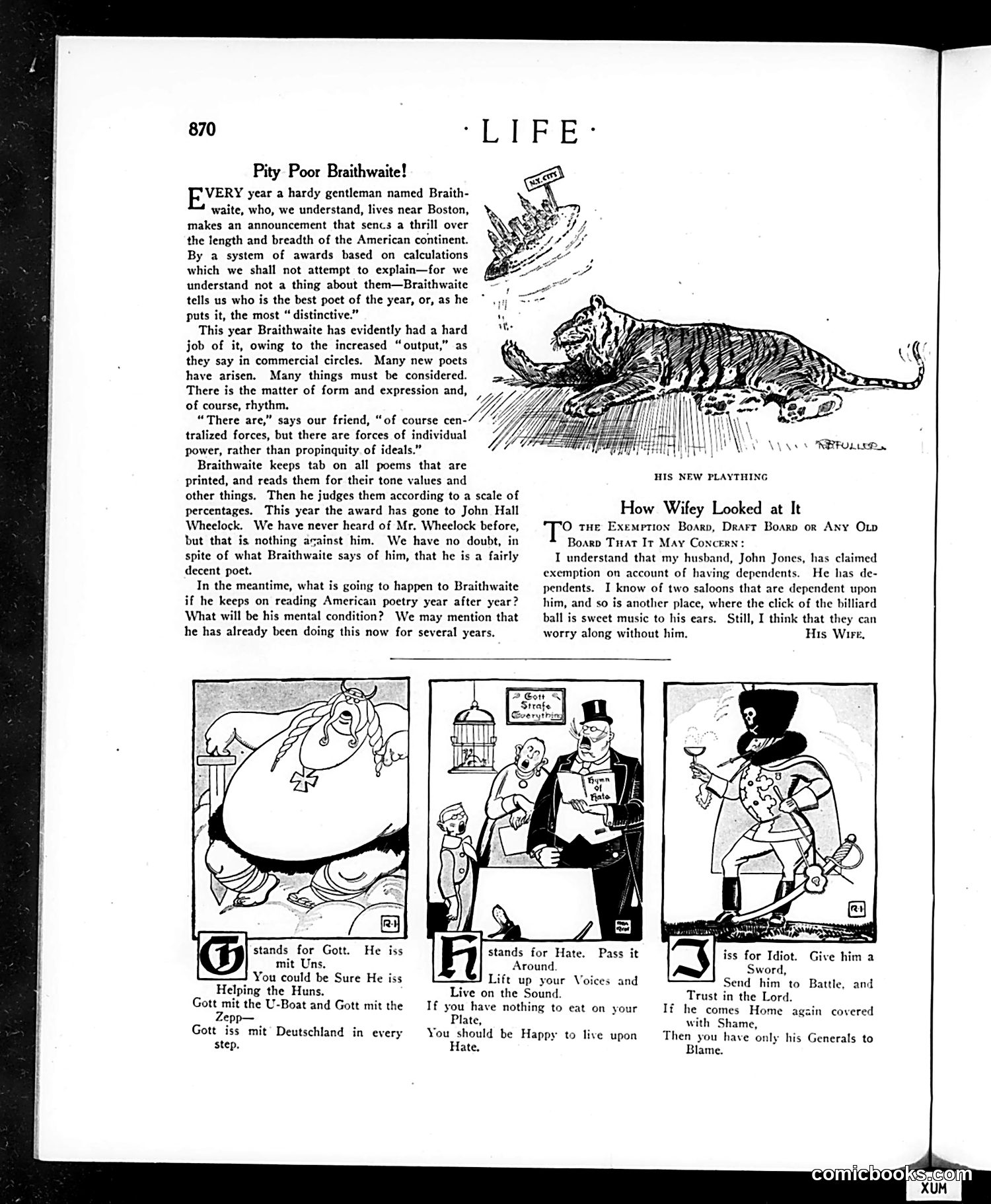
This page contains WWI-era satire. The top section mocks poet John Hall Wheelock's annual poetry awards, suggesting repeated recognition may damage his mental state. The three lower cartoons use letters (G, H, I) as a political alphabet, likely targeting German leadership and WWI enemies: - **G (Gott)**: References German militarism and "Deutschland in every step" - **H (Hate)**: Shows a figure telling others to "Live on the Sound!" and "be Happy to live upon Hate"—mocking enemy propaganda - **I (Idiot)**: Depicts a military figure, suggesting contempt for enemy commanders The satire's crude caricatures and dehumanizing language reflect American wartime sentiment. The magazine uses cartoon shorthand to encourage public animosity toward Central Powers through mockery and wordplay.
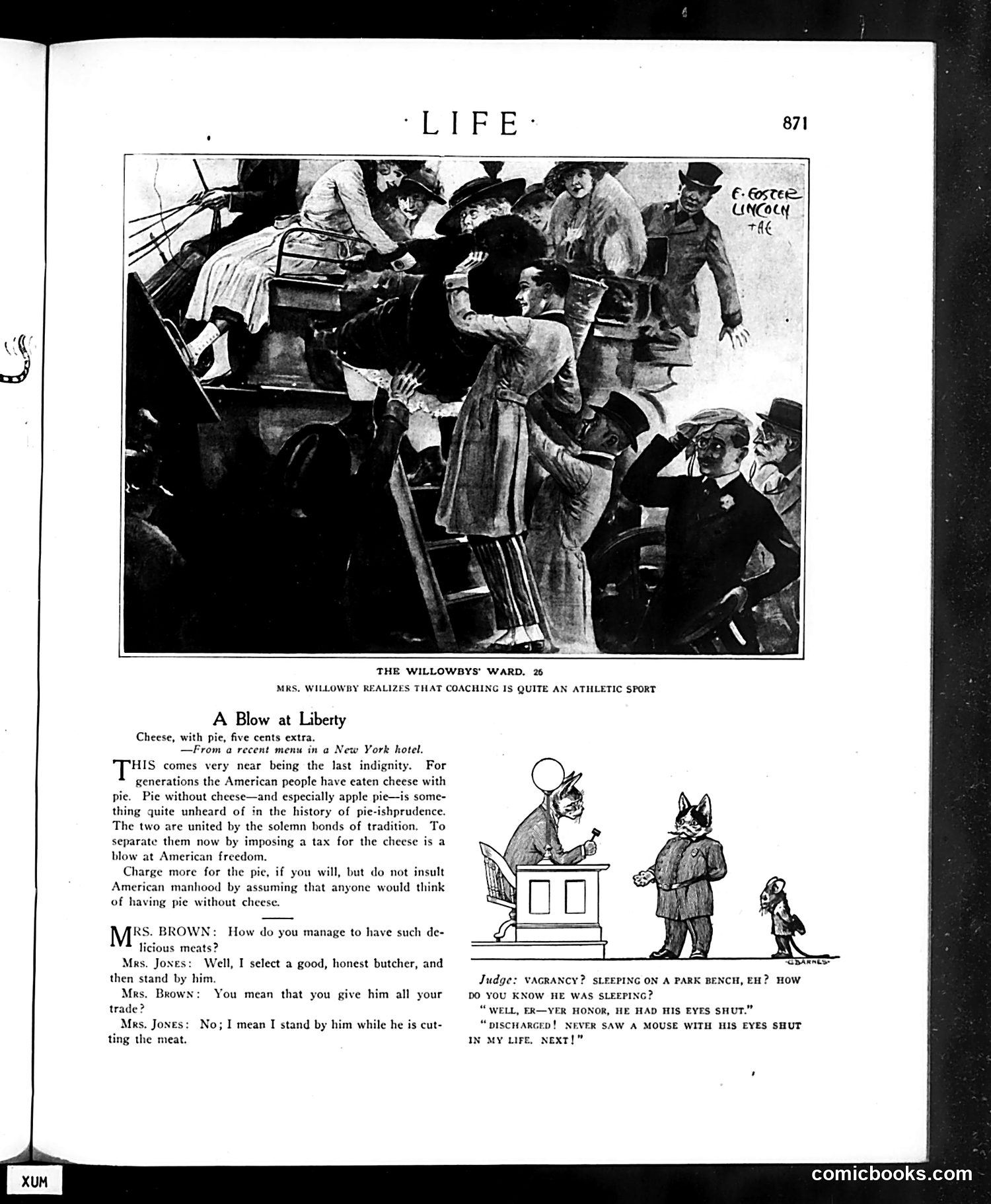
**Top Image:** "The Willowbys' Ward" (panel 26) - appears to be a domestic comedy scene showing Mrs. Willowby realizing that coaching is "quite an athletic sport," likely depicting physical exertion or chaos during a lesson. **Main Article:** "A Blow at Liberty" satirizes a proposed cheese tax at American hotels. The satirist argues that separating cheese from pie violates American tradition—cheese with pie has been standard fare for generations. The piece treats this humorously as an "indignity" to American freedom, charging extra for cheese alongside pie. **Bottom Cartoon:** Animal characters (likely representing politicians or types) discuss catching someone "vagancy" (vagrancy). The discharge's indignant response about "never saw a mouse with his eyes shut" appears to be absurdist humor about unreasonable expectations or standards. The page blends domestic comedy with light political/consumer satire typical of Life's style.
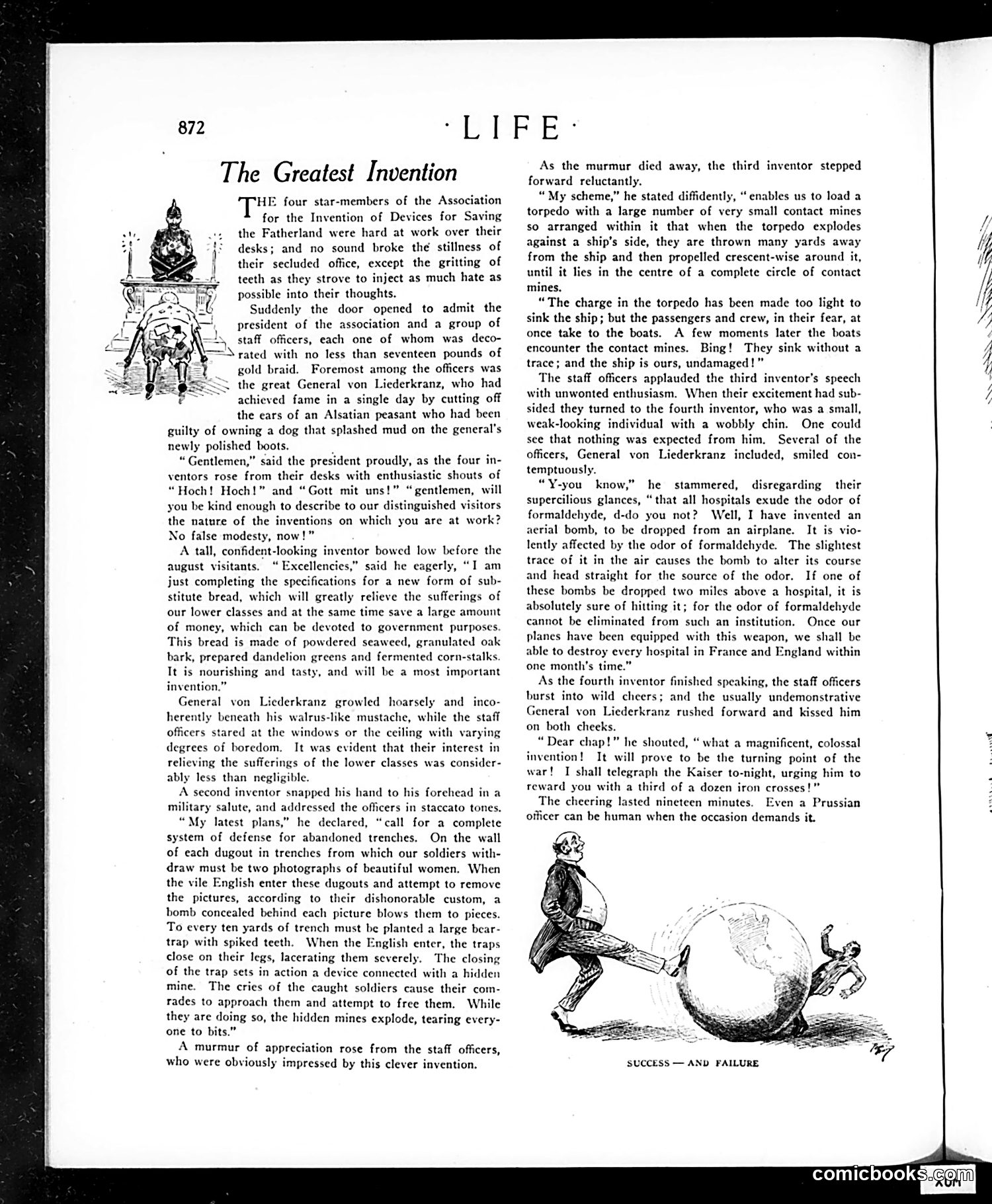
This is a satirical story mocking German military leadership during World War I. Four inventors present weapons to **General von Liederkranz** and other decorated German staff officers. The satire works through contrast: the inventors propose increasingly absurd and morally questionable "innovations"—substitute bread made from seaweed and bark (betraying contempt for the lower classes), booby-trapped trenches using photographs of women as bait, and deliberately weakened torpedoes designed to terrify rather than kill. The joke: the officers show complete indifference to humanitarian concerns (relieving suffering) but enthusiasm only for weapons causing maximum cruelty and psychological terror. The caption "SUCCESS—AND FAILURE" (visible in the illustration) suggests the bitter irony that German ingenuity produces weapons, not solutions. This reflects American wartime attitudes portraying Germans as militaristic, cruel, and morally bankrupt—a propaganda piece designed to reinforce anti-German sentiment among American readers.
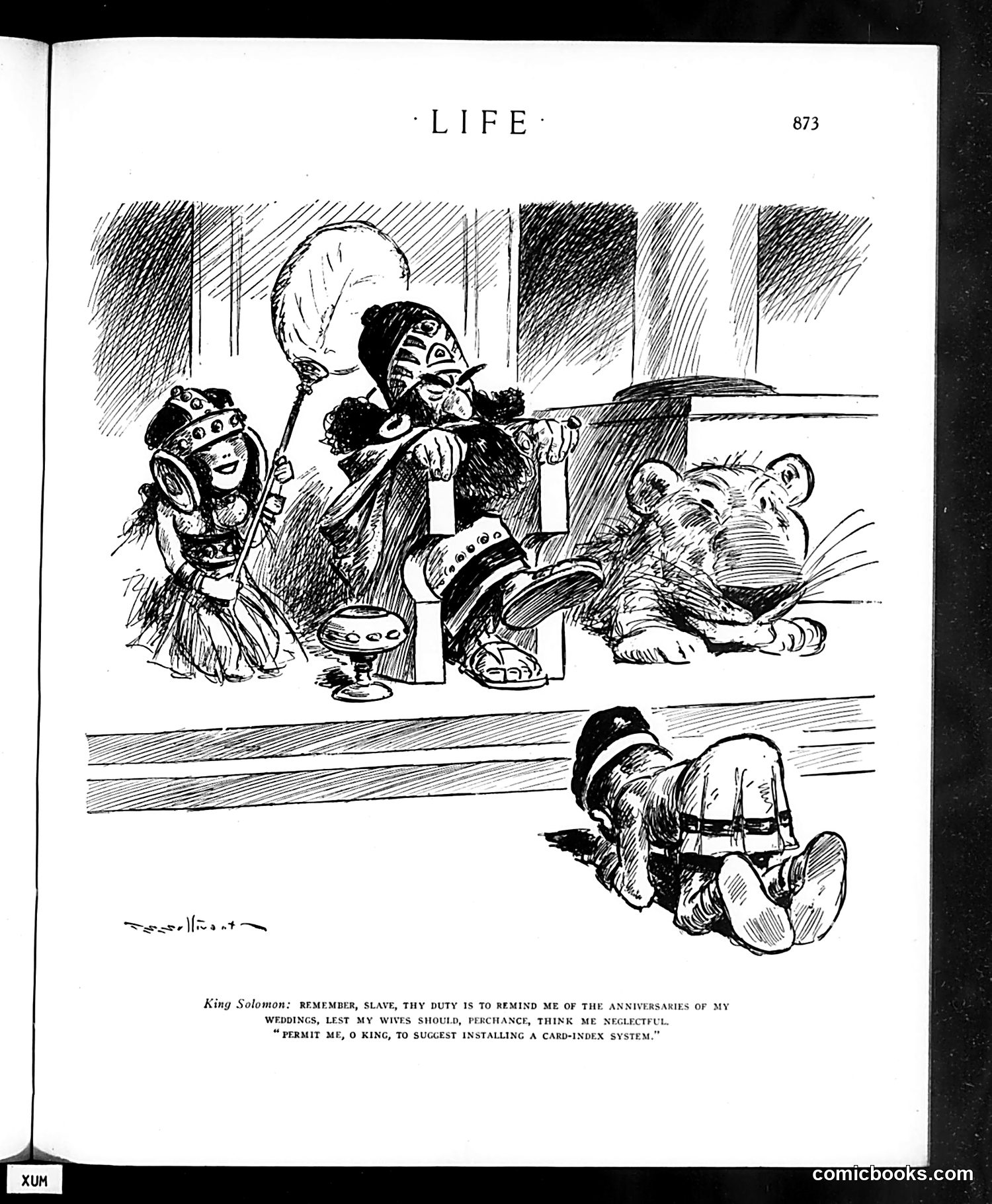
This satirical cartoon depicts King Solomon with multiple wives, addressing a slave about remembering their wedding anniversaries. The humor centers on Solomon's legendary polygamy—he famously had many wives in biblical tradition—and the impractical administrative burden this created. The joke is modern for its era: the slave suggests installing a "card-index system" (an early filing/organization method) to manage the anniversary dates. The satire mocks both Solomon's excess and the absurdity of needing bureaucratic organization for domestic obligations. For contemporary readers, this likely satirized either wealthy men's marital entanglements or—less likely but possible—critiqued business/industrial organization as excessive. The caricatured figures (appearing to represent stereotypical "exotic" servants) were typical of period illustration style.
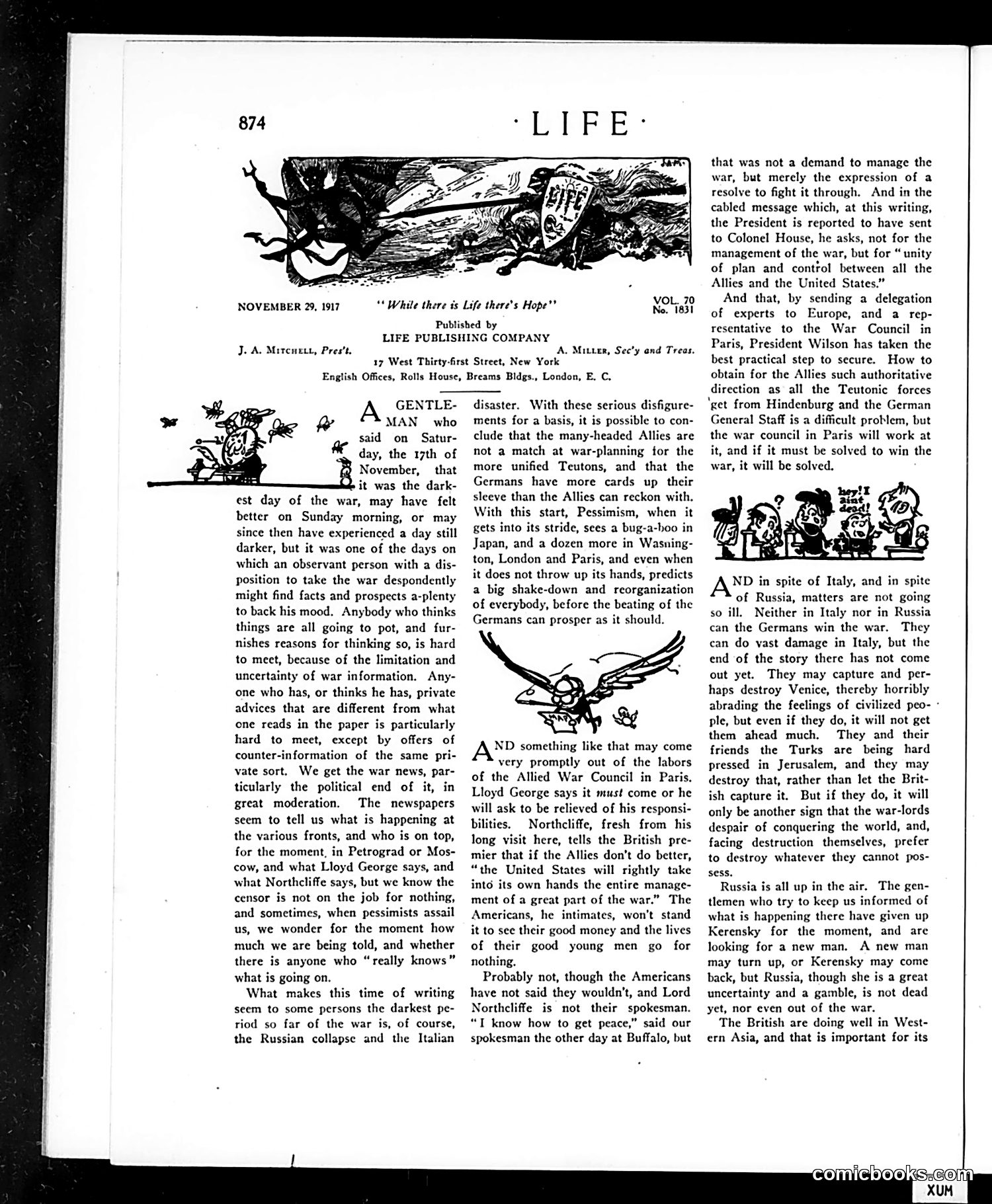
This editorial discusses Allied war prospects during WWI, written after Russia's military collapse and Italy's military disaster. The author addresses widespread pessimism about whether the fragmented Allied command structure can match Germany's unified war planning. The two small cartoons illustrate the piece's themes: the top image depicts a soldier in despair (the "darkest day" referenced), while the bottom shows caricatured figures representing Allied confusion and discord. The text argues that despite setbacks, American intervention—via President Wilson's delegation of experts to Paris and representative to the Allied War Council—offers practical hope for unified strategy. Lloyd George and Lord Northcliffe are quoted suggesting the U.S. must take greater control of war management if the Allies fail to improve coordination. The satire targets Allied disunity and pessimism while championing American organizational intervention as the war's potential salvation.
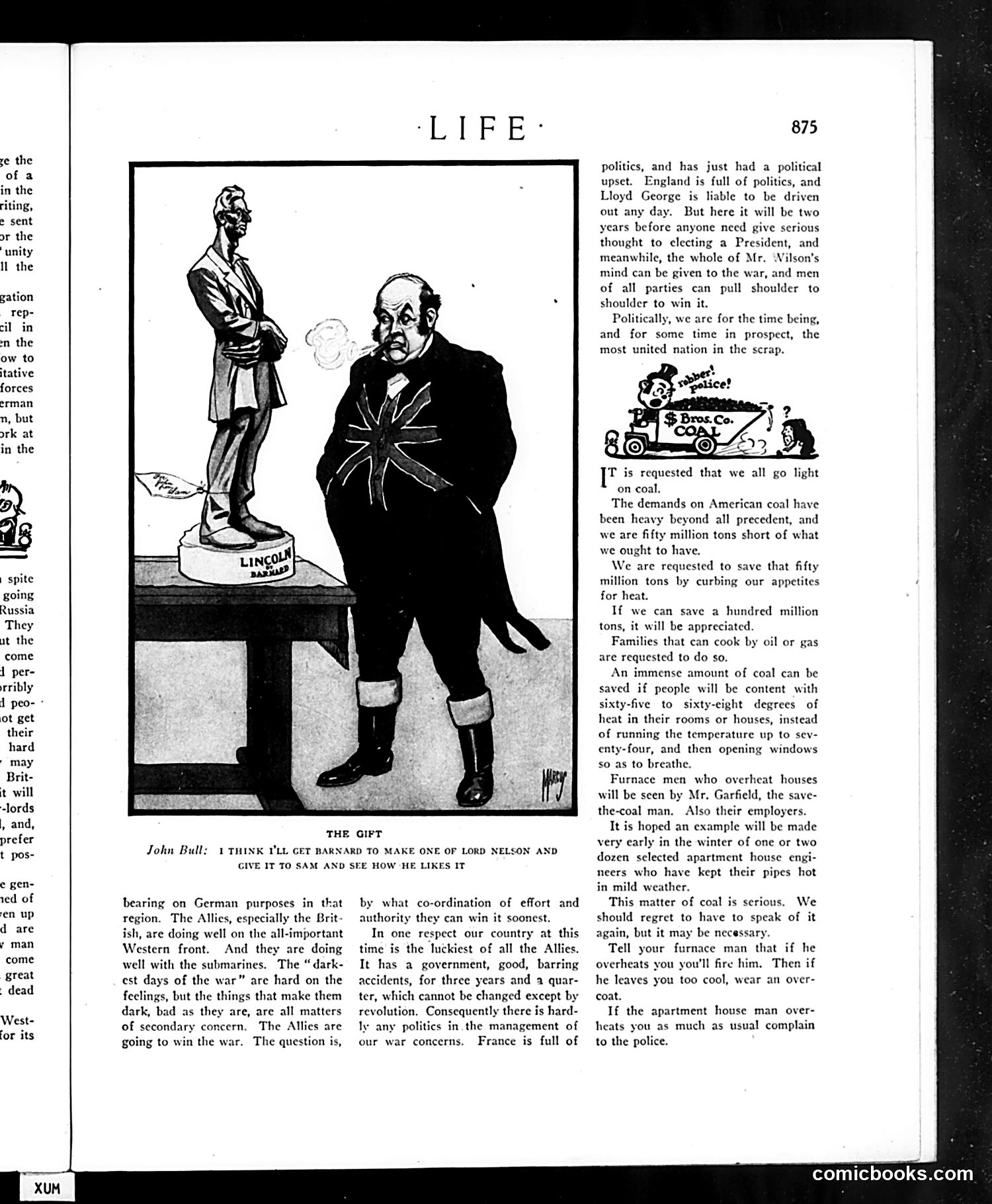
This cartoon satirizes Anglo-American wartime relations during World War I. "John Bull" (personification of Britain) proposes gifting "Sam" (Uncle Sam, representing America) a statue of Lord Nelson—Britain's legendary naval hero—as a pointed joke. The caption suggests Britain is subtly asserting its naval superiority and war experience to the relatively newer American combatant. The accompanying text discusses Allied unity and American political stability as advantages in the war effort. The cartoon's humor relies on the tension between allies: Britain offering America a reminder of British military glory reads as either patronizing or gently competitive—a jab at American newcomers to the conflict. The statue on a pedestal visually emphasizes this dynamic. The page also addresses coal rationing efforts, reflecting genuine WWI-era American home-front concerns about resource management.
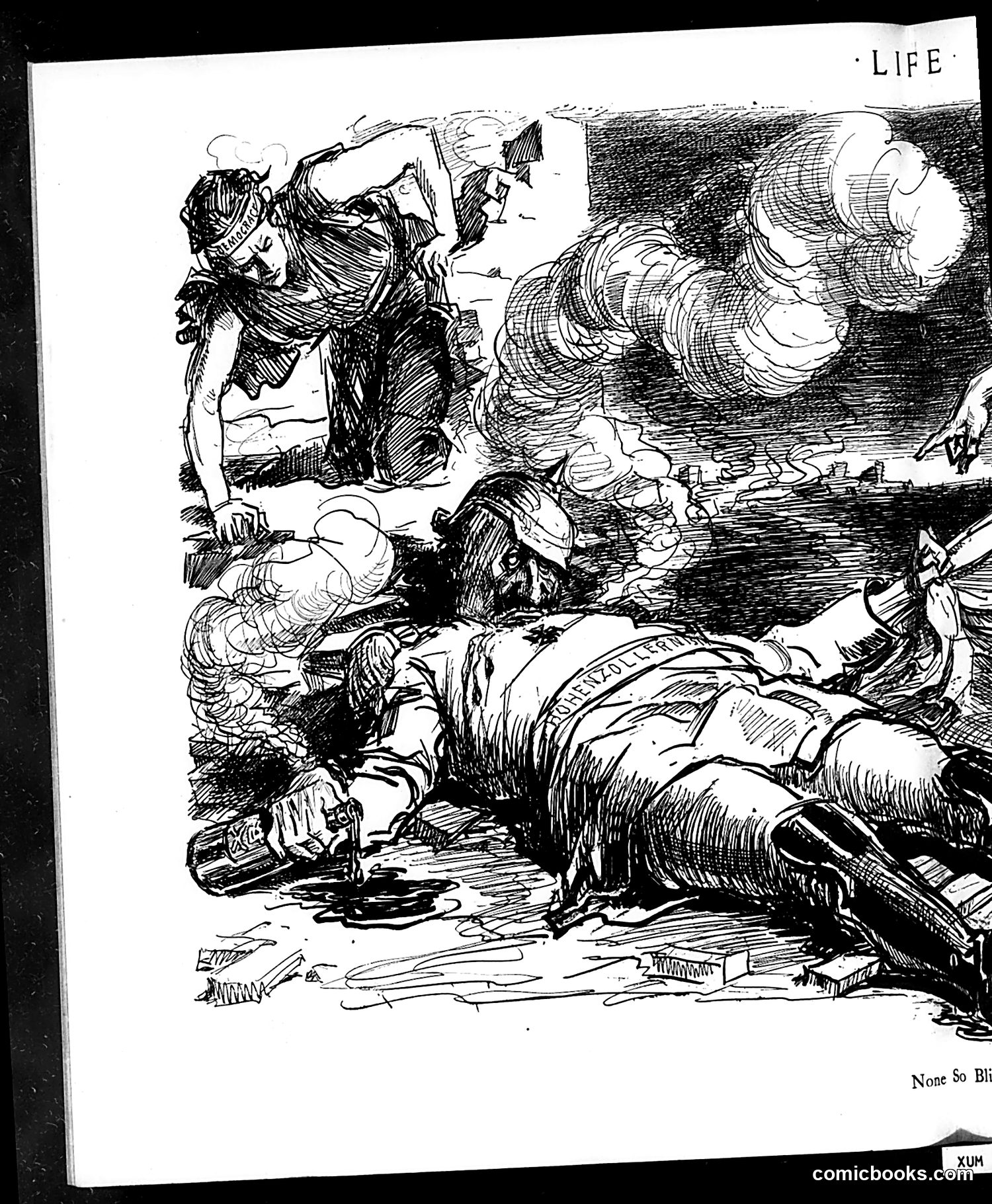
This Life magazine page shows a satirical cartoon titled "None So Bli[nd]" (text cut off). The illustration depicts what appears to be a wealthy or powerful figure lying prone on the ground, seemingly incapacitated or dead, while other figures stand around gesturing or observing. The prone figure wears formal attire and appears heavily shaded/darkened. The incomplete caption "None So Blind" suggests the familiar phrase "None so blind as those who will not see"—implying willful ignorance or refusal to acknowledge obvious truths. Without the full caption and publication date, I cannot identify the specific figures or political event being satirized. The cartoon appears to critique either willful negligence by observers or the downfall of someone in power, but the exact target remains unclear from the visible text alone.
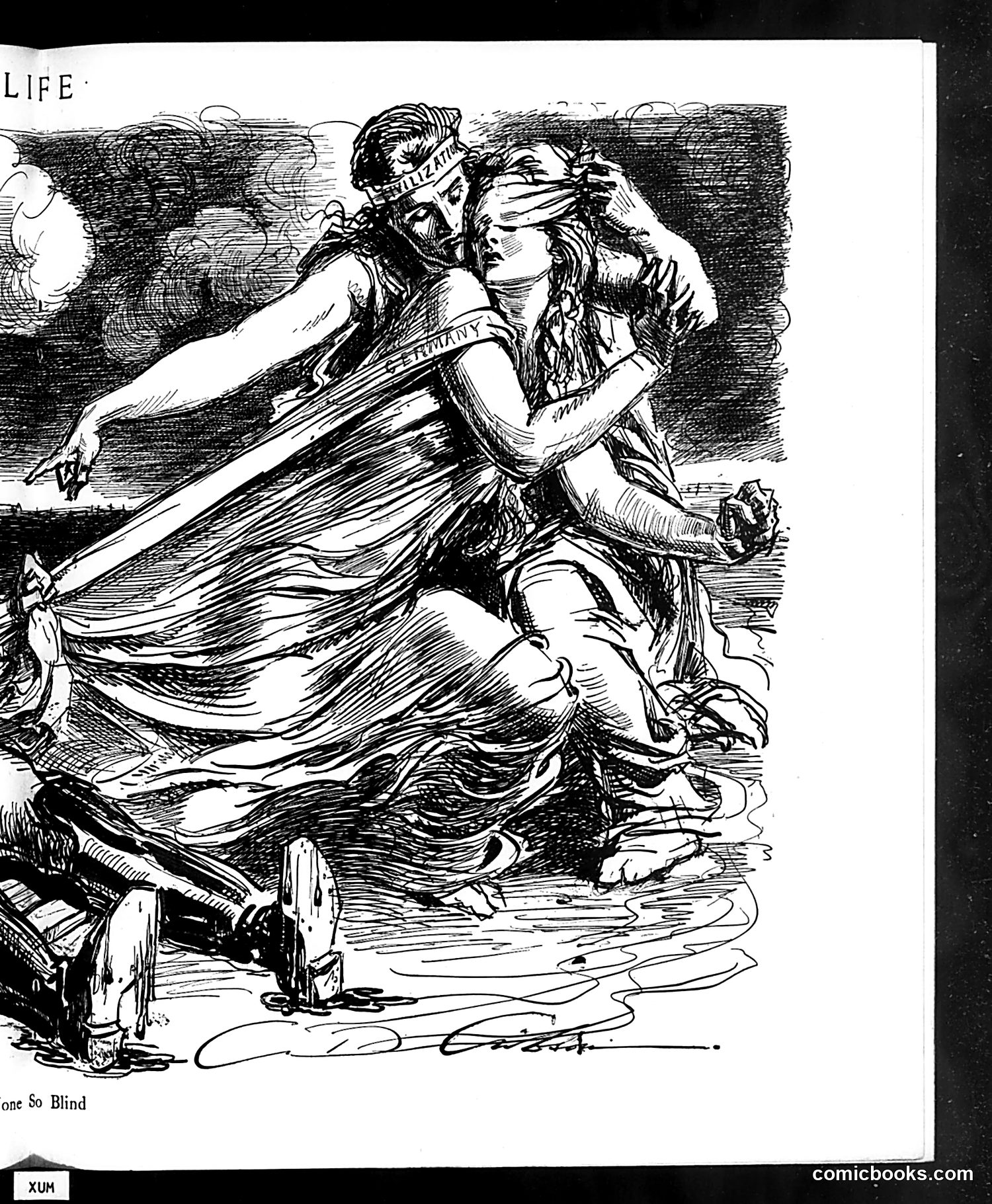
This political cartoon from *Life* magazine depicts a blindfolded female figure (likely representing Germany, based on the visible text "GERMANY" on her garment) being led by a military officer wearing a Prussian-style helmet. The dramatic composition—with the woman stumbling or being dragged—suggests she is being manipulated or misled by militaristic leadership. The title "One So Blind" implies willful ignorance or self-deception. The satire critiques Germany's acceptance of aggressive military leadership and imperial policies, suggesting the German people were either deliberately blinded to or complicit in their nation's warmongering course. The style and subject matter suggest this is from the WWI era.
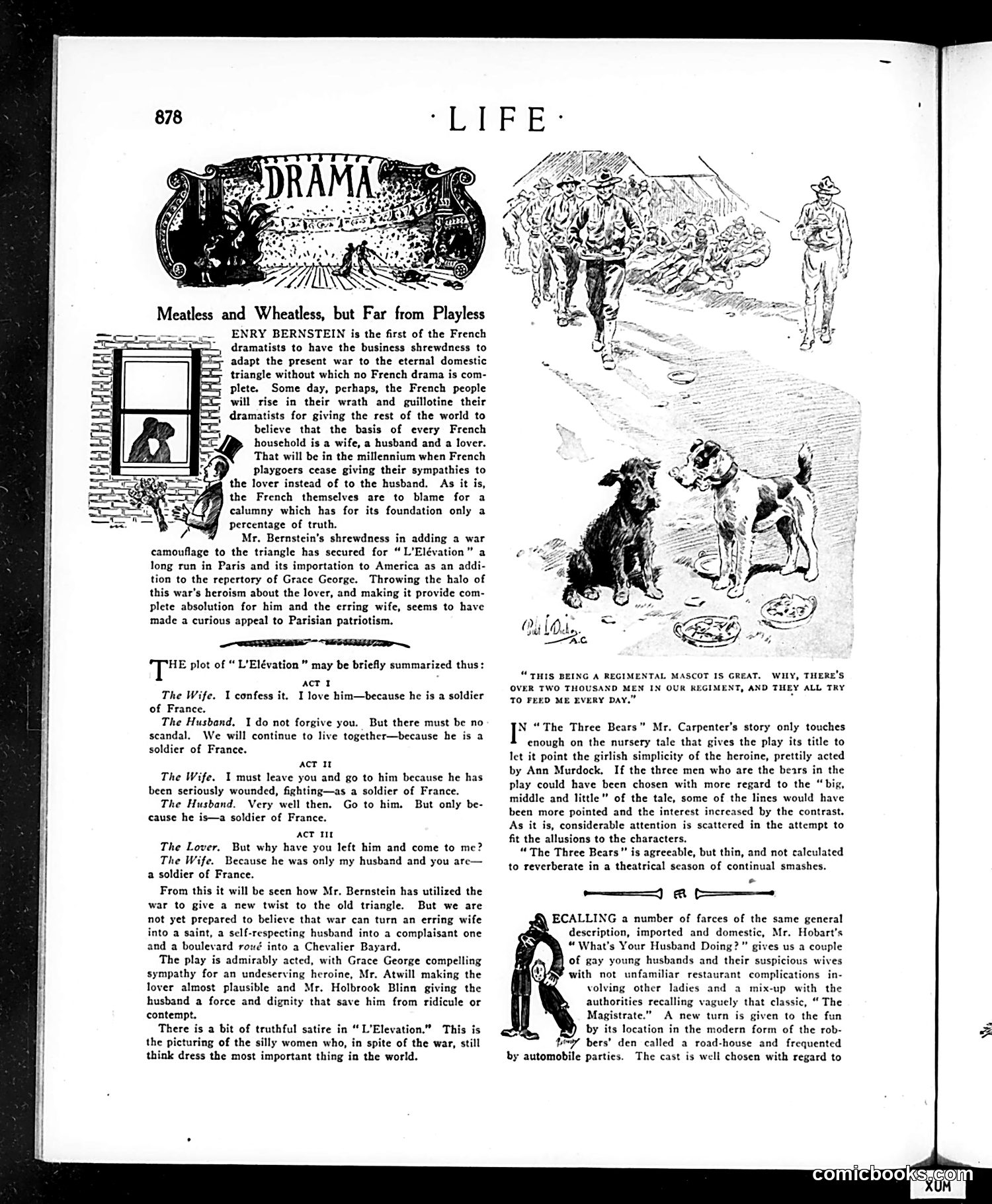
This page reviews French playwright Henry Bernstein's "L'Élévation," which satirizes the classic French dramatic obsession: the domestic love triangle (wife, husband, lover). Bernstein's innovation is patriotic camouflage—he makes the lover a wounded French soldier, thereby "absolving" the affair through wartime heroism. Life's critic mocks this cynical manipulation: the play's logic reduces to characters accepting infidelity solely because the lover is "a soldier of France." The satire exposes how wartime sentiment can rationalize moral compromise and how French audiences will forgive anything if patriotism is invoked. The accompanying illustration shows dogs eating, likely commenting on base appetites—a visual parallel to the play's reduction of human morality to simple, animalistic justifications.
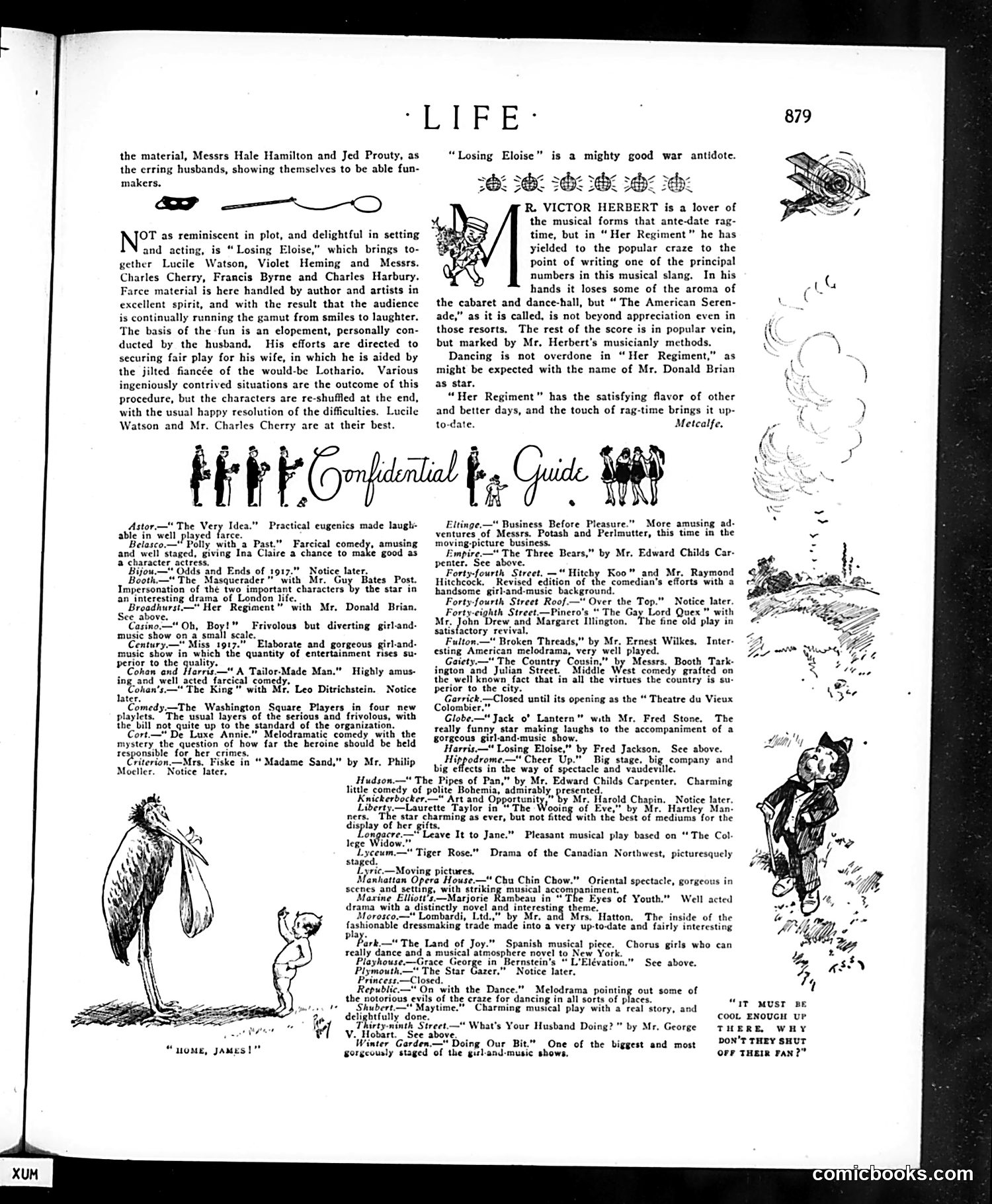
This page contains theater reviews and advertisements from Life magazine's entertainment section. The main content consists of brief, witty critiques of Broadway productions, using a standardized format listing theater names and show titles. The cartoons appear satirical commentary on theater itself: one shows a stork delivering a baby to a couple, labeled "Home, James!" — likely satirizing the prevalence of domestic farce plots in productions of that era. The text discusses musicals and comedies of the 1917 period, including reviews of "Losing Eloise" (called "a mighty good war antidote"), and notes on composer Victor Herbert's attempt to incorporate ragtime and "musical slang" into his work — suggesting some theatrical snobbery about modernizing traditional musical forms. The overall tone is gossipy and dismissive toward lighter entertainment, typical of Life's sophisticated humor magazine approach to popular culture.
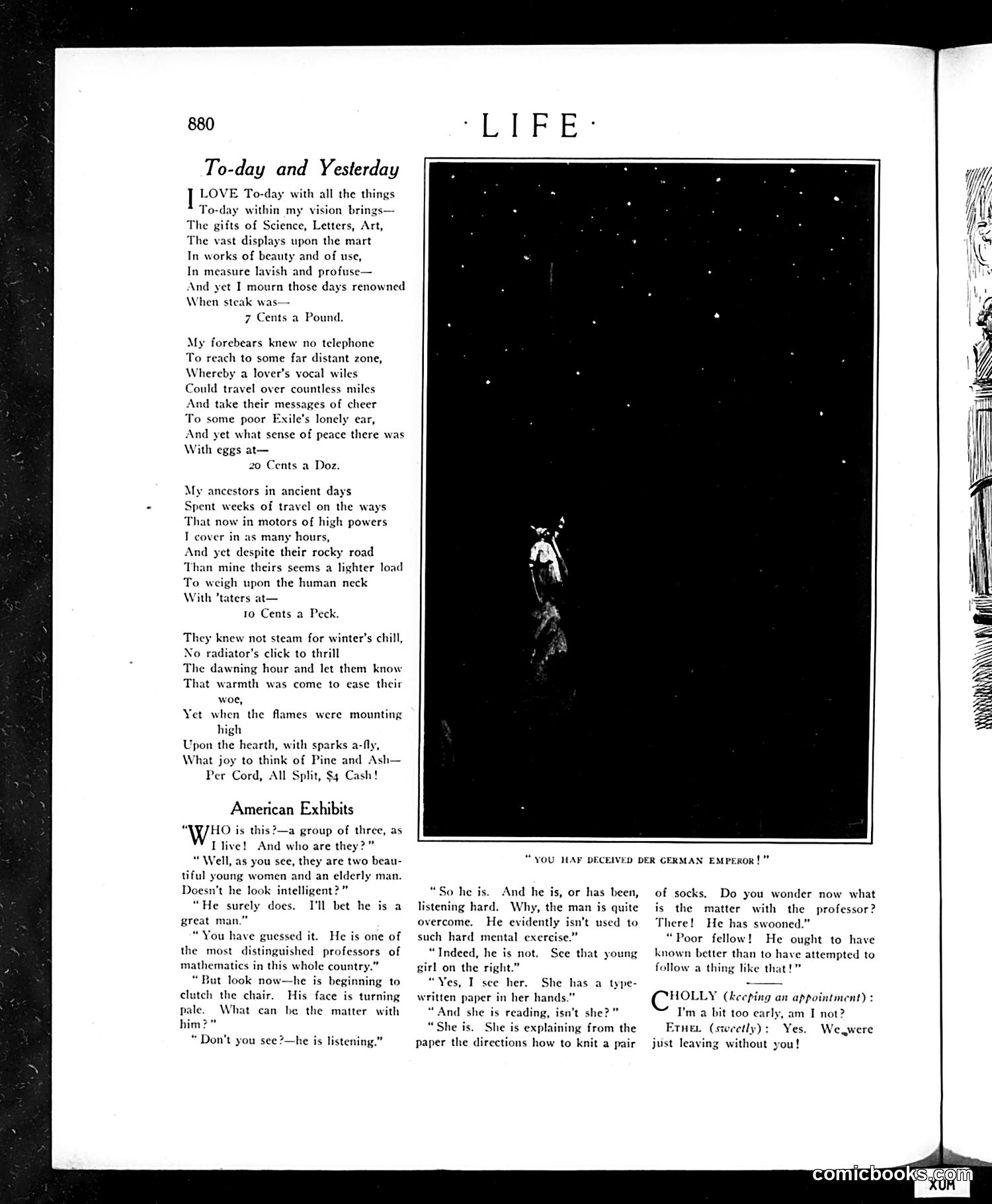
This page contains a nostalgic poem "To-day and Yesterday" lamenting modern progress—contrasting contemporary conveniences (telephones, automobiles, central heating) with cheaper prices from an earlier era (steak at 7¢/pound, eggs at 20¢/dozen). The satire critiques consumerism: we've gained technology but lost affordable living. The cartoon "American Exhibits" ridicules academic pretension and women's wartime activities. A distinguished mathematics professor literally faints while listening to a young woman read knitting instructions from a typed paper. The joke: intellectuals are overwhelmed by mundane domestic tasks, particularly those associated with women's wartime contributions (knitting for soldiers was common WWI/WWII-era civic duty). The German Emperor caption appears sarcastic—suggesting the professor has been "deceived" by underestimating women's influence. The final "Holly" exchange provides light social comedy about punctuality and social awkwardness.
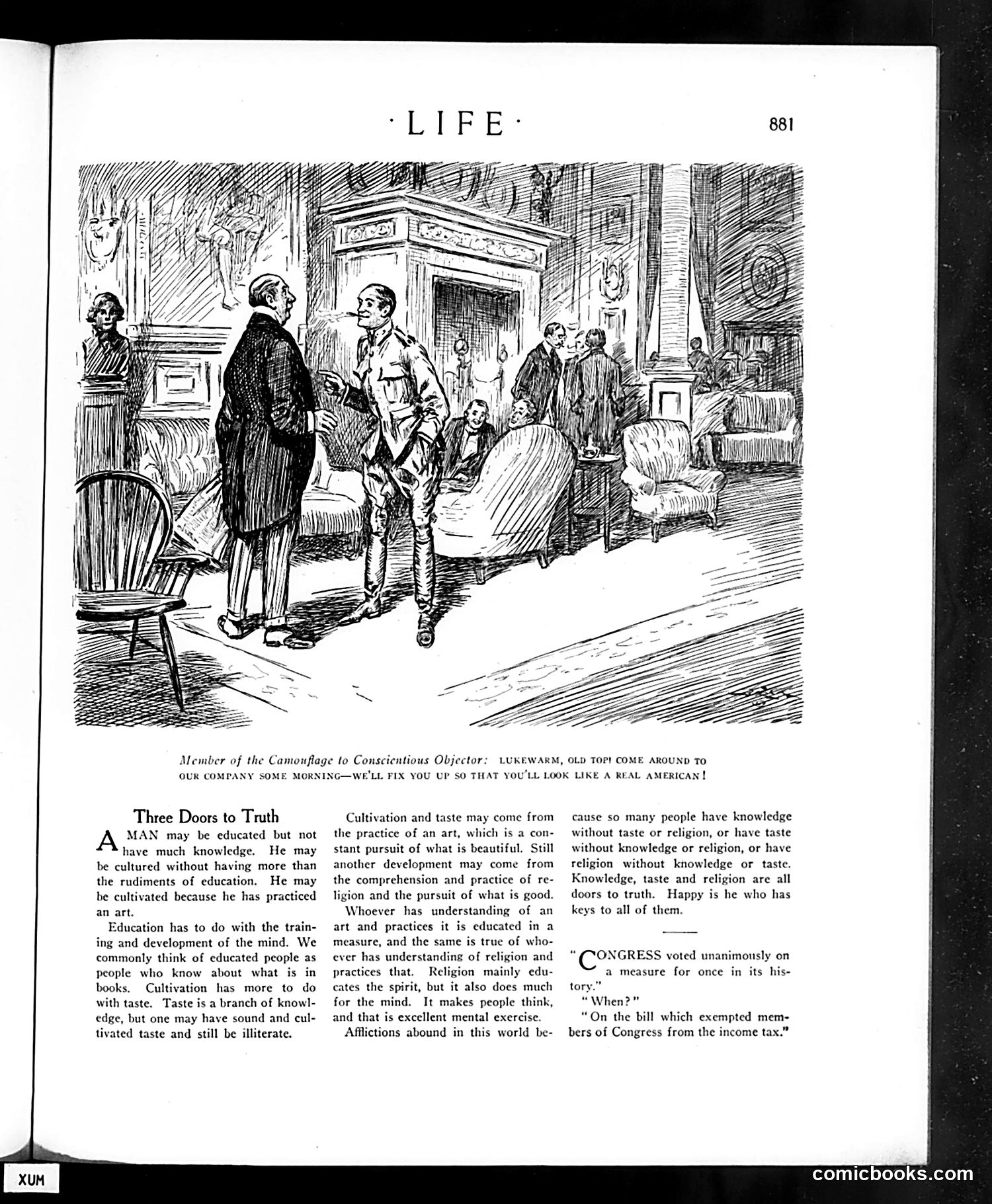
**The Cartoon (top):** A military recruiter addresses a "Conscientious Objector" (someone opposed to military service on moral grounds), offering to make him "look like a real American" through the "Camouflage" unit. This satirizes WWI-era pressure on draft resisters—suggesting that refusing military service was un-American, and that the military could "fix" objectors through propaganda or coercion disguised as patriotism. **The Article "Three Doors to Truth":** A philosophical essay distinguishing education, cultivation, and taste as separate but complementary paths to knowledge and truth, all rooted in religion, art, or learning. **The Joke (bottom):** Congress unanimously passed a bill exempting its own members from income tax. The satire mocks congressional hypocrisy—their only unanimous vote was self-serving legislation benefiting themselves, implying Congress rarely agrees on anything unless personally advantageous.
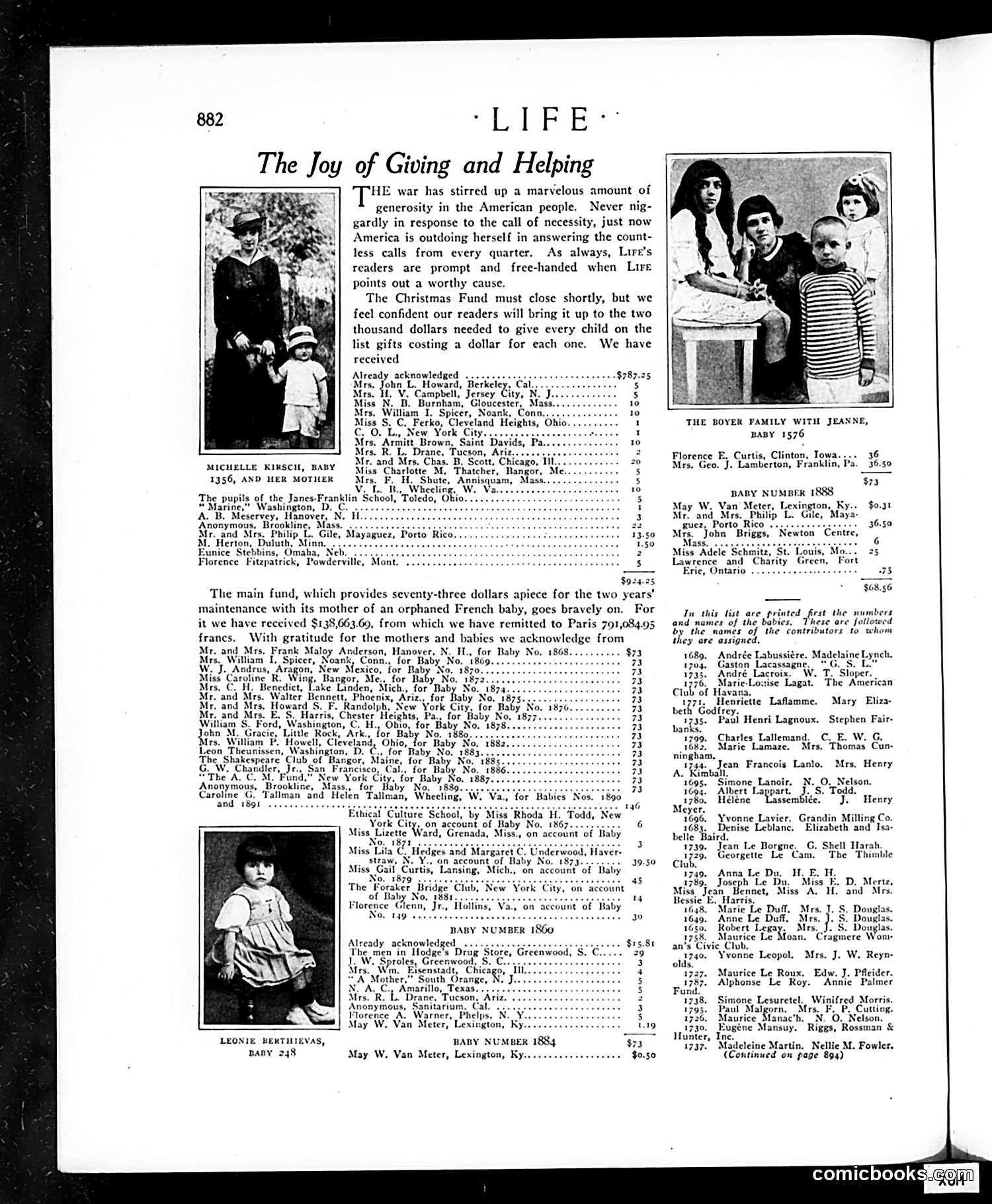
This page documents Life magazine's Christmas charity fundraising campaign during World War I. The main content is a list of donors contributing to two causes: 1. **The Christmas Fund**: raising $2,000 to provide $1 gifts to needy children 2. **The Main Fund**: supporting orphaned French babies at $73 annually for two years' maintenance The photographs show beneficiary children—Michelle Kirsch and her mother, the Boyer family with baby Jeanne, and Leonie Berthevas—illustrating the human impact of donations. The accompanying text appeals to American generosity during wartime, noting that Life readers are "prompt and free-handed" when worthy causes are presented. The extensive donor list—ranging from individuals to organizations like the Shakespeare Club of Bangor, Maine—demonstrates the magazine's role as a conduit for middle-class philanthropy, celebrating both the donors' generosity and the magazine's ability to mobilize charitable giving during the war years.
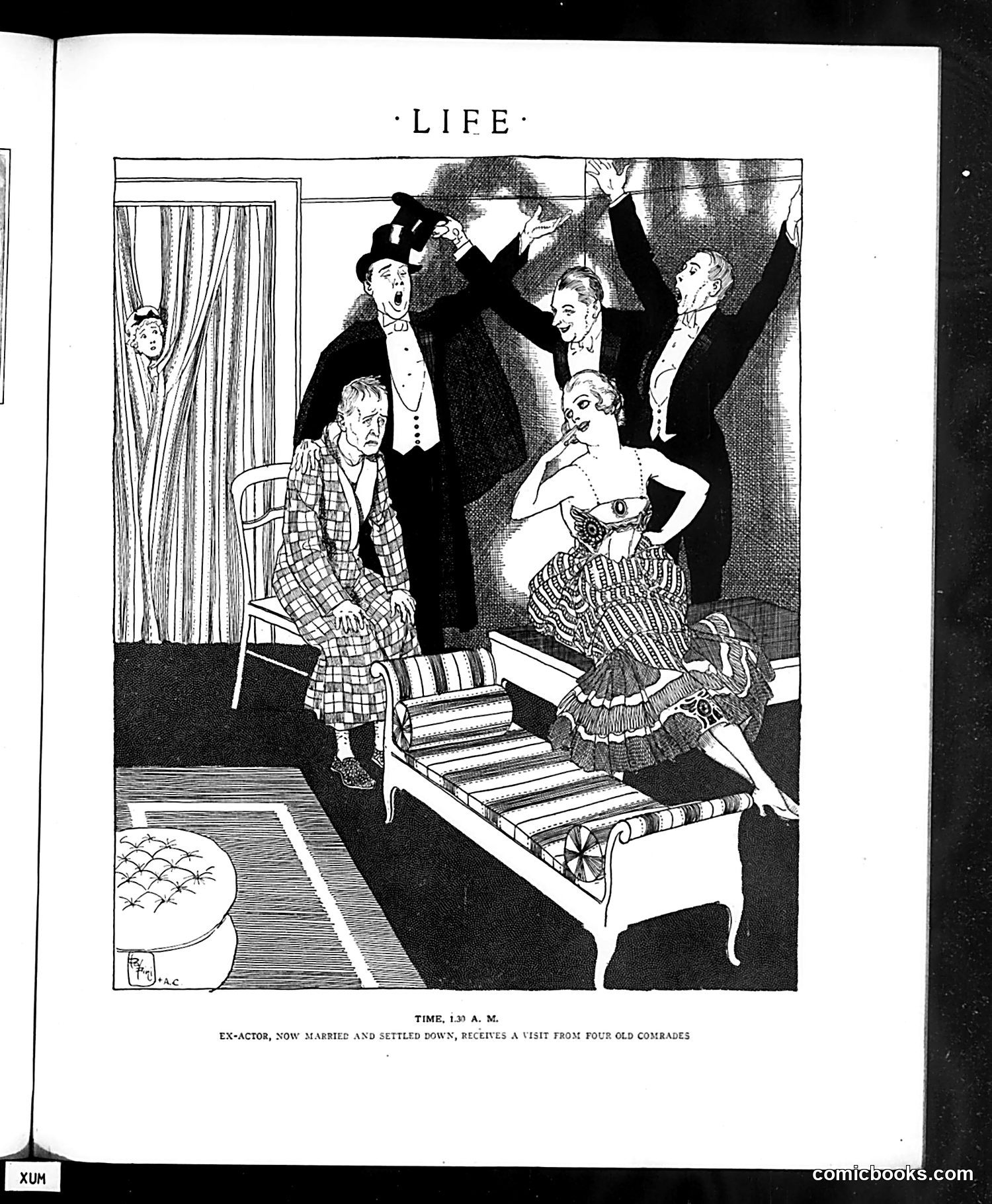
This satirical cartoon depicts a domestic scene with clear class and behavioral contrasts. A man in pajamas (the "ex-actor, now married and settled down") sits uncomfortably while his wife reclines nearby in revealing attire. Four formally-dressed men in tuxedos celebrate boisterously in the background, appearing to represent his "old comrades"—likely fellow actors or entertainers from his theatrical past. The satire contrasts the ex-actor's domesticated, respectable married life with the wild, hedonistic lifestyle of his former theatrical associates. The late hour (1:39 A.M.) emphasizes the disruption. His discomfort and formal restraint versus their uninhibited revelry suggests tension between settling into bourgeois respectability and the bohemian theater world. The cartoon mocks both the stuffiness of married domesticity and the excess of theatrical culture.
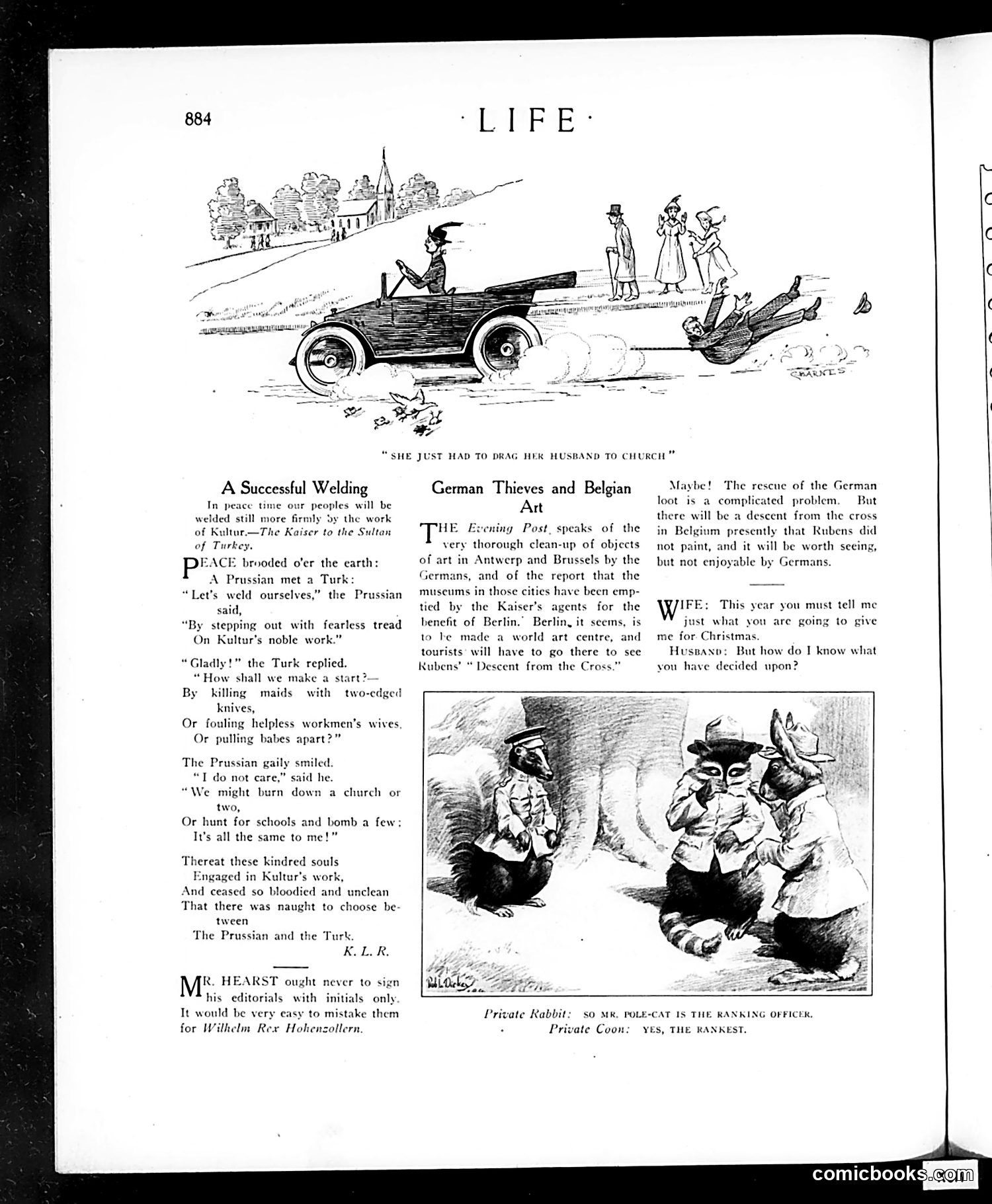
This page contains anti-German propaganda from World War I. The top cartoon mocks a supposed alliance between Prussia and the Ottoman Empire ("Kultur"), depicting both as equally savage and willing to commit atrocities—burning churches, bombing schools, assaulting women and children. The poem sarcastically suggests these nations are "kindred souls" united in barbarism. The middle section ridicules German art theft from Belgium, reporting that German agents systematically looted museums in Antwerp and Brussels to make Berlin a cultural center. The author darkly suggests Germans will face their own reckoning ("a descent from the cross") in Belgium. The bottom cartoon uses animal characters (rabbit, coon, pole-cat) in a dialogue about military rank, likely satirizing German military hierarchy or racial attitudes, though the specific reference is unclear today. Throughout, the magazine uses satire to portray Germans as thieves, vandals, and war criminals during WWI.
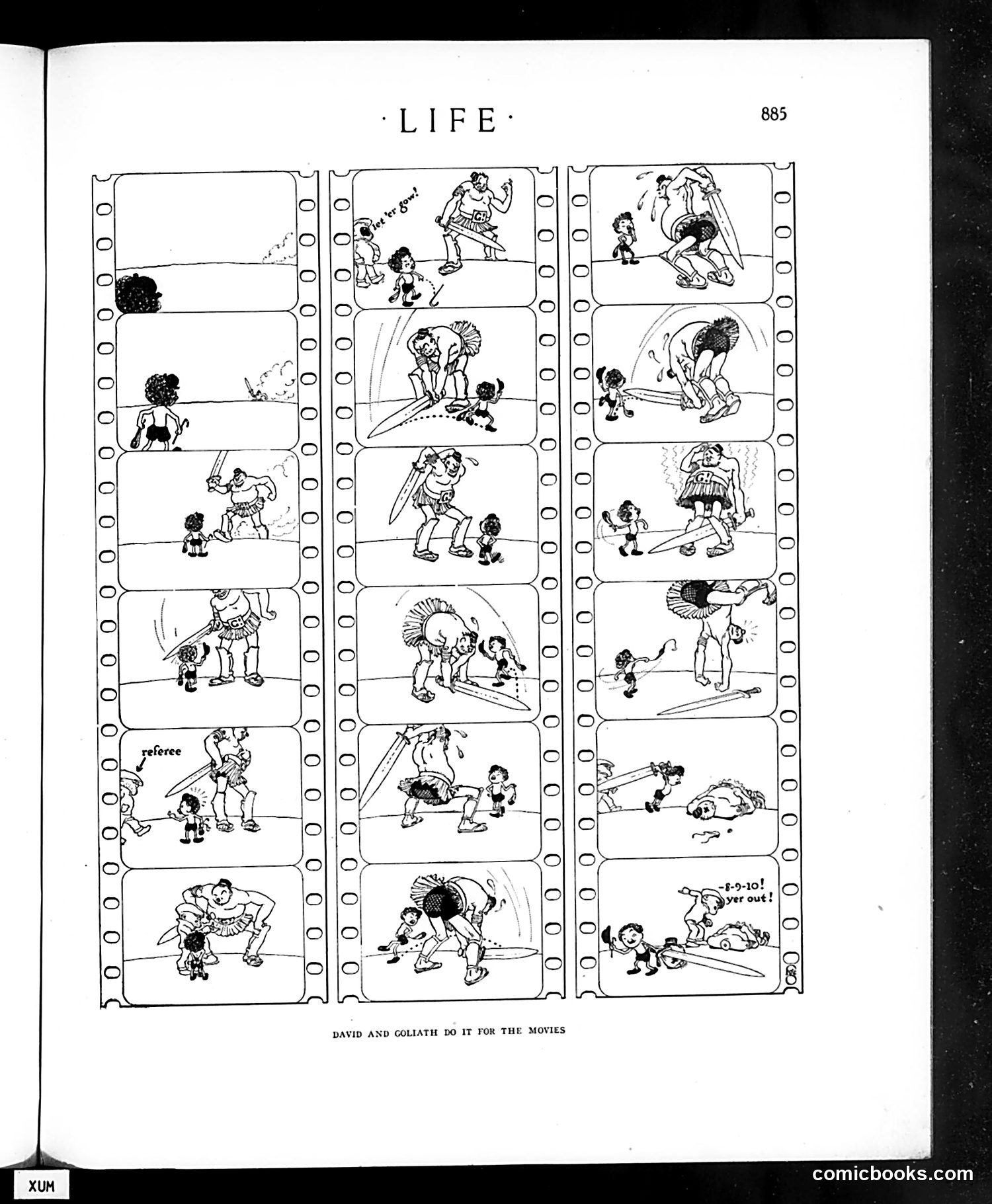
This is a film strip-style comic strip titled "David and Goliath Do It for the Movies," satirizing Hollywood adaptations of the biblical story. The sequential panels show a small child (David) repeatedly attempting to defeat a large adult man (Goliath) using various physical comedy props and techniques—slingshots, wrestling moves, acrobatics—reminiscent of silent film slapstick. The satire appears to mock how filmmakers dramatized and comedified classic biblical narratives for entertainment value, reducing the legendary underdog victory to physical farce. The "referee" figure suggests this is presented as sport-like entertainment rather than religious content. The joke critiques how Hollywood prioritized spectacle and humor over faithful storytelling, turning sacred material into vaudeville-style performances for profit.
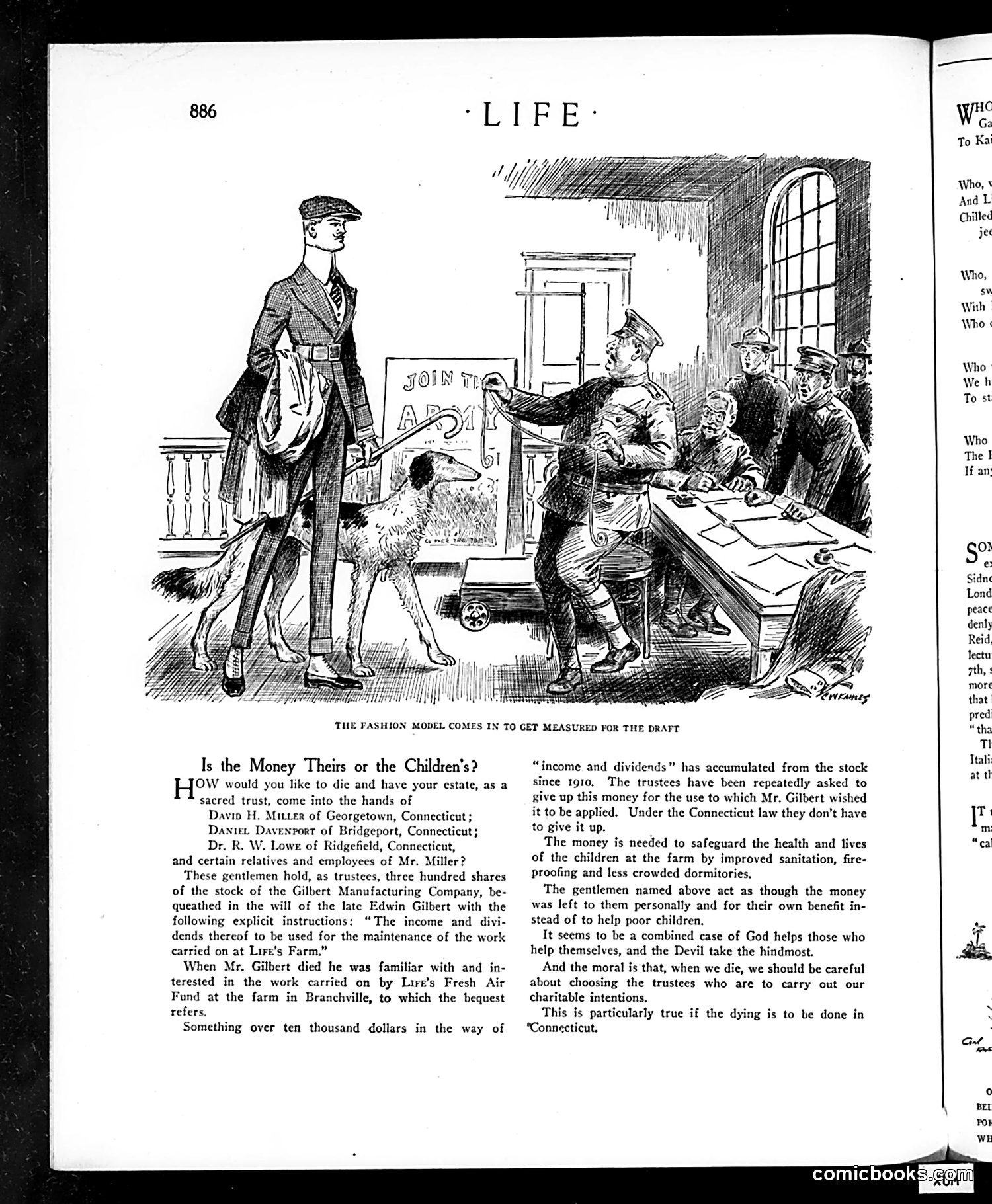
This page contains two separate satirical pieces from *Life* magazine: **"The Fashion Model Comes In to Get Measured for the Draft"** (cartoon): A well-dressed young man in a fashionable suit stands while military/government officials measure him, suggesting he's being conscripted. The satire appears to mock wealthy or fashionable young men facing military service—likely during World War I era. **"Is the Money Theirs or the Children's?"** (article with commentary): This exposes alleged trustee misconduct. Connecticut trustees holding stock shares from a deceased man's (Edwin Gilbert's) will were explicitly instructed to use accumulated dividends ($10,000+) for a children's farm charity. Instead, the trustees refused to release the funds. The satire ridicules how privileged trustees exploit legal loopholes to personally benefit from charitable bequests while vulnerable children go without needed resources, concluding with biting sarcasm: "when we die...be careful" choosing trustees "particularly...in Connecticut."
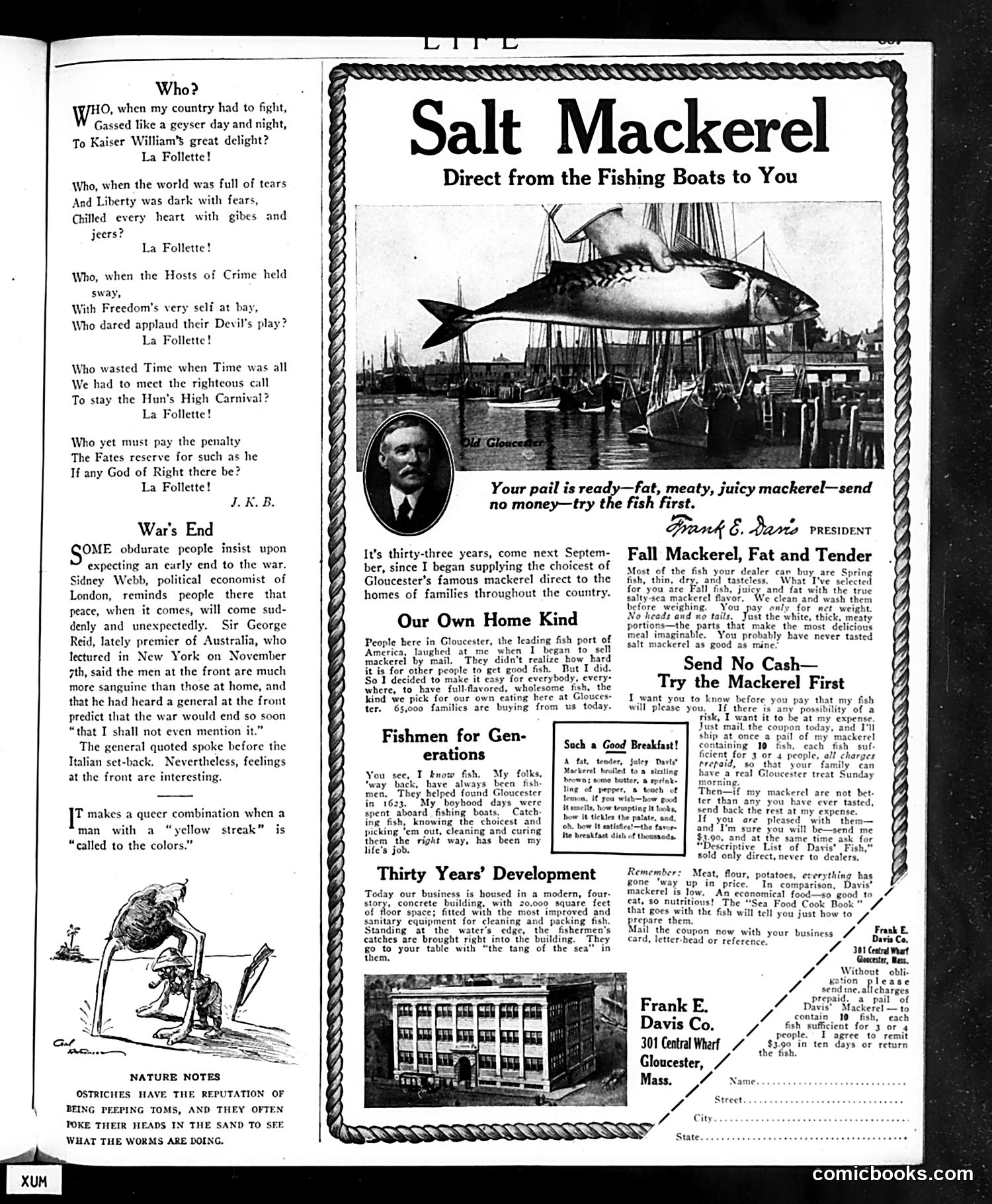
The left column contains a **bitter attack on Senator Robert La Follette**, a Wisconsin Progressive politician who opposed American entry into World War I. The poem "Who?" repeatedly blames La Follette for: - Supporting Germany ("Kaiser William's great delight") - Undermining wartime morale with criticism - Opposing the war effort while "crime held sway" - Wasting time needed to fight "the Hun" The cartoon predicts he'll face divine punishment ("pay the penalty / The Fates reserve"). **Context**: This reflects 1917-1918 wartime hostility toward anti-war voices. La Follette was genuinely vilified for his pacifist stance, facing calls for his expulsion from the Senate. The right side is an **advertisement** for Frank E. Davis's mail-order salt mackerel from Gloucester, Massachusetts—unrelated political content sharing the page. A brief humor note below discusses ostriches, also unrelated. This page exemplifies Life magazine's dual role: satirical political commentary mixed with advertising and light humor.
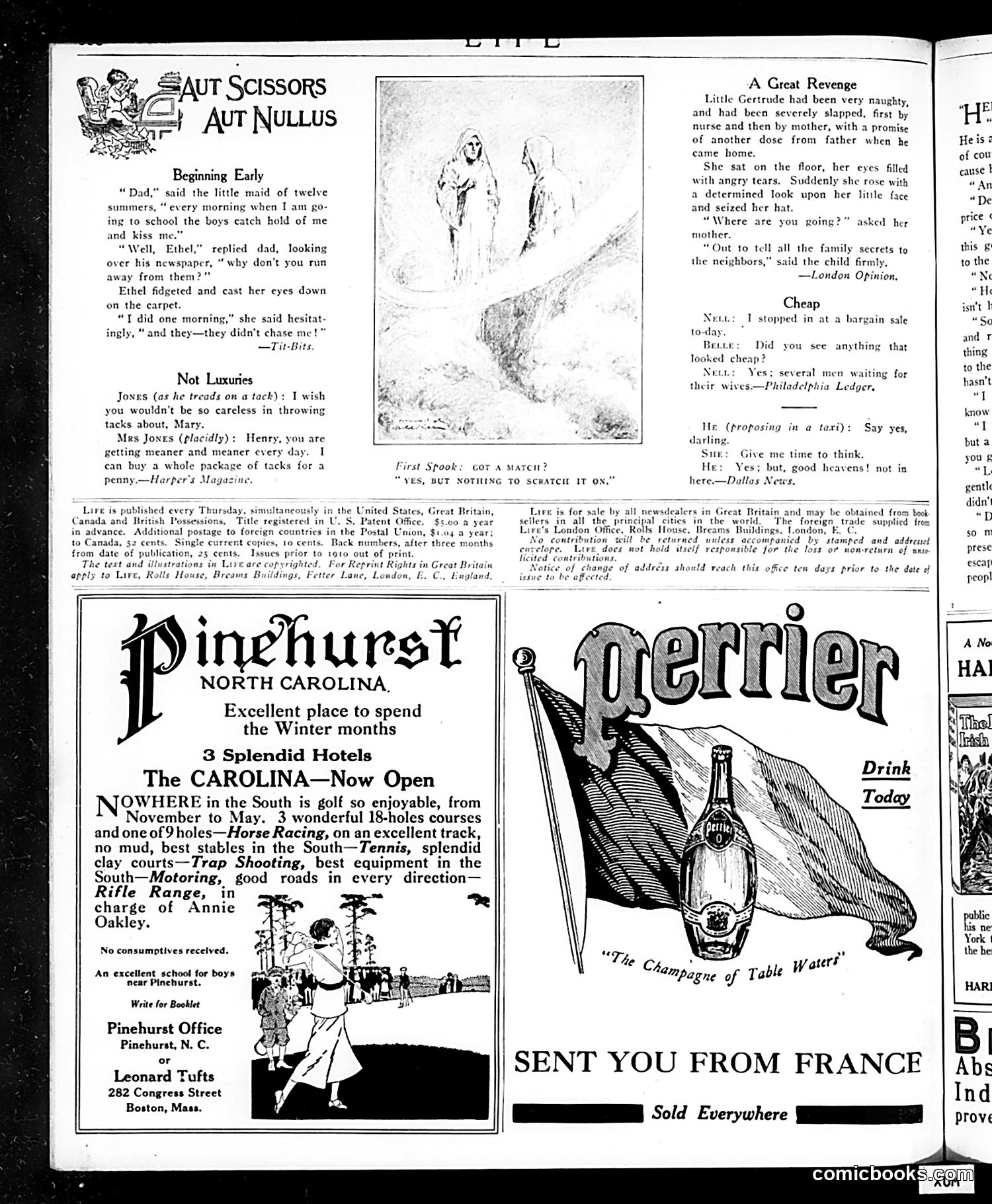
This page contains several short humorous anecdotes typical of early 20th-century Life magazine, which was primarily a humor and satire publication. The cartoons present domestic comedy scenarios: a young girl being chased and kissed by boys at school; a child threatening to reveal "family secrets to the neighbors" after being punished; a couple at a bargain sale where the cheapest thing is men waiting for their wives; and a marriage proposal in a taxi. These jokes rely on period gender dynamics and social conventions—children's behavior, marital relationships, and shopping culture. The humor is gentle and domestic rather than overtly political. The page is dominated by **advertising**, particularly a substantial Pinehurst, North Carolina resort ad featuring golf, horse racing, and tennis, notably specifying "No consumptives received" (excluding tuberculosis patients). There's also a Perrier water advertisement emphasizing its French origin—likely appealing to post-WWI American audiences valuing European sophistication. The content reflects early 1900s American middle-class concerns and leisure activities rather than political satire.
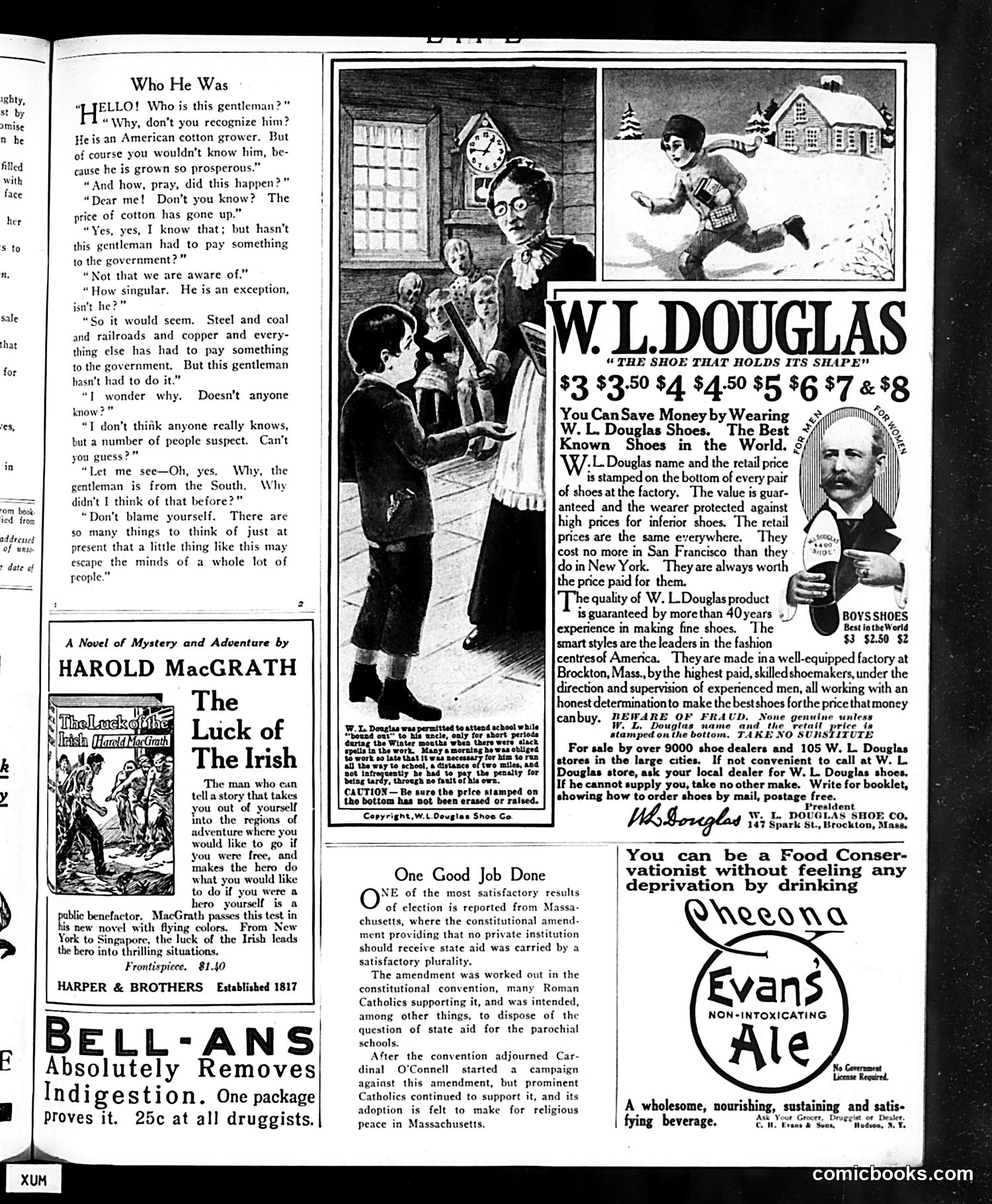
The main cartoon satirizes **tariff favoritism** toward Southern cotton growers. The dialogue mocks the inconsistency that while steel, coal, railroads, and copper industries had to "pay something to the government" (likely through tariffs or taxes), a prosperous Southern cotton grower apparently hasn't. The punchline—"he's from the South"—suggests the South received preferential treatment or exemptions, possibly referencing post-Civil War Reconstruction politics or regional economic policy disputes. The page is otherwise advertising-heavy, featuring W.L. Douglas shoes and other products. A book advertisement promotes Harold MacGrath's *The Luck of the Irish*, a mystery-adventure novel. The satirical point relies on readers' understanding of early 20th-century tariff debates and regional economic tensions between North and South.
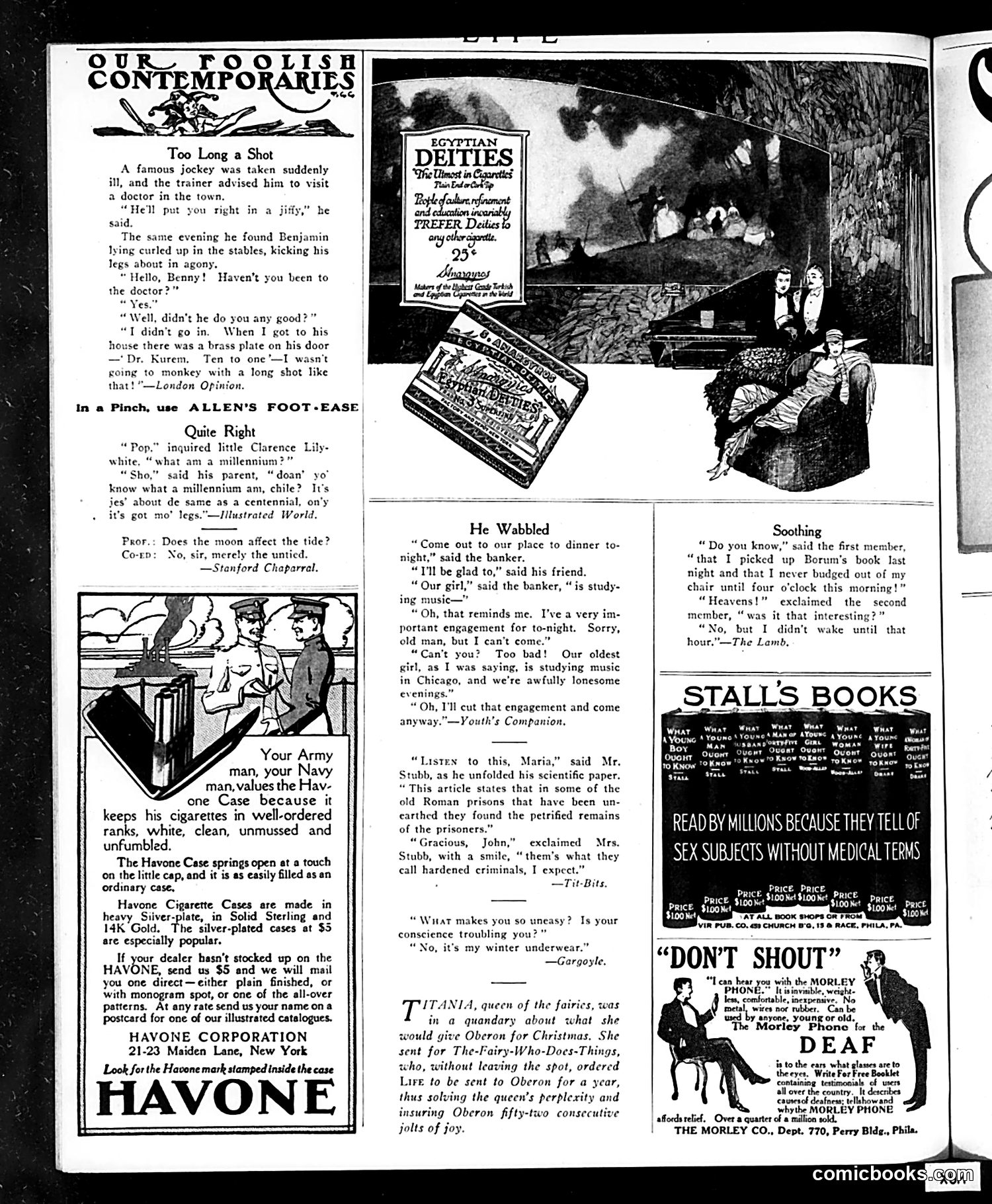
This page from *Life* magazine contains several short humorous anecdotes typical of early 20th-century American humor, plus period advertisements. **The jokes** rely on wordplay and misunderstandings: - "Too Long a Shot" plays on a jockey mistaking a doctor's nameplate "Ten to one" (odds) for a warning about risk - "Quite Right" involves a child confusing "millennium" with "centennial" - Other brief jokes exploit puns ("untied" vs. "tide") **The social context**: These represent genteel humor for educated, middle-class readers—clever but mild by modern standards. References to jockeys, bankers, and scientific papers reflect the magazine's audience. **The advertisements** are period-specific: cigarette cases for military men, foot powder, books on "sex subjects without medical terms" (euphemistic health/hygiene guides common then), and a "Morley Phone" device for the deaf. The overall tone is inoffensive, domestic satire with no political edge—typical of *Life's* entertainment function before it became a news magazine.
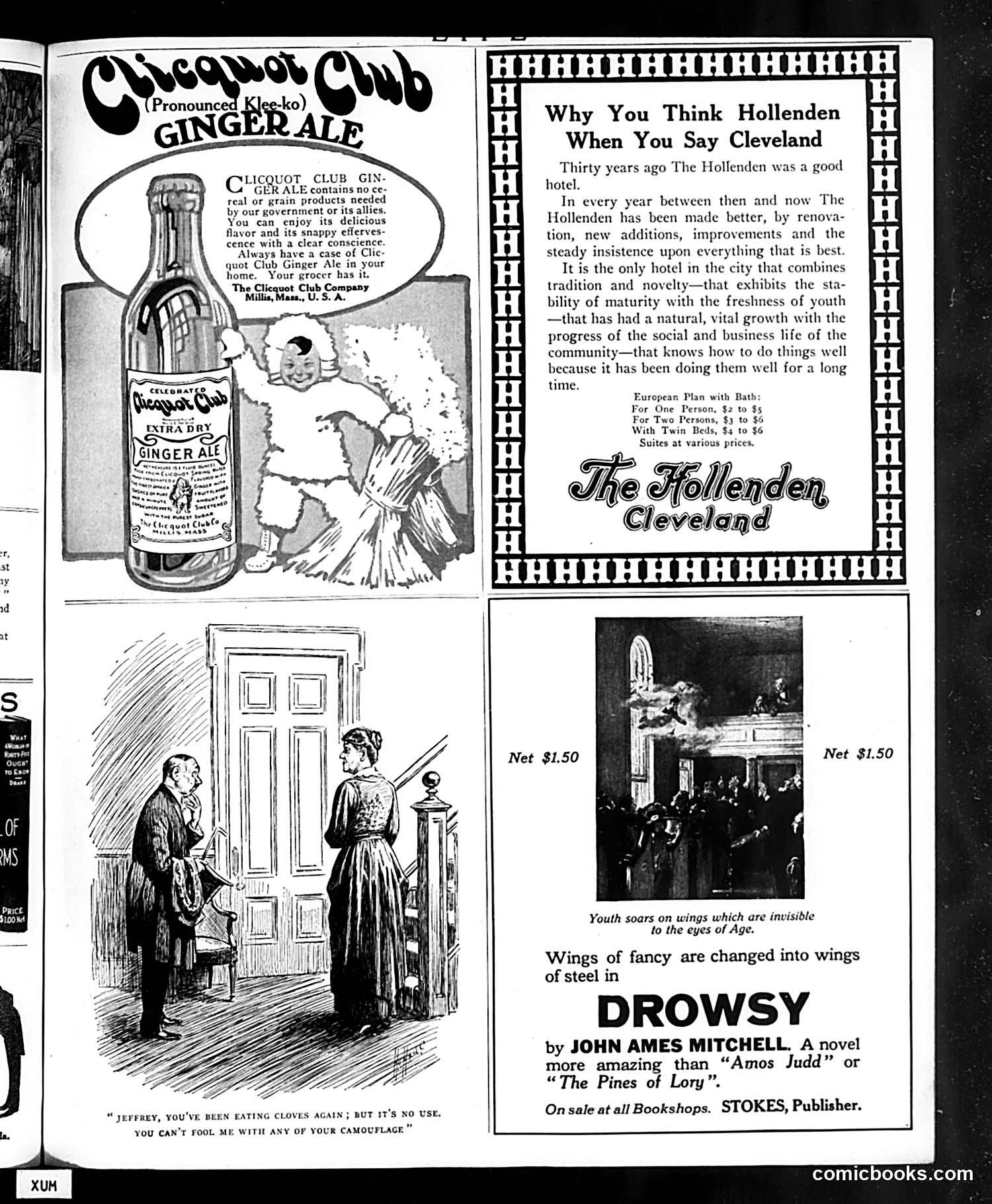
This is primarily a **advertising page** from Life magazine, with one cartoon and several product ads. The cartoon (lower left) depicts a domestic scene where a woman confronts a man about eating cloves to hide his breath—likely from drinking alcohol. The caption's reference to "camouflage" is a **Prohibition-era joke**: during alcohol prohibition, people consumed spirits secretly and used breath mints or cloves to hide evidence from spouses or authorities. The humor lies in the woman seeing through his deception. The page otherwise contains ads for **Clicquot Club Ginger Ale** (emphasizing it contains no grain products—relevant during wartime rationing), **The Hollenden hotel** in Cleveland, and a novel called **"Drowsy"** by John James Mitchell. The Prohibition reference dates this to the 1920s-early 1930s period when the 18th Amendment was in effect.
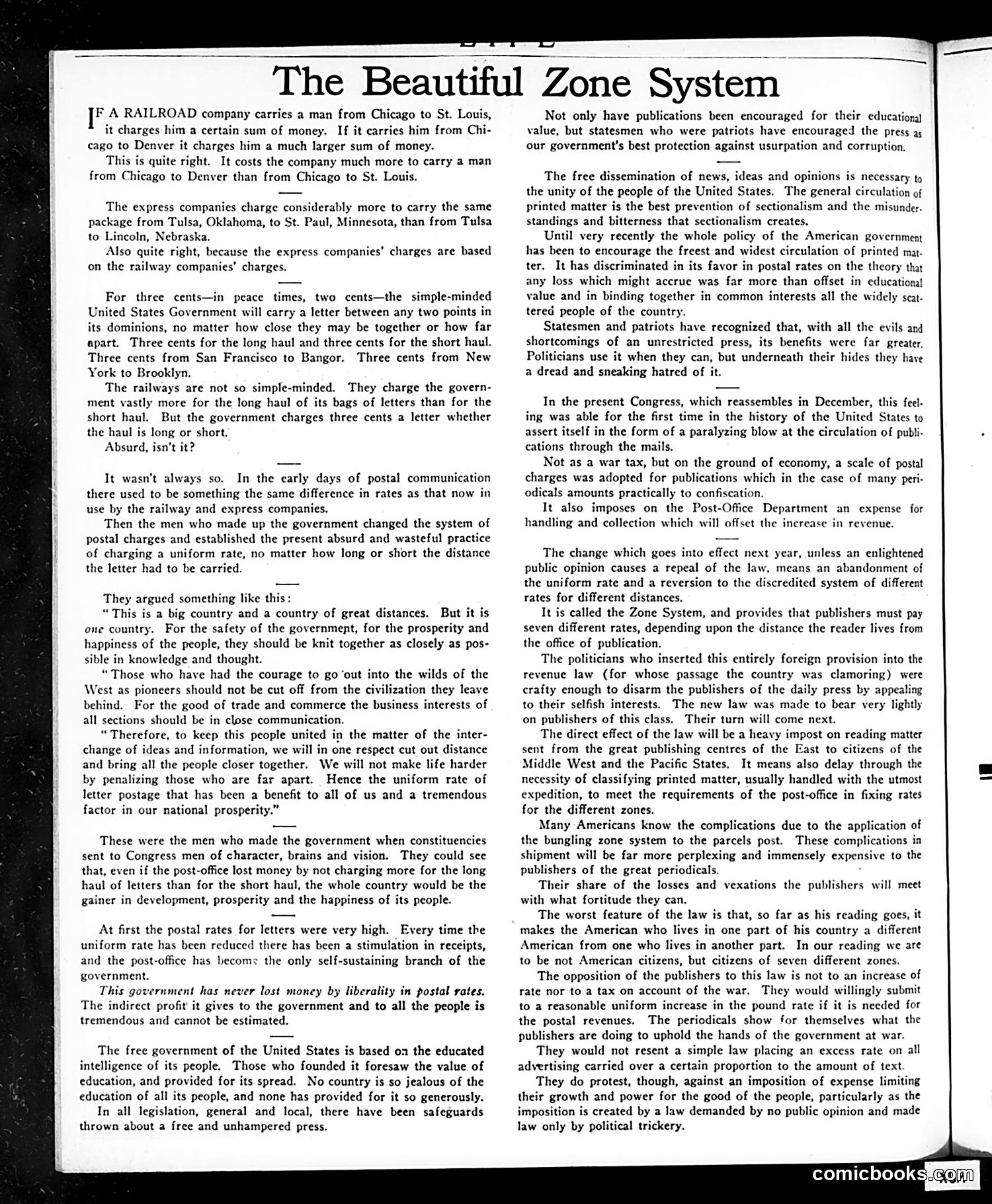
This page critiques a proposed change to U.S. postal rates. The government traditionally charged a uniform 3-cent rate nationwide—same cost from New York to Brooklyn as San Francisco to Bangor—treating the country as unified. This subsidized long-distance communication to bind the nation together. The article argues against adopting a "zone system" (like railroads use) that would charge more for longer distances. The satire is implicit: the author shows how early government leaders understood that uniform rates, though economically "absurd," strengthened national unity and commerce by removing distance as a barrier. The piece warns that creating differential rates would fragment Americans into "seven different zones"—making citizens feel like foreigners within their own country. It defends postal "liberality" as wise policy: every rate reduction increased revenue, making the Post Office self-sustaining while advancing democracy through accessible communication. The underlying argument: national cohesion matters more than pure accounting logic.
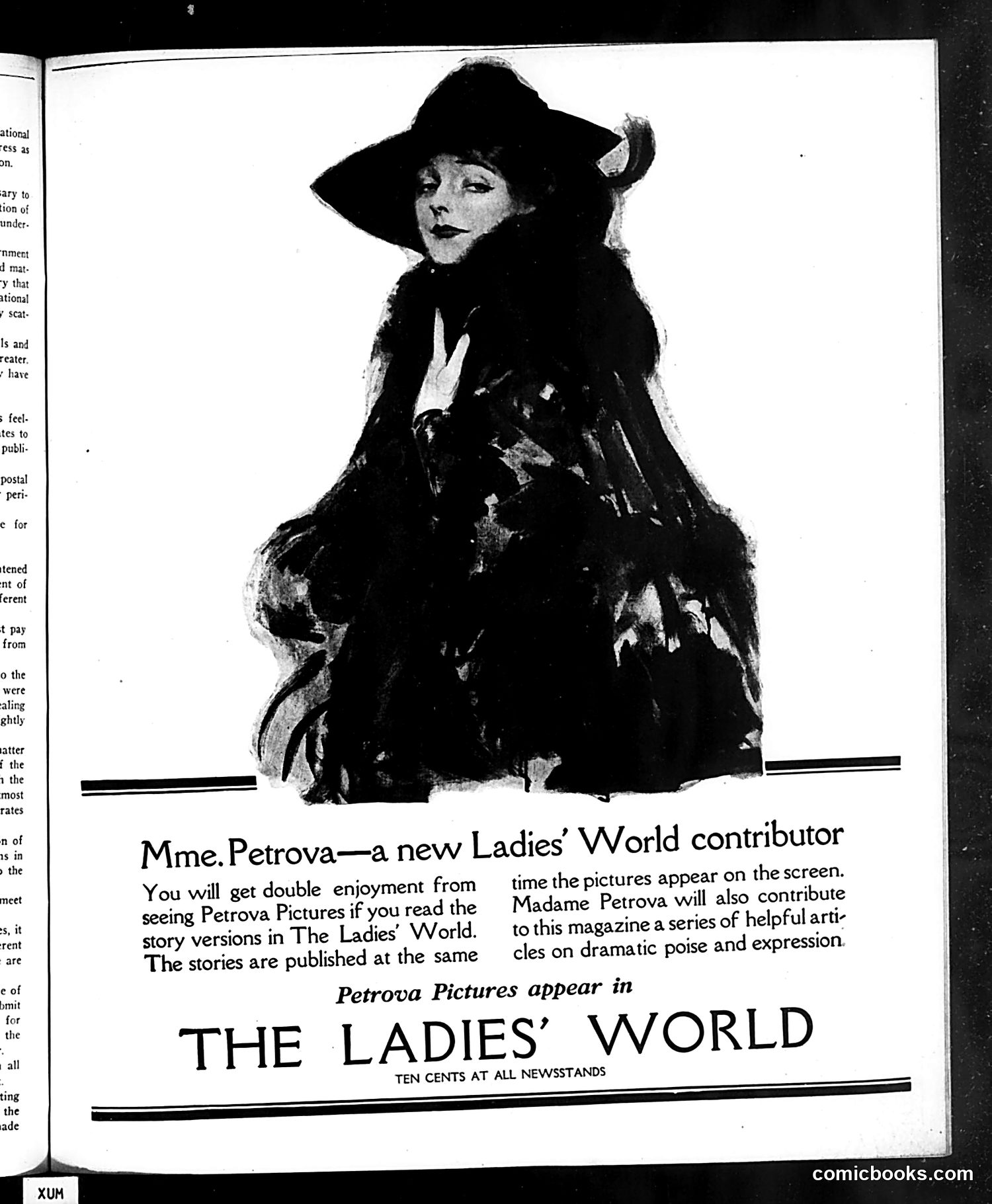
This is a **product advertisement**, not political satire. It promotes **Petrova Pictures** films and their tie-in with *The Ladies' World* magazine. The image shows **Madame Petrova**, a film actress of the silent era, dressed in dramatic costume (wide-brimmed hat, fur stole). The advertisement leverages cross-media marketing: readers who watch her films and then read the published story versions in *The Ladies' World* magazine get "double enjoyment." Additionally, Petrova will contribute articles on "dramatic poise and expression" to the magazine—positioning her as an expert instructing women on performance and comportment. The ad targets female readers (hence the ladies' magazine placement) and costs ten cents at newsstands. This represents early 20th-century synergy between cinema and print media to drive audiences to both products.
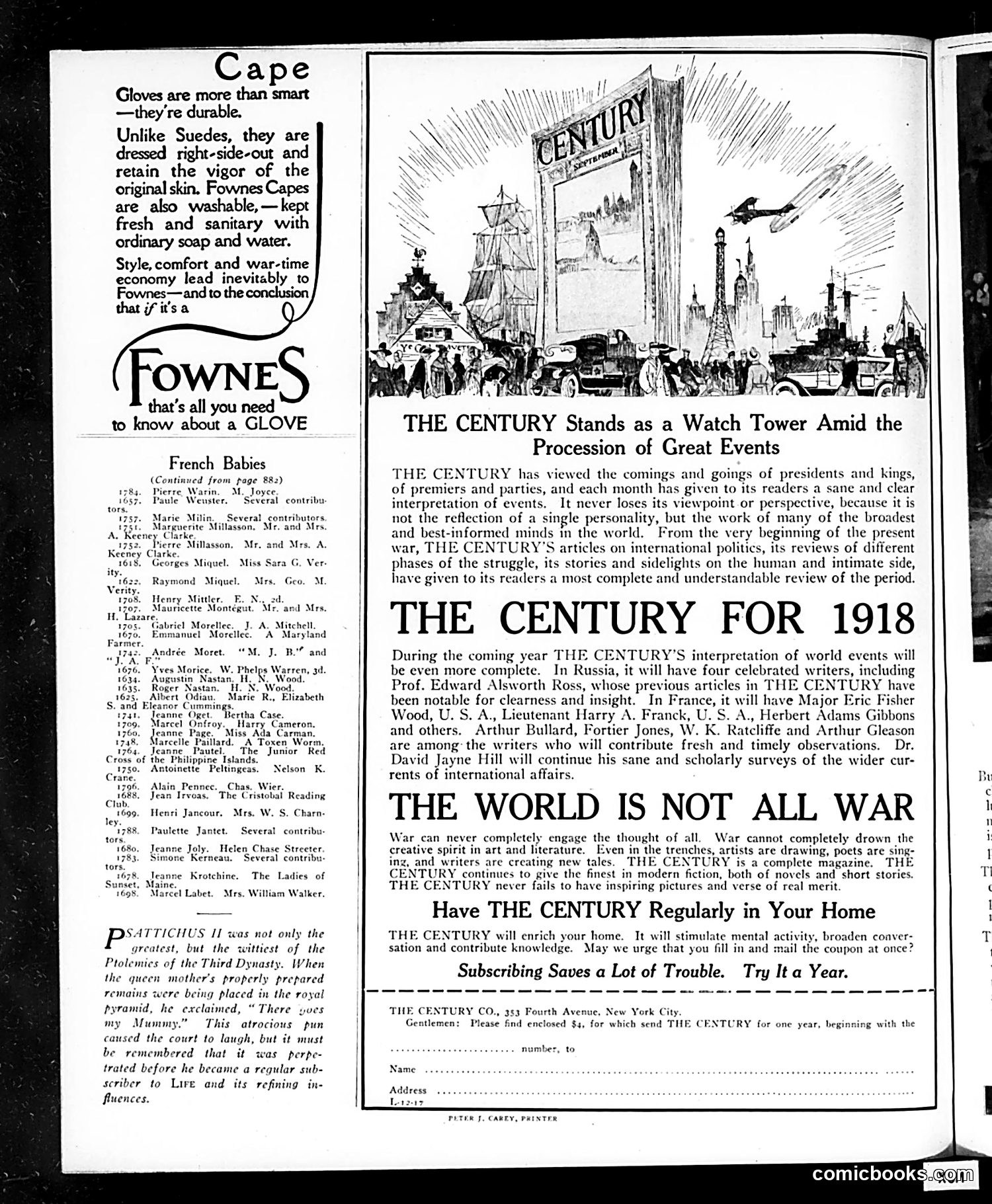
This page is primarily **advertising and magazine promotion**, not political satire. The left column advertises Fownes brand gloves, emphasizing their durability and washability—practical wartime concerns. The bulk of the page promotes *The Century* magazine for 1918. The key context: America was actively involved in World War I (1917-1918). The Century's advertisement emphasizes its comprehensive war coverage while asserting "**The World Is Not All War**"—promising readers that despite the conflict consuming global attention, the magazine still publishes fiction, poetry, art, and cultural content. This reflects how WWI dominated public discourse, making it noteworthy that a magazine would reassure readers it offered non-war material. The advertisement names several war correspondents and international writers (Edward Alsworth Ross, Eric Fisher Wood, Arthur Bullard), indicating the magazine's serious journalism credentials during this pivotal year. The subscription pitch stresses mental stimulation and knowledge—positioning the magazine as essential home reading during wartime uncertainty.
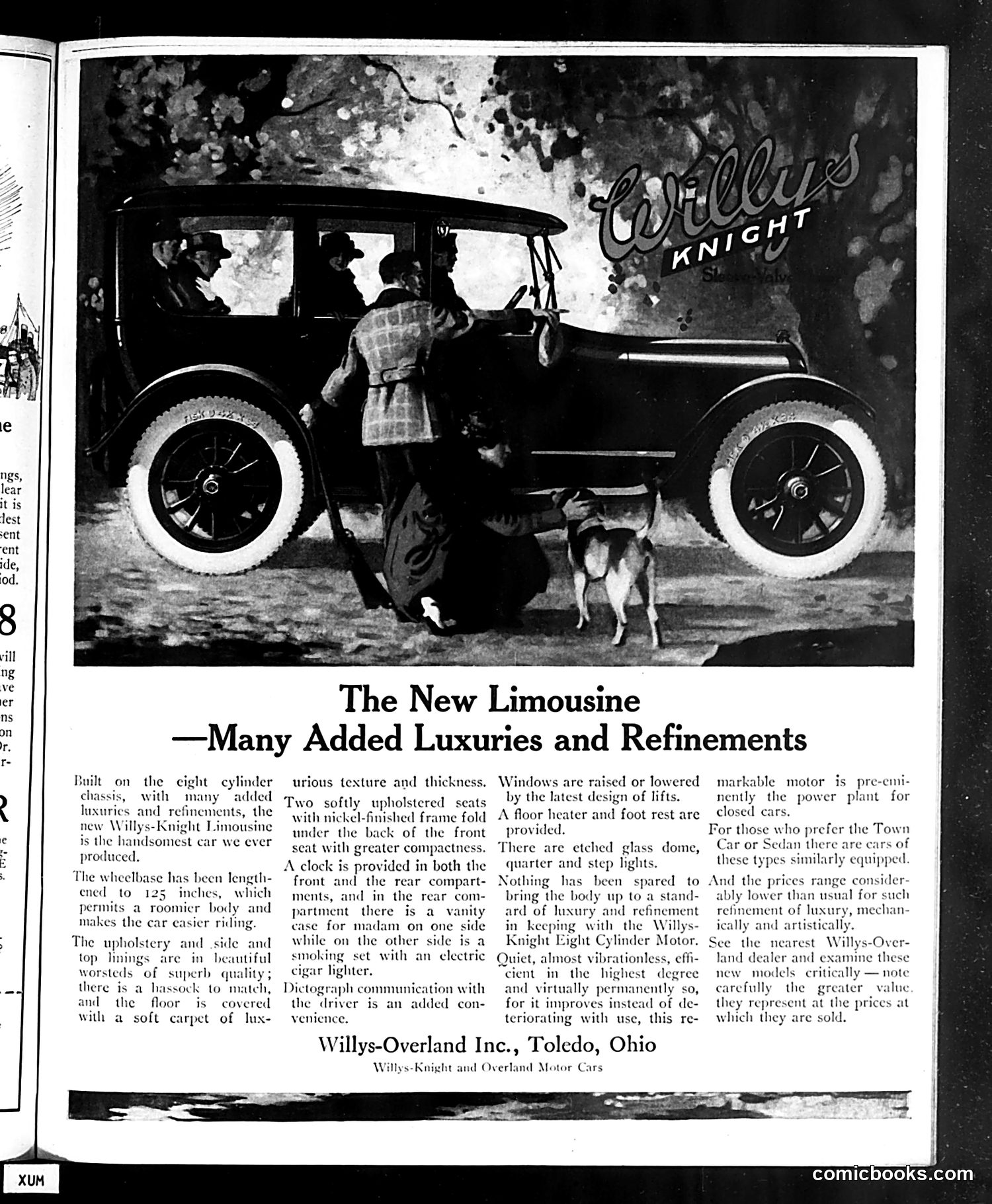
This is **not a cartoon or satire**—it's a straightforward automobile advertisement for the Willys-Knight Limousine, manufactured by Willys-Overland Inc. in Toledo, Ohio. The image shows a vintage car (approximately 1920s era based on design) with passengers and a dog, positioned to showcase the vehicle's features. The accompanying text describes luxury amenities: an eight-cylinder engine, extended wheelbase (125 inches), upholstered seats with wool worsted fabric, a hassock, carpeted floor, clocks in front and rear compartments, a vanity case, smoking set with electric cigar lighter, floor heater, foot rest, etched glass windows, and a "Dictograph" communication system between driver and passengers. The advertisement emphasizes refinement and comfort ("almost vibrationless") as selling points, positioning the Willys-Knight as a competitive luxury vehicle at reasonable prices compared to similar models. This represents early-20th-century automotive marketing targeting affluent consumers.
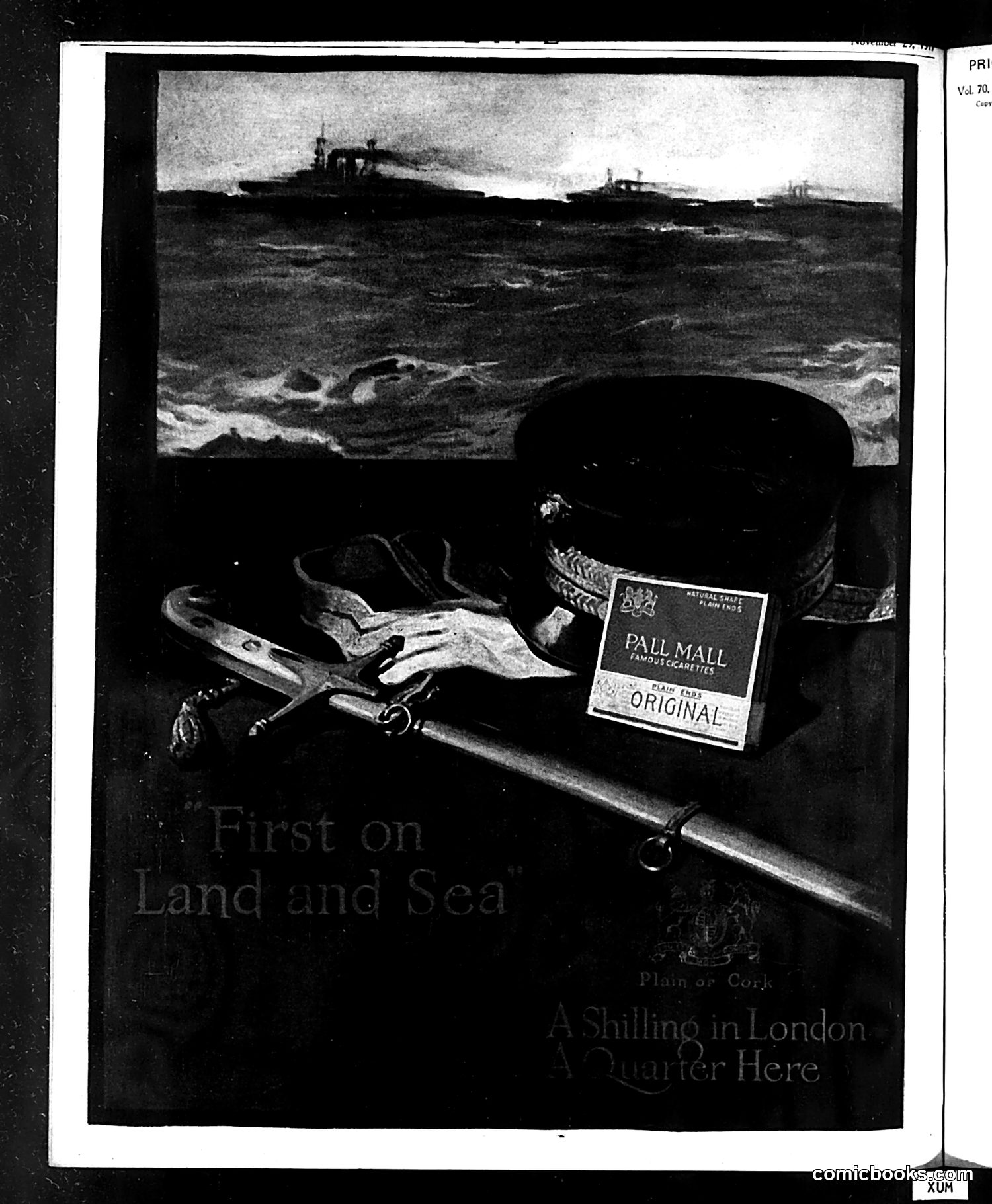
This appears to be a **Pall Mall cigarette advertisement** rather than a political cartoon. The page shows a still life arrangement featuring: - A pipe and rifle (suggesting outdoor/sporting activity) - A Pall Mall cigarette package labeled "ORIGINAL" - A wide-brimmed hat - A background image of naval vessels at sea The visible text phrases—"First on Land and Sea," "A shilling in London," "A quarter Here"—suggest this ad uses patriotic/military imagery and compares British and American pricing to appeal to consumers. The "ORIGINAL" label emphasizes the brand's authenticity or superiority. Rather than satire, this is straightforward product marketing using masculine, militaristic imagery typical of early 20th-century cigarette advertising.