
Life, 1917-11-29 · page 22 of 40
Life — November 29, 1917 — page 22: what you’re looking at
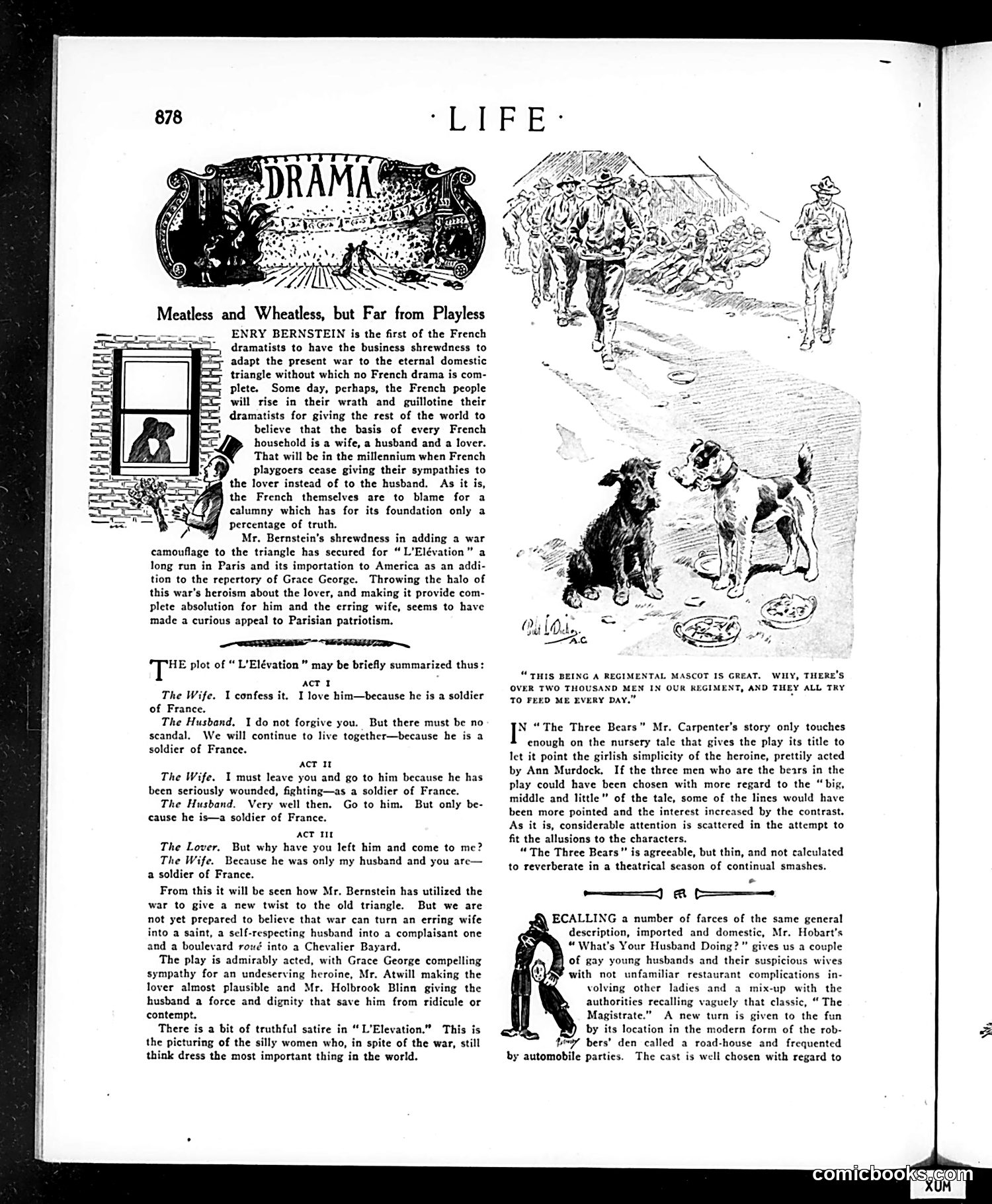
What you’re looking at
This page reviews French playwright Henry Bernstein's "L'Élévation," which satirizes the classic French dramatic obsession: the domestic love triangle (wife, husband, lover). Bernstein's innovation is patriotic camouflage—he makes the lover a wounded French soldier, thereby "absolving" the affair through wartime heroism. Life's critic mocks this cynical manipulation: the play's logic reduces to characters accepting infidelity solely because the lover is "a soldier of France." The satire exposes how wartime sentiment can rationalize moral compromise and how French audiences will forgive anything if patriotism is invoked. The accompanying illustration shows dogs eating, likely commenting on base appetites—a visual parallel to the play's reduction of human morality to simple, animalistic justifications.
📄 Transcribed text from this page (OCR, searchable)
Machine-transcribed from the original scan — historical spelling and the odd misread are preserved.
Meatless and Wheatless, but Far from Playless ENRY BERNSTEIN is the first of the French dramatists to have the business shrewdness to adapt the present war to the eternal domestic triangle without which no French drama is com- plete. Some day, perhaps, the French people will rise in their wrath and guillotine their ;, dramatists for giving the rest of the world to believe that the basis of every French household is a wife, a husband and a lover. That will be in the millennium when French playgoers cease giving their sympathies to the lover instead of to the husband. As it is, the French themselves are to blame for a calumny which has for its foundation only a percentage of truth. Mr. Bernstein’s shrewdness in adding a war camouflage to the triangle has secured for “ L’Elévation” a long run in Paris and its importation to America as an addi- tion to the repertory of Grace George. Throwing the halo of this war's heroism about the lover, and making it provide com- plete absolution for him and the erring wife, seems to have made a curious appeal to Parisian patriotism. eee - ee sl Di plot of “ L’Elévation ” may be briefly summarized thus: act The Wife. 1 confess it. I love him—because he is a soldier of France. The Husband. I do not forgive you. But there must be no scandal. We will continue to live together—because he is a soldier of France. ACT It The Wife. 1 must leave you and go to him because he has been seriously wounded, fighting—as a soldier of France. The Husband. Very well then. Go to him. But only be- cause he is—a soldier of France. act nt The Lover. But why have you left him and come to me? The Wife. Because he was only my husband and you are— a soldier of France. From this it will be seen how Mr. Bernstein has utilized the war to give a new twist to the old triangle. But we are not yet prepared to believe that war can turn an erring wife into a saint, a self-respecting husband into a complaisant one and a boulevard roué into a Chevalier Bayard. The play is admirably acted, with Grace George compelling sympathy for an undeserving heroine, Mr. Atwill making the lover almost plausible and Mr. Holbrook Blinn giving the husband a force and dignity that save him from ridicule or contempt. There is a bit of truthful satir “L'Elevation.” This is the picturing of the silly women who, in spite of the war, still think dress the most important thing in the world. “THIS BEING A REGIMENTAL MASCOT IS GREAT. WILY, THERE'S OVER TWO THOUSAND IN OUR REGIMENT, AND THEY ALL TRY TO FEED ME EVERY DAY.” i “The Three Bears” Mr. Carpenter's story only touches enough on the nursery tale that gives the play its title to let it point the girlish simplicity of the heroine, prettily acted by Ann Murdock. If the three men who are the bears in the play could have been chosen with more regard to the “big, middle and little" of the tale, some of the lines would have been more pointed and the interest increased by the contrast. As it is, considerable attention is scattered in the attempt to fit the allusions to the characters. “The Three Bears” is agreeable, but thin, and not calculated to reverberate in a theatrical season of continual smashes. ——. a > — ECALLING a number of farces of the same general description, imported and domestic, Mr. Hobart’s “What's Your Husband Doing?” gives us a couple of gay young husbands and their suspicious wives with not unfamiliar restaurant complications in- volving other ladies and a mix-up with the authorities recalling vaguely that classic, “The Magistrate.” A new turn is given to the fun by its location in the modern form of the rob- te bers’ den called a road-house and frequented by automobile parties. The cast is well chosen with regard to