
Life, 1917-11-29 · page 36 of 40
Life — November 29, 1917 — page 36: what you’re looking at
What you’re looking at
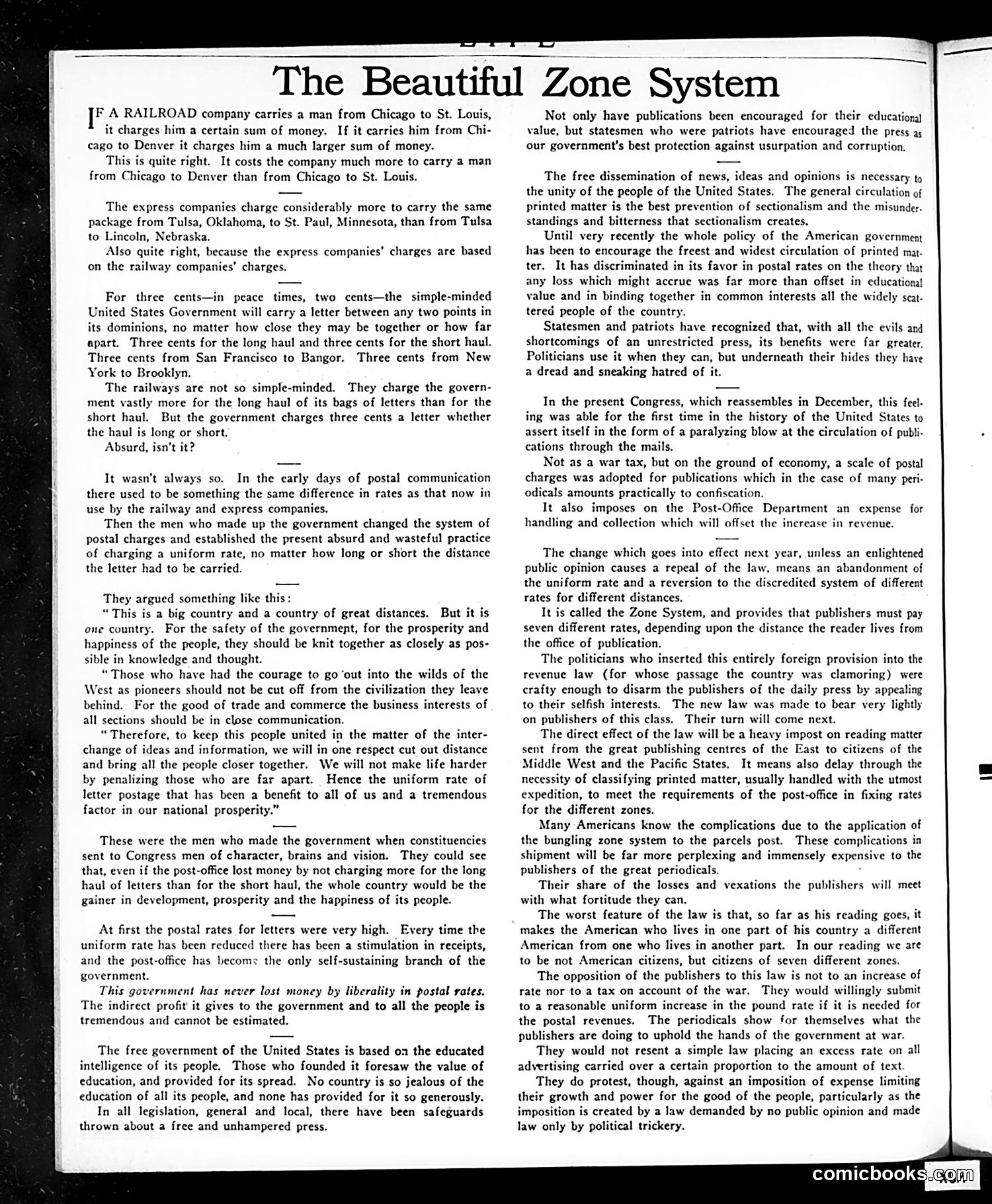
This page critiques a proposed change to U.S. postal rates. The government traditionally charged a uniform 3-cent rate nationwide—same cost from New York to Brooklyn as San Francisco to Bangor—treating the country as unified. This subsidized long-distance communication to bind the nation together. The article argues against adopting a "zone system" (like railroads use) that would charge more for longer distances. The satire is implicit: the author shows how early government leaders understood that uniform rates, though economically "absurd," strengthened national unity and commerce by removing distance as a barrier. The piece warns that creating differential rates would fragment Americans into "seven different zones"—making citizens feel like foreigners within their own country. It defends postal "liberality" as wise policy: every rate reduction increased revenue, making the Post Office self-sustaining while advancing democracy through accessible communication. The underlying argument: national cohesion matters more than pure accounting logic.
📄 Transcribed text from this page (OCR, searchable)
Machine-transcribed from the original scan — historical spelling and the odd misread are preserved.
F A RAILROAD company carries a man from Chicago to St. Louis, it charges him a certain sum of money. If it carries him from Chi- cago to Denver it charges him a much larger sum of money. This is quite right. It costs the company much more to carry a man from Chicago to Denver than from Chicago to St. Loui: The express companies charge considerably more to carry the same package from Tulsa, Oklahoma, to St. Paul, Minnesota, than from Tulsa to Lincoln, Nebraska. Also quite right, because the express companies’ charges are based on the railway companies’ charges. For three cents—in peace times, two cents—the simple-minded United States Government will carry a letter between any two points in its dominions, no matter how close they may be together or how far apart. Three cents for the long haul and three cents for the short haul. Three cents from San Francisco to Bangor. Three cents from New York to Brooklyn. The railways are not so simple-minded. They charge the govern- ment vastly more for the long haul of its bags of letters than for the short haul. But the government charges three cents a letter whether the haul is long or short. Absurd, isn’t it? It wasn’t always so. In the early days of postal communication there used to be something the same difference in rates as that now in use by the railway and express companies. Then the men who made up the government changed the system of postal charges and established the present absurd and wasteful practice of charging a uniform rate, no matter how long or short the distance the letter had to be carried. They argued something like this: “This is a big country and a country of great distances. But it is one country. For the safety of the government, for the prosperity and happiness of the people, they should be knit together as closely as pos- sible in knowledge and thought. “Those who have had the courage to go ‘out into the wilds of the West as pioneers should not be cut off from the civilization they leave behind. For the good of trade and commerce the business interests of all sections should be in close communication. “Therefore, to keep this people united in the matter of the inter- change of ideas and information, we will in one respect cut out distance and bring all the people closer together. We will not make life harder by penalizing those who are far apart. Hence the uniform rate of letter postage that has been a benefit to all of us and a tremendous factor in our national prosperity.” These were the men who made the government when constituencies sent to Congress men of character, brains and vision. They could see that, even if the post-office lost money by not charging more for the long haul of letters than for the short haul, the whole country would be the gainer in development, prosperity and the happiness of its people. At first the postal rates for letters were very high. Every time the uniform rate has been reduced there has been a stimulation in receipts, and the post-office has become the only self-sustaining branch of the government. ‘his government has never lost money by liberality in postal rates. The indirect profit it gives to the government and to all the people is tremendous and cannot be estimated. The free government of the United States is based on the educated intelligence of its people. Those who founded it foresaw the value of education, and provided for its spread. No country is so jealous of the education of all its people, and none has provided for it so generously. In all legislation, general and local, there have been safeguards thrown about a free and unhampered press. The Beautiful Zone System Not only have publications been encouraged for their educational value, but statesmen who were patriots have encouraged the press as our government's best protection against usurpation and corruption. The free dissemination of news, ideas and opinions is necessary to the unity of the people of the United States. The general circulation of printed matter is the best prevention of sectionalism and the misunder. standings and bitterness that sectionalism creates, Until very recently the whole policy of the American government has been to encourage the freest and widest circulation of printed mat- ter. It has discriminated in its favor in postal rates on the theory that any loss which might accrue was far more than offset in educational value and in binding together in common interests all the widely scat- tered people of the country. Statesmen and patriots have recognized that, with all the evils and shortcomings of an unrestricted press, its benefits were far greater. Politicians use it when they can, but underneath their hides they have a dread and sneaking hatred of it. In the present Congress, which reassembles in December, this feel- ing was able for the first time in the history of the United States to assert itself in the form of a paralyzing blow at the circulation of publi- cations through the mails. Not as a war tax, but on the ground of economy, a scale of postal charges was adopted for publications which in the case of many peri- odicals amounts practically to confiscation. It also imposes on the Post-Office Department an expense for handling and collection which will offset the increase in revenue. The change which goes into effect next year, unless an enlightened public opinion causes a repeal of the law, means an abandonment of the uniform rate and a reversion to the discredited system of different rates for different distances. It is called the Zone System, and provides that publishers must pay seven different rates, depending upon the distance the reader lives from the office of publication. The politicians who inserted this entirely foreign provision into the revenue law (for whose passage the country was clamoring) were crafty enough to disarm the publishers of the daily press by appealing to their selfish interests. The new law was made to bear very lightly on publishers of this class. Their turn will come next. The direct effect of the law will be a heavy impost on reading matter sent from the great publishing centres of the East to citizens of the Middle West and the Pacific States. It means also delay through the necessity of classifying printed matter, usually handled with the utmost expedition, to meet the requirements of the post-office in fixing rates for the different zones. Many Americans know the complications due to the application of the bungling zone system to the parcels post. These complications in shipment will be far more perplexing and immensely expensive to the publishers of the great periodicals. Their share of the losses and vexations the publishers will meet with what fortitude they can. The worst feature of the law is that, so far as his reading goes, it makes the American who lives in one part of his country a different American from one who lives in another part. In our reading we are to be not American citizens, but citizens of seven different zones. The opposition of the publishers to this law is not to an increase of rate nor to a tax on account of the war. They would willingly submit to a reasonable uniform increase in the pound rate if it is needed for the postal revenues. The periodicals show for themselves what the publishers are doing to uphold the hands of the government at war. They would not resent a simple law placing an excess rate on all advertising carried over a certain proportion to the amount of text. They do protest, though, against an imposition of expense limiting their growth and power for the good of the people, particularly as the imposition is created by a law demanded by no public opinion and made law only by political trickery.