
Life, 1917-11-29 · page 16 of 40
Life — November 29, 1917 — page 16: what you’re looking at
What you’re looking at
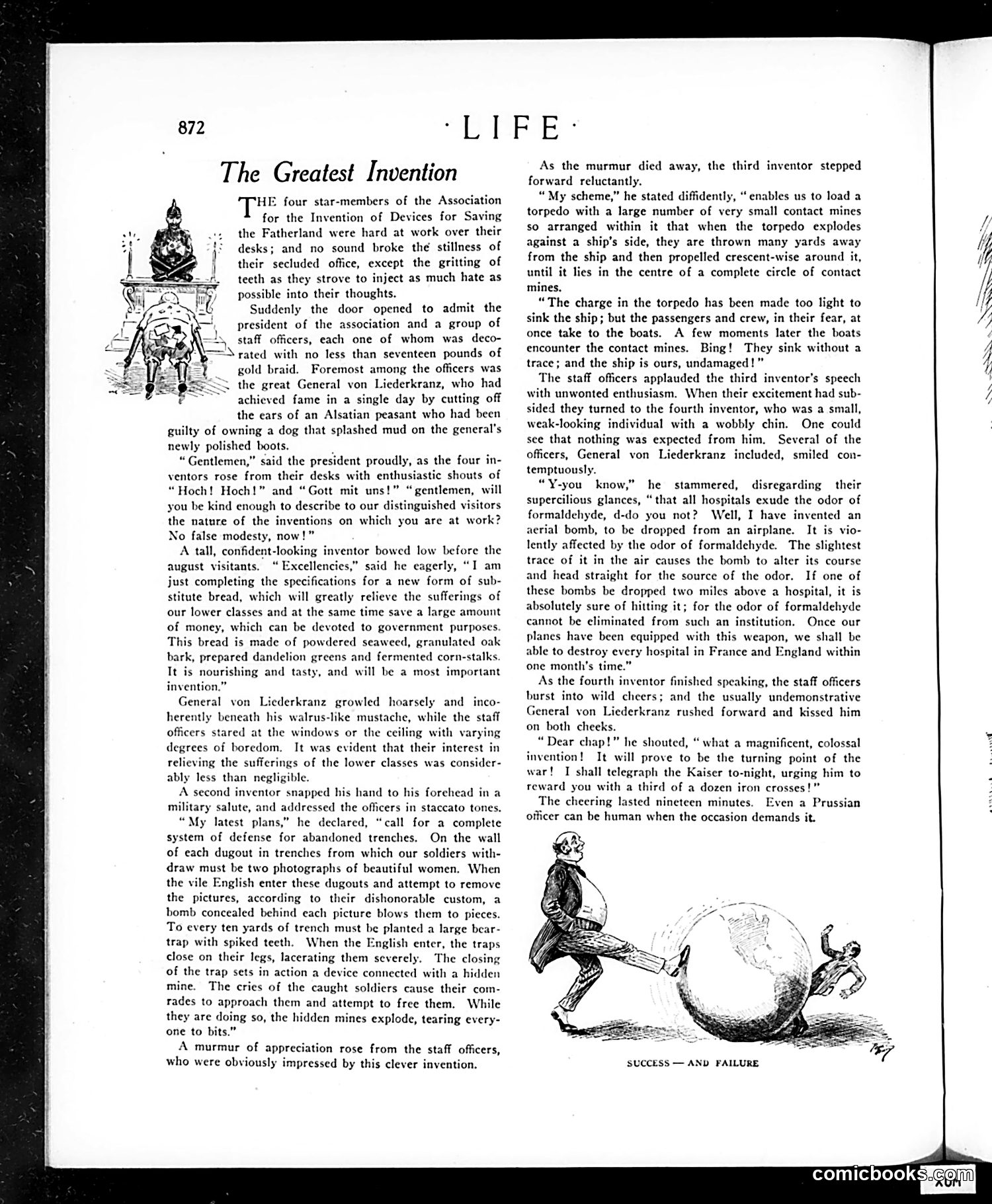
This is a satirical story mocking German military leadership during World War I. Four inventors present weapons to **General von Liederkranz** and other decorated German staff officers. The satire works through contrast: the inventors propose increasingly absurd and morally questionable "innovations"—substitute bread made from seaweed and bark (betraying contempt for the lower classes), booby-trapped trenches using photographs of women as bait, and deliberately weakened torpedoes designed to terrify rather than kill. The joke: the officers show complete indifference to humanitarian concerns (relieving suffering) but enthusiasm only for weapons causing maximum cruelty and psychological terror. The caption "SUCCESS—AND FAILURE" (visible in the illustration) suggests the bitter irony that German ingenuity produces weapons, not solutions. This reflects American wartime attitudes portraying Germans as militaristic, cruel, and morally bankrupt—a propaganda piece designed to reinforce anti-German sentiment among American readers.
📄 Transcribed text from this page (OCR, searchable)
Machine-transcribed from the original scan — historical spelling and the odd misread are preserved.
“REE ° The Greatest Invention HE four star-members of the Association for the Invention of Devices for Saving the Fatherland were hard at work over their desks; and no sound broke the stillness of their secluded office, except the gritting of teeth as they strove to inject as much hate as possible into their thoughts. Suddenly the door opened to admit the president of the association and a group of staff officers, each one of whom was deco- rated with no less than seventeen pounds of gold braid. Foremost among the officers was the great General von Liederkranz, who had achieved fame in a single day by cutting off the ears of an Alsatian peasant who had been guilty of owning a dog that splashed mud on the general's newly polished boots. . “Gentlemen,” said the president proudly, as the four in- ventors rose from their desks with enthusiastic shouts of “Hoch! Hoch!” and “Gott mit uns!” “gentlemen, will you be kind enough to describe to our distinguished visitors the nature of the inventions on which you are at work? No false modesty, now!” A tall, confident-looking inventor bowed low before the august visitants. “Excellencies,” said he eagerly, “I am just completing the specifications for a new form of sub- stitute bread, which will greatly relieve the sufferings of our lower classes and at the same time save a large amount of money, which can be devoted to government purposes. This bread is made of powdered seaweed, granulated bark, prepared dandelion greens and fermented corn-stalks. It is nourishing and tasty, and will be a most important invention.” General von Licderkranz growled hoarsely and inco- herently beneath his walrus-like mustache, while the staff officers stared at the windows or the ceiling with varying degrees of boredom. It was evident that their interest in relieving the sufferings of the lower classes was consider- ably less than negligible. A second inventor snapped his hand to his forehead in a military salute, and addressed the officers in staccato tones. “My latest plans,” he declared, “call for a complete system of defense for abandoned trenches. On the wall of each dugout in trenches from which our soldiers with- draw must be two photographs of beautiful women. When the vile English enter these dugouts and attempt to remove the pictures, according to their dishonorable custom, a bomb concealed behind each picture blows them to pieces. To every ten yards of trench must be planted a large bear- trap with spiked teeth. When the English enter, the traps close on their legs, lacerating them severely. The closing of the trap sets in action a device connected with a hidden mine. The cries of the caught soldiers cause their com- rades to approach them and attempt to free them. While they are doing so, the hidden mines explode, tearing every- one to bit: A murmur of appreciation rose from the staff officers, who were obviously impressed by this clever invention. As the murmur died away, the third inventor stepped forward reluctantly. “My scheme,” he stated diffidently, “ enables us to load a torpedo with a large number of very small contact mines so arranged within it that when the torpedo explodes against a ship’s side, they are thrown many yards away from the ship and then propelled crescent-wise around it, until it lies in the centre of a complete circle of contact mines. “The charge in the torpedo has been made too light to sink the ship; but the passengers and crew, in their fear, at once take to the boats. A few moments later the boats encounter the contact mines. Bing! They sink without a trace; and the ship is ours, undamaged!” The staff officers applauded the third inventor's speech with unwonted enthusiasm. When their excitement had sub- sided they turned to the fourth inventor, who was a small, weak-looking individual with a wobbly chin. One could see that nothing was expected from him, Several of the officers, General von Liederkranz included, smiled con- temptuously. “Y-you know,” he stammered, disregarding — their supercilious glances, “that all hospitals exude the odor of formaldehyde, d-do you not? Well, I have invented an aerial bomb, to be dropped from an airplane. It is vio- lently affected by the odor of formaldehyde. The slightest trace of it in the air causes the bomb to alter its course and head straight for the source of the odor. If one of these bombs be dropped two miles above a hospital, it is absolutely sure of hitting it; for the odor of formaldehyde cannot be eliminated from such an institution. Once our planes have been equipped with this weapon, we shall be able to destroy every hospital in France and England within one month's time. As the fourth inventor finished speaking, the staff officers burst into wild cheers; and the usually undemonstrative General von Liederkranz rushed forward and kissed him on both cheeks. “Dear chap!” he shouted, “what a magnificent, colossal invention! It will prove to be the turning point of the war! I shall telegraph the Kaiser to-night, urging him to reward you with a third of a dozen iron crosses!” The cheering lasted nineteen minutes. Even a Prussian officer can be human when the occasion demands it. SUCCESS — AND FAILURE comicbooksgeom|