
Life, 1917-11-29 · page 8 of 40
Life — November 29, 1917 — page 8: what you’re looking at
What you’re looking at
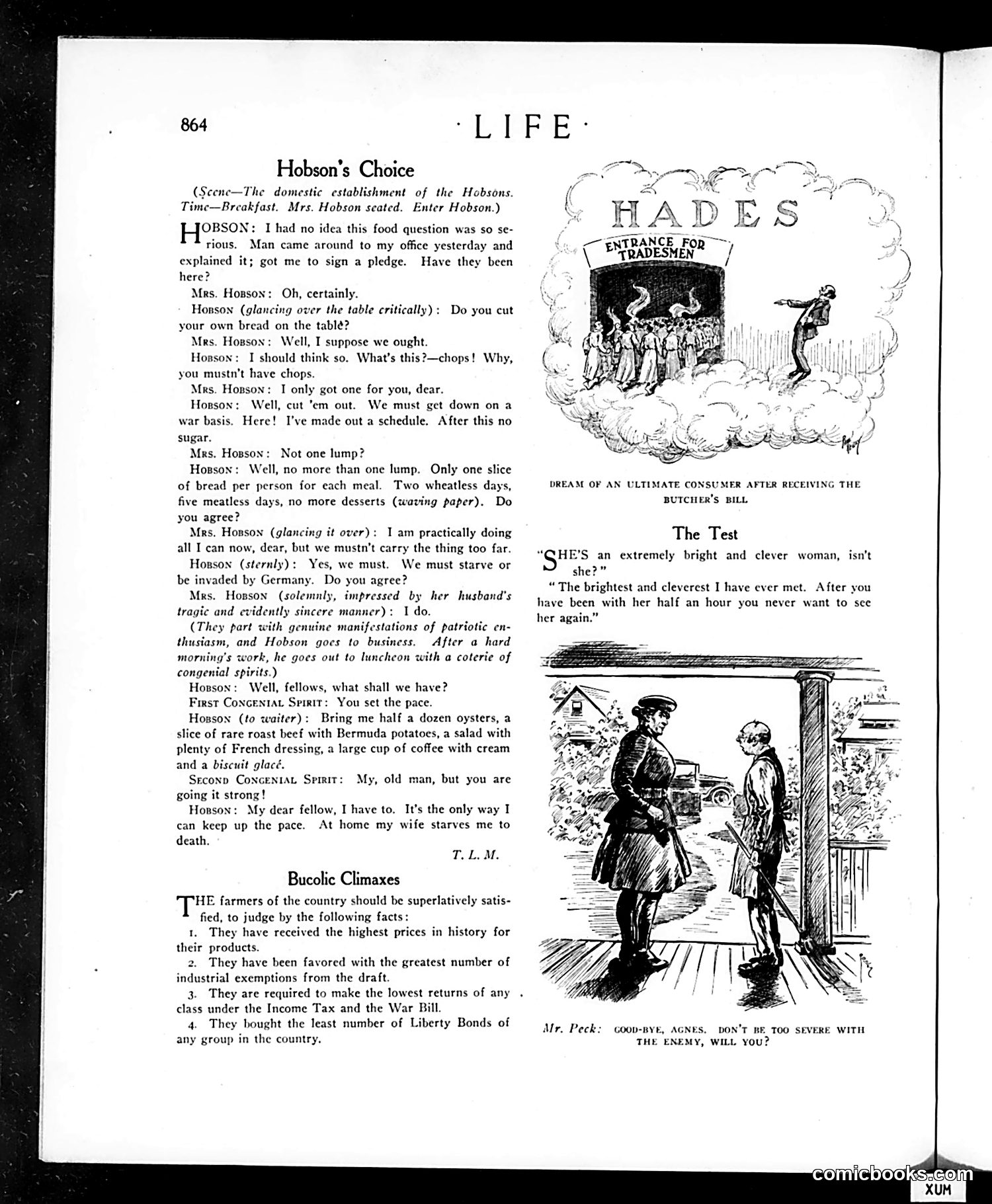
This page contains wartime satire about food rationing and sacrifice during what appears to be WWI (based on references to draft exemptions and Liberty Bonds). **"Hobson's Choice"** depicts a domestic argument where Mr. Hobson presents his wife with extreme rationing: one chop, minimal bread, no desserts, five meatless days. He justifies starvation as patriotic duty to avoid German invasion. The satire mocks both strict home rationing policies and husbands using patriotism to justify deprivation. **"The Test"** and accompanying sketch appear to critique class disparities—one illustration shows a well-dressed woman with a car, contrasting with rationing rhetoric. **"Bucolic Climaxes"** sarcastically praises farmers' wartime benefits: high prices, draft exemptions, low taxes, and bond purchases—suggesting farmers profited while civilians starved, exposing hypocrisy in "shared sacrifice."
📄 Transcribed text from this page (OCR, searchable)
Machine-transcribed from the original scan — historical spelling and the odd misread are preserved.
864 Hobson’s Choice (Scene—The domestic establishment of the Hobsons. Time—Breakfast. Mrs. Hobson seated. Enter Hobson.) OBSON: I had no idea this food question was so se- Man came around to my office yesterday and Have they been rious. explained it; got me to sign a pledge. here? Mrs. Hosson: Oh, certainly. Honson (glancing over the table critically) : your own bread on the tablé? Mrs. Hosson: Well, I suppose we ought. Hosson: I should think so. What's this?—chops! Why, you mustn’t have chops. Mrs. Hopson: I only got one for you, dear. Horson: Well, cut ‘em out. We must get down on a Here! I've made out a schedule, After this no Do you cut war basis. sugar. Mrs. Hopson: Not one lump? Hosson: Well, no more than one lump. Only one slice of bread per person for each meal. Two wheatless days, five meatless days, no more desserts (waving paper). Do you agree? Mrs. Hosson (glancing it over): I am practically doing all I can now, dear, but we mustn't carry the thing too far. Horson (sternly): Yes, we must. We must starve or be invaded by Germany. Do you agree? Mrs. Hosson (solemnly, impressed by her husband's tragic and evidently sincere manner): 1 do. (They part with genuine manifestations of patriotic en- thusiasm, and Hobson goes to business. After a hard morning's work, he goes out to luncheon with a coterie of congenial spirits.) Hosso: Well, fellows, what shall we have? First Concentat Spirit: You set the pace. Hosson (to waiter): Bring me half a dozen oysters, a slice of rare roast beef with Bermuda potatoes, a salad with plenty of French dressing, a large cup of coffee with cream and a biscuit glacé. Seconp ConceNiAL Spirit: going it strong! Honson: My dear fellow, I have to. It's the only way I can keep up the pace. At home my wife starves me to death. My, old man, but you are T.L. M. Bucolic Climaxes HE farmers of the country should be superlatively satis- fied, to judge by the following facts: 1. They have received the highest prices in history for their products. 2. They have been favored with the greatest number of industrial exemptions from the draft. 3. They are required to make the lowest returns of any class under the Income Tax and the War Bill. 4. They bought the least number of Liberty Bonds of any group in the country, “IL TEPAE * “ —— ENTRANCE Fon ~~ ENTRADESMEN / DREAM OF AN ULTIMATE CONSUMER AFTER RECEIVING THE BUTCHER'S BILL The Test “QHE’S an extremely bright and clever woman, isn’t she?” “The brightest and cleverest I have ever met. After you have been with her half an hour you never want to sce her again.” Mr. Peck: Goov-Byt, AGNES, DON’T RE_TOO SEVERE WITH THE ENEMY, WILL You?