
A complete issue · 38 pages · 1917
Life — November 1, 1917
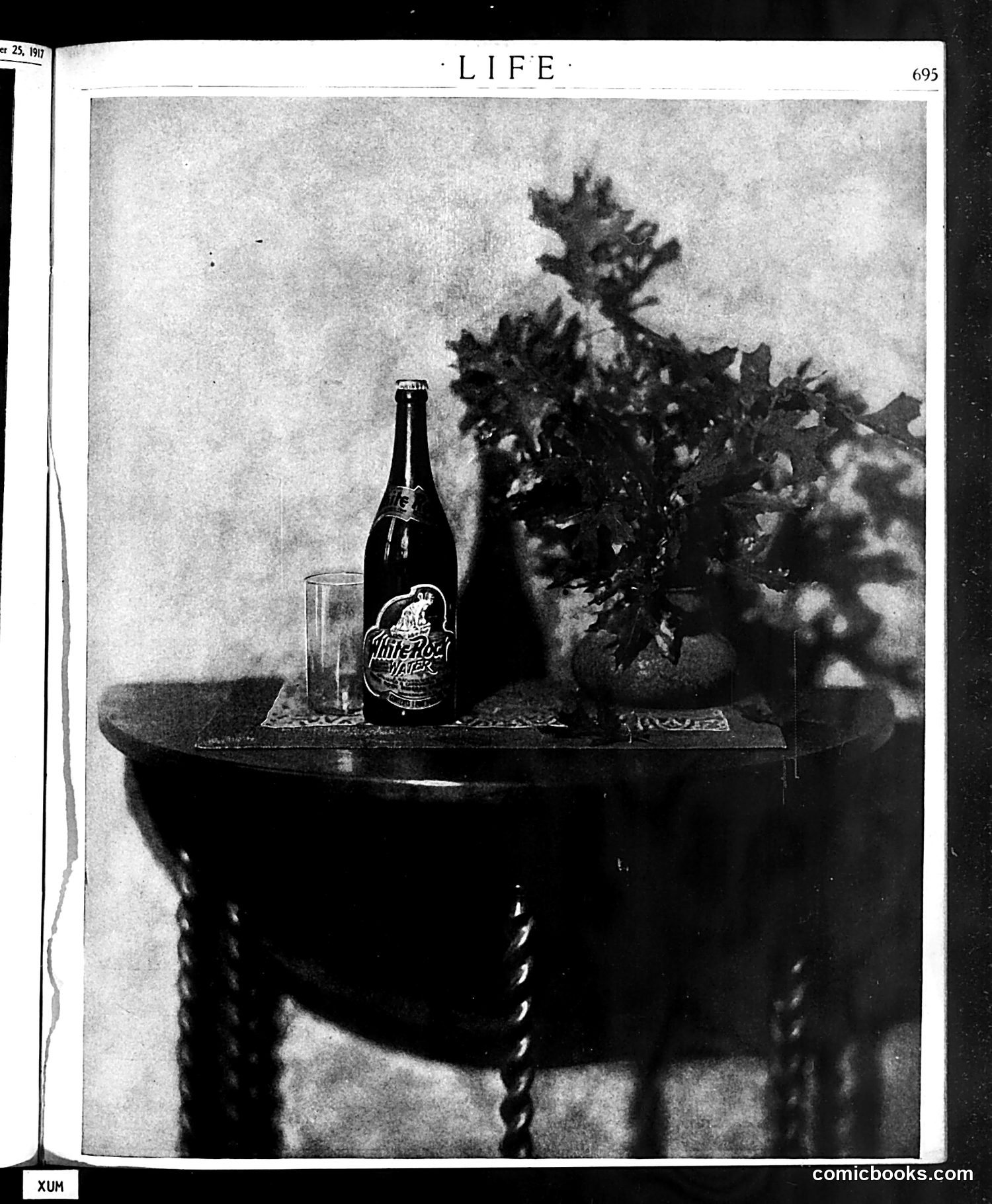
This appears to be a **product advertisement** rather than political satire. The image shows a still-life composition featuring a beer bottle (with a visible label), an empty glass, and a decorative potted plant on what appears to be a dark wooden table. The page is from LIFE magazine (page 695), but without clearly readable OCR text or visible caption, I cannot definitively identify the specific beer brand or the advertisement's messaging. The black-and-white photography suggests this is from the early-to-mid 20th century. This is a commercial advertisement promoting beer consumption, using tasteful product display photography typical of vintage magazine advertising—not political or social commentary.
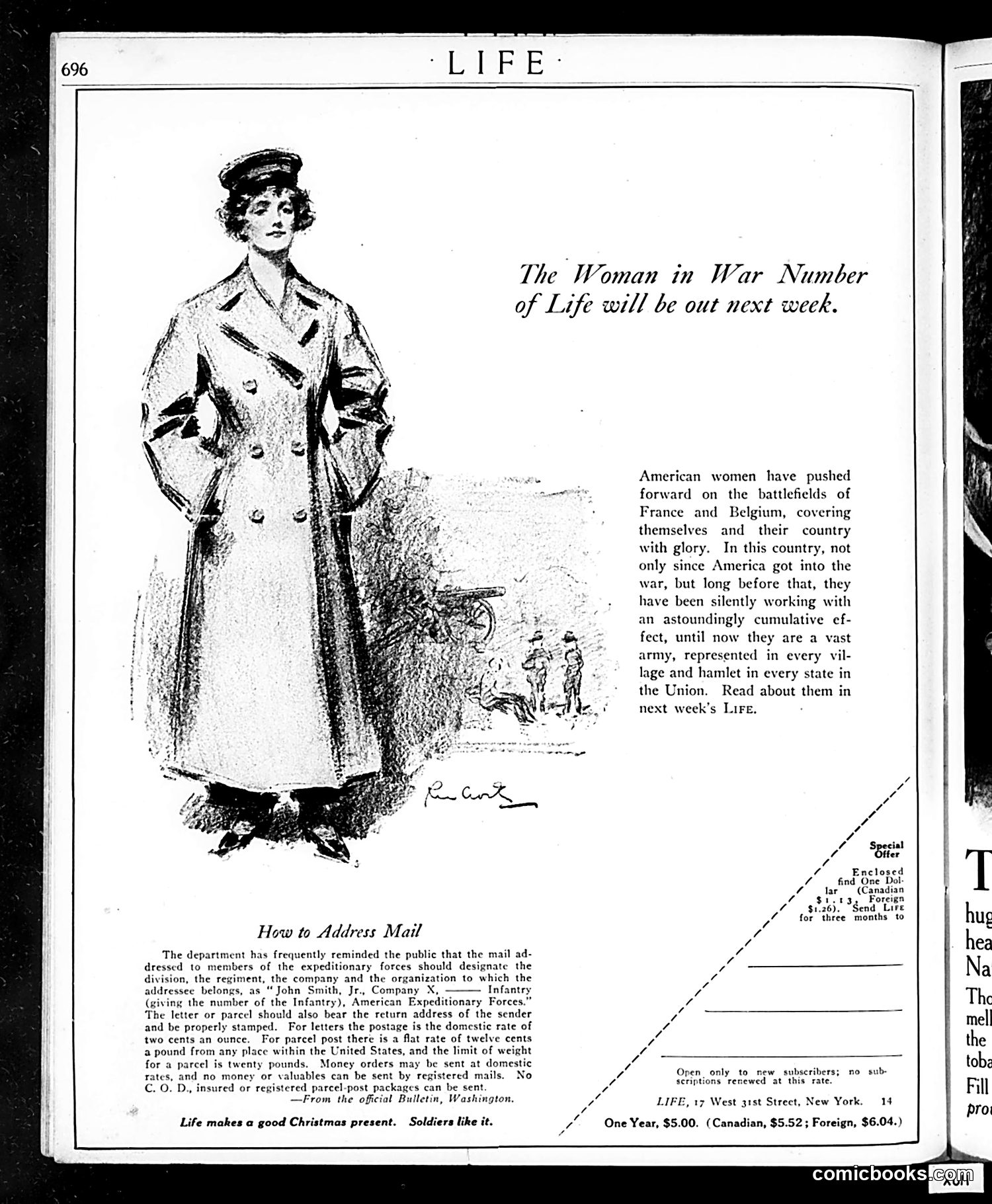
This page primarily advertises Life magazine's upcoming "Woman in War Number," promoting next week's special issue. The illustration shows a woman in military-style uniform and cap, standing authoritatively while soldiers work in the background—visually representing American women's expanding roles in World War I support efforts. The accompanying text celebrates American women's contributions to the war effort in France and Belgium, describing their work as having "astonishing cumulative effect." It notes women are now represented "in every village and hamlet in every state in the Union." The page also includes practical postal information for addressing mail to soldiers overseas. This is primarily promotional content rather than satirical commentary—reflecting genuine wartime messaging about women's patriotic mobilization during WWI.
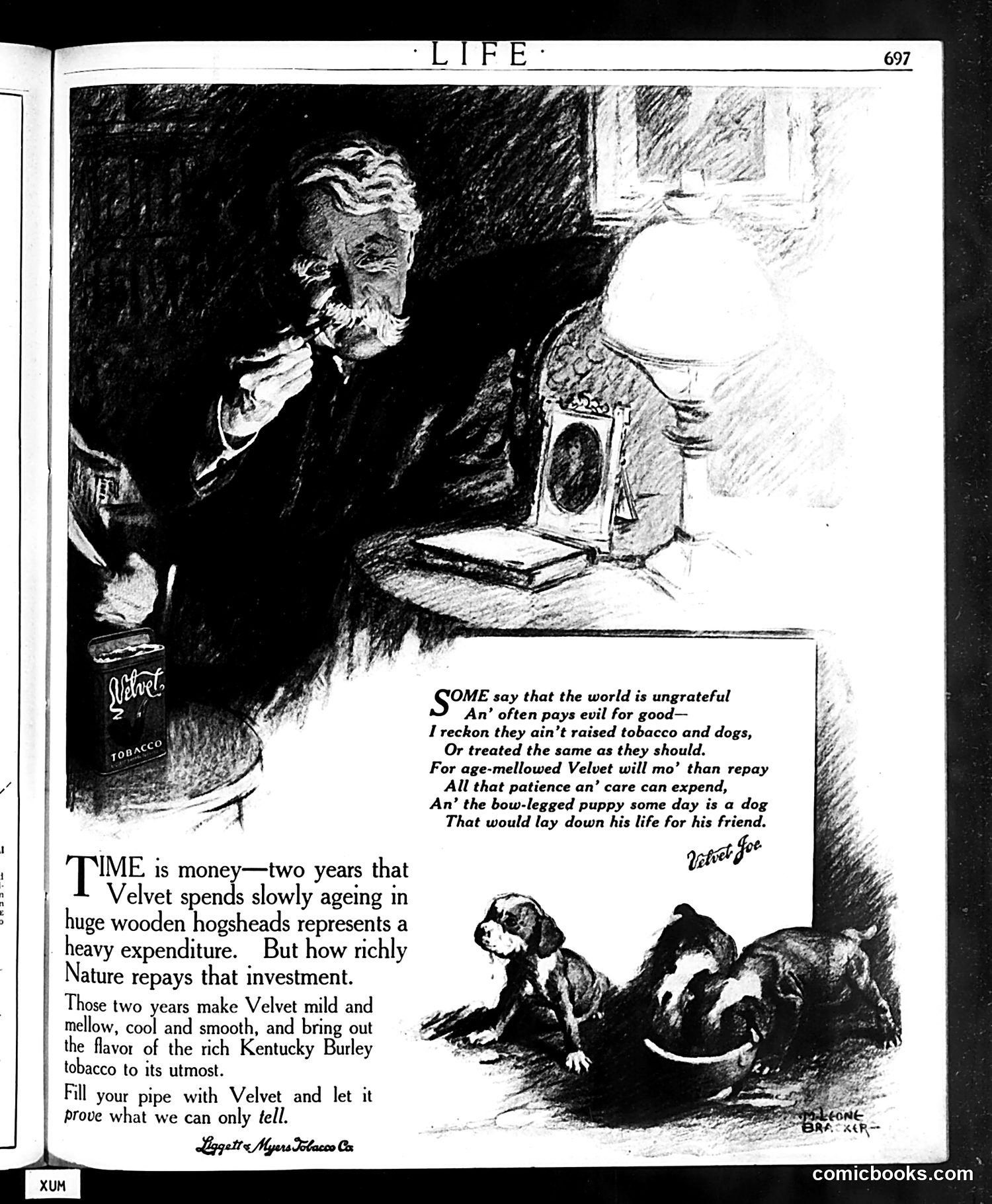
This is primarily a **tobacco advertisement** for Velvet pipe tobacco, not political satire. The page features two illustrated scenes: 1. **Top illustration**: An elderly bearded man (likely representing a satisfied customer) examining a package of Velvet tobacco by lamplight. 2. **Bottom illustration**: Two hunting dogs resting, accompanying a poem attributed to "Velvet Joe" about loyalty and gratitude. The advertisement's central claim is that Velvet tobacco improves through two years of aging in wooden "hogsheads," becoming "mild and mellow" with Kentucky Burley tobacco flavor. The dog poem serves as emotional branding—associating the product with loyalty and patience, suggesting Velvet rewards those who appreciate quality. This reflects early 20th-century advertising that used sentiment and lifestyle imagery rather than direct product claims.
This is **not a cartoon or satire page**—it's a full-page advertisement for The Gorham Company, a New York silversmith and goldsmith manufacturer. The ad uses an appeal to classical authority, opening with a fabricated quote attributed to Aristotle about purchasing decisions. The rhetorical strategy argues that silverware is a sound investment because its benefits accumulate across generations, eventually far exceeding its initial cost. The ornate decorative border and formal layout mimic editorial content to blend seamlessly into the magazine. This is early 20th-century advertising designed to position luxury goods as economically rational purchases rather than mere indulgences—targeting affluent readers of *Life* magazine. There is no political satire present on this page.
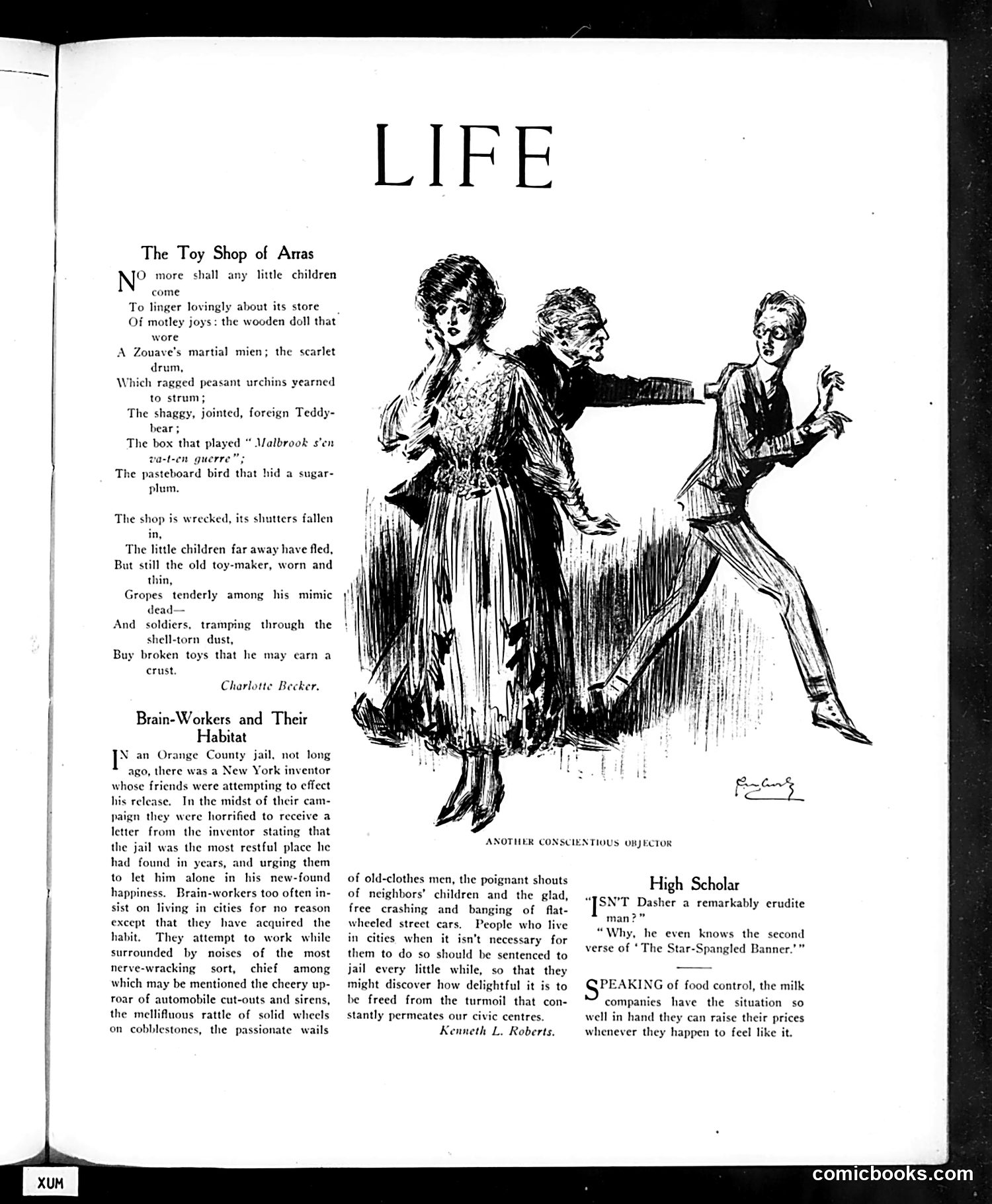
This page contains three distinct pieces of social commentary: 1. **"The Toy Shop of Arras"** (Charlotte Becker poem): A melancholic piece about a destroyed toy shop during wartime, with an elderly toy-maker salvaging broken toys amid soldiers and destruction. References WWI damage to the French town of Arras. 2. **"Brain-Workers and Their Habitat"** (Kenneth L. Roberts): Satirizes urban professionals forced to work amid constant noise pollution—automobile sirens, street cars, and city chaos. The critique targets how modern city life undermines intellectual work through relentless acoustic assault. 3. **"High Scholar"**: A brief joke mocking an overly erudite person who knows obscure literary references ("The Star-Spangled Banner's" second verse). The main illustration depicts a woman with two children, captioned "Another Conscientious Objector"—likely satirizing pacifist opposition to WWI.
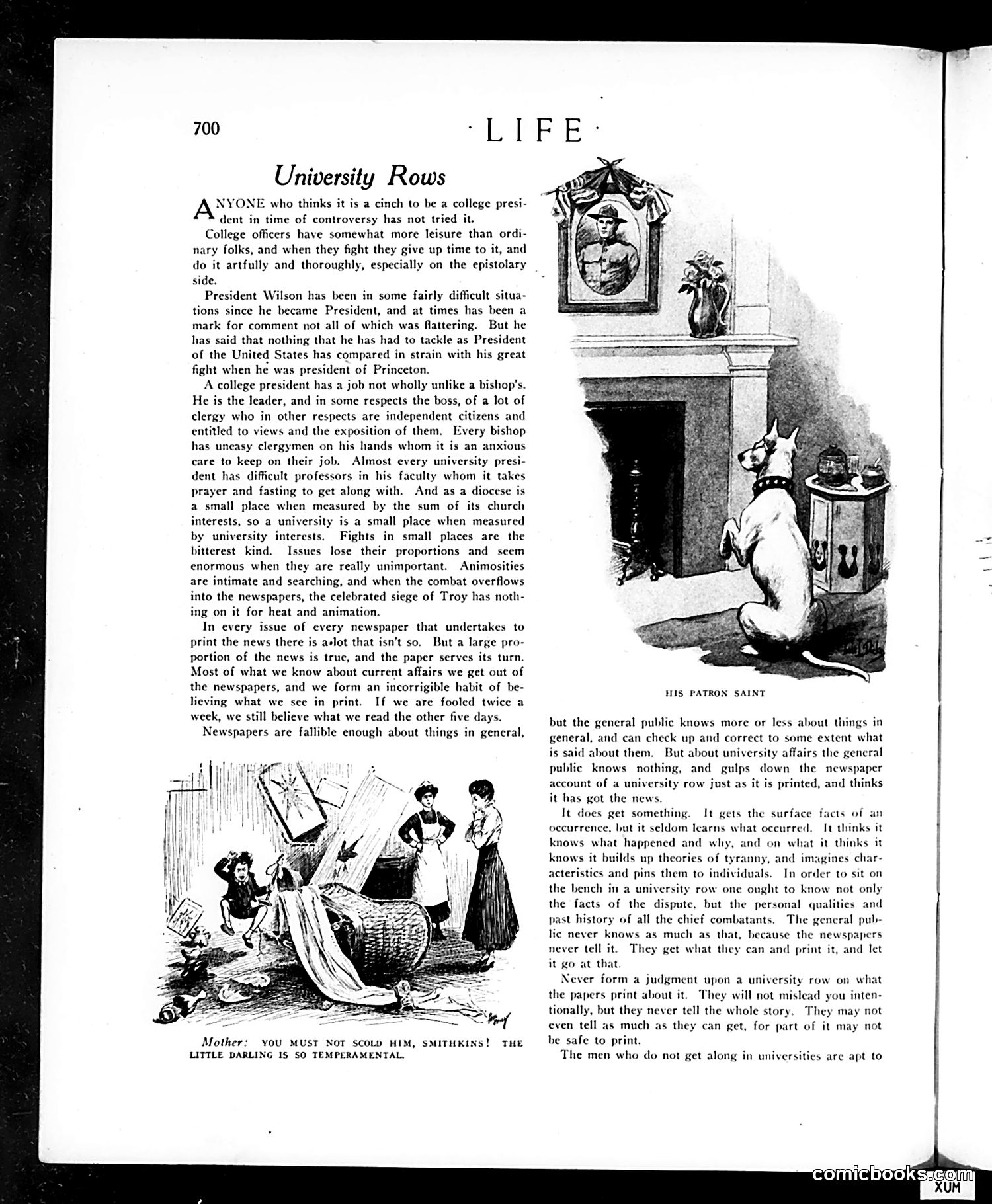
This article criticizes how newspapers cover university controversies, using President Wilson's tenure at Princeton as a reference point. The text argues that college disputes, while serious to those involved, become sensationalized in print and lose nuance. The two cartoons illustrate this theme: 1. **"His Patron Saint"** (top right): A dog worships at a shrine, likely satirizing blind devotion to authority figures in academic disputes. 2. **"Mother: You Must Not Scold Him, Smithkins!"** (bottom left): Shows a domestic scene where a child is protected from discipline, possibly suggesting universities coddle problematic figures rather than address issues directly. The satire suggests newspapers exaggerate academic conflicts while universities suppress facts, preventing public understanding of what actually occurs.
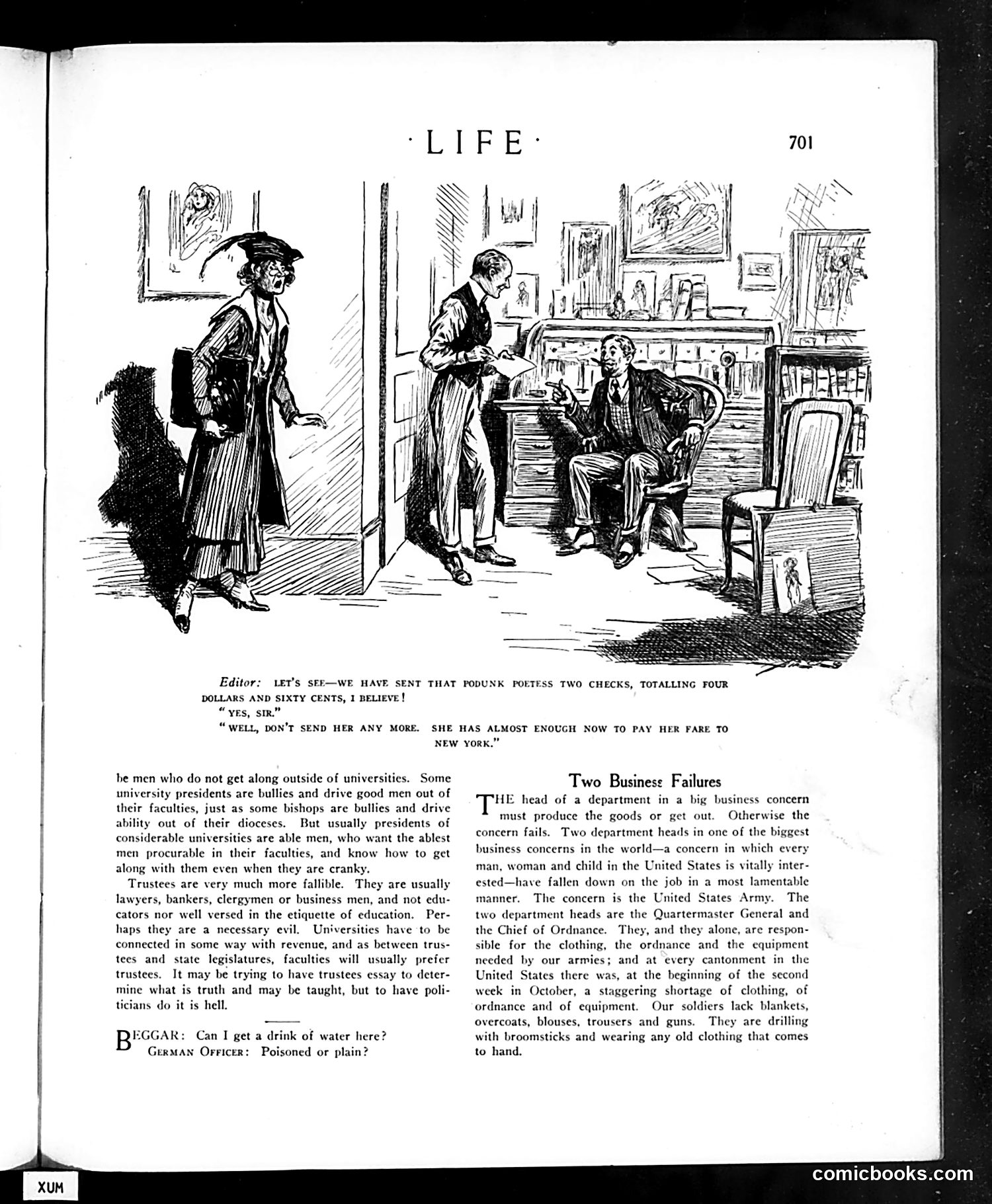
**The Cartoon:** Shows an editor informing someone that they've sent a "podunk poetess" two checks totaling $4.60, with a colleague suggesting they stop payments because "she has almost enough now to pay her fare to New York." **The Satire:** This mocks aspirational rural writers—small-town female poets seeking literary success in New York City. The dismissive term "podunk poetess" (podunk = a small, insignificant town) ridicules both the writer's humble origins and presumed limited talent. The joke hinges on the editor's cynicism: they've accidentally funded this woman's ambition to relocate to the literary capital, which they apparently view as undesirable. **Social Context:** Reflects early 20th-century class attitudes toward provincial Americans and gatekeeping in literary publishing circles.
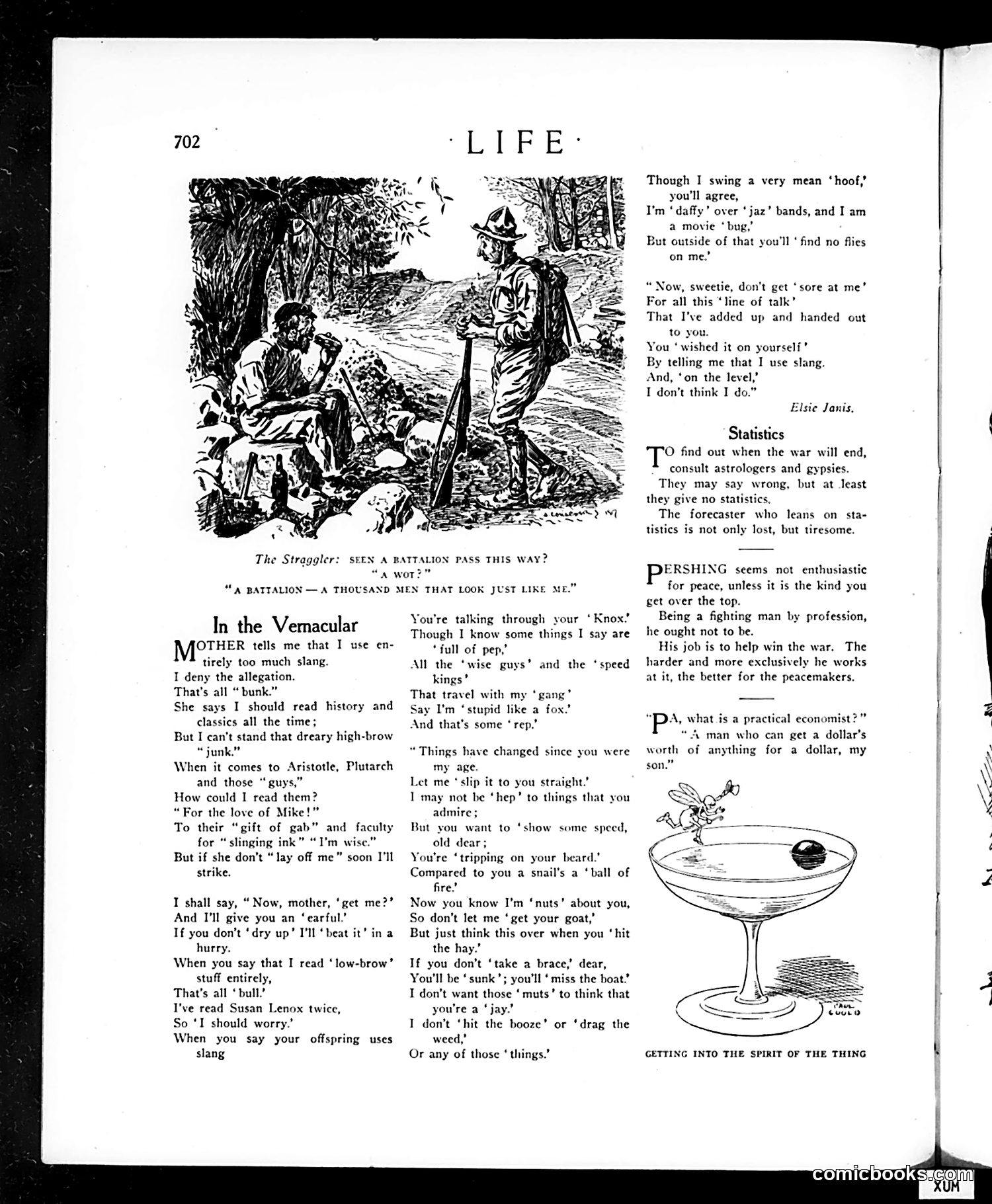
This page contains three distinct pieces of WWI-era satirical content: 1. **The Straggler illustration**: Shows soldiers encountering a tired, disheveled soldier asking if a battalion passed by. The caption jokes that the battalion consists of "a thousand men that look just like me"—satirizing the exhaustion and depleted state of soldiers. 2. **"In the Vernacular"**: A poem mocking how mothers defend their sons' use of slang and military language, contrasting "high-brow" literary standards with practical soldier speak. It pokes fun at generational and class-based attitudes toward language. 3. **"Statistics" and other brief pieces**: Short satirical quips about wartime forecasts, pacifism, and economics—suggesting skepticism toward predictions and idealistic peace proposals during active warfare. The overall tone critiques both military conditions and civilian attitudes toward war.
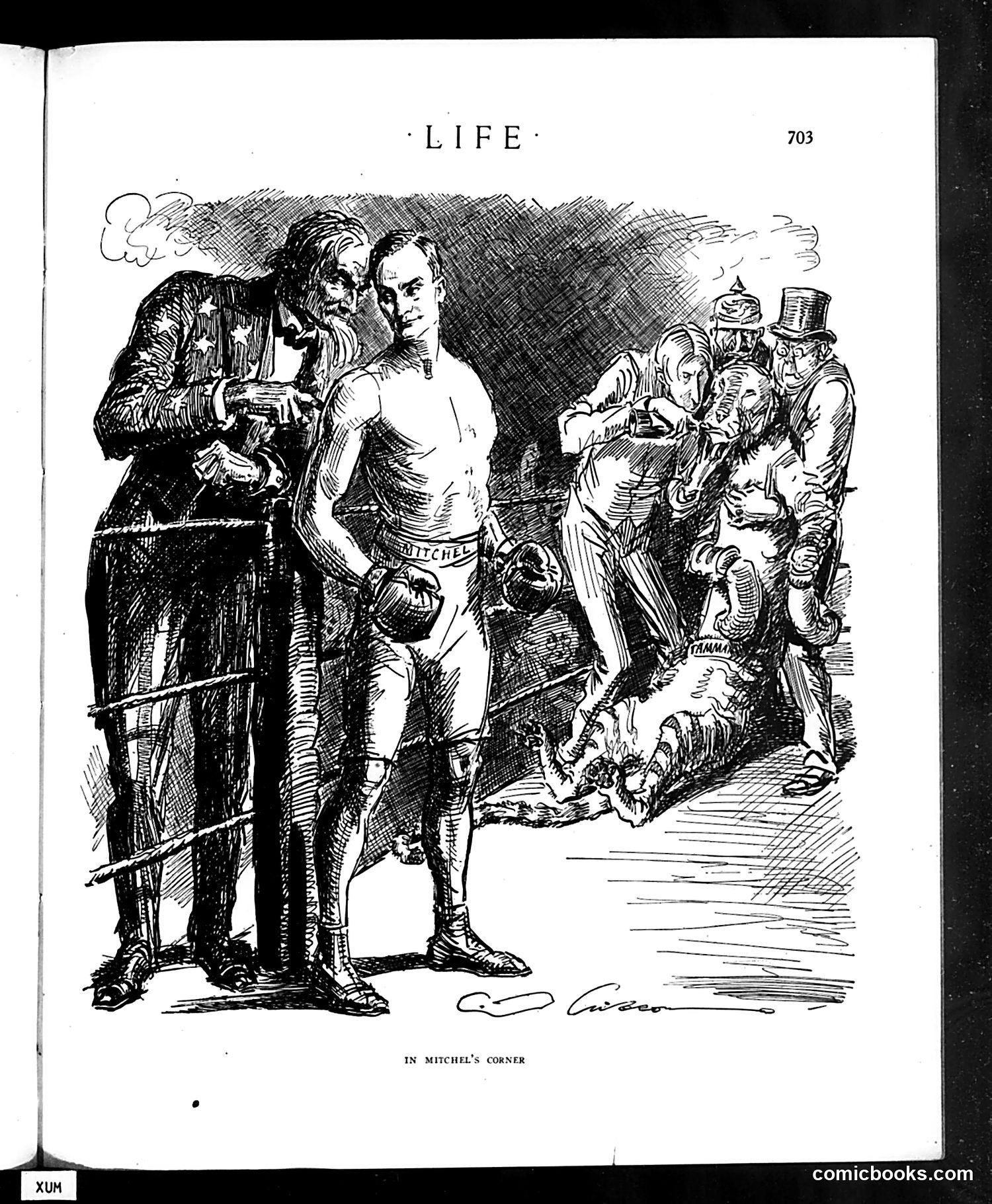
This satirical cartoon depicts what appears to be a medical or scientific examination scene. A nearly-nude male subject stands center while an older, bearded authority figure (likely a doctor or scientist) examines him with instruments. A group of well-dressed observers—including men in top hats and formal wear—watches from the right, suggesting official scrutiny or public interest in the subject's condition. The title "In Mitchell's Corner" indicates this references a specific person or place, likely a medical establishment. The cartoon satirizes either medical practice, scientific examination of human subjects, or possibly social/political inspection of an individual. The formal attire of observers suggests institutional or governmental involvement, though the specific historical context remains unclear without additional information about who "Mitchell" was.
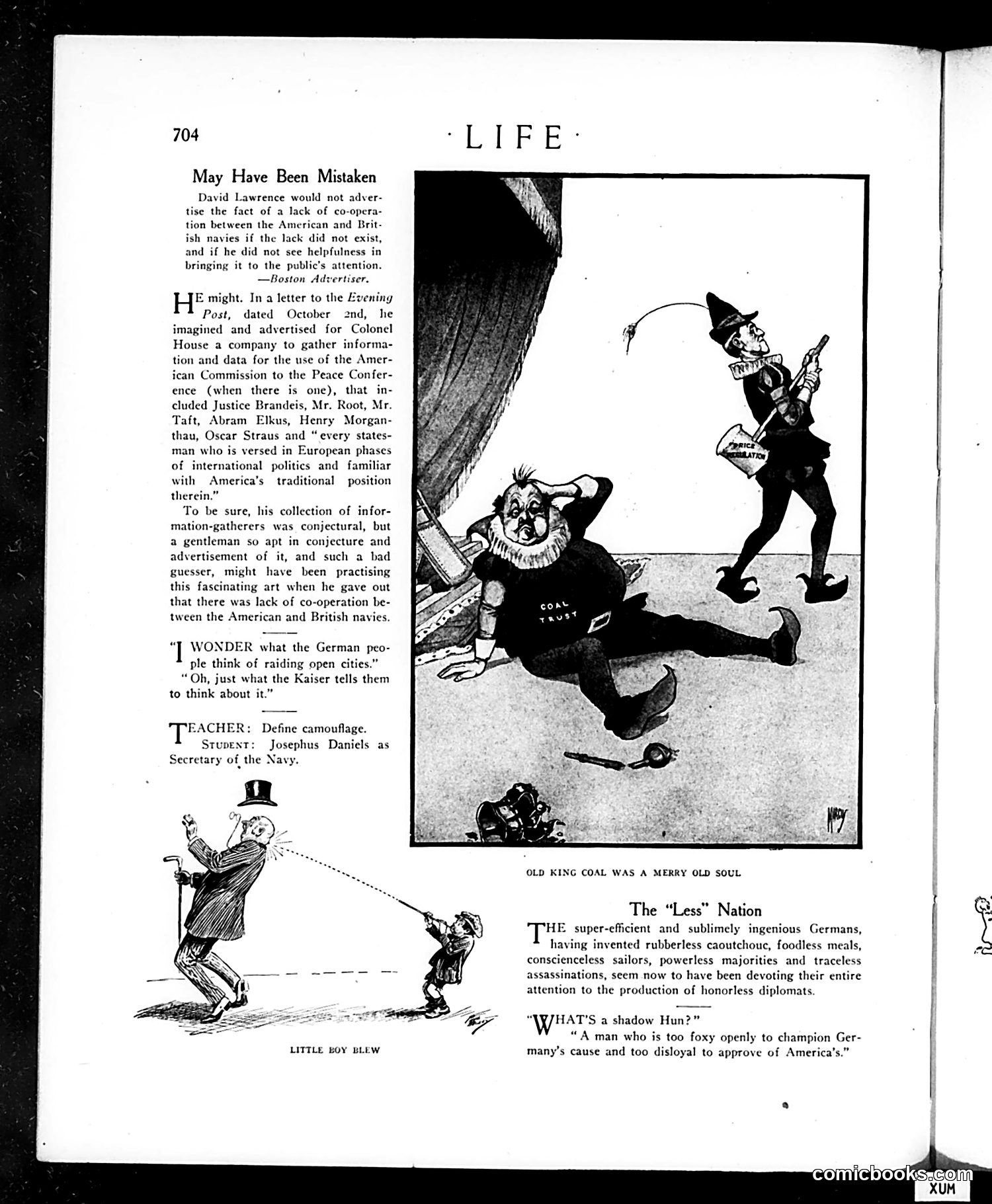
This page from *Life* magazine satirizes World War I diplomacy and German conduct. The large cartoon titled "Old King Coal Was a Merry Old Soul" depicts a bloated figure labeled "Coal Trust" being kicked by two caricatured figures (likely representing British and American interests), suggesting criticism of profiteering during wartime. The text "May Have Been Mistaken" discusses David Lawrence's proposal for an American-British naval commission, questioning whether lack of cooperation between the navies actually existed. The smaller cartoon "Little Boy Blew" uses nursery rhyme imagery to mock Germany's military aggression. The section "The 'Less' Nation" sarcastically praises Germany's innovations in ruthlessness—rubber-less goods, footless assassins, conscience-less sailors—mocking German wartime practices and atrocities.
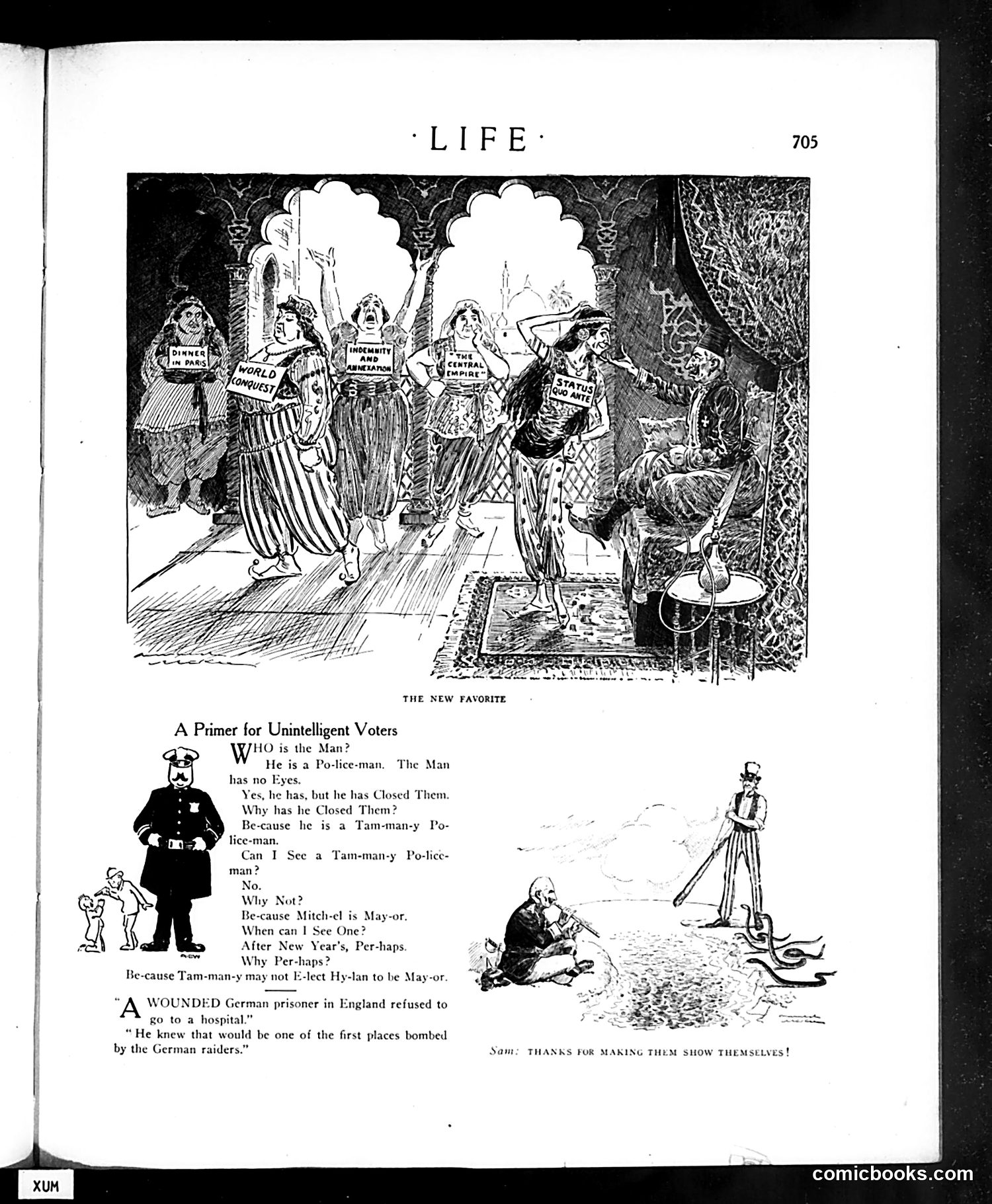
**Top Cartoon ("The New Favorite"):** A satirical scene showing several women holding signs labeled with political/social causes ("Immunity," "Suffrage," "Central Empire," etc.) presenting themselves to an enthroned figure on the right. The satire appears to mock how various political movements or special interests compete for favor and attention from those in power, depicted here as a detached authority figure. **Bottom Content ("A Primer for Unintelligent Voters"):** A deliberately simplistic, condescending "educational" piece using childlike language and illustrations about a policeman ("Po-lice-man"). It satirizes voter ignorance or the patronizing political discourse of the era. **Bottom Right Cartoon:** Shows a figure displaying dead snakes with the caption "Thanks for making them show themselves!" — likely satirizing how public disclosure or debate exposes problematic figures or positions.
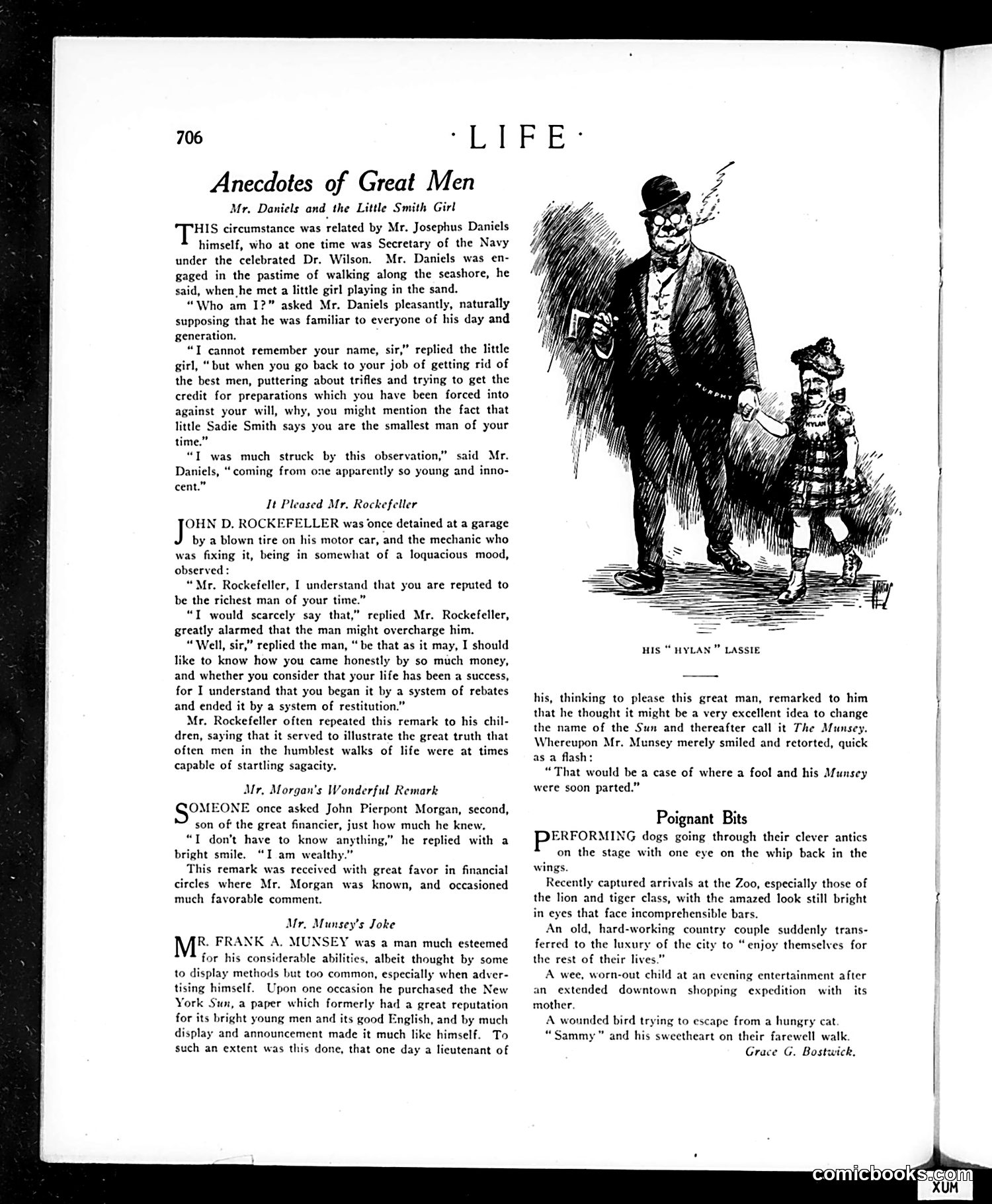
This page contains **anecdotes about prominent men** rather than political cartoons. The illustration shows a well-dressed gentleman with a small child labeled "HIS 'HYLAN' LASSIE"—likely referring to **Mayor John F. Hylan** of New York (evident from the child's nickname). The anecdotes mock wealthy figures: - **Mr. Daniels** (Navy Secretary under Dr. Wilson) is humorously corrected by a child about his importance - **John D. Rockefeller** is questioned about being the richest man, emphasizing luck over merit - **J.P. Morgan Jr.** claims ignorance about finances with false modesty - **Frank Munsey** is satirized for his self-promotion via newspaper ownership The humor targets wealthy industrialists' pretensions and self-aggrandizement through contrasting their claims with reality—a common Progressive Era satirical theme.
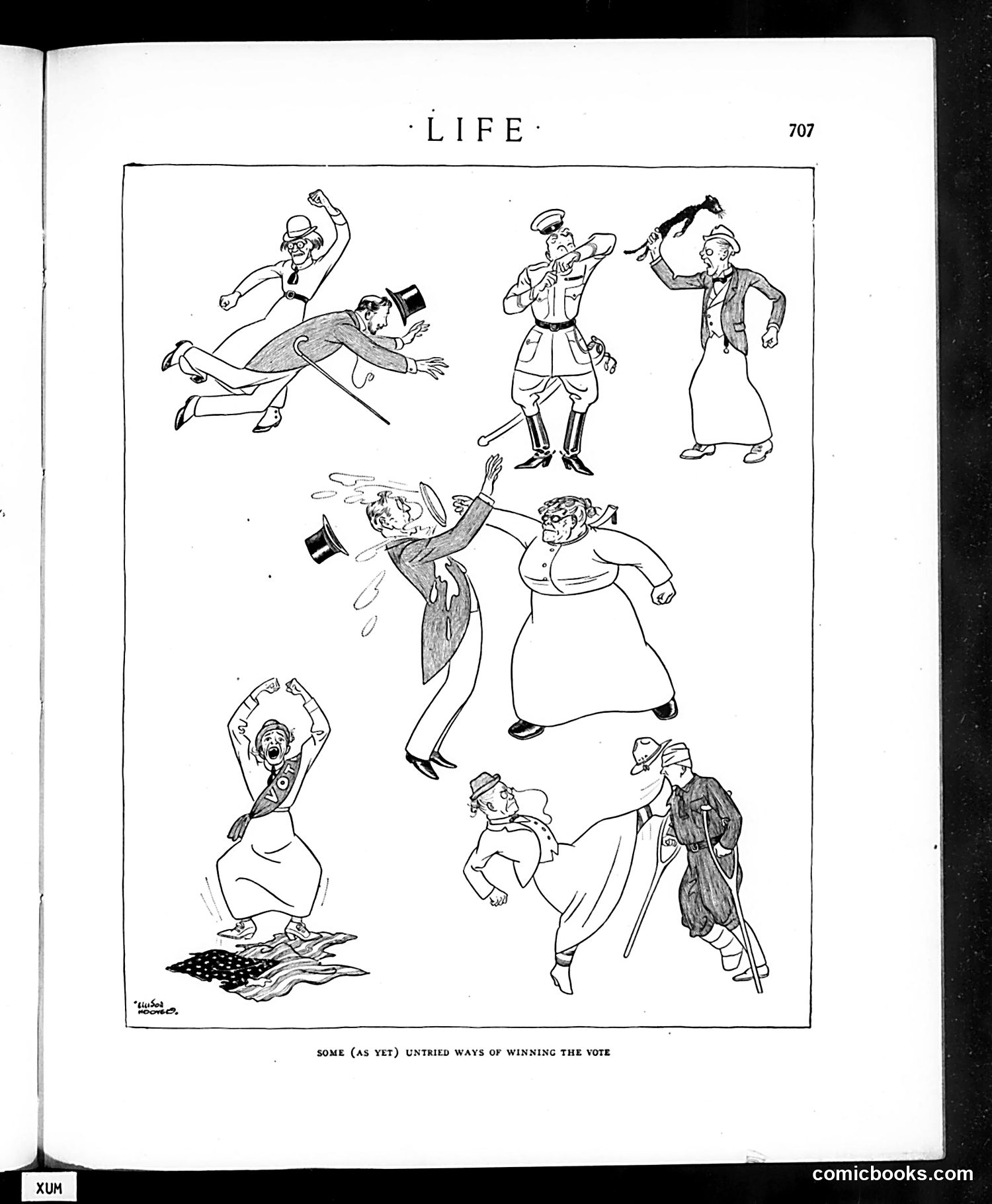
This Life magazine cartoon satirizes voter manipulation tactics. The caption reads "SOME (AS YET) UNTRIED WAYS OF WINNING THE VOTE," suggesting these are hypothetical (but pointed) methods politicians might use. The illustrations depict various underhanded campaign strategies: figures are shown literally knocking people over, using violence and intimidation, bribing with money, physically dragging voters, and other aggressive coercion tactics. One figure appears to be drowning someone while holding their ballot. The satire critiques electoral corruption and voter suppression by exaggerating these practices to absurd, violent extremes. This appears to reference actual voting irregularities of the early-to-mid 20th century—ballot stuffing, intimidation, and fraud—through humorous but scathing visual commentary on how far some politicians would go to win elections.
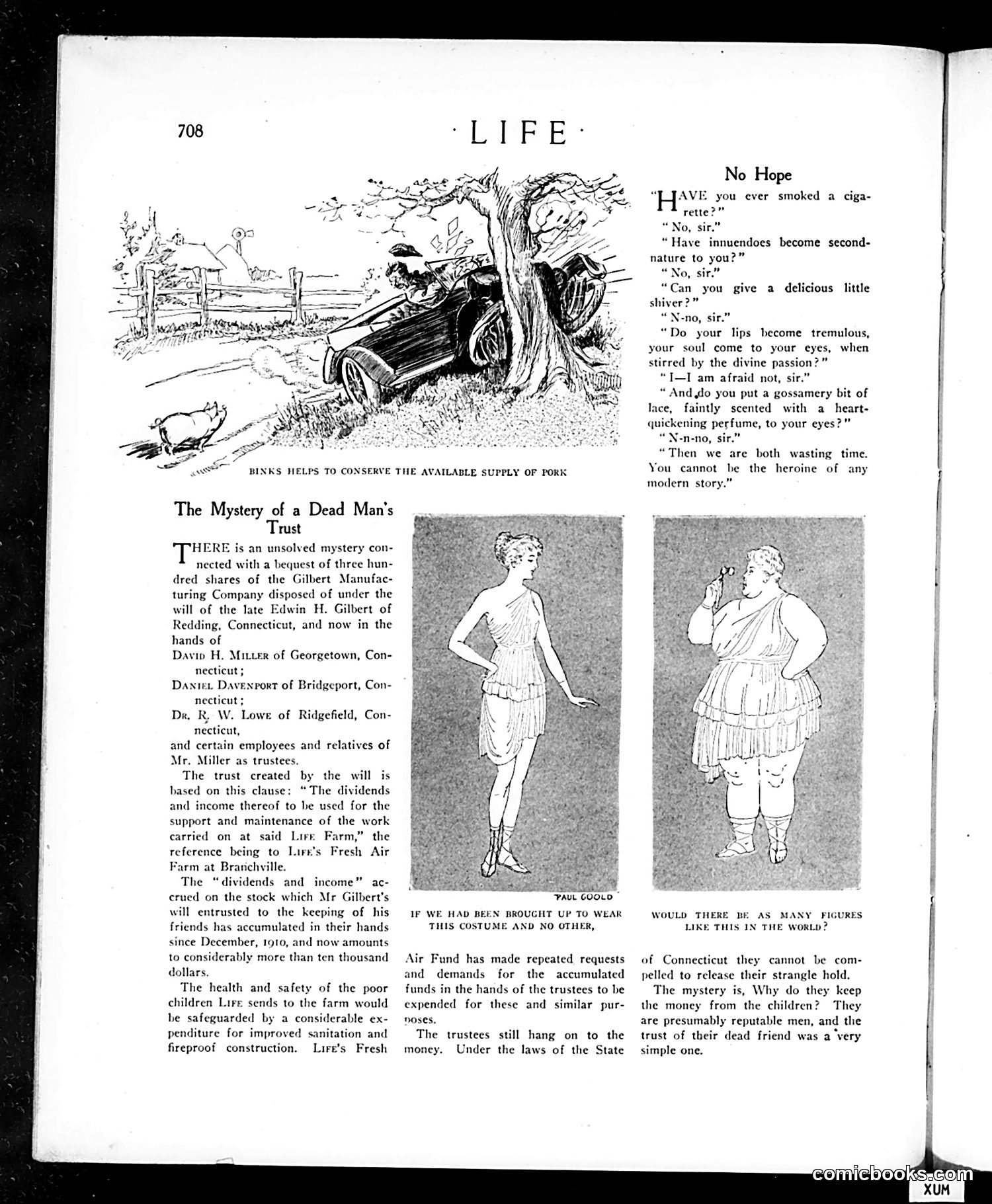
**Top Section ("No Hope"):** A satirical dialogue between two men. One asks the other increasingly suggestive questions—about smoking, "delicious little favors," perfume—all of which the other man prudishly refuses. The joke mocks Victorian-era sexual prudishness and the impossibility of romantic/seductive interaction when one party refuses all conventional flirtation. **Bottom Section ("The Mystery of a Dead Man's Trust"):** Discusses an unsolved legal matter involving a bequest of 300 shares from a deceased Connecticut manufacturer (Gilbert of Redding). Three trustees control accumulated dividends intended for Lir's Fresh Air Farm charity. The mystery: why do the trustees withhold substantial funds ($10,000+) meant for poor children's welfare? The satire implies the trustees' motives are questionable. **Fashion illustrations:** Two women in period dress, apparently unrelated commentary.
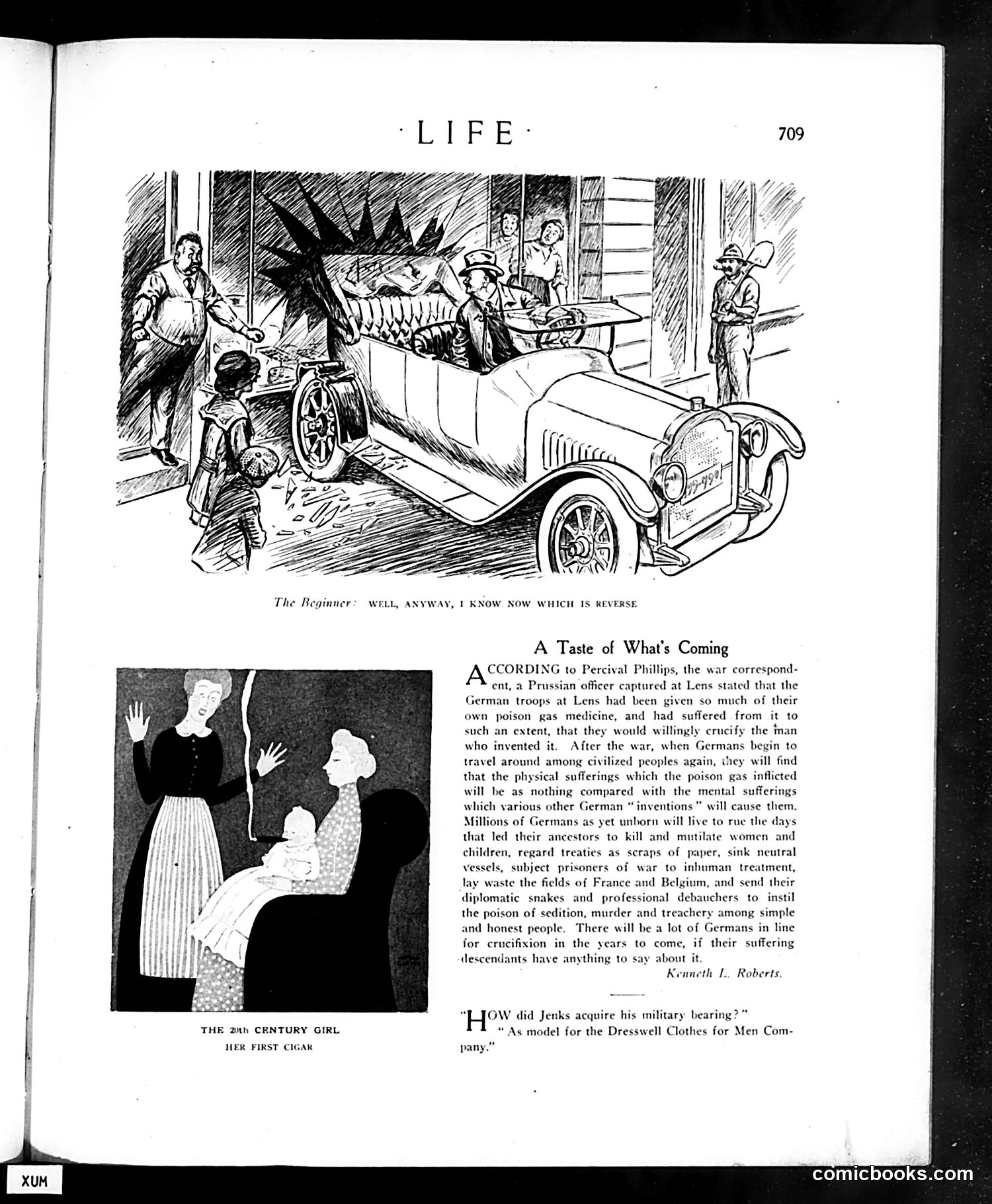
**Top Cartoon: "The Beginner"** Shows a novice driver causing chaos—a car has crashed into a building, destroying a statue of Liberty. The caption reads "Well, anyway, I know now which is reverse," mocking new drivers who don't understand basic car mechanics. **Article: "A Taste of What's Coming"** Kenneth L. Roberts warns of post-WWI German resentment. He predicts Germans will blame their ancestors for the war's suffering, and their descendants will later seek revenge on nations that defeated them—a prescient warning about future German grievance and potential conflict. **Bottom Image: "The 20th Century Girl—Her First Cigar"** Satirizes modern women's newfound freedoms (smoking, independence). The silhouetted woman lighting a cigarette represents changing social norms regarding female behavior.
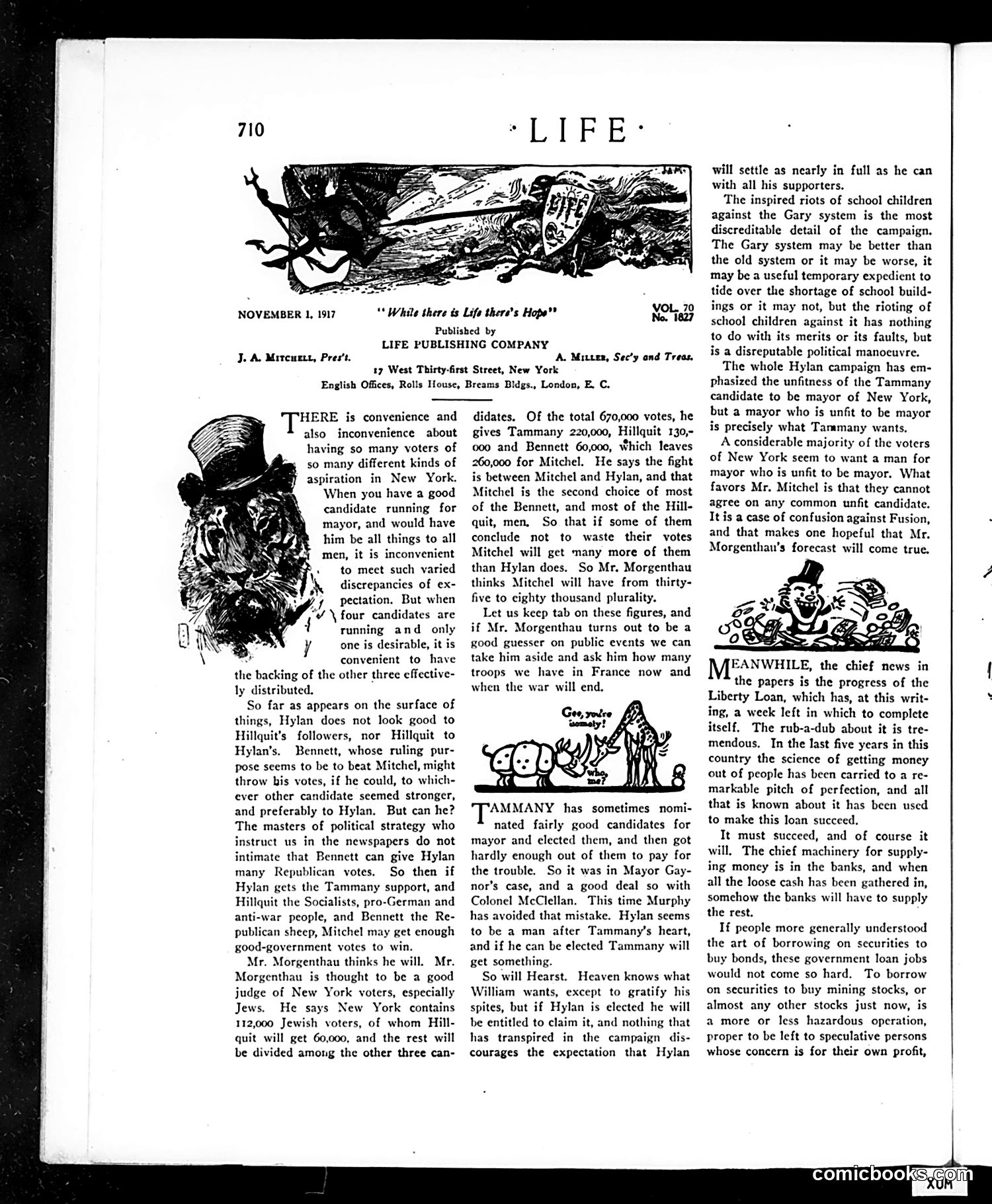
This page analyzes New York City's 1917 mayoral race featuring four candidates: incumbent John Purroy Mitchel (the incumbent "good-government" choice), John F. Hylan (Tammany Hall's candidate), Morris Hillquit (Socialist), and William Bennet (Republican). The cartoons and text satirize the fragmented electorate and strategic vote-splitting. The left cartoon depicts a skeletal "Death" figure, likely representing war or chaos—contextually relevant given America's 1917 WWI involvement. The right cartoon shows pigs labeled "Gary system" (a controversial school reorganization plan). The article's key satirical point: Mitchel may win despite being less popular than his opponents because their votes split among Hylan, Hillquit, and Bennett. The author criticizes how Hylan's campaign exploited school-children riots against the "Gary system" as a "disreputable political manoeuvre" rather than genuine policy debate—exposing Tammany's cynical manipulation of public sentiment.
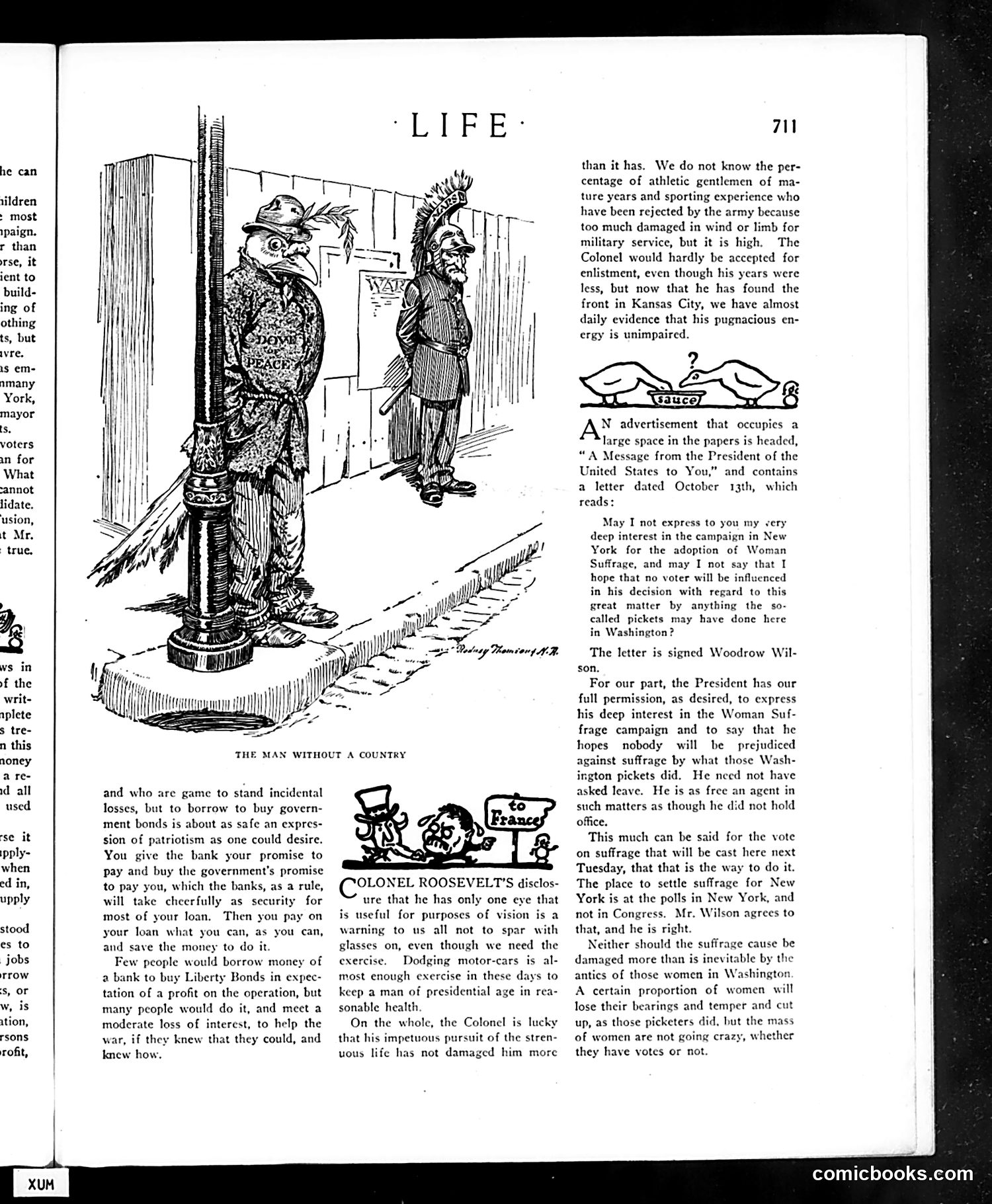
The cartoon depicts two caricatured figures — one appears to be a German soldier (left, heavily decorated uniform) confronting an American soldier (right). The title "The Man Without a Country" references Edward Everett Hale's Civil War-era story about patriotic duty. The accompanying text discusses Colonel Theodore Roosevelt's disclosure that he has only one functional eye, yet remains physically vigorous and politically active in Kansas City. The satire suggests Roosevelt's continued aggressive "strenuous life" pursuits despite his age and disabilities — ironically comparing his vigor to actual soldiers rejected from WWI service due to injury. The page also contains a message from President Woodrow Wilson regarding New York's women's suffrage vote, encouraging voters not to be prejudiced against suffrage by Washington picketers' tactics. The text defends both Wilson's right to express support and women's right to vote, while gently criticizing suffrage activists' disruptive methods.
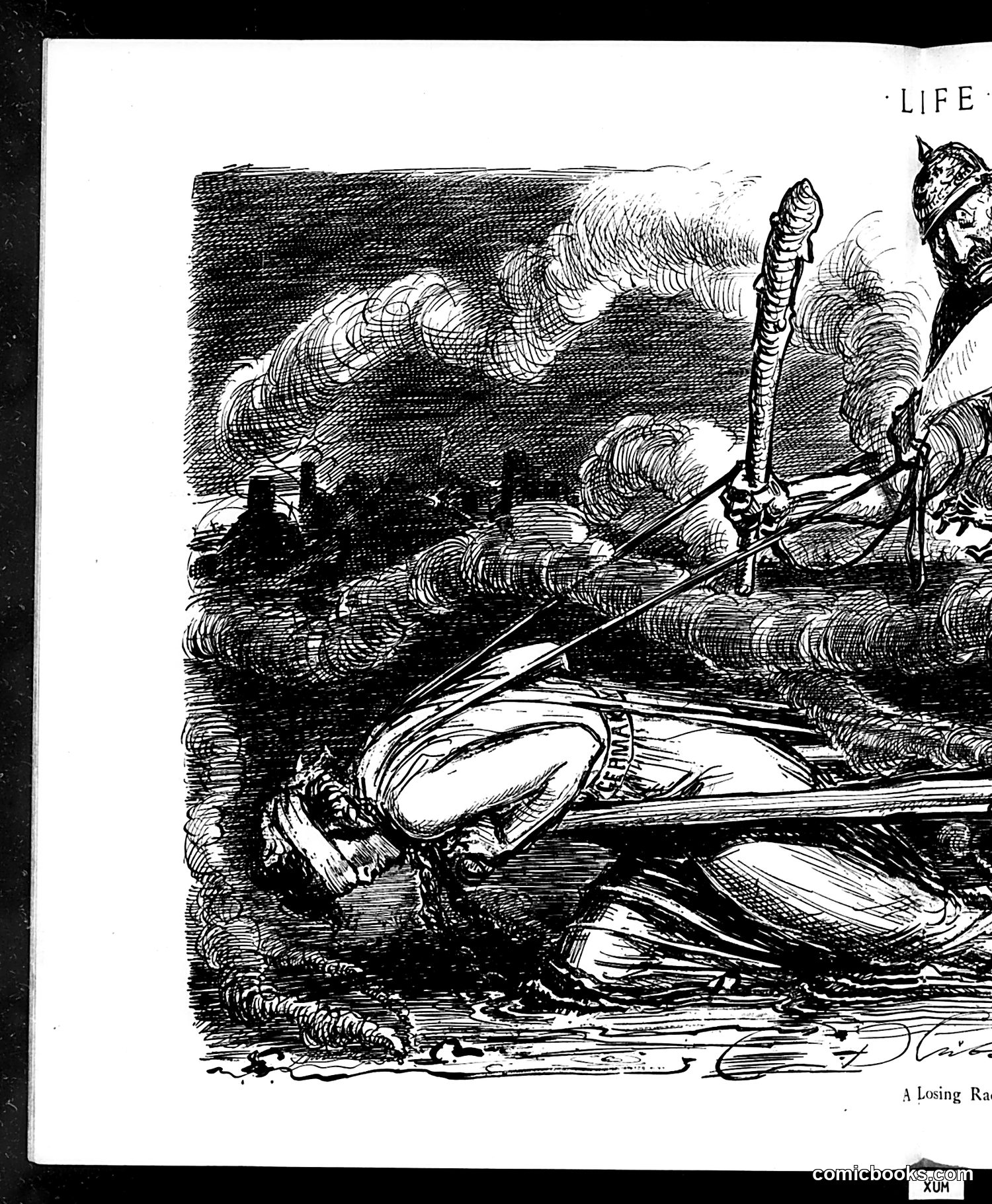
This page from *Life* magazine shows a political cartoon titled "A Losing Rac[e]" (title partially cut off). The illustration depicts a figure in military or formal dress lying prone on the ground, apparently defeated or exhausted. Behind this figure are armed soldiers or military personnel, and the scene includes various military equipment and supplies scattered about. The cartoon appears to satirize a military conflict or political struggle of the era. Without the complete caption or surrounding article text visible, the specific historical reference remains unclear—it could reference WWI, a labor dispute, or another contemporary conflict. The "losing race" title suggests commentary on an inevitable defeat or failed effort, but the exact subject requires additional context to identify with certainty.
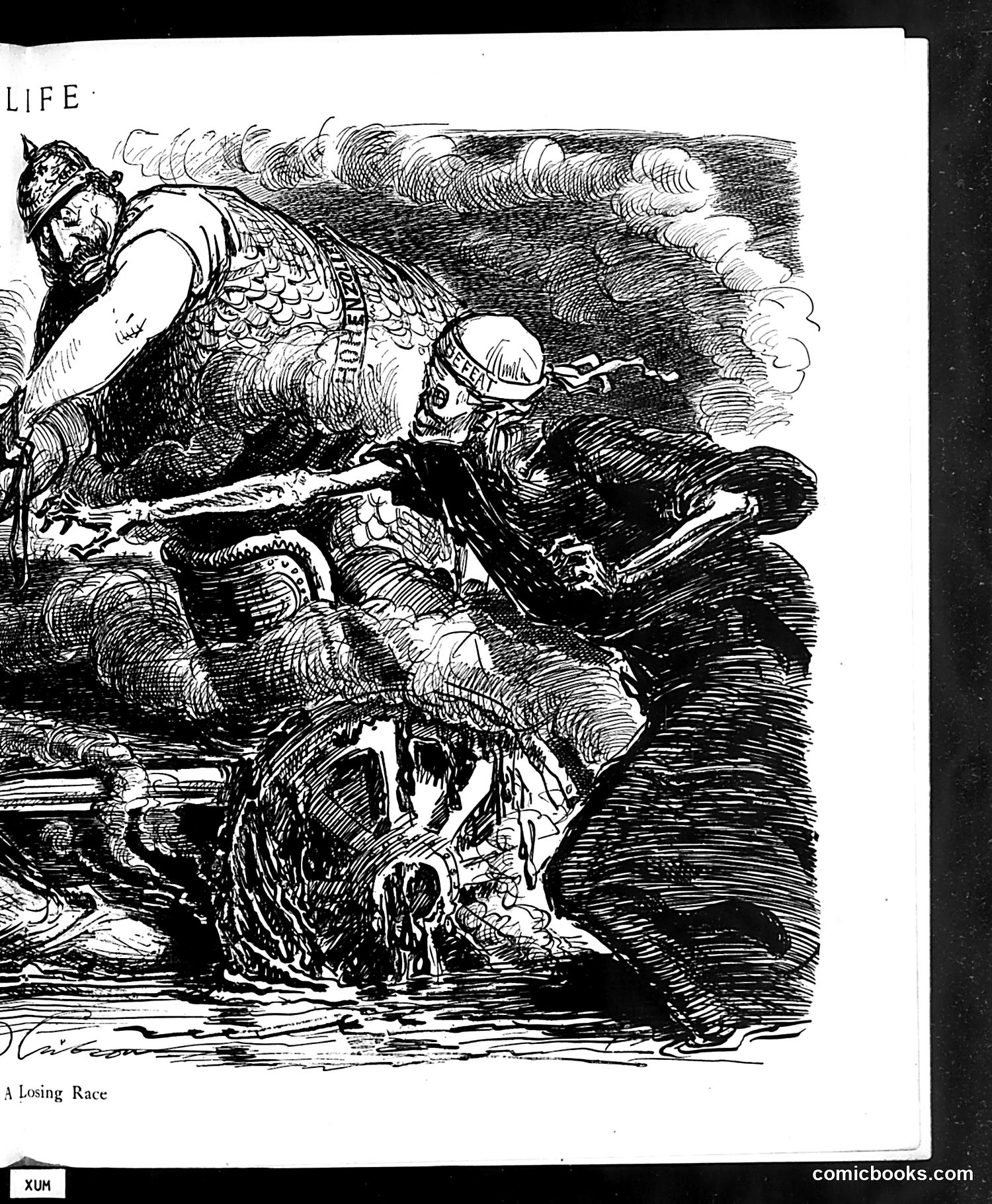
This political cartoon depicts what appears to be a military or conflict scenario titled "A Losing Race." The image shows several figures in combat or pursuit, with military attire and helmets visible. One figure appears to be fleeing or retreating while others pursue. Without additional context or caption text beyond the title, the specific historical event or political figures referenced are unclear. The style and printing technique suggest this is from an early-to-mid 20th century issue of Life magazine. The "losing race" likely refers to a military campaign, electoral competition, or political struggle of that era. To accurately identify the specific satire, political figures involved, and historical context would require additional text or date information from the magazine itself.
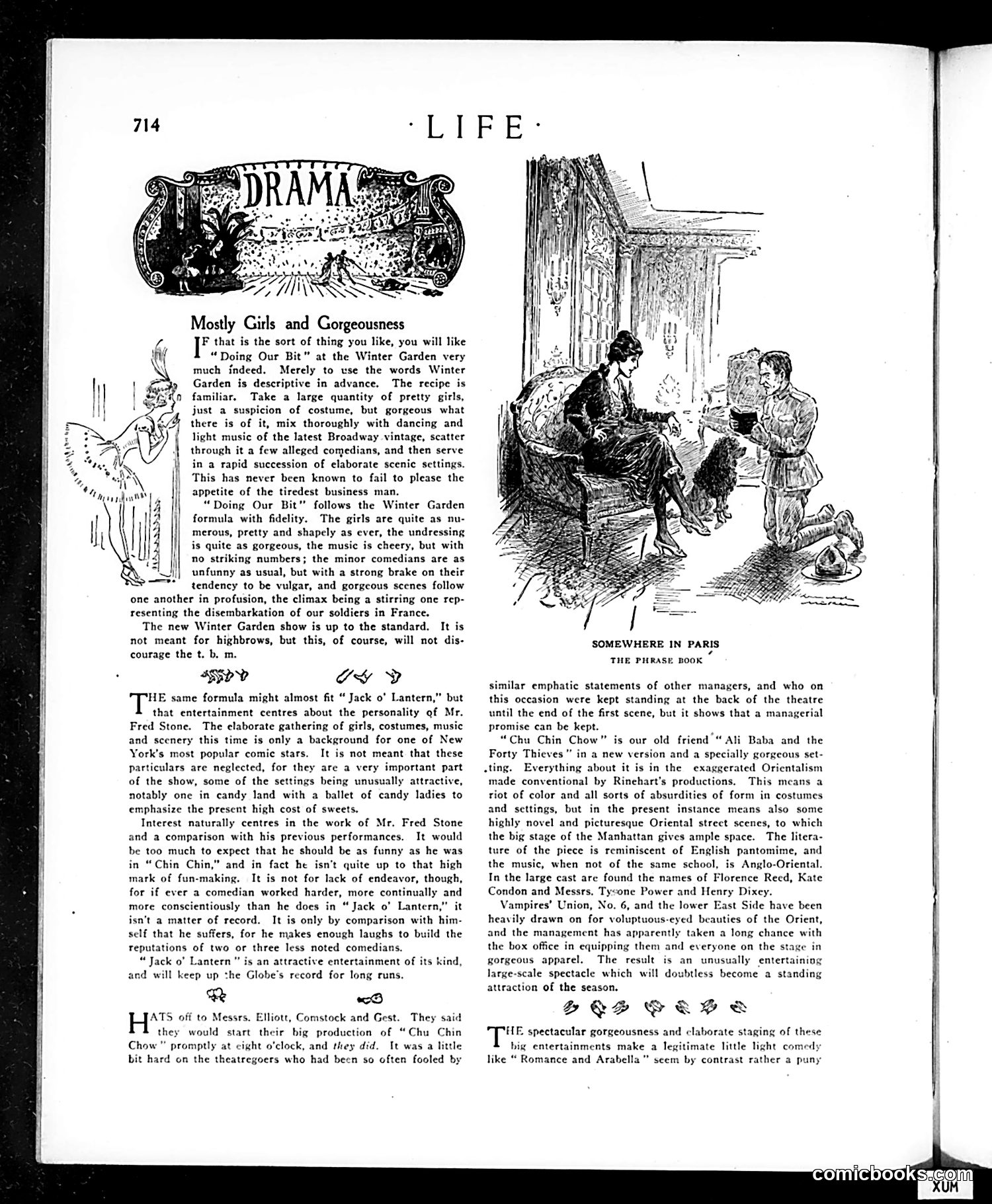
This page reviews three Broadway productions using the magazine's characteristic satirical tone. The reviews mock popular entertainment formulas of the era: **"Doing Our Bit"** at the Winter Garden is critiqued as following a predictable recipe: "pretty girls, just a suspicion of costume" mixed with dancing, minor comedians, and elaborate scenery. The satire targets tired businessmen ("t.b.m.") as the intended audience, suggesting the show lacks intellectual merit but succeeds through spectacle and female performers. **"Jack o' Lantern"** centers on comic star Fred Stone. The review acknowledges his talent but suggests he's working harder than necessary to compensate for not matching his previous success in "Chin Chin." One set features "candy ladies" in "candy land," mocking the show's whimsical excess. **"Chu Chin Chow"** is an orientalist adaptation of "Ali Baba and the Forty Thieves," praised for punctuality and criticized for exaggerated "Orientalism"—stereotypical Asian aesthetics treated as exotic spectacle. The sketch "Somewhere in Paris" appears unrelated to these reviews.
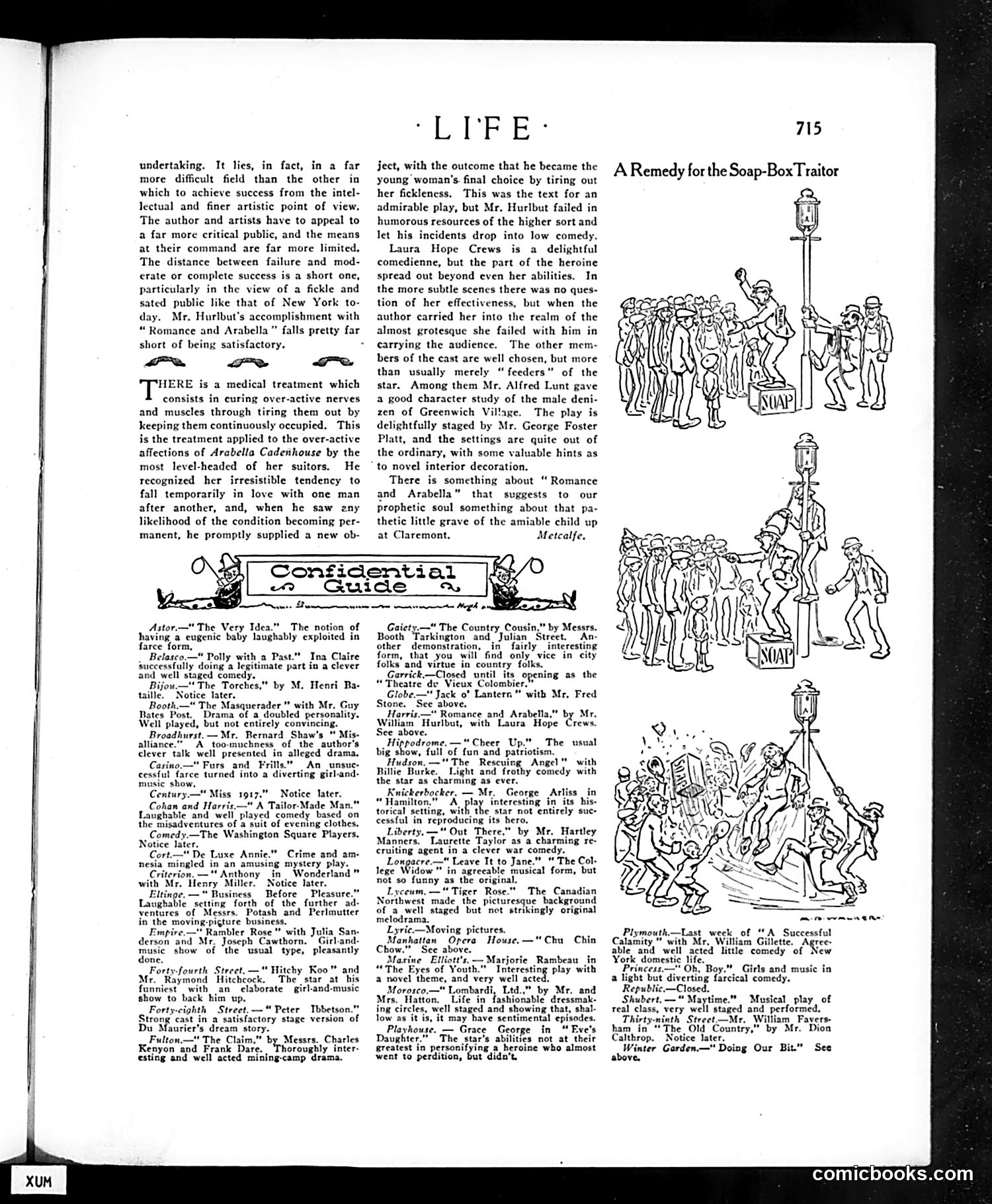
This satirical cartoon depicts a crowd of people gathered around street soap-boxes (improvised platforms for public speaking), which were common venues for political agitators and radical speakers in early 20th-century America. The figure labeled "SOAP" appears repeatedly, likely representing socialist, communist, or anarchist street orators who used such platforms to recruit followers and spread their ideology. The cartoon's title suggests mockery of radical activists who converted ordinary citizens to their causes through street preaching. The illustration satirizes both the soap-box speakers themselves and their audiences, portraying them as a mob susceptible to manipulation. This reflects contemporary American anxieties about radical political movements and immigrant-influenced activism during the post-WWI period, when such concerns were widespread among mainstream publications like Life magazine.
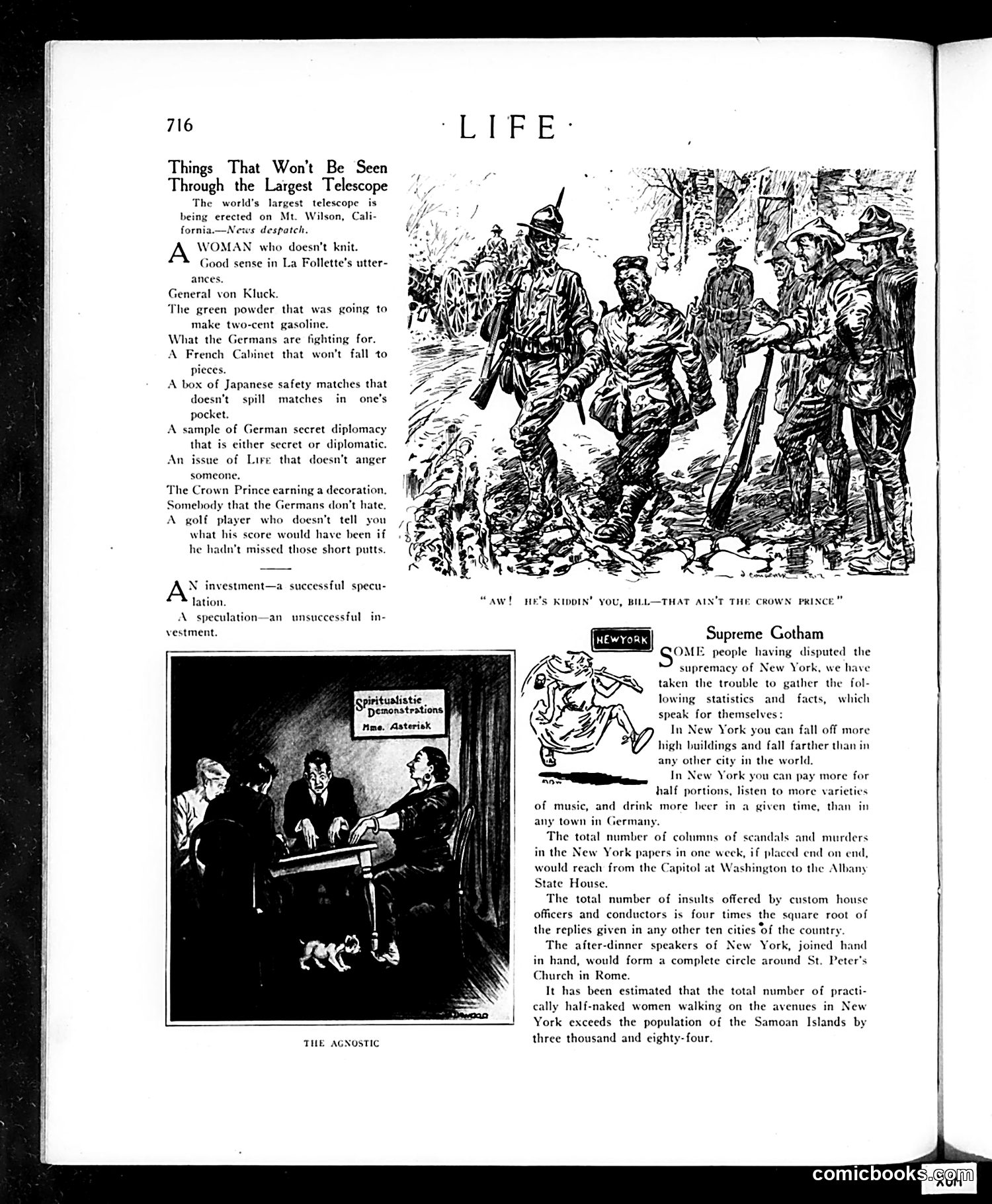
**"Things That Won't Be Seen Through the Largest Telescope"** is a satirical list commenting on WWI-era politics and society. It mocks absent or invisible things: women who don't knit (wartime patriotism pressure), General von Kluck (German military leader), failed technological promises (two-cent gasoline), and implicitly criticizes political figures like La Follette (anti-war Senator). The humor lies in impossibilities—things that *don't exist* that supposedly can't be seen even through the world's most powerful telescope. **"The Agnostic"** cartoon (lower left) shows spiritualist séance performers—likely charlatans claiming to contact the dead—deceiving a client. The caption references spiritualism fraud popular in this era. **"Supreme Gotham"** celebrates New York City's supremacy through absurdist statistics: more building falls, more half-naked women, more scandal columns than other cities. It's tongue-in-cheek boasting about urban excess and chaos. All three pieces reflect early 20th-century American satirical magazine humor: topical WWI references, debunking pseudoscience, and urban social commentary.
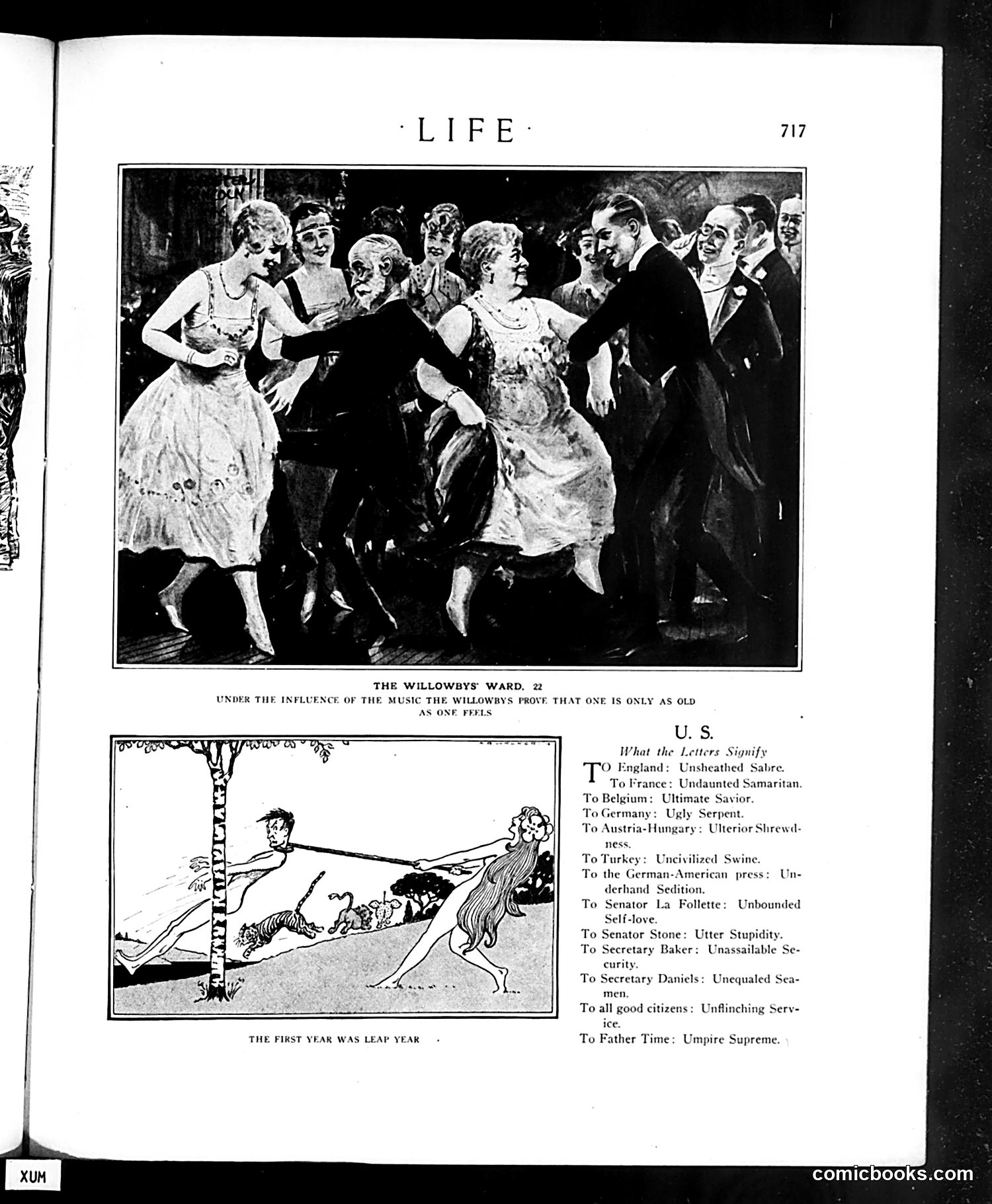
This page contains two satirical pieces about American identity during World War I era. The top cartoon, "The Willowbys' Ward," depicts a dance scene where the Willowby family demonstrates youthful vitality through music and movement—satirizing how Americans maintained optimism and vigor despite wartime pressures. The bottom section, "U.S. What the Letters Signify," is a political commentary assigning character traits to various nations and American political figures through alliterative phrases beginning with "U." It portrays the U.S. as an "Umpire Supreme" to Father Time, while labeling Germany an "Ugly Serpent" and Turkey "Uncivilized Swine." Notably, it mocks American isolationists like Senators La Follette and Stone as embodying "Unbounded Self-love" and "Utter Stupidity," while praising Secretaries Baker and Daniels for military preparedness—clearly pro-intervention propaganda from this WWI-era satirical magazine.
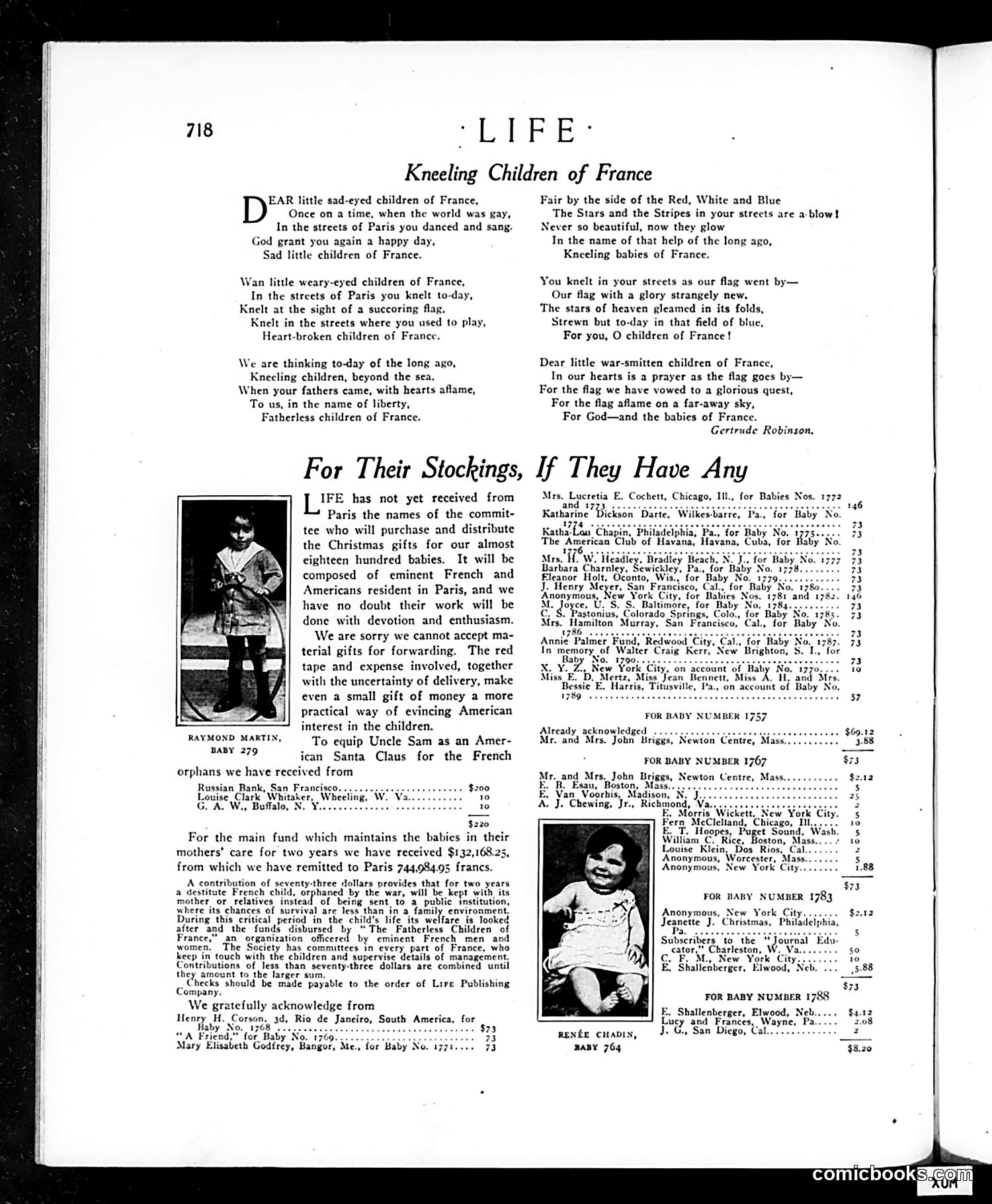
This page combines patriotic poetry with fundraising for French war orphans, reflecting America's involvement in World War I. The poem "Kneeling Children of France" by Gertrude Robinson addresses French children orphaned or displaced by the war. It evokes nostalgia for pre-war Paris ("Once on a time, when the world was gay") while celebrating American intervention—specifically the sight of the American flag alongside the French flag in French streets. The "kneeling" references both children's prayer and their gratitude toward American aid. The accompanying section solicits donations for nearly 1,800 French babies, emphasizing that money (not physical goods) should be sent due to shipping complications. The photographs show representative beneficiary children. **Context for modern readers:** This reflects America's WWI-era humanitarian efforts and the emotional appeals used to mobilize domestic charitable giving for European war relief—framing American aid as fulfilling a historical debt to France and as Christian charity toward innocent child victims.
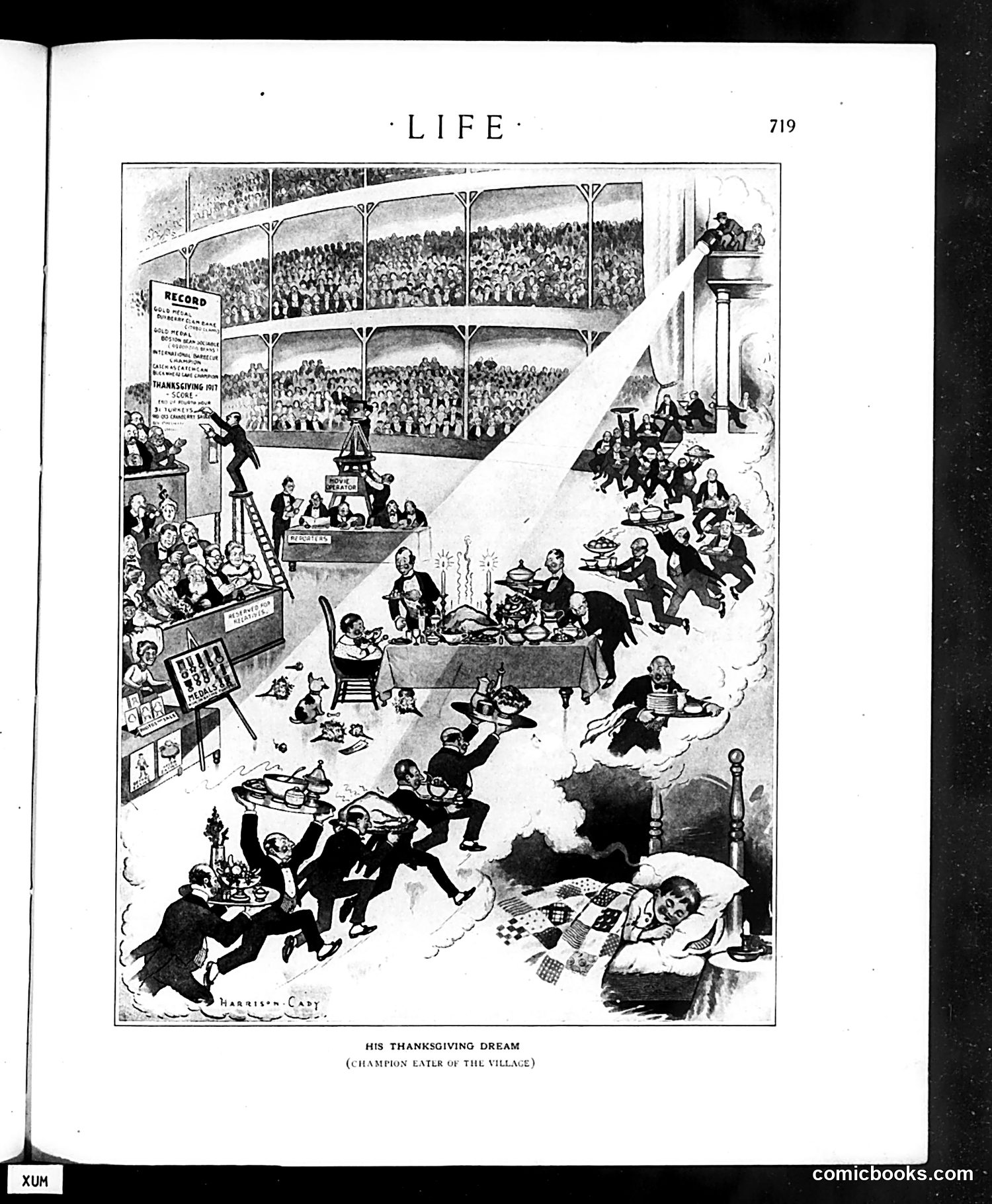
This satirical cartoon by Hamilton Cary depicts a chaotic Thanksgiving fantasy. A man sleeps in bed (lower right), dreaming of an elaborate village celebration in a grand hall with packed gallery seating above. The scene shows simultaneous chaos: men in formal dress run around frantically, a central dining table sits in disarray, food and dishes scatter across the floor, smoke billows, and figures appear to be fighting or fleeing in panic. The satire likely mocks the contrast between idealized Thanksgiving fantasies and the actual mayhem of holiday celebrations—the "village champion eater" imagining himself a celebrated figure, yet the dream devolves into comical disaster. The crowded venue and formal setting underscore the gap between aspirational holiday visions and inevitable comedic reality.
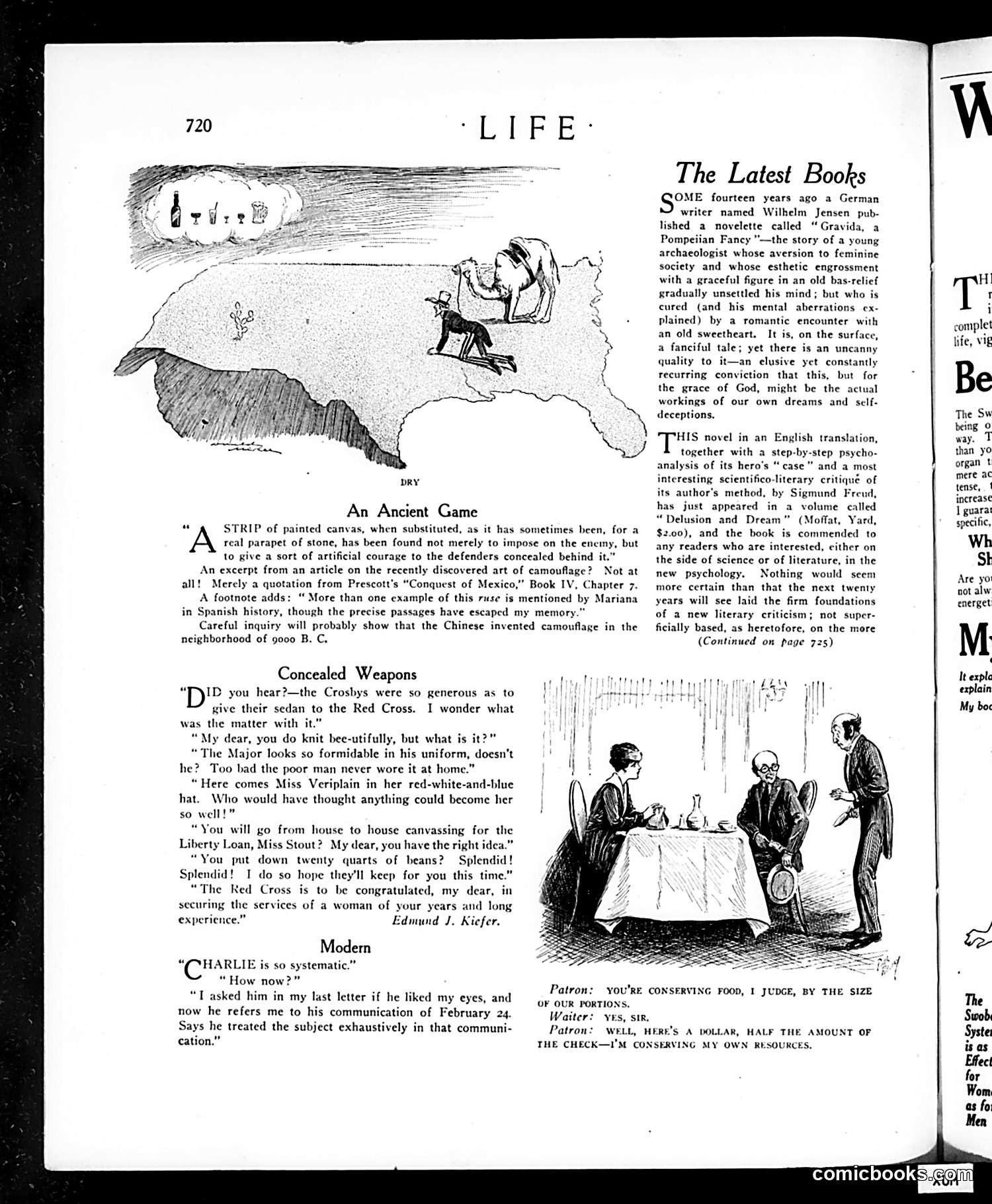
**"An Ancient Game"** discusses military camouflage, but uses scholarly sources to make a point: the practice is ancient, not modern invention. The satire suggests people wrongly credit contemporary military innovation when history shows this deception dates back centuries (even joking that China invented it around 9000 B.C.). **"Concealed Weapons"** by Edmund J. Kiefer satirizes women's WWI-era patriotic activities—Red Cross donations, Liberty Loan canvassing, food conservation. The "concealed weapons" are backhanded compliments disguised as praise: insulting remarks wrapped in polite society language ("Who would have thought anything could become her so well!"). **"Modern"** cartoon mocks a man's systematic efficiency: he references previous correspondence rather than answer directly about his preferences. The dining scene shows wartime food rationing humor—the patron conserves food by eating small portions, then half-pays the bill claiming he's "conserving resources." Both strip the veneer of patriotic sacrifice to expose self-interest.
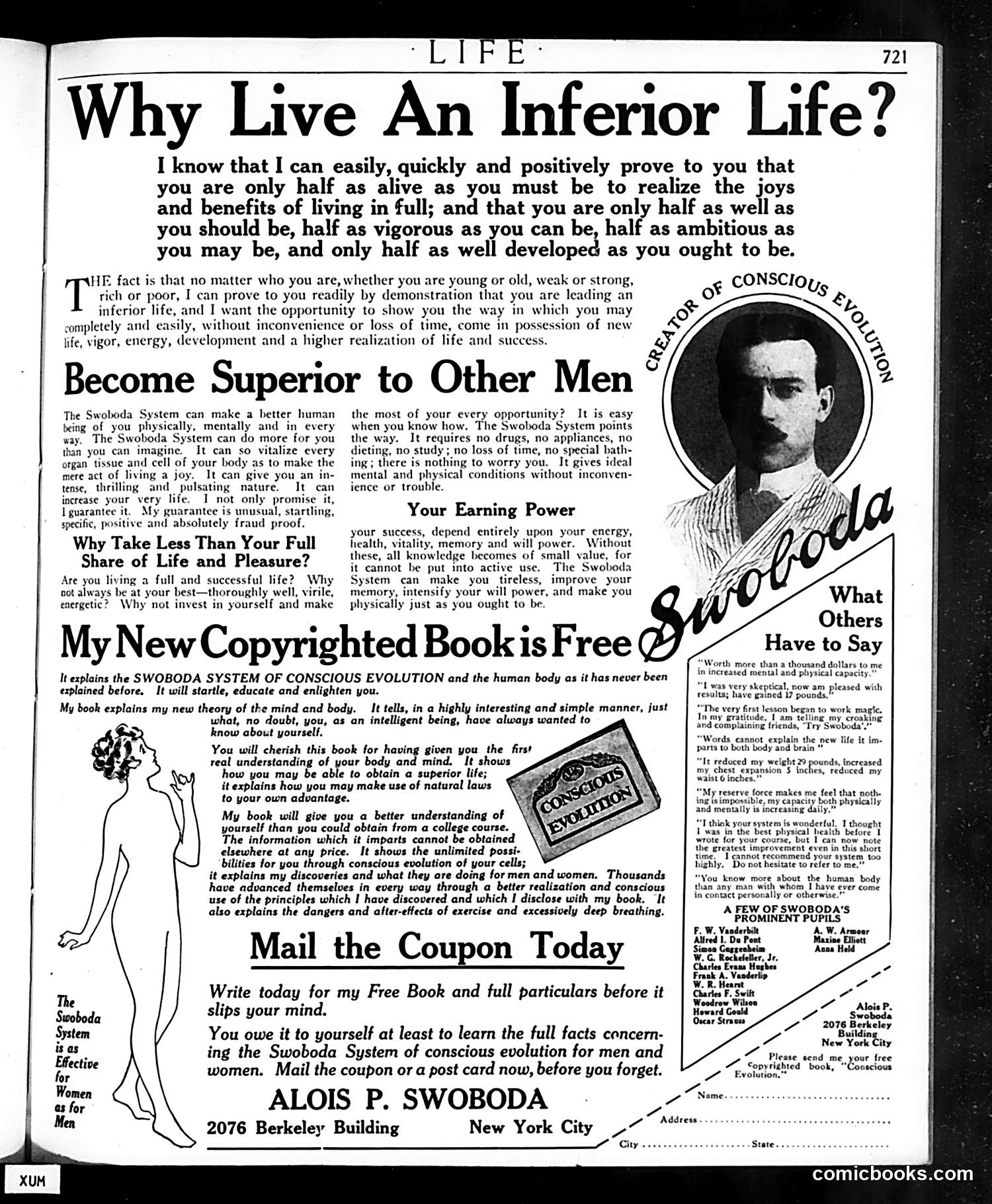
This is a **full-page advertisement**, not satire or political content. It promotes Alois P. Swoboda's self-help system claiming to transform readers into superior versions of themselves—physically, mentally, and economically. **Key appeals:** - Claims readers are "only half alive" and underperforming - Promises vitality, vigor, earning power, and superiority over other men without drugs, dieting, or exercise - Offers a free copyrighted book on "Conscious Evolution" **Historical context:** This exemplifies early-20th-century pseudoscientific self-improvement marketing. Terms like "conscious evolution" echo popular (misapplied) Darwinian ideas. The testimonials from named individuals add false credibility. **For modern readers:** This resembles contemporary wellness/self-help marketing but is remarkably brazen about promising superiority and exploiting insecurity. The lack of specifics about *how* the system works is notable—characteristic of fraudulent schemes.
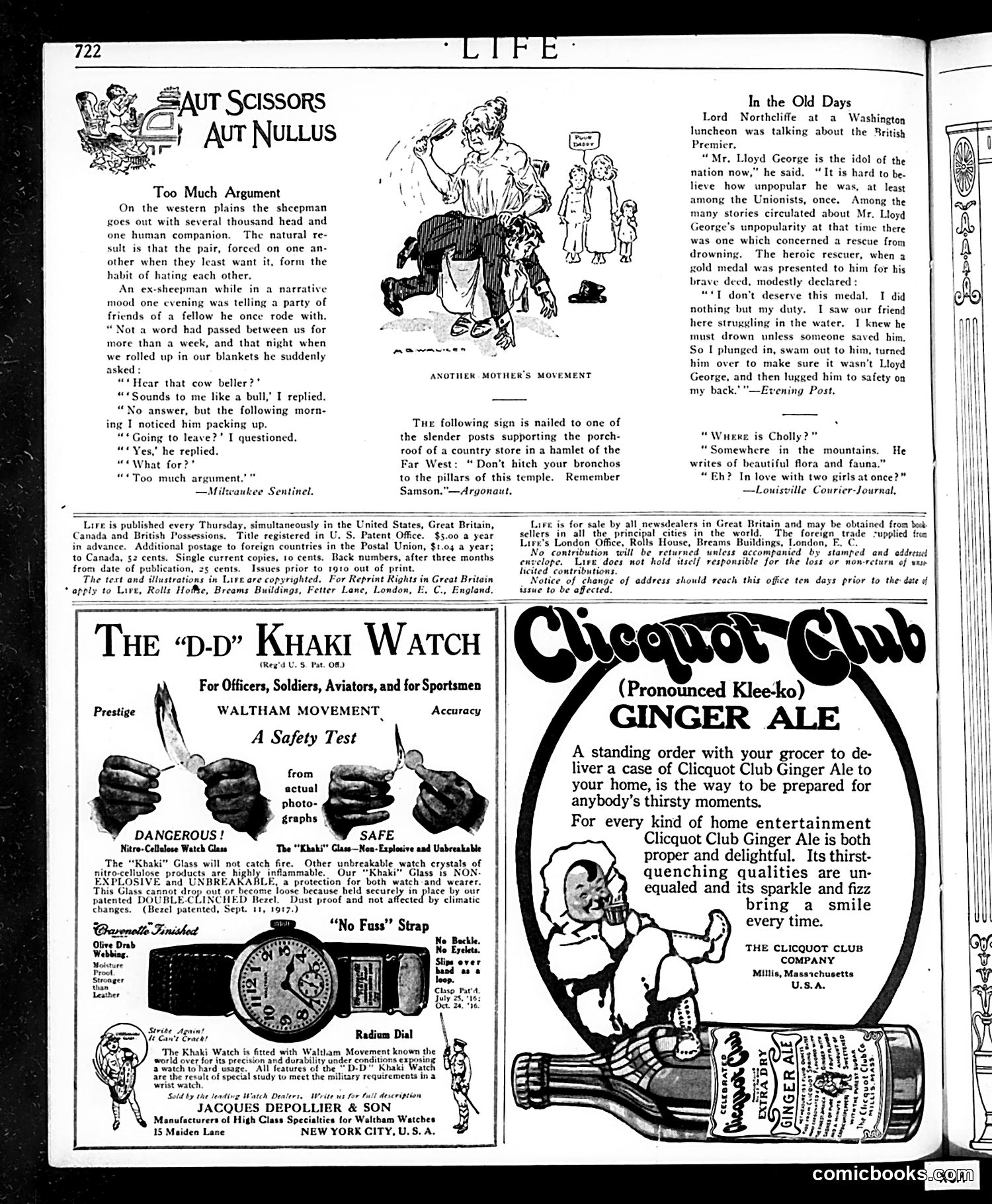
This page contains three short humorous anecdotes typical of Life's satirical humor: **"Too Much Argument"** mocks the isolation and friction of sheepherding life on western plains. Two sheepherders argue over whether a sound is a cow or bull—such trivial dispute that one abandons his job, illustrating how confined quarters breed absurd conflicts. **"Another Mother's Movement"** jokes about a country store sign invoking Samson's biblical warning against tying horses to pillars, humorously equating the store's porch supports with the temple Samson destroyed. **"In the Old Days"** recounts an anecdote about Lloyd George (British Prime Minister), where Lord Northcliffe describes how unpopular George once was among Unionists—so much so that a drowning rescuer humorously claims he nearly let George drown, only saving him after confirming his identity. The page is primarily advertising (D-D Khaki Watch, Clicquot Club Ginger Ale), with these brief comic pieces interspersed—typical of Life's format blending satire with commercial content.
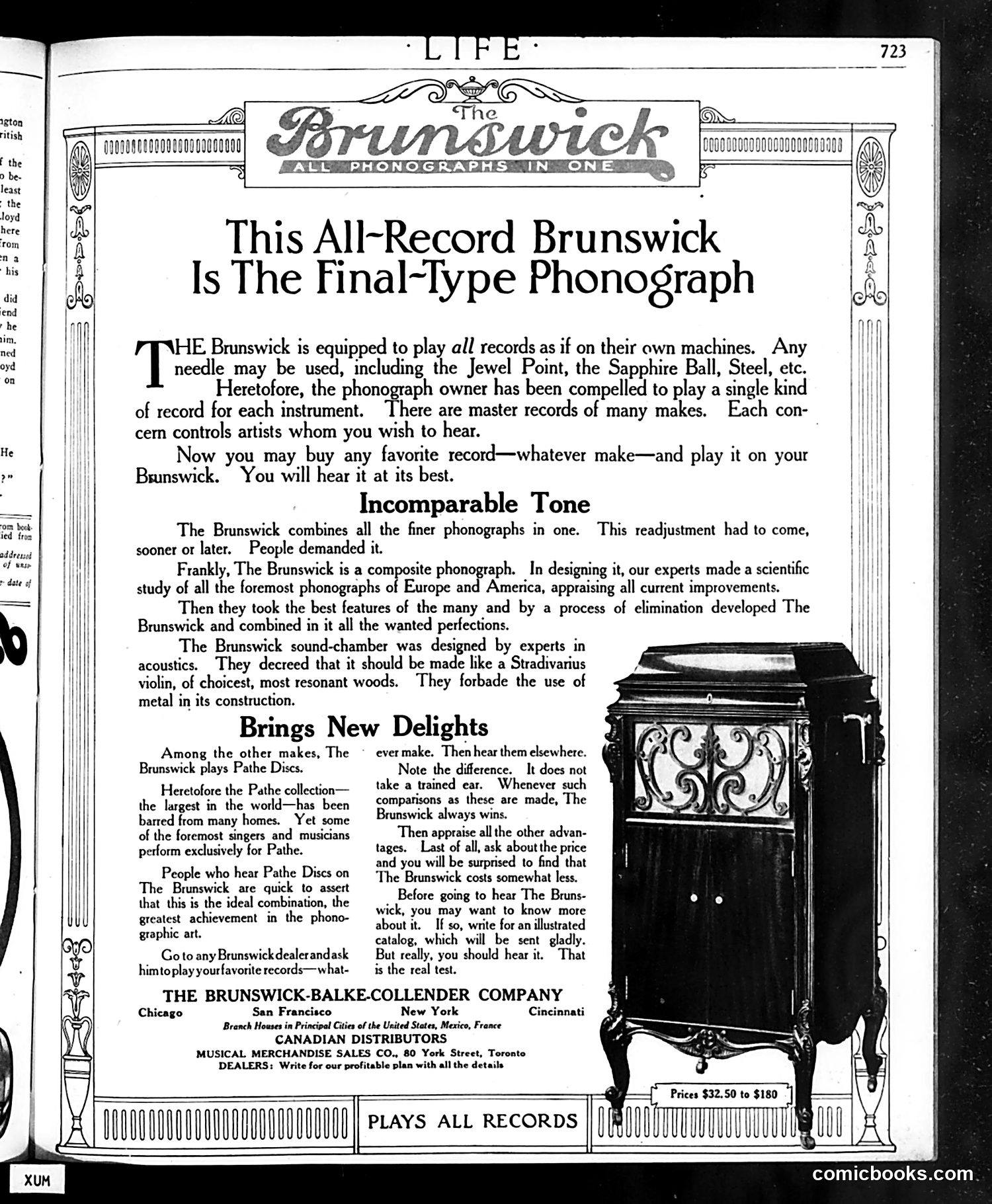
This page is a full-page advertisement for the Brunswick phonograph, not satirical content or political commentary. It's a straightforward product pitch disguised in the advertising style of the era. **The Product & Sales Pitch:** The Brunswick claims to be the "final-type phonograph"—a universal machine capable of playing records from *any* manufacturer (Victor, Columbia, Pathe, etc.), when competitors' machines played only their own brand's records. This was a genuine competitive advantage. **Key Marketing Claims:** - Superior tone quality (sound chamber designed like a Stradivarius violin) - Access to Pathe's exclusive catalog, previously unavailable on other machines - Lower price than competitors - Superior sound quality in direct comparisons The advertisement emphasizes the practical benefit: consumers could finally buy their favorite records regardless of make and play them on one machine—a significant convenience innovation for the era.
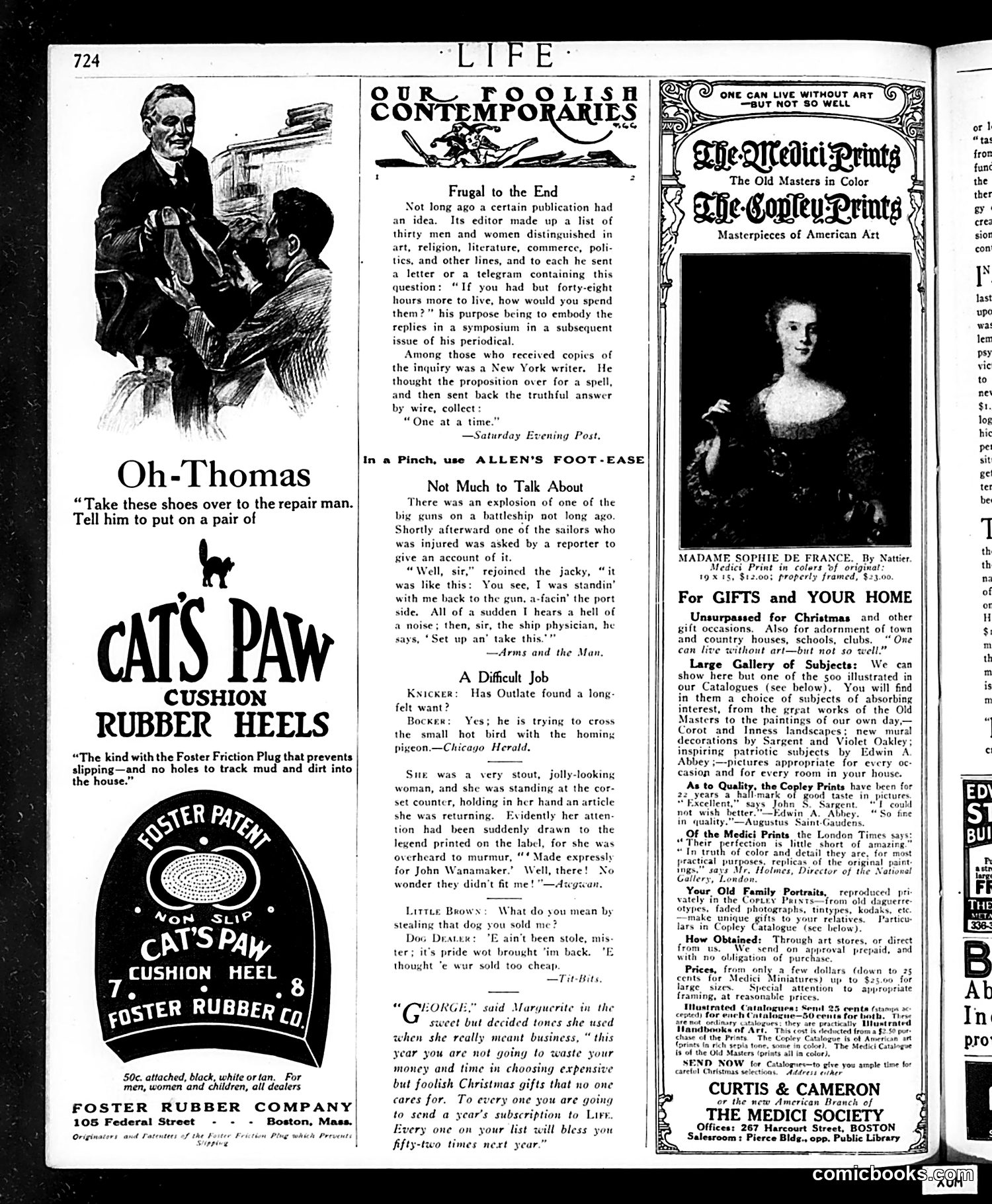
This page is primarily **advertising** interspersed with brief humorous anecdotes. The main content includes: **The Cartoon/Illustration:** "Oh-Thomas" shows a domestic scene where a man instructs someone (likely a servant) to take shoes to a repair man—a setup for advertising Cat's Paw Cushion Rubber Heels, a shoe product. **The Humor Pieces:** Several brief jokes and observations appear, including: - A writer's response to a "how would you spend 48 hours left to live" survey: "One at a time"—implying the question itself was absurd - A sailor's account of a battleship gun explosion - A stout woman confused by a corset label reading "Made expressly for John Wanamaker" (a famous department store owner), joking this explains why it didn't fit - Wordplay about a stolen dog **Advertisements:** The page heavily features product ads (Foster Rubber Company, Allen's Foot-Ease, Copley Prints, Medici Prints) alongside these light satirical pieces typical of Life magazine's format blending humor with commercial content.
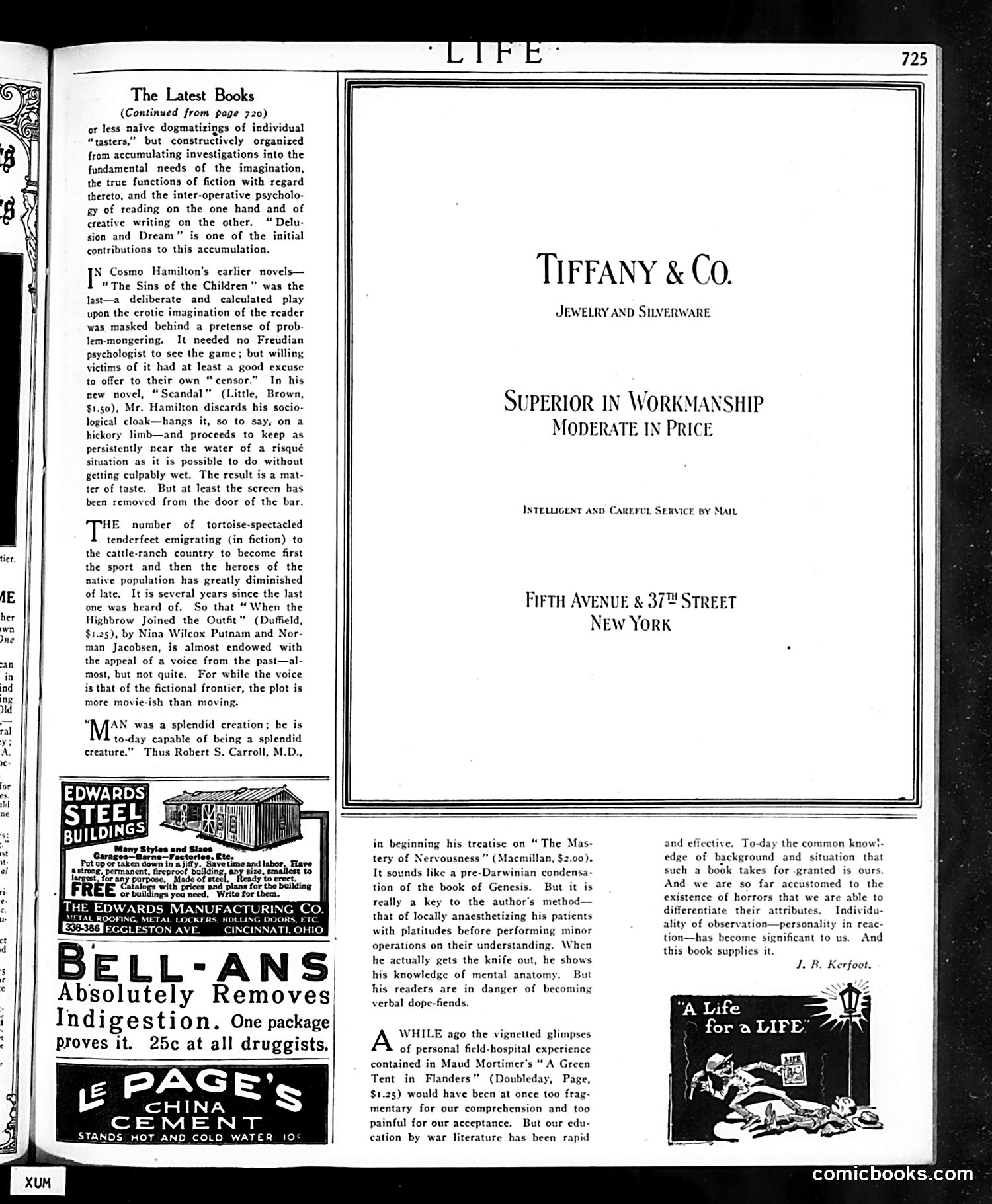
This page is primarily a book review section and advertising, not a political cartoon. The left column contains literary criticism of recent novels, discussing works by Cosmo Hamilton, Nina Wilcox Putnam, Norman Jacobsen, Robert S. Carroll, and Maud Mortimer. The reviewer examines themes and methods in contemporary fiction. The right side features advertisements, including a prominent Tiffany & Co. jewelry advertisement for their Fifth Avenue location. Below are ads for Edwards Steel Buildings, Bell-Ans indigestion remedy, and Le Page's cement. There are no political cartoons, satirical illustrations, or recognizable caricatures on this page—it is a standard magazine layout of book reviews and period advertisements typical of *Life* magazine's editorial format.
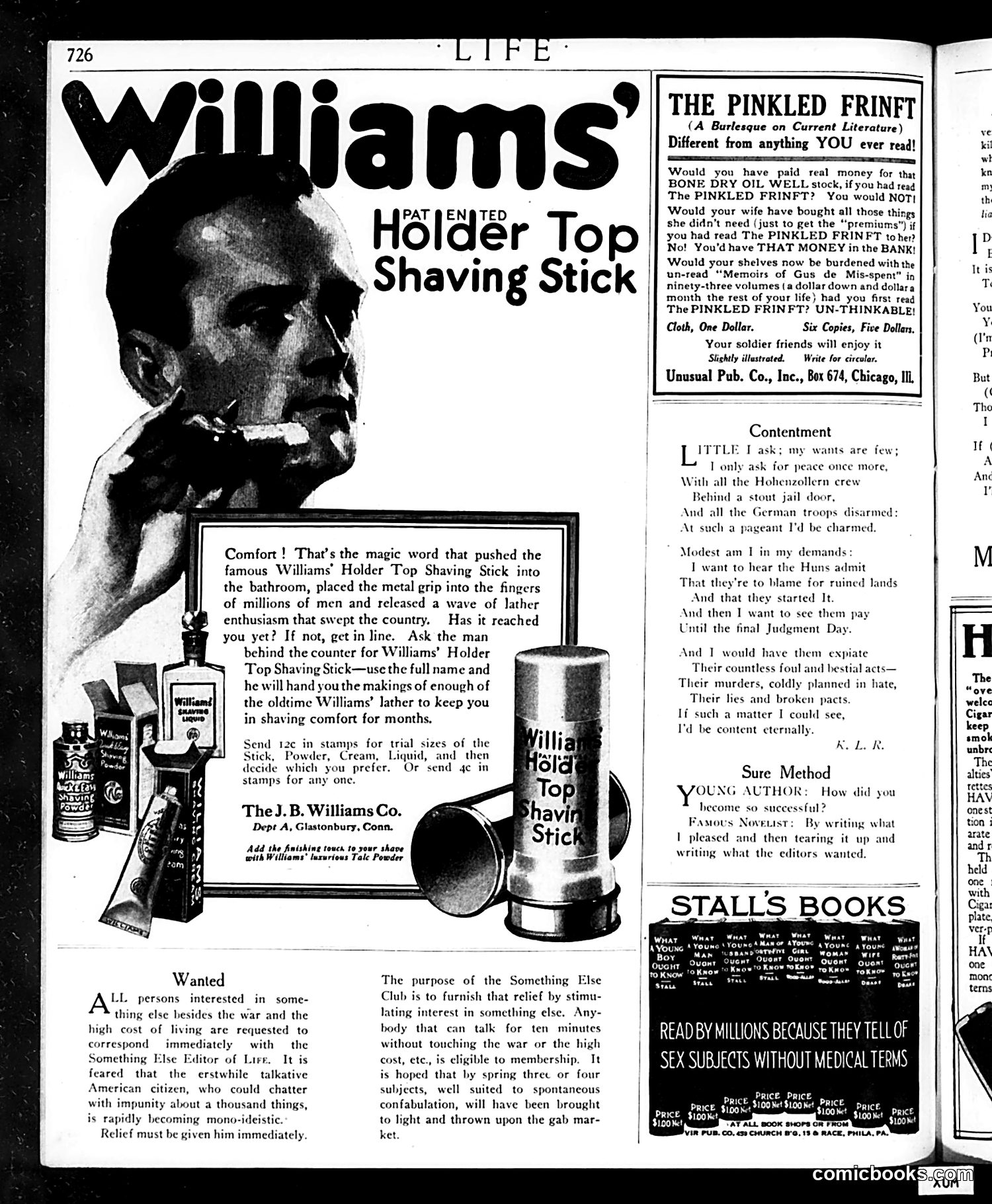
This page mixes commercial advertising with satirical commentary typical of Life magazine's format. **Main Advertisement:** Williams' Holder Top Shaving Stick dominates the left side, using a large photograph of a man's face mid-shave to sell comfort and convenience—standard early 20th-century advertising rhetoric. **Satire Content:** "The Pinkled Frinft" mocks contemporary commercial culture, suggesting a fictional book that would have prevented readers from making foolish purchases (bogus oil stocks, unnecessary mail-order items). It's satire on consumerism and gullibility. "Something Else Club" humorously addresses war-obsession: Americans have become so fixated on WWI and inflation that they've lost ability to discuss anything else. The piece seeks people capable of normal conversation—reflecting genuine social concern about how completely the war dominated American discourse. "Contentment" is a bitter poem listing WWI grievances: demands for German surrender, punishment, and reparations. The page captures wartime American life: commercial capitalism continuing alongside deep anxiety about the conflict's meaning and cost.
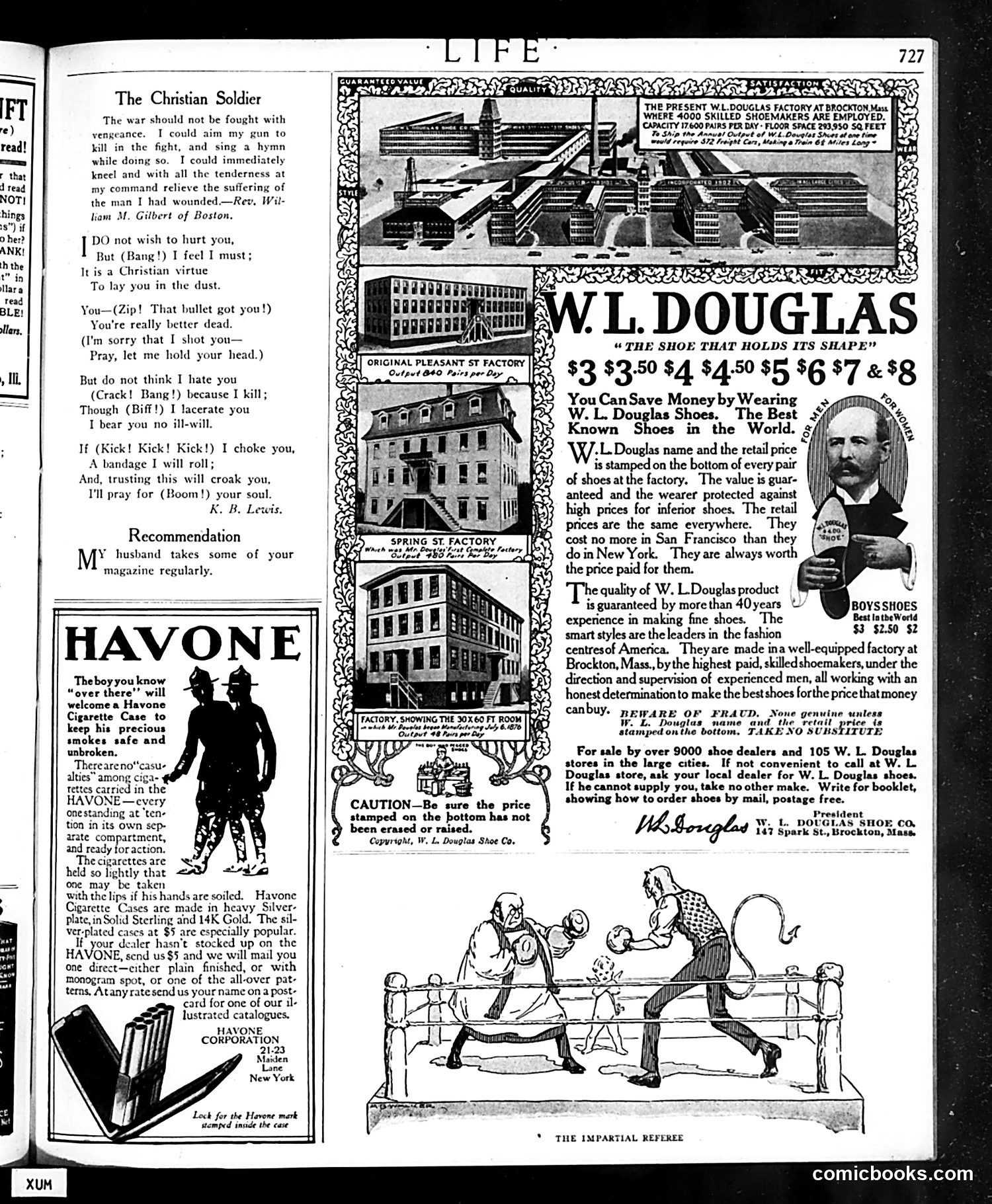
This page, from a WWI-era *Life* magazine, contains satirical and advertising content. **"The Christian Soldier" Poem:** This is sharp anti-war satire by K. B. Lewis, mocking the hypocrisy of religious justification for violence. It presents a soldier claiming Christian virtue while shooting, stabbing, and choking enemies—all while praying for their souls and expressing no ill-will. The jarring contrast between violent actions (Bang! Crack! Kick!) and pious sentiments exposes the absurdity of reconciling warfare with Christian morality. The epigraph attributes the original sentiment to Rev. William M. Gilbert of Boston, suggesting this critiques actual religious arguments used to sanitize combat. **Advertisements:** The page features standard WWI-era ads for Havone cigarette cases (marketed to soldiers "over there") and W. L. Douglas shoes, emphasizing affordability and quality. **"The Impartial Referee" Cartoon:** A boxing match scene illustrates the page's advertising, unrelated to the satirical content above. The page's juxtaposition—brutal anti-war satire alongside patriotic soldier-targeted advertising—reflects *Life*'s dual role as both satirical commentary and commercial publication during wartime.
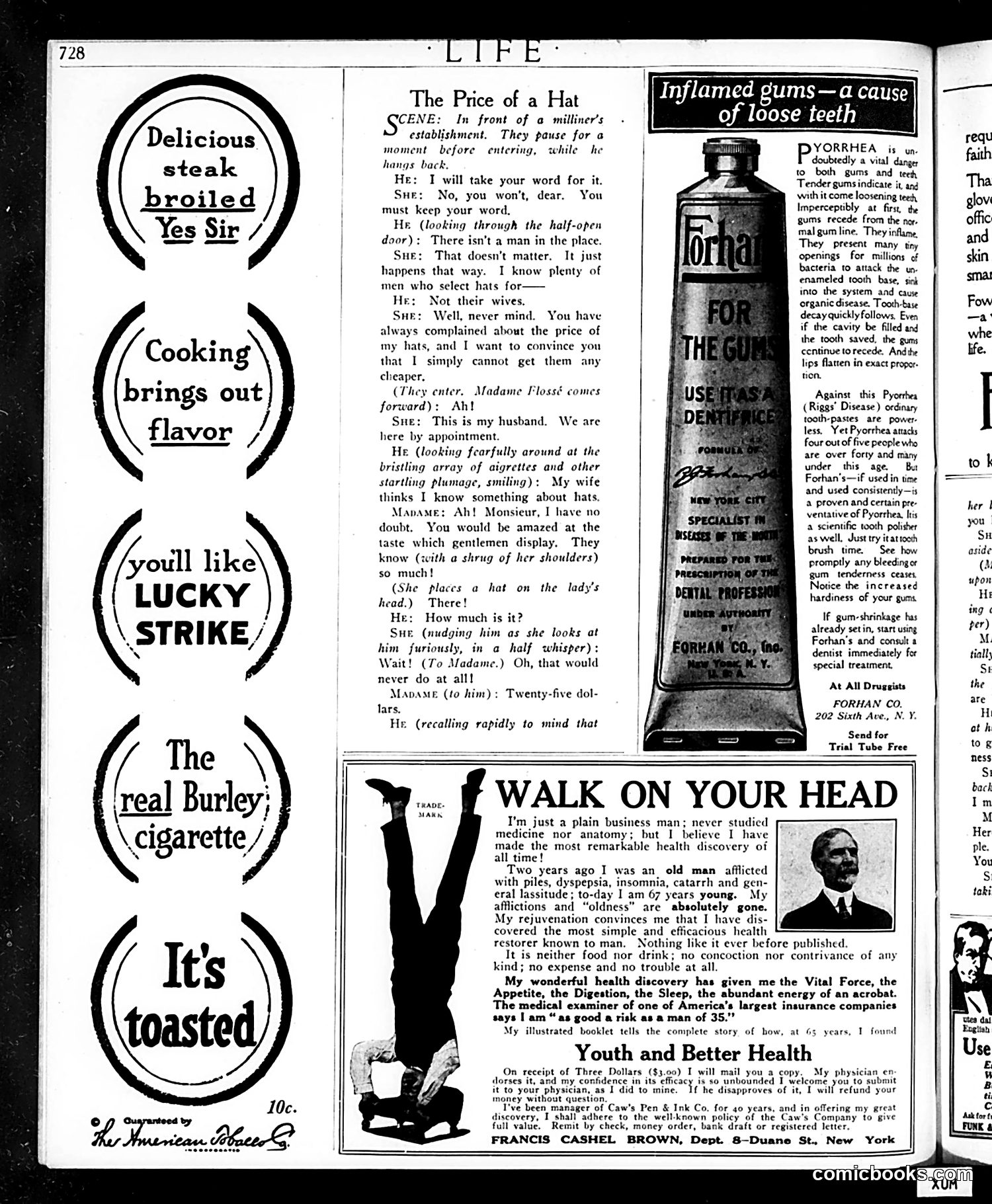
**The Price of a Hat (Cartoon/Sketch):** This is a humorous domestic scene satirizing marital dynamics and consumer behavior. A husband and wife visit a milliner's shop. The wife insists on buying an expensive hat despite the husband's protests about price. The joke plays on gender stereotypes: the wife manipulates her husband by reminding him he "always complained" about hat prices and must help her find cheaper ones—then immediately selects an expensive model. The husband's final line ("Twenty-five dollars!") and rapid mental calculation suggest his resignation to matrimonial financial defeat. It satirizes both wasteful spending and the husband's powerlessness in marriage. **Advertisements:** The page also contains period ads for Burley cigarettes, dental hygiene products (Forhan's for pyorrhea/gum disease), and a dubious health scheme ("Walk on Your Head") promising rejuvenation—typical early 20th-century patent medicine marketing.
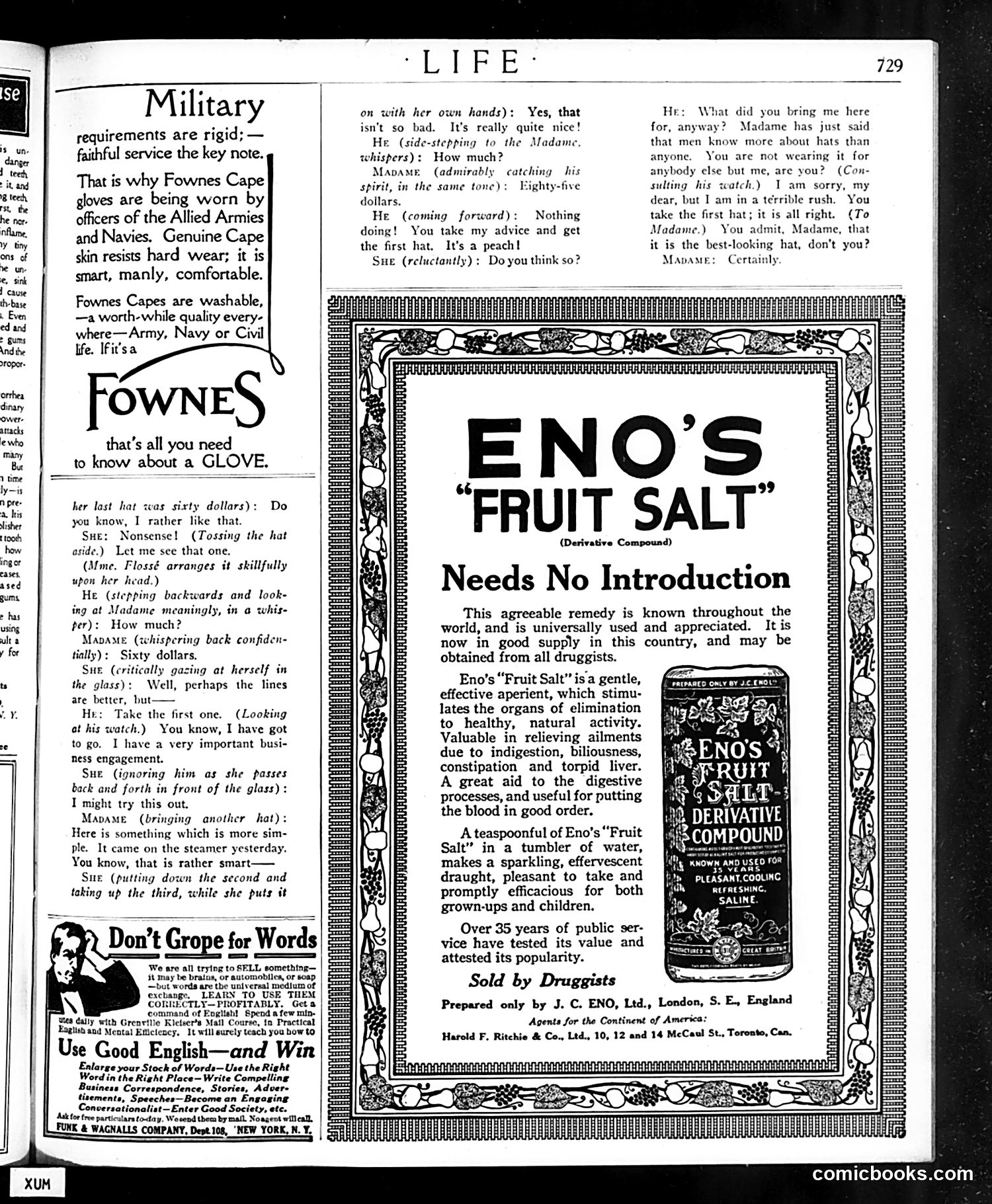
This page contains two distinct elements: **The Main Comic Sketch** depicts a couple shopping for women's hats, satirizing gender dynamics and consumer behavior. The husband repeatedly urges his wife to choose the cheapest option while she deliberates over three hats (priced $60, $85, and an unspecified amount). The satire targets husbands who claim superior taste in fashion while actually prioritizing cost-cutting, and wives who seek male approval despite their own judgment. The sketch mocks the performative nature of marital shopping dynamics—the husband's transparent impatience contrasts with his condescending advice. **The Advertisements** promote Fownes Cape gloves (marketed to military officers) and Eno's Fruit Salt (a digestive remedy), both typical early 20th-century products using patriotic and health-based appeals. The "Don't Grope for Words" section advocates for clear English communication as a practical skill for salesmanship and social success, reflecting period concerns about proper language use.
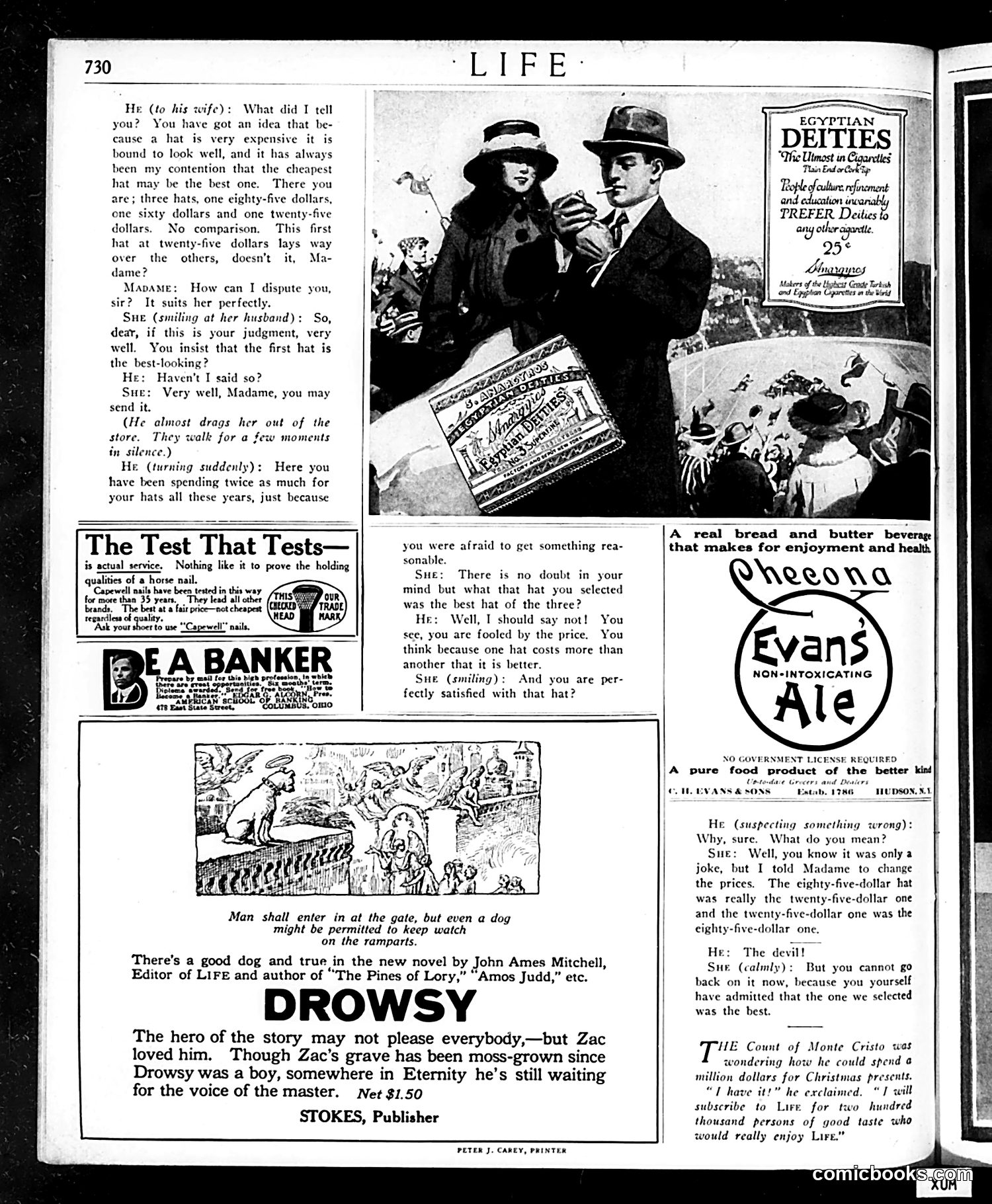
**Main Cartoon:** A domestic comedy about price and value. A husband lectures his wife about hats, insisting the cheapest ($25) is superior to expensive ones ($85). His wife tricks him by having the milliner swap the price tags. When he discovers he's been fooled into praising what was actually the most expensive hat, he's caught in his own logic—he can't now claim it's inferior without contradicting his stated belief that price doesn't determine quality. **The Satire's Point:** This mocks male pretension and false reasoning about economics and taste. The husband uses pseudo-logical arguments about value to dominate his wife, but the joke exposes that his judgment was actually based on price psychology all along. His wife's clever reversal demonstrates that his "principles" are hollow. **Context:** This reflects early-20th-century gender dynamics where wives controlled household spending but husbands claimed rational authority. The humor targets male vanity and faulty reasoning dressed up as philosophy. The page also contains period advertisements (Capewell nails, a banker, Egyptian Deities cigarettes, Evans ale).
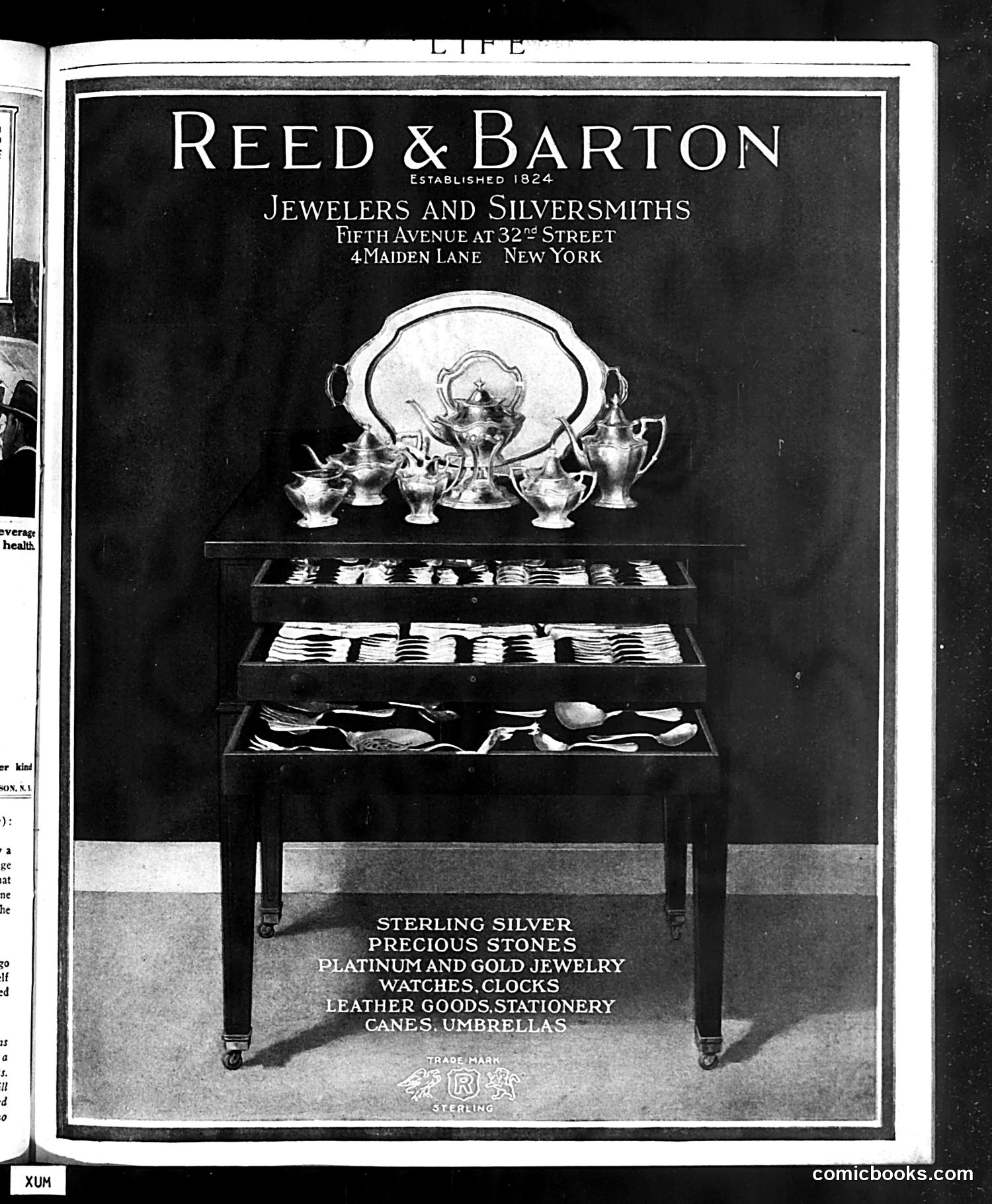
This is a full-page advertisement, not a cartoon or satirical content. It showcases Reed & Barton, a New York jewelry and silversmith company established in 1824. The ad displays their luxury goods—sterling silver flatware and serving pieces, precious stone jewelry, watches, and clocks—arranged in an elegant display case with drawers. The composition emphasizes craftsmanship and wealth, targeting affluent readers of *Life* magazine. There is no political satire or social commentary here; this is straightforward commercial advertising designed to promote high-end luxury goods to the magazine's upscale readership during what appears to be the early-to-mid twentieth century.
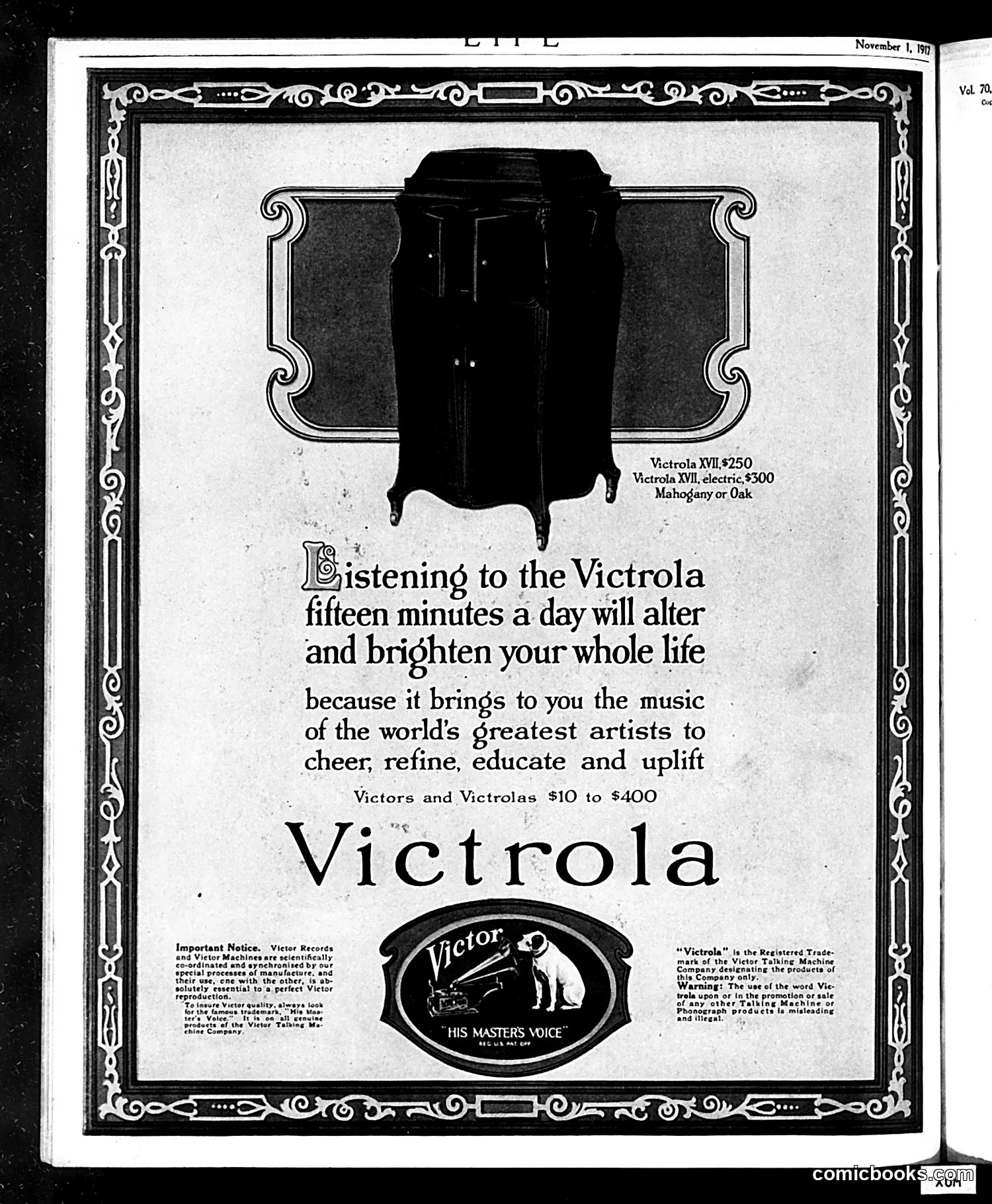
The page is a full-page Victrola phonograph advertisement from *Life* magazine (November 1, 1911). It shows the cabinet-style machine and makes extravagant claims: that listening just fifteen minutes daily will "alter and brighten your whole life" by bringing "the world's greatest artists" to refine and uplift the listener. This is classic early advertising hyperbole—using grandiose language to market a consumer product. The Victrola was a relatively new technology, and manufacturers aggressively promoted phonographs as devices that would elevate people's taste and education through recorded music. Prices ranged from $10 to $400, making higher models luxury items.