
Life, 1917-11-01 · page 31 of 38
Life — November 1, 1917 — page 31: what you’re looking at
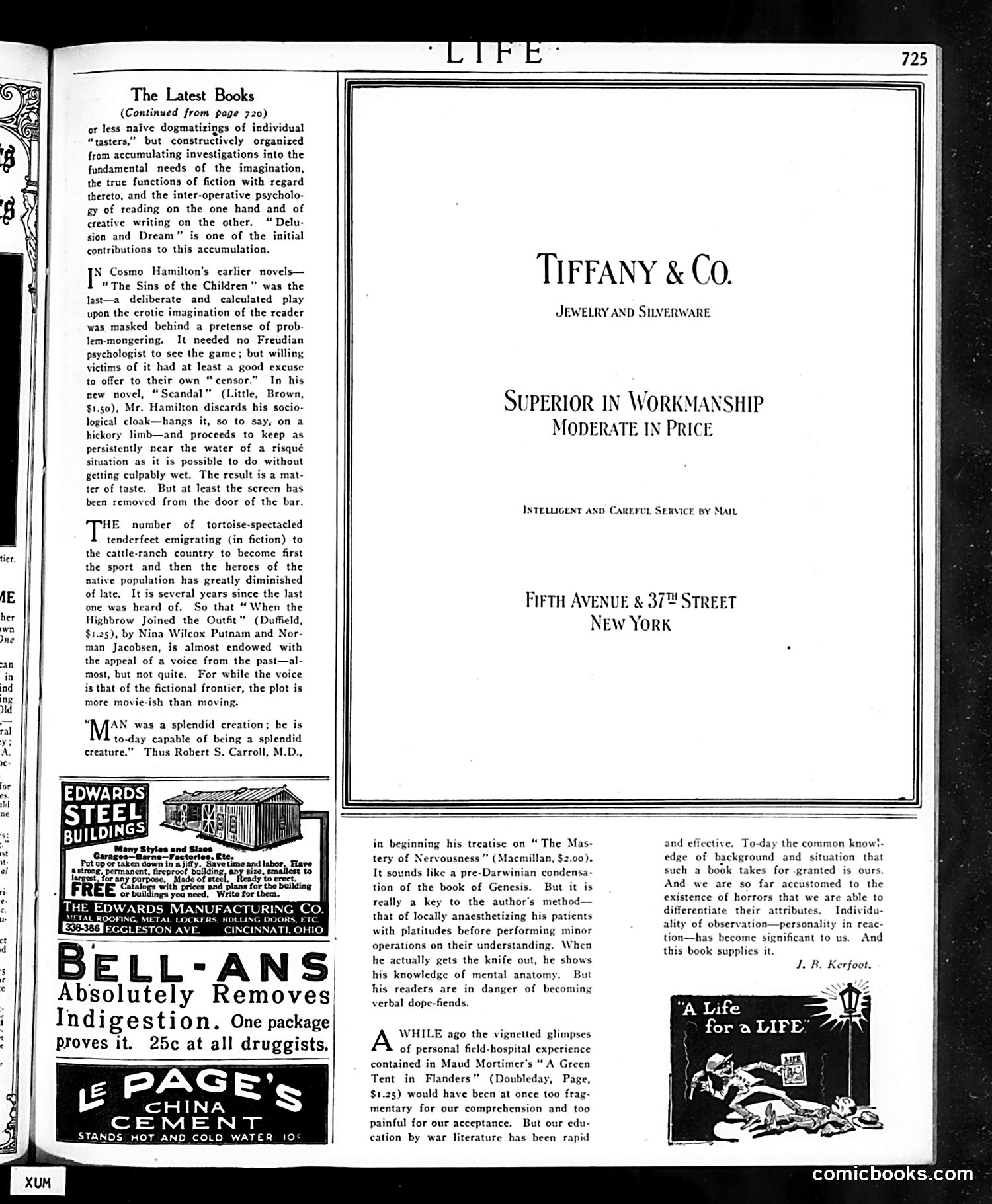
What you’re looking at
This page is primarily a book review section and advertising, not a political cartoon. The left column contains literary criticism of recent novels, discussing works by Cosmo Hamilton, Nina Wilcox Putnam, Norman Jacobsen, Robert S. Carroll, and Maud Mortimer. The reviewer examines themes and methods in contemporary fiction. The right side features advertisements, including a prominent Tiffany & Co. jewelry advertisement for their Fifth Avenue location. Below are ads for Edwards Steel Buildings, Bell-Ans indigestion remedy, and Le Page's cement. There are no political cartoons, satirical illustrations, or recognizable caricatures on this page—it is a standard magazine layout of book reviews and period advertisements typical of *Life* magazine's editorial format.
📄 Transcribed text from this page (OCR, searchable)
Machine-transcribed from the original scan — historical spelling and the odd misread are preserved.
tier. Ine The Latest Books (Continued from page 720) or less naive dogmatizings of individual “tasters,” but constructively organized from accumulating investigations into the fundamental needs of the imagination, the true functions of fiction with regard thereto, and the inter-operative psycholo- gy of reading on the one hand and of creative writing on the other. “ Delu- sion and Dream” is one of the initial contributions to this accumulation. N Cosmo Hamilton's earlier novels— “The Sins of the Children” was the last—a deliberate and calculated play upon the crotic imagination of the reader was masked behind a pretense of prob- lem-mongering. It needed no Freudian psychologist to see the game; but willing victims of it had at least a good excuse to offer to their own “censor.” In his new novel, “Scandal” (Little, Brown, $1.50), Mr. Hamilton discards his socio- logical cloak—hangs it, so to say, on a hickory limb—and proceeds to keep as persistently near the water of a risqué situation as it is possible to do without getting culpably wet. The result is a mat- ter of taste. But at least the screen has been removed from the door of the bar. HE number of tortoise-spectacled tenderfeet emigrating (in fiction) to the cattle-ranch country to become first the sport and then the heroes of the native population has greatly diminished of late, It is several years since the last one was heard of. So that “ When the Highbrow Joined the Outfit” (Duffield, $1.25), by Nina Wilcox Putnam and Nor- man Jacobsen, is almost endowed with the appeal of a voice from the past—al- most, but not quite. For while the voice is that of the fictional frontier, the plot is more movie-ish than moving. ‘AN was a splendid creation; he is to-day capable of being a splendid creature.” Thus Robert S. Carroll, M.D., tn TIFFANY & CO. JEWELRY AND SILVERWARE SUPERIOR IN WORKMANSHIP MODERATE IN PRICE INTELUGENT AND CAREFUL SERVICE BY MAIL FIFTH AVENUE & 37@ STREET NEw York Wu mm jay Stvioe a and ere Ete: | Cp otiaken down in: ajitts time and Have ate permanent. fireproof building, ony. a sie, asa 7 FE cola Made of steel, ‘tocrect. with and fc ye the Dull FRE tra atistetes THE TOWARDS MANUFACTURING CO. MCTAL ROOFING, METAL LOCKERS, ROLLING DOOR EXCEESEGGLESTON AV BELL-ANS. Absolutely Removes' Indig estion. One package proves a 25c at all ae CHINA be _SuINa 7 STANDS HOT AND COLD WATER 10¢ in beginning his treatise on “ The Mas- tery of Nervousness" (Macmillan, $2.00). It sounds like a pre-Darwinian condensa- tion of the book of Genesis, But it is really a key to the author's method— that of locally anaesthetizing his patients with platitudes before performing minor operations on their understanding. When he actually gets the knife out, he shows his knowledge of mental anatomy. But his readers are in danger of becoming verbal dope-fiends. WHILE ago the vignetted glimpses of personal ficld-hospital experience contained in Maud Mortimer’s “ A Green Tent in Flanders” (Doubleday, Page, $1.25) would have been at once too frag: mentary for our comprehension and too painful for our acceptance. But our edu- cation by war literature has been rapid and effective. To-day the common know!- edge of background and situation that such a book takes for granted is ours. And we are so far accustomed to the existence of horrors that we are able to differentiate their attributes. Individu- ality of observation—personality in reac- tion—has become significant to us. And this book supplies it. J. B. Kerfoot. ‘A Life for a LIFE” comicbooks.com