
Life, 1917-11-01 · page 6 of 38
Life — November 1, 1917 — page 6: what you’re looking at
What you’re looking at
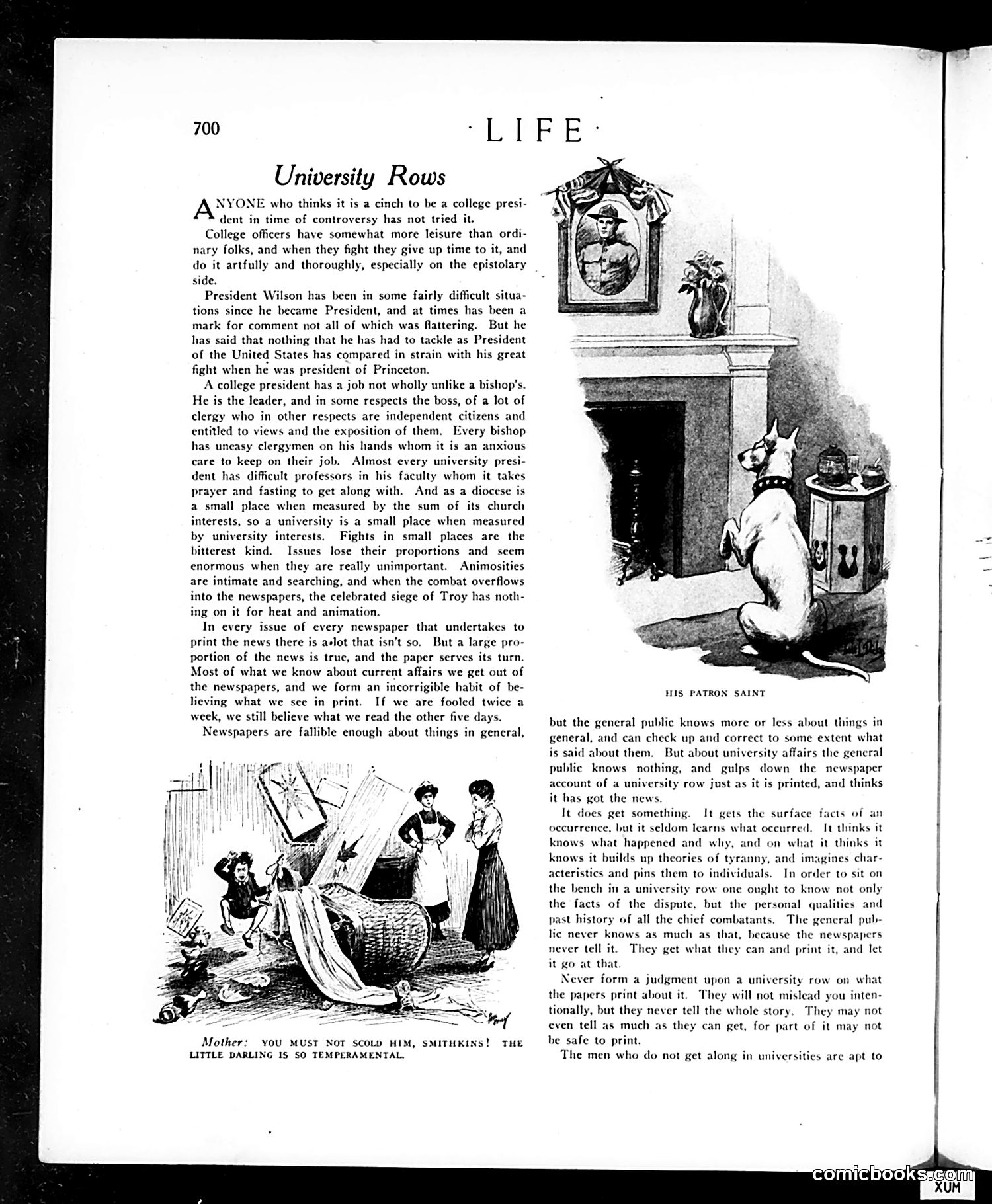
This article criticizes how newspapers cover university controversies, using President Wilson's tenure at Princeton as a reference point. The text argues that college disputes, while serious to those involved, become sensationalized in print and lose nuance. The two cartoons illustrate this theme: 1. **"His Patron Saint"** (top right): A dog worships at a shrine, likely satirizing blind devotion to authority figures in academic disputes. 2. **"Mother: You Must Not Scold Him, Smithkins!"** (bottom left): Shows a domestic scene where a child is protected from discipline, possibly suggesting universities coddle problematic figures rather than address issues directly. The satire suggests newspapers exaggerate academic conflicts while universities suppress facts, preventing public understanding of what actually occurs.
📄 Transcribed text from this page (OCR, searchable)
Machine-transcribed from the original scan — historical spelling and the odd misread are preserved.
University Rows ‘YONE who thinks it is a cinch to be a college presi- dent in time of controversy has not tried it. College officers have somewhat more leisure than ordi- nary folks, and when they fight they give up time to it, and do it artfully and thoroughly, especially on the epistolary side. President Wilson has been in some fairly difficult situa- tions since he became President, and at times has been a mark for comment not all of which was flattering. But he has said that nothing that he has had to tackle as President of the United States has compared in strain with his great fight when he was president of Princeton. A college president has a job not wholly unlike a bishop's. He is the leader, and in some respects the boss, of a lot of clergy who in other respects are independent citizens and entitled to views and the exposition of them. Every bishop has uneasy clergymen on his hands whom it is an anxious care to keep on their job. Almost every university presi- dent has difficult professors in his faculty whom it takes prayer and fasting to get along with. And as a diocese is a small place when measured by the sum of its church interests, so a university is a small place when measured by university interests. Fights in small places are the bitterest kind. Issues lose their proportions and seem enormous when they are really unimportant. Animosities are intimate and searching, and when the combat overflows into the newspapers, the celebrated siege of Troy has noth- ing on it for heat and animation. In every issue of every newspaper that undertakes to print the news there is aslot that isn’t so. But a large pro- portion of the news is true, and the paper serves its turn. Most of what we know about current affairs we get out of the newspapers, and we form an incorrigible habit of be- lieving what we see in print. If we are fooled twice a week, we still believe what we read the other five days. Newspapers are fallible enough about things in general, Mother: you MUST NOT SCOLD HIM, SMITHKIN LITTLE DARLING IS SO TEMPERAMENTAL. HIS PATRON SAINT but the general public knows more or less about things in general, and can check up and correct to some extent what is said about them. But about university affairs the gencral public knows nothing, and gulps down the newspaper account of a university row just as it is printed, and thinks it has got the news. It does get something. It gets the surface facts of an occurrence, but it seldom learns what occurred. It thinks it knows what happened and why, and on what it thinks it knows it builds up theories of tyranny, and imagines char- acteristics and pins them to individuals. In order to sit on the bench in a university row one ought to know not only the facts of the dispute, but the personal qualities and past history of all the chief combatants. The general pub- lic never knows as much as that, because the newspapers never tell it. They get what they can and print it, and let it go at that. Never form a judgment upon a university row on what the papers print about it. They will not mislead you inten- tionally, but they never tell the whole story. They may not even tell as much as they can get, for part of it may not be safe to print. The men who do not get along in universities are apt to