
Life, 1917-11-01 · page 17 of 38
Life — November 1, 1917 — page 17: what you’re looking at
What you’re looking at
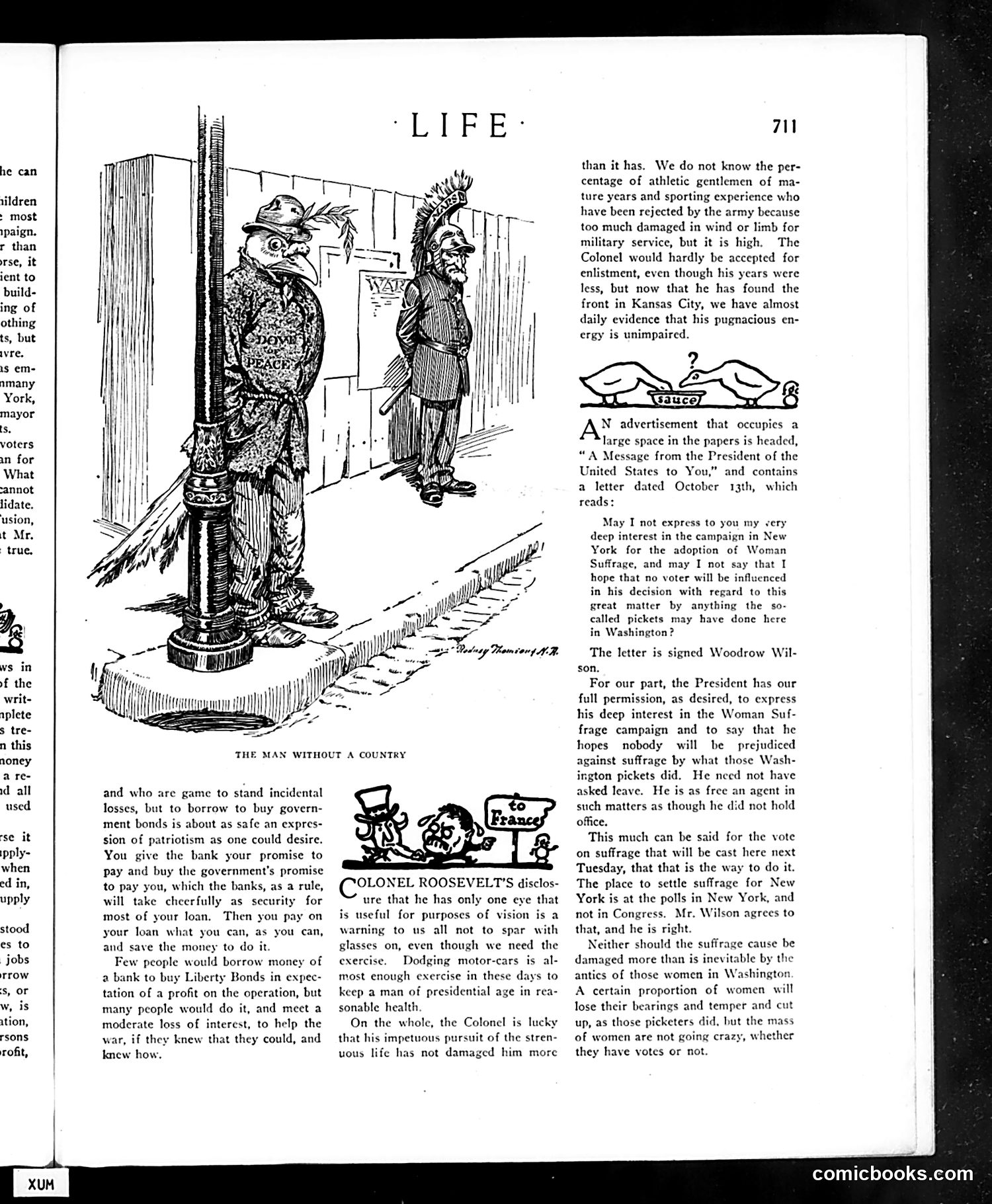
The cartoon depicts two caricatured figures — one appears to be a German soldier (left, heavily decorated uniform) confronting an American soldier (right). The title "The Man Without a Country" references Edward Everett Hale's Civil War-era story about patriotic duty. The accompanying text discusses Colonel Theodore Roosevelt's disclosure that he has only one functional eye, yet remains physically vigorous and politically active in Kansas City. The satire suggests Roosevelt's continued aggressive "strenuous life" pursuits despite his age and disabilities — ironically comparing his vigor to actual soldiers rejected from WWI service due to injury. The page also contains a message from President Woodrow Wilson regarding New York's women's suffrage vote, encouraging voters not to be prejudiced against suffrage by Washington picketers' tactics. The text defends both Wilson's right to express support and women's right to vote, while gently criticizing suffrage activists' disruptive methods.
📄 Transcribed text from this page (OCR, searchable)
Machine-transcribed from the original scan — historical spelling and the odd misread are preserved.
he can lildren > most .paign. r than rse, it ient to build- ing of othing ts, but wre. 1s em- nmany York, mayor is, voters, in for What cannot lidate. ‘usion, t Mr. ws in f the writ- aplete s tre- n this noney a re- id all used se it pply- when ed in, upply stood es to jobs rrow Ss, OF w, is ation, rsons rofit, THE MAN WITHOUT A COUNTRY and who are game to stand incidental losses, but to borrow to buy govern- ment bonds is about as safe an expres- sion of patriotism as one could desire. You give the bank your promise to pay and buy the government's promise to pay you, which the banks, as a rule, will take cheerfully as security for most of your loan. Then you pay on your loan what you can, as you can, and save the money to do it. people would borrow money of a bank to buy Liberty Bonds in expec- tation of a profit on the operation, but many people would do it, and meet a moderate loss of interest, to help the war, if they knew that they could, and knew how. 'OLONEL ROOSEVELT’S disclos- ure that he has only one eye that is useful for purposes of vision is a warning to us all not to spar with glasses on, even though we need the exercise. Dodging motor-cars is al- most enough exercise in these days to keep a man of presidential age in rea- sonable health On the whole, the Colonel is lucky that his impetuous pursuit of the stren- uous life has not damaged him morc 711 than it has. We do not know the per- centage of athletic gentlemen of ma- ture years and sporting experience who have been rejected by the army because too much damaged in wind or limb for military service, but it is high, The Colonel would hardly be accepted for enlistment, even though his years were less, but now that he has found the front in Kansas City, we have almost daily evidence that his pugnacious en- ergy is unimpaired. AN advertisement that occupies a large space in the papers is headed, “A Message from the President of the United States to You,” and contains a letter dated October 13th, which reads: May I not express to you my very deep interest in the campaign in New York for the adoption of Woman Suffrage, and may I not say that I hope that no voter will be influenced in his decision with regard to this great matter by anything the so- called pickets may have done here in Washington? The letter is signed Woodrow Wil- son. For our part, the President has our full permission, as desired, to express his deep interest in the Woman Suf- frage campaign and to say that he hopes nobody will be prejudiced against suffrage by what those Wash- ington pickets did. He need not have asked leave. He is as free an agent in such matters as though he did not hold office, This much can be said for the vote on suffrage that will be cast here next Tuesday, that that is the way to do it. The place to settle suffrage for New York is at the polls in New York, and not in Congress. Mr. Wilson agrees to that, and he is right. Neither should the suffrage cause be damaged more than is inevitable by the antics of those women in Washington. A certain proportion of women will lose their bearings and temper and cut up, as those picketers did, but the mass of women are not going crazy, whether they have votes or not. comicbooks.com