
Life, 1917-11-01 · page 8 of 38
Life — November 1, 1917 — page 8: what you’re looking at
What you’re looking at
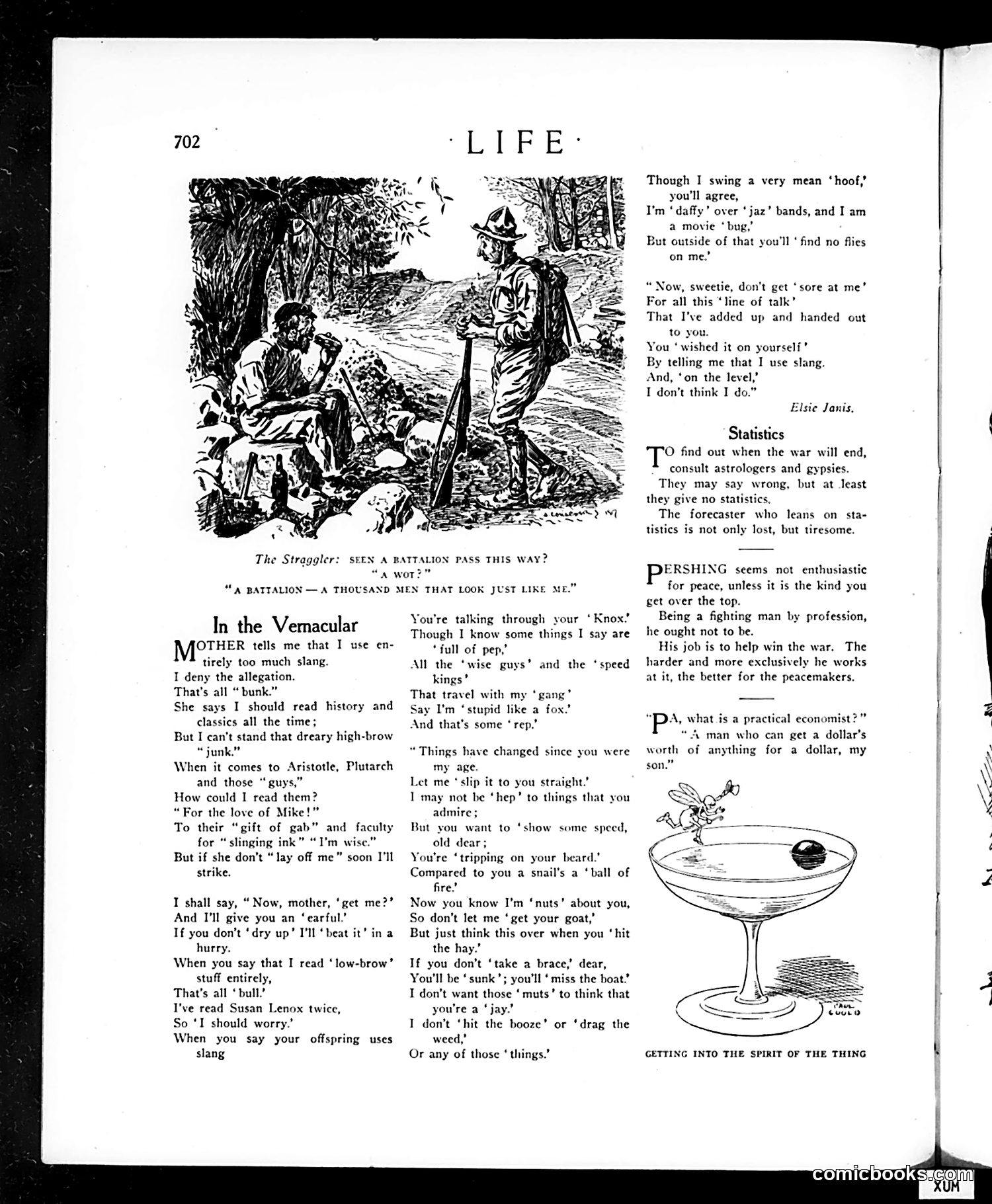
This page contains three distinct pieces of WWI-era satirical content: 1. **The Straggler illustration**: Shows soldiers encountering a tired, disheveled soldier asking if a battalion passed by. The caption jokes that the battalion consists of "a thousand men that look just like me"—satirizing the exhaustion and depleted state of soldiers. 2. **"In the Vernacular"**: A poem mocking how mothers defend their sons' use of slang and military language, contrasting "high-brow" literary standards with practical soldier speak. It pokes fun at generational and class-based attitudes toward language. 3. **"Statistics" and other brief pieces**: Short satirical quips about wartime forecasts, pacifism, and economics—suggesting skepticism toward predictions and idealistic peace proposals during active warfare. The overall tone critiques both military conditions and civilian attitudes toward war.
📄 Transcribed text from this page (OCR, searchable)
Machine-transcribed from the original scan — historical spelling and the odd misread are preserved.
The Straggler: seEN A BATTALION PASS THIS WAY? “a wot?” “(4 BATTALION — A THOUSAND MEN THAT LOOK JUST LIKE ME.” In the Vemacular OTHER tells me that I use en- tirely too much slang. I deny the allegation. That's all “ bunk.” She says I should read history and classics all the time; But I can’t stand that dreary high-brow “junk.” When it comes to Aristotle, Plutarch and those “guys,” How could I read them? “For the love of Mike!” To their ift of gab” and faculty for “slinging ink” “I'm wise.” But if she don’t “lay off me” soon I'll strike. I shall say, “Now, mother, ‘get me?’ And I'll give you an ‘earful.’ If you don’t ‘dry up’ I'll ‘beat it’ in a hurry. When you say that I read ‘low-brow’ stuff entirely, That’s all ‘ bull.” I've read Susan Lenox twice, So ‘I should worry.’ When you say your offspring uses slang You're talking through your ‘Knox? Though I know some things I say are ‘full of pep,’ All the ‘wise guys’ and the ‘speed kings’ That travel with my ‘gang’ Say I'm ‘stupid like a fox.’ And that’s some ‘rep.’ “Things have changed since you were my age. Let me ‘slip it to you straight”, 1 may not be ‘hep’ to things that you admire; But you want to ‘show some speed, old dear; You're ‘tripping on your beard.’ Compared to you a snail's a ‘ball of fire.” Now you know I'm ‘nuts’ about you, So don't let me ‘get your goat,’ But just think this over when you ‘hit the hay.’ If you don’t ‘take a brace,’ dear, You'll be ‘sunk’; you'll ‘ miss the boat.” I don't want those ‘ muts’ to think that you're a ‘jay.’ I don’t ‘hit the booze’ or ‘drag the weed,’ Or any of those ‘things.’ Though I swing a very mean ‘hoof,’ you'll agree, I'm ‘daffy’ over ‘jaz’ bands, and I am a movie ‘bug,’ But outside of that you'll ‘find no flies on me.’ “Now, sweetie, don’t get ‘sore at me’ For all this “line of talk’ That I've added up and handed out to you. You ‘wished it on yourseli’ By telling me that I use slang. And, ‘on the level,’ I don't think I do.” Elsie Janis, Statistics 'O find out when the war will end, * consult astrologers and gypsies. They may say wrong, but at least they give no statistics, The forecaster who leans on sta- tistics is not only lost, but tiresome. ERSHING seems not enthusiastic for peace, unless it is the kind you get over the top. Being a fighting man by profession, he ought not to be. His job is to help win the war. The harder and more exclusively he works at it, the better for the peacemakers. “DA, what is a practical economist?” “A man who can get a dollar’s worth of anything for a dollar, my GETTING INTO THE SPIRIT OF THE THING ——— Oe \ \ \