
A complete issue · 40 pages · 1917
Life — October 18, 1917
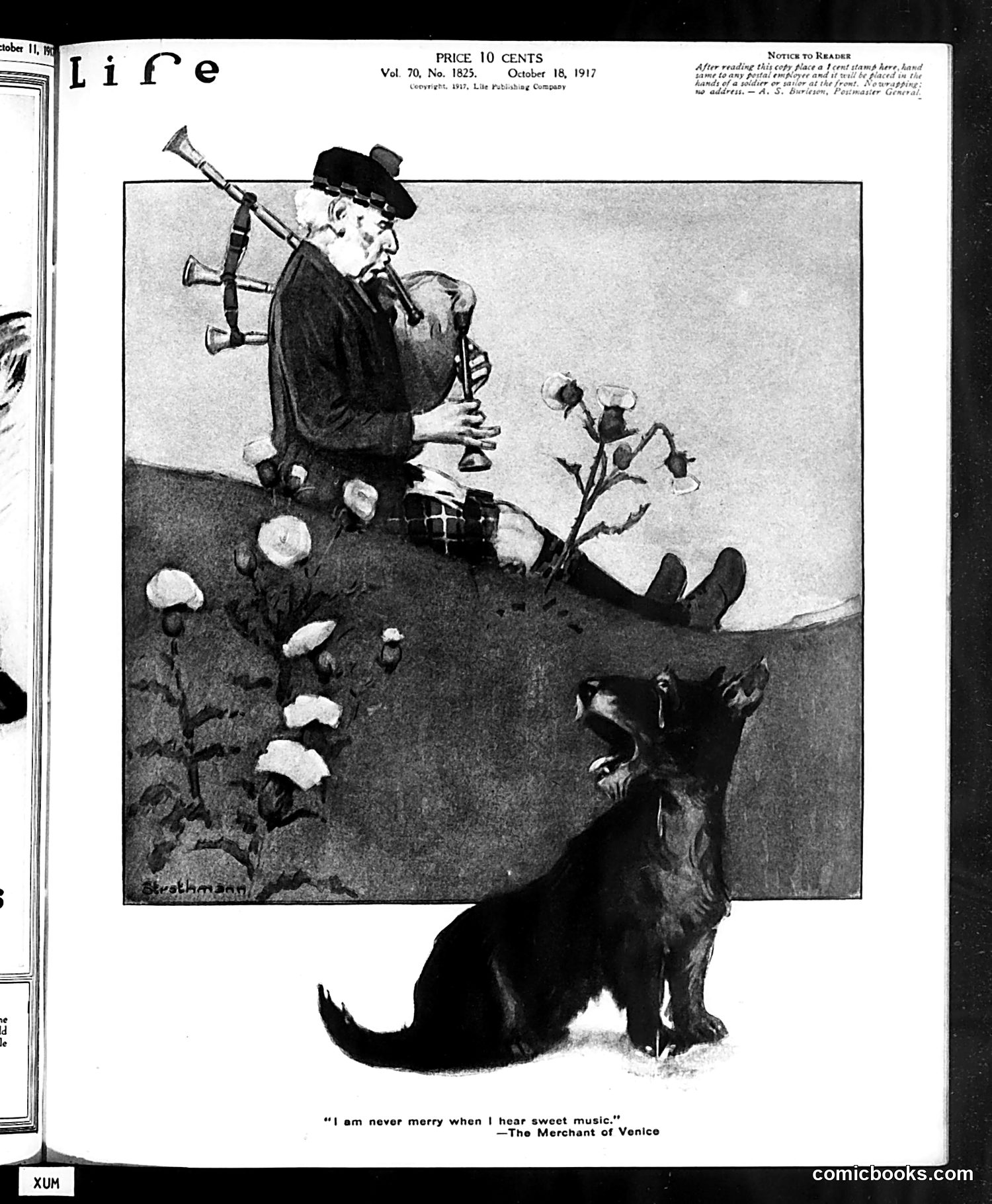
This satirical cartoon depicts a man sitting atop a hill surrounded by mushrooms, playing bagpipes while a dog listens below. The caption quotes Shakespeare's *Merchant of Venice*: "I am never merry when I hear sweet music." The image appears to satirize someone's tone-deaf behavior or misplaced priorities during World War I (the magazine date places this mid-war). The mushrooms likely reference poison or something toxic, suggesting the "music" (policies or statements) being produced is harmful rather than pleasant—a commentary on incompetent or counterproductive leadership. The dog's attentive posture creates ironic contrast with the Shakespeare quote, implying the listener cannot escape this unpleasant "music." The overall message critiques someone in power whose actions or words are causing public harm.
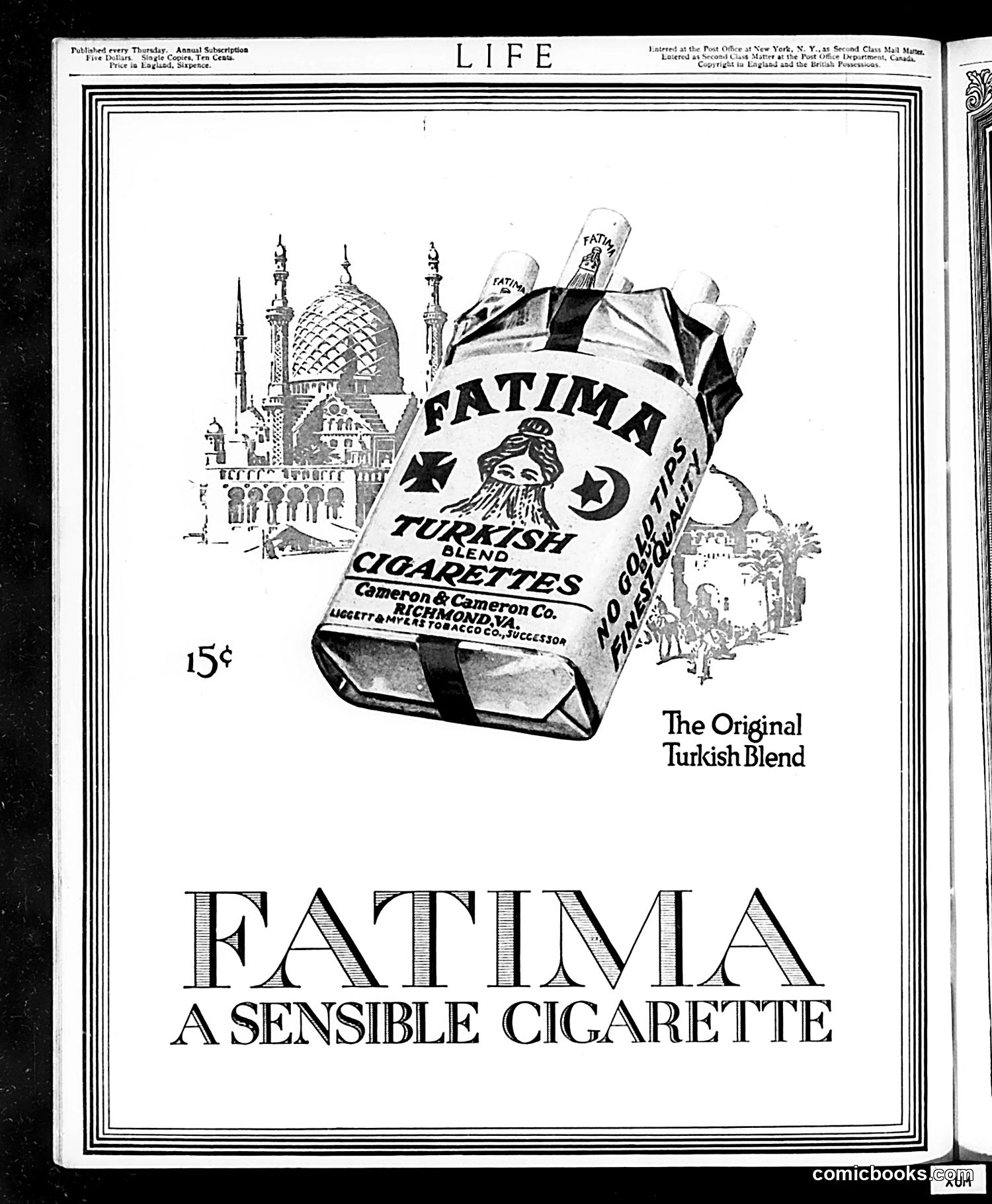
This is primarily a **cigarette advertisement**, not political satire. The page promotes Fatima Turkish Blend Cigarettes, manufactured by Cameron & Cameron Co. of Richmond, Virginia. The ad features an ornate Ottoman mosque with minarets in the background, establishing an "exotic Turkish" brand identity. A large cigarette package dominates the center with decorative ribbons and the Fatima brand name prominently displayed. The tagline "The Original Turkish Blend" and "A Sensible Cigarette" suggest the product positioned itself as sophisticated and reasonable compared to competitors. The 15¢ price point indicates early 20th-century pricing. The exotic architectural imagery was common marketing strategy of the era, associating the product with romantic foreign allure to appeal to American consumers.
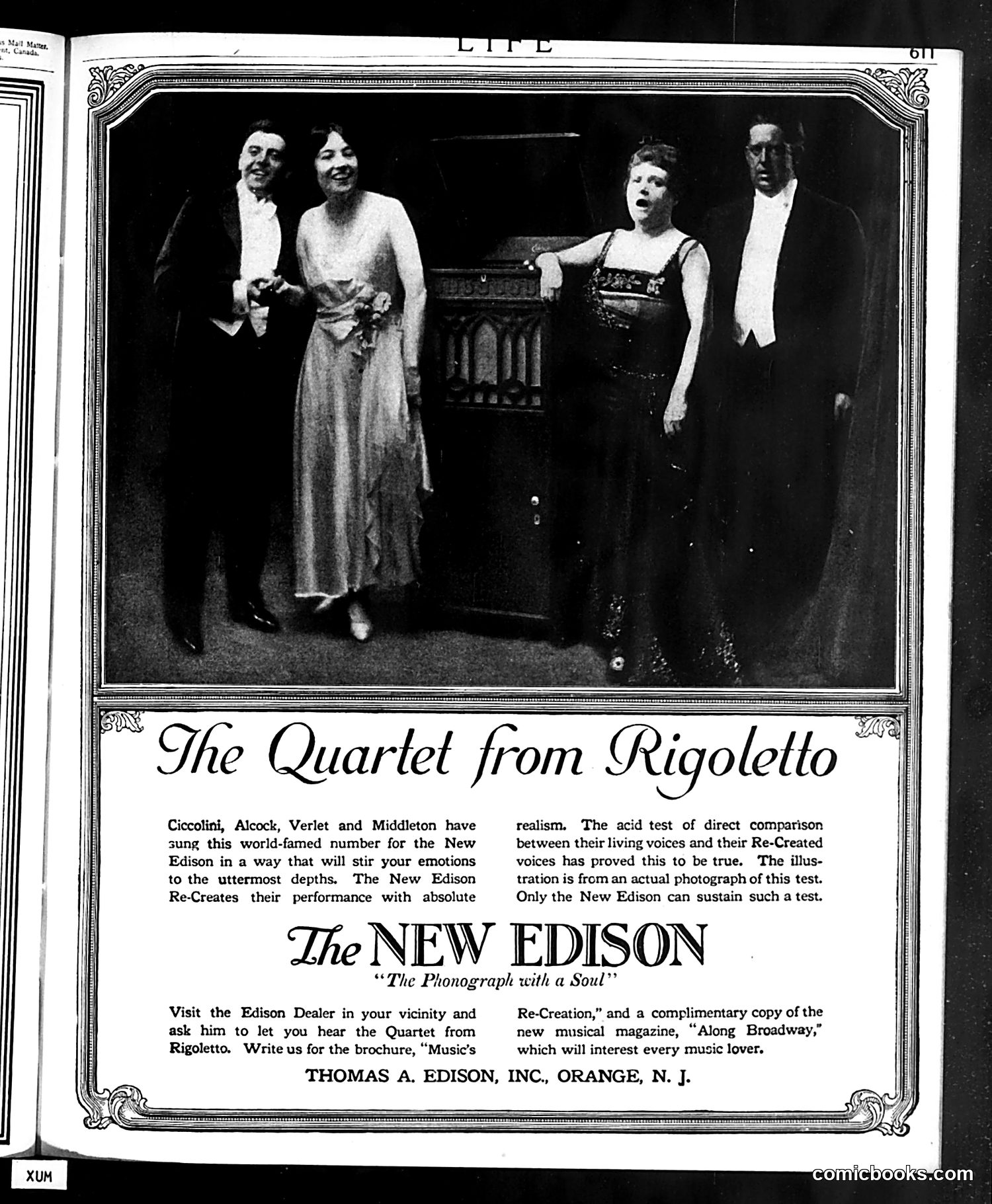
This is primarily an **advertisement**, not satire. It promotes Thomas A. Edison's phonograph technology by claiming the New Edison can "Re-Create" performances with such fidelity that listeners cannot distinguish recorded voices from live singers. The ad features four performers (identified as Ciccolini, Alcock, Verlet, and Middleton) performing the famous quartet from Verdi's opera *Rigoletto*. Edison's marketing pitch emphasizes that the phonograph reproduces music "with absolute realism"—so convincingly that direct comparison between live and recorded performances proves the technology's superiority. The tagline "The Phonograph with a Soul" positions Edison's device as capturing not mere mechanical sound, but genuine artistic expression. This represents early 1920s advertising rhetoric celebrating technological advancement.
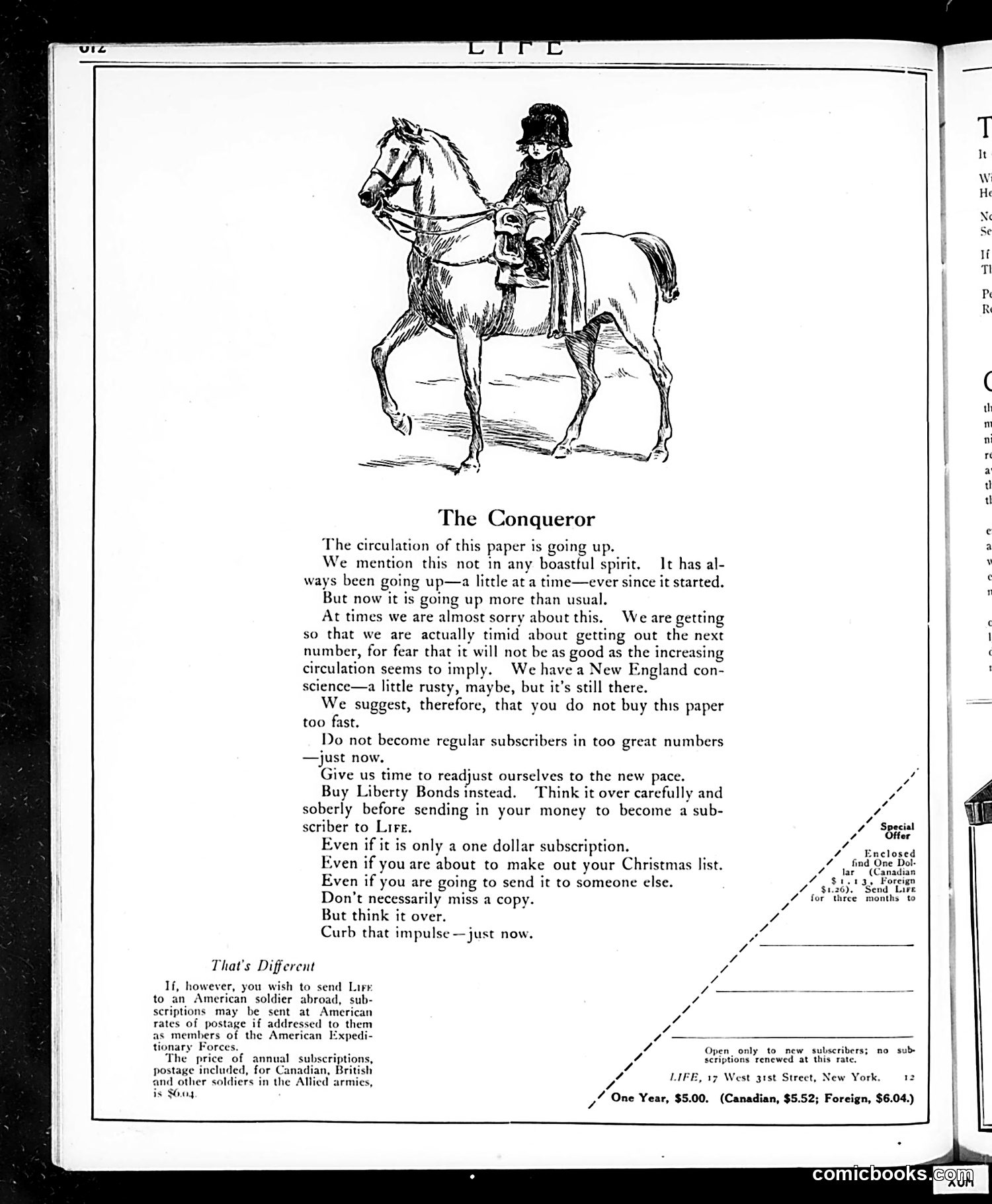
This page is primarily a subscription advertisement for *Life* magazine, not political satire. The illustration shows a figure in military dress on horseback, titled "The Conqueror"—likely referencing Napoleon, a common symbol of ambition and conquest. The advertisement's actual message concerns *Life's* rising circulation during what appears to be World War I (references to American soldiers abroad and Liberty Bonds suggest this era). The magazine humorously warns readers not to subscribe too quickly, claiming they're struggling to keep up with demand and need time to adjust production. This reverse-psychology pitch—asking people to *not* buy—serves as self-promotional humor while simultaneously urging readers to consider Liberty Bonds as an alternative investment, reflecting wartime patriotic messaging.
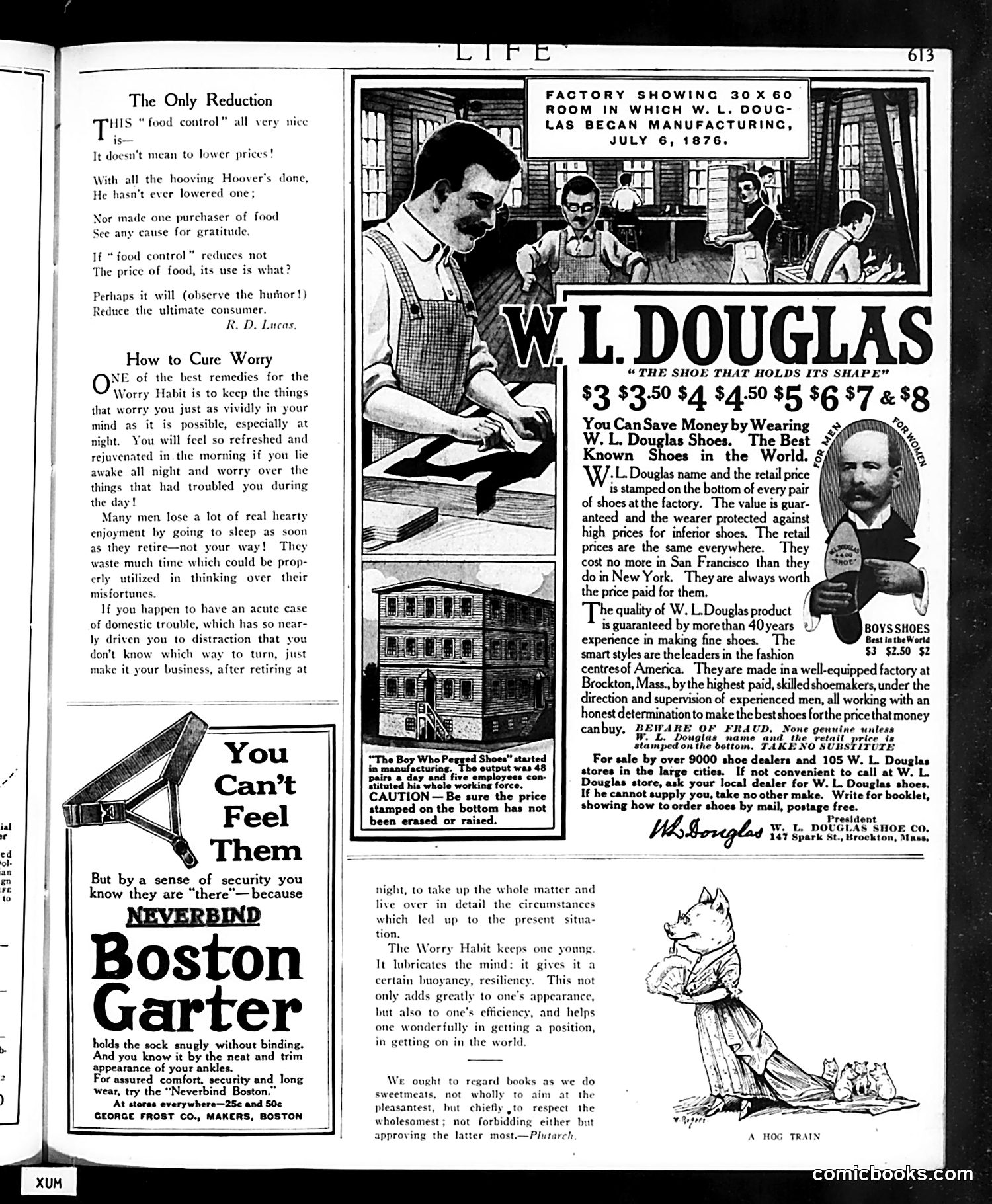
This page is primarily **advertisements** with limited satirical content. The main political element appears in "The Only Reduction" essay (top left), which critiques Herbert Hoover's "food control" policies during what seems to be WWI rationing. The author argues Hoover's measures don't actually lower prices for consumers—only the ultimate buyer benefits. This satirizes government food management as ineffective price control. The rest of the page consists of commercial ads: W.L. Douglas shoes (prominent center-right), Boston Garter socks (left), and others. The Douglas shoe advertisement includes a factory image dated July 6, 1876, and emphasizes quality and fair pricing. The "How to Cure Worry" and "You Can't Feel Them" sections offer lifestyle advice rather than satire. A small "Hog Train" cartoon appears at bottom right—apparently humorous but lacking clear political meaning in this context.
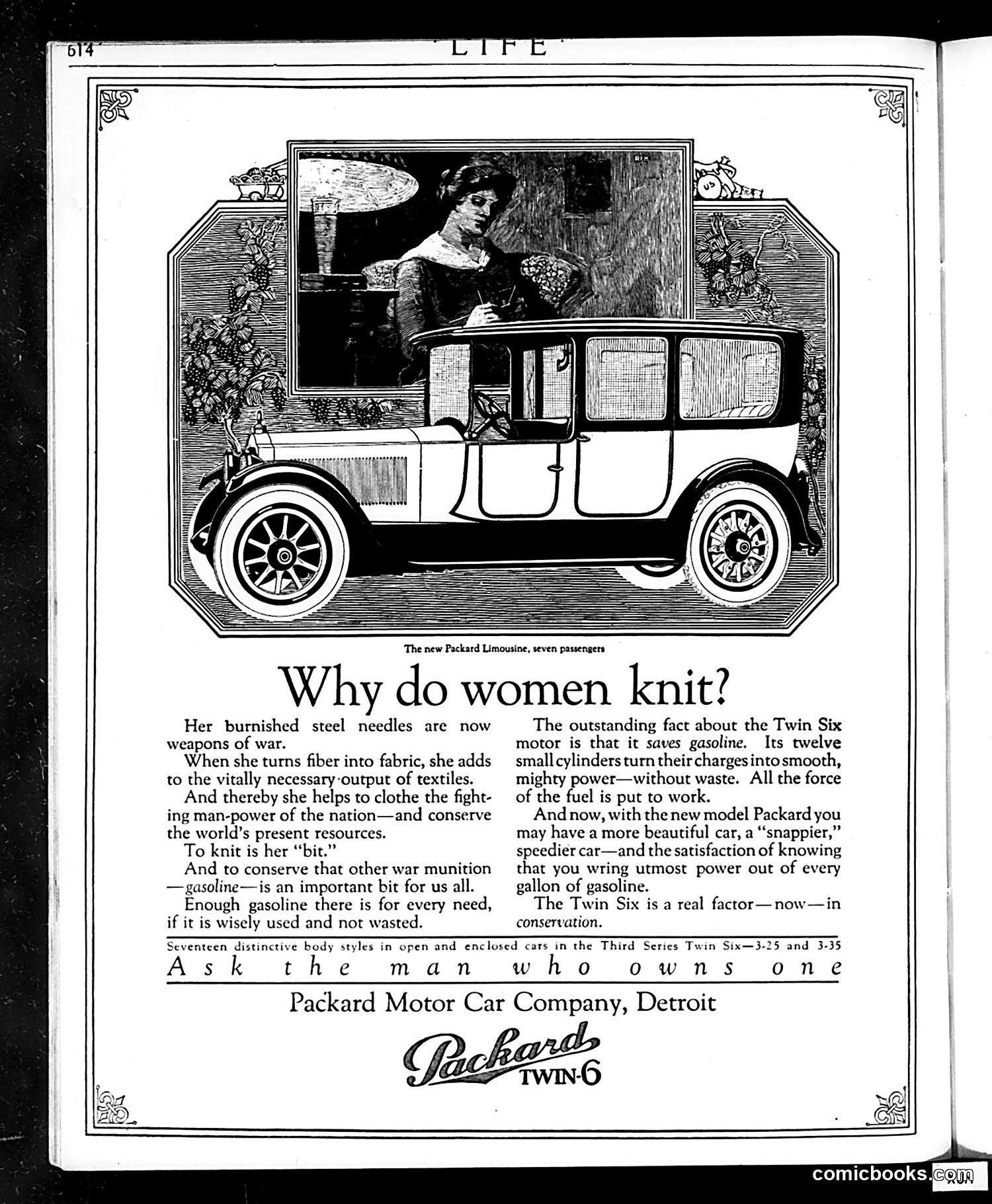
This is primarily a **Packard automobile advertisement**, not political satire. The ad uses World War I patriotism to market the new Packard Twin-Six limousine. The central image shows a well-dressed woman knitting in the car. The ad's headline "Why do women knit?" connects women's wartime knitting (producing socks, scarves, and other supplies for soldiers) to fuel conservation. The copywriter argues that just as women's knitting conserves resources for "the fighting man-power of the nation," efficient cars conserve gasoline—another crucial wartime resource. The appeal blends **gender stereotypes** (women as homemakers), **patriotic duty**, and **consumerism**: buying this specific car becomes an act of patriotic conservation. The technical details about the Twin-Six motor emphasize fuel efficiency as a selling point during wartime rationing.
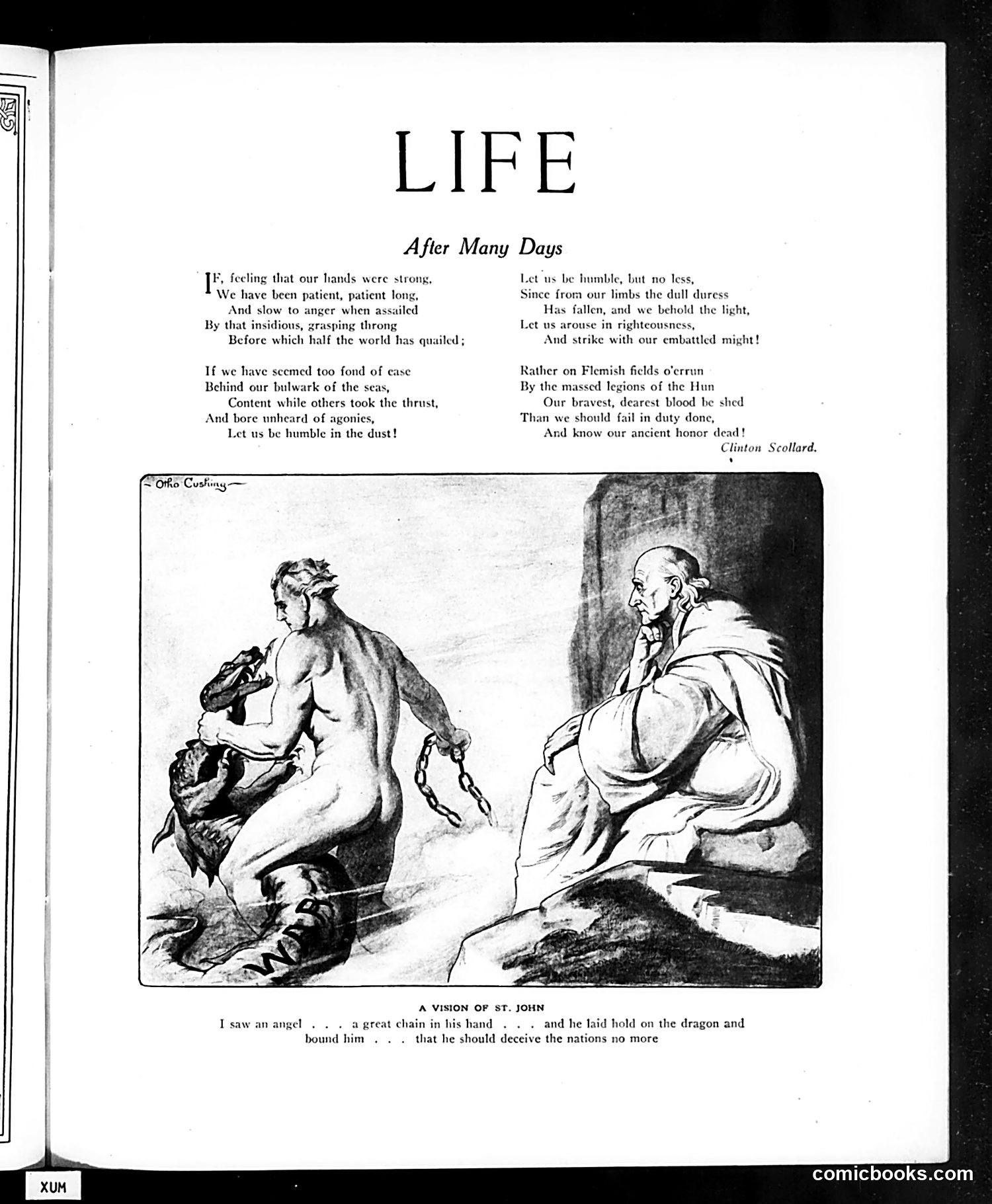
This page features a patriotic poem by Clinton Scollard alongside an illustration labeled "A Vision of St. John." The poem celebrates military strength and honor, invoking imagery of "Flemish fields" and sacrifice—likely referencing World War I combat. The illustration, credited to Otto Cushing, depicts a biblical scene: an angel constraining a dragon with a chain. The caption references Revelation, where an angel binds Satan to prevent deceiving nations. The visual appears to use religious symbolism to suggest divine intervention against destructive forces—possibly representing hope that evil (the dragon/Satan) would be restrained during wartime. Together, the poem and illustration frame military conflict as spiritually justified, blending patriotic and religious themes common in WWI-era American propaganda.
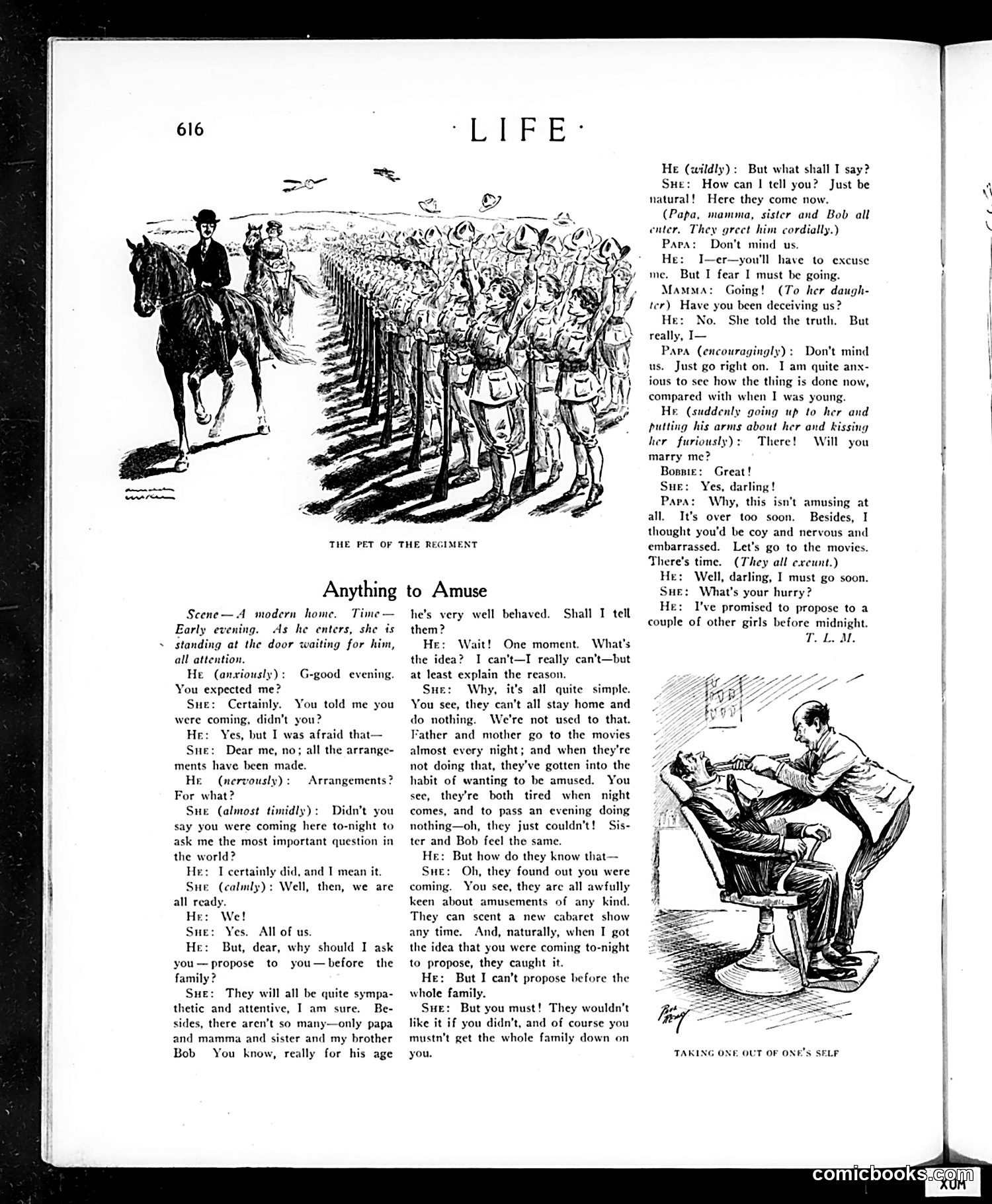
This page contains a romantic comedy sketch about a young man proposing to his girlfriend before taking her to meet his family. The humor centers on generational differences in courtship and entertainment. The dialogue reveals that the protagonist's parents frequently attend movies for amusement—a modern entertainment habit the younger generation considers somewhat embarrassing and old-fashioned. The girlfriend worries about making a good impression, while the young man must propose before introducing her to his family to secure their approval. The two illustrations show typical early 20th-century domestic scenes: the regimental procession at top depicts soldiers, while the lower cartoon shows a couple in a parlor setting, captioned "Taking One Out of One's Self"—likely referencing courtship rituals and the novelty of cinema as popular entertainment for all social classes.
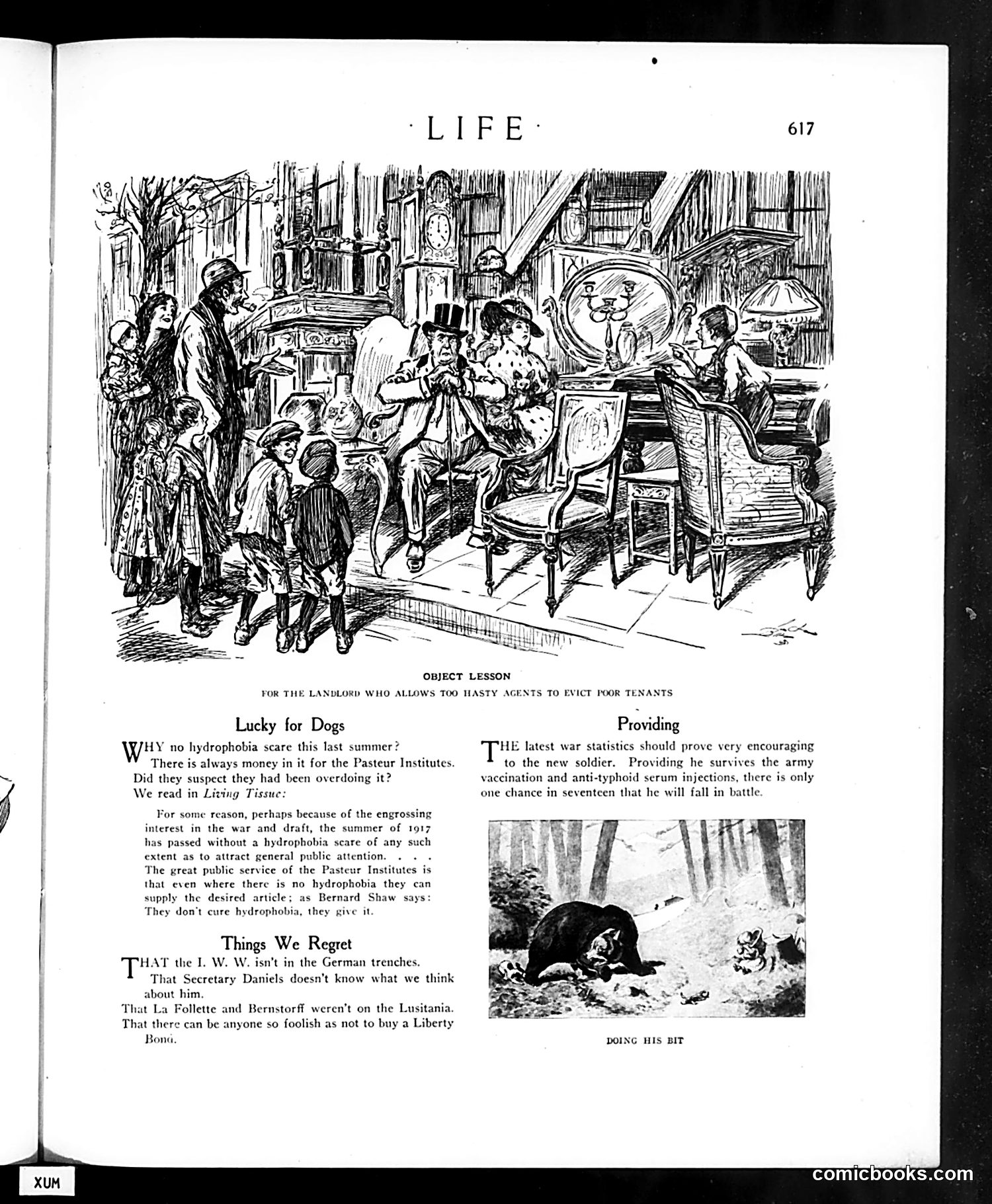
The top illustration is captioned "Object Lesson: For the Landlord Who Allows Too Hasty Agents to Evict Poor Tenants." It depicts a crowded interior scene with various figures and furniture, satirizing landlords who use overzealous agents to evict tenants, apparently commenting on housing injustice. Below are three brief commentary sections: "Lucky for Dogs" discusses hydrophobia concerns and the Pasteur Institutes; "Things We Regret" lists wartime-related regrets (I.W.W., Secretary Daniels, La Follette, Bernstorf, and the Lusitania); and "Providing" notes war statistics and soldier vaccination rates. A photograph labeled "Doing His Bit" shows a dog in a trench, reinforcing animal service themes during wartime. The page appears to address early 20th-century social and wartime concerns.
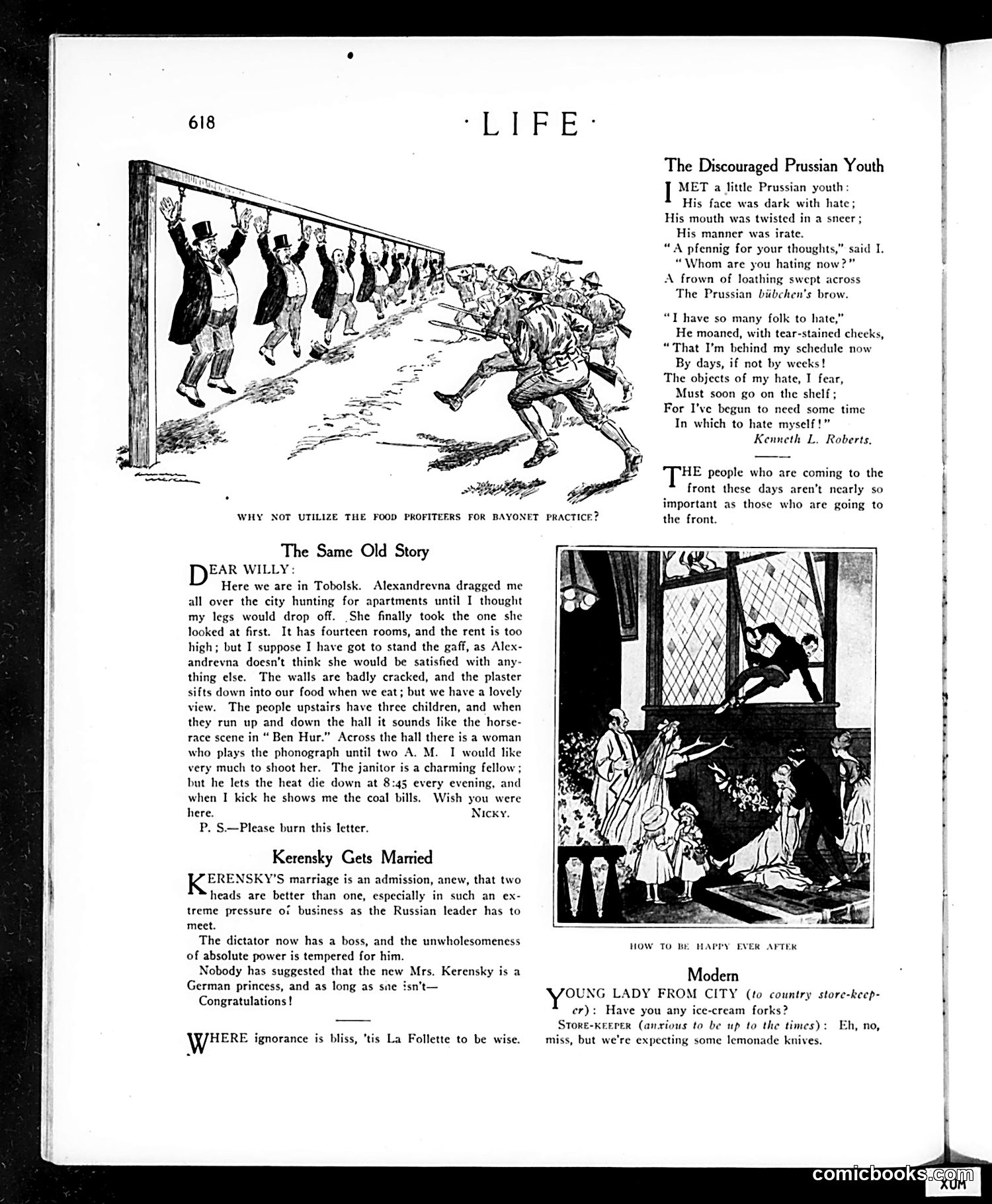
The top cartoon satirizes Prussian militarism during World War I. It depicts a young Prussian soldier consumed by hatred—his face "dark with hate," twisted in anger. The accompanying poem by Kenneth L. Roberts shows him hating various groups ("folk to hate"), including those behind the front lines and even himself. The soldiers on the left represent the approved military establishment he's meant to emulate. The satire critiques how Prussian military culture systematized hatred as a virtue, warping youth into instruments of perpetual rage. The juxtaposition of gleeful officers with the tormented young soldier underscores the human cost of this ideology. Below are lighter pieces: personal correspondence about housing in Tobolsk and congratulations on Kerensky's marriage, reflecting post-Russian Revolution chaos.
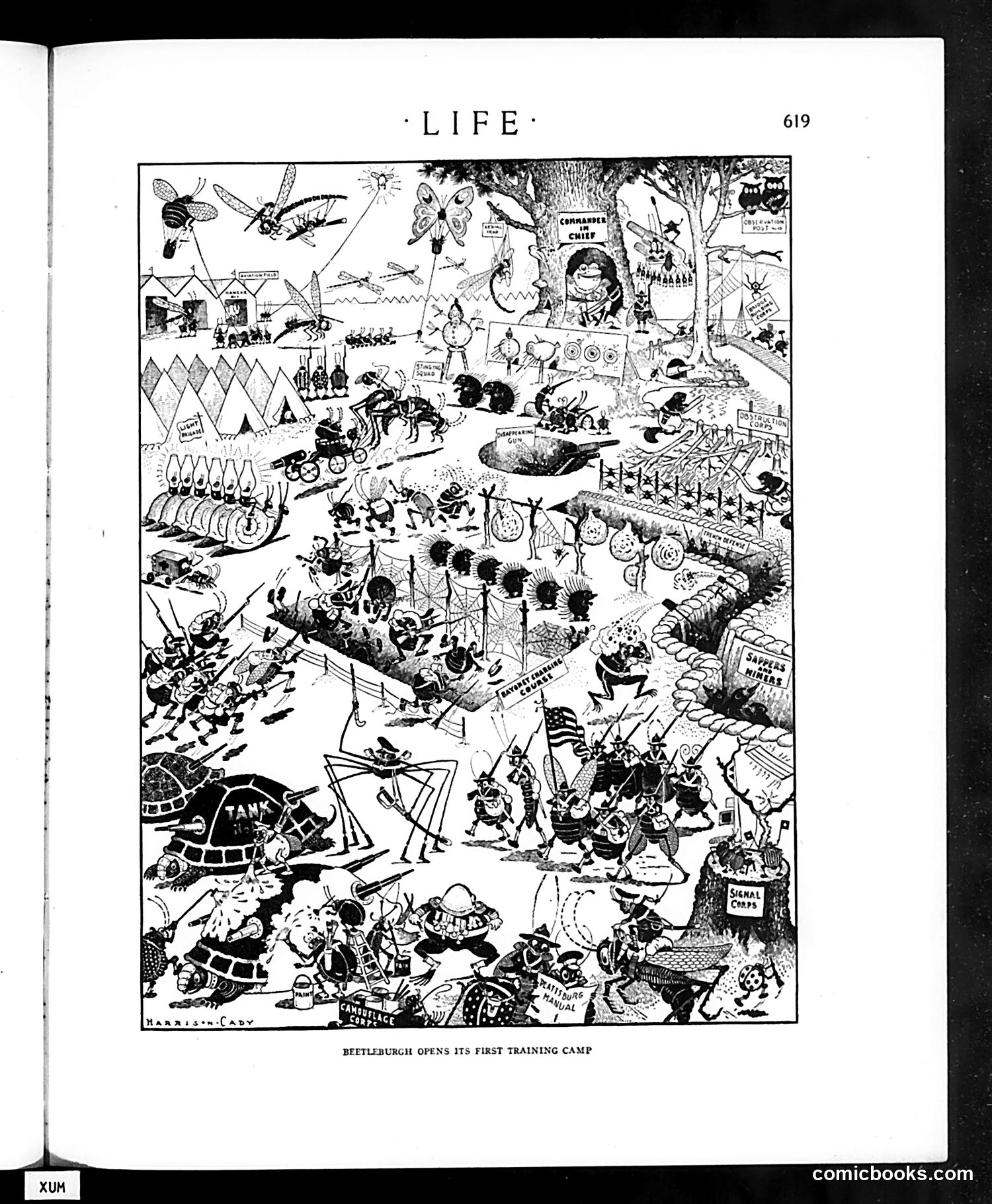
This is a single satirical illustration by Harrison Cady depicting an insect community establishing a military training camp. The cartoon anthropomorphizes beetles, ants, grasshoppers, and other insects as if they were human soldiers and civilians organizing for war. The satire likely comments on militarization and war preparation, presenting the serious business of military training as absurd when performed by insects. The detailed chaos—with tiny tents, marching formations, equipment, and flags—parodies how human societies mobilize for conflict. Published in *Life* magazine (page 619), this appears to be social commentary on contemporary military buildup, possibly during a period of international tension, though the specific historical moment remains unclear without publication date context.
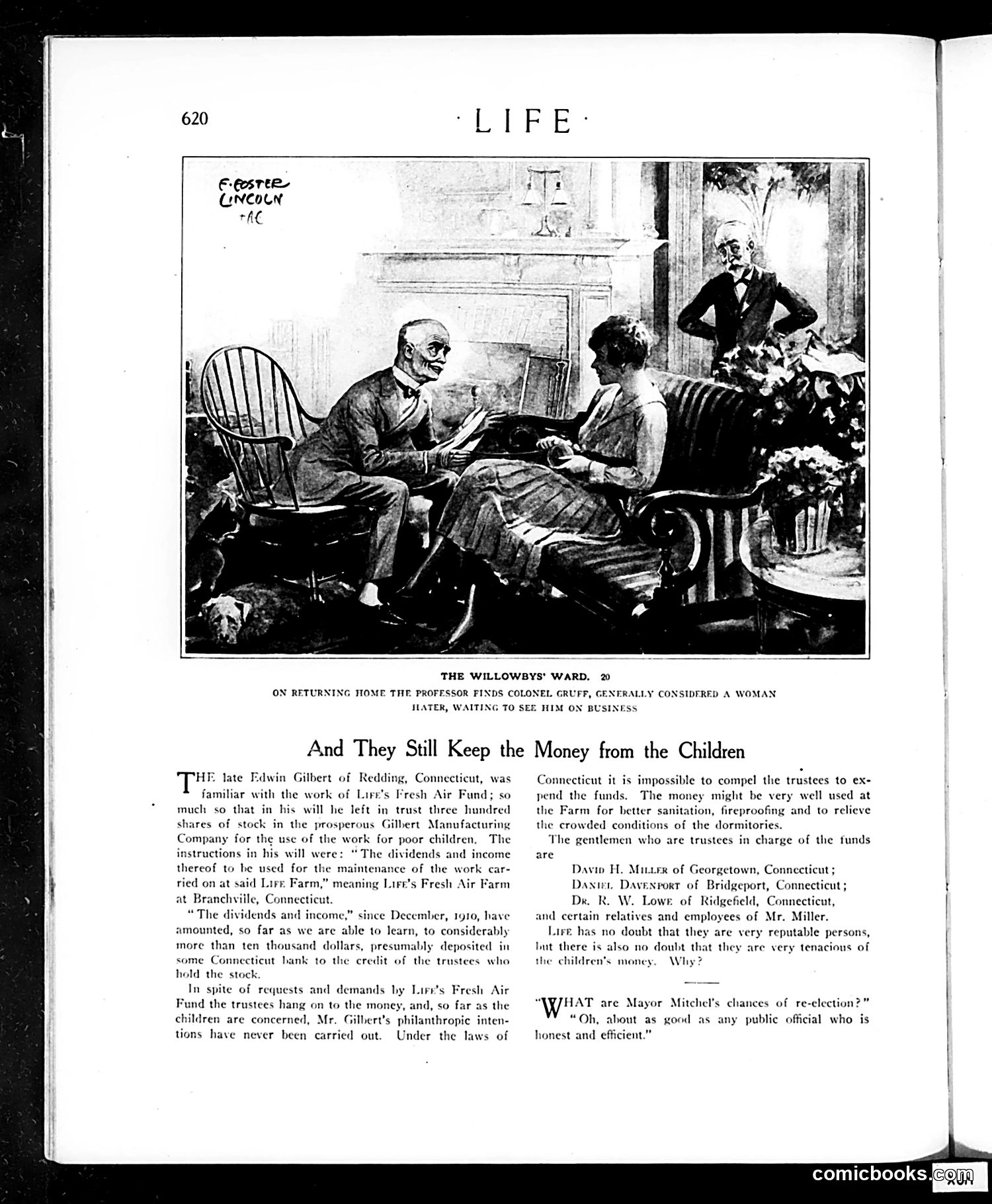
This page contains a serialized cartoon strip titled "The Willowbys' Ward" (panel 20), depicting a domestic scene where a man and woman converse while an elderly gentleman stands nearby—apparently a Colonel Gruff awaiting business. Below this is an article titled "And They Still Keep the Money from the Children," criticizing trustees managing Edwin Gilbert's bequest to Lirr's Fresh Air Fund. The article alleges that despite receiving substantial donations, the funds intended for poor children's welfare have been diverted or withheld. Named trustees include David H. Miller, Daniel Davenport, and Dr. R. W. Lowe. The piece satirizes how charitable organizations' management can fail their intended beneficiaries, with a closing joke about Mayor Mitchell's re-election prospects.
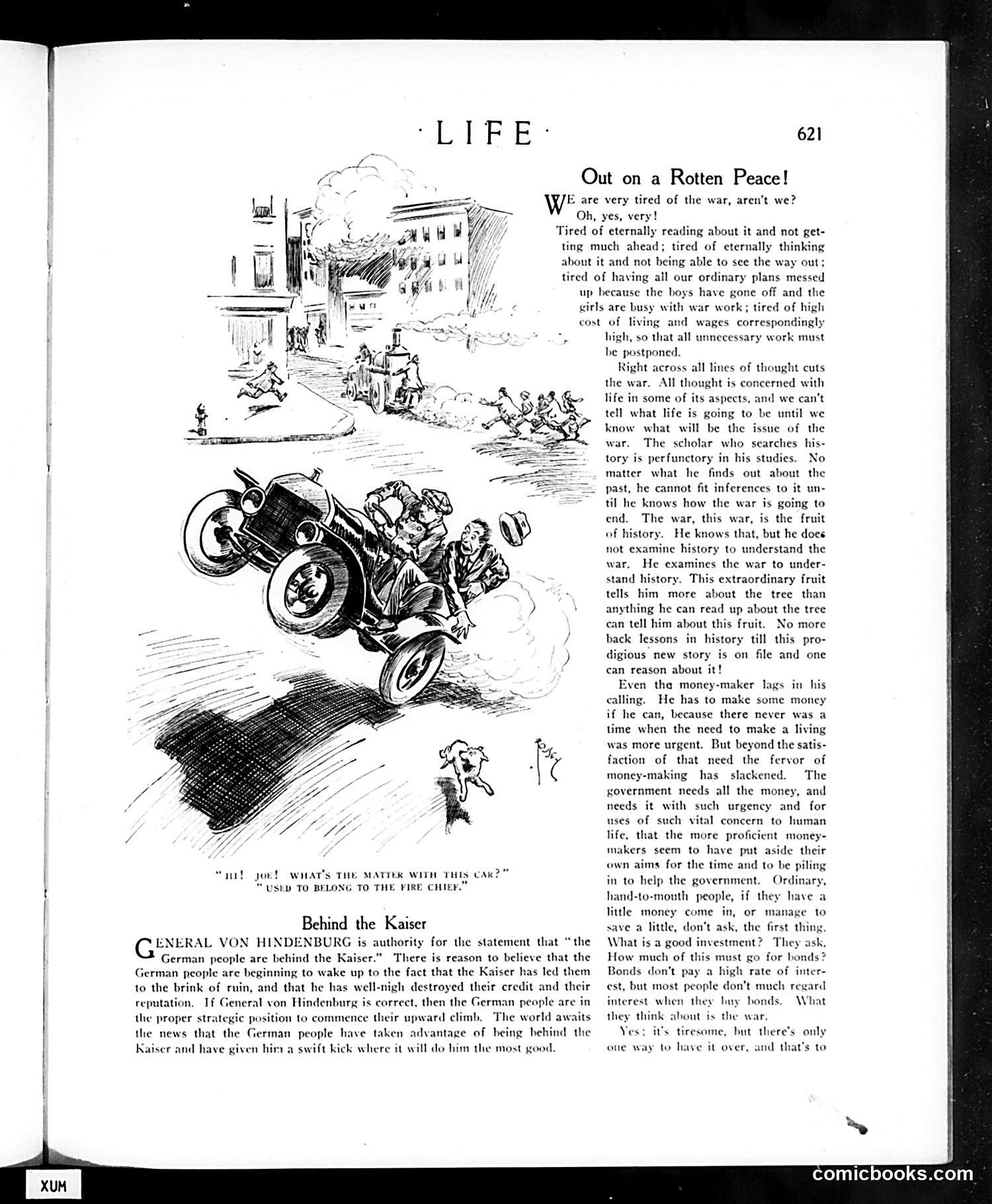
**Main Cartoon:** The illustration shows a motorcar that "used to belong to the fire chief" being driven recklessly, with the caption asking "Hi! you! What's the matter with this car?" The satire depicts wartime civilian hardship—likely referencing vehicle requisitioning or fuel rationing during World War I, when vehicles were commandeered for military use. **"Behind the Kaiser" Article:** This section discusses whether German people support Kaiser Wilhelm II, suggesting they've been led to ruin and destroyed their nation's credit. The text argues Germans should abandon him and "give him a swift kick where it will do him the most good"—dark satire advocating the Kaiser's overthrow during the war. **Overall Theme:** War's disruption of ordinary civilian life and critique of German leadership.
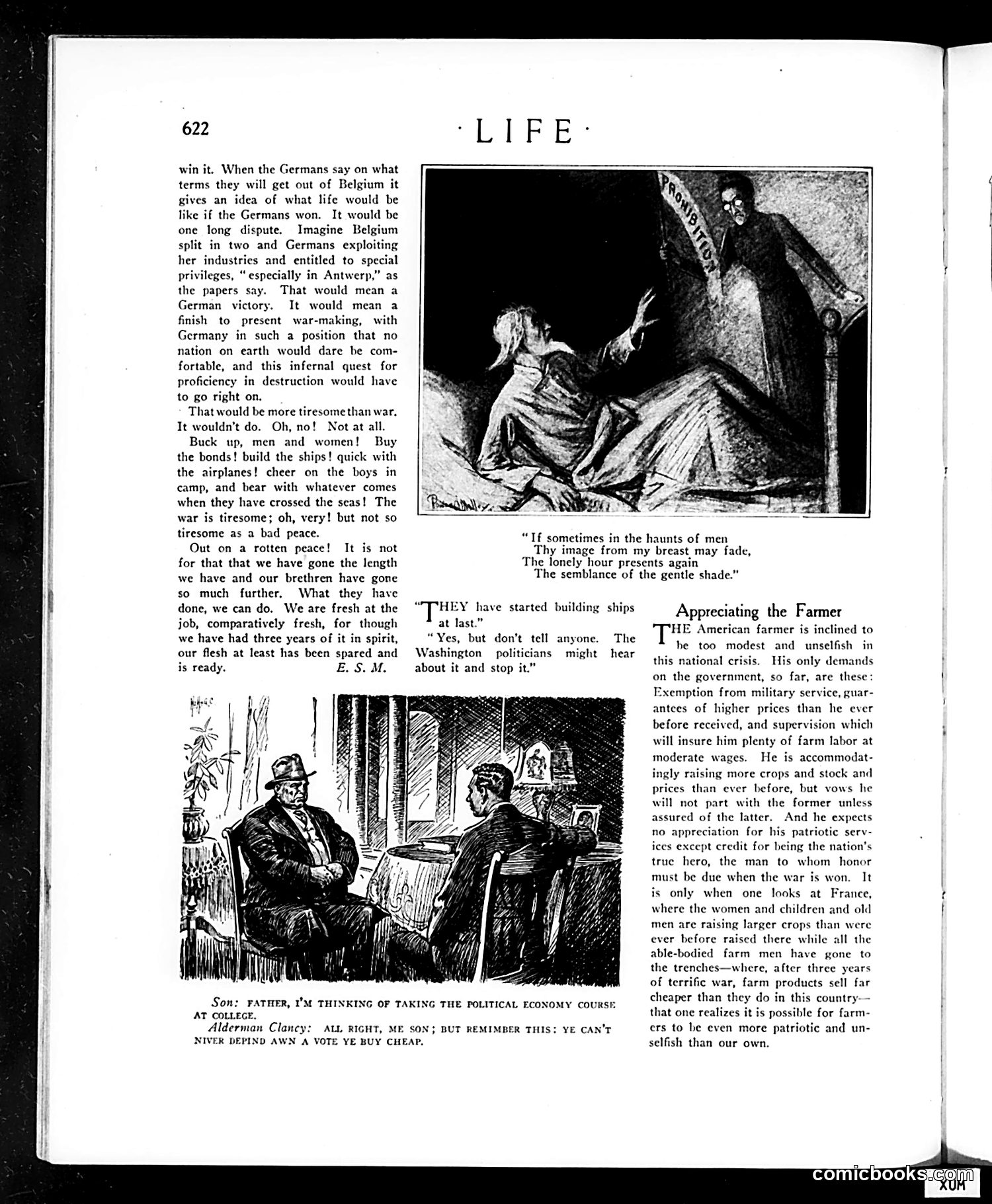
This page contains two distinct cartoons. The upper illustration depicts a classical allegorical figure, likely representing a nation or ideal, with accompanying verse about memory and gentleness—likely symbolic commentary on wartime sacrifice. The lower cartoon shows two men in conversation, labeled as "Alderman Clancy" and "Son." The son mentions taking a political economy course at college; Clancy responds: "All right, me son; but remember this: ye can't niver depend awn a vote ye buy cheap." This satirizes working-class political corruption—specifically, the practice of buying votes with minimal expenditure. The Irish names and dialect suggest commentary on urban machine politics and immigrant communities vulnerable to such manipulation. The joke critiques both voter corruptibility and the cheapness of those attempting to purchase political influence.
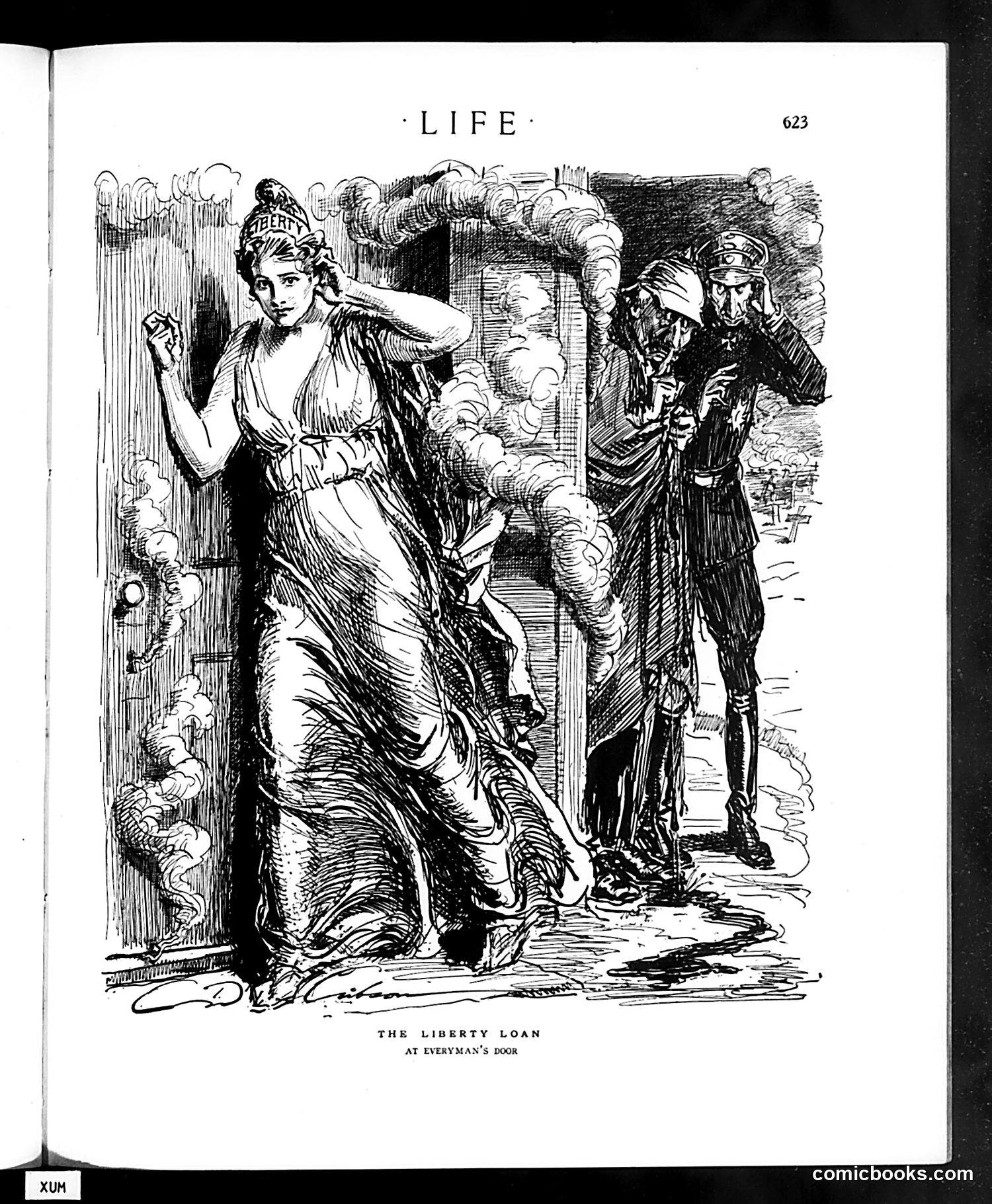
This illustration depicts a female allegorical figure of Liberty at a doorway, being solicited by two military officers. The caption indicates this refers to the "Liberty Loan"—government bonds sold to finance World War I. The satire appears to mock aggressive war-bond sales tactics, portraying Liberty herself as being pressured at her own door. The uniformed figures represent military or government authority literally bringing loan solicitation into private homes. The composition suggests the pervasiveness and insistence of wartime fundraising appeals to ordinary citizens ("everyman's door"). This reflects public sentiment during WWI about the omnipresent, somewhat coercive nature of mandatory patriotic participation in war financing through bond purchases.
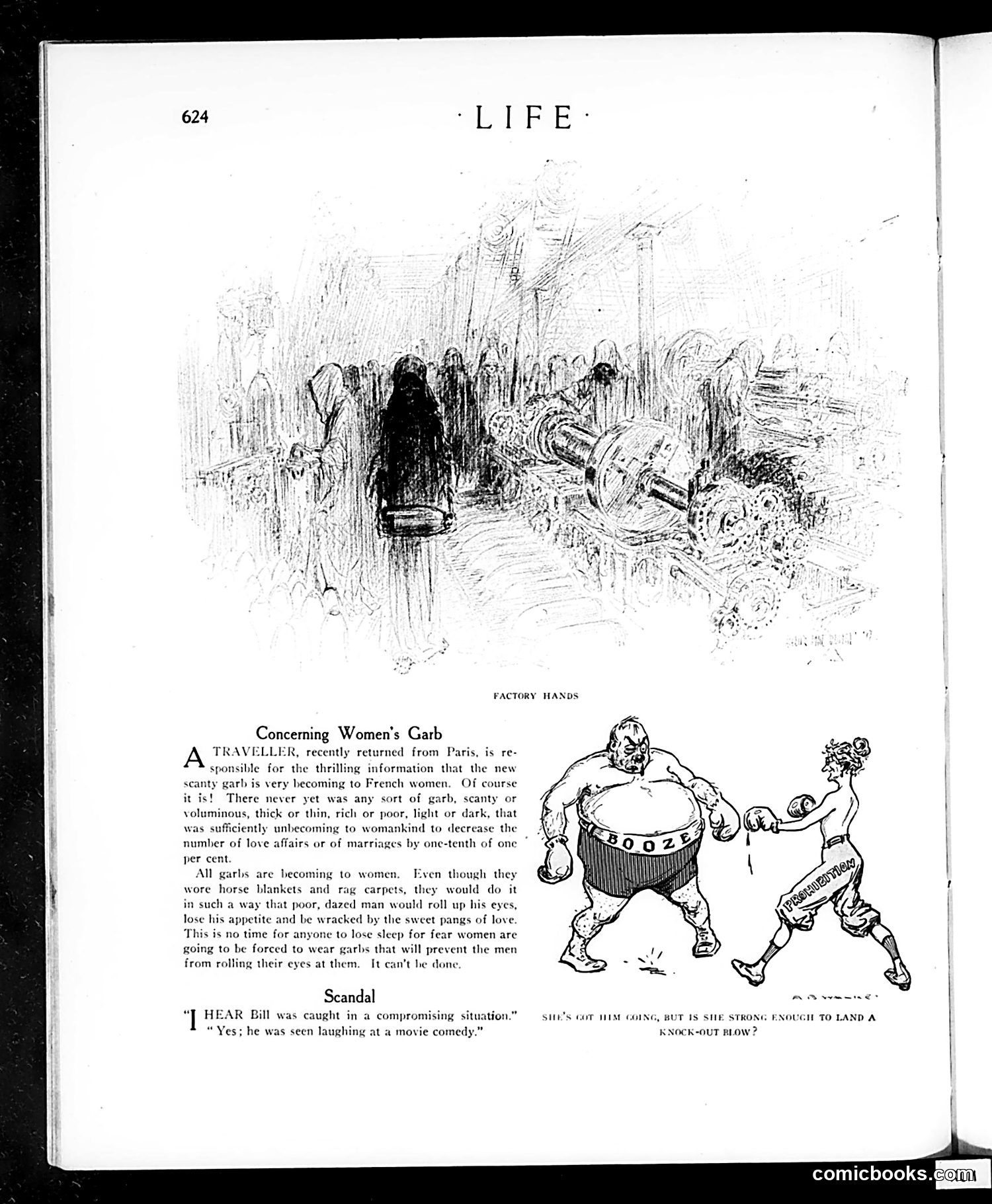
This page contains satirical commentary on 1920s fashion and gender relations, alongside unrelated cartoon humor. The upper sketch depicts a factory scene, illustrating the "Factory Hands" headline. The main article, "Concerning Women's Garb," mocks contemporary anxieties about women wearing increasingly revealing clothing (post-WWI fashion trends featured shorter skirts and looser silhouettes). The satire argues that women look attractive in *any* garment—even "horse blankets and rag carpets"—because they possess inherent charm. The author humorously dismisses fears that scanty clothing will seduce men, suggesting women's appeal transcends fashion. The cartoon below shows caricatured male and female figures labeled "SHE'S GOT HIM GOING, BUT IS SHE STRONG ENOUGH TO LAND A KNOCK-OUT BLOW?"—a boxing metaphor for romantic/sexual dynamics where women are depicted as aggressors. The brief "Scandal" joke is unrelated, involving someone named Bill caught in a compromising situation at a movie. The overall tone is tongue-in-cheek commentary on evolving gender roles and fashion during the Jazz Age.
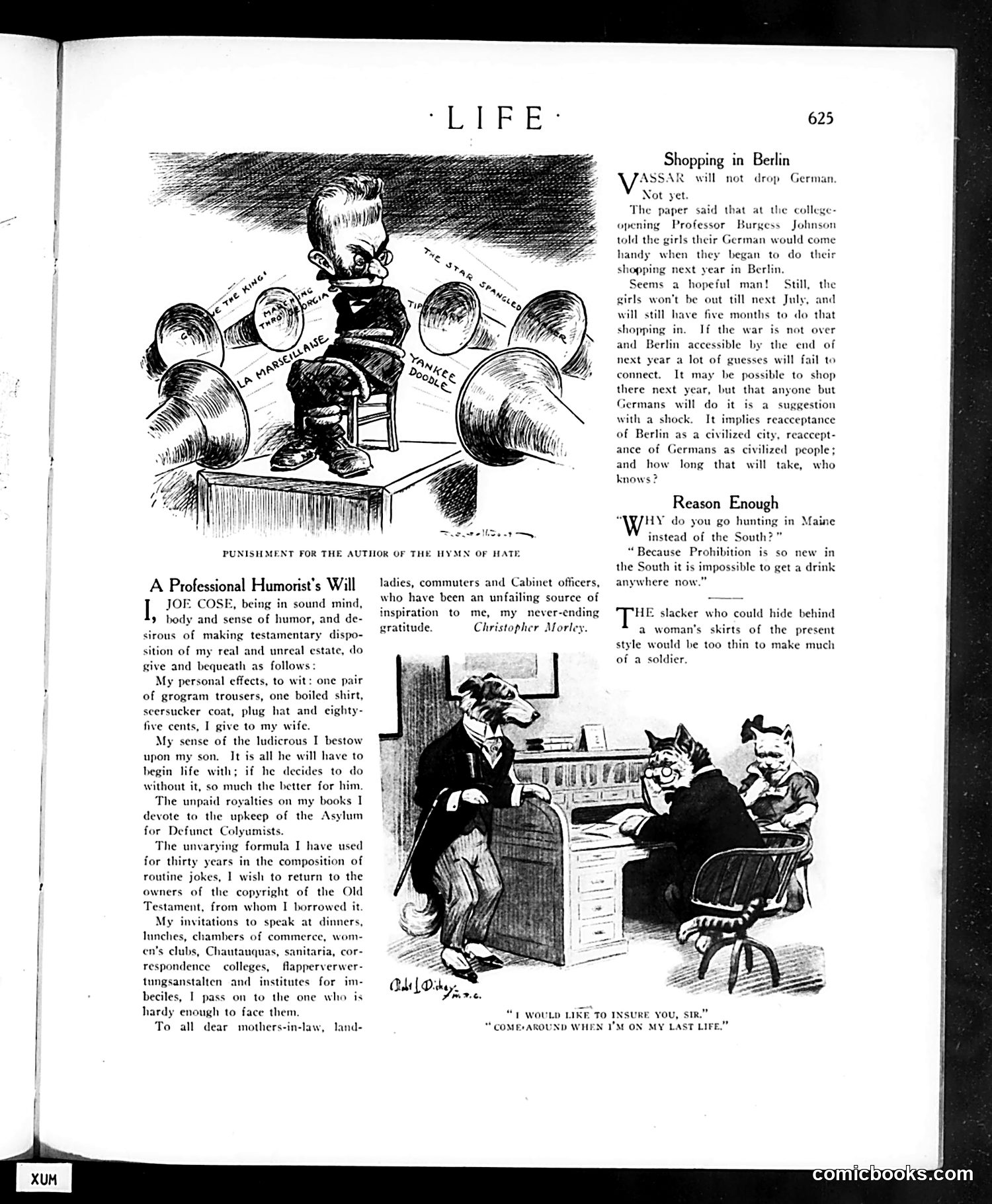
**Top Cartoon:** Depicts punishment for the author of the "Hymn of Hate"—a famous anti-British German poem. The figure is surrounded by large German military helmets, suggesting satirical consequences for German wartime propaganda. This reflects American sentiment during World War I. **"Professional Humorist's Will":** Christopher Morley's humorous essay bequeaths his comedic formulas, speaking invitations, and sense of humor—satirizing the predictability of professional humor writing and the exhausting social obligations of public figures. **"Shopping in Berlin":** Mocks an optimistic professor suggesting female students will shop in Berlin after the war. The satire implies such confidence is absurd—questioning whether Americans would ever visit post-war Germany and whether Germans would remain "civilized" after the war's devastation. **Bottom Cartoon:** A salesman's insurance pitch to an anxious client, likely commenting on wartime uncertainty and financial anxiety.
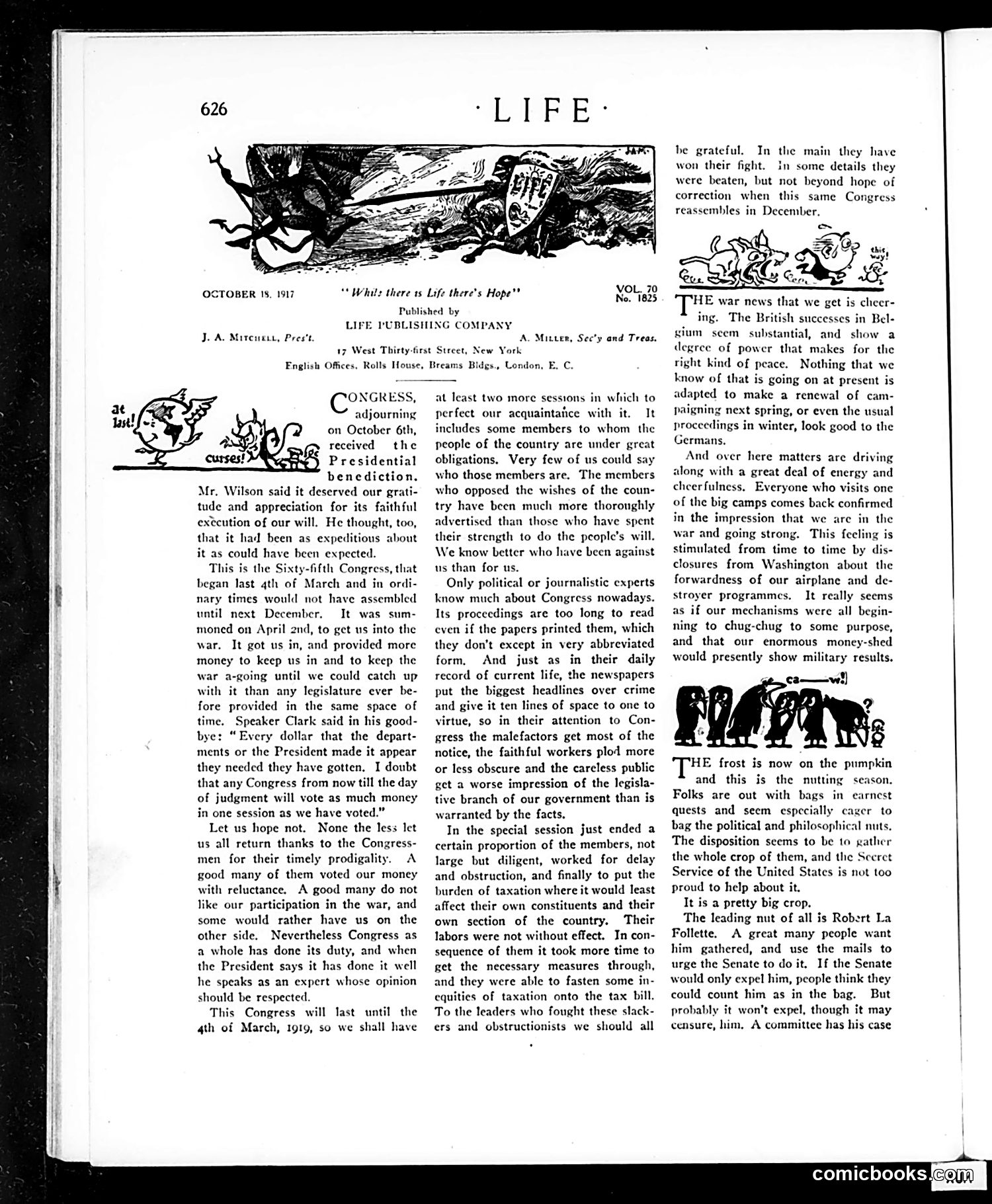
This October 1917 *Life* editorial praises Congress for funding America's World War I effort while criticizing it for insufficient public recognition of its work. The main cartoon (top left) appears to depict a figure being struck or knocked down—likely representing Congress's critics or obstructionists. The editorial's core argument: Congress has performed its duty by appropriating massive funds for the war, yet newspapers sensationalize congressional opposition and obstruction while ignoring the "faithful workers" who advance the war effort. The author laments that Americans know more about congressional malefactors than patriots because news media prioritizes conflict over virtue. A secondary complaint targets certain congressmen who deliberately delayed tax legislation to shield their own regions from financial burden. The piece calls for gratitude toward congressional leaders who fought these "slackers and obstructionists." The tone is patriotic and pro-war, reflecting early American enthusiasm for WWI intervention.
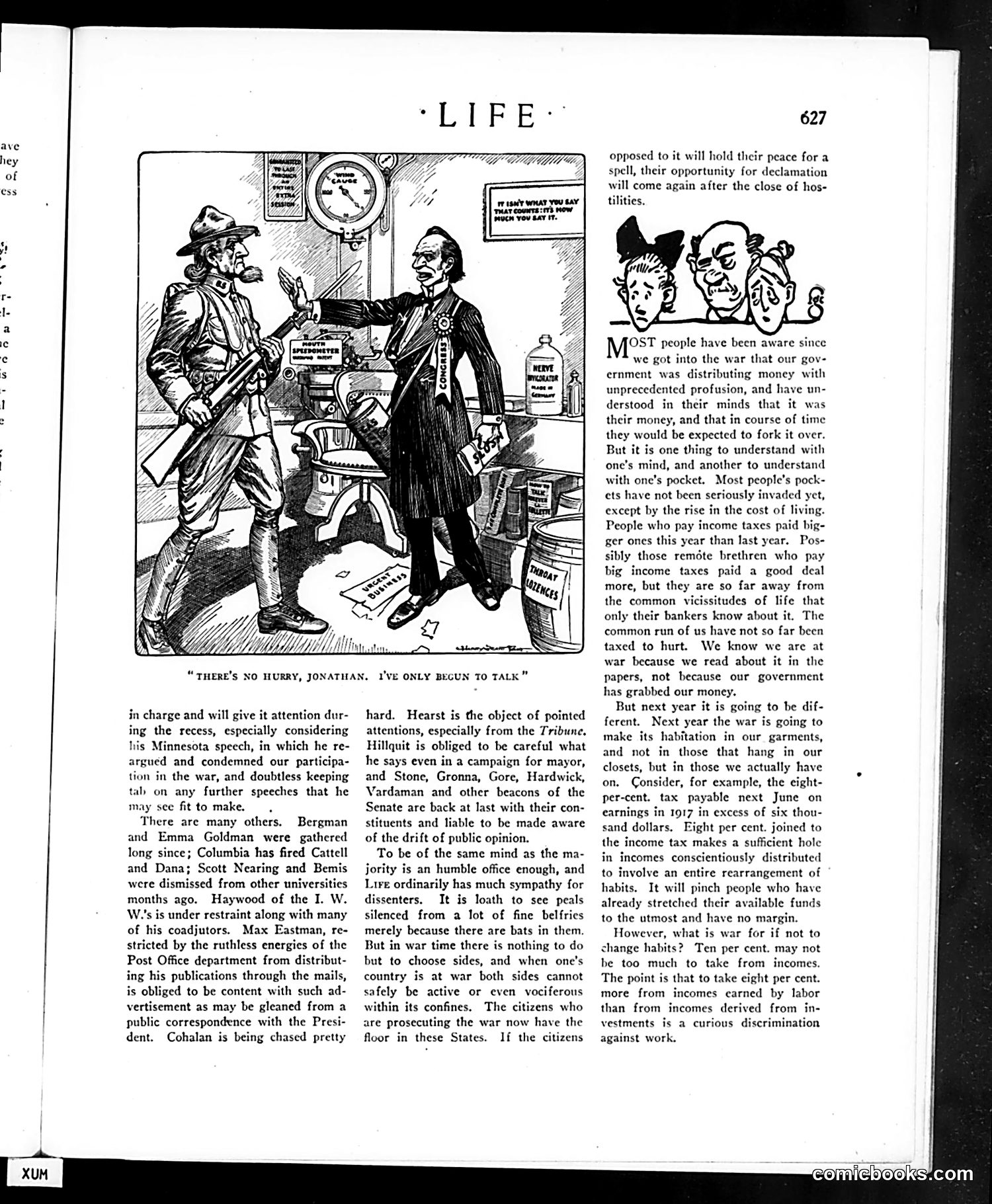
## The Cartoon The illustration depicts a military figure (labeled "Jonathan," likely Uncle Sam) being lectured by a civilian official about war-related matters. The caption "There's no hurry, Jonathan, I've only begun to talk" suggests bureaucratic obstruction or endless discussion about war policy. ## The Article's Subject Matter The text discusses government suppression of war dissenters during WWI. It names several figures prosecuted or silenced for anti-war positions: Emma Goldman, Max Eastman, Scott Nearing, and others. The article argues that while Life sympathizes with dissenters generally, wartime requires choosing sides—and currently, war supporters "have the floor." ## The Political Point The article then shifts to criticizing unequal taxation: an eight-percent tax on labor income versus no comparable tax on investment income. The satire suggests the government demands sacrifice from working people while protecting wealthy investors—questioning whether this is truly fair wartime burden-sharing. The overall message: the government silences dissent while implementing economically discriminatory policies favoring the wealthy.
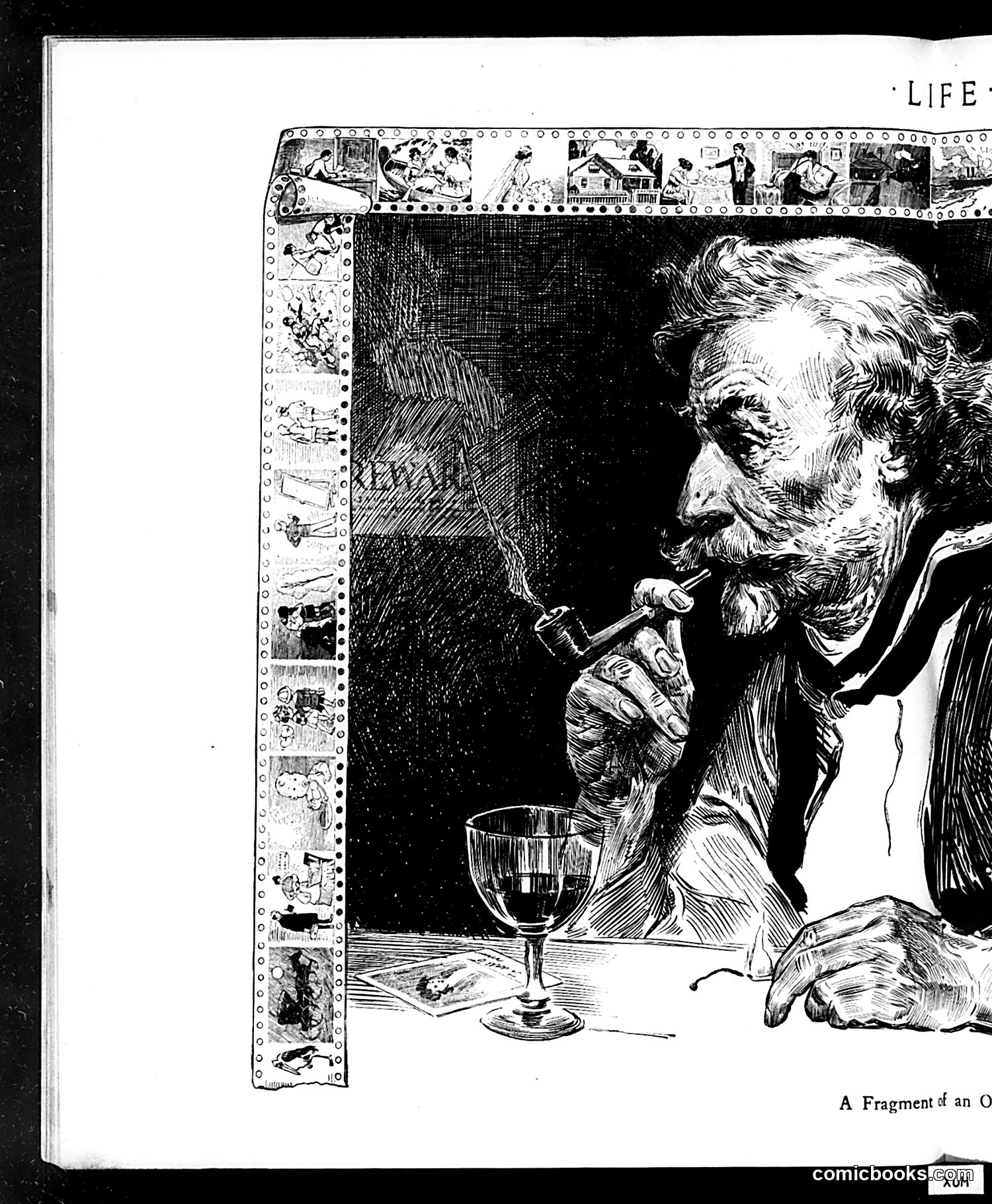
This page from *Life* magazine features a large illustration of an elderly man with distinctive facial features (beard, prominent nose) smoking a pipe and holding a wine glass. He appears contemplative or world-weary. The left border displays a film strip with various scenes and vignettes, suggesting this relates to cinema or theatrical entertainment. The caption reads "A Fragment of an O" (likely incomplete or cut off), which is unclear without full context. Without the complete caption or more textual information, I cannot definitively identify the specific figure or the satire's exact target. The illustration style and film-strip border suggest commentary on entertainment, theater, or possibly a notable cultural figure of the era, but I cannot assert specifics beyond what's visible.
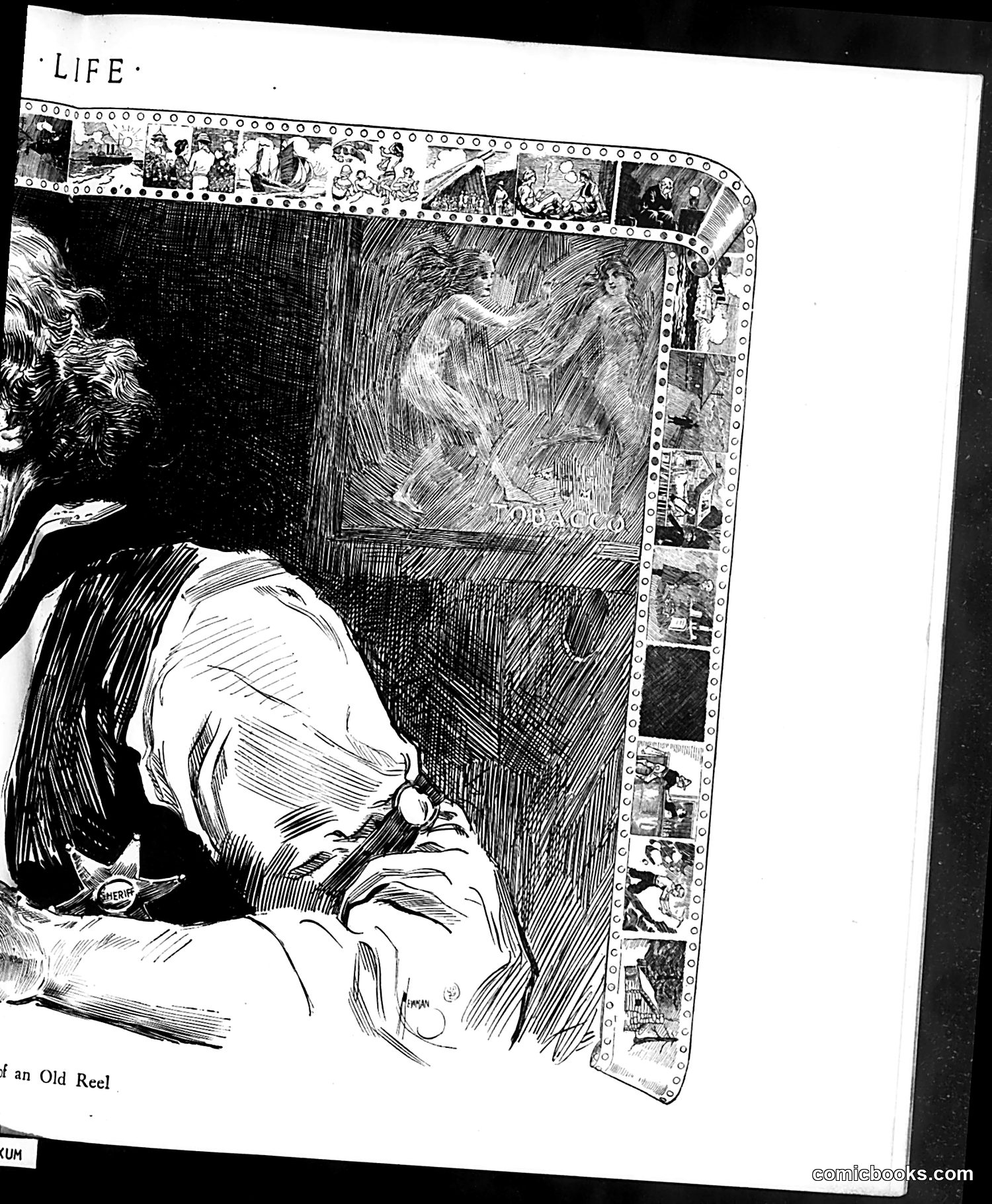
This Life magazine page depicts someone watching an old film reel—visible as a strip of film frames along the border. The viewer, shown in profile on the left, appears absorbed in watching what's labeled "TOBACCO" on the screen. The satire likely critiques either: 1. The addictive nature of tobacco/smoking habits (someone compulsively rewatching), or 2. Nostalgia for outdated products or practices The "old reel" title suggests commentary on obsolete entertainment or advertising methods, while the prominent tobacco label indicates this is satirizing the tobacco industry—possibly their continued marketing of an "old" product or the persistence of smoking despite known harms. The exact historical context and intended target remain unclear without additional dating or attribution information.
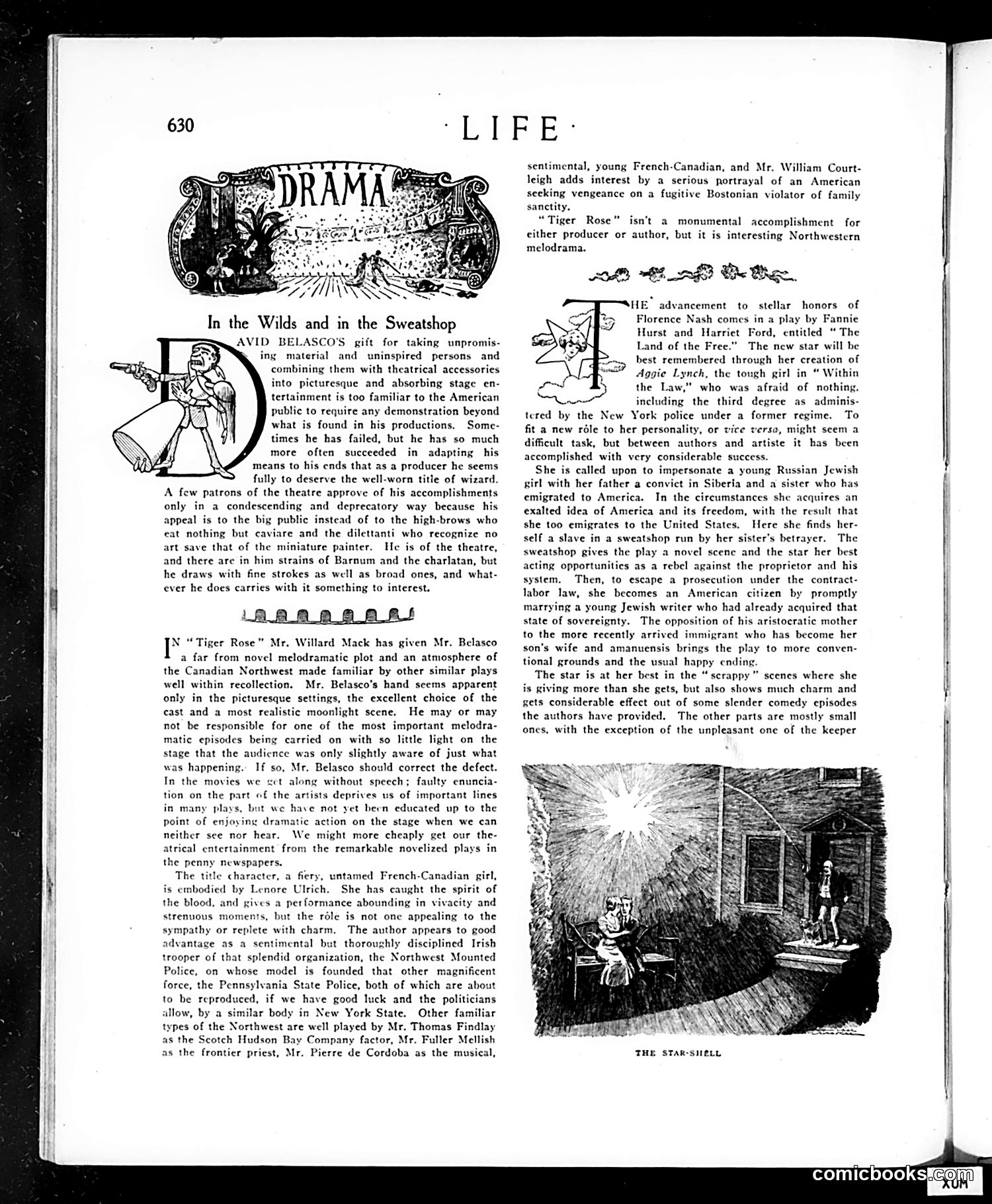
This page reviews two theatrical productions. The main critique concerns David Belasco's staging of "Tiger Rose," a Canadian Northwest melodrama. The reviewer praises Belasco's wizardry in transforming mundane material through theatrical spectacle, but criticizes his use of overly dim lighting during a crucial plot moment—arguing this creates incomprehensible action. The reviewer sarcastically suggests audiences might as well watch novelized plays in penny newspapers if they can't see or hear the stage action. The illustration labeled "THE STAR-SHELL" appears to depict a dramatic scene from the play, likely showing the poorly-lit sequence being critiqued. A secondary review discusses Florence Nash's advancement to starring roles in "The Land of the Free," noting her previous success as the tough character Aggie Lynch in "Within the Law." The page emphasizes theatrical realism versus spectacle—a tension central to early 20th-century American theater criticism.
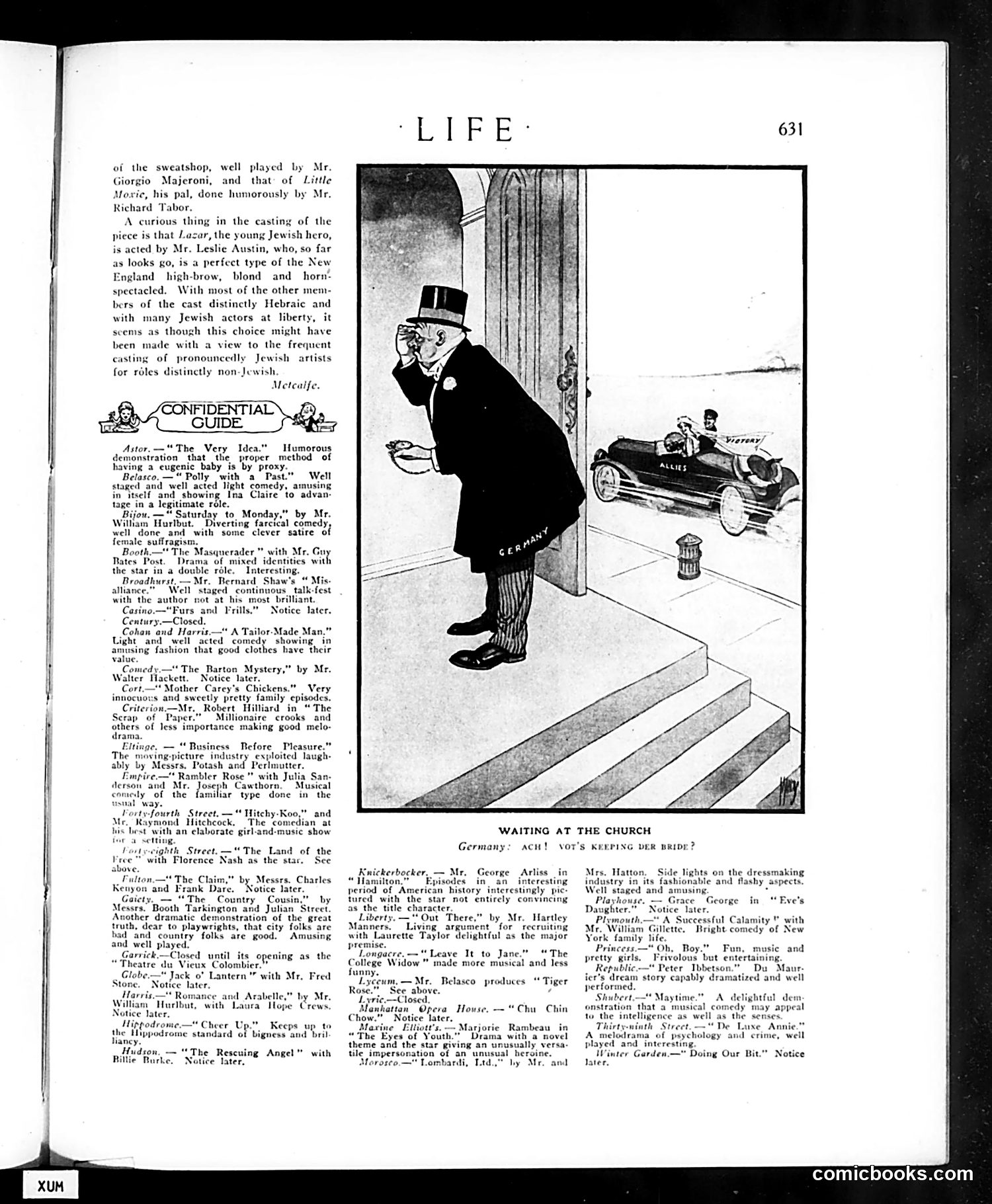
This cartoon satirizes German militarism and marital anxiety during World War I. A caricatured German officer (labeled "Germany") stands anxiously at a church entrance, checking his watch—the classic pose of a groom waiting for his bride who hasn't arrived. The joke plays on the phrase "waiting at the church," a period expression for being abandoned or jilted. Here, "Germany" is the spurned party, implying that his hoped-for victory or alliance has failed to materialize. The accompanying text asks "ACH! VOT'S KEEPING HER BRIDE?"—using exaggerated German dialect humor typical of WWI-era American satire. The racing car in the background (labeled "Victory") speeding away reinforces that Germany's anticipated triumph has eluded him. The cartoon mocks German military ambitions as doomed romantic disappointment, using domestic comedy tropes to ridicule the enemy nation's war prospects.
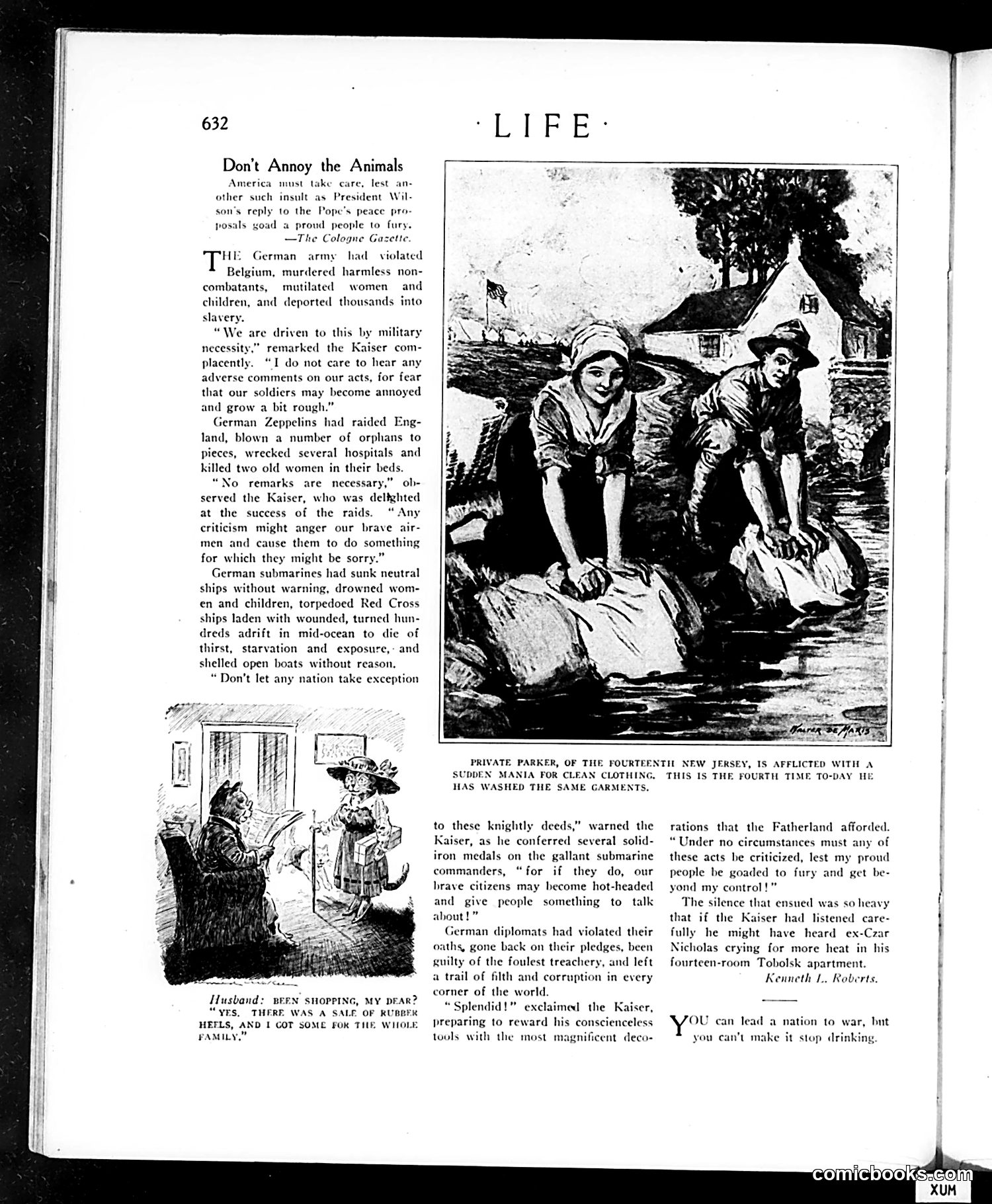
This is a satirical attack on Kaiser Wilhelm II's justifications for German atrocities during World War I. The piece uses ironic absurdity: the Kaiser claims German soldiers might become "annoyed" and "rough" if criticized for violating Belgium, bombing hospitals and orphans, sinking neutral ships, and drowning civilians—as if the soldiers were temperamental children needing praise rather than accountability. The satire inverts reality: Germany committed documented war crimes, yet the Kaiser warns *others* against annoying his troops. The small cartoon shows a husband and wife shopping, humorously contrasting domestic triviality with wartime barbarity. The closing reference to "ex-Czar Nicholas" in a Tobolsk apartment alludes to the Russian imperial family's 1918 imprisonment, suggesting the Kaiser's regime faces similarly ignominious consequences. The final epigram mocks the contradiction of prosecuting war while claiming moral restraint. The piece is anti-German propaganda from America's perspective during or just after WWI, delegitimizing German military conduct through rhetorical reversal.
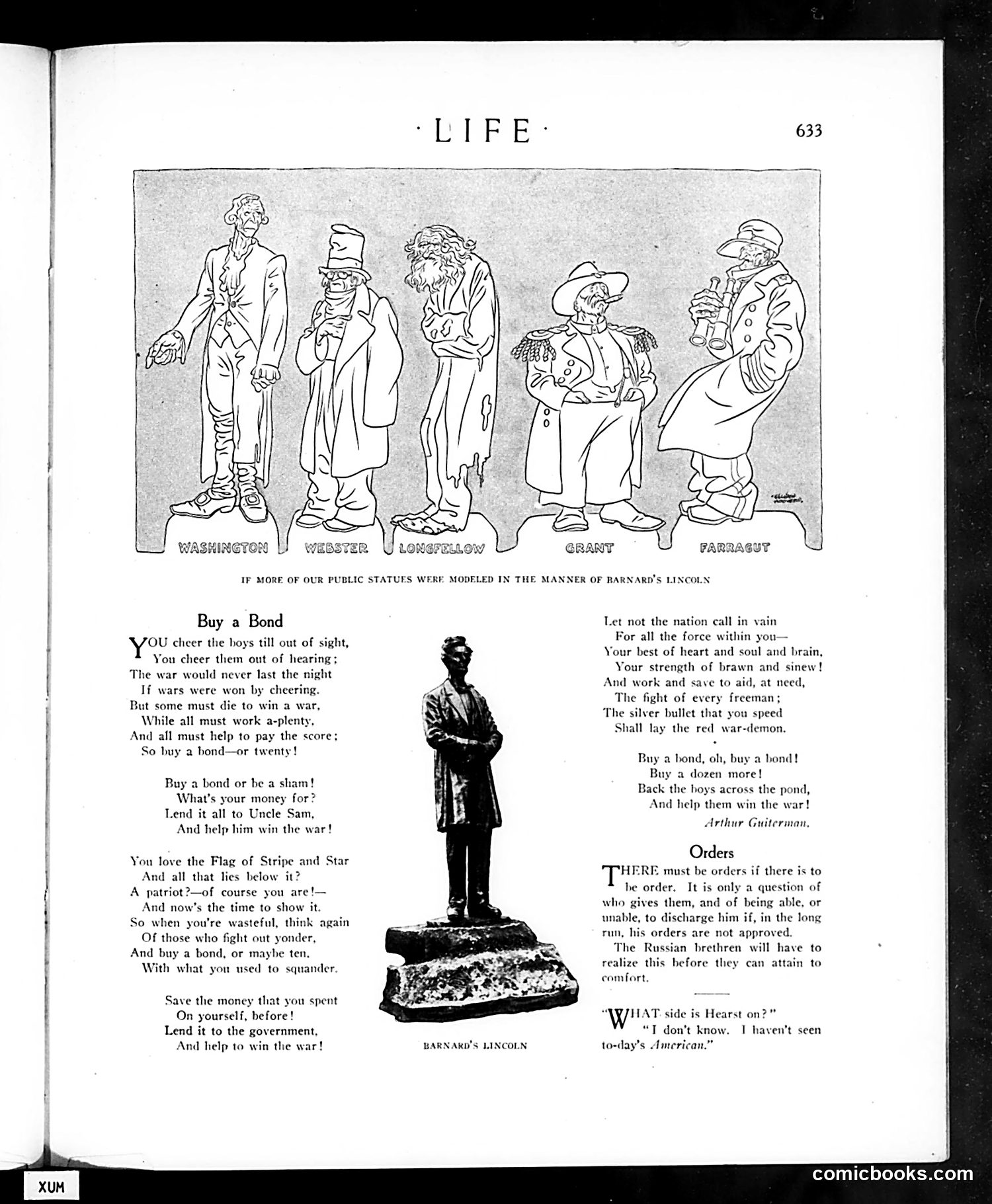
**Top Cartoon:** This satirizes American public monuments by depicting five historical figures (Washington, Webster, Longfellow, Grant, and Farragut) modeled in the style of Barnard's Lincoln statue—shown as a dignified, realistic figure. The joke suggests that if our statues adopted this naturalistic approach rather than idealized grandeur, our public figures would appear more human and less pompous. **"Buy a Bond" Content:** This is a WWI-era patriotic appeal (likely 1917-1918), urging Americans to purchase war bonds to finance the war effort. The poem shames those who merely cheer soldiers while refusing financial sacrifice, equating bond purchases with patriotic duty and economic support for "the boys across the pond." **"Orders" Section:** A brief commentary on Russian governance (likely referencing post-Revolution chaos), arguing that military hierarchies require clear command structures—implying Russia's disorder stems from inadequate obedience to authority. **Bottom Joke:** A quip about newspaper publisher William Randolph Hearst's political ambiguity, playing on his *American* newspaper.
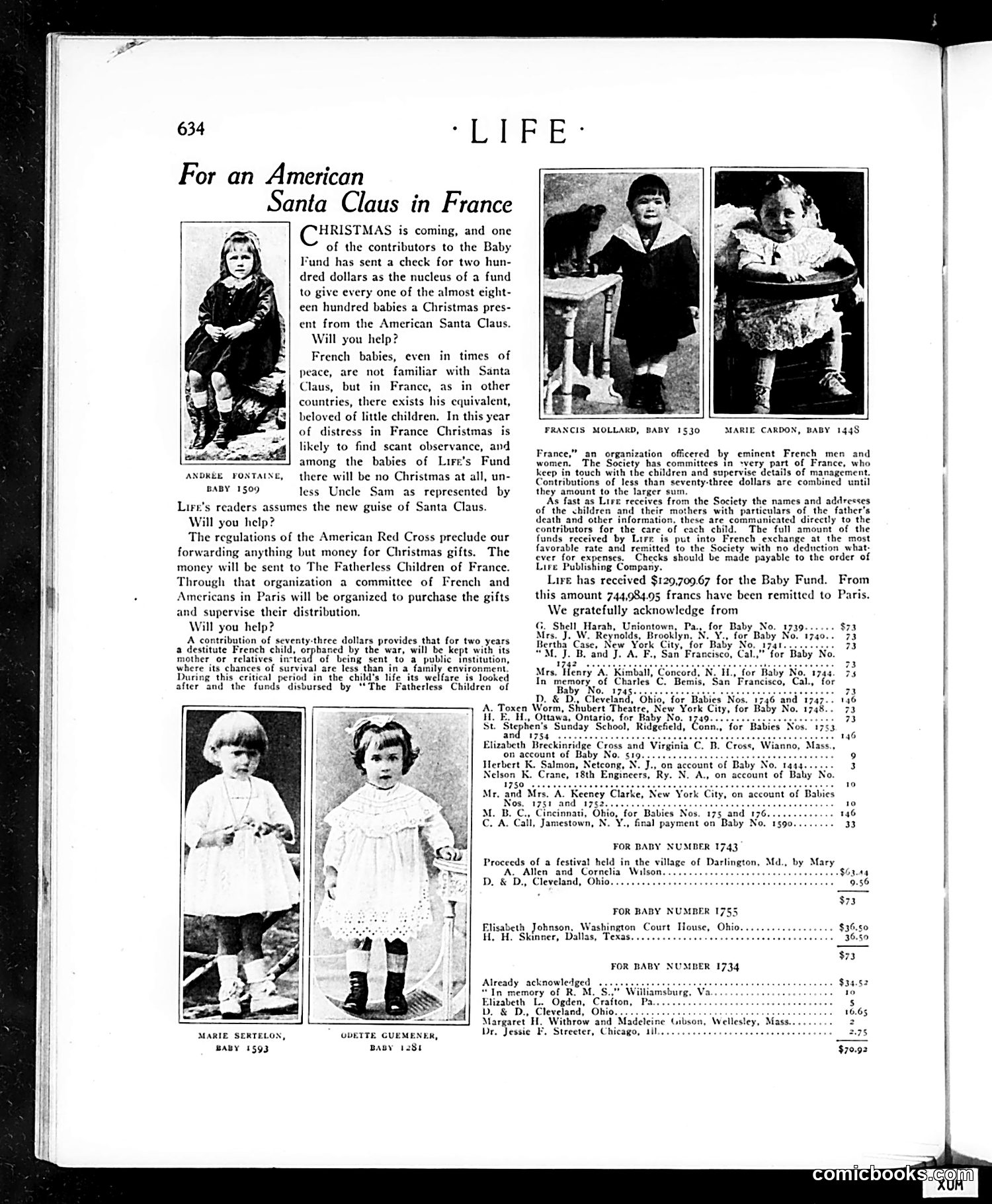
This is a fundraising appeal, not satire. Life magazine solicits American donations to provide Christmas gifts for approximately 1,800 French war orphans and fatherless children. The photographs show actual babies benefiting from the "Baby Fund"—a charitable initiative managed through "The Fatherless Children of France" organization. The appeal emphasizes that French children lack Santa Claus tradition and that wartime distress makes Christmas observance unlikely without American intervention. Contributors could sponsor individual children for two years; donations ranged from $73 upward. The page documents received contributions with donor names and baby numbers. This reflects America's humanitarian engagement with French civilian suffering during World War I, presenting charitable giving as a patriotic duty—"Uncle Sam" assuming Santa's role to aid America's Allied ally.
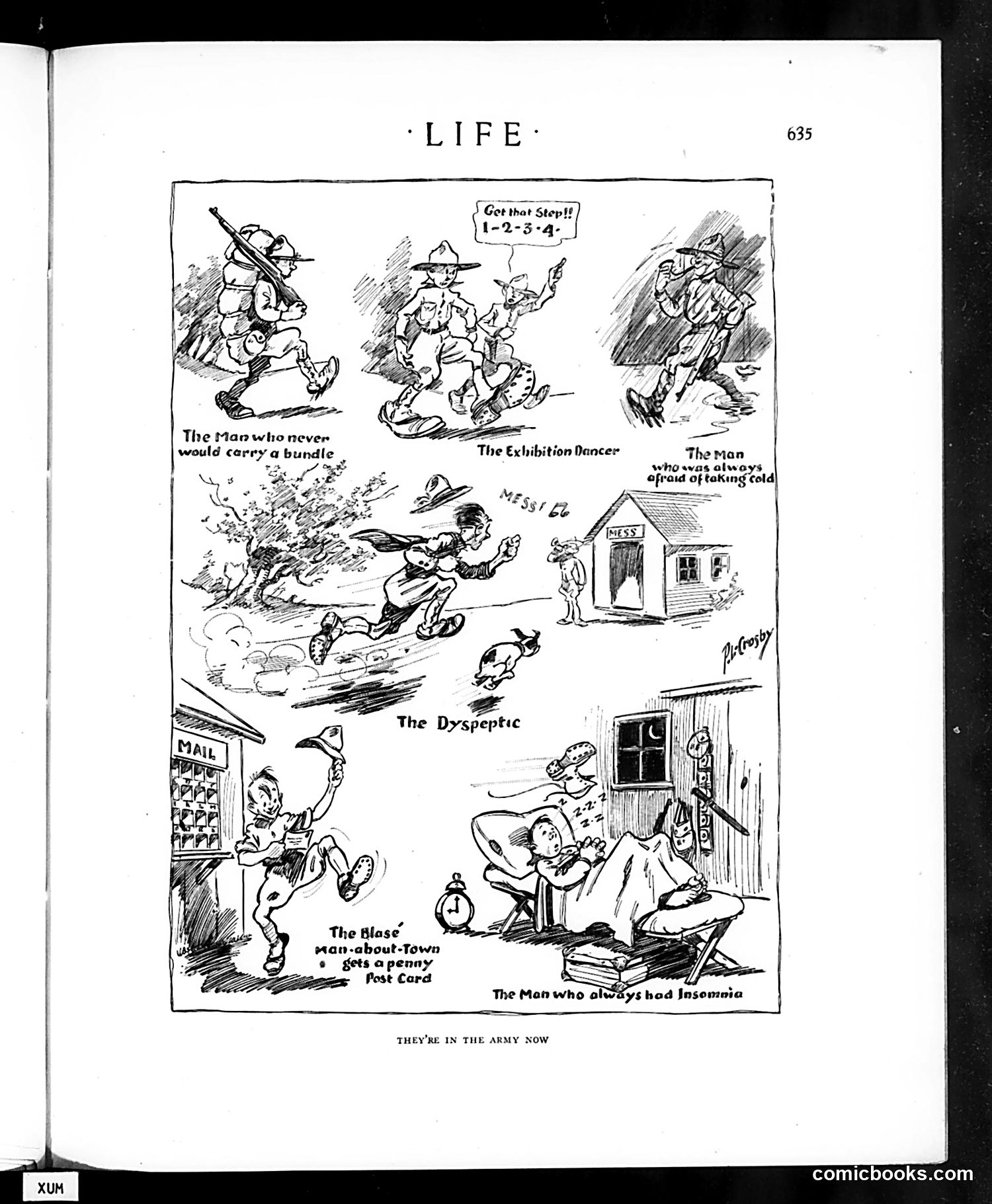
This cartoon satirizes various civilian character types being drafted into military service. Each vignette depicts a recognizable social stereotype forced into army life: - "The Man who never would carry a bundle" - depicting someone unaccustomed to labor - "The Exhibition Dancer" - a vain performer learning discipline - "The Man who was always afraid of taking cold" - a hypochondriac - "The Dyspeptic" - someone with digestive complaints - "The Blasé man-about-Town" - a sophisticated urbanite - "The Man who always had insomnia" - now sleeping in barracks The headline "THEY'RE IN THE ARMY NOW" suggests this reflects WWI-era conscription, when diverse civilian populations were drafted. The humor relies on contrasting these men's former leisured or neurotic civilian identities against the regimented demands of military service, implying that army life will "cure" their affectations and complaints.
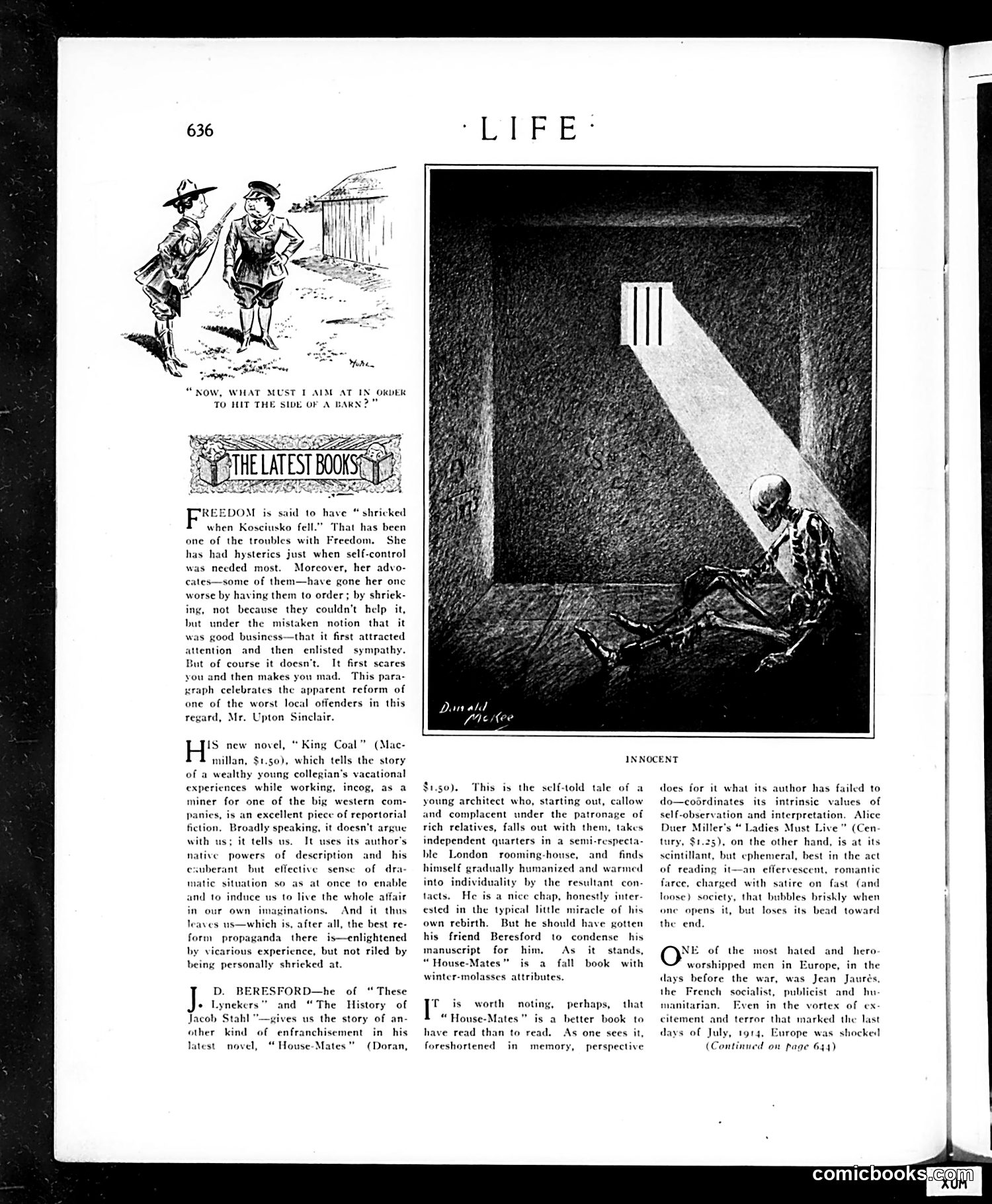
The top cartoon shows two figures aiming at a barn, with the caption "Now, what must I aim at in order to hit the side of a barn?" This appears to be satirical commentary on **Upton Sinclair**, the muckraking author and socialist activist. The accompanying text criticizes Sinclair for his overly emotional, "hysterical" advocacy style—his tendency to "shriek" about injustices rather than calmly persuade. However, the reviewer praises his novel *King Coal* for taking a more restrained, reportorial approach: it shows rather than preaches, allowing readers to experience conditions firsthand without being "riled by being personally shricked at." The satire equates Sinclair's previous shrill activism with wildly misdirected aim—suggesting his emotional approach fails to hit its target effectively. The review celebrates what it sees as his reform toward more subtle persuasion. The page continues with book reviews of other contemporary works.
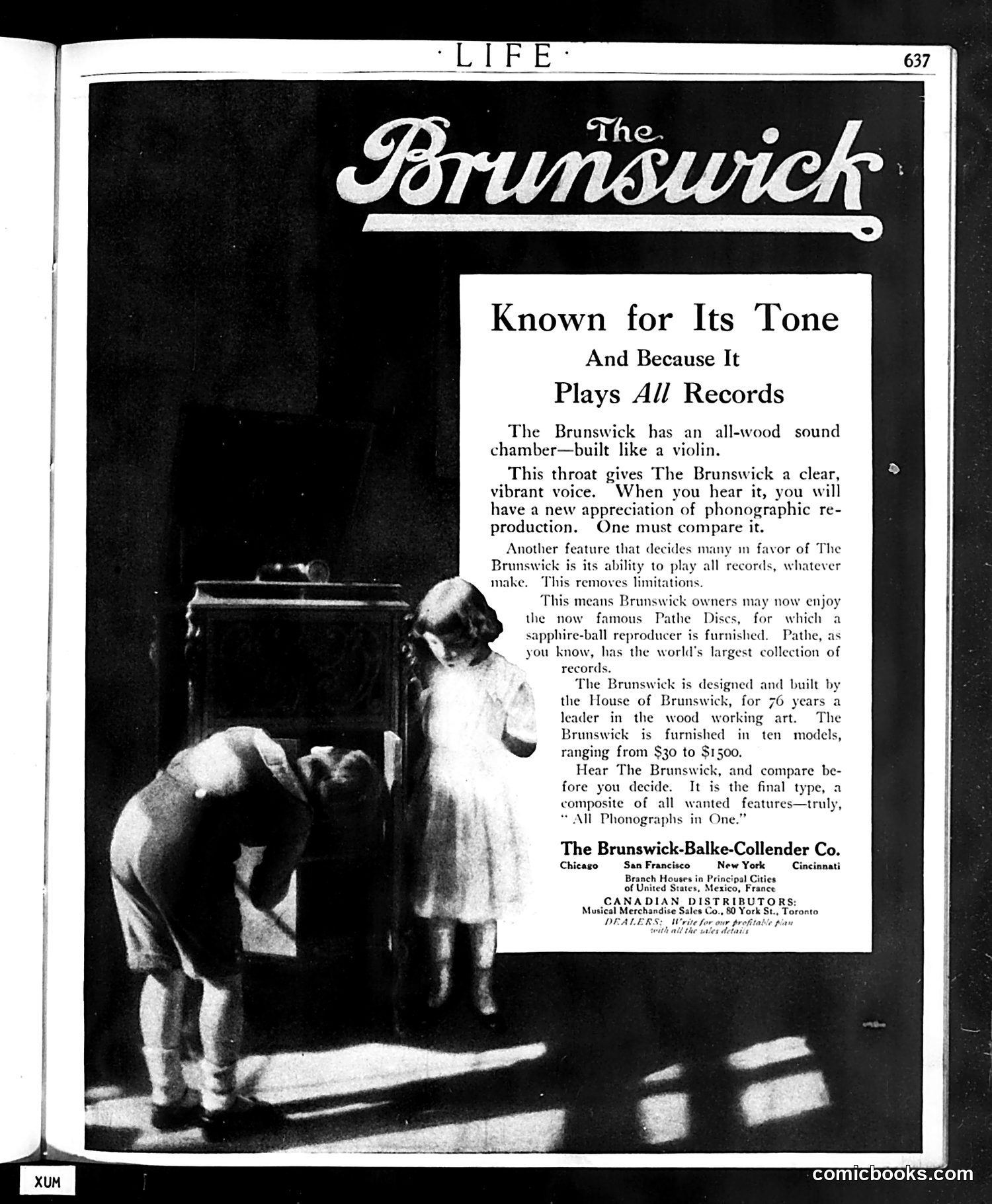
This is a **product advertisement**, not political satire. It promotes The Brunswick phonograph (a record player) in *Life* magazine, page 637. The image shows two children operating a Brunswick phonograph, illustrating its appeal to families. The advertisement emphasizes: 1. **Superior sound quality** — an all-wood sound chamber "built like a violin" for clear, vibrant reproduction 2. **Universal compatibility** — it plays "all records" regardless of manufacturer, removing limitations that affected competing models 3. **Specific advantage** — owners can play Pathé Discs (a major record label) using the included sapphire-ball reproducer 4. **Prestige and history** — made by the House of Brunswick, a 76-year-old woodworking leader 5. **Price range** — $30 to $1,500 across ten models The Brunswick-Balke-Collender Co. had locations in major U.S. cities and Canadian distributors. This reflects the early phonograph era when format compatibility and sound fidelity were genuine competitive advantages among manufacturers.
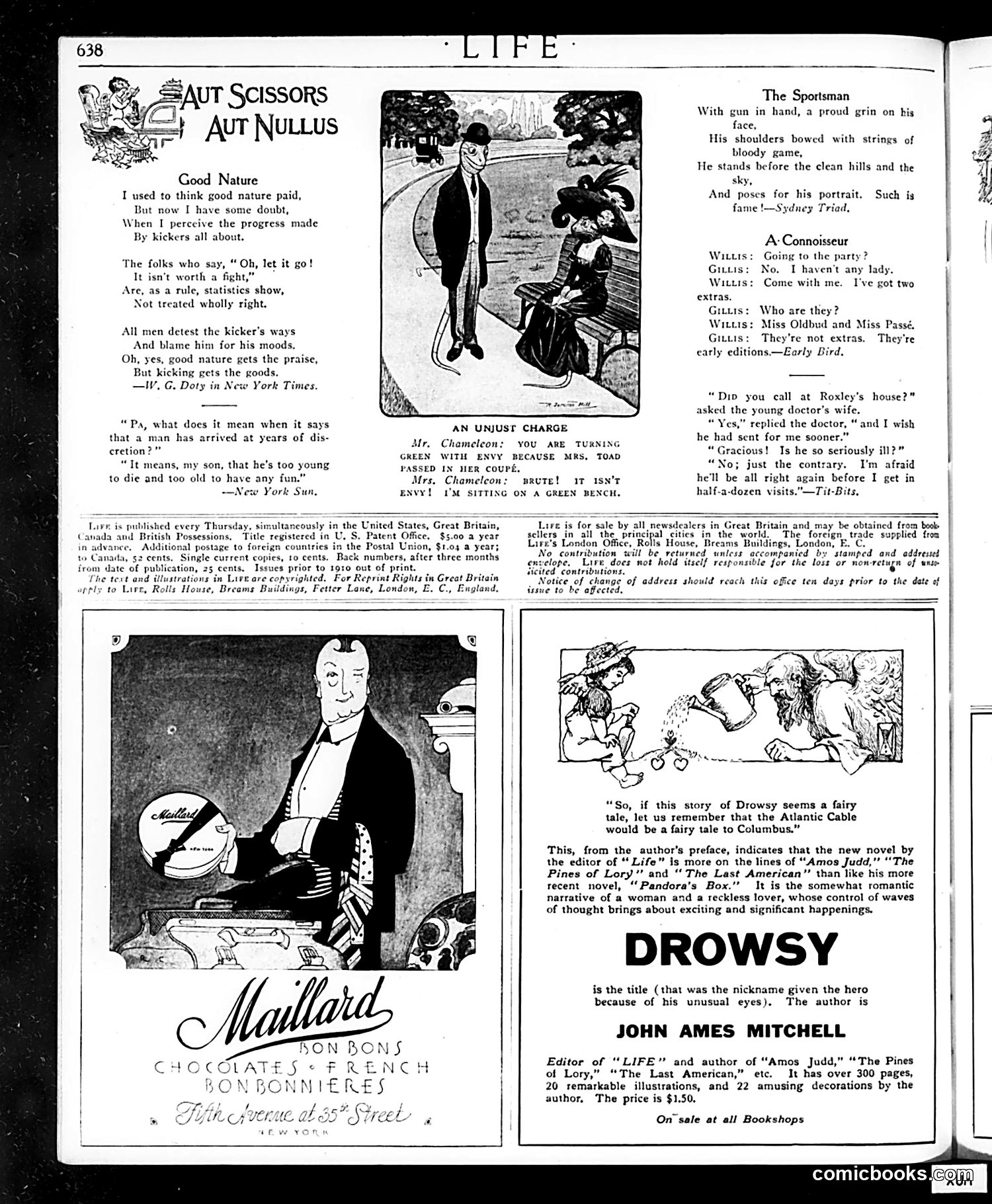
This page from *Life* magazine (a satirical publication) contains several short humor pieces and advertisements: **"Good Nature"** is a poem critiquing the notion that being good-natured pays off. It argues that aggressive "kickers" (complainers/agitators) actually get better treatment and results than passive, well-mannered people—a satirical commentary on unfair social dynamics. **"An Unjust Charge"** is a dialogue joke where Mrs. Chameleon accuses Mr. Chameleon of turning "green with envy" over Mrs. Toad's coffee. He retorts that she's being unfair since he's simply sitting on a green bench—a play on misinterpreted appearances. **"A Connoisseur"** and **"The Sportsman"** are brief satirical sketches about social pretense and vanity. The page also advertises **Maillard Chocolates** and promotes John Ames Mitchell's novel **"Drowsy,"** positioning it as imaginative fiction comparable to the Atlantic Cable's invention being once-unbelievable. The cartoons mock everyday social hypocrisy and human nature's contradictions.
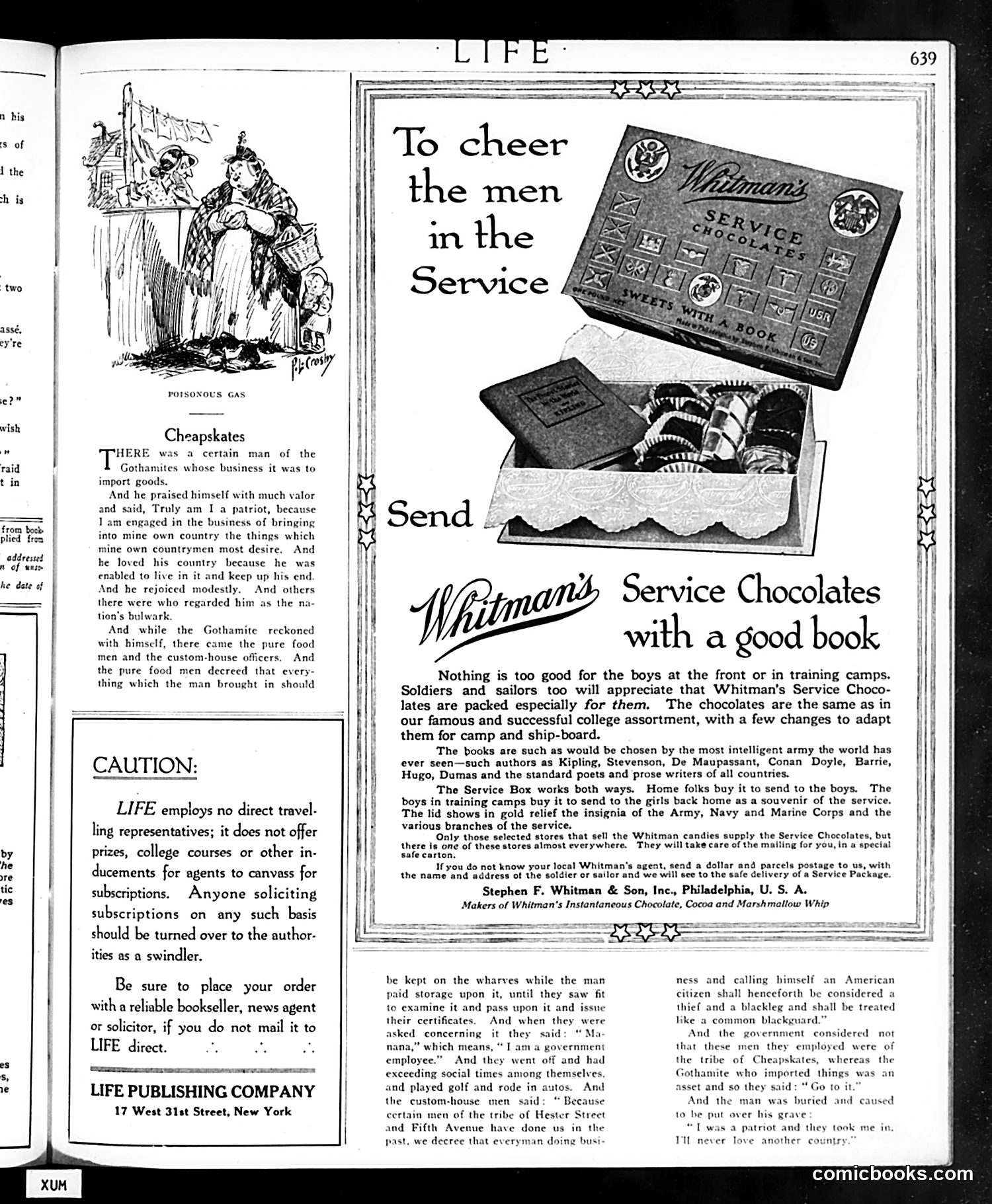
This page presents two distinct satirical pieces from Life magazine (likely WWI-era, given the "Service" references): **Left side ("Poisonous Gas"):** A mock-biblical parable mocking an import businessman who considers himself patriotic. The joke: he brings foreign goods into America, then federal food safety inspectors and customs officers deliberately delay his shipments through bureaucratic obstruction ("Mañana"), claiming revenge against "Hester Street and Fifth Avenue" merchants (a coded reference to Jewish immigrant traders). The satire targets both the self-important importer's hollow patriotism AND government corruption—workers playing golf while sabotaging commerce under pretense of regulation. **Right side:** A Whitman's Chocolates advertisement patriotically marketing gift boxes "for the men in the Service" (soldiers/sailors), with accompanying caution about Life magazine's legitimate circulation practices. The juxtaposition is ironic: while the left page ridicules fake patriotic commerce, the right page exemplifies genuine wartime commercial patriotism.
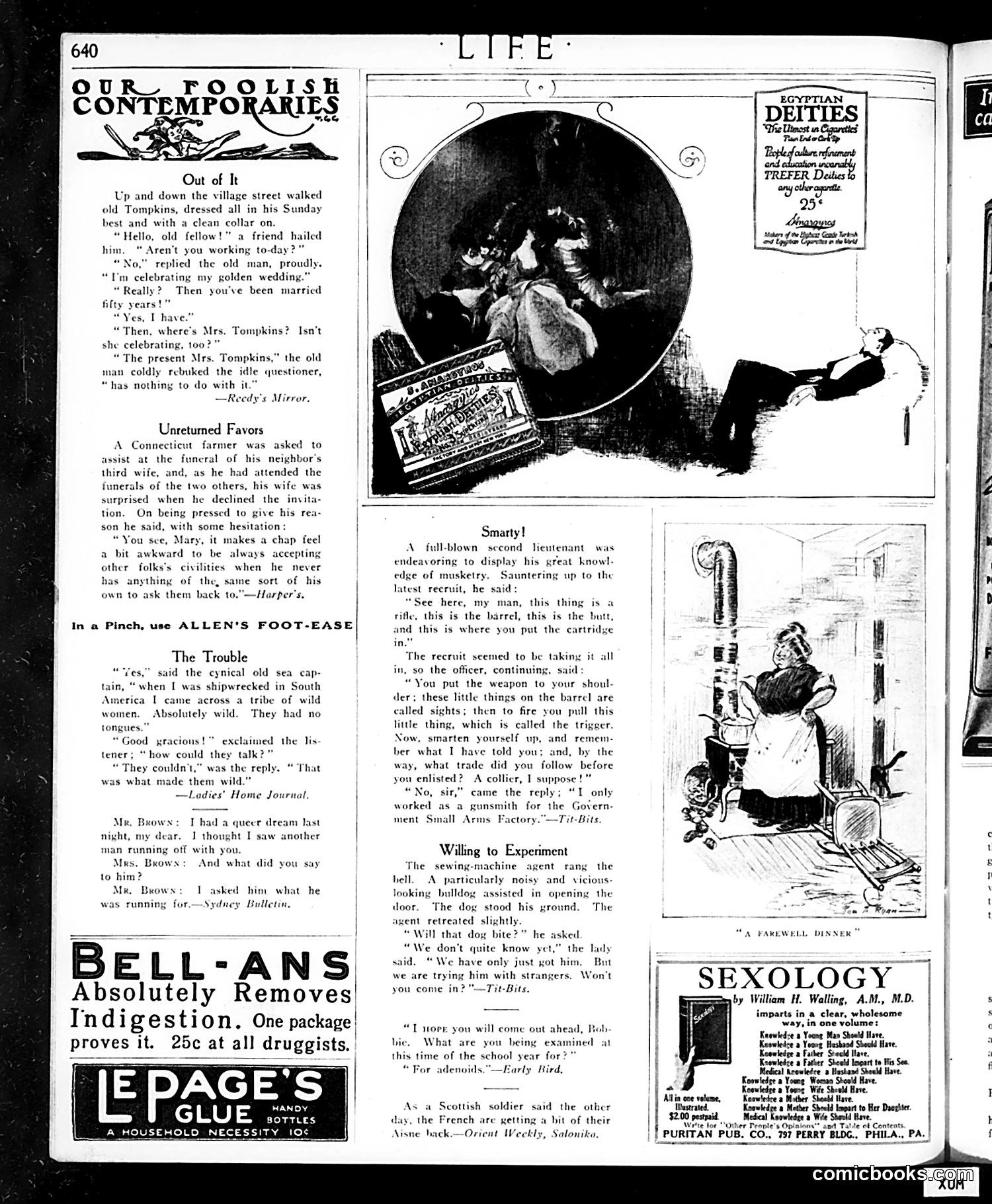
This page from *Life* magazine contains several brief humorous anecdotes under the heading "Our Foolish Contemporaries," typical of the magazine's satirical humor. **"Out of It"**: An old man celebrates his "golden wedding" (50th anniversary) alone. When asked where his wife is, he coldly replies she has "nothing to do with it"—implying he's remarried, making the joke about his wife's absence darkly comic. **"The Trouble"**: A sea captain claims to have encountered tongueless women in South America. The punchline plays on the phrase "what made them wild"—suggesting women are inherently difficult/wild, a common early-20th-century sexist trope. **"Smarty!"**: A pompous officer lectures a new recruit on rifle mechanics, only to learn the recruit already worked as a gunsmith—deflating the officer's supposed superiority through humble circumstances. The cartoons mock social pretension, marital discord, and military arrogance. The surrounding advertisements (Bell-Ans, Sexology books) are period typical.
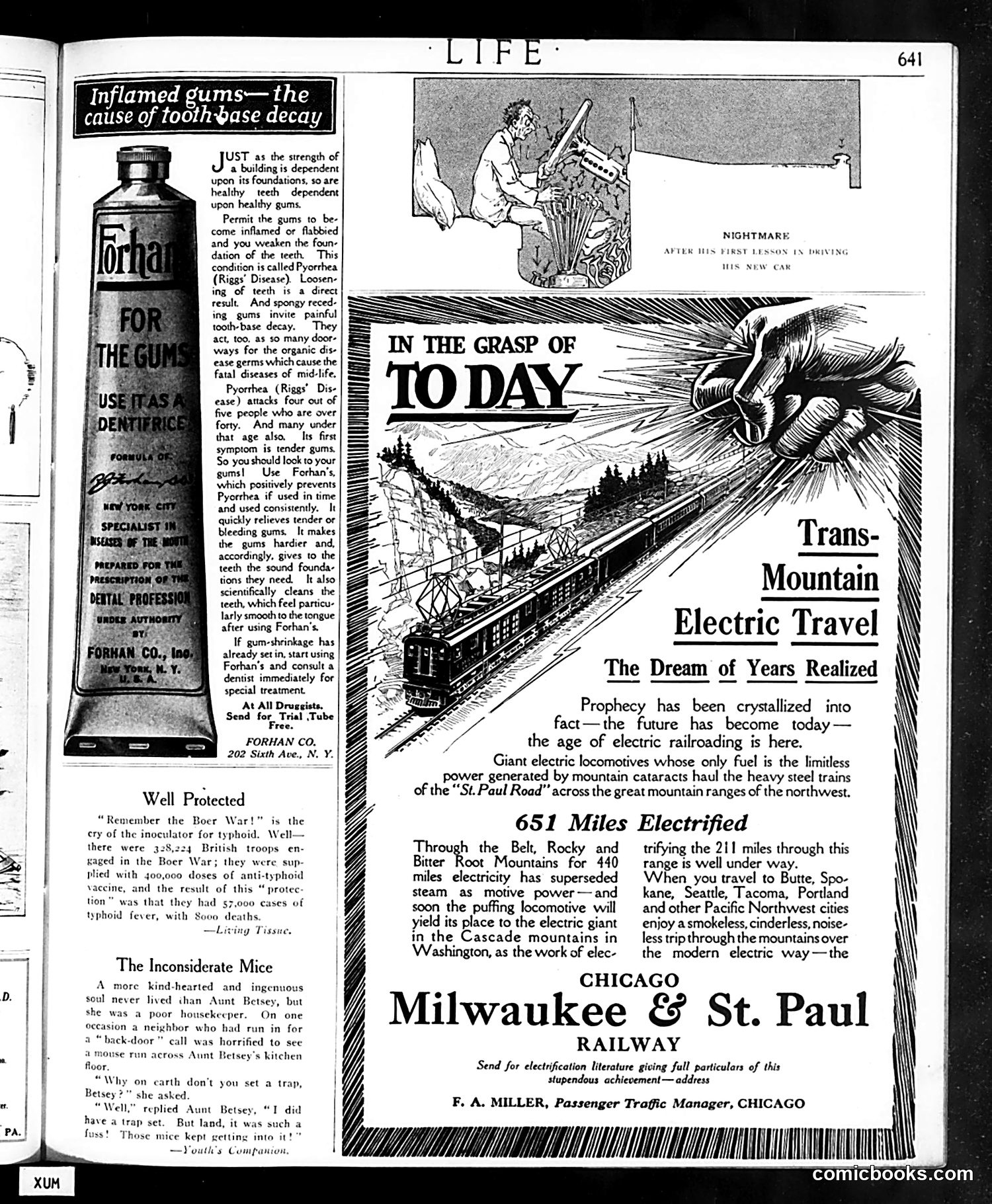
This page mixes advertisements with brief humorous anecdotes typical of Life's satirical format. **Main Content:** - A **Forhan's toothpaste ad** addresses gum disease (Pyorrhea/Riggs' Disease), claiming the product prevents tooth decay by hardening gums. The medical claims reflect early 20th-century dental marketing. - A **brief anecdote about "The Inconsiderate Mice"** mocks Aunt Betsey's poor housekeeping: she complains that mice keep escaping the traps she sets for them—absurd logic that satirizes incompetence. - A **Milwaukee & St. Paul Railway advertisement** celebrates electrified rail travel as futuristic progress, advertising 651 miles of electrified track through the Rocky Mountains as "the dream of years realized." This reflects genuine early-1900s technological optimism about electric power replacing steam locomotives. - A small cartoon labeled **"Nightmare"** shows a nervous driver in his new car, gentle humor about automobile anxiety. The page is primarily **advertising-driven**, with light satire and product promotion typical of Life magazine's commercial-editorial blend.
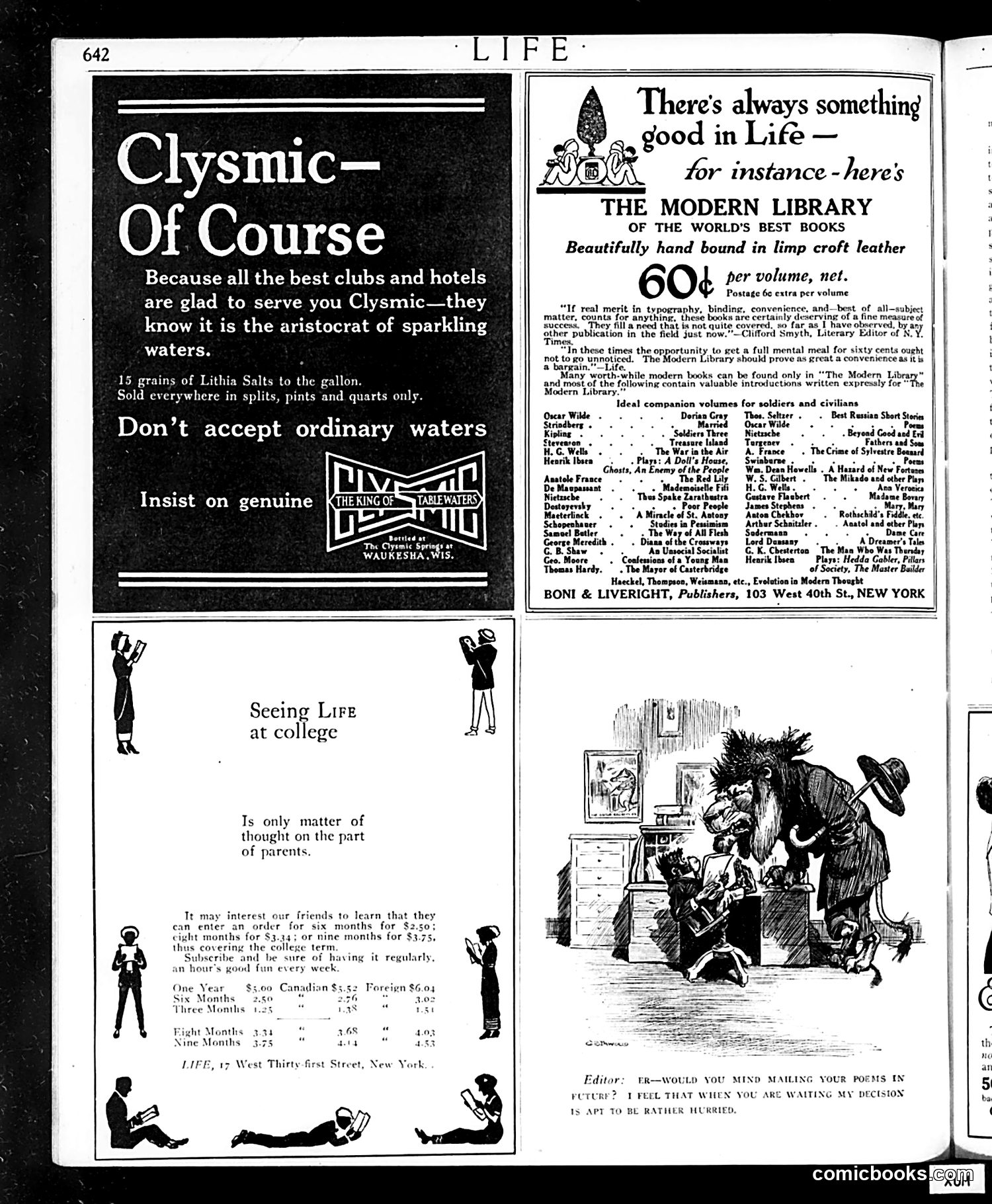
This page contains three distinct advertisements and editorial content: **Top Left: Clysmic Water Ad** — Promotes "Clysmic" mineral water from Waukesha, Wisconsin, positioning it as the preferred drink of aristocratic clubs and hotels. The appeal is to class consciousness and exclusivity. **Top Right: Modern Library Books Ad** — Boni & Liveright publishers advertise classic literature at 60 cents per volume (affordable for mass market). The selection spans contemporary modernist writers (Shaw, Wells, Ibsen, Nietzsche) alongside established classics, suggesting intellectual sophistication is now democratized. **Bottom: Life Magazine Subscription & College Cartoon** — The subscription section promotes Life as essential reading for college students. The accompanying cartoon (showing rough caricatures in what appears to be a dorm room) satirizes college life, with the caption suggesting parents needn't worry about their children's education—Life magazine provides sufficient intellectual stimulation. This is self-promotional humor typical of the era. The page overall reflects early 20th-century marketing targeting educated, aspirational middle-class readers seeking cultural refinement.
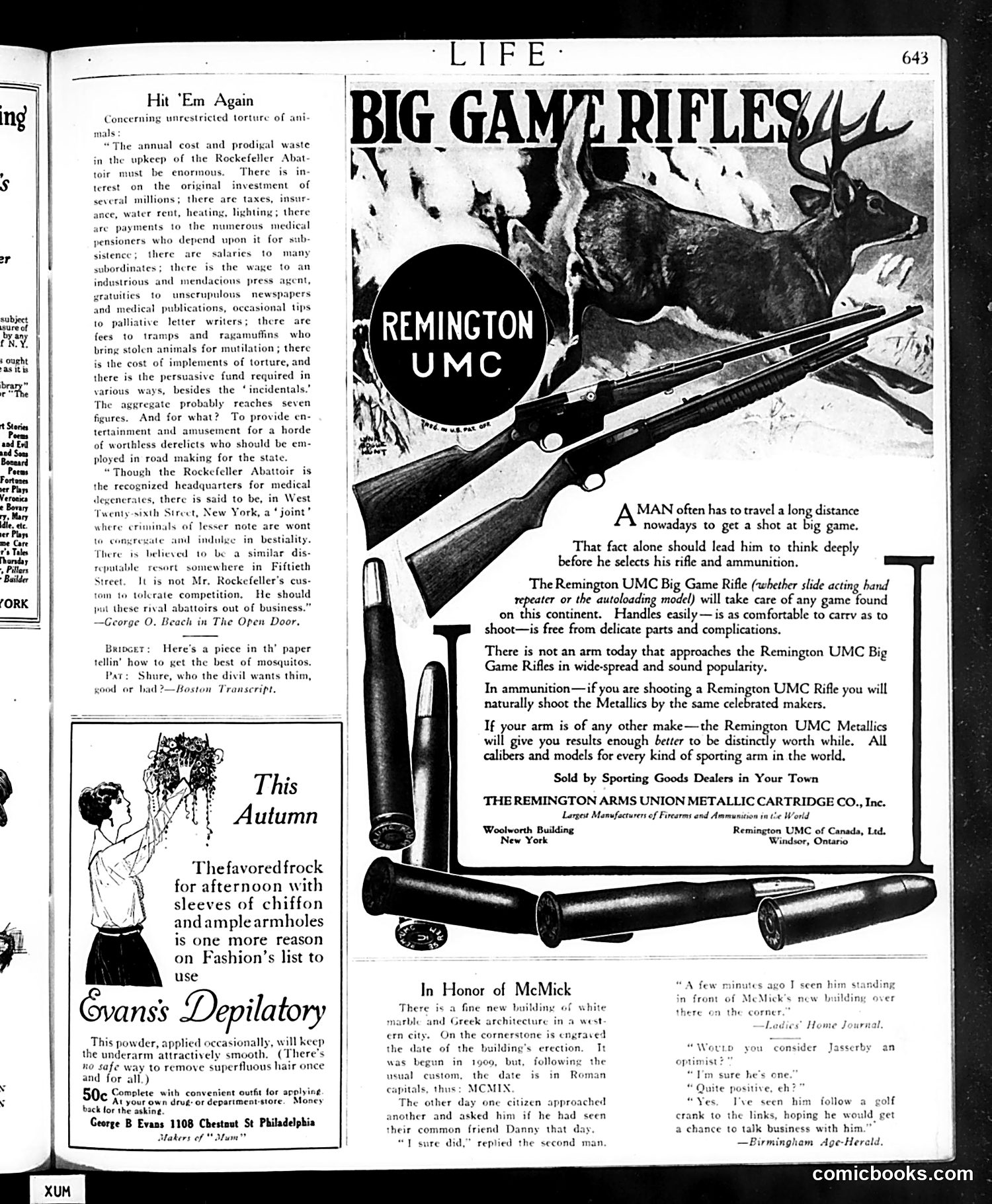
This page contains primarily **advertisements and miscellaneous content** rather than coherent political satire. The main visual element is a **Remington UMC rifles advertisement** featuring a deer and hunting rifle, marketing big game rifles to sportsmen. The text includes several brief satirical pieces: "Hit 'Em Again" criticizes the **Rockefeller Abattoir** (animal slaughterhouse) as wasteful and questions its purpose beyond entertaining "worthless derelicts." This appears to reference Progressive Era concerns about animal cruelty and municipal institutions. A small dialogue joke between characters "Pat" and the "Bridget" column puns on mosquito control. The page also advertises **Evanss Depilatory**, a hair-removal powder marketed to women for underarm grooming. A brief piece titled "In Honor of McMick" describes a new building's cornerstone. Overall, this represents typical Life magazine content from the early 20th century: **mix of light satirical commentary on social institutions, fashion/beauty advertising, and humor columns** rather than focused political cartooning.
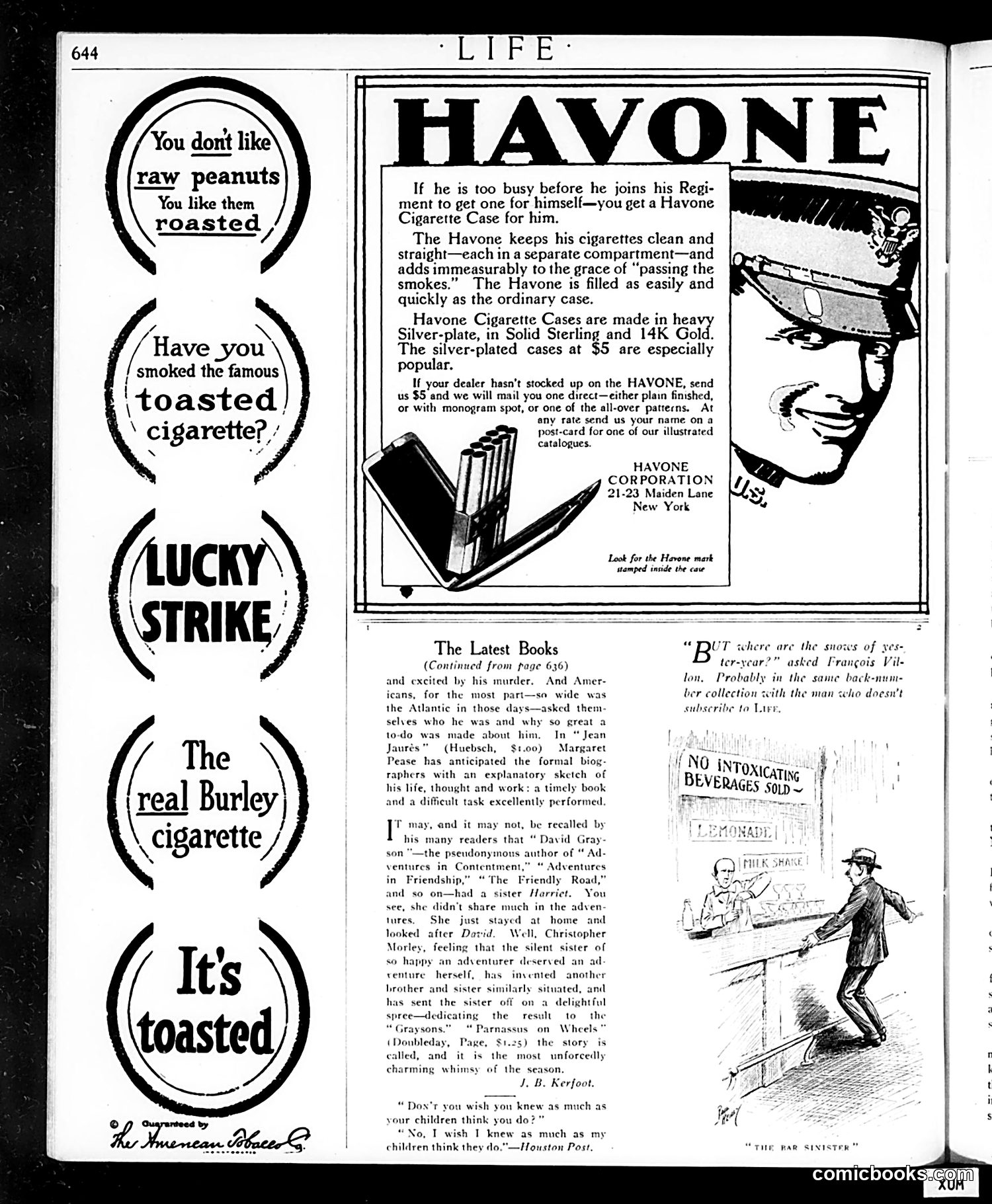
This page contains **primarily advertisements**, not political satire. **Left side:** A Lucky Strike cigarette ad using a repetitive rhetorical device—"You don't like raw peanuts / You like them roasted"—to argue that toasted cigarettes are superior. The "real Burley cigarette" claim suggests competition with other brands (likely Camel, which also advertised "toasted" tobacco). **Center:** A Havone cigarette case advertisement targeting military men ("before he joins his Regiment"), emphasizing luxury goods (sterling silver, 14K gold) at $5—a significant price for the era. **Right side:** A book review section discussing recent publications, including works about Jean Jaurès (French socialist politician assassinated 1914) and Christopher Morley's *Parnassus on Wheels*. **Bottom right:** A small illustration labeled "The Bar Sinister" (unclear context without fuller image). The page reflects early 20th-century consumer culture and wartime concerns (military references suggest WWI era).
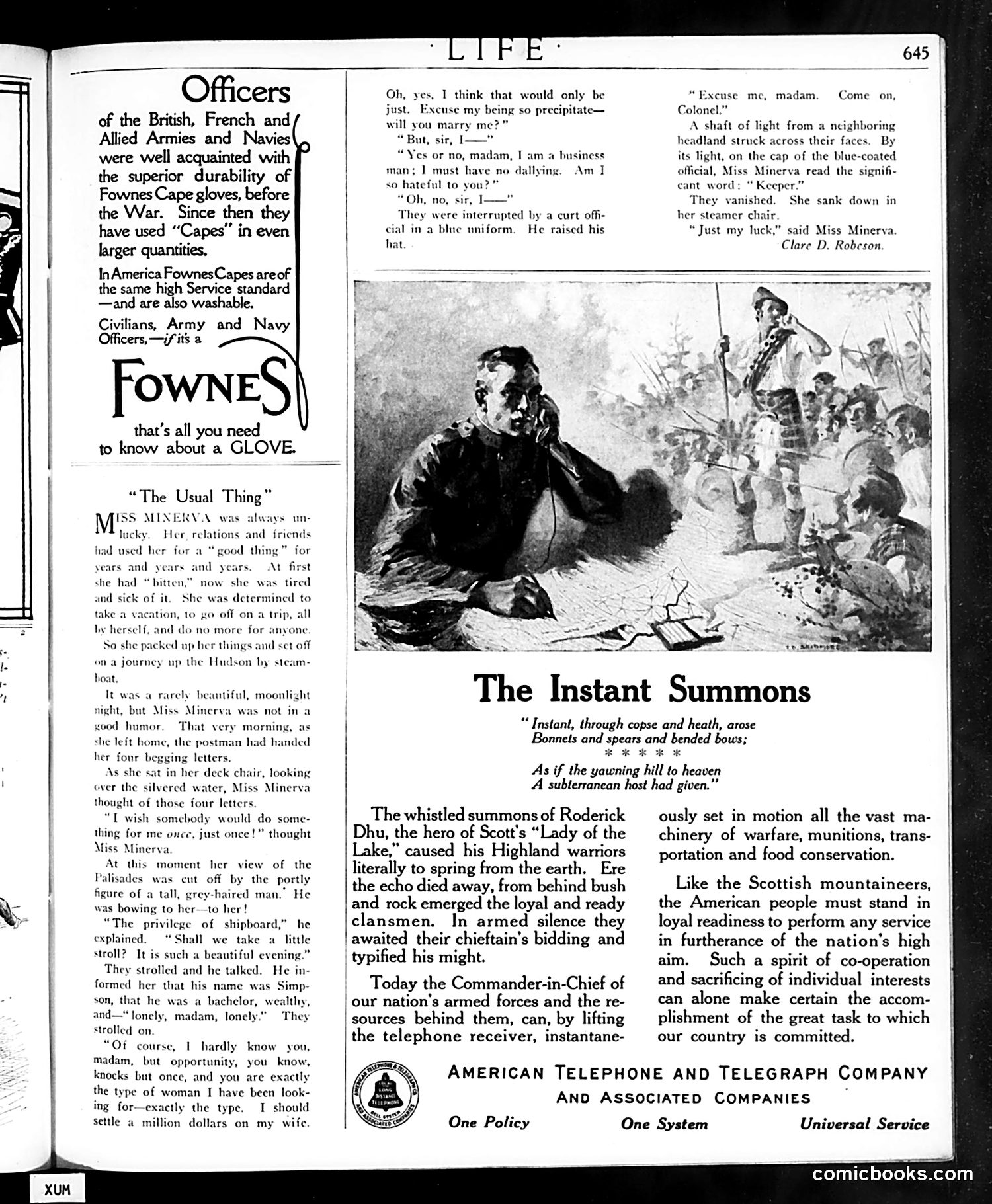
This page contains two distinct pieces: a short story and a WWI-era advertisement. **The Story**: "The Usual Thing" by Clare D. Robeson is a comic narrative about Miss Minerva, an unlucky woman who finally gets her wish—someone does something *for* her. On a Hudson River steamboat, a wealthy bachelor named Simpson proposes marriage and offers to settle a million dollars on her. However, just as she's about to respond, a uniformed official interrupts, ordering "Come on, Colonel," and both vanish. Miss Minerva realizes she's been summoned as a military keeper—her bad luck continues. **The Advertisement** uses a patriotic analogy: just as Scottish warriors in Sir Walter Scott's "Lady of the Lake" sprang instantly to their chieftain's call, American citizens must stand ready to serve their nation during WWI. The telephone company positions itself as enabling this instant national mobilization for "warfare, munitions, transportation and food conservation." The juxtaposition is ironic—a light domestic comedy followed by serious wartime propaganda about duty and sacrifice.
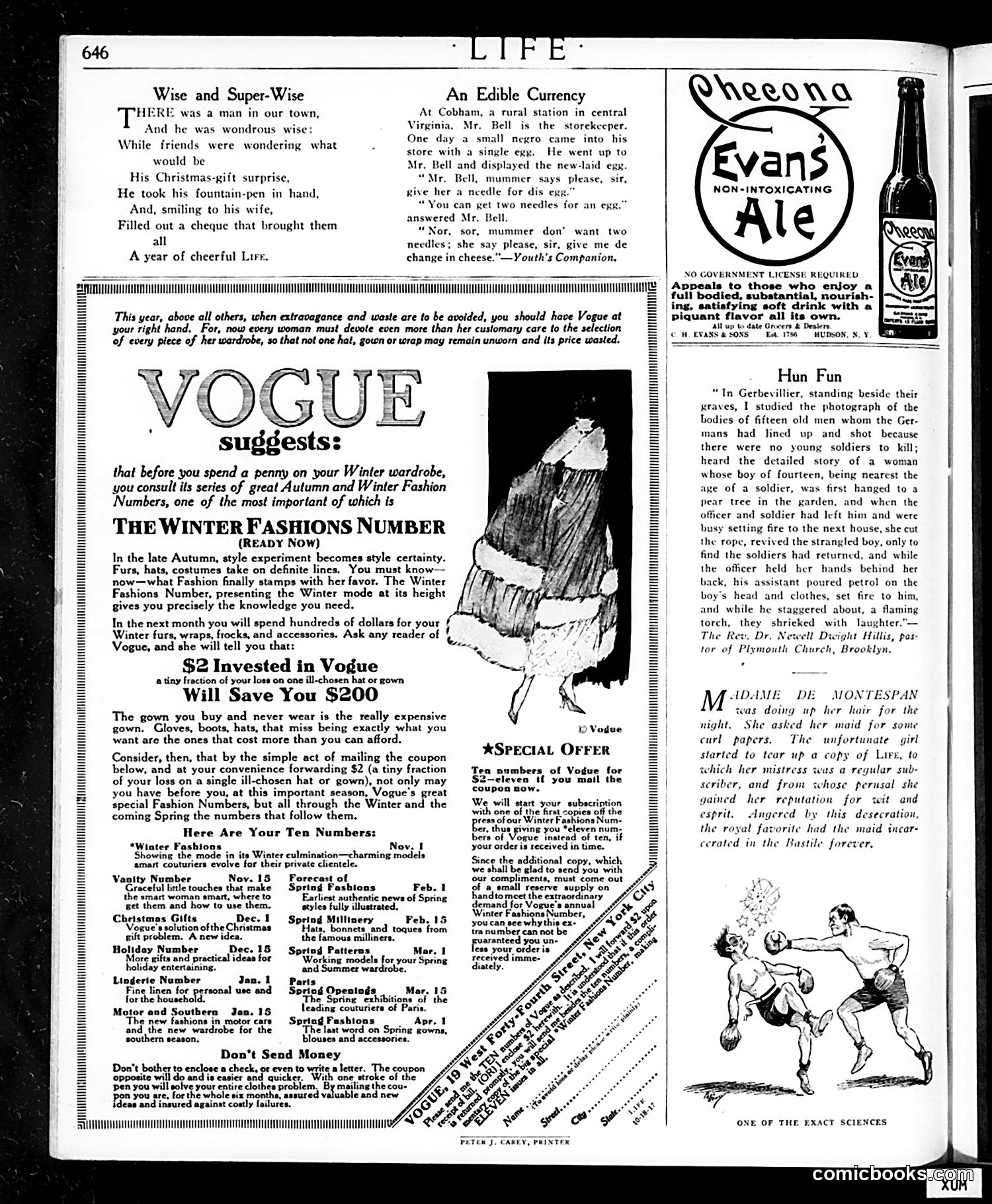
This page mixes humor, practical advice, and advertising typical of Life magazine's satirical format. **"Wise and Super-Wise"** is a brief poem about a man who gives his wife a check for Christmas—a practical but unromantic gift that ironically provides "a year of cheerful Life." **"An Edible Currency"** is a short humorous anecdote from *Youth's Companion* about a Black worker in rural Virginia attempting to trade an egg for sewing supplies. The storekeeper offers "two needles for an egg," but the worker requests the excess value be given "in cheese" instead—playing on the concept of barter economy and the absurdity of negotiating change in food rather than money. **The main content** is Vogue magazine advertising its Winter Fashions Number, emphasizing wartime economy (the phrase "extravagance and waste are to be avoided" suggests WWI-era conservation). The ad argues that investing $2 in Vogue prevents costly fashion mistakes worth far more. **"Hun Fun"** recounts a supposedly humorous anecdote about a German soldier's execution during the war, presenting graphic violence as entertainment.
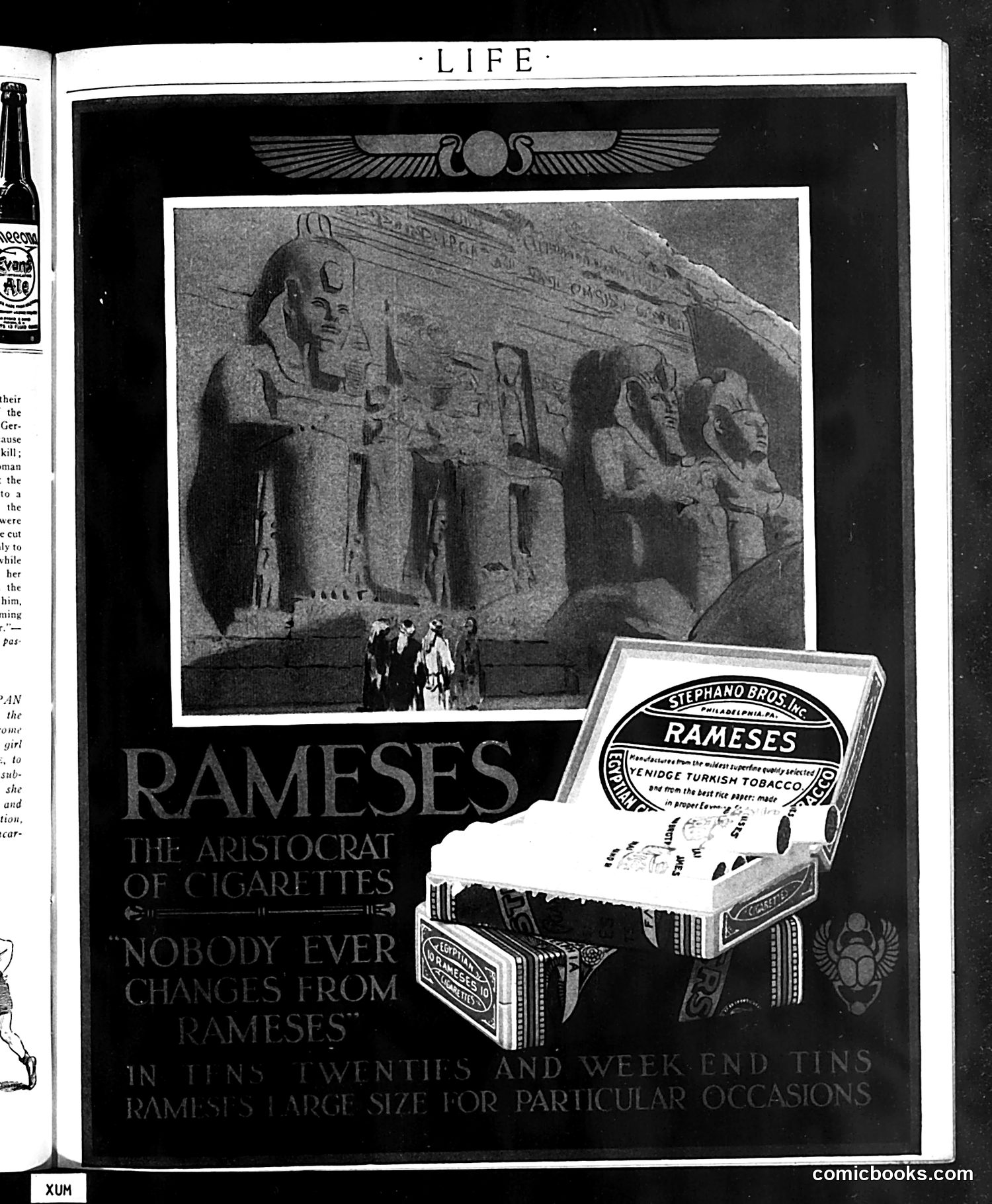
This is primarily a **cigarette advertisement** for Rameses brand, not political satire. The ad features a photograph of Abu Simbel's colossal Egyptian statues with small human figures standing before them for scale, emphasizing grandeur and monumentality. The advertisement's tagline—"THE ARISTOCRAT OF CIGARETTES" and "NOBODY EVER CHANGES FROM RAMESES"—uses the ancient Egyptian monument as a symbol of timelessness, durability, and prestige. The product packaging is displayed prominently on the right. The ad markets Rameses in multiple tin sizes for "particular occasions," positioning the cigarettes as a premium product. This represents early 20th-century advertising that leveraged exotic imagery and historical grandeur to suggest quality and sophistication to consumers.
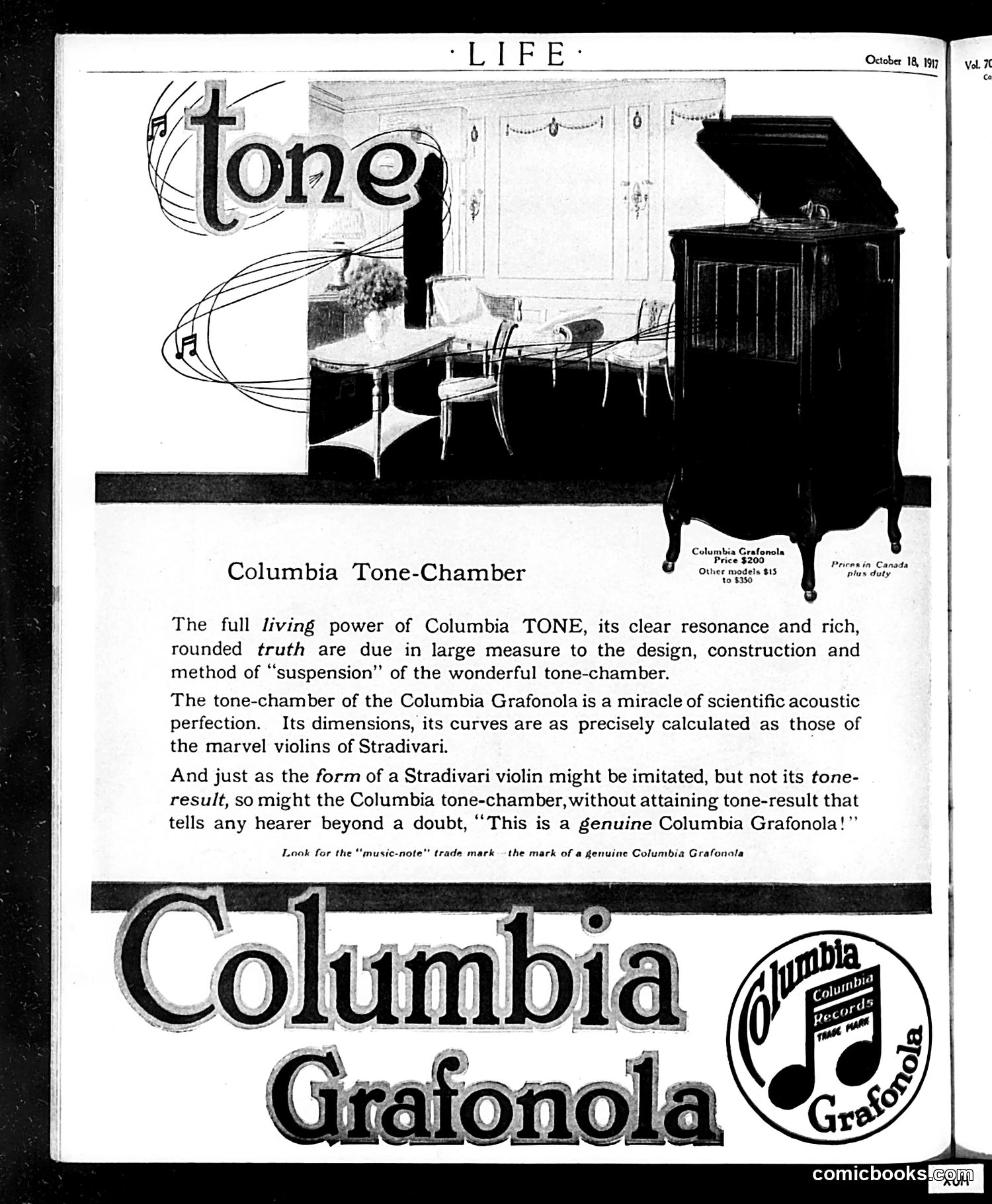
This is **not a political cartoon or satire**, but rather a **straight product advertisement** for the Columbia Grafonola phonograph, published in Life magazine on October 18, 1917. The page promotes the Columbia Grafonola (a record player priced at $200, roughly $4,000 today) by emphasizing its "tone-chamber"—a carefully engineered acoustic component claimed to rival the quality of Stradivari violins. The advertisement uses technical language about "scientific acoustic perfection" to justify its premium price and position it as a luxury good. The only potentially humorous element is the implicit comparison: just as a violin's *form* can be imitated but not its *tone*, Columbia suggests competitors might copy the appearance of their gramophones but cannot replicate the sound quality. This is marketing positioning rather than satire—targeting affluent consumers in wartime America by appealing to their desire for authenticity and superior craftsmanship. The page shows a dining room scene illustrating aspirational middle-class domesticity alongside the product.