
Life, 1917-10-18 · page 19 of 40
Life — October 18, 1917 — page 19: what you’re looking at
What you’re looking at
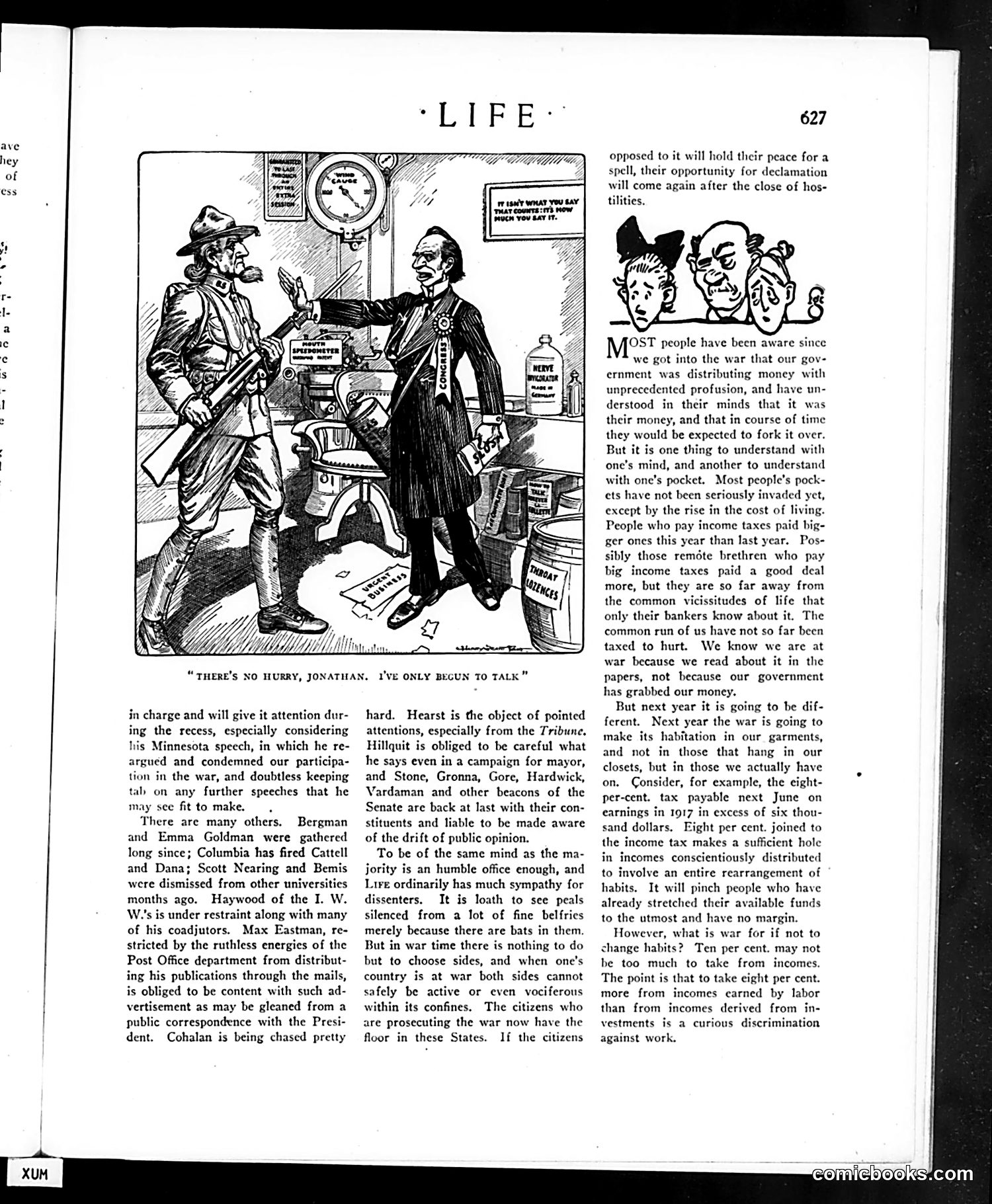
## The Cartoon The illustration depicts a military figure (labeled "Jonathan," likely Uncle Sam) being lectured by a civilian official about war-related matters. The caption "There's no hurry, Jonathan, I've only begun to talk" suggests bureaucratic obstruction or endless discussion about war policy. ## The Article's Subject Matter The text discusses government suppression of war dissenters during WWI. It names several figures prosecuted or silenced for anti-war positions: Emma Goldman, Max Eastman, Scott Nearing, and others. The article argues that while Life sympathizes with dissenters generally, wartime requires choosing sides—and currently, war supporters "have the floor." ## The Political Point The article then shifts to criticizing unequal taxation: an eight-percent tax on labor income versus no comparable tax on investment income. The satire suggests the government demands sacrifice from working people while protecting wealthy investors—questioning whether this is truly fair wartime burden-sharing. The overall message: the government silences dissent while implementing economically discriminatory policies favoring the wealthy.
📄 Transcribed text from this page (OCR, searchable)
Machine-transcribed from the original scan — historical spelling and the odd misread are preserved.
XUM “ THERE'S NO HURRY, JONATHAN, I'VE ONLY BEGUN TO TALK” in charge and will give it attention dur- ing the recess, especially considering his Minnesota speech, in which he re- argued and condemned our participa- tion in the war, and doubtless keeping tab on any further speeches that he may see fit to make. , There are many others. Bergman and Emma Goldman were gathered long since; Columbia has fired Cattell and Dana; Scott Nearing and Bemis were dismissed from other universities months ago. Haywood of the I. W. W's is under restraint along with many of his coadjutors. Max Eastman, re- stricted by the ruthless energies of the Post Office department from distribut- ing his publications through the mails, is obliged to be content with such ad- vertisement as may be gleaned from a public correspondence with the Presi- dent. Cohalan is being chased pretty hard. Hearst is the object of pointed attentions, especially from the Tribune, Hillquit is obliged to be careful what he says even in a campaign for mayor, and Stone, Gronna, Gore, Hardwick, Vardaman and other beacons of the Senate are back at last with their con- stituents and liable to be made aware of the drift of public opinion. To be of the same mind as the ma- jority is an humble office enough, and Lire ordinarily has much sympathy for dissenters. It is loath to see peals silenced from a lot of fine belfries merely because there are bats in them. But in war time there is nothing to do but to choose sides, and when one's country is at war both sides cannot safely be active or even vociferous within its confines. The citizens who are prosecuting the war now have the floor in these States. If the citizens 627 opposed to it will hold their peace fora spell, their opportunity for declamation will come again after the close of hos- tilities. OST people have been aware since we got into the war that our gov- ernment was distributing money with unprecedented profusion, and have un- derstood in their minds that it was their money, and that in course of time they would be expected to fork it over. But it is one thing to understand with one’s mind, and another to understand with one’s pocket. Most people’s pock- ets have not been seriously invaded yet, except by the rise in the cost of living. People who pay income taxes paid big- ger ones this year than last year. Pos- sibly those remote brethren who pay big income taxes paid a good deal more, but they are so far away from the common vicissitudes of life that only their bankers know about it. The common run of us have not so far been taxed to hurt. We know we are at war because we read about it in the papers, not because our government has grabbed our money. But next year it is going to be dif- ferent. Next year the war is going to make its habitation in our garments, and not in those that hang in our closets, but in those we actually have on. Consider, for example, the ecight- per-cent. tax payable next June on earnings in 1917 in excess of six thou- sand dollars. Eight per cent. joined to the income tax makes a sufficient hole in incomes conscientiously distributed to involve an entire rearrangement of habits. It will pinch people who have already stretched their available funds to the utmost and have no margin. However, what is war for if not to change habits? Ten per cent. may not he too much to take from incomes. The point is that to take eight per cent. more from incomes earned by labor than from incomes derived from in- vestments is a curious discrimination against work.