
Life, 1917-10-18 · page 28 of 40
Life — October 18, 1917 — page 28: what you’re looking at
What you’re looking at
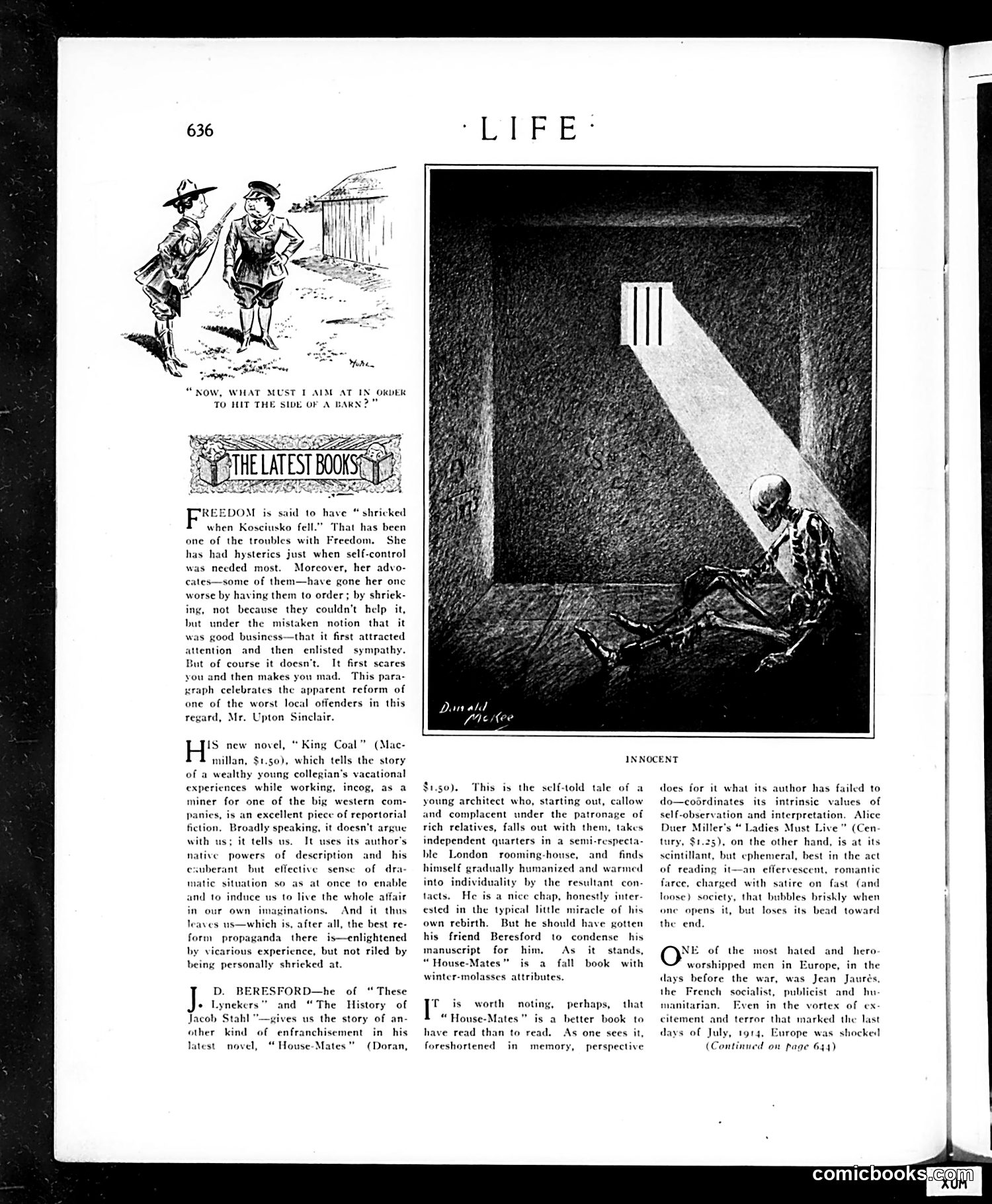
The top cartoon shows two figures aiming at a barn, with the caption "Now, what must I aim at in order to hit the side of a barn?" This appears to be satirical commentary on **Upton Sinclair**, the muckraking author and socialist activist. The accompanying text criticizes Sinclair for his overly emotional, "hysterical" advocacy style—his tendency to "shriek" about injustices rather than calmly persuade. However, the reviewer praises his novel *King Coal* for taking a more restrained, reportorial approach: it shows rather than preaches, allowing readers to experience conditions firsthand without being "riled by being personally shricked at." The satire equates Sinclair's previous shrill activism with wildly misdirected aim—suggesting his emotional approach fails to hit its target effectively. The review celebrates what it sees as his reform toward more subtle persuasion. The page continues with book reviews of other contemporary works.
📄 Transcribed text from this page (OCR, searchable)
Machine-transcribed from the original scan — historical spelling and the odd misread are preserved.
aS he. nog RA ee “Now, WHAT MUST I AIM AT IN OKDER TO MIT THE SIDE OF A BARN?” REEDOM is said to have “ shricked when Kosciusko fell.” That has been one of the troubles with Freedom. She has had hysterics just when self-control was needed most. Moreover, her advo- cates—some of them—have gone her onc worse by having them to order; by shriek- ing, not because they couldn't help it, but under the mistaken notion that it was good business—that it first attracted attention and then enlisted sympathy. But of course it doesn’t. It first scares you and then makes you mad. This para- xraph celebrates the apparent reform of one of the worst local offenders in this regard, Mr. Upton § nclair. IS new novel, “King Coal” (Mac- millan, $1.50), which tells the story of a wealthy young collegian’s vacational experiences while working, incog, as a miner for one of the big western com- panies, is an excellent piece of reportorial fiction, Broadly speaking, it doesn’t argue with us; it tells us, Tt uses its author's tive powers of description and his nt but effective sense of dra ic situation so as at once to enable and to induce us to live the whole affair in our own imaginations. And it thus leaves us—which is, after all, the best re- form propaganda there is—enlightened by vicarious experience, but not riled by being personally shricked at. exube: D. BERESFORD—he of “These « Lynekers” and “The History of Jacob Stahl "gives us the story of an- other kind of enfranchisement in his “ House-Mates” (Doran, latest novel, Dd ee ( 7 INNOCENT $1.50). This is the self-told tale of a does for it what its author has failed to young architect who, starting out, callow do—codrdinates its intrinsic values of and complacent under the patronage of — self-observation and interpretation. Alice rich relatives, falls out with them, takes Duer Miller's “ Ladies Must Live” (Cen independent quarters in a semi-respecta- tury, $1.25), on the other hand, is at its ble London rooming-house, and finds scintillant, but ephemeral, best in the act himself gradually humanized and warmed — of reading it—an effervescent, romantic into individuality by the resultant con- farce, charged with satire on fast (and tacts. He a nice chap, honestly inter- loose) society, that bubbles briskly when ested in the typical little miracle of his one opens it, but loses its bead toward own rebirth. But he should have gotten the end. his friend Beresford to condense his manuscript. for him. As it stands, O “House-Mates” is a fall book with worshipped men in Europe, in the winter-molasses attributes. days before the war, was Jean Jaurés, the French socialist, publicist and hu I is worth noting, perhaps, that manitarian. Even in the vortex of ex “ House-Mates” is a better book to citement and terror that marked the last have read than to read. As one sees it, days of July, 1914, Europe was shocked (Continued on page 644) of the most hated and hero foreshortened in| memory, perspective comicbooksieemmy