
Life, 1917-10-18 · page 24 of 40
Life — October 18, 1917 — page 24: what you’re looking at
What you’re looking at
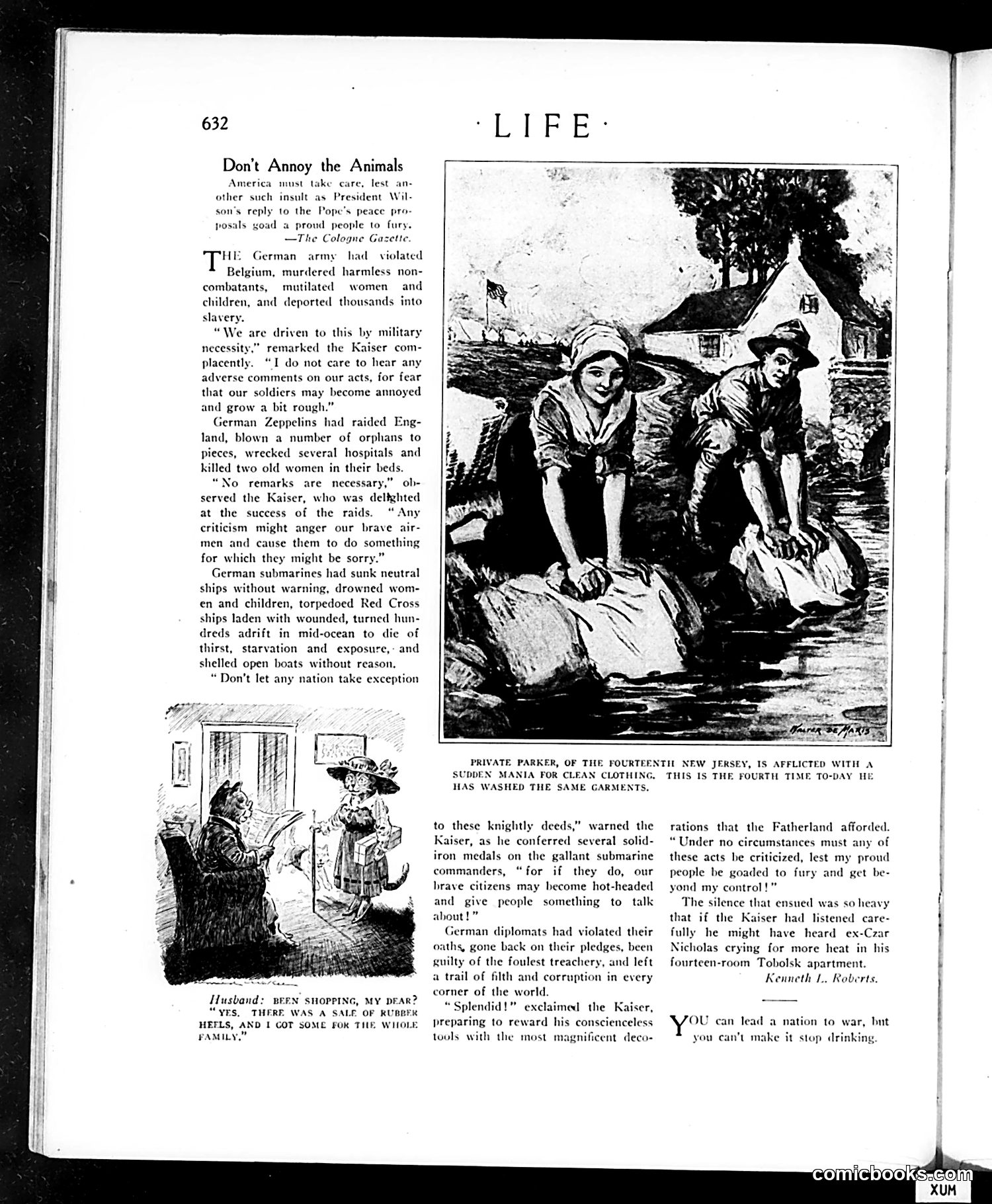
This is a satirical attack on Kaiser Wilhelm II's justifications for German atrocities during World War I. The piece uses ironic absurdity: the Kaiser claims German soldiers might become "annoyed" and "rough" if criticized for violating Belgium, bombing hospitals and orphans, sinking neutral ships, and drowning civilians—as if the soldiers were temperamental children needing praise rather than accountability. The satire inverts reality: Germany committed documented war crimes, yet the Kaiser warns *others* against annoying his troops. The small cartoon shows a husband and wife shopping, humorously contrasting domestic triviality with wartime barbarity. The closing reference to "ex-Czar Nicholas" in a Tobolsk apartment alludes to the Russian imperial family's 1918 imprisonment, suggesting the Kaiser's regime faces similarly ignominious consequences. The final epigram mocks the contradiction of prosecuting war while claiming moral restraint. The piece is anti-German propaganda from America's perspective during or just after WWI, delegitimizing German military conduct through rhetorical reversal.
📄 Transcribed text from this page (OCR, searchable)
Machine-transcribed from the original scan — historical spelling and the odd misread are preserved.
632 Don’t Annoy the Animals Am a must take care, lest an- other such insult as President Wil- son's reply to the Pope's peace pro- posals yoad a proud people to fury. —The Cologne et HE German army had violated Belgium, murdered harmless non- combatants, mutilated women and children, and deported thousands into slavet ¢ driven to this by military necessity,” remarked the Kaiser com- placently. “I do not care to hear any adverse comments on our acts, for fear that our soldiers may become annoyed and grow a bit rough.” German Zeppelins had raided Eng- land, blown a number of orphans to pieces, wrecked several hospitals and killed two old women in their beds. “No remarks are sary,” ob- served the Kaiser, who was delighted at the success of the raids. “Any criticism might anger our brave air- men and cause them to do something for which they might be sorry.” German submarines had sunk neutral ships without warning, drowned wom- en and children, torpedoed Red Cross ships laden with wounded, turned hun- dreds adrift in mid-ocean to die of thirst, starvation and exposure,- and shelled open boats without reason, “Don’t let any nation take exception PRIVATE PARKER, OF TE SUDDE NIA FOR CLEAN CLOTHI HAS WASHED THE SAME GARMENTS, to these knightly deeds,” warned the Kaiser, as he conferred several solid- iron medals on the gallant submarine commanders, “for if they do, our brave citizens may become hot-headed and give people something to talk about!” German diplomats had violated their oaths, gone back on their pledges, been guilty of the foulest treachery, and left a trail of filth and corruption in every corner of the world. usband: BEEN SHOPPING, MY DEAR? One a cas . os Hastotd: nopeeo, MY Splendid!" exclaimed the Kaiser, “YES, THERE WAS A SALE OF RUBREK 3 HEFLS, AND I COT SOME Fok THE WHOLE Preparing to reward his conscienceless FAMILY,” tools with the most magnificent deco- IS AFFLICTED WITH A 1S THE FOURTH TIME TO-DAY HE. rations that the Fatherland afforded. “Under no circumstances must any of these acts be criticized, lest my proud people be goaded to fury and get be- yond my control!" The silence that ensued was so he: that if the Kaiser had listened car fully he might have heard ex-C: Nicholas crying for more heat in his fourteen-room Tobolsk apartment. Kenneth 1. Roberts. OU can lead a nation to war, but you can't make it stop drinking.