
Life, 1917-10-18 · page 22 of 40
Life — October 18, 1917 — page 22: what you’re looking at
What you’re looking at
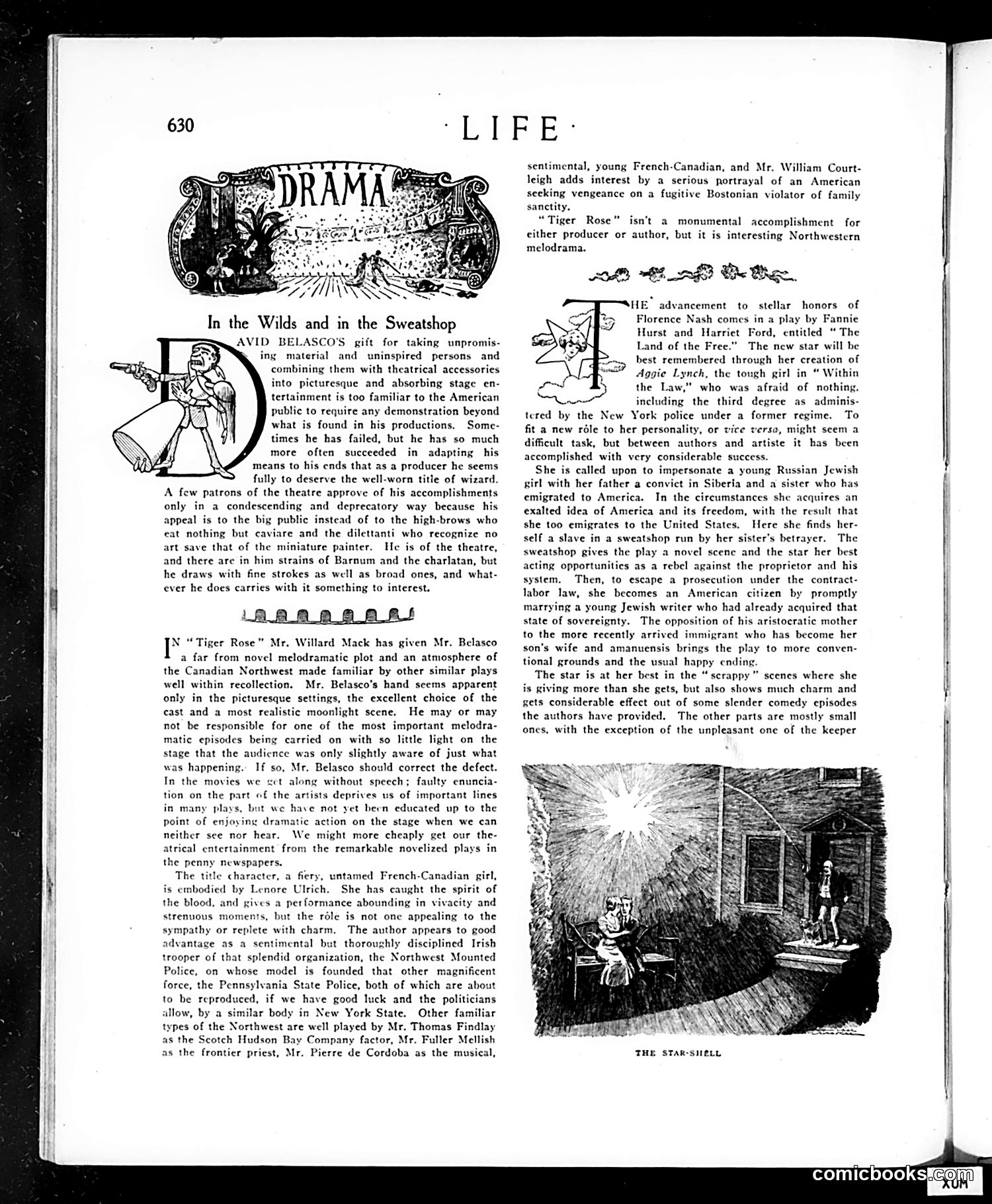
This page reviews two theatrical productions. The main critique concerns David Belasco's staging of "Tiger Rose," a Canadian Northwest melodrama. The reviewer praises Belasco's wizardry in transforming mundane material through theatrical spectacle, but criticizes his use of overly dim lighting during a crucial plot moment—arguing this creates incomprehensible action. The reviewer sarcastically suggests audiences might as well watch novelized plays in penny newspapers if they can't see or hear the stage action. The illustration labeled "THE STAR-SHELL" appears to depict a dramatic scene from the play, likely showing the poorly-lit sequence being critiqued. A secondary review discusses Florence Nash's advancement to starring roles in "The Land of the Free," noting her previous success as the tough character Aggie Lynch in "Within the Law." The page emphasizes theatrical realism versus spectacle—a tension central to early 20th-century American theater criticism.
📄 Transcribed text from this page (OCR, searchable)
Machine-transcribed from the original scan — historical spelling and the odd misread are preserved.
In the Wilds and in the Sweatshop AVID BELASCO’S gift for taking unpromis- ing material and uninspired persons and combining them with theatrical accessories into picturesque and absorbing stage en- tertainment is too familiar to the American public to require any demonstration beyond what is found in his productions, Some- times he has failed, but he has so much more often succeeded in adapting his means to his ends that as a producer he seems fully to deserve the well-worn title of wizard. A few patrons of the theatre approve of his accomplishments only in a condescending and deprecatory way because his appeal is to the big public instead of to the high-brows who eat nothing but caviare and the dilettanti who recognize no art save that of the miniature painter. He is of the theatre, and there are in him strains of Barnum and the charlatan, but he draws with fine strokes as well as broad ones, and what- ever he does carries with it something to interest. IX “Tiger Rose” Mr. Willard Mack has given Mr. Belasco far from novel melodramatic plot and an atmosphere of the Canadian Northwest made familiar by other similar plays well within recollection. Mr. Belasco’s hand seems apparent only in the picturesque settings, the excellent choice of the cast and a most realistic moonlight scene. He may or may not be responsible for one of the most important melodra- matic episodes being carried on with so little light on the stage that the audience was only slightly aware of just what was happening. If so, Mr. Belasco should correct the defect. In the movies we get along without speech; faulty enuncia- tion on the part of the artists deprives us of important lines in many plays, but we have not yet becn educated up to the point of enjoying dramatic action on the stage when we can neither sce nor hear. We might more cheaply get our the- atrical entertainment from the remarkable novelized plays in the penny newspapers. The title character, a fiery, untamed French-Canadian girl, is embodied by Lenore Ulrich. She has caught the spirit of the blood, and gives a performance abounding in vivacity and strenuous moments, but the réle is not one appealing to the sympathy or replete with charm. The author appears to good advantage as a sentimental but thoroughly plined Irish trooper of that splendid organization, the Northwest Mounted Police, on whose model is founded that other magnificent force, the Pennsylvania State Police, both of which are about to be reproduced, if we have good luck and the politicians allow, by a similar body in New York State. Other familiar types of the Northwest are well played by Mr. Thomas Findlay as the Scotch Hudson Bay Company factor, Mr, Fuller Mellish as the frontier priest, Mr. Pierre de Cordoba as the musical, “EDF E ° sentimental, young French-Canadian, and Mr. William Court- leigh adds interest by a serious portrayal of an American seeking vengeance on a fugitive Bostonian violator of family sanctity, “Tiger Rose” isn't a monumental accomplishment for cither producer or author, but it is interesting Northwestern melodrama. HE” advancement to stellar honors of Florence Nash comes in a play by Fannie Hurst and Harriet Ford, entitled “ The Land of the Free.” The new star will be best remembered through her creation of Aggie Lynch, the tough girl in “ Within ae > the Law,” who was afraid of nothing. es including the third degree as adminis- tered by the New York police under a former regime. To fit a new rale to her personality, or vice versa, might seem a difficult task, but between authors and artiste it has been accomplished with very considerable success. She is called upon to impersonate a young Russian Jewish girl with her father a convict in Siberia and a sister who emigrated to America. In the circumstances she acquires an exalted idea of America and its freedom, with the result that she too emigrates to the United States, Here she finds her- self a slave in a sweatshop run by her sister's betrayer. The sweatshop gives the play a novel scene and the star her best acting opportunities as a rebel against the proprietor and his system. Then, to escape a prosecution under the contract- labor law, she becomes an American citizen by promptly marrying a young Jewish writer who had already acquired that state of sovereignty. The opposition of his aristocratic mother to the more recently arrived immigrant who has become her son’s wife and amanuensis brings the play to more conven- tional grounds and the usual happy ending. The star is at her best in the “scrappy” scenes where she is giving more than she gets, but also shows much charm and gets considerable effect out of some slender comedy episodes the authors have provided. The other parts are mostly small ones, with the exception of the unpleasant one of the keeper THE STAR-SUPLL comicbooksfgony